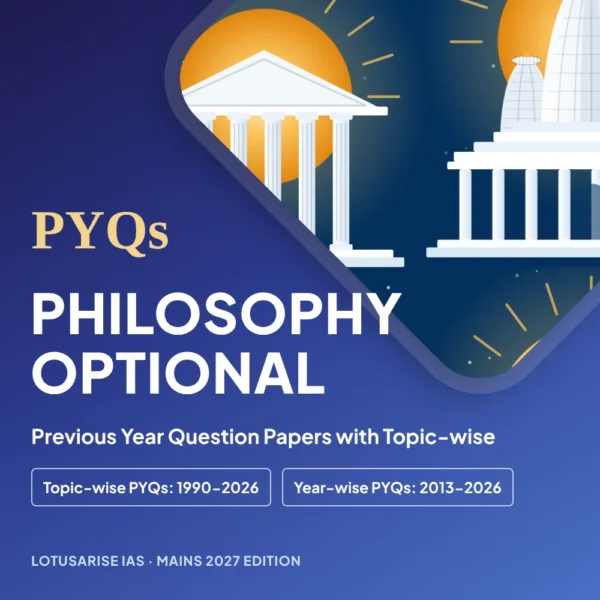
Philosophy Optional Question Papers with Topic-wise
₹59.00
₹59 for 197 pages and 1,338 questions, under 5 paise a question. Mains 2027 edition, updated with both 2026 papers.
Most Philosophy aspirants meet previous year questions one paper at a time: a 2024 PDF here, a screenshot of 2019 there. They never notice that Plato’s theory of Forms has been set in 12 different years, or that Nyāya–Vaiśeṣika drew 32 questions in the last ten papers.
Philosophy Optional Question Papers with Topic-wise puts the whole pattern in front of you.
📚 1,338 questions, topic-wise, 1990–2026, sorted into all 40 syllabus units of Paper I and Paper II, newest first
📝 Every full paper, 2013–2026: Paper I and Paper II as set, with the marks for every sub-part
📊 Ten-year pattern charts, 2017–2026: unit weightage, year-by-year heat map, rising and cooling units
🏷️ Sub-topic tags: see which thinker, school or concept each question is really testing
📱 197-page printable A4 PDF for laptop, phone or tablet, offline
🗓️ Updated to UPSC Mains 2026. Unlimited downloads; the link does not expire.
One-time payment. No subscription. The download link is emailed the moment payment clears; check your spam folder if it is not in the inbox.
⭐ Trusted by the 300,000+ UPSC aspirants who read LotusArise IAS every month
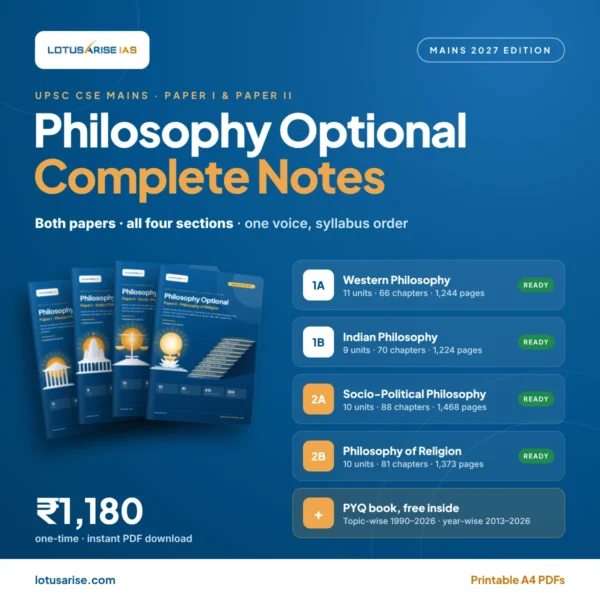
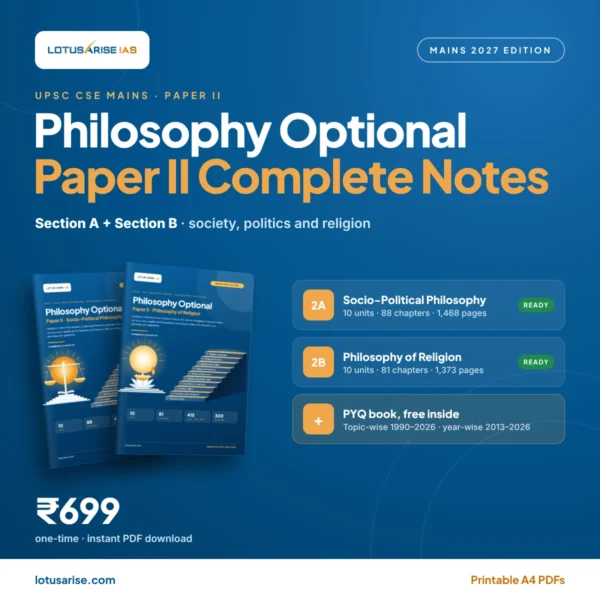
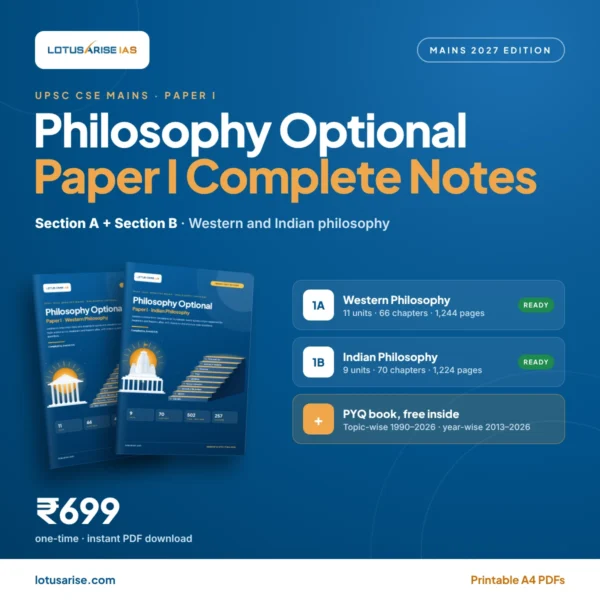
Want the notes too? This question book comes free inside Philosophy Optional Complete Notes (all four sections, ₹1,180) and in each paper bundle, Paper I or Paper II (₹699 each).
Features:
- Comprehensive Coverage
- Complete Syllabus
- Suitable for: UPSC & State PSCs exams
- Format: Digital PDF (Downloadable)
- 337,362+ aspirants visit every month
The Philosophy problem most aspirants don’t talk about
Ask a Philosophy aspirant a few months into preparation how they use previous year questions. They won’t say they ignore them. They will say one of three things:
“I have the last five papers saved somewhere. I have never seen what UPSC asked on Kant’s synthetic a priori or the Nyāya theory of inference before that.”
“I know Paper II has two very different sections. I don’t know which themes, justice, secularism, the proofs for God, religious language, UPSC actually keeps coming back to.”
“I read the 2025 paper at home. I have never sat a full paper against the clock.”
None of that is a discipline problem. The questions are public; UPSC prints them every year. What is missing is the questions arranged: every unit’s history on one page, every paper complete with its marks, and the pattern worked out for you.
That is what this book is.
Why PYQs decide Philosophy more than most optionals
Philosophy is 500 marks: two papers of 250, each with two sections. The syllabus is fixed at 40 units, and UPSC returns to the same thinkers, schools and concepts year after year, rephrasing rather than replacing.
- UPSC repeats itself. Plato’s theory of Forms has been set in 12 different years, most recently in 2015, 2016, 2017, 2021, 2022 and 2025. Seeing every framing side by side is how you stop being surprised in the hall.
- Most units never go quiet. 21 of the 40 units were asked in every one of the last ten years, and even the least-asked units appeared in 7 of the 10 papers. There is no safe skip.
- The weight is uneven. Nyāya–Vaiśeṣika drew 32 questions between 2017 and 2026, the Schools of Vedānta 29 and the Notions of God 22, while Mīmāṃsā is the fastest-rising unit.
The four sections are almost perfectly balanced, at about 2,000 marks each over ten years, so you cannot top Philosophy on one paper. The same material pays twice: Socio-Political Philosophy and the Philosophy of Religion feed GS Paper IV and the Essay.
What’s inside: 197 pages
📚 Topic-wise questions, 1990–2026: 1,338 questions in 40 units
Every question sorted into its syllabus unit, newest first:
- Paper I, Section A: Western Philosophy (11 units): Plato and Aristotle, the rationalists, the empiricists, Kant, Hegel, Moore, Russell and the early Wittgenstein, logical positivism, the later Wittgenstein, Husserl, the existentialists, Quine and Strawson
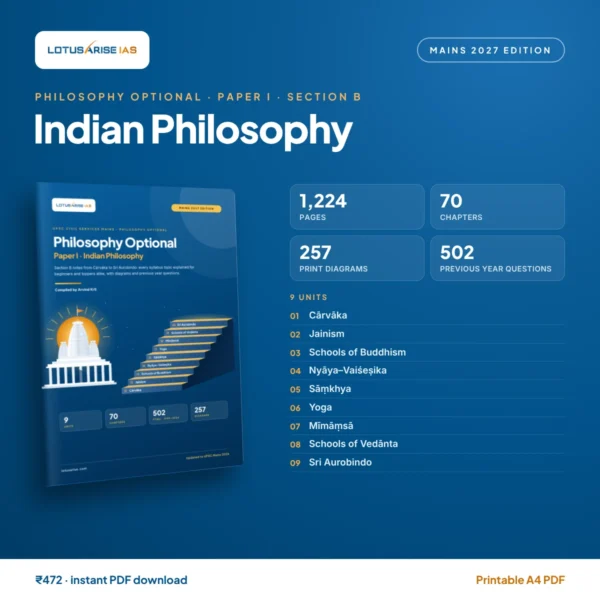
- Paper I, Section B: Indian Philosophy (9 units): Cārvāka, Jainism, the schools of Buddhism, Nyāya–Vaiśeṣika, Sāṃkhya, Yoga, Mīmāṃsā, the schools of Vedānta and Sri Aurobindo
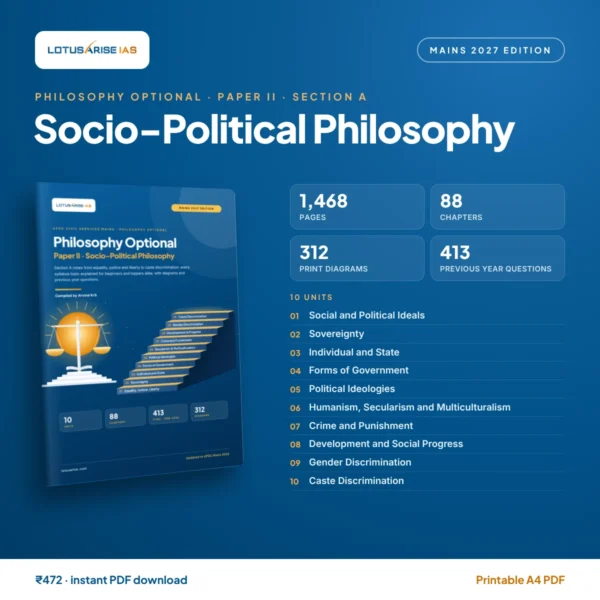
- Paper II, Section A: Socio-Political Philosophy (10 units): social and political ideals, sovereignty, individual and state, forms of government, political ideologies, humanism, secularism and multiculturalism, crime and punishment, development and social progress, gender and caste discrimination
- Paper II, Section B: Philosophy of Religion (10 units): notions of God, the proofs and their critique, the problem of evil, the soul, reason, revelation and faith, religious experience, religion without God, religion and morality, religious pluralism and religious language
Each unit opens with its ten-year count, the marks it carried, how many of the ten years it was asked, and a year-by-year bar chart. Every question carries a sub-topic tag naming the thinker, school or concept it tests.
📝 Year-wise papers, 2013–2026: 14 years, 28 papers
Paper I and Paper II for every year from 2026 back to 2013, section by section, with the marks for every sub-part. Sit them against the clock: three hours, five questions.
📊 Ten-year pattern analysis, 2017–2026: five charts
560 questions and 8,000 printed marks, worked out unit by unit:
- Unit weightage: questions and marks from each unit, both papers on one scale
- Year-by-year heat map: which units UPSC asks every year and which come and go
- Rising and cooling units: 2017–2021 against 2022–2026
- Unit scorecard: questions since 1990, years asked and average marks a year
- Question size: which units come as 10-markers and which as 20-markers
📖 The official syllabus, unit by unit
The full UPSC syllabus for both papers, with the unit codes used throughout the book, so every question traces back to the clause it tests.
The aspirant who buys this
First-time aspirants. Start every unit by reading its questions, newest first. You will know what UPSC wants from a topic before you read a page of notes on it.
Repeaters. You have the content. Use the heat map and the rising units to find where your preparation and UPSC’s attention have drifted apart, then sit full papers to fix your timing.
Aspirants already using notes. Whatever notes you follow, this is the checklist to test them against: 40 units, 1,338 questions, nothing left unmapped.
Self-study aspirants outside the coaching cities. No test series needed to see the pattern. The analysis is already done.
Working professionals. Twenty minutes on one unit’s questions is a complete study session. Printable, offline, on any device.
Why not just use the free papers?
UPSC publishes every question paper, and year-wise PDFs are shared everywhere. If you only need last year’s paper, you do not need this.
The difference is not the questions; it is the arrangement. Thirty-seven years of questions sorted into the 40 syllabus units, a sub-topic tag on every question, every paper since 2013 with its marks, and the pattern charted across ten papers. Doing that yourself is weeks of work that most aspirants start and never finish.
₹59, under 5 paise a question
1,338 topic-wise questions, 28 full papers and five pattern charts for ₹59. The same book comes free inside Philosophy Optional Complete Notes (₹1,180) and in the Paper I and Paper II notes bundles (₹699 each); take one of those instead if you want the notes as well.
- One-time payment. No subscription. No recurring charge.
- The download link is emailed the moment payment clears; check your spam folder if it is not in the inbox.
- Unlimited downloads; the link does not expire.
- Medium: English · Format: PDF · Pages: 197
Read before you buy: the free sample has the pattern charts, two full units and the complete 2026 papers.
For support: support@lotusarise.com