

Anthropology Optional Paper II Complete Notes: Indian Civilization and Society + Tribal India by LotusArise IAS
₹699.00
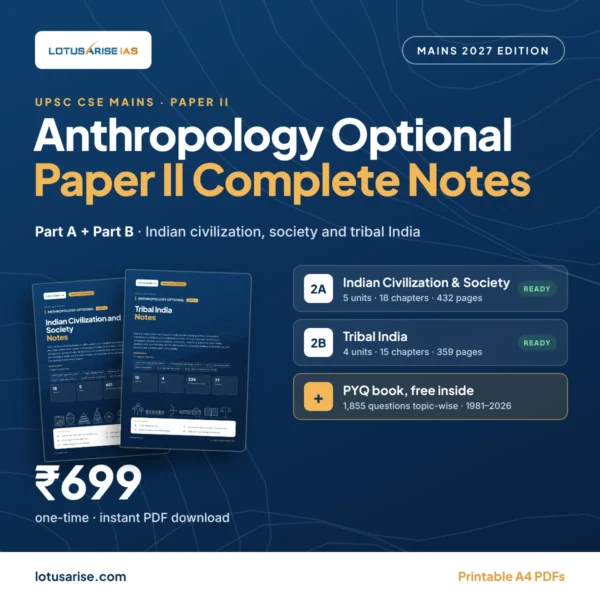
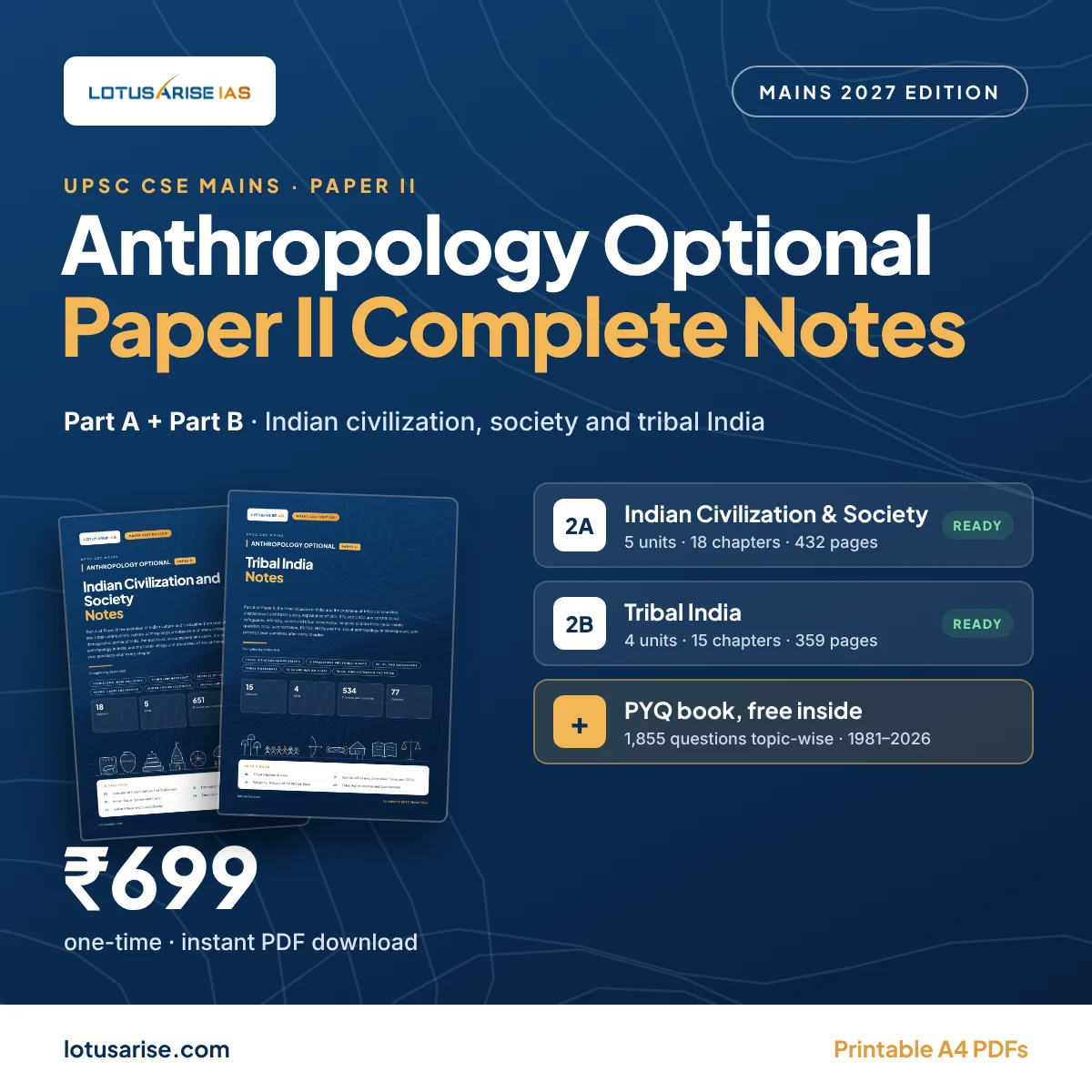
₹699 for the whole of Anthropology Paper II: Indian civilization and society, and tribal India, one-time payment.
Paper II is where most Anthropology aspirants run out of notes. Caste and the village are read from sociology books, tribal India from newspaper cuttings, and the paper then asks you to weigh Elwin against Ghurye, or to judge PESA and the Forest Rights Act against the Cernea model. The Indian half and the tribal half of your notes have never met.
Anthropology Optional Paper II Complete Notes covers both parts in one voice, in syllabus order, from plain words to 300-mark depth.
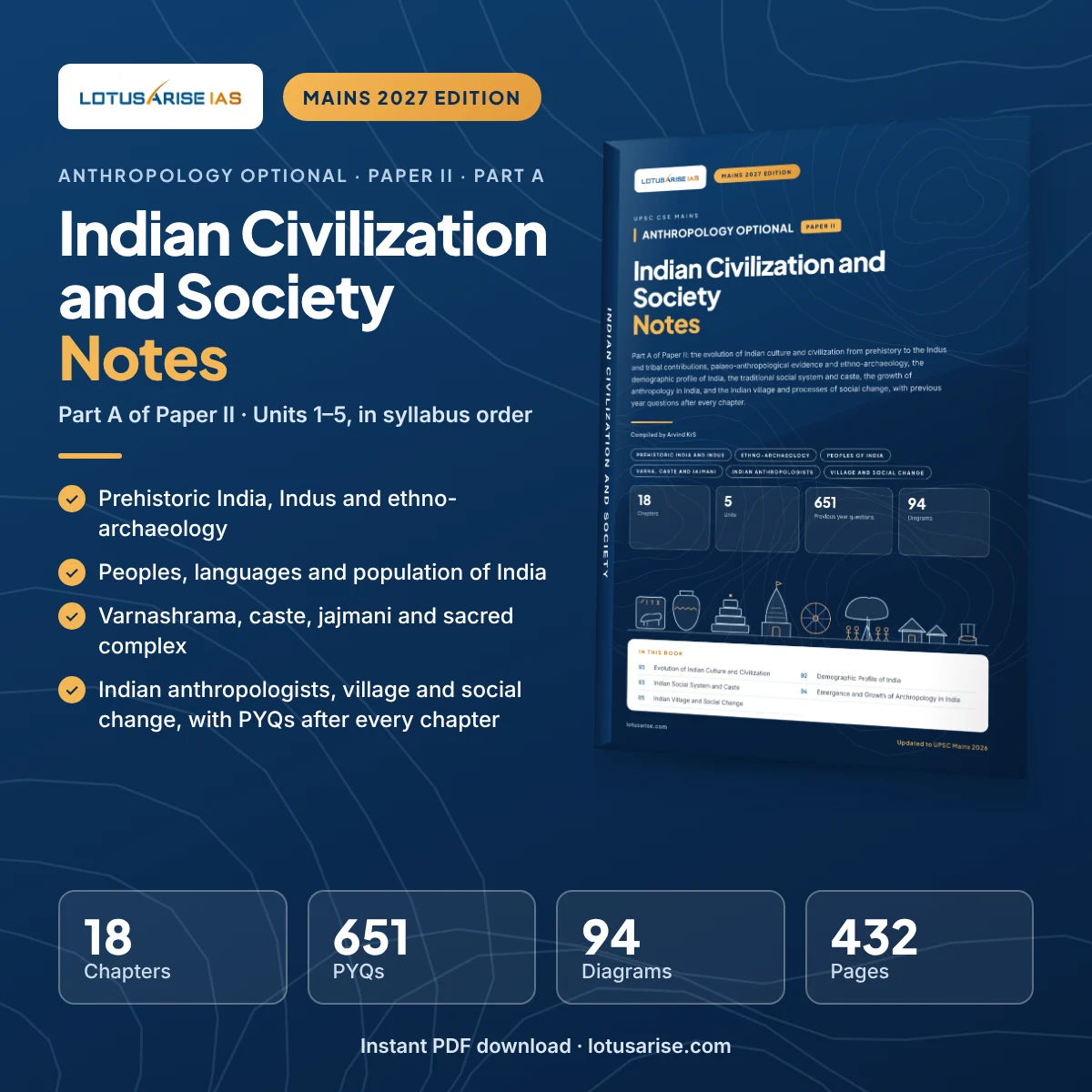
🏺 Part A: Indian Civilization and Society, 432 pages. Prehistoric India to social change in the village in 18 chapters.
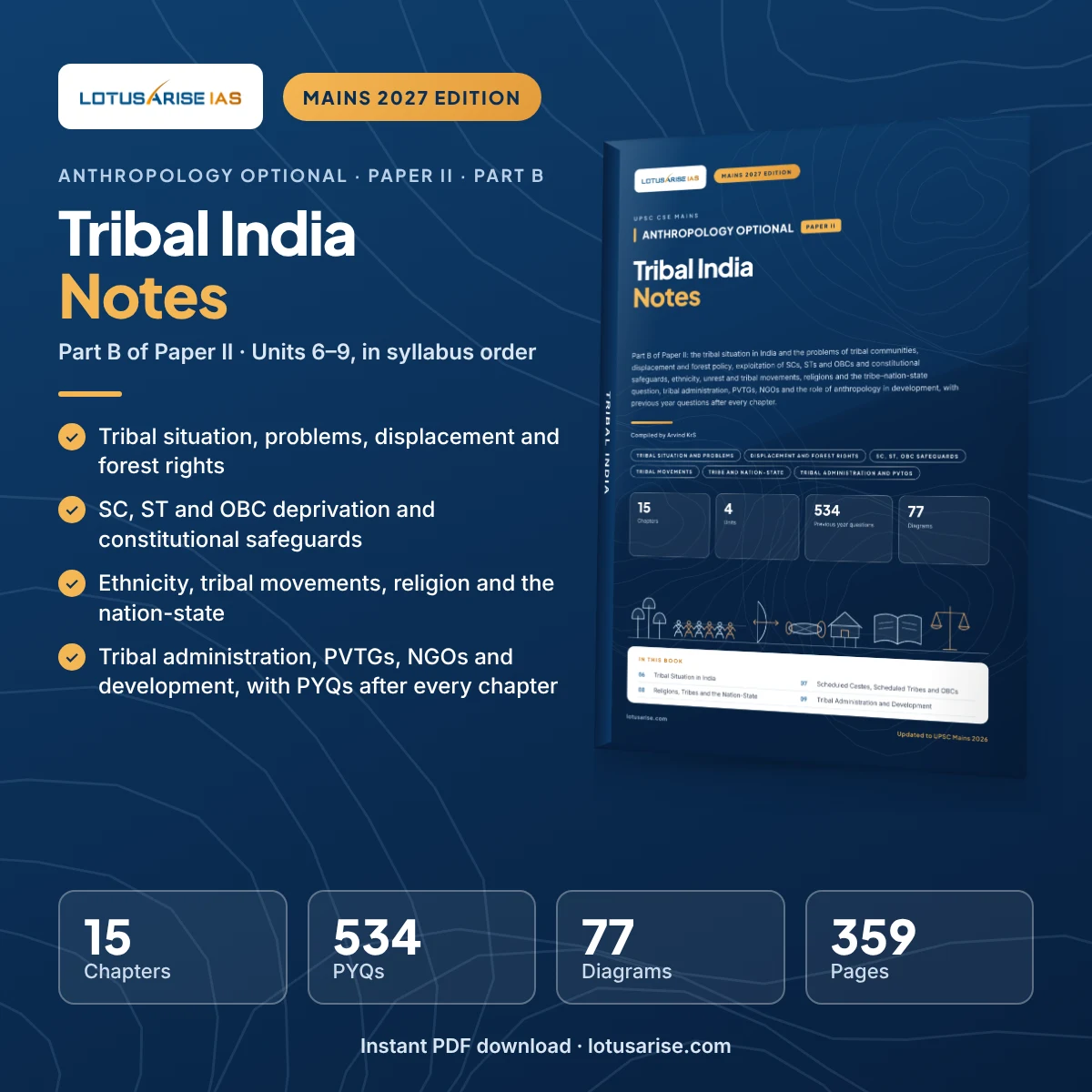
🏹 Part B: Tribal India, 359 pages. The tribal situation to the role of anthropology in development in 15 chapters.
🎁 Anthropology PYQ book, free inside. 1,855 questions topic-wise from 1981 to 2026, all 26 full papers from 2014 to 2026, and ten-year pattern charts.
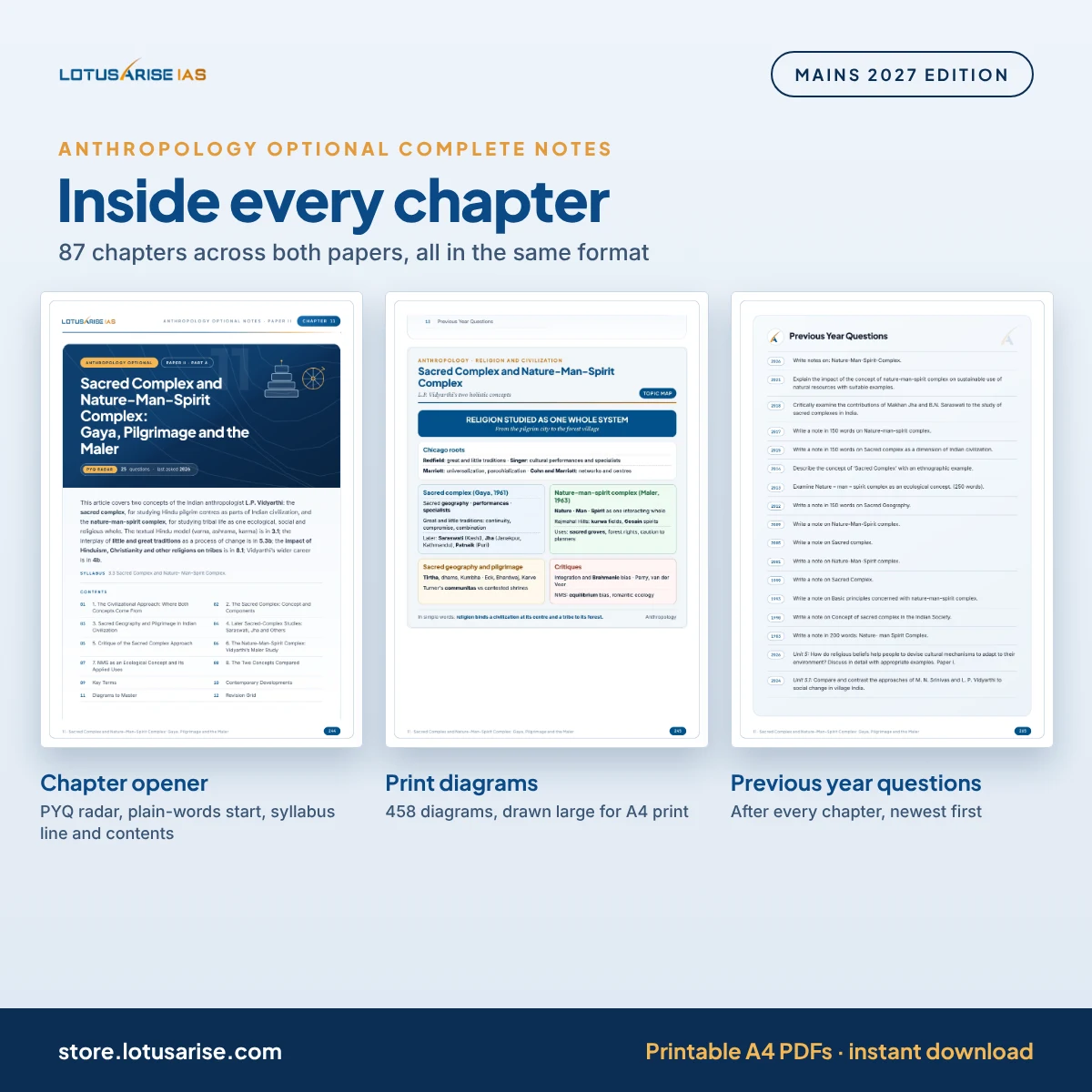
📝 Previous year questions after every chapter, and 171 diagrams drawn for print.
One-time payment with no subscription. Printable A4 PDFs that work offline on any device. The download links are emailed the moment payment clears; check your spam folder if they are not in the inbox.
⭐ Trusted by the 300,000+ UPSC aspirants who read LotusArise IAS every month
Sample: Part ASample: Part BSample: PYQ book
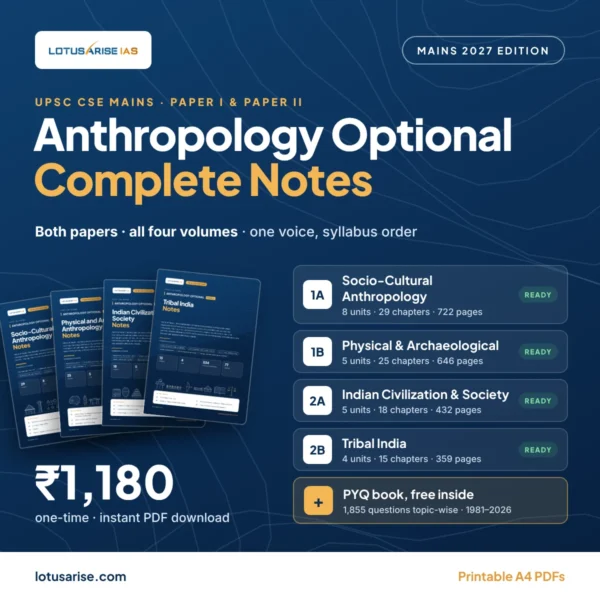
Need Paper I as well? All four volumes come together in Anthropology Optional Complete Notes for ₹1,180.
Features:
- Comprehensive Coverage
- Complete Syllabus
- Suitable for: UPSC & State PSCs exams
- Format: Digital PDF (Downloadable)
- 337,362+ aspirants visit every month
The problem most Anthropology aspirants don’t talk about
Ask an Anthropology aspirant who is a year into preparation what is going wrong. Most will not say the syllabus is too long. They will say one of these three things:
“I understood Malinowski’s functionalism in class. In the answer I could not tie it to a single Indian example.”
“Paper I biology is a list of fossils and syndromes I revise the night before. I can’t tell which genetics topics UPSC actually asks.”
“Paper II is where my notes run out. Tribal administration, PVTGs and the latest schemes come from newspaper cuttings.”
None of these is a discipline problem. They are material problems. Anthropology rewards answers that move between theory, a named ethnography and an Indian case, and most notes give you the definitions without the case or the scholar.
Why the whole syllabus, in one place, matters
Anthropology carries 500 marks: two papers of 250 marks each. Paper I splits into socio-cultural and physical-archaeological anthropology, and Paper II into Indian society and tribal India. A weak half is not a small gap. It is a quarter of the optional you walk into the hall unsure about.
The two papers also lean on each other. Prehistoric archaeology in Paper I is prehistoric India and the Indus in Paper II. Race and genetic markers return as the racial and ethnic elements of the Indian population. Kinship and religion become caste, jajmani and the sacred complex. Research methods and functionalism become the village studies of Srinivas and Dube, and applied anthropology becomes the role of anthropology in tribal development. Answers that make these links show the examiner that you understand the subject.
The benefit goes beyond the optional. Indian society, caste, tribes, weaker sections and welfare schemes feed straight into GS Paper I, GS Paper II and the Essay paper.
What’s inside: 791 pages, 33 chapters
🏺 Paper II, Part A: Indian Civilization and Society, 432 pages
- Prehistoric India, the Indus civilization and the tribal contributions to Indian civilization
- The Siwaliks, Ramapithecus and Narmada Man; ethno-archaeology in India
- Ethnic and linguistic elements of the Indian population, and its structure and growth
- Varnashrama, caste and its theories, dominant caste, jajmani, the tribe-caste continuum and the sacred complex
- Scholar-administrators and Indian anthropologists; village studies, minorities, Sanskritization, little and great traditions, Panchayati Raj and media
🏹 Paper II, Part B: Tribal India, 359 pages
- The tribal situation in India and the problems of tribal communities
- Development projects and displacement; forest policy, urbanisation, industrialisation and the Forest Rights Act
- Exploitation of SCs, STs and OBCs, constitutional safeguards and social change in tribal societies
- Ethnicity, regionalism and autonomy, pseudo-tribalism and the tribal movements from the Santal Hul to Jharkhand
- Religions and tribes, tribe and nation-state; tribal administration, PVTGs, NGOs and the contribution of anthropology to development
🎁 Anthropology PYQ book, included free
Sold on its own as Anthropology Optional Question Papers with Topic-wise for ₹59; here it comes free in the same download. The book holds 1,855 previous year questions sorted into the 53 syllabus units of both papers, from 1981 to 2026 and newest first, with thinker and scholar tags. It also has all 26 full papers from 2014 to 2026 with the marks printed against each sub-part, and ten years of pattern charts showing which units UPSC asks most and which are rising. In addition, every chapter of the notes ends with its own previous year questions.
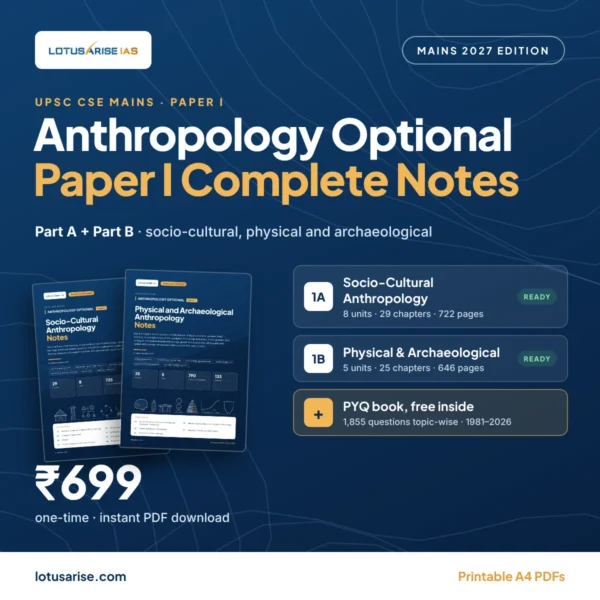
Please note: this pack covers Paper II only. Paper I, socio-cultural, physical and archaeological anthropology, is sold separately as Anthropology Optional Paper I Complete Notes (₹699), or take both papers together in Anthropology Optional Complete Notes (₹1,180).
How every chapter is built
- Beginner first, topper deep. Every topic starts in plain words and builds to the theory, the critique and the ethnographic example that examiners reward.
- Diagrams made for print. 171 diagrams across this paper, from kinship charts and fossil skulls to growth curves and the Cernea model, drawn large enough to read on a printed A4 page.
- A topic map and a PYQ radar on every opener. You see how many times UPSC has asked the chapter and when it was last set before you read a line.
- Scholars and ethnographies by name. Malinowski, Radcliffe-Brown, Lévi-Strauss, S. C. Roy, Verrier Elwin, M. N. Srinivas, L. P. Vidyarthi and many more, each with the work you can quote.
- Key terms, contemporary developments and a revision grid at the end of every chapter, followed by its previous year questions, newest first.
Who buys this
The first-timer who has just chosen Anthropology. You want the whole optional sorted on day one, instead of discovering in month six that Paper II was never really covered.
The repeater whose optional score stalled. The marks are usually in the missing ethnographic example, the half you under-prepared and the link between papers you never made.
The science or medical graduate who picked Anthropology for its biology. Paper I genetics and evolution will feel familiar; the notes explain every social science term the first time it appears.
The self-study aspirant far from a coaching city. You get one complete set of material, printable and offline, at a price that does not decide your month.
The price
₹699, one-time. That buys both parts of Paper II, with the PYQ book included: 791 pages across 33 chapters.
There is no subscription and no recurring charge. The download links reach your email as soon as payment clears. If they are not in your inbox within a few minutes, check the spam folder.
Read before you buy: free samples are open to everyone, each with the full contents and two complete chapters: Part A, Part B and the PYQ book.
Questions before or after buying: support@lotusarise.com