

Public Administration Optional Complete Notes: Paper I + Paper II (All 4 Parts) by LotusArise IAS
₹1,180.00
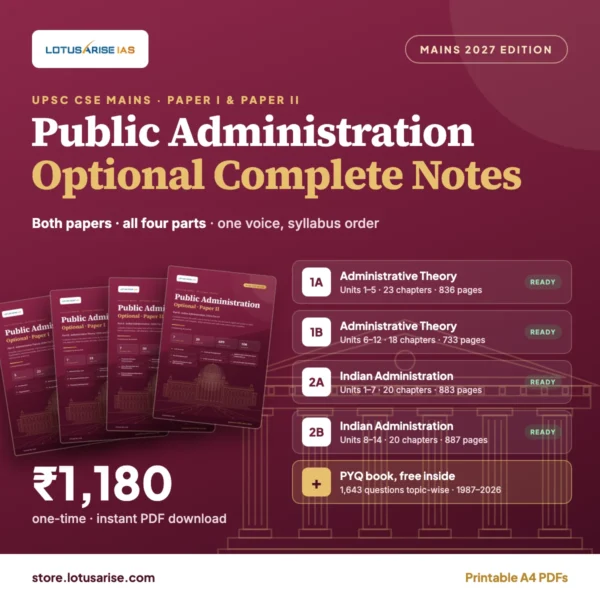
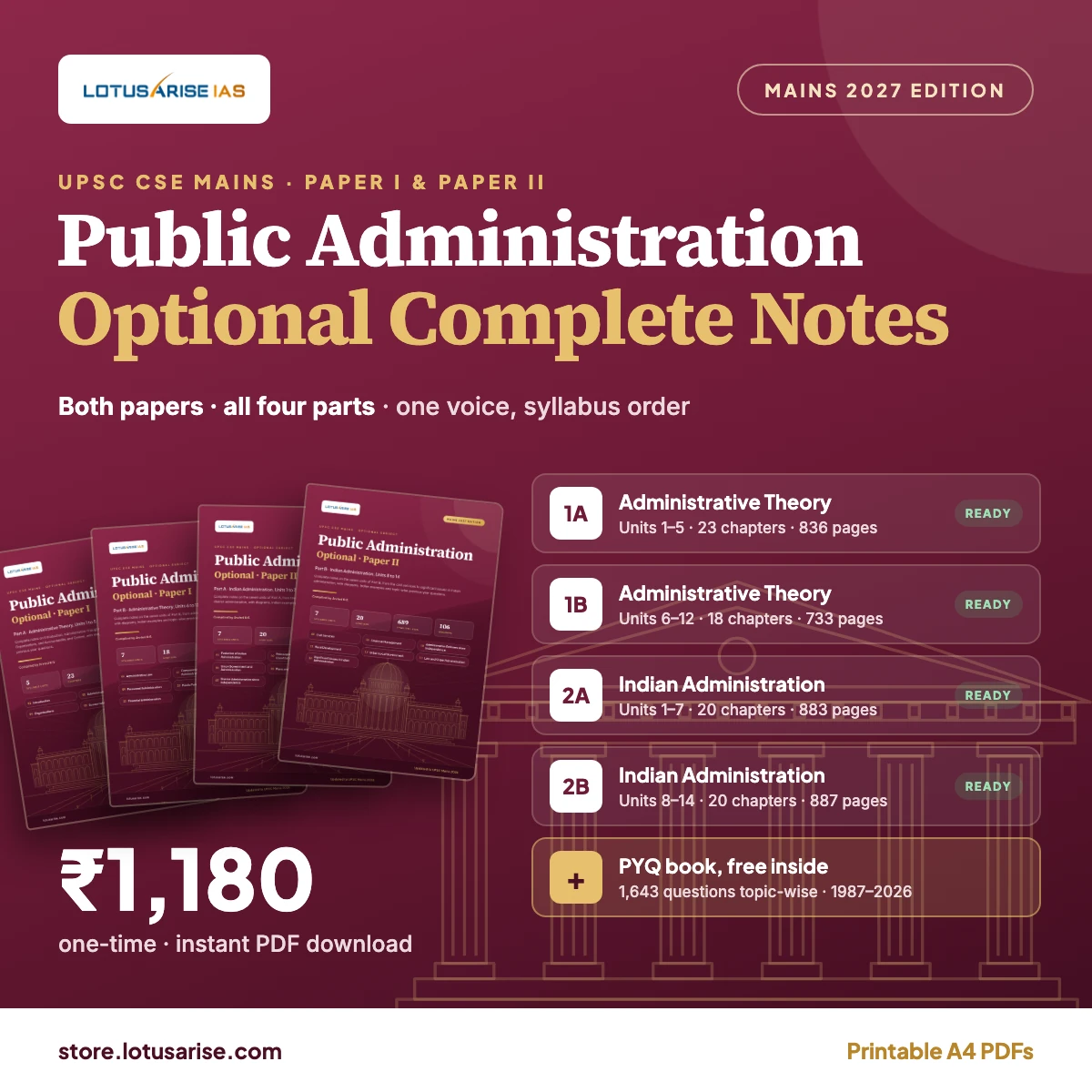
₹1,180 for the whole Public Administration optional: Paper I and Paper II, all four parts, one-time payment. Bought paper by paper they cost ₹1,398.
Most Public Administration aspirants build the optional out of pieces: the thinkers from one book, Indian administration from a second, and the last two years from newspaper cuttings. The result is three voices, three orders, and a Paper II that never quite gets finished.
Public Administration Optional Complete Notes covers the whole syllabus in one voice, in syllabus order, written so that beginners can follow it and deep enough for Mains answers.
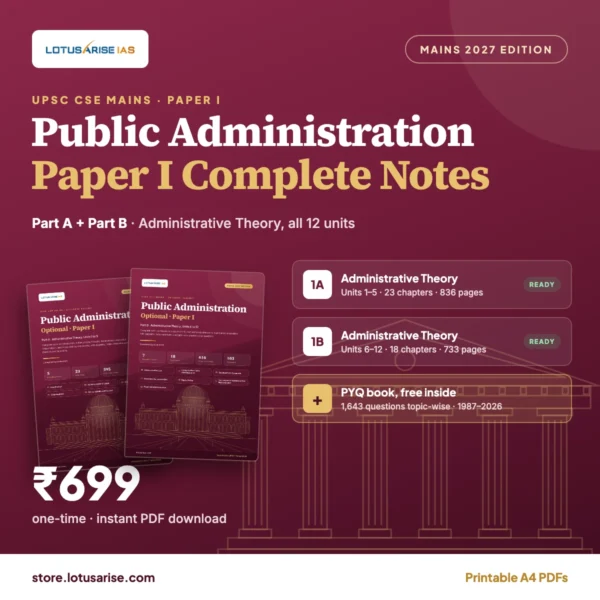
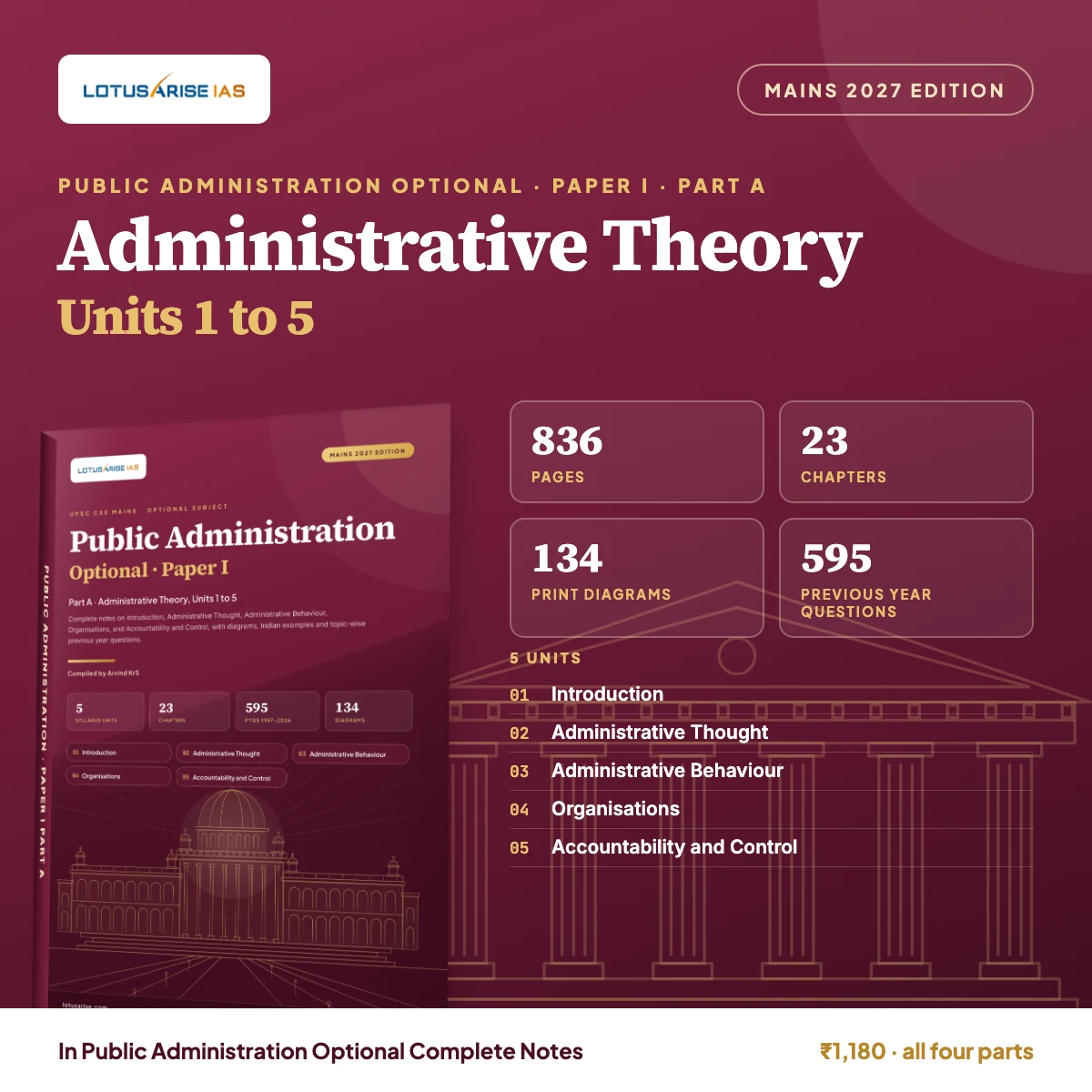
🏛️ Paper I, Part A: Administrative Theory, Units 1 to 5, 836 pages. Meaning and scope to accountability and control in 23 chapters.
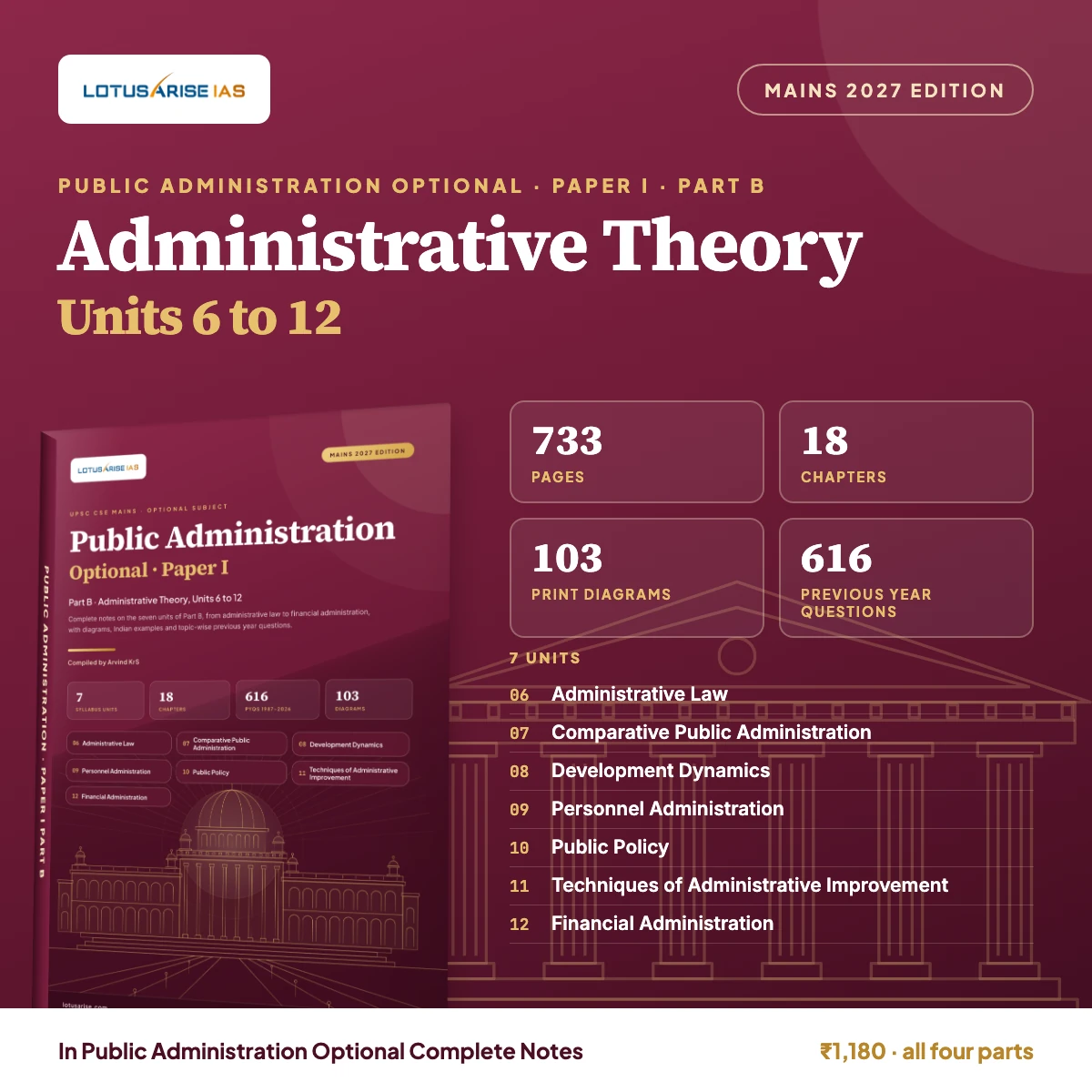
📐 Paper I, Part B: Administrative Theory, Units 6 to 12, 733 pages. Administrative law to financial administration in 18 chapters.
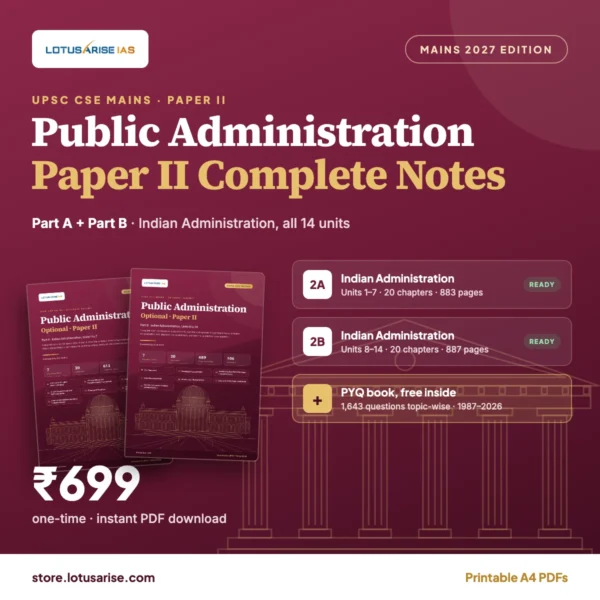
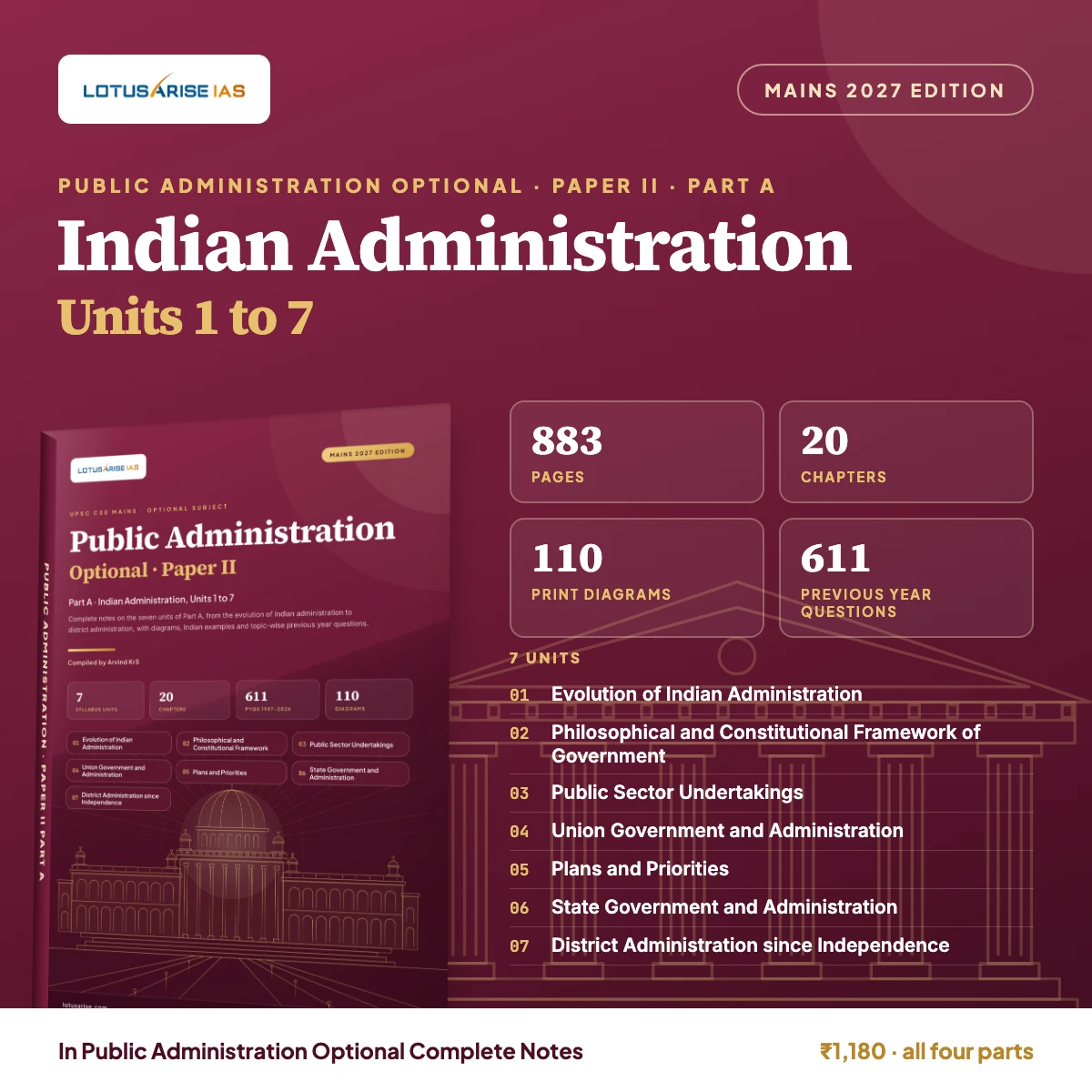
🇮🇳 Paper II, Part A: Indian Administration, Units 1 to 7, 883 pages. Kautilya to the District Collector in 20 chapters.
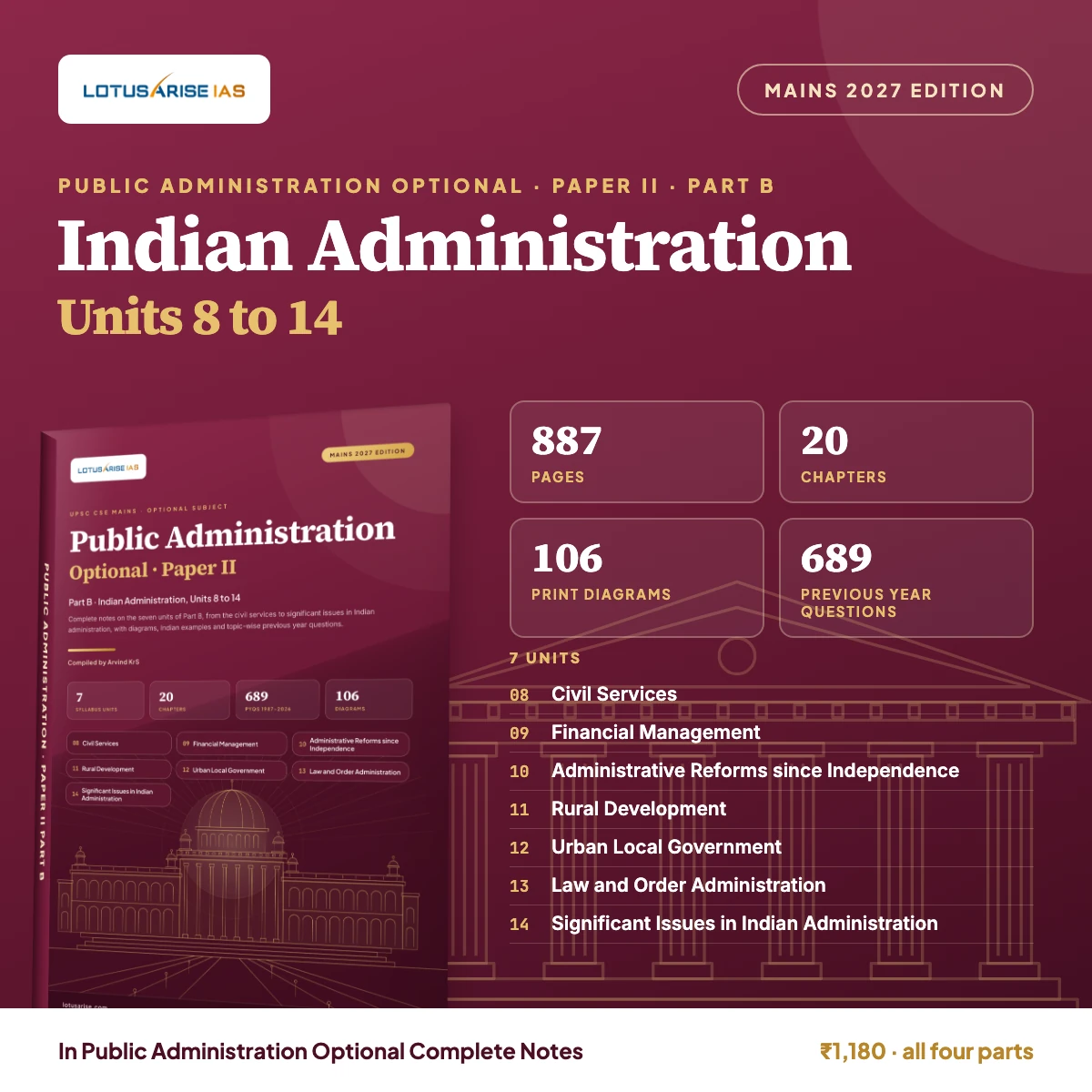
⚖️ Paper II, Part B: Indian Administration, Units 8 to 14, 887 pages. Civil services to disaster management in 20 chapters.
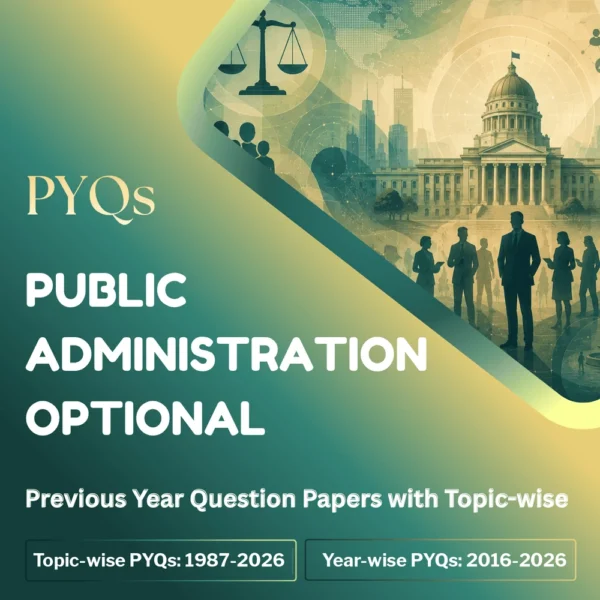
🎁 Public Administration PYQ book, free inside. 1,643 questions topic-wise from 1987 to 2026, 22 full papers from 2016 to 2026, and ten-year pattern charts.
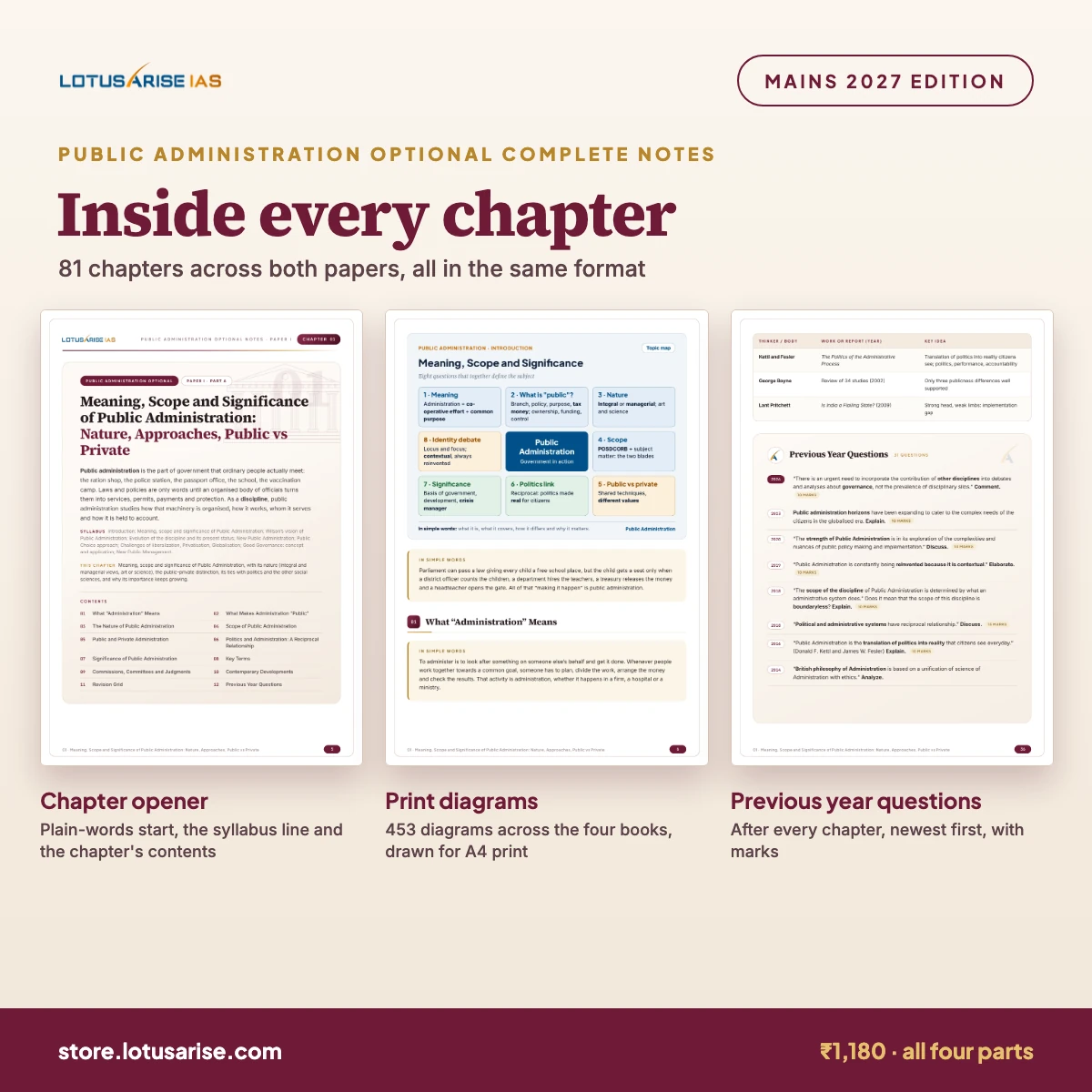
📝 Previous year questions after every chapter, and 453 diagrams drawn for print.
One-time payment with no subscription. Printable A4 PDFs that work offline on any device. The download links are emailed the moment payment clears; check your spam folder if they are not in the inbox. The diagrams are kept at full print quality, so each PDF is 64–80 MB: download them on Wi-Fi.
⭐ Trusted by the 300,000+ UPSC aspirants who read LotusArise IAS every month
Sample: Paper I Part ASample: Paper I Part BSample: Paper II Part ASample: Paper II Part B
Features:
- Comprehensive Coverage
- Complete Syllabus
- Suitable for: UPSC & State PSCs exams
- Format: Digital PDF (Downloadable)
- 337,362+ aspirants visit every month
The problem most Public Administration aspirants don’t talk about
Ask a Public Administration aspirant who is a year into preparation what is going wrong. Most will not say the syllabus is too long. They will say one of these three things:
“I have read Weber, Simon and Riggs. When the question asks me to compare them, or to apply them to an Indian office, I have nothing to say.”
“My Paper II notes are newspaper cuttings. I don’t know where NITI Aayog, the 16th Finance Commission or Mission Karmayogi fit in the syllabus.”
“I finished Paper I properly. Paper II is still a list of committees I never read.”
None of these is a discipline problem. They are material problems. Public Administration is not memorised definitions. It is theory applied to real institutions, and most notes give you one without the other.
Why the whole syllabus, in one place, matters
Public Administration carries 500 marks: two papers of 250 marks each. Paper I, Administrative Theory, has 12 units; Paper II, Indian Administration, has 14. A weak unit is not a small gap, because UPSC asks across almost every unit, every year.
The papers also lean on each other. Weber’s bureaucracy in Paper I is the civil service, its neutrality and its reform in Paper II. Accountability and control in Paper I returns as the CAG, the Lokpal and the citizen–administration interface. Personnel and financial administration in Paper I are the civil services and financial management of Paper II. Answers that make these links show the examiner that you understand the subject.
The benefit goes beyond the optional. Governance, the Constitution’s institutions, ethics in public service and the current reforms feed straight into GS Paper II, GS Paper IV and the Essay paper.
What’s inside: 3,339 pages, 81 chapters, 26 syllabus units
🏛️ Paper I, Part A: Administrative Theory, Units 1 to 5, 836 pages
- Introduction: meaning, scope and significance; Wilson’s vision and the evolution of the discipline; New Public Administration and Public Choice; LPG and good governance; New Public Management, New Public Service and digital-era governance
- Administrative thought: Taylor, Fayol and the classical school, Weber and the post-Weberians, Follett, Mayo, Barnard, Simon, and Likert, Argyris and McGregor
- Administrative behaviour: decision-making, communication and morale, motivation theories, and theories of leadership
- Organisations: systems and contingency theories; ministries, corporations, boards and field administration; regulatory authorities and PPPs
- Accountability and control: legislative, executive and judicial control; citizen and administration; citizen’s charters, RTI and social audit
📐 Paper I, Part B: Administrative Theory, Units 6 to 12, 733 pages
- Administrative law: Dicey and the rule of law, delegated legislation and administrative tribunals
- Comparative public administration: ecology, Heady’s approaches and current status; Riggs’s prismatic and sala models and their critique
- Development dynamics: development administration and the anti-development thesis; bureaucracy, state versus market and liberalisation; women and development and the self-help group movement
- Personnel administration: recruitment, training and promotion; discipline, appraisal and employee relations; administrative ethics
- Public policy, and techniques of improvement: models of policy-making and the policy process; O&M, work study, PERT, CPM, MIS and e-governance
- Financial administration: monetary and fiscal policy and public debt; budgets and the budgetary process; financial accountability, accounts and audit
🇮🇳 Paper II, Part A: Indian Administration, Units 1 to 7, 883 pages
- Evolution of Indian administration: Kautilya’s Arthashastra, Mughal administration and the legacy of British rule
- Constitutional framework: salient features and value premises; constitutionalism and political culture; bureaucracy, democracy and development
- Public sector undertakings: forms, autonomy and accountability; liberalisation, privatisation and disinvestment
- Union government: the executive, Parliament and the judiciary; PMO, Cabinet Secretariat and Central Secretariat; ministries, departments and field organisations
- Plans and priorities: Planning Commission, NDC and NITI Aayog; decentralised planning after the 73rd and 74th Amendments
- State and district: Union–State relations and the Finance Commission; Governor, Chief Minister and Chief Secretary; the changing role of the Collector and democratic decentralisation
⚖️ Paper II, Part B: Indian Administration, Units 8 to 14, 887 pages
- Civil services: constitutional position and recruitment; training and Mission Karmayogi; good governance initiatives; conduct, discipline and grievances; neutrality and activism
- Financial management: budget, parliamentary control and the Finance Ministry; accounts, audit, the CGA and the CAG
- Administrative reforms: major concerns and implementation problems; the reform commissions and committees
- Rural and urban local government: rural development programmes; Panchayati Raj, the 73rd Amendment and PESA; municipal governance, the 74th Amendment and city management
- Law and order: British legacy, police commissions and investigative agencies; CAPFs, insurgency, terrorism and criminalisation of politics; police reforms
- Significant issues: values in public service, regulatory commissions and the NHRC; coalition regimes and the citizen–administration interface; corruption; disaster management
🎁 Public Administration PYQ book, included free
Sold on its own as Public Administration Optional Question Papers with Topic-wise for ₹59; here it comes free in the same download.
The book holds 1,643 previous year questions sorted into all 26 syllabus units, from 1987 to 2026 and newest first. It also has 22 full papers from 2016 to 2026, Paper I and Paper II as set with the marks for every sub-part, and ten years of pattern charts showing which units UPSC asks most and which are rising. In addition, every chapter of the notes ends with its own previous year questions.
How every chapter is built
- Beginner first, Mains deep. Every chapter opens with a topic map and starts each idea in plain words, then builds to the thinkers, the debates and the Indian practice that answers are marked on.
- Diagrams made for print. 453 diagrams across these books, drawn large enough to read on a printed A4 page and simple enough to redraw in an answer.
- Colour-coded boxes. “In simple words” and “Common confusion” boxes in every chapter, “Indian Connect” boxes in most, and “Criticism” and “Defence” set side by side on the big debates.
- Up to date. A “Contemporary Developments” section in every chapter, carried to 2026: the 16th Finance Commission, the 2025 amendment to the Disaster Management Act, VB–G RAM G and Mission Karmayogi among them.
- Built to revise. Key terms, a revision grid and the chapter’s previous year questions, verbatim and with the year, close every chapter.
Who buys this
The first-timer who has just chosen Public Administration. You want the whole optional sorted on day one, instead of discovering in month six that half of Paper II was never really covered.
The repeater whose optional score stalled. The marks are usually in the missing thinker, the unit you under-prepared and the link between the papers you never made.
The engineer or science graduate who picked Public Administration for its overlap with GS. The notes assume no background and explain every term the first time it appears.
The self-study aspirant far from a coaching city. You get one complete set of material, printable and offline, at a price that does not decide your month.
The price
₹1,180, one-time. That buys both papers, all four parts, with the PYQ book included: 3,339 pages across 81 chapters. Bought paper by paper, the same notes cost ₹1,398.
There is no subscription and no recurring charge. The download links reach your email as soon as payment clears. If they are not in your inbox within a few minutes, check the spam folder. Each PDF is 64–80 MB because the diagrams are kept at full print quality, so download them on Wi-Fi.
Read before you buy: free samples are open to everyone, each with the full contents, Chapter 1 and one more complete chapter: Paper I Part A, Paper I Part B, Paper II Part A, Paper II Part B, and the PYQ book.
Questions before or after buying: support@lotusarise.com