

Modern Indian History Summary Notes for UPSC Prelims (2027 Edition) by LotusArise IAS
₹149.00
₹149 for the 2027 Edition — 269 pages, about 55 paise a page.
Most aspirants study Modern History the wrong way. A 700-page textbook they never finish, a coaching handout for the freedom struggle, a Telegram list of newspapers and sessions — and no idea which facts Prelims actually checks. Then the paper asks who leased the land for Madras, what the 1919 Act did to the provinces, or who founded the Self-Respect Movement, and none of the three sources has it in one place.
Modern Indian History Summary Notes puts every Prelims fact in one book.
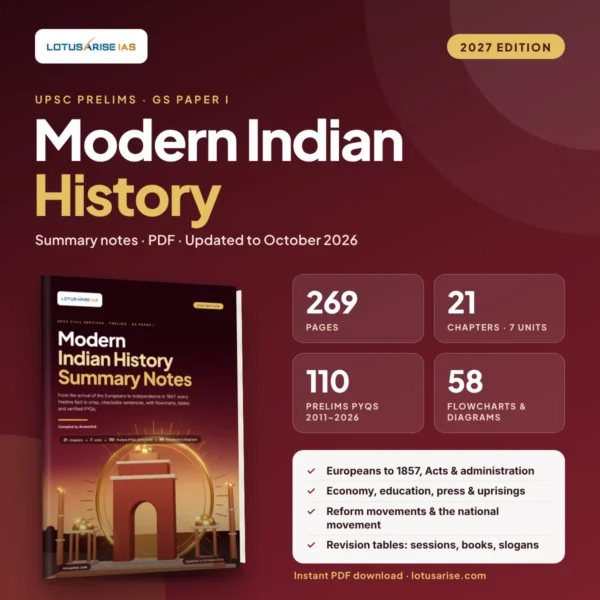
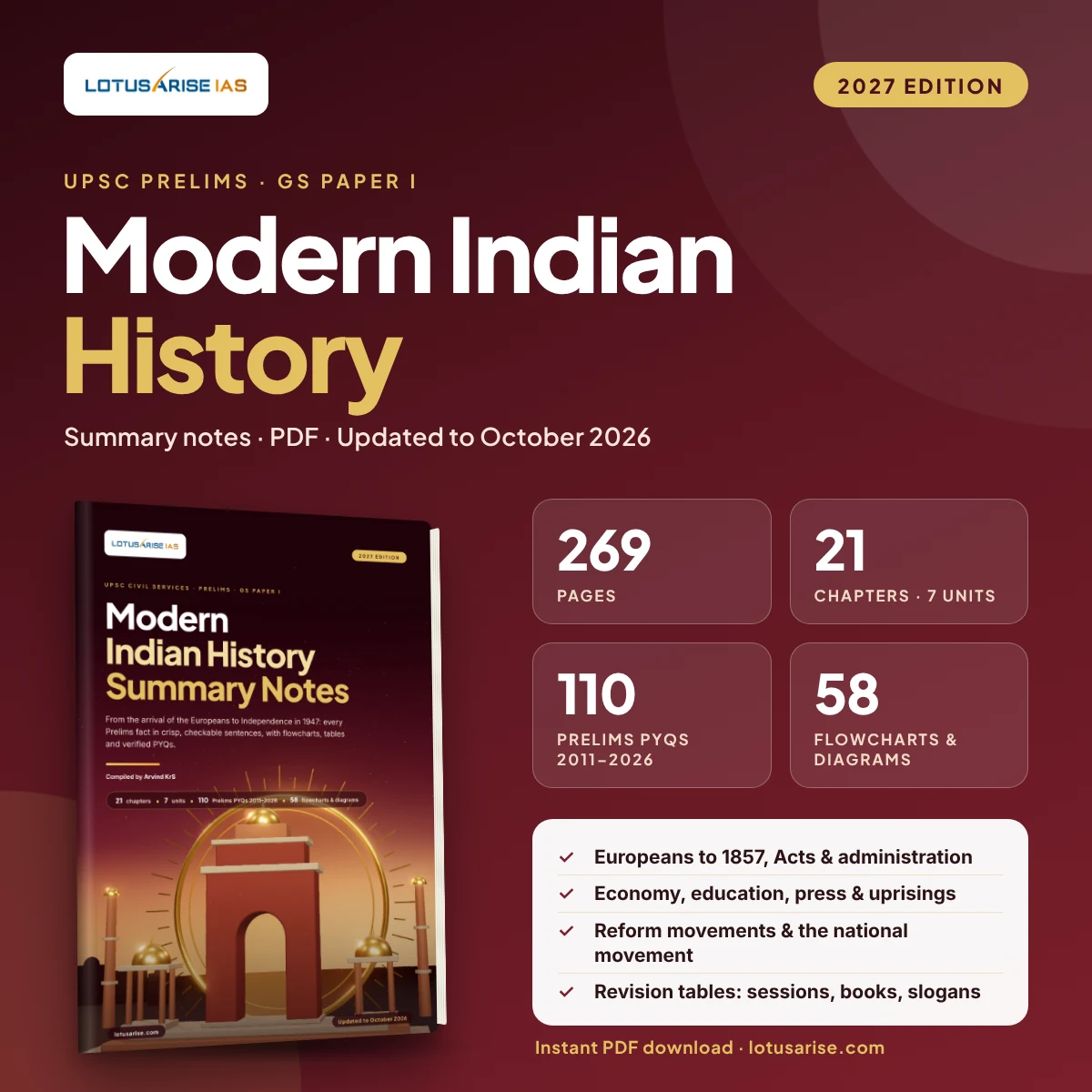
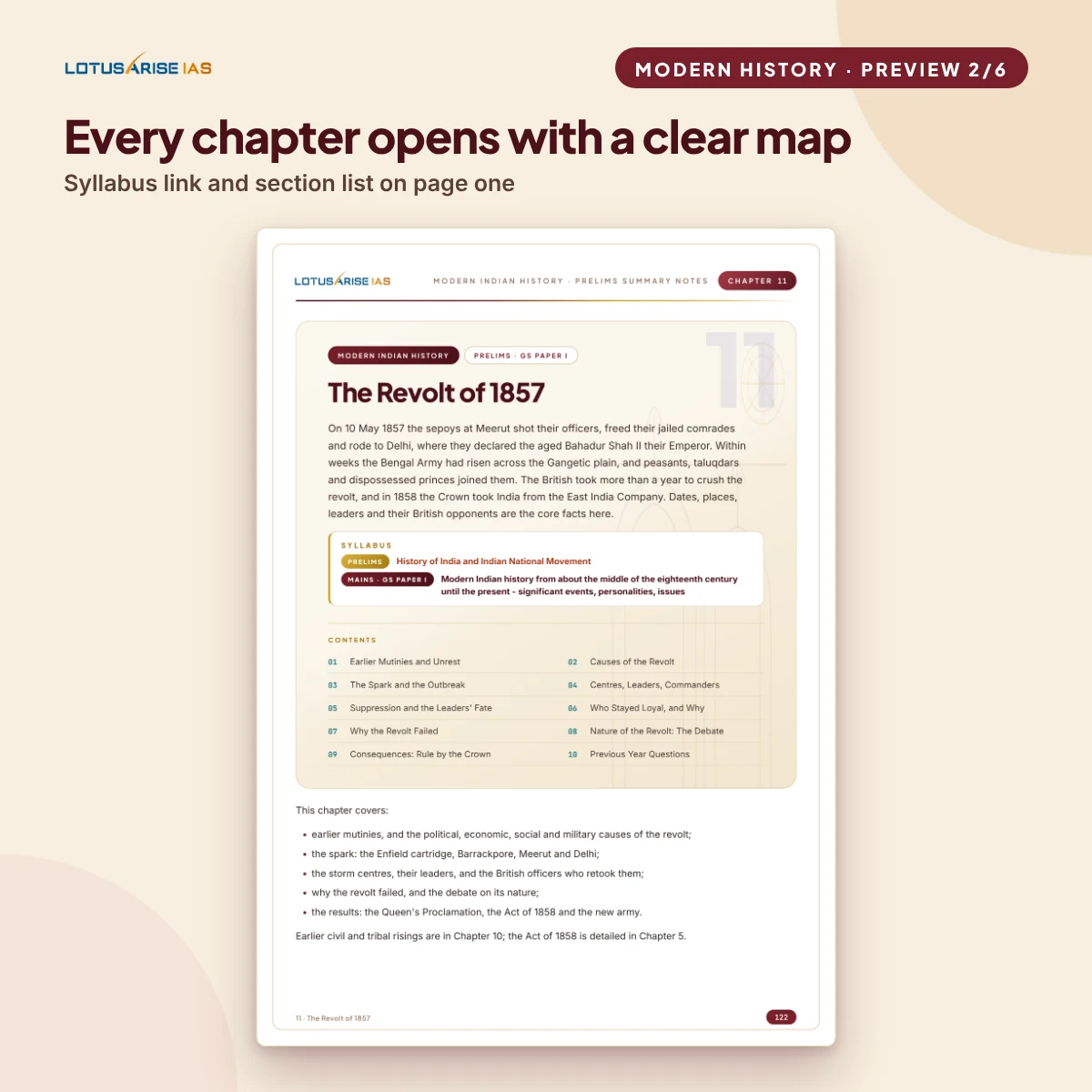
📜 21 chapters in 7 units, 269 pages — from the arrival of the Europeans in 1498 to Independence in 1947
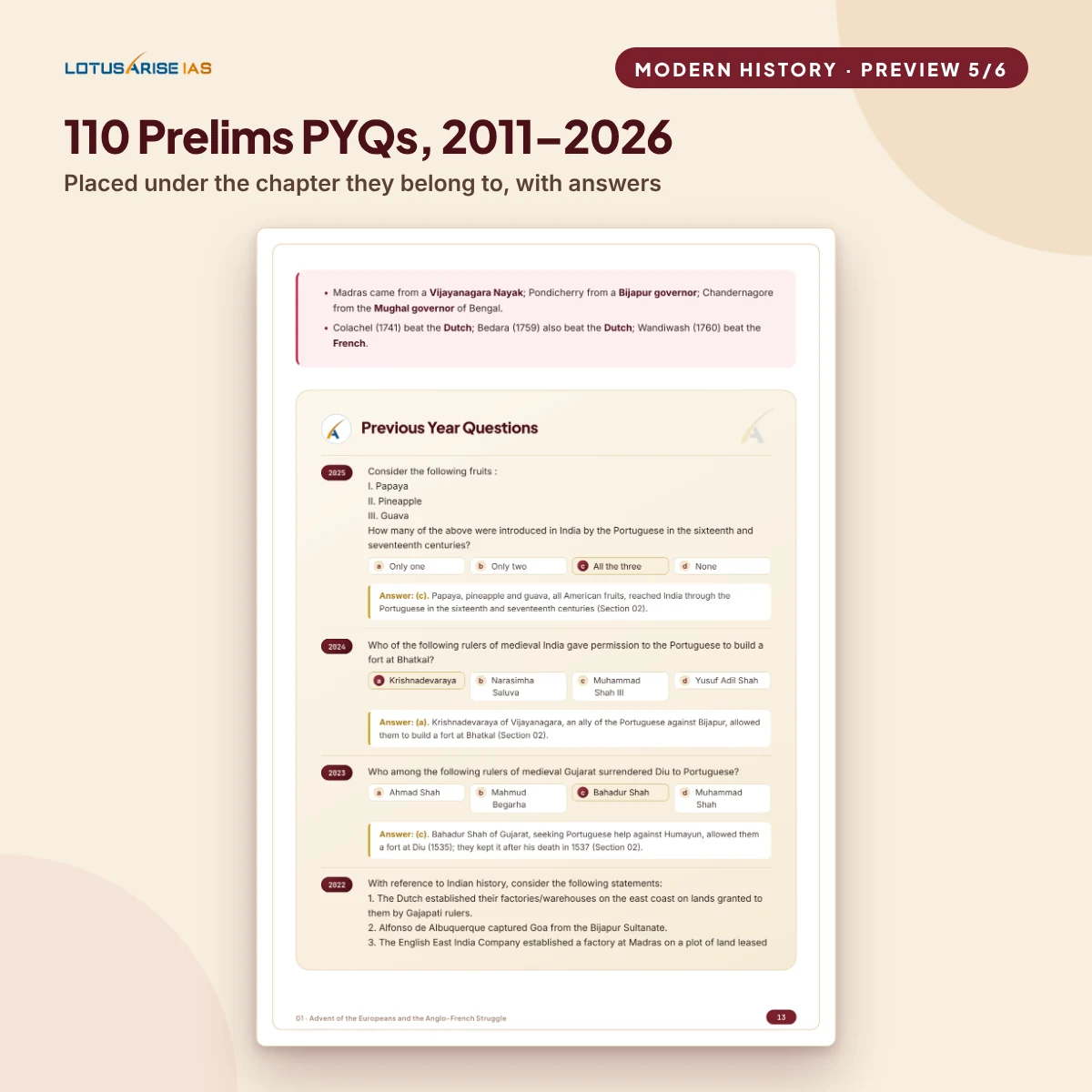
📝 110 Prelims PYQs (2011–2026) — verbatim, with the answer marked and a one-line reason, under the chapter that answers each one
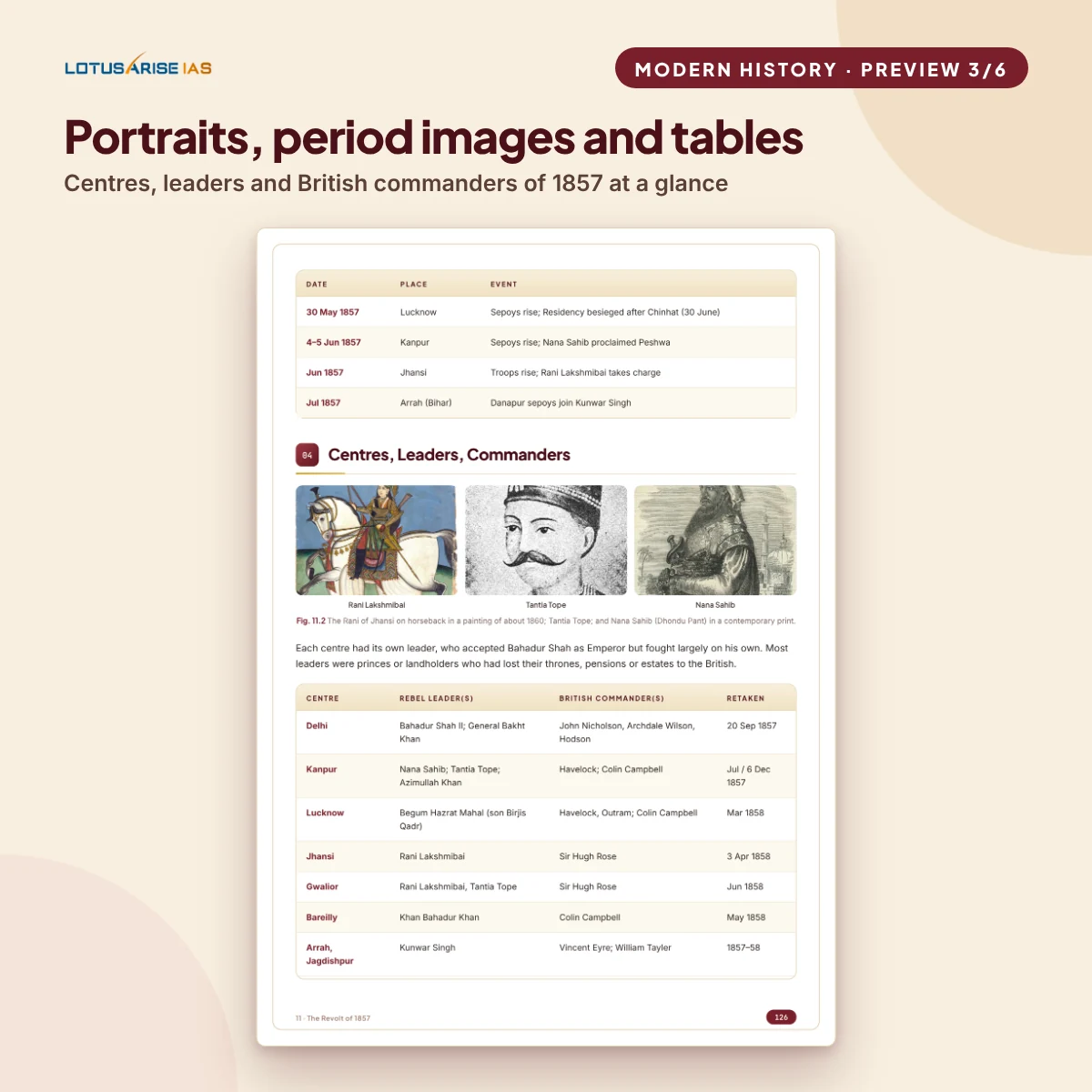
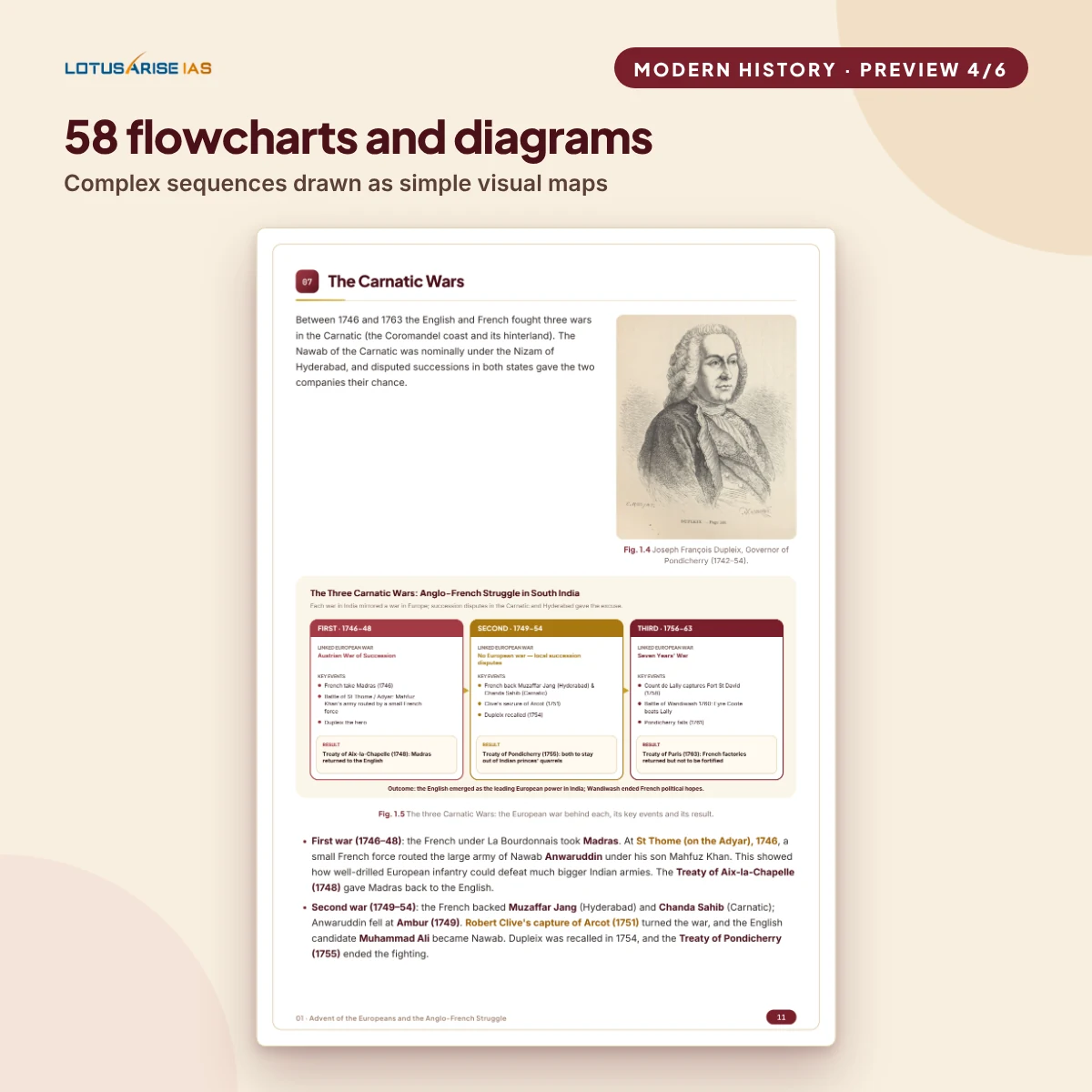
🧭 58 flowcharts and diagrams + period portraits — wars, Acts, movements and sessions drawn as simple visual maps
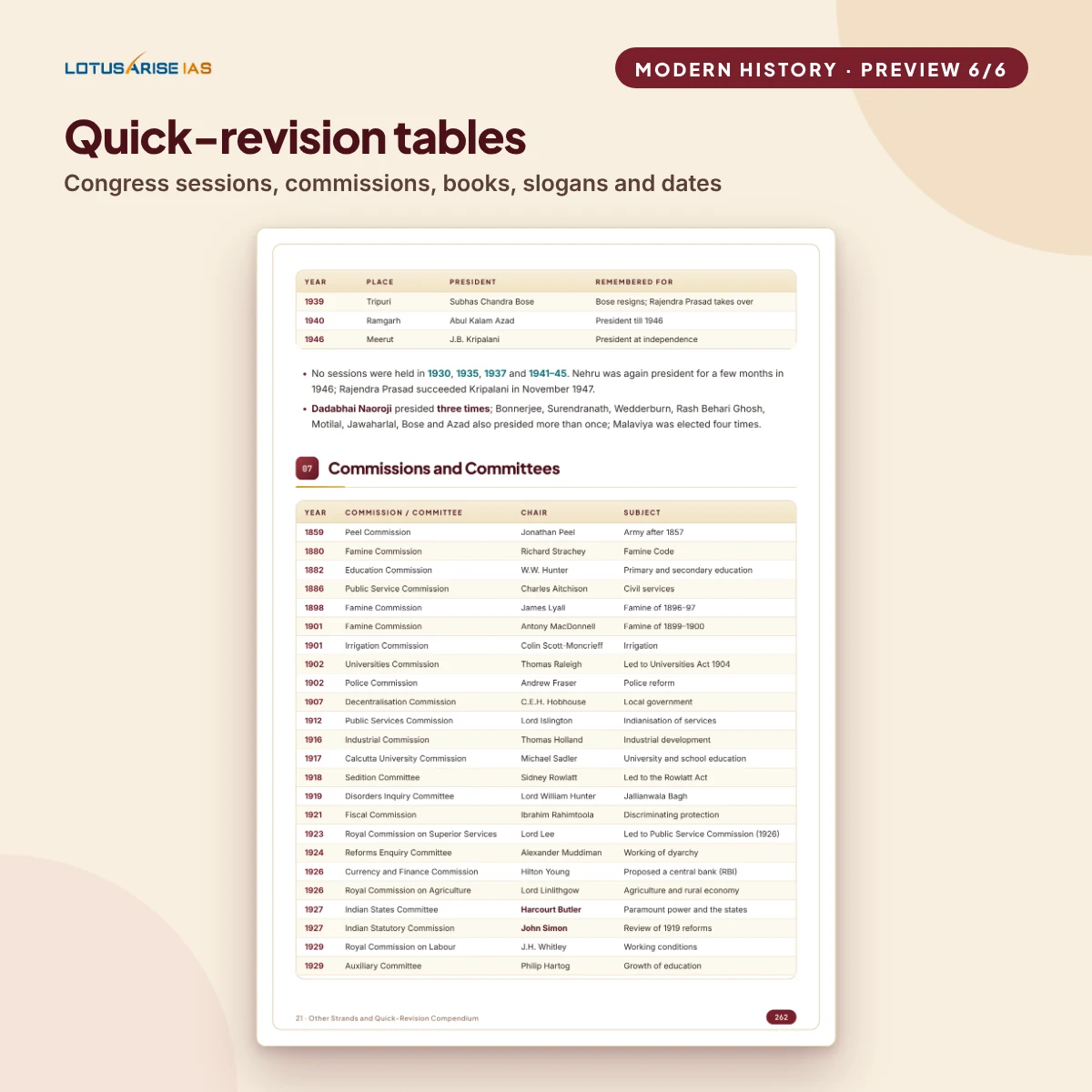
✅ Fact sentences in the Prelims pattern — dates, firsts, founders, treaties and “trap” boxes in every chapter, plus quick-revision tables of sessions, commissions, books and slogans
📱 Instant PDF download — laptop, mobile or tablet, offline, printable
One-time payment. No subscription. Unlimited downloads — the link does not expire.
⭐ Read by 300,000+ UPSC aspirants every month on LotusArise IAS
Features:
- Comprehensive Coverage
- Complete Syllabus
- Suitable for: UPSC & State PSCs exams
- Format: Digital PDF (Downloadable)
- 337,362+ aspirants visit every month
The problem nobody admits about Modern History
Ask an aspirant a month before Prelims how Modern History is going, and they will rarely say the subject is hard. They will say one of three things:
“I have read the standard book twice, but I still mix up the Charter Acts, the Councils Acts and who was Viceroy when.”
“I know the big movements, but Prelims keeps asking small things — a newspaper’s founder, a tribal revolt’s leader, a session’s president — and those are exactly what I skipped.”
“My notes are spread across a book, a coaching module and three PDFs. Two days before the exam I can’t revise any of them.”
These are not memory problems. Modern History is a subject of thousands of small, testable facts, and most material is written as long prose that buries them. Modern Indian History Summary Notes is one book built the other way round: facts first, in the sentence form Prelims uses.
Why Modern History deserves a book of its own
Modern History has given UPSC Prelims questions almost every year: the 110 questions from 2011 to 2026 inside this book are the proof, from the Portuguese and the Carnatic Wars to the Cabinet Mission. The same material feeds GS Paper I in Mains, the Essay and the Interview, and it is a large part of almost every State PSC syllabus.
The subject does not change, but the way it is tested has. Statement-based questions now check exact provisions, founders and dates, and an option you half-remember is an option you get wrong. The real challenge is not understanding Modern History. It is revising all of it quickly and accurately.
What’s inside
📜 The summary notes — 21 chapters, 269 pages
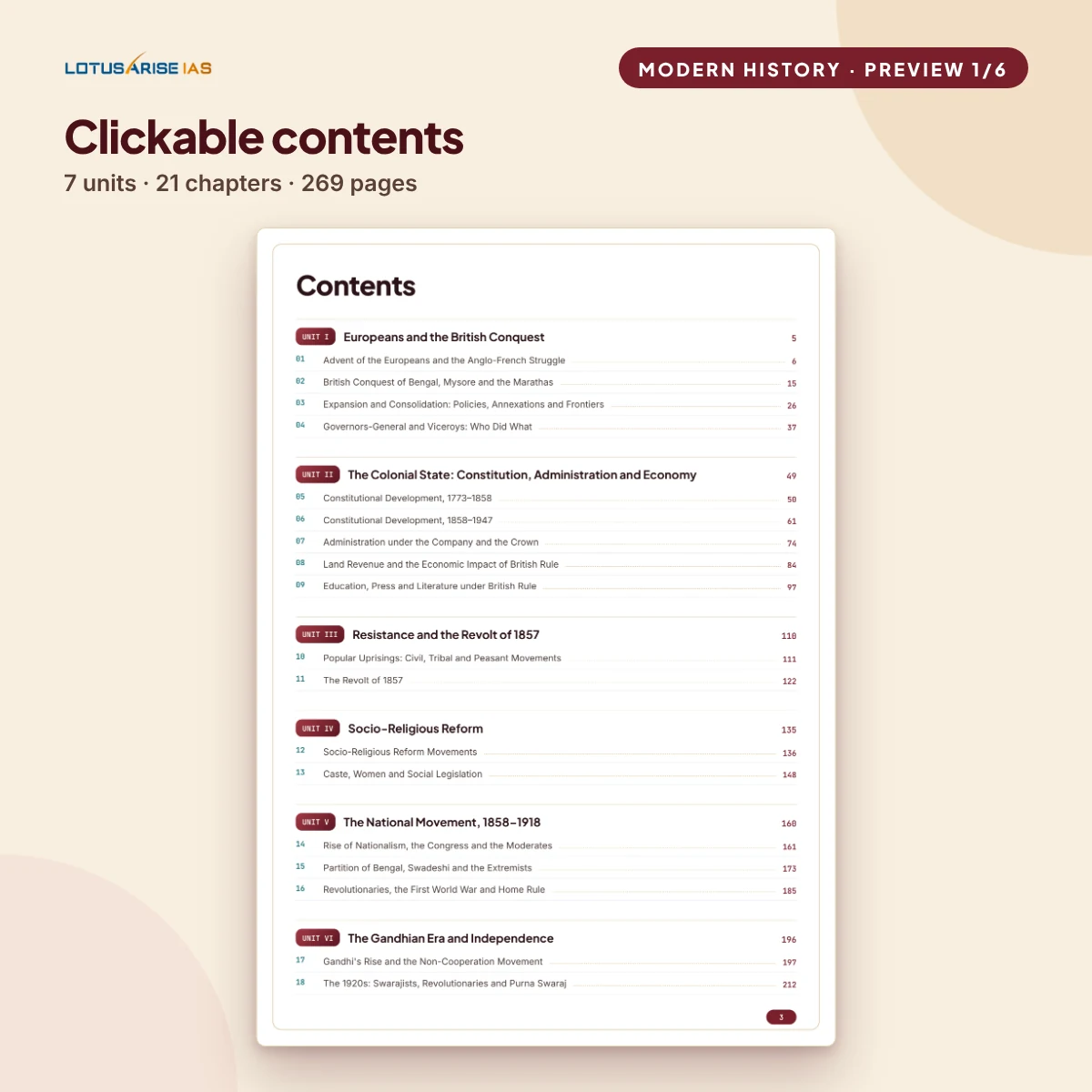
Seven units, in the order the period is best learnt:
- Europeans and the British Conquest — the Portuguese, Dutch, English, Danes and French; the Carnatic Wars; Plassey, Buxar and the Diwani; the Mysore, Maratha and Sikh wars; Subsidiary Alliance and Doctrine of Lapse; every Governor-General and Viceroy and what each one did
- The Colonial State — every Act from the Regulating Act of 1773 to the Indian Independence Act of 1947; civil services, police, judiciary and army; Permanent, Ryotwari and Mahalwari settlements, drain of wealth, famines and railways; education commissions, press laws and newspapers
- Resistance and the Revolt of 1857 — civil, tribal and peasant uprisings with leaders, regions and years; the Revolt of 1857, its centres, leaders and British commanders, and its consequences
- Socio-Religious Reform — Brahmo Samaj to Ramakrishna Mission, Aligarh, Deoband and the Singh Sabhas; Phule, Narayana Guru, Periyar and Ambedkar; social laws from 1829 to 1929
- The National Movement, 1858–1918 — associations before the Congress, the Moderates, the Partition of Bengal and Swadeshi, the Extremists, the revolutionaries at home and abroad, Home Rule and the Lucknow Pact
- The Gandhian Era and Independence — Champaran to Non-Cooperation, the Swarajists and the revolutionaries of the 1920s, Civil Disobedience and the Round Table Conferences, Quit India, the INA, the Cabinet Mission and Partition
- Other Strands and Quick Revision — peasant and working-class movements, communal politics, States’ people’s movements, women in the movement, and revision tables of every Congress session, commissions, books, slogans and a 1498–1947 timeline
What makes this different from downloaded PDFs: every chapter is written fresh for Prelims, not copied from a textbook. Each fact sits in a short, checkable sentence, the way statement questions are framed. Dates and names were checked where sources disagree, and several errors that circulate in popular notes are corrected. Every chapter ends with a “Prelims Traps” box of the confusions UPSC likes to test.
📝 110 Prelims PYQs, 2011–2026
Every question appears verbatim with all four options, the answer marked and a one-line reason that points to the section covering it. The questions sit under the chapter that answers them, so you finish a topic and immediately see how UPSC has tested it.
🧭 58 flowcharts and diagrams, with period portraits
The Carnatic Wars, the Anglo-Mysore and Anglo-Maratha wars, the ladder of constitutional Acts, the land revenue systems, the course of 1857, the Gandhian movements — each drawn as a simple visual map. Portraits and period images of the people and places help the facts stick.
🗂️ Built for revision
A clickable contents page, unit pages that list every topic before you begin, a bookmark panel that takes you to any section in one tap, and 3–6 tables in almost every chapter.
The aspirant who buys this
First-time aspirants — you want one trusted book that covers the whole period for Prelims, instead of a thick textbook you never finish.
Repeaters who lost marks to Modern History — you know the broad story; what hurt you were the small facts. The chapter-wise PYQs and trap boxes show exactly where those questions come from.
Last-month revisers — 269 pages you can get through in a few days, with tables and flowcharts for the final read.
Self-study aspirants outside Delhi, Prayagraj or Jaipur — no classroom, no batch timings; one PDF on your phone that covers the whole syllabus.
State PSC aspirants — modern history is central to most State PSC papers, so the same book serves both.
Why not just use free notes from Telegram?
Free Modern History notes exist, and many aspirants have folders full of them. The problem is not that they are bad. It is that they are scattered across a dozen files, repeat each other’s errors, and are never connected to the questions UPSC has actually asked.
This book is one connected system: 21 chapters in syllabus order, facts written the way Prelims tests them, and every PYQ placed where it belongs.
If you have the time to build that system yourself from scattered sources, you may not need this. If you want it already built — open it and start revising — this is what the book is for.
Price and delivery
A single printed Modern History guide costs more than this PDF, and it will not carry chapter-wise Prelims PYQs to 2026.
₹149 for 269 pages — about 55 paise a page.
Want to see it first? Download the free sample PDF — the cover, the full contents and two complete chapters (01 and 11).
One-time payment. No subscription. No recurring charge.
Instant PDF download after payment. The download link is also sent to your email — please check the spam folder if it does not arrive in a few minutes. Download it again any time from My Account.
For support: support@lotusarise.com
Related products
-

-
Agriculture Notes for UPSC: Prelims & Mains GS Papers I and III (2027 Edition) by LotusArise IAS
Original price was: ₹250.00.₹149.00Current price is: ₹149.00. -
Science and Technology Notes for UPSC: Prelims & Mains GS Paper III (2027 Edition) by LotusArise IAS
Original price was: ₹500.00.₹295.00Current price is: ₹295.00. -
Environment and Ecology Notes for UPSC: Prelims & Mains GS Paper III (2027 Edition) by LotusArise IAS
Original price was: ₹500.00.₹236.00Current price is: ₹236.00.