

Philosophy Optional Notes (Paper I): Section-A {Western Philosophy}
₹472.00
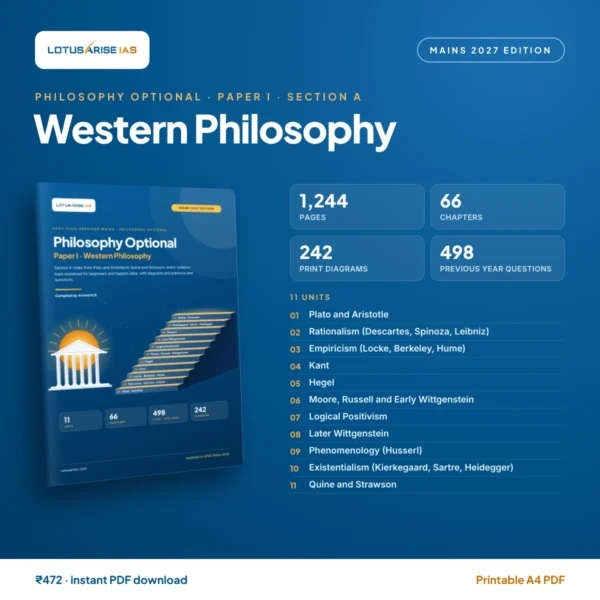
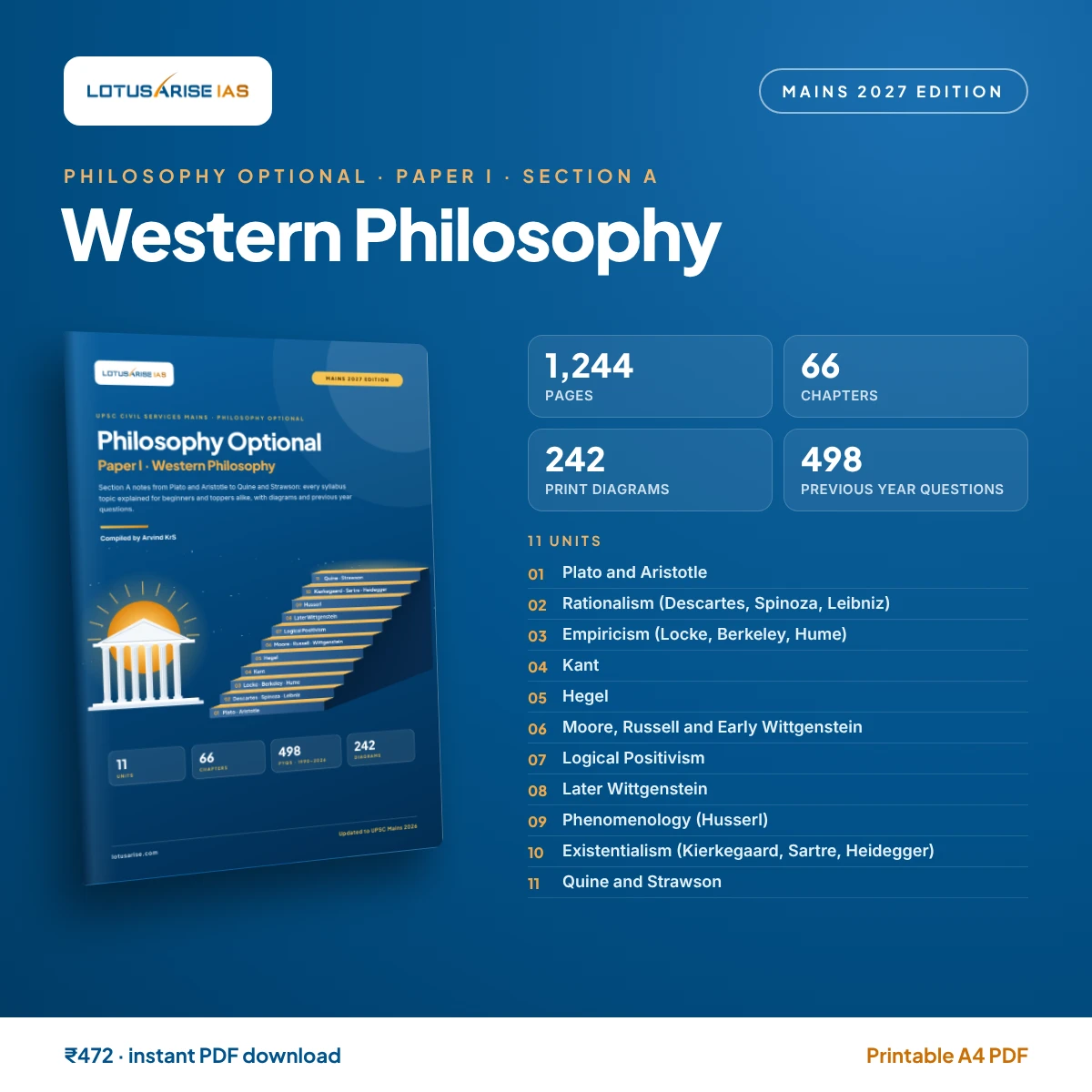
₹472 for Paper I, Section A: Western Philosophy, 1,244 pages, one-time payment.
Most Philosophy aspirants read Western philosophy as a parade of thinkers: Plato, then Descartes, then Hume, then Kant, each summarised and none compared. Then the question asks whether Kant really answered Hume, or why Wittgenstein abandoned the Tractatus, and the summaries have nothing to say.
Philosophy Optional Notes (Paper I): Section-A {Western Philosophy} puts the argument back on the page.
📘 66 chapters across all 11 syllabus units. Plato and Aristotle to Quine and Strawson, in UPSC syllabus order.
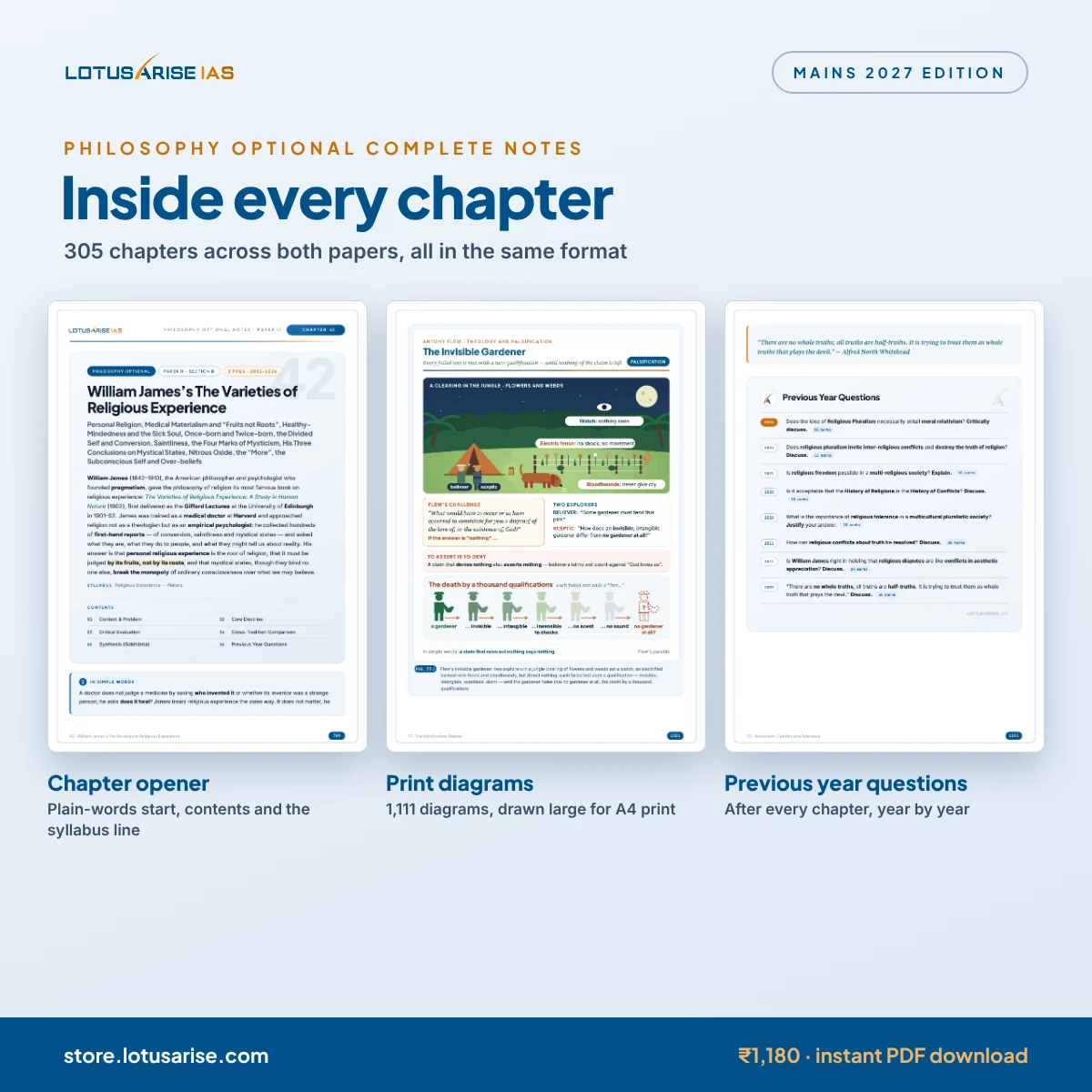
🎨 242 diagrams drawn for print, large enough to read on an A4 page.
📝 Previous year questions after every chapter, 498 in all, with the year marked on each.
🖨️ Printable A4 PDF, 1,244 pages, on any device and offline.
One-time payment with no subscription. The download link is emailed the moment payment clears; check your spam folder if it is not in the inbox.
⭐ Trusted by the 300,000+ UPSC aspirants who read LotusArise IAS every month
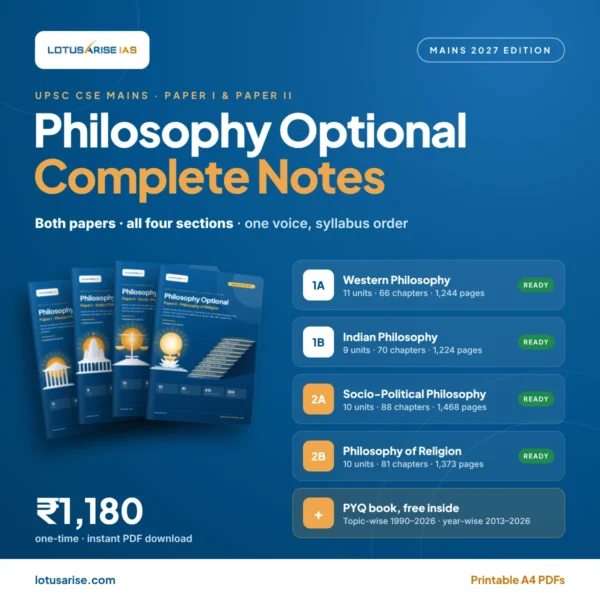
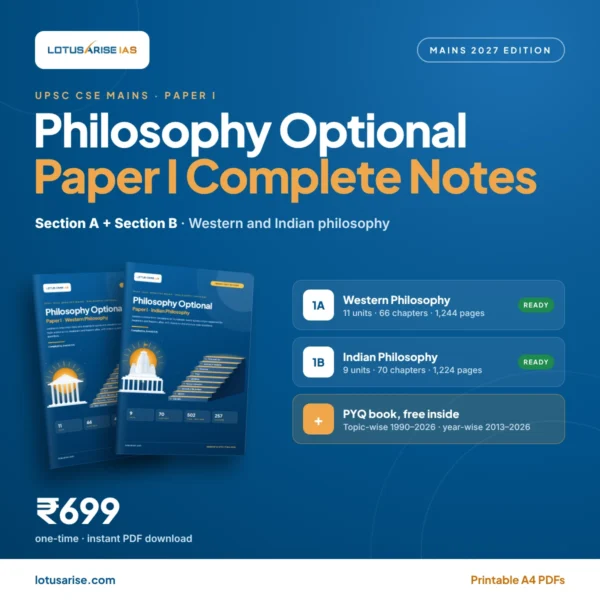
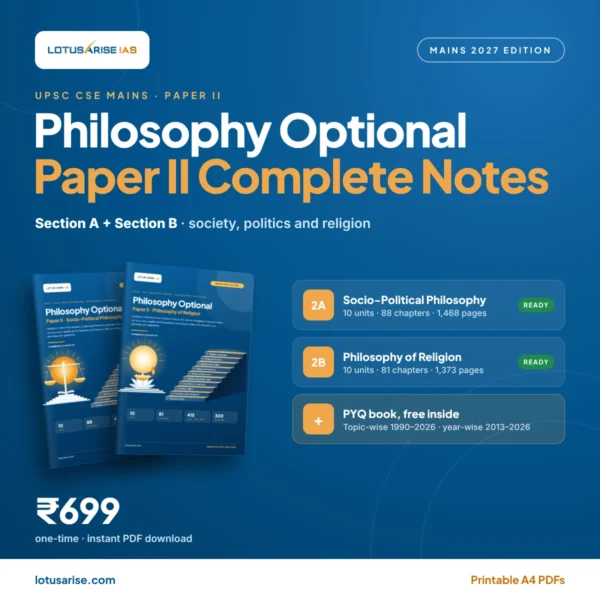
Save more: both Paper I sections plus the Philosophy PYQ book come together as Philosophy Optional Paper I Complete Notes for ₹699, or get all four sections in Philosophy Optional Complete Notes for ₹1,180.
Features:
- Comprehensive Coverage
- Complete Syllabus
- Suitable for: UPSC & State PSCs exams
- Format: Digital PDF (Downloadable)
- 337,362+ aspirants visit every month
The problem most aspirants don’t talk about
Ask a Philosophy aspirant what worries them about Paper I, Section A. It is rarely the length. It is usually one of these three things:
“I understood Kant in the lecture. A week later I can’t explain the synthetic a priori in my own words.”
“I can summarise Descartes, Spinoza and Leibniz one by one. When the question asks me to compare their views of substance, I have nothing.”
“Wittgenstein, logical positivism, Husserl and Heidegger feel like four different subjects, and I never know how much to write on each.”
None of these is a discipline problem. They are material problems. Philosophy is not memorised. It is argued, and most notes give you conclusions without the argument, the objection and the reply.
Why this section matters
Section A carries a quarter of the optional’s marks, and it is the section where a summary and an argument look most different on the page. It rewards conceptual precision: what Descartes means by clear and distinct ideas, why Hume denies a necessary connection, how Kant’s categories answer him. Its thinkers also return in Paper II, from the proofs for God to the soul and religious language, so a firm Section A makes the second paper easier.
What’s inside: 1,244 pages, 66 chapters, 11 units
- Plato and Aristotle (5 chapters)
- Rationalism (Descartes, Spinoza, Leibniz) (8 chapters)
- Empiricism (Locke, Berkeley, Hume) (9 chapters)
- Kant (7 chapters)
- Hegel (4 chapters)
- Moore, Russell and Early Wittgenstein (8 chapters)
- Logical Positivism (4 chapters)
- Later Wittgenstein (4 chapters)
- Phenomenology (Husserl) (4 chapters)
- Existentialism (Kierkegaard, Sartre, Heidegger) (8 chapters)
- Quine and Strawson (5 chapters)
What every chapter gives you
- Thinker by thinker in UPSC syllabus order, from the Forms to the analytic–synthetic debate
- Every major argument with its objection and reply: the cogito, Hume’s fork, the synthetic a priori, the picture theory
- Indian connects beside the Western positions: Kant with Śaṅkara, Hume with the Buddhists, Spinoza with Advaita
- Plain words first, then the argument, the objection and the reply, which is the dialectic examiners reward
- Colour-coded boxes: “In simple words”, “Indian connect”, “Common confusion” and “Criticism vs defence”, plus a key idea in every section
- 242 diagrams drawn for print and previous year questions after every chapter
Please note: this pack covers Paper I, Section A only. Section B of Paper I and the Philosophy PYQ book come with it in Philosophy Optional Paper I Complete Notes (₹699), or take all four sections in Philosophy Optional Complete Notes (₹1,180).
The price
₹472, one-time. That buys 1,244 pages across 66 chapters.
There is no subscription and no recurring charge. The download link reaches your email as soon as payment clears. If it is not in your inbox within a few minutes, check the spam folder.
Read before you buy: the free sample has the full contents and the complete first chapter of this section.
Questions before or after buying: support@lotusarise.com