Sociology Optional Notes Paper 1 PDF | Complete Syllabus
Original price was: ₹590.00.₹354.00Current price is: ₹354.00.
Most Sociology Optional aspirants prepare Paper 1 the wrong way — reading Marx, Weber and Durkheim as three separate biographies, then writing answers that summarise them instead of applying them. No critics named. No Indian example. No idea why a confidently-written answer came back with 9 out of 20.
Sociology Optional Notes {Paper-1} fixes this.
📚 All 10 Paper 1 units — 716 pages — from Sociology: The Discipline to Social Change in Modern Society, with nothing left to source elsewhere
🧠 107 pages on the six core thinkers — Marx, Durkheim, Weber, Parsons, Merton and Mead, each with the critiques examiners look for
🔬 Research methods in full — positivism and its critique, non-positivist methodologies, fact-value-objectivity, sampling, reliability, validity
✍️ Written for answer writing, not reading — concepts framed the way a 10-mark and a 20-mark answer need them
📱 Instant PDF download — laptop, mobile or tablet, offline, printable for handwritten practice
📥 Permanent download — yours to keep. No expiry, no batch date, no renewal.
One-time payment. No subscription. Instant access after purchase.
View Sample PDF
⭐⭐⭐⭐⭐ Trusted by 300,000+ UPSC aspirants monthly on LotusArise IAS
Features:
- Comprehensive Coverage
- Complete Syllabus
- Suitable for: UPSC & State PSCs exams
- Format: Digital PDF (Downloadable)
- 337,362+ aspirants visit every month
The problem most Sociology aspirants don’t talk about
Ask any Sociology Optional aspirant six months in what their biggest problem is. They won’t say the syllabus is too long — Paper 1 is famously short. They will say one of three things:
“I’ve read Marx, Durkheim and Weber four times each and I still can’t tell you what a sociological answer looks like as opposed to a summary.”
“My notes come from three coaching PDFs and a YouTube playlist, and when two of them contradict each other on positivism I have no idea which one UPSC wants.”
“I know the theory. But in the exam hall I write the theory and nothing else — no critique, no Indian example, no application. And that is exactly where the marks are.”
These are not personal failings. Most aspirants have the content. What is missing is one integrated, exam-facing treatment of the whole paper — where the thinker, the critique of the thinker and the application sit on the same page instead of across three sources.
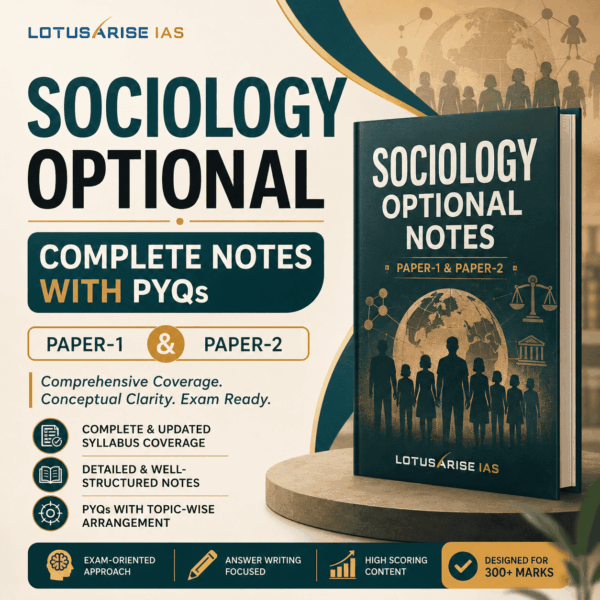
That is what Sociology Optional Notes {Paper-1} is: 716 pages covering the entire Paper 1 syllabus in one file.
Why Paper 1 is where the optional is won
Paper 1 carries 250 marks. Unlike Paper 2, it is not a body of Indian facts you can accumulate — it is a conceptual apparatus, and the same apparatus is what makes Paper 2 answers good. A candidate who genuinely understands Weber’s rationality writes a better answer on Indian bureaucracy in Paper 2 than one who has memorised the Indian bureaucracy chapter alone.
The return does not stop at the optional. Stratification, kinship, social movements, secularisation, development and dependency, education as an agent of change — these are GS Paper 1 and GS Paper 2 content, and in the Essay a candidate who can name a mechanism rather than gesture at a sentiment stands out immediately.
So the difficulty was never that Sociology is hard. It is that most aspirants prepare Paper 1 as a reading list rather than as a system of concepts they can deploy under time pressure.
What’s inside
📖 Unit 1–3: Foundations and Method — Pages 4–112
- Modernity and social changes in Europe, and the emergence of sociology — the triple revolution, the Commercial and Scientific Revolutions, the Enlightenment, and sociology’s often-overlooked debt to the conservative reaction
- Scope of the subject and comparison with other social sciences
- Sociology and common sense knowledge
- Science, scientific method and its critique; major theoretical strands in research methodology
- Positivism and its critique; fact, value and objectivity; non-positivist methodologies
- Qualitative and quantitative methods; techniques of data collection; variables, sampling, hypothesis, reliability and validity
🧠 Unit 4: Sociological Thinkers — Pages 113–219
107 pages on the six thinkers UPSC returns to every single year: Karl Marx (1818–1883), Emile Durkheim, Max Weber (1864–1920), Talcott Parsons (social system, pattern variables), Robert K. Merton, and G. H. Mead (self and identity).
What makes this different from a downloaded PDF: each thinker comes with the scholarship around them, not just their own propositions. Nisbet’s unit ideas alongside Comte. Irving Zeitlin’s systematisation of the conservative reaction. Michael Anderson’s Preston study and Peter Laslett’s Cambridge Group work qualifying the extended-to-nuclear family story that most notes still repeat as literal fact. That layer of qualification and counter-evidence is the difference between an answer that is correct and an answer that is marked as informed.
📊 Unit 5–7: Structure, Work and Power — Pages 220–481
- Stratification and mobility: equality, inequality, hierarchy, exclusion, poverty and deprivation; theories of stratification; class, status groups, gender, ethnicity and race; open and closed systems, types, sources and causes of mobility
- Works and economic life: social organisation of work across society types; formal and informal organisation of work; labour and society
- Politics and society: sociological theories of power; power elite, bureaucracy, pressure groups and political parties; nation, state, citizenship, democracy, civil society, ideology; protest, agitation, social movements, collective action and revolution
🕊️ Unit 8–10: Religion, Kinship and Social Change — Pages 482–716
- Religion and society: sociological theories of religion; animism, monism, pluralism, sects, cults; religion and science, secularisation, religious revivalism, fundamentalism
- Systems of kinship: family, household and marriage; types and forms of family; lineage and descent; patriarchy and the sexual division of labour; contemporary trends
- Social change in modern society: theories of social change; development and dependency; agents of social change; education and social change; science, technology and social change
Every unit of the Paper 1 syllabus is covered. There is no thirteenth chapter you have to go and find somewhere else.
The aspirant who buys this
The first-timer choosing Sociology — wants one trusted, complete source from Day 1 instead of assembling a Paper 1 corpus from four coaching sets and discovering the gaps in March.
The repeater whose optional score sat in the 230–260 band — the content is already there. What is missing is the critique layer and the application layer, and that is precisely where this material is denser than standard notes.
The aspirant with a different optional — takes Sociology for nothing, but stratification, kinship, social movements and secularisation are GS Paper 1 and GS Paper 2 content regardless. At this price it is a GS purchase that happens to be an optional resource.
The self-study aspirant outside Delhi, Prayagraj or Jaipur — not paying ₹15,000–₹54,000 for optional coaching and not planning to. Needs the material that coaching’s notes are, without the classroom.
The working professional — no batch dates, no live schedule to keep. A permanent download that opens on a phone during a commute and prints for weekend answer practice.
Why not just use free notes from Telegram?
Free Sociology notes exist. They are widely shared, and some of them are genuinely good. Most aspirants already have gigabytes of them and have systematically read very little of it.
The difference is not the content. It is that a folder of scattered PDFs has no single treatment of a topic — Durkheim from one source, the critique of Durkheim from another using different terminology, the application from nowhere at all. No consistent depth, and no way to know when a topic is finished.
If you have the discipline to build your own integrated Paper 1 system out of scattered sources, you may not need this. If you would rather open one file and start, that is what these notes are for.
The price
Optional coaching costs ₹15,000–₹54,000 in Delhi, Prayagraj and Jaipur.
716 pages at ₹354 works out to under 50 paise per page.
Regular price ₹590 · Launch offer: ₹354
One-time payment. No subscription. No recurring charge. Permanent download — yours to keep.
Instant PDF access after payment. If the email does not arrive within a few minutes, check your spam folder.
📘 Paper 2 notes are sold separately. Take both for the complete optional.
For support: support@lotusarise.com
Related products
-

Sociology Optional Notes Paper 2 PDF | Complete Syllabus
Original price was: ₹590.00.₹354.00Current price is: ₹354.00. -
-
#OFFER: Sociology Optional Master Blueprint: Complete Updated Notes (Paper 1 & 2) + Topic-wise PYQs Bundle
Original price was: ₹765.00.₹500.00Current price is: ₹500.00. -