

Philosophy Optional Paper I Complete Notes: Western Philosophy + Indian Philosophy by LotusArise IAS
₹699.00
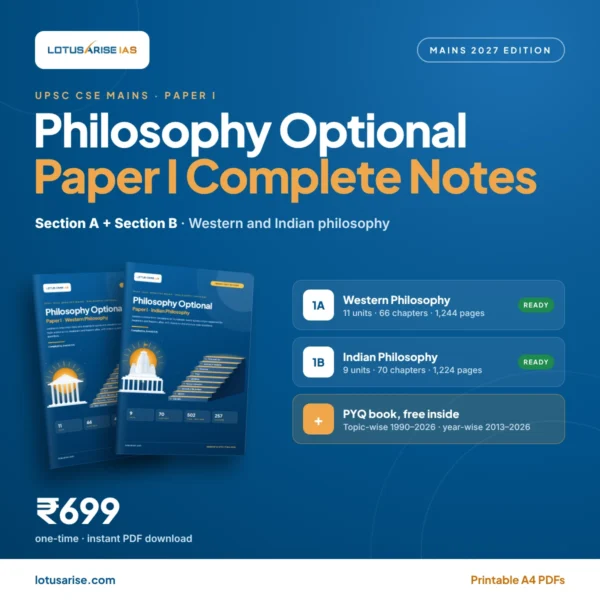
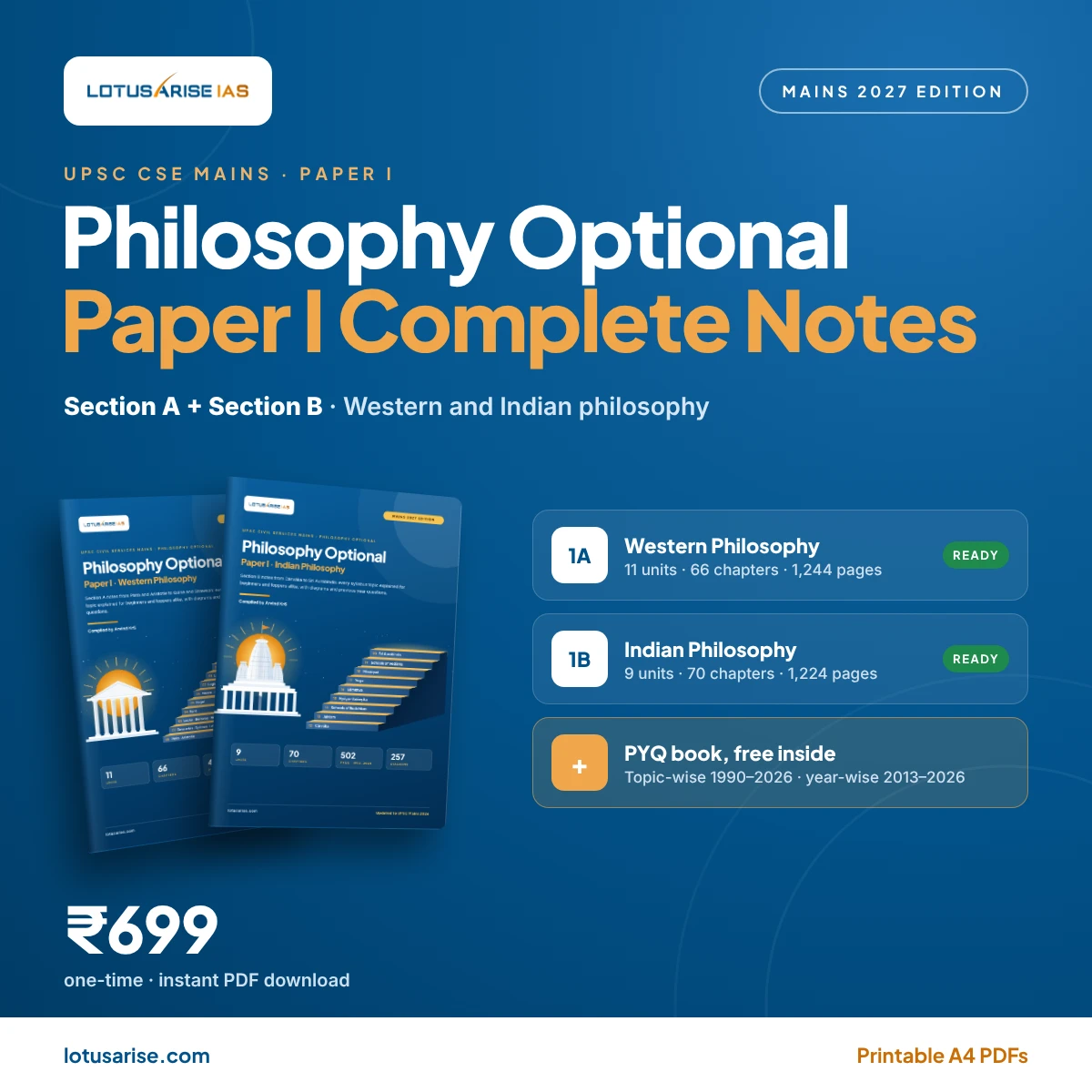
₹699 for the whole of Philosophy Paper I: Western and Indian philosophy, one-time payment. Bought section by section, the same notes cost ₹944.
Paper I is where most Philosophy aspirants lose the thread. Kant is understood in the lecture and forgotten a week later; the Indian schools become lists of Sanskrit terms that cannot be argued for or against. The paper then asks you to compare Hume with the Buddhists, or Kant with Śaṅkara, and the two halves of your notes have never met.
Philosophy Optional Paper I Complete Notes covers both sections in one voice, in syllabus order, from plain words to 300-mark depth.
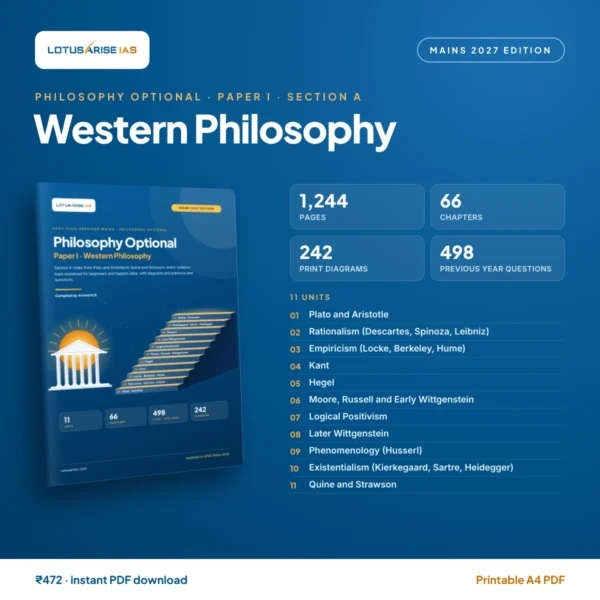
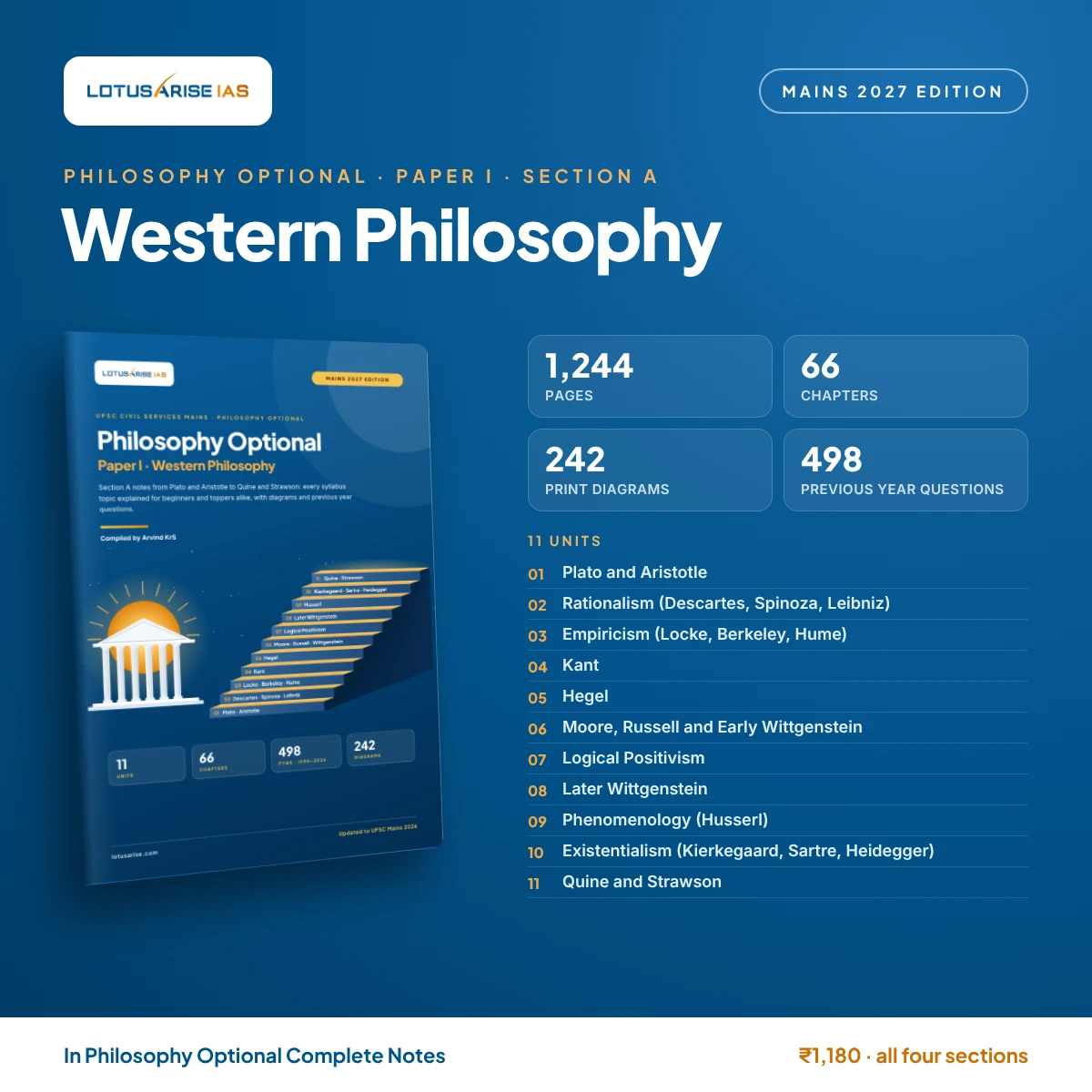
📘 Section A: Western Philosophy, 1,244 pages. Plato and Aristotle to Quine and Strawson in 66 chapters.
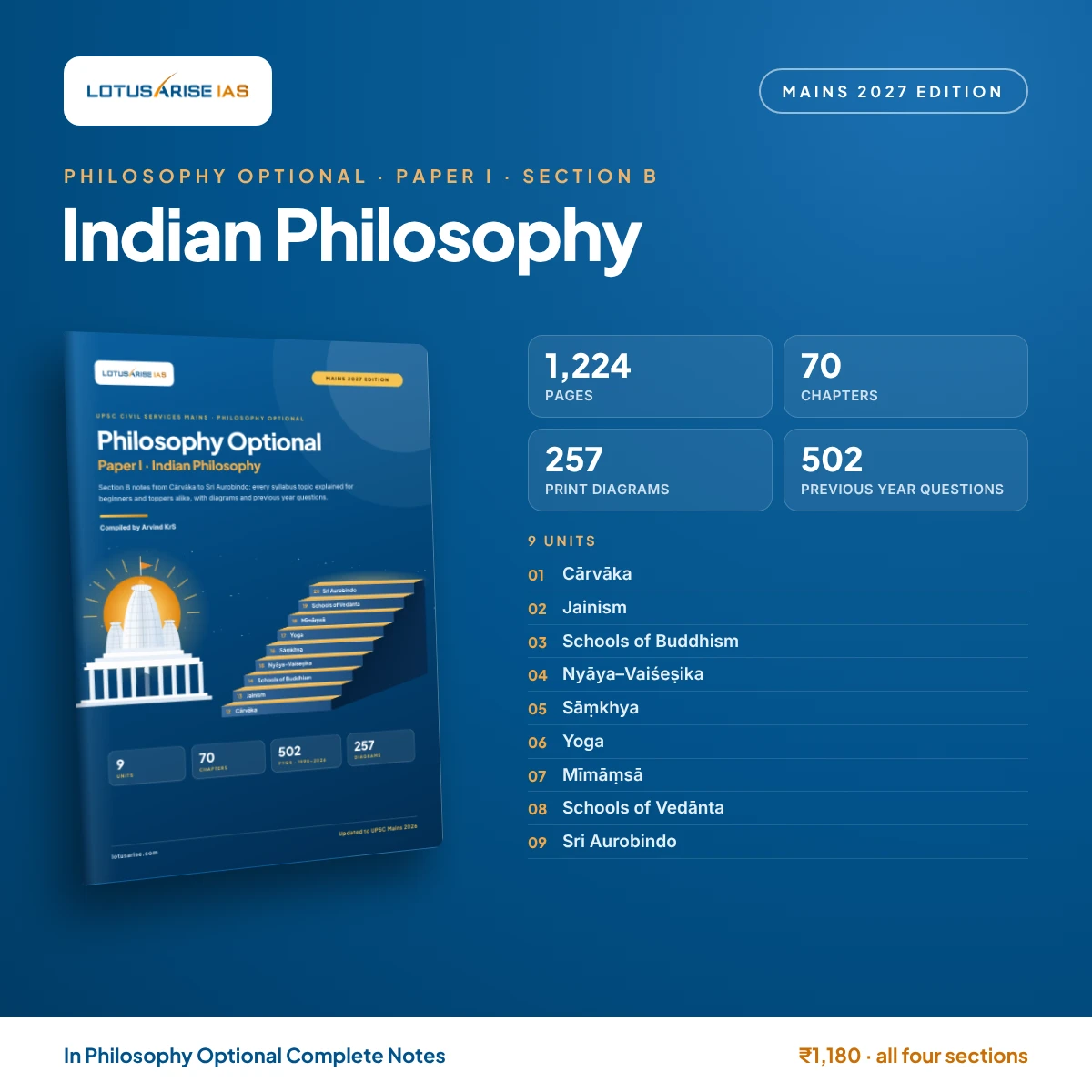
🪷 Section B: Indian Philosophy, 1,224 pages. Cārvāka to Sri Aurobindo in 70 chapters.
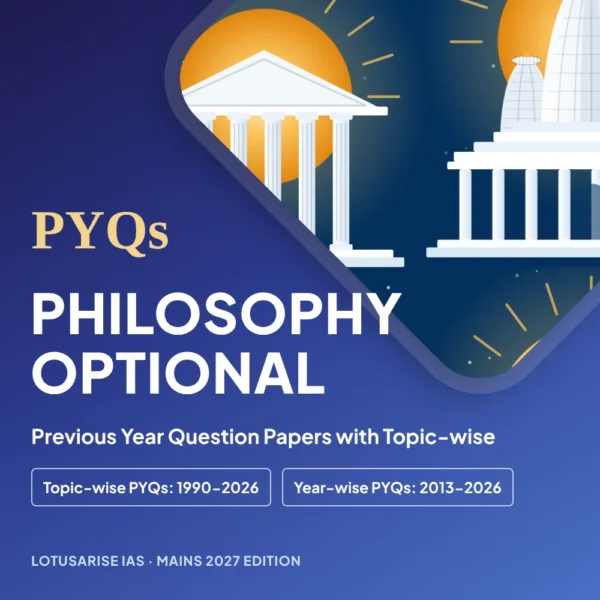
🎁 Philosophy PYQ book, free inside. 1,338 questions topic-wise from 1990 to 2026, every full paper from 2013 to 2026, and ten-year pattern charts.
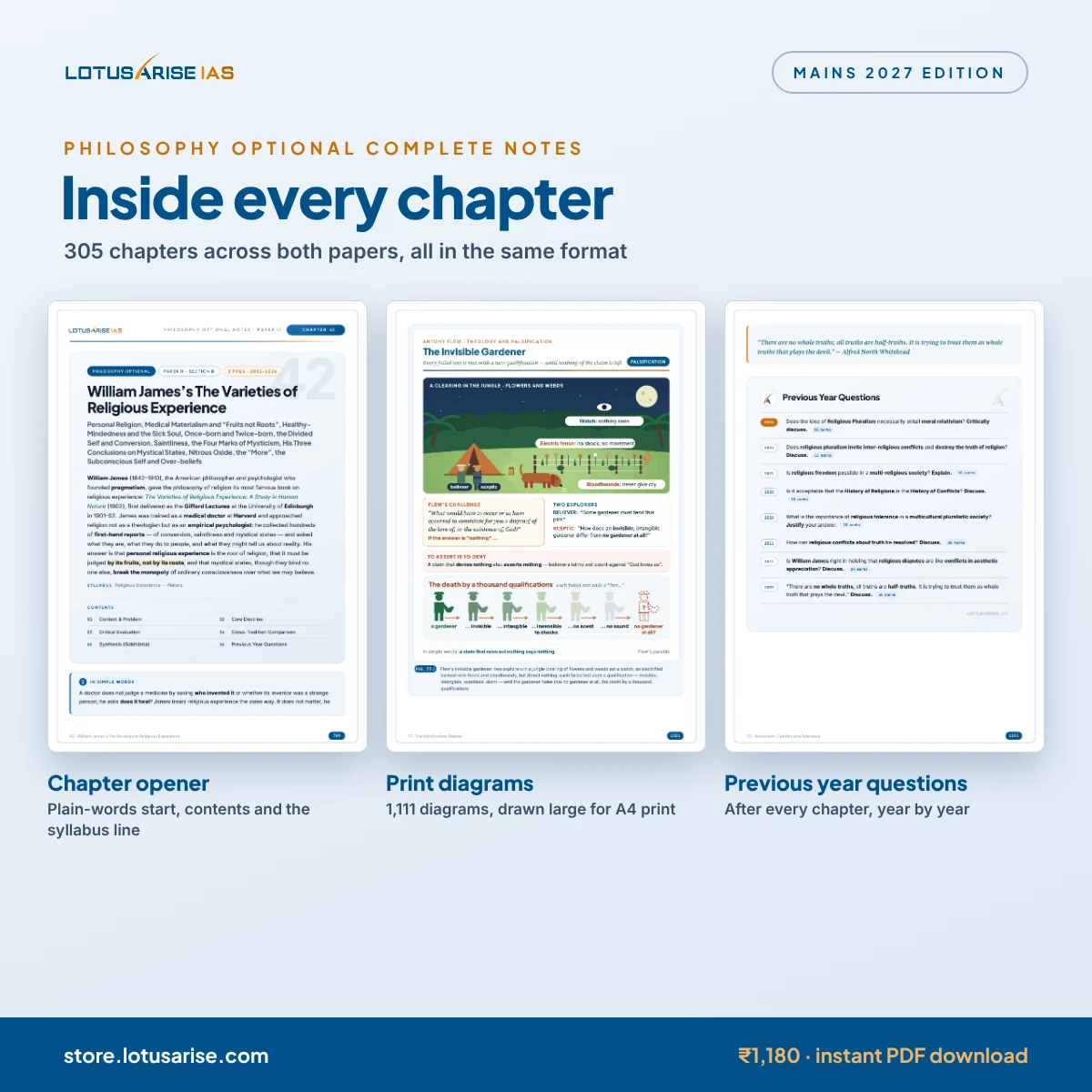
📝 Previous year questions after every chapter, and 499 diagrams drawn for print.
One-time payment with no subscription. Printable A4 PDFs that work offline on any device. The download links are emailed the moment payment clears; check your spam folder if they are not in the inbox.
⭐ Trusted by the 300,000+ UPSC aspirants who read LotusArise IAS every month
Sample: Section ASample: Section B
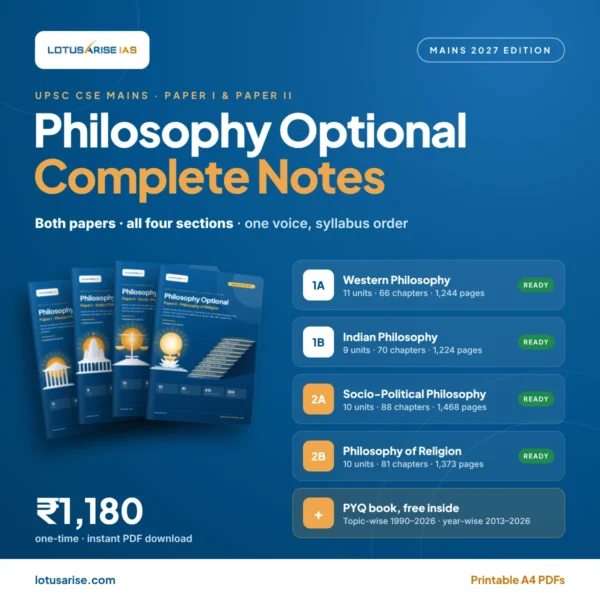
Need Paper II as well? All four sections come together in Philosophy Optional Complete Notes for ₹1,180.
Features:
- Comprehensive Coverage
- Complete Syllabus
- Suitable for: UPSC & State PSCs exams
- Format: Digital PDF (Downloadable)
- 337,362+ aspirants visit every month
The problem most Philosophy aspirants don’t talk about
Ask a Philosophy aspirant who is a year into preparation what is going wrong. Most will not say the syllabus is too long. They will say one of these three things:
“I understood Kant in the lecture. A week later I can’t explain the synthetic a priori in my own words.”
“My Indian philosophy notes are a list of Sanskrit terms. I know what Satkaryavada means, but I can’t argue for it or against it.”
“I finished Paper I properly. Paper II is a few photocopies and whatever I read in the newspaper.”
None of these is a discipline problem. They are material problems. Philosophy is not memorised. It is argued, and most notes give you conclusions without the argument, the objection and the reply.
Why the whole syllabus, in one place, matters
Philosophy carries 500 marks: two papers of 250 marks each, and each paper has two sections. A weak section is not a small gap. It is a quarter of the optional you walk into the hall unsure about.
The sections also lean on each other. The Nyaya and Kantian treatments of the proofs for God in Paper I are the proofs and critiques of Paper II. The Buddhist doctrine of no-self in Paper I is the soul, rebirth and liberation of Paper II. Gandhi and Ambedkar on caste, Sankara on Brahman, and Hume on the self all return across both papers. Answers that make these links show the examiner that you understand the subject.
The benefit goes beyond the optional. Ethics, justice, liberty, secularism and the philosophy of religion feed straight into GS Paper IV and the Essay paper.
What’s inside: 2,468 pages, 136 chapters
📘 Paper I, Section A: Western Philosophy, 1,244 pages
- Plato and Aristotle: Forms, substance, form and matter, causation, actuality and potentiality
- The rationalists and empiricists: Descartes, Spinoza and Leibniz; Locke, Berkeley and Hume
- Kant: the synthetic a priori, space and time, the categories, the ideas of reason, the antinomies and the critique of the proofs for God
- Hegel; Moore, Russell and the early Wittgenstein; logical positivism; the later Wittgenstein
- Husserl’s phenomenology; Kierkegaard, Sartre and Heidegger; Quine and Strawson
🪷 Paper I, Section B: Indian Philosophy, 1,224 pages
- Carvaka: theory of knowledge and the rejection of transcendent entities
- Jainism: theory of reality, Saptabhanginaya, bondage and liberation
- Schools of Buddhism: Pratityasamutpada, Ksanikavada and Nairatmyavada
- Nyaya-Vaisesika: categories, pramanas, self and liberation, God, causation and atomism
- Samkhya, Yoga and Mimamsa; the schools of Vedanta; Sri Aurobindo
🎁 Philosophy PYQ book, included free
Sold on its own as Philosophy Optional Question Papers with Topic-wise for ₹59; here it comes free in the same download.
The book holds 1,338 previous year questions sorted into the 40 syllabus units, from 1990 to 2026 and newest first, with a sub-topic tag on every question. It also has every full Paper I and Paper II from 2013 to 2026 with marks, and ten years of pattern charts showing which units UPSC asks most, which are rising and how each unit is asked. In addition, every chapter of the notes ends with its own previous year questions.
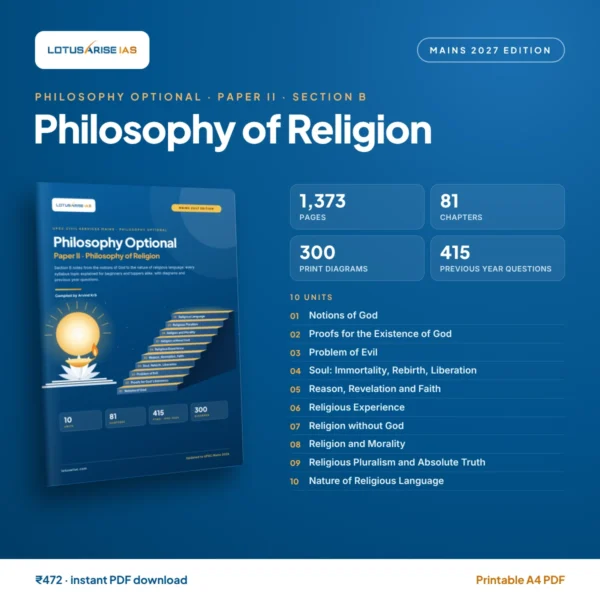
Please note: this pack covers Paper I only. Paper II, Socio-Political Philosophy and Philosophy of Religion, is sold separately as Philosophy Optional Paper II Complete Notes (₹699), or take both papers together in Philosophy Optional Complete Notes (₹1,180).
How every chapter is built
- Beginner first, topper deep. Every idea starts in plain words and builds to the argument, the objection and the reply, which is the dialectic examiners reward.
- Diagrams made for print. 499 diagrams across this paper, drawn large enough to read on a printed A4 page.
- Colour-coded boxes. “In simple words”, “Indian connect”, “Common confusion” and “Criticism vs defence” boxes, plus a key idea in every section.
- Correct terms. Sanskrit terms with proper diacritics, and Greek, Latin and German terms where the thinkers use them.
- Western and Indian side by side. Kant beside Sankara, Hume beside the Buddhists, and Spinoza beside Advaita, so that comparison questions come naturally.
Who buys this
The first-timer who has just chosen Philosophy. You want the whole optional sorted on day one, instead of discovering in month six that Paper II was never really covered.
The repeater whose optional score stalled. The marks are usually in the missing counter-argument, the section you under-prepared and the link between papers you never made.
The engineer or science graduate who picked Philosophy for its short syllabus. The notes assume no background and explain every term the first time it appears.
The self-study aspirant far from a coaching city. You get one complete set of material, printable and offline, at a price that does not decide your month.
The price
₹699, one-time. That buys both sections of Paper I, with the PYQ book included: 2,468 pages across 136 chapters.
There is no subscription and no recurring charge. The download links reach your email as soon as payment clears. If they are not in your inbox within a few minutes, check the spam folder.
Read before you buy: free samples of both sections are open to everyone, each with the full contents and a complete first chapter: Section A, Section B and the PYQ book.
Questions before or after buying: support@lotusarise.com