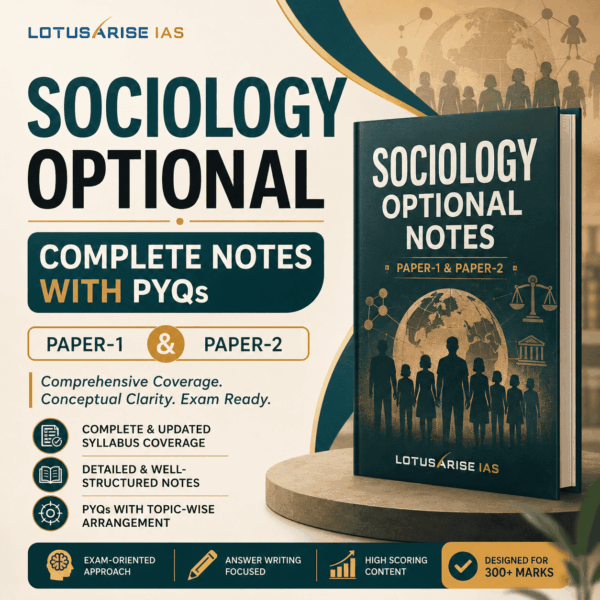
Sociology Optional Notes Paper 2 PDF | Complete Syllabus
Original price was: ₹590.00.₹354.00Current price is: ₹354.00.
Paper 2 is where Sociology aspirants quietly start writing General Studies. You describe caste conflict, dowry, urban slums — accurately, fluently — and cite nobody. No Srinivas. No Dumont. No Béteille. No Desai. The examiner reads a competent GS answer sitting in a Sociology paper, and marks it as exactly that.
Sociology Optional Paper-2 Notes fixes this.
📚 All 15 Paper 2 units — 426 pages — Perspectives on Indian Society through to Challenges of Social Transformation
📝 Verbatim PYQs at the end of every topic — real UPSC questions with their years, from the 1990s through 2025
🧠 Assessment and Critique on every thinker — Ghurye, Srinivas, Desai, Dumont, Béteille and their critics, where the marks above 12 actually sit
🇮🇳 Contemporary Relevance and Key Terms at a Glance — on every topic: the present-day hook and the revision block, already written
📱 Instant PDF download — laptop, mobile or tablet, offline, printable for handwritten practice
📥 Permanent download — yours to keep. No expiry, no batch date, no renewal.
One-time payment. No subscription. Instant access after purchase.
⭐⭐⭐⭐⭐ Trusted by 300,000+ UPSC aspirants monthly on LotusArise IAS
Features:
- Comprehensive Coverage
- Complete Syllabus
- Suitable for: UPSC & State PSCs exams
- Format: Digital PDF (Downloadable)
- 337,362+ aspirants visit every month
The problem most Paper 2 aspirants don’t talk about
Ask a Sociology Optional aspirant which paper worries them and most say Paper 1 — the thinkers, the methodology, the abstraction. Then the marks come back and Paper 2 is the one that underperformed. Ask why and you get three answers:
“I know all of this. Caste, tribes, agrarian change, women’s movements — I read about it in the newspaper every day. So my answers came out sounding like the newspaper.”
“I can name Srinivas and Ghurye, but if a question asks me to critically examine Ghurye’s Indological approach, I have the approach and none of the critique.”
“I never know when a Paper 2 topic is finished. There’s always another article, another report, another commission. So I keep reading and never consolidate.”
None of this is a discipline problem. Paper 2 punishes a structural gap: the aspirant has the empirical content and lacks the sociological apparatus — the named perspective, its critique, and the vocabulary that tells the examiner a sociologist wrote this answer rather than a well-read citizen.
Sociology Optional Paper-2 Notes is 426 pages built around closing that gap.
Why Paper 2 is the more winnable paper
Paper 1 rewards conceptual precision, and precision takes months to build. Paper 2 rewards something more tractable: knowing which perspective to bring to which Indian institution, and being able to critique it. That is learnable material, not a slowly acquired instinct — which is why Paper 2 is usually where a score moves first.
It also has the widest crossover in the optional. Caste, tribal autonomy, land reform, urbanisation and slums, secularisation, regionalism, women’s and Dalit movements, population policy, poverty — this is GS Paper 1 and GS Paper 2 content almost line for line, and Essay content of the kind that separates a structured essay from an opinionated one.
The obstacle was never that Paper 2 is hard. It is that most aspirants prepare it as current affairs with sociology sprinkled on, rather than as sociology with Indian evidence.
What’s inside
📖 Section A: Introducing Indian Society — Pages 4–52
- Perspectives on the study of Indian society: Indology (G.S. Ghurye), structural functionalism (M.N. Srinivas), Marxist sociology (A.R. Desai) — the three-lens framework nearly every Paper 2 question can be answered through
- Impact of colonial rule: the social background of Indian nationalism, modernization of Indian tradition, and protest movements and social reform in the colonial period
🏘️ Section B: Social Structure — Pages 53–221
- Rural and agrarian social structure — the idea of the Indian village and the village studies tradition; evolution of land tenure and land reforms
- Caste system — Ghurye, Srinivas, Louis Dumont and André Béteille on caste; features of the system; untouchability, its forms and its perspectives
- Tribal communities — definitional problems, geographical spread, colonial policy toward tribes, and the integration-versus-autonomy debate
- Social classes — agrarian class structure, industrial class structure, the middle classes
- Systems of kinship in India — lineage and descent, types of kinship system, family and marriage, household dimensions
- Religion and society — religious communities, problems of religious minorities, patriarchy, entitlements and the sexual division of labour
🔄 Section C: Social Changes in India — Pages 222–426
- Visions of social change — development planning and the mixed economy; Constitution, law and social change; education and social change
- Rural and agrarian transformation — rural development programmes, CDP, cooperatives, poverty alleviation; the Green Revolution; changing modes of production in Indian agriculture; rural labour, bondage and migration
- Industrialization and urbanisation — evolution of modern industry, growth of urban settlements, working-class structure and mobilization, the informal sector and child labour, slums and deprivation
- Politics and society — nation, democracy and citizenship; political parties, pressure groups, social and political elite; regionalism and decentralization; secularization
- Social movements — peasant and farmer, women’s, Backward Classes and Dalit, environmental, ethnicity and identity movements
- Population dynamics — size, growth, composition and distribution; components of growth; population policy and family planning; ageing, sex ratios, infant mortality, reproductive health
- Challenges of social transformation — crisis of development and sustainability; poverty and inequality; violence against women; caste conflicts; ethnic conflict, communalism and revivalism; illiteracy and educational disparity
📝 What every single topic ends with
This is the part that makes the notes usable as an answer-writing resource rather than a reading resource. Each topic closes with the same four blocks:
- Assessment and Critique — the named criticisms. T.K. Oommen on Srinivas’s “objective idealism”. Anand Chakravarti on his neglect of gender and Dalit mobilisation. The Ghurye–Verrier Elwin dispute over tribal assimilation versus isolation. Most notes skip this layer entirely, and it is what “critically examine” is actually asking for.
- Contemporary Relevance — the present-day application, already made. Srinivas’s dominant caste read against reservation politics; Ghurye’s cultural-versus-political nationhood read against caste-segmented online matrimony platforms.
- Key Terms at a Glance — book view and field view, Sanskritisation, positional versus structural change, orthogenetic and heterogenetic change, gotra and charana. A one-line revision block per topic.
- Previous Year Questions — verbatim UPSC questions with their years, from the 1990s through 2025, so you can see which framings repeat and how they have been worded.
The aspirant who buys this
The aspirant whose Paper 2 undershot Paper 1 — usually a critique gap, not a content gap. This material is dense precisely where standard notes thin out.
The first-timer starting Paper 2 — wants one source that follows the official syllabus in the official order, so there is a defined finish line instead of an infinite reading list.
The aspirant with a different optional — takes no Sociology, but caste, tribal policy, agrarian transformation, urbanisation, social movements and population dynamics are GS syllabus regardless.
The self-study aspirant outside Delhi, Prayagraj or Jaipur — not paying ₹15,000–₹54,000 for optional coaching, and needs coaching’s material without the classroom.
The working professional — no batch dates, no live schedule. A permanent download that opens on a phone at night and prints for weekend answer practice.
Why not just use free notes from Telegram?
Free Paper 2 notes exist, and they are widely shared. Most aspirants already have several sets and have systematically finished none of them.
The difference is not the content. Indian society is exhaustively documented and freely available — that is precisely the problem. A folder of scattered PDFs gives you the description of caste without Dumont’s argument about it, the argument without its critics, and the critics without the question actually asked in 2022. Nothing tells you when a topic is done.
If you would rather assemble that yourself from scattered sources, you can. If you would rather open one file that already follows the syllabus and ends every topic with the critique, the current-day hook and the real questions, that is what these notes are.
The price
Optional coaching costs ₹15,000–₹54,000 in Delhi, Prayagraj and Jaipur.
426 pages across all 15 syllabus units at ₹354 works out to roughly ₹24 per syllabus unit.
Regular price ₹590 · Launch offer: ₹354
One-time payment. No subscription. No recurring charge. Permanent download — yours to keep.
Instant PDF access after payment. If the email does not arrive within a few minutes, check your spam folder.
📘 Paper 1 notes are sold separately — 716 pages. Both papers together come to ₹708 for 1,142 pages, which is the complete optional.
For support: support@lotusarise.com
Related products
-

#OFFER: Sociology Optional Master Blueprint: Complete Updated Notes (Paper 1 & 2) + Topic-wise PYQs Bundle
Original price was: ₹765.00.₹500.00Current price is: ₹500.00. -
-
Sociology Optional Notes Paper 1 PDF | Complete Syllabus
Original price was: ₹590.00.₹354.00Current price is: ₹354.00. -