

Complete Indian History Notes for GS Prelims and Mains: 6-Book Bundle with Art & Culture (2027 Edition) by LotusArise IAS
Original price was: ₹1,999.00.₹799.00Current price is: ₹799.00.
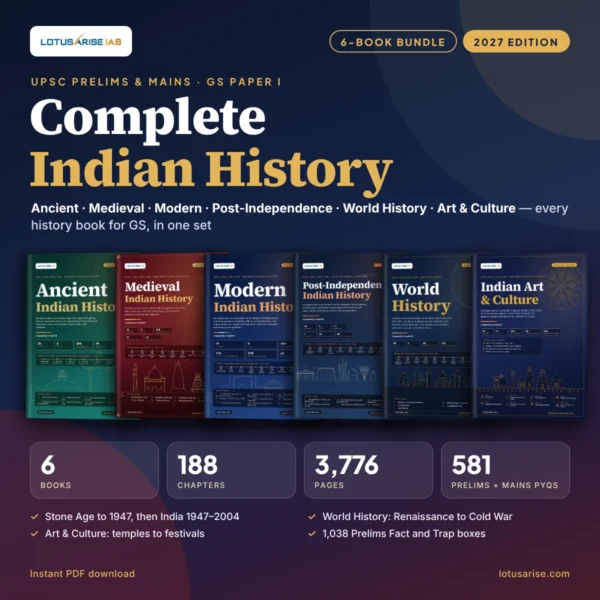
₹799 for all six books, 2027 Edition. MRP ₹1,999 — ₹1,360 if bought separately. 3,776 pages, about 21 paise a page.
Most aspirants prepare GS history from five or six sources, one per period, each in a different style. Harappa from one PDF, the Sultanate from another, the national movement from a coaching handout, Art and Culture left for the last month. Nothing joins them, and nothing tells you which questions UPSC has already asked from which chapter.
Complete Indian History Notes for GS Prelims and Mains puts the whole of GS history in one six-book set.
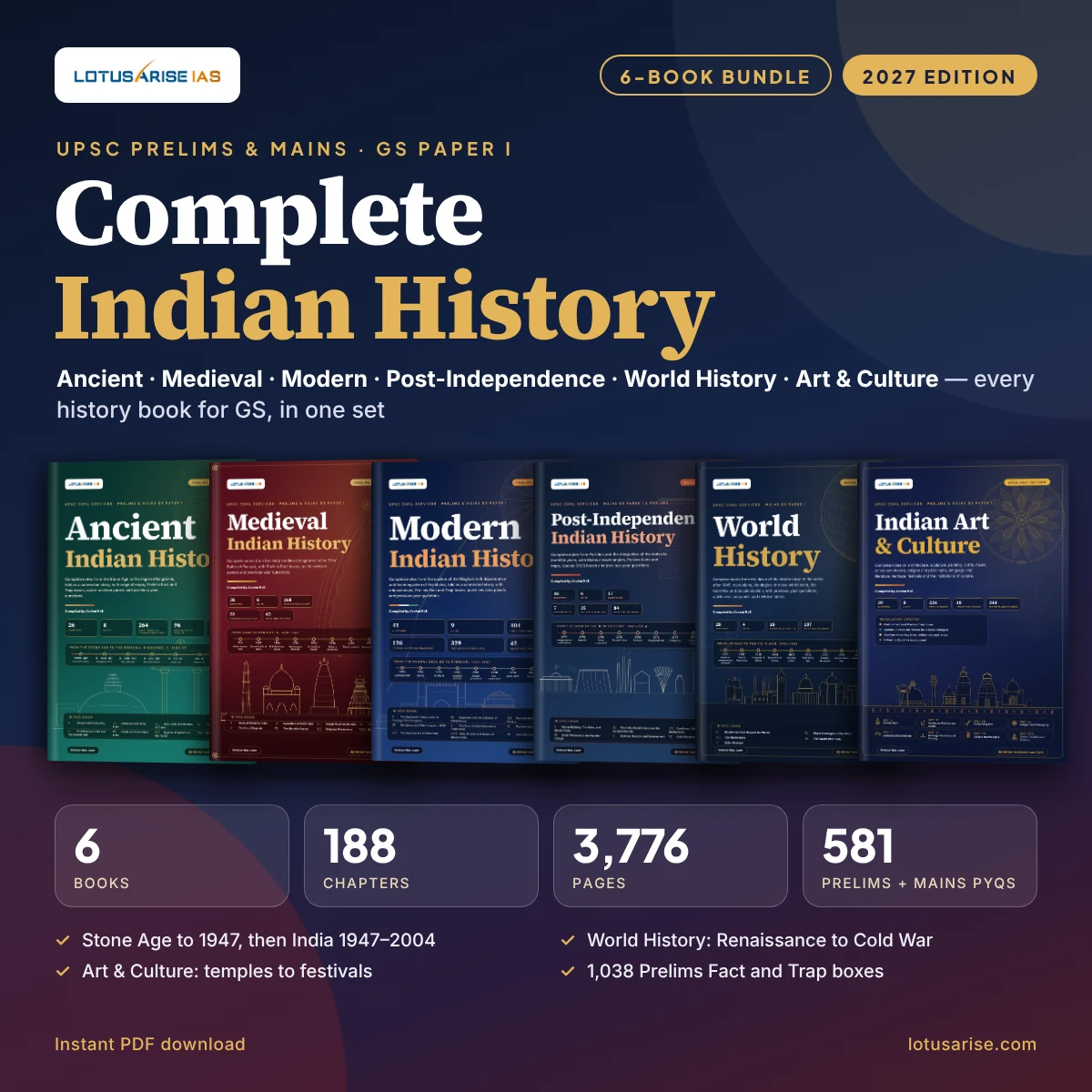
📚 6 books, 188 chapters, 3,776 pages — Ancient, Medieval, Modern, Post-Independence, World History and Art & Culture
📝 581 PYQs — 483 Prelims questions (1995–2026) with answers and 98 Mains questions, each under the chapter it comes from
🎯 1,038 Prelims Fact and Trap boxes — the names, dates, sites and look-alike pairs that options are built from
🗺️ 800+ maps, diagrams, pictures and archival photo cards — sites, routes, campaigns and monuments you can see, not just read
📱 Instant PDF download — all six books, laptop, mobile or tablet, offline, printable
One-time payment. No subscription. Unlimited downloads — the links do not expire.
Free samples: AncientMedievalModernPost-IndependenceWorld HistoryArt & Culture
⭐ Read by 300,000+ UPSC aspirants every month on LotusArise IAS
Features:
- Comprehensive Coverage
- Complete Syllabus
- Suitable for: UPSC & State PSCs exams
- Format: Digital PDF (Downloadable)
- 337,362+ aspirants visit every month
The problem nobody admits about GS history
Ask an aspirant how much history they have finished, and the answer is rarely a number. They will say one of three things:
“I’ve read Ancient and Modern, but Medieval and Art and Culture are still in four different PDFs I never opened.”
“I know the dates. But when Prelims puts two Sultans, two temples or two Congress sessions side by side, both options look right.”
“Post-independence India and World History come last in the syllabus, so I’ve never studied them properly. And they are the ones Mains asks about.”
These are not effort problems. GS history is one long story told across six areas, and most aspirants study it from sources that were never written to work together. Complete Indian History Notes for GS Prelims and Mains is a set of six books built to fix exactly that.
Why history deserves a complete set
History is tested in both stages, and in more than one paper. The Prelims syllabus lists the History of India and the Indian National Movement, and every year’s paper also draws on culture: temples, schools of art, dances, texts and saints. Mains GS Paper I asks about Indian culture from ancient to modern times, modern Indian history from the middle of the eighteenth century, the freedom struggle, consolidation after independence, and world history from the eighteenth century. The 581 previous year questions inside these books show how wide that range is.
History also feeds the Essay, Ethics case studies and the Interview, where a well-placed example from the past is often the strongest line in an answer. The challenge is not the subject. It is coverage and connection: knowing that every period is done, in one consistent style, so that the Mauryas, the Mughals and the Moderates sit in one mental timeline instead of six separate files.
What’s inside
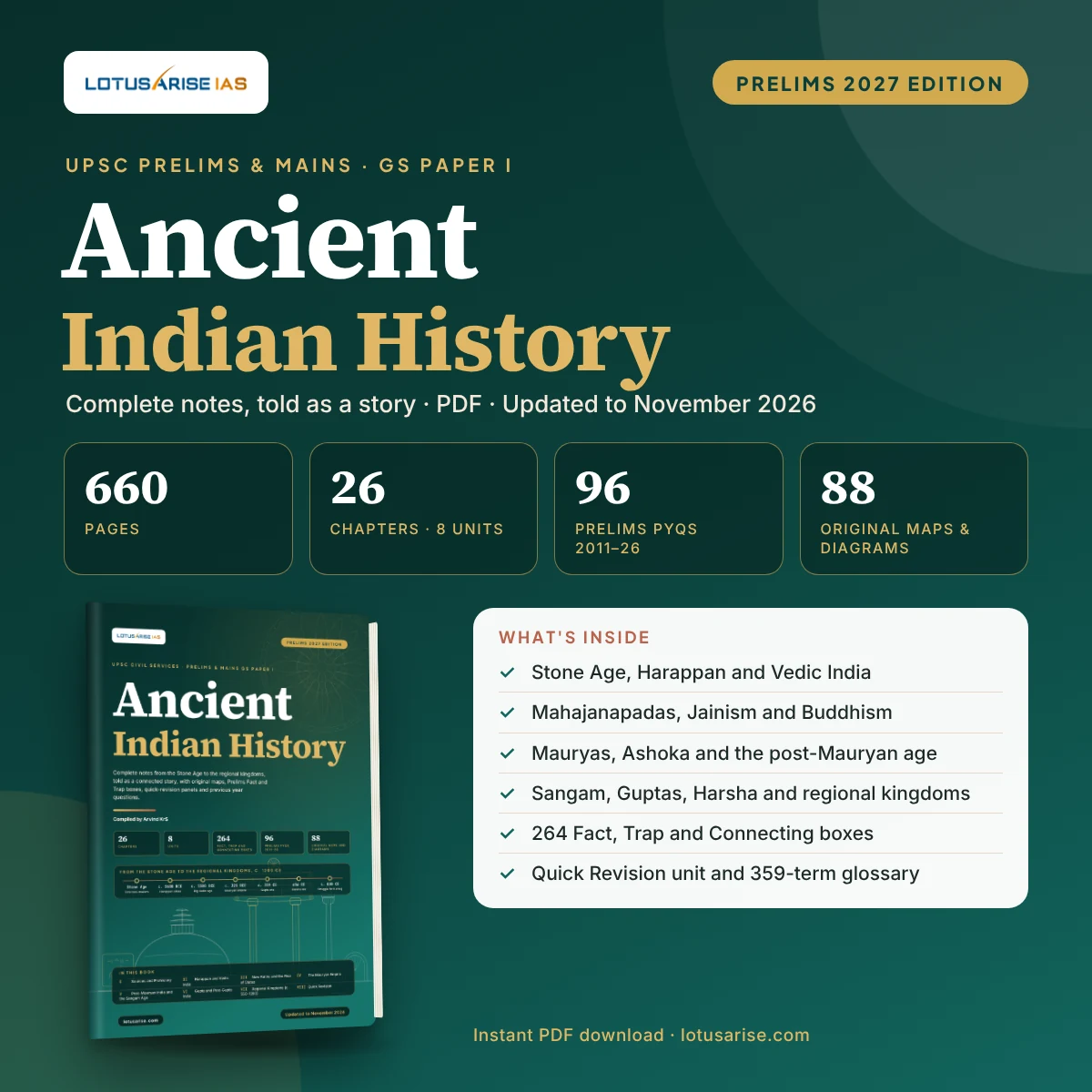
📜 Book 1 · Ancient Indian History — 26 chapters, 660 pages
From the first tool-makers and the Harappan cities to the Vedic age, the mahajanapadas, the Mauryas, the Guptas and the regional kingdoms (c. 1200 CE), told as one connected story so the facts stay tied to each other. 179 Prelims Fact and Trap boxes, 85 Connecting the Dots chains, 96 Prelims PYQs (2011–2026) with answers, 21 Mains questions and 88 original maps and diagrams.
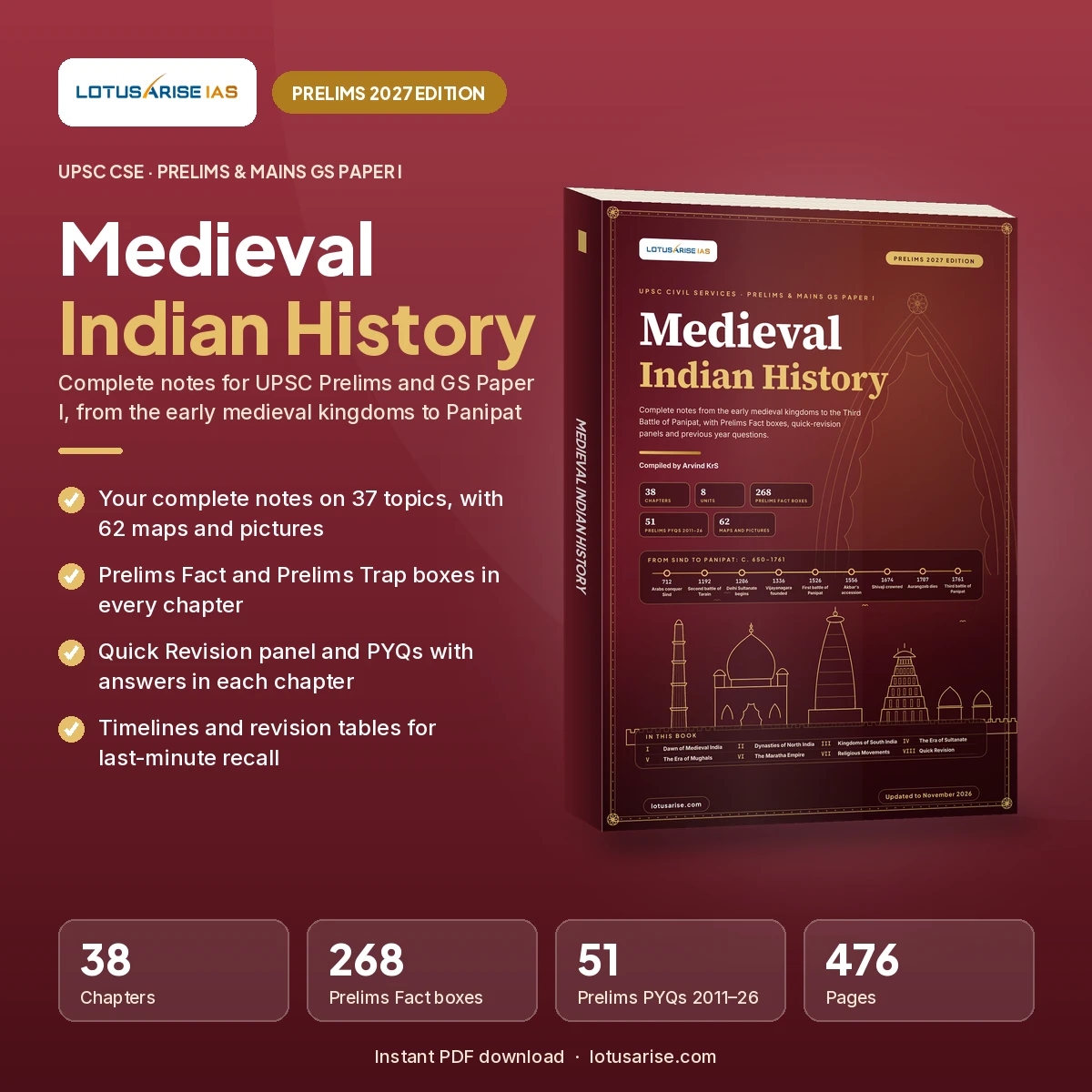
🕌 Book 2 · Medieval Indian History — 38 chapters, 476 pages
The Tripartite Struggle and the Cholas, the Delhi Sultanate, Vijayanagara, the Mughals and the Marathas, and the Bhakti, Sufi and Sikh movements. 268 Prelims Fact and Trap boxes, every medieval Prelims question from 2011 to 2026 (51 in all), a Quick Revision panel in every chapter and 444 rows of revision tables.
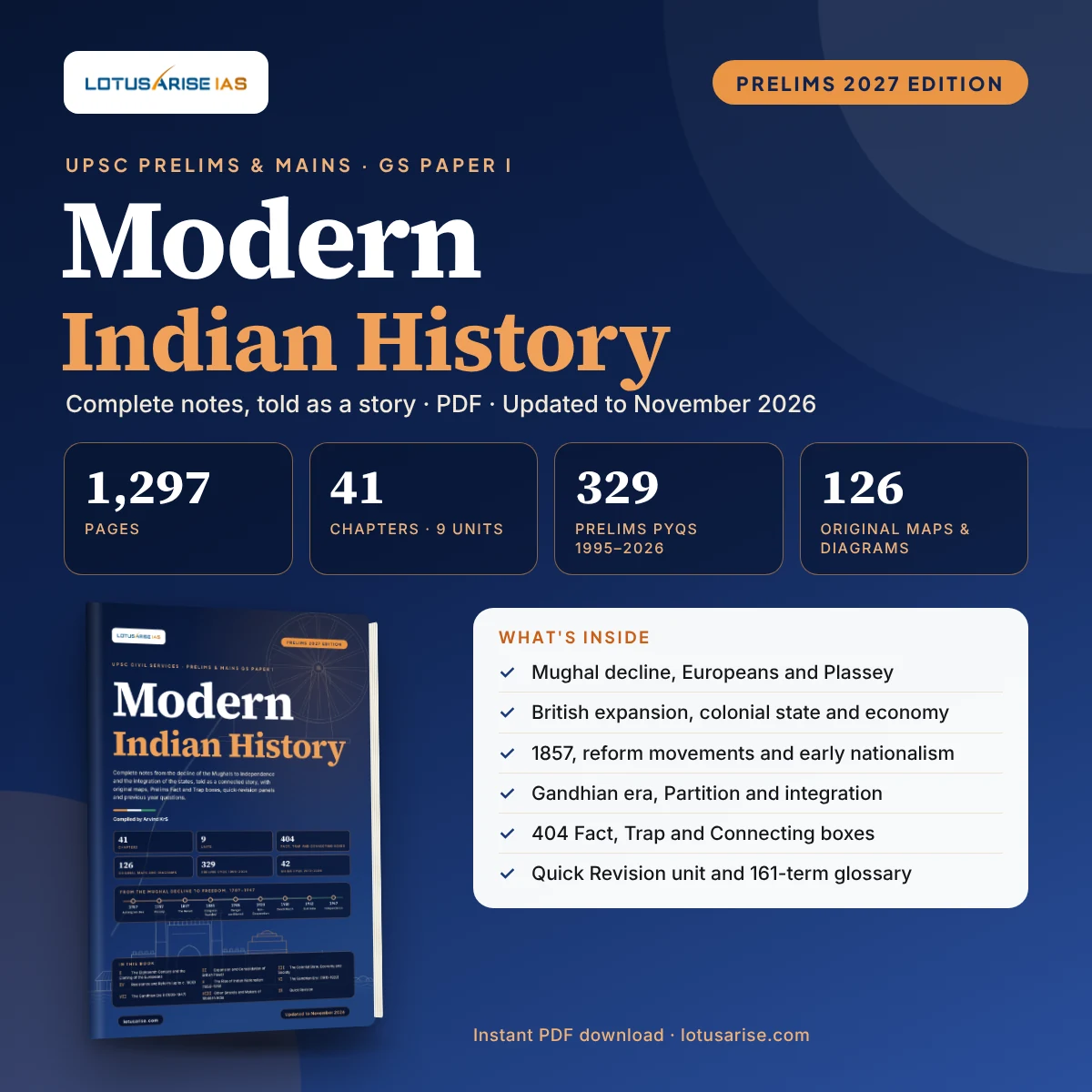
🇮🇳 Book 3 · Modern Indian History — 41 chapters, 1,297 pages
1707 to 1947 as one connected story: the Mughal decline and Plassey, the British administration and economy, 1857, the Congress, the Gandhian movements, Partition and the integration of the states. 286 Prelims Fact and Trap boxes, 118 Connecting the Dots chains, 329 Prelims PYQs (1995–2026) with answers, 42 Mains questions, 126 original maps and diagrams and 148 archival photo cards.
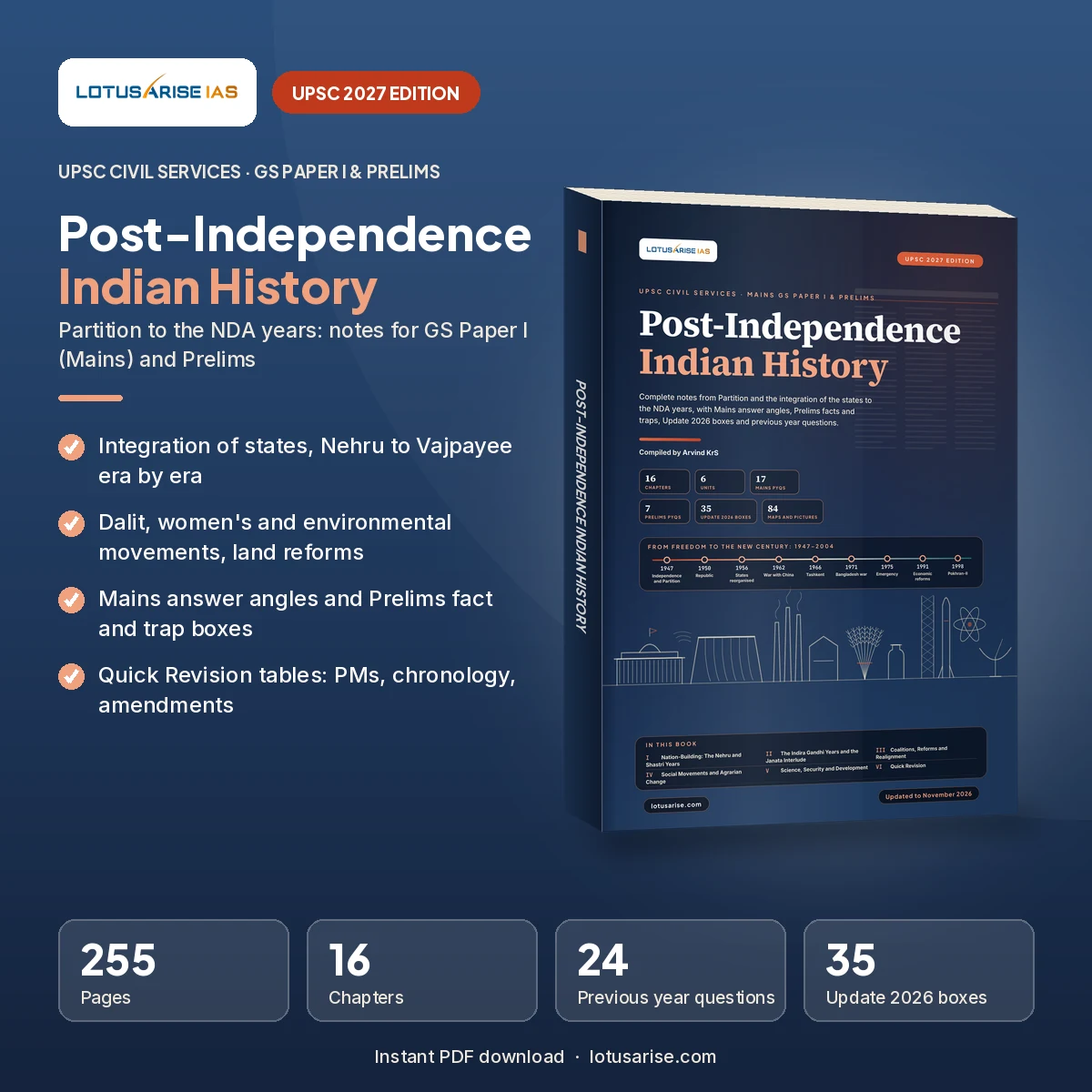
🏛️ Book 4 · Post-Independence Indian History — 16 chapters, 255 pages
1947 to 2004: Partition and the integration of the states, the reorganisation of states, the Nehru to Vajpayee years era by era, land reforms, the Dalit, women’s and environmental movements, and the nuclear programme. 17 Mains PYQs with answer approaches, 13 Mains Answer Angle boxes, 71 Prelims Fact and Trap boxes, and 35 Update 2026 boxes for what has changed since.
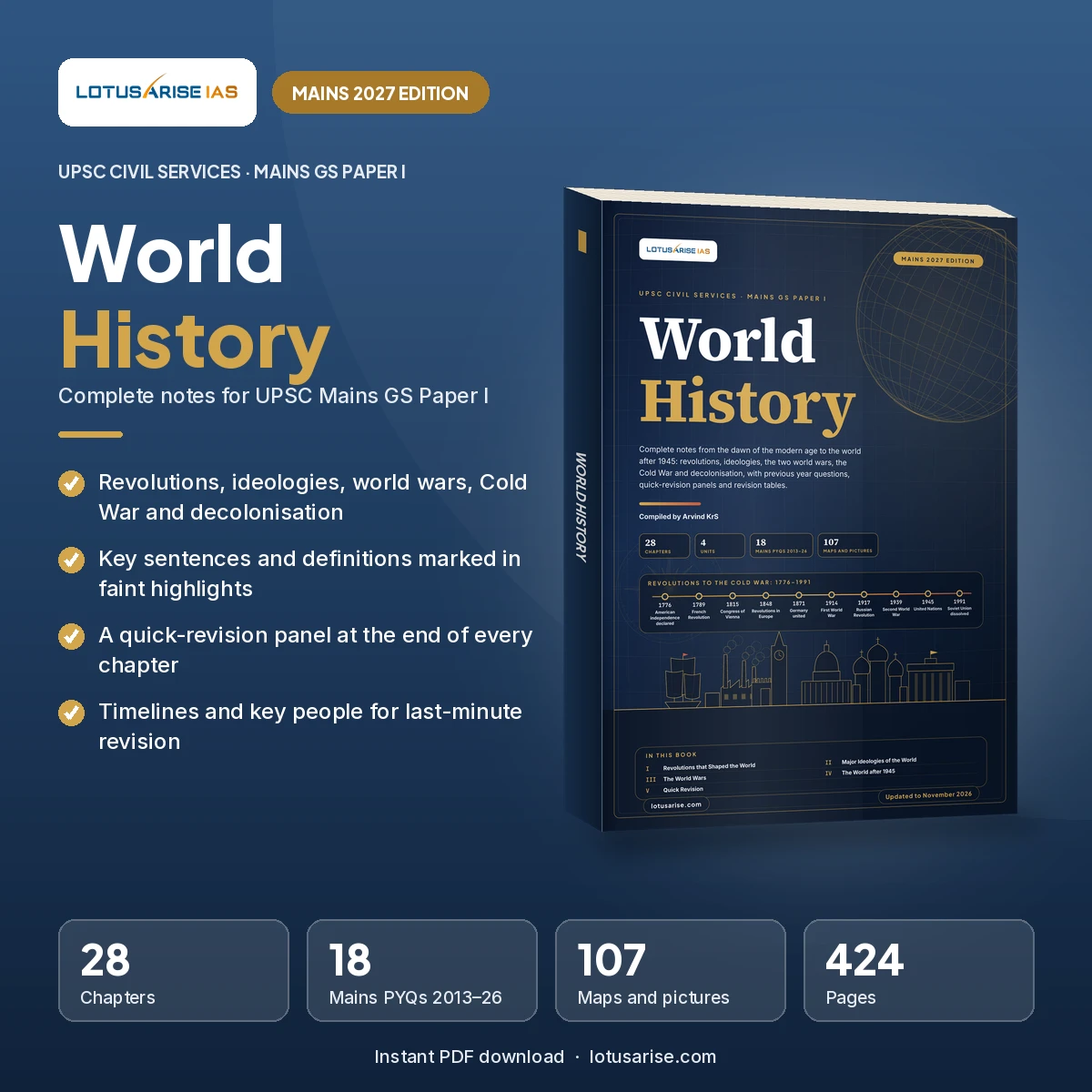
🌍 Book 5 · World History — 28 chapters, 424 pages
The Renaissance and the voyages of discovery, the American, French and Industrial Revolutions, socialism, communism and fascism, imperialism, both World Wars, the Cold War and decolonisation. 18 Mains PYQs (2013–2026) in the chapters they belong to, 107 maps and pictures, and a timelines chapter with every key date and person.
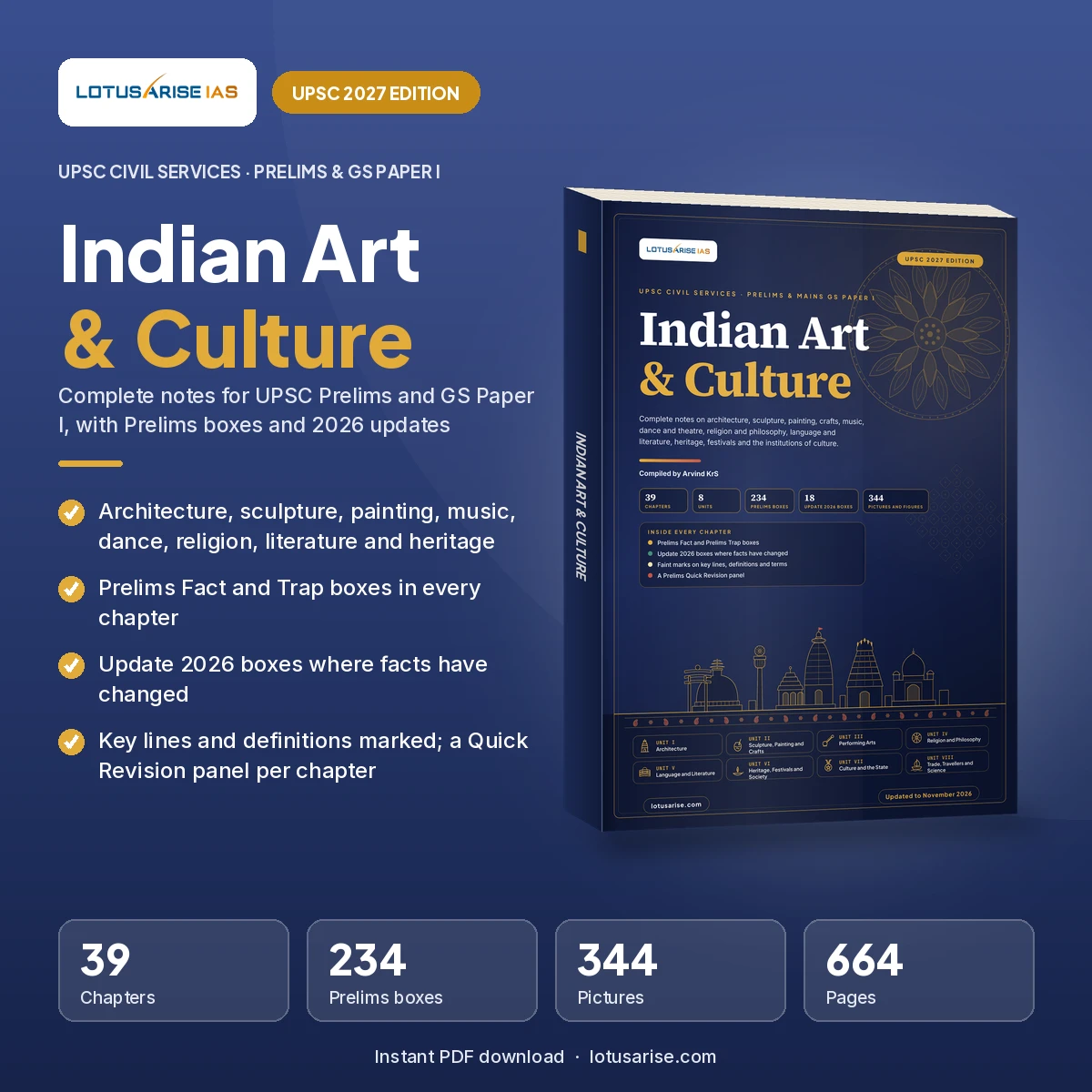
🎨 Book 6 · Indian Art & Culture — 39 chapters, 664 pages
Architecture, sculpture, painting, crafts, music, dance, theatre, religion, philosophy, languages, literature, heritage, festivals and the institutions of culture. 234 Prelims Fact and Trap boxes on the look-alike pairs UPSC loves, 18 Update 2026 boxes, and 344 pictures and figures, so you see the temple, the cave and the painting you are reading about.
What makes this different from downloaded PDFs: the six books are written as one series for the exam. Each period is taught once, in the right book, in the same layout, so the end of one book leads into the start of the next. The Prelims boxes pick out the exact facts that options are built from, the PYQs sit under the chapter that answers them, and the Post-Independence and Art & Culture books carry Update 2026 boxes wherever facts have changed.
The aspirant who buys this
First-time aspirants — you want the whole of GS history from one trusted source, in the order it should be learnt, from the first day.
Repeaters who keep losing Prelims marks to history and culture — the questions come from every period, and Art and Culture is where many aspirants drop easy marks. The chapter-wise PYQs and the Trap boxes show exactly where the marks went.
Mains aspirants preparing GS Paper I — Modern, Post-Independence and World History with Mains PYQs, answer approaches and examples that also serve the Essay.
History Optional aspirants — a compact, exam-ready revision layer for the GS side of the subject, alongside your optional notes.
Self-study aspirants outside Delhi, Prayagraj or Jaipur — no classroom, no batch timings; six PDFs on your phone that cover the whole subject.
Why not just use free notes from Telegram?
Free history notes exist in huge numbers, and most aspirants have downloaded more than they will ever read. The problem is not that they are bad. It is that they are fragments: a PDF for the Guptas, a list of Governors-General, an old file on temple architecture. They do not connect, they are rarely updated, and they do not tell you which parts of the syllabus are still missing.
This set is one connected system: 188 chapters across six books, every period covered once, current updates, and every PYQ placed where it belongs.
If you have the time and discipline to build that system yourself from scattered sources, you may not need this. If you want it already built — open the first book and start reading — this is what the set is for.
Price and delivery
Printed history guides for the same coverage usually run to several volumes and cost several times this price, and they will not carry PYQs to 2026 placed chapter by chapter.
Bought separately, the six books cost ₹236 + ₹236 + ₹299 + ₹176 + ₹177 + ₹236 = ₹1,360.
MRP ₹1,999 → bundle price ₹799 for 3,776 pages — about 21 paise a page.
Want to see them first? Download the free samples: Ancient Indian History · Medieval Indian History · Modern Indian History · Post-Independence Indian History · World History · Indian Art & Culture — each has the cover, the contents and complete sample chapters.
One-time payment. No subscription. No recurring charge.
Instant download of all six PDFs after payment. The download links are also sent to your email — please check the spam folder if they do not arrive in a few minutes. Download them again any time from My Account.
For support: support@lotusarise.com
Related products
-

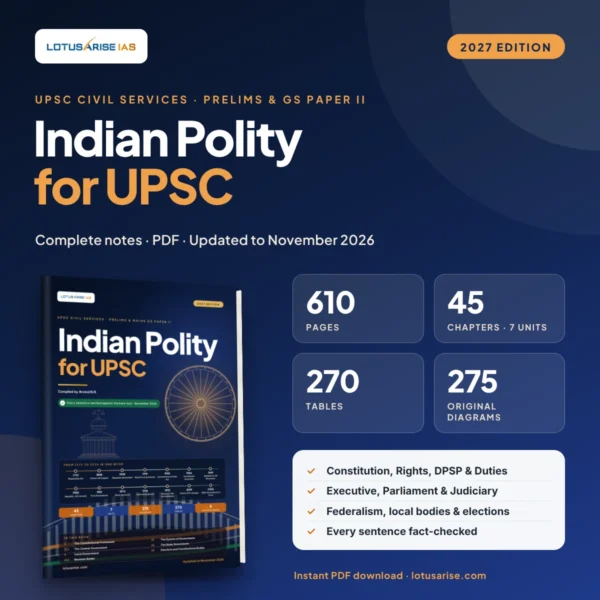
Indian Polity Notes for UPSC: Prelims & Mains GS Paper II (2027 Edition) by LotusArise IAS
Original price was: ₹700.00.₹349.00Current price is: ₹349.00. -
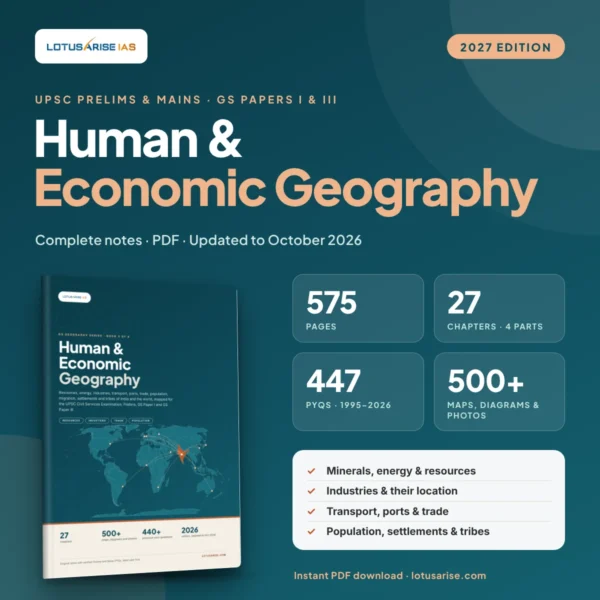
Human & Economic Geography Notes for UPSC: Prelims & Mains GS Papers I and III (2027 Edition) by LotusArise IAS
Original price was: ₹400.00.₹199.00Current price is: ₹199.00. -
-
Environment and Ecology Notes for UPSC: Prelims & Mains GS Paper III (2027 Edition) by LotusArise IAS
Original price was: ₹500.00.₹236.00Current price is: ₹236.00.