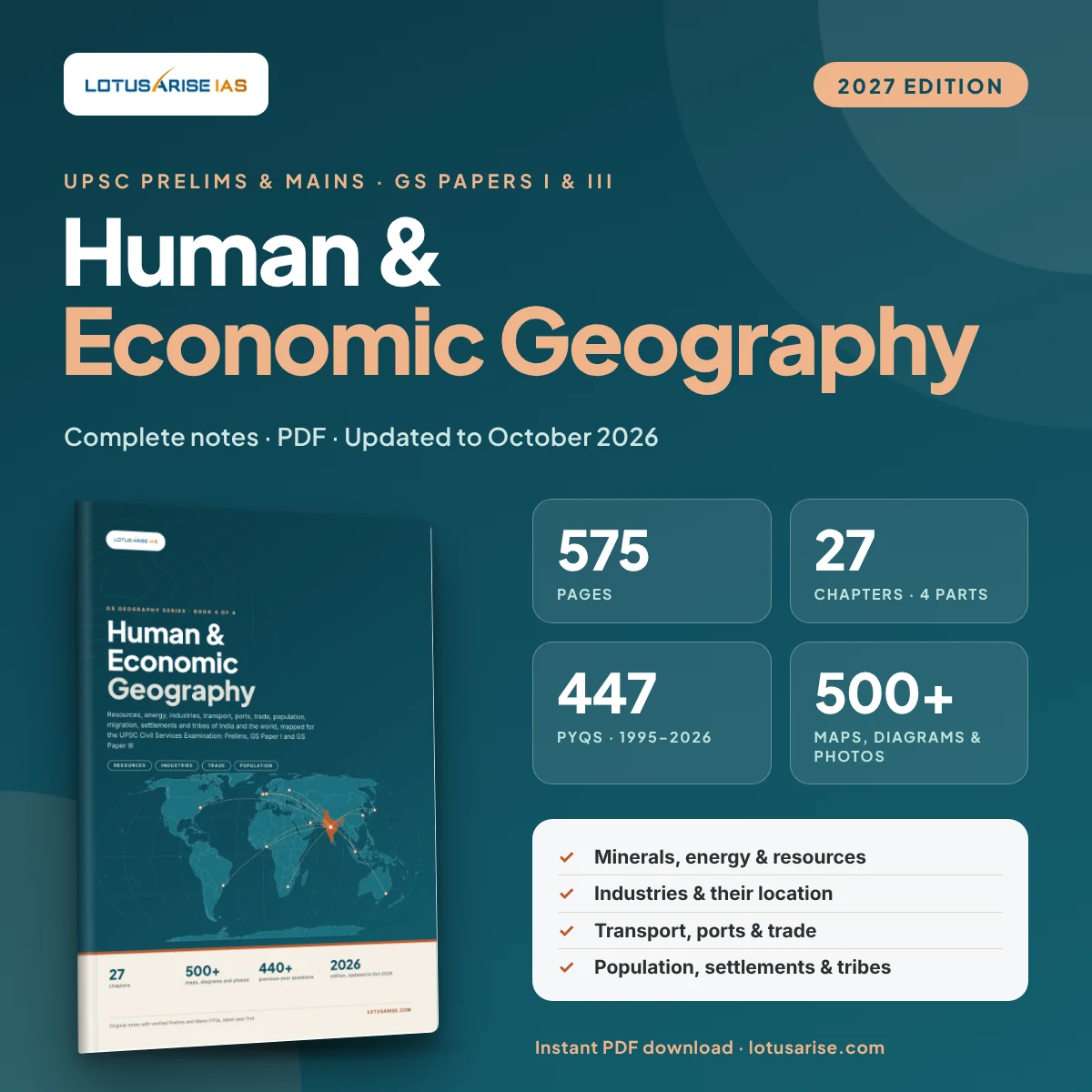


Human & Economic Geography Notes for UPSC: Prelims & Mains GS Papers I and III (2027 Edition) by LotusArise IAS
Original price was: ₹400.00.₹199.00Current price is: ₹199.00.
₹199 launch price for the 2027 Edition. MRP ₹400 — 575 pages, about 35 paise a page.
Most aspirants treat economic geography as lists. Mines in one PDF, industries in another, ports in a third, and population from an old Census chapter. Then Prelims asks which state leads in a mineral today, or Mains asks why an industry moved south — and the lists have no reasons and no current data.
Human & Economic Geography Notes for UPSC explains where things are, and why.
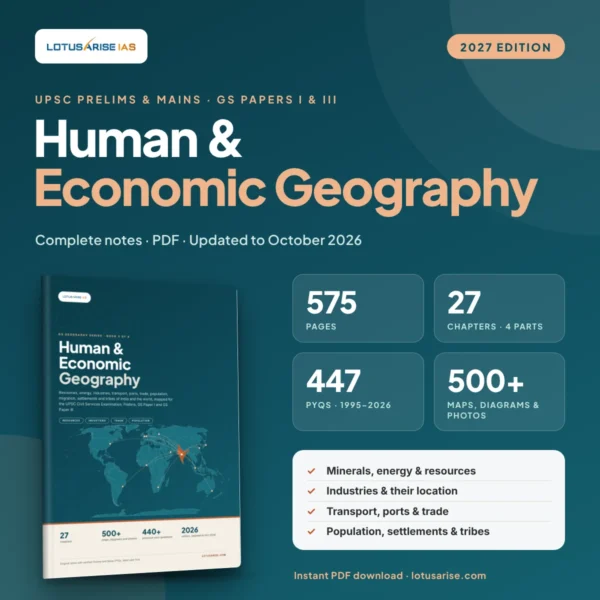
📘 27 chapters in 4 parts, 575 pages — resources and energy, industries, transport and trade, population and settlements
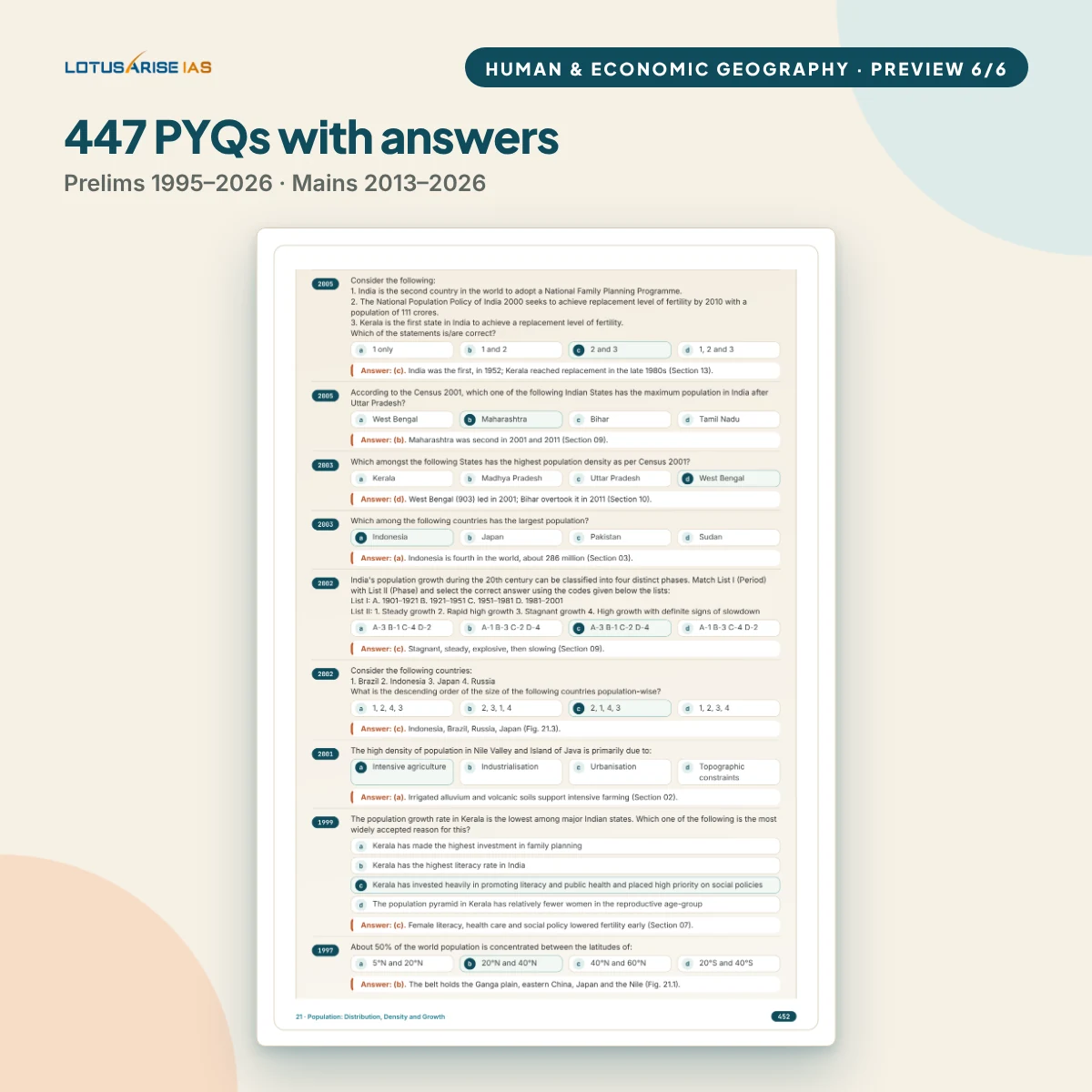
📝 447 PYQs — 301 Prelims (1995–2026) with answers and 146 Mains (2013–2026) with answer approaches, each under its chapter
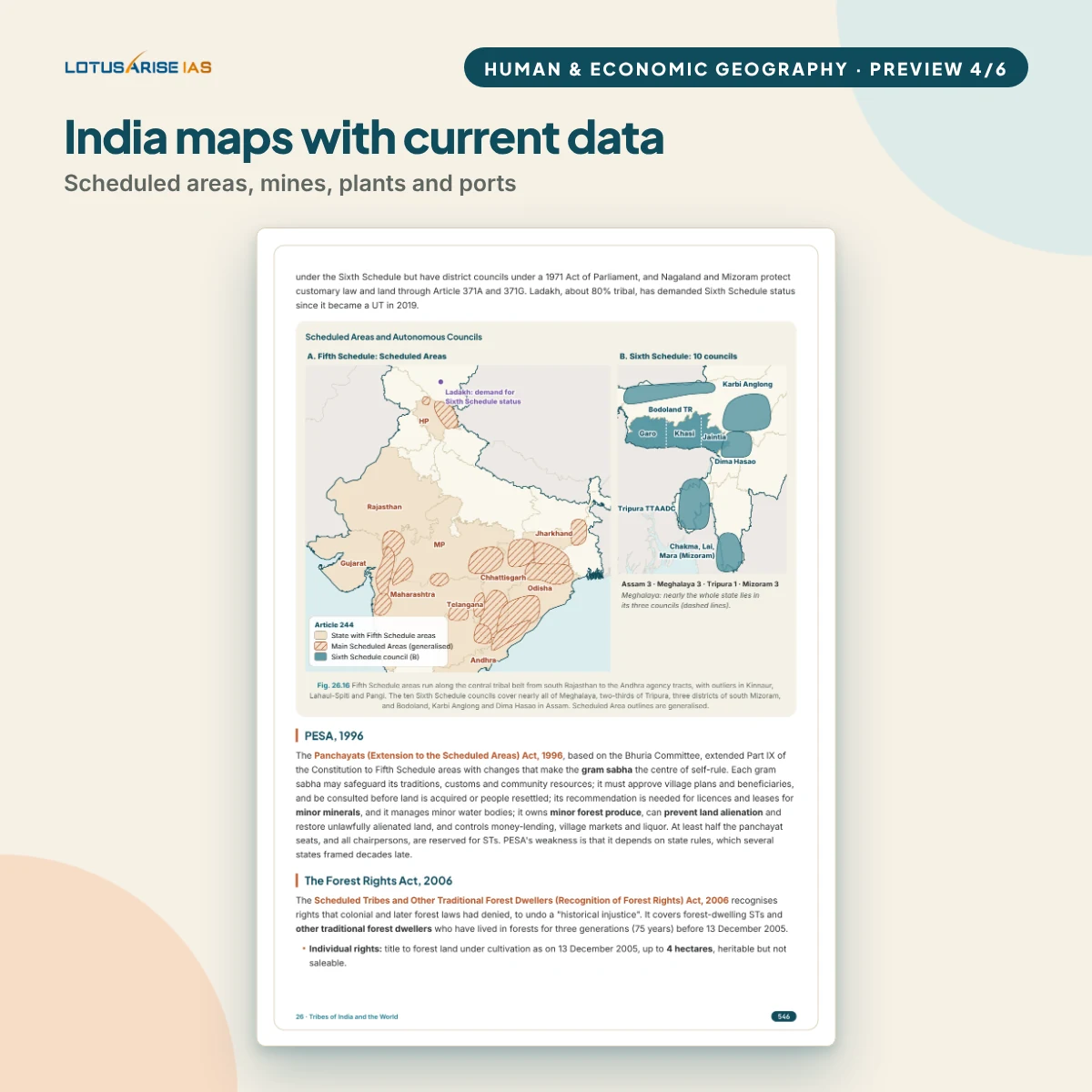
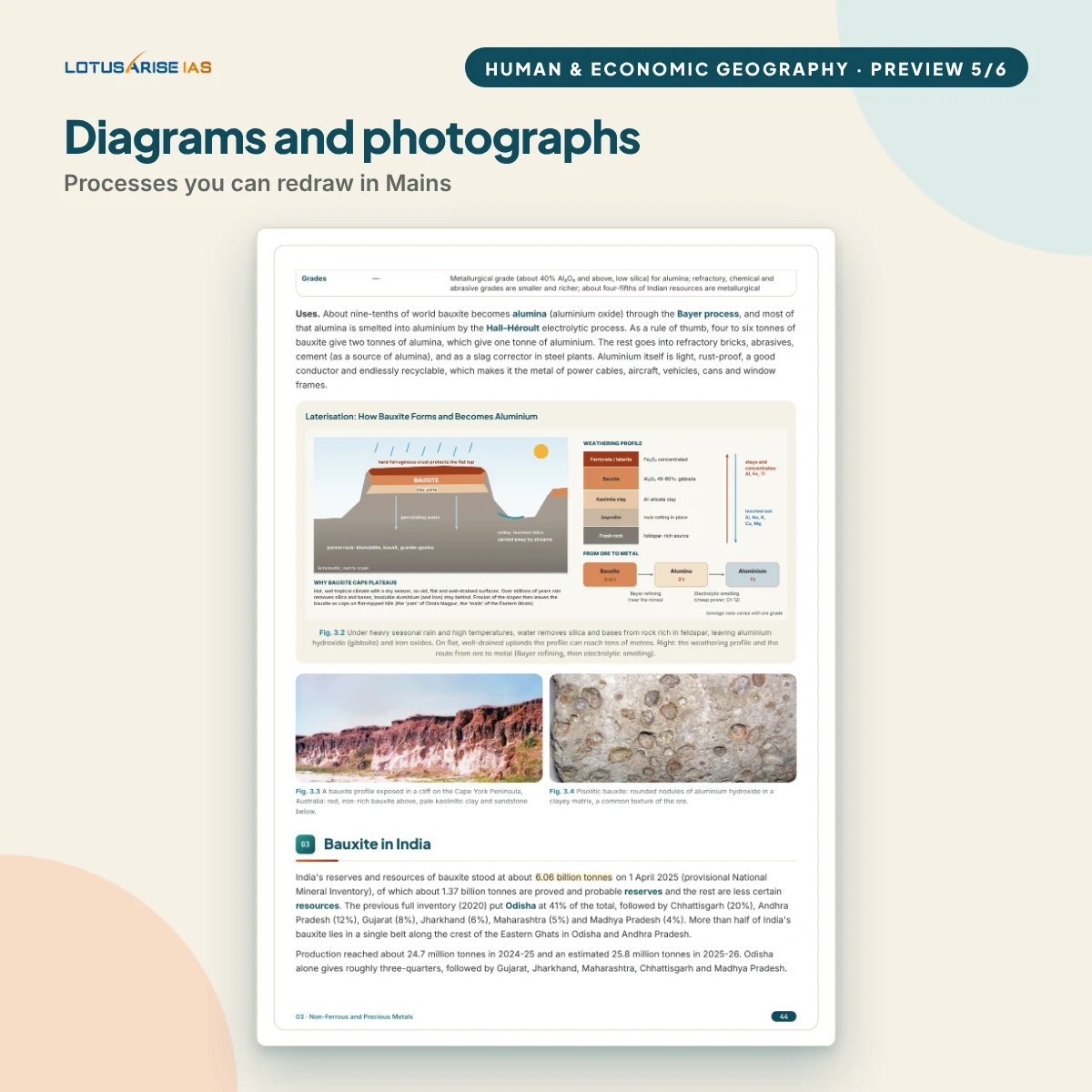
🗺️ 500+ maps, charts, diagrams and colour photographs — mines, plants, corridors, ports and population, with India’s official boundary
🗓️ Data updated to 2026 — FY2025-26 production, trade and port figures, new missions, Census 2027 and the latest population data
📱 Instant PDF download — laptop, mobile or tablet, offline, printable
One-time payment. No subscription. Unlimited downloads — the link does not expire.
⭐ Read by 300,000+ UPSC aspirants every month on LotusArise IAS
Features:
- Comprehensive Coverage
- Complete Syllabus
- Suitable for: UPSC & State PSCs exams
- Format: Digital PDF (Downloadable)
- 337,362+ aspirants visit every month
The problem nobody admits about economic geography
Ask an aspirant how they prepare resources, industries and population, and the answer is usually a sigh. They will say one of three things:
“I have mineral lists and industry lists, but I can’t explain why anything is located where it is.”
“My data is from 2018 or 2021. I don’t know the current leading states, the new corridors or what changed in trade.”
“Mains asks about the location of industries, migration or urbanisation, and my answers have no maps and no examples.”
These are not effort problems. This part of the syllabus is about location and change, and old lists capture neither. Human & Economic Geography Notes for UPSC is one book built to fix exactly that.
Why this deserves a book of its own
Mains GS Paper I asks directly for “distribution of key natural resources across the world”, “factors responsible for the location of primary, secondary and tertiary sector industries”, “population and associated issues” and “urbanisation, their problems and remedies”. GS Paper III adds infrastructure — energy, ports, roads, railways — and inclusive growth. The 146 Mains questions from 2013 to 2026 in this book show how often these topics return, and the 301 Prelims questions from 1995 to 2026 show the facts UPSC keeps testing: minerals, power plants, corridors, ports, tribes and Census data.
The subject also changes every year. New mines and refineries, new corridors and ports, new trade agreements, new population estimates. The challenge is not understanding it. It is having one current source that explains location, not just lists it.
What’s inside
📘 The complete notes — 27 chapters, 575 pages
Four parts:
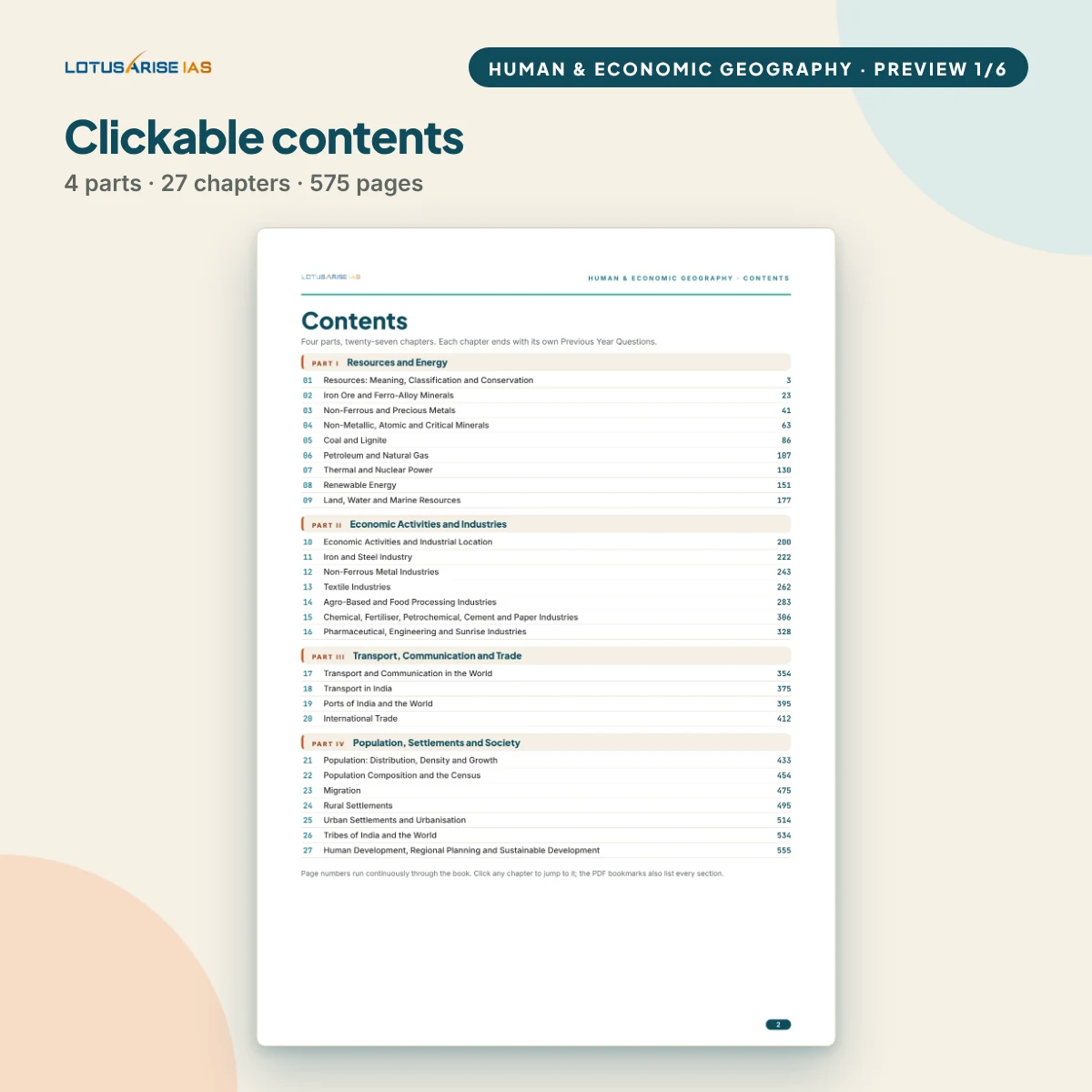
- Resources and Energy — resources and conservation; iron ore and ferro-alloy minerals; non-ferrous and precious metals; non-metallic, atomic and critical minerals; coal and lignite; petroleum and natural gas; thermal and nuclear power; renewable energy; land, water and marine resources
- Economic Activities and Industries — economic activities and the theories of industrial location; iron and steel; non-ferrous metal industries; textiles; agro-based and food processing; chemicals, fertilisers, petrochemicals, cement and paper; pharmaceuticals, engineering and sunrise industries
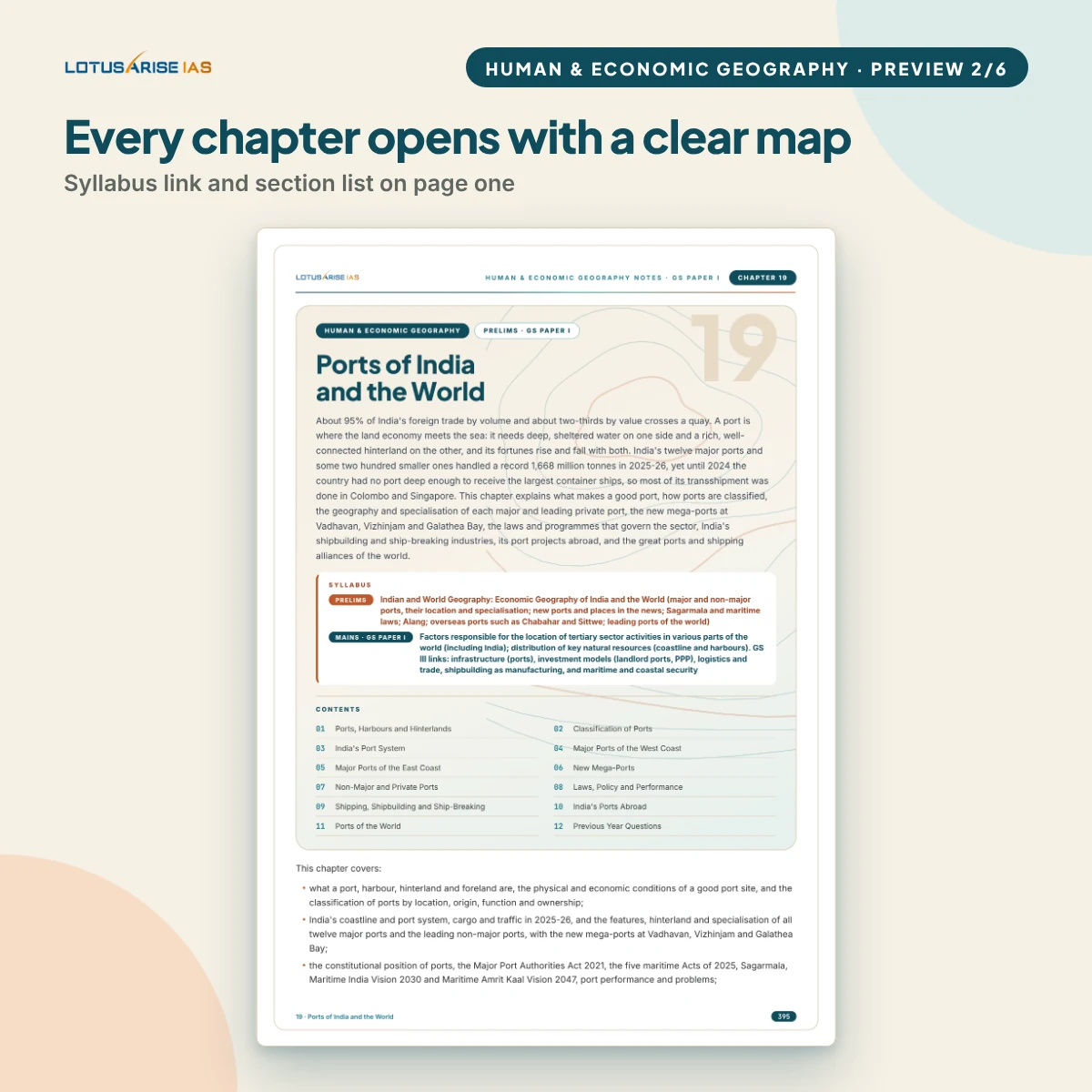
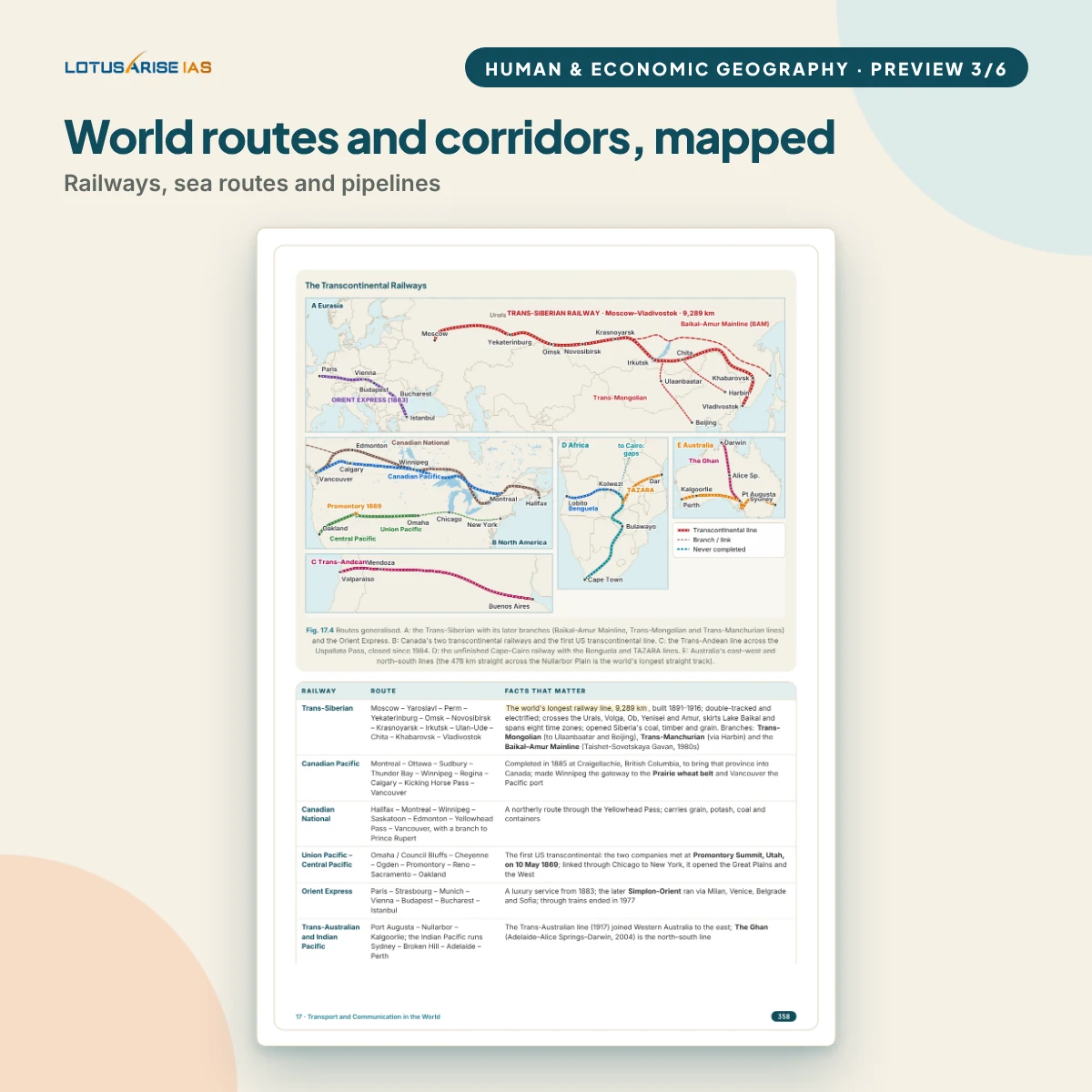
- Transport, Communication and Trade — world routes, pipelines, corridors and submarine cables; roads, railways, waterways, pipelines and airports of India; ports of India and the world; international trade, WTO and India’s trade agreements
- Population, Settlements and Society — population distribution, density and growth; composition and the Census; migration; rural settlements; urban settlements and urbanisation; tribes of India and the world; human development, regional planning and sustainable development
Each resource and industry chapter covers both India (reserves and production by state, major mines, plants and clusters, policy) and the world (leading producers, trade and major regions), with the factors of location explained.
What makes this different from downloaded PDFs: every chapter is written fresh for the exam and checked against current official data — production, capacity, trade and port figures for 2025-26, and the latest population estimates. Every list comes with a reason, and every chapter closes with its own previous year questions.
📝 447 PYQs — Prelims 1995–2026 and Mains 2013–2026
Every Prelims question appears verbatim with all four options, the answer marked and a one-line reason. Every Mains question carries its paper and marks and a short answer approach. Both sit under the chapter that answers them.
🗺️ 500+ maps, charts, diagrams and colour photographs
Mineral belts, coalfields, refineries and power plants; industrial regions and corridors; highways, freight corridors, waterways and ports; world routes and pipelines; population density, sex ratio and urbanisation maps; tribal regions — plus production and trade charts built from current data.
🗂️ Built for revision
A clickable contents page, part pages that list every topic, a bookmark panel that takes you to any section in one tap, and mapping tables for quick revision.
The aspirant who buys this
First-time aspirants — you want one book for the whole human and economic side of geography, instead of collecting it from Economy, Geography and Census notes.
Repeaters who lost marks to location and data questions — leading states, plant locations, corridors, ports. The maps and chapter-wise PYQs are built for exactly those questions.
Mains aspirants preparing GS Papers I and III — industrial location, resources, population, migration, urbanisation and infrastructure, each with maps and examples you can use in an answer.
State PSC aspirants — resources, industries and population are a large part of most State PSC syllabi.
Self-study aspirants outside Delhi, Prayagraj or Jaipur — no classroom, no batch timings; one PDF on your phone that covers the whole subject.
Why not just use free notes from Telegram?
Free economic geography notes exist, and many aspirants have folders full of them. The problem is not that they are bad. It is that they are lists without reasons, and the numbers in them are years old. A 2019 list of leading states or major ports is simply wrong in 2026.
This book is one connected system: 27 chapters, maps for every distribution, current data, and every PYQ placed where it belongs.
If you have the time and discipline to build that system yourself from scattered sources, you may not need this. If you want it already built — open it and start reading — this is what the book is for.
Price and delivery
A single printed guide to Indian and world economic geography usually costs more than this PDF, and it will not carry 2025-26 data or chapter-wise PYQs to 2026.
MRP ₹400 → launch price ₹199 for 575 pages — about 35 paise a page.
Want to see it first? Download the free sample PDF — the cover, the full contents and two complete chapters (11 Iron and Steel Industry and 19 Ports of India and the World).
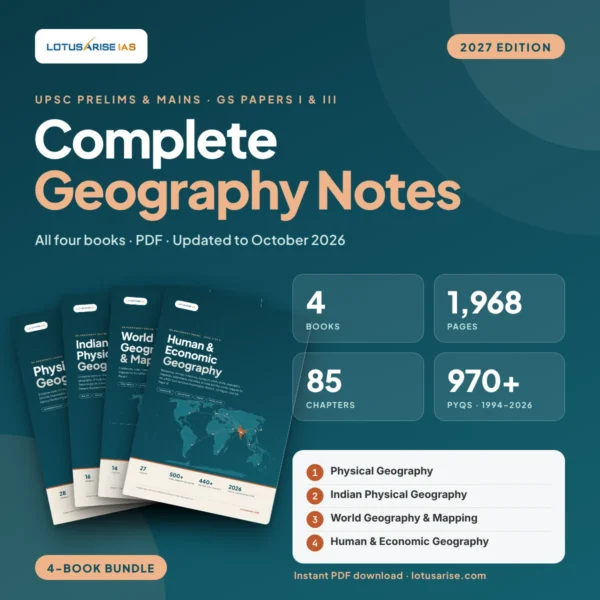
Also available: the Complete Geography Notes bundle — all four GS Geography books for ₹599.
One-time payment. No subscription. No recurring charge.
Instant PDF download after payment. The download link is also sent to your email — please check the spam folder if it does not arrive in a few minutes. Download it again any time from My Account.
For support: support@lotusarise.com
You may also like…
-

Complete Geography Notes for UPSC GS Prelims + Mains: 4-Book Bundle (2027 Edition) by LotusArise IAS
Original price was: ₹1,500.00.₹599.00Current price is: ₹599.00.

Related products
-
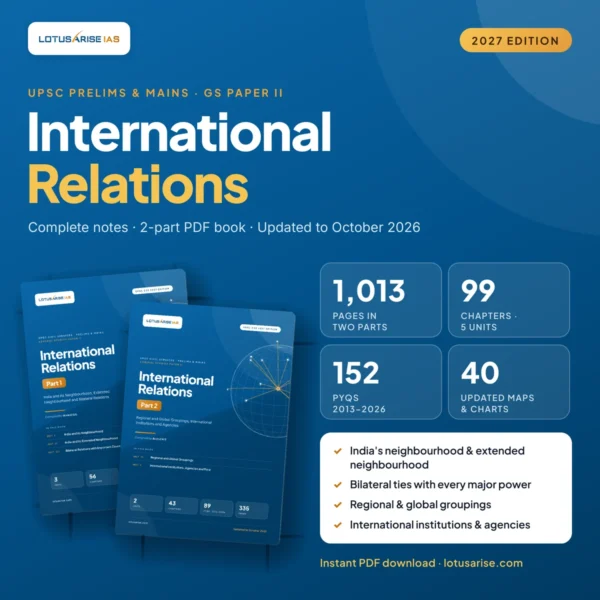
International Relations Notes for UPSC: Prelims & Mains GS Paper II (2027 Edition) by LotusArise IAS
Original price was: ₹500.00.₹236.00Current price is: ₹236.00. -
-
-
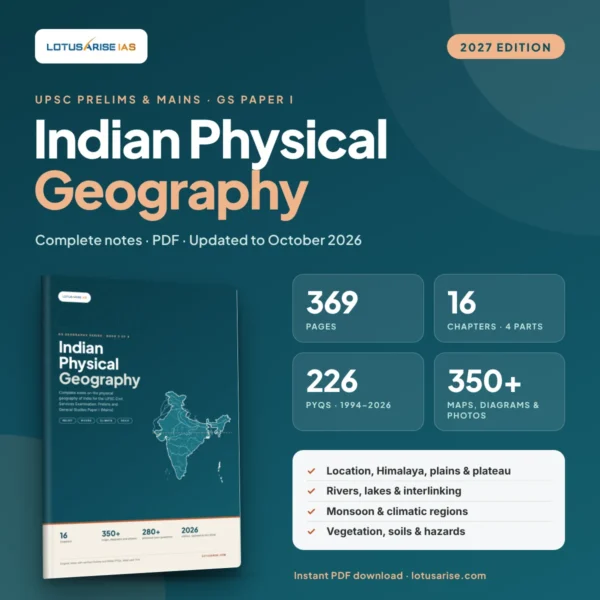
Indian Physical Geography Notes for UPSC: Prelims & Mains GS Paper I (2027 Edition) by LotusArise IAS
Original price was: ₹300.00.₹149.00Current price is: ₹149.00.