


Indian Physical Geography Notes for UPSC: Prelims & Mains GS Paper I (2027 Edition) by LotusArise IAS
Original price was: ₹300.00.₹149.00Current price is: ₹149.00.
₹149 launch price for the 2027 Edition. MRP ₹300 — 369 pages, about 40 paise a page.
Most aspirants study Indian Geography without a map in front of them. They read about the Siwaliks, the Chambal ravines or the Mahanadi delta, but never see where they are. Then Prelims asks them to order rivers from north to south, or name the pass between two valleys, and the answer is not in their memory because it was never on a map.
Indian Physical Geography Notes for UPSC teaches India through maps.
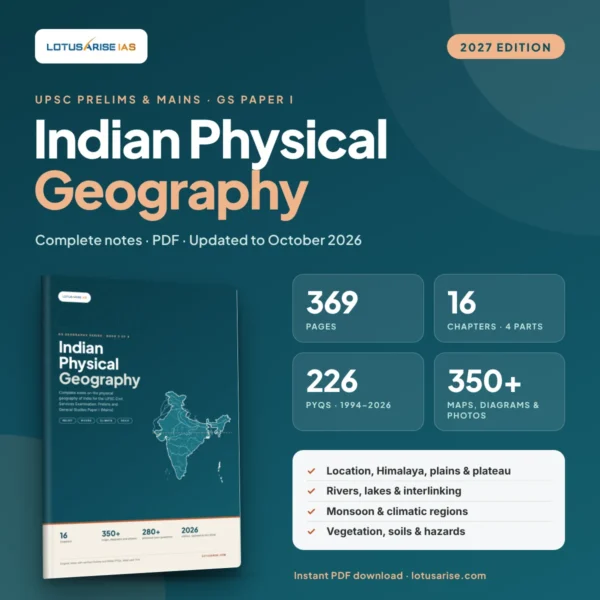
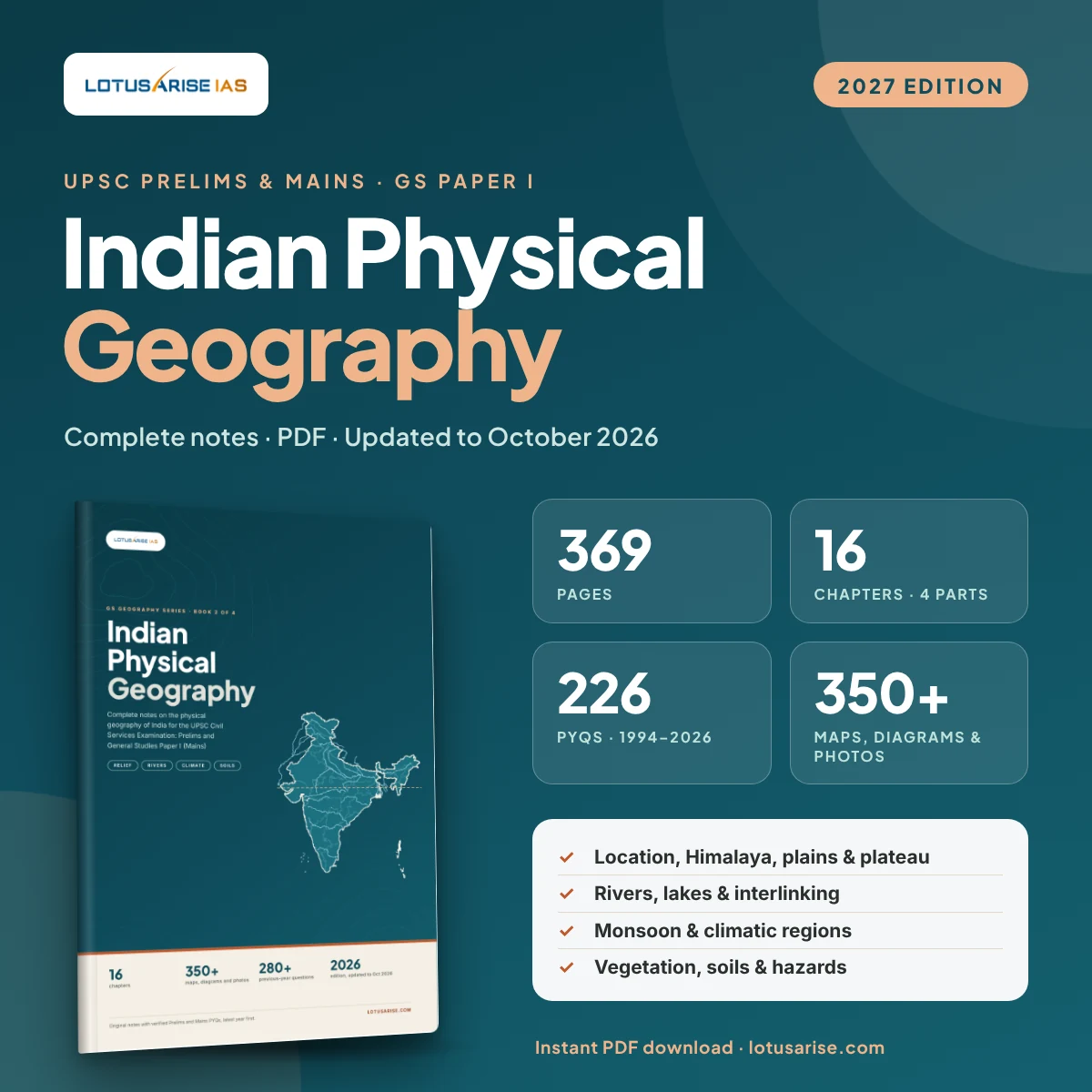
🗺️ 16 chapters in 4 parts, 369 pages — relief, rivers, monsoon, climate, vegetation, soils and hazards
📝 226 PYQs — 148 Prelims (1994–2026) with answers and 78 Mains (2013–2026) with answer approaches, each under its chapter
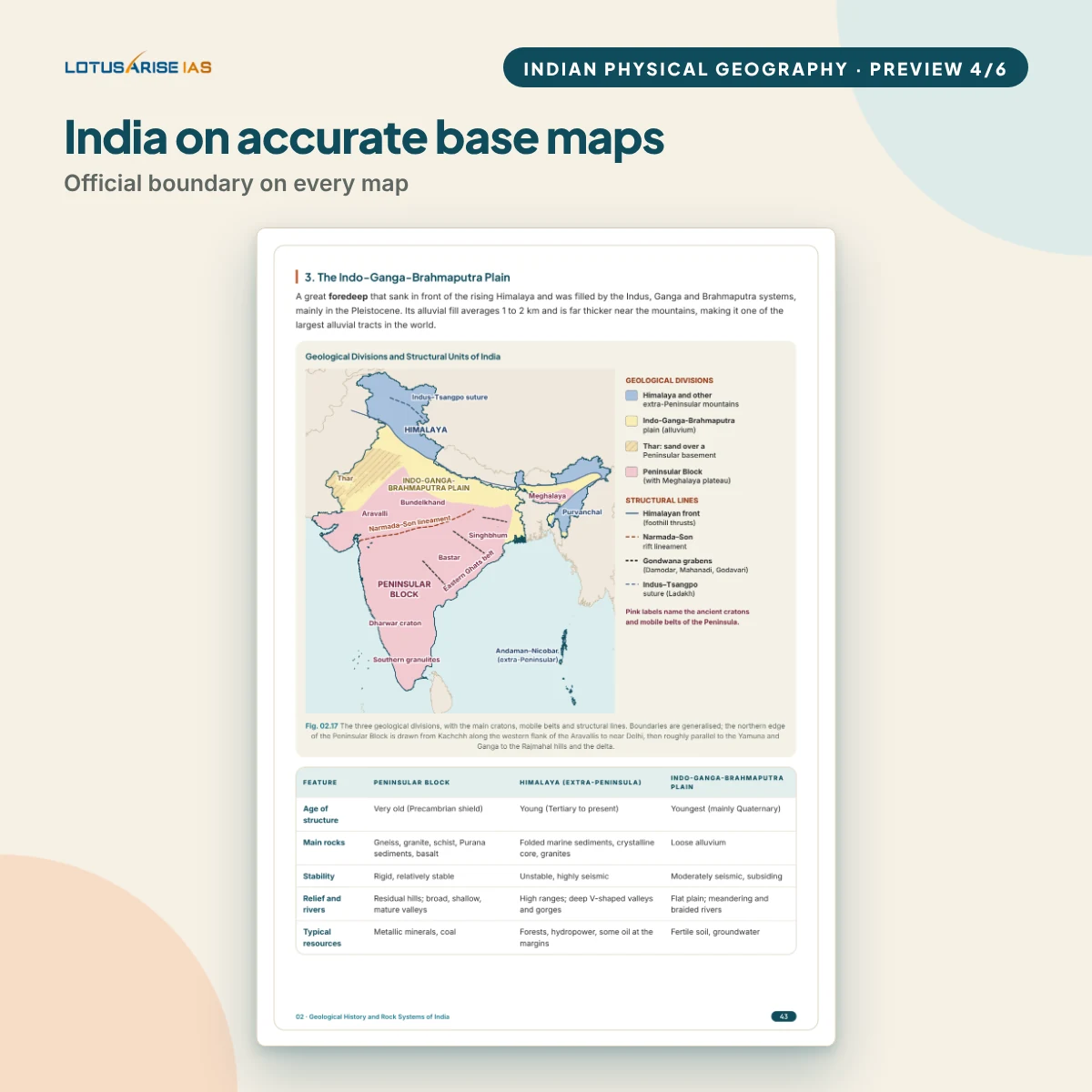
🎨 350+ maps, diagrams and colour photographs — accurate base maps with India’s official boundary on every map
🗓️ Updated to October 2026 — latest forest survey, monsoon research, river disputes and disasters
📱 Instant PDF download — laptop, mobile or tablet, offline, printable
One-time payment. No subscription. Unlimited downloads — the link does not expire.
⭐ Read by 300,000+ UPSC aspirants every month on LotusArise IAS
Features:
- Comprehensive Coverage
- Complete Syllabus
- Suitable for: UPSC & State PSCs exams
- Format: Digital PDF (Downloadable)
- 337,362+ aspirants visit every month
The problem nobody admits about Indian Geography
Ask an aspirant how they prepare the geography of India, and the honest answer is usually “I’ve read it, but I can’t picture it”. They will say one of three things:
“I know the names of the Himalayan ranges and passes, but if you showed me a blank map I couldn’t place half of them.”
“Every river question confuses me — which river is a tributary of which, which flows west, which rises where.”
“My notes still quote old forest and drought figures. I don’t know what changed after 2021.”
These are not memory problems. Indian Geography is spatial, and it cannot be learnt from text alone. Indian Physical Geography Notes for UPSC is one book built to fix exactly that.
Why Indian Geography deserves a book of its own
Questions on India’s physical geography appear in GS Prelims every year — the 148 Prelims questions from 1994 to 2026 in this book are the proof: rivers and their tributaries, passes, national parks along a river, soils, the monsoon, the order of places from north to south. In Mains, GS Paper I asks directly for “salient features of India’s physical geography”, and the 78 Mains questions from 2013 to 2026 show how often the monsoon, Himalayan rivers, the Peninsular plateau, floods and droughts return.
The same material feeds Environment, Disaster Management, Agriculture and the Essay paper. The real challenge is not the volume of facts. It is learning them on a map, in the right order, with current data.
What’s inside
🗺️ The complete notes — 16 chapters, 369 pages
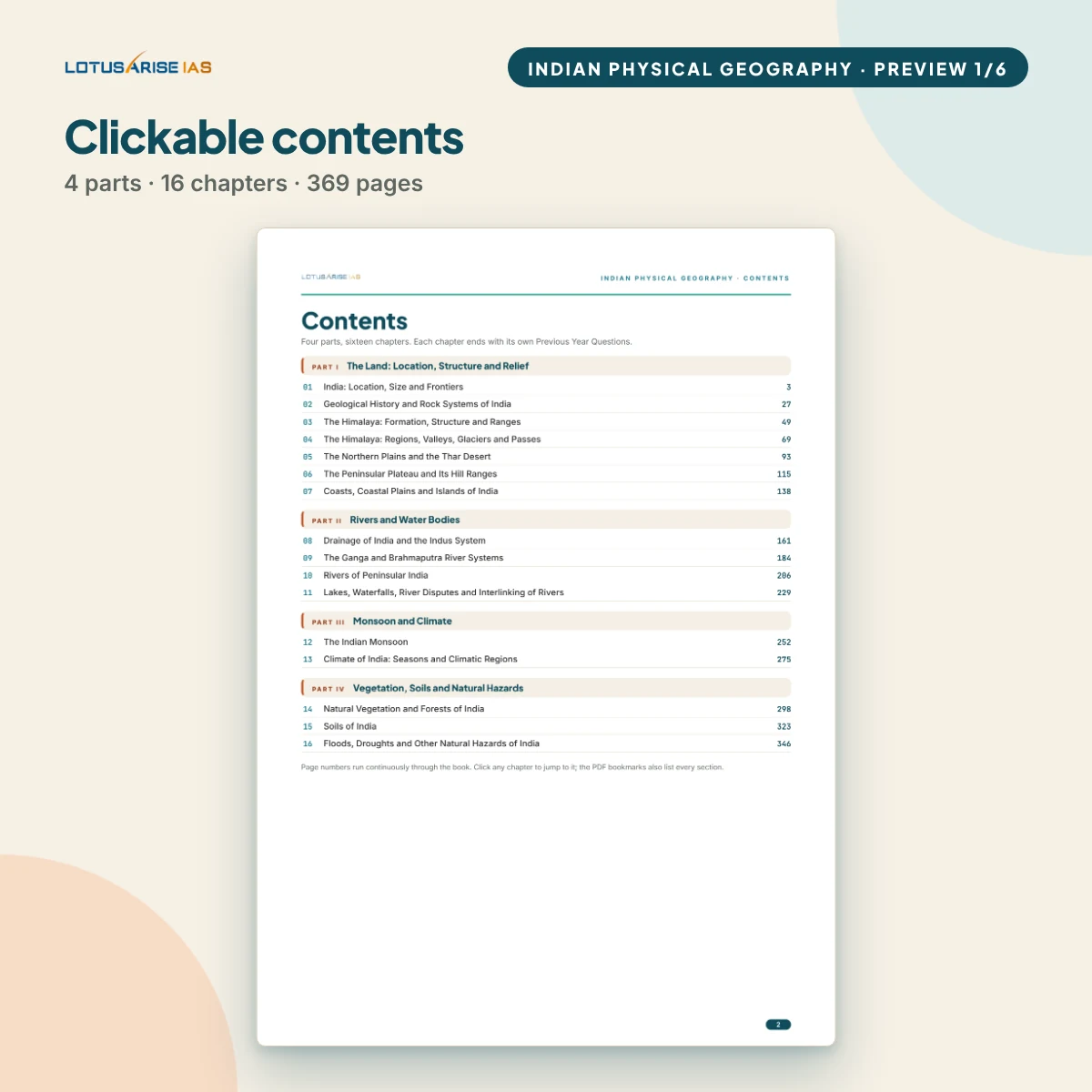
Four parts, in the order the subject is best learnt:
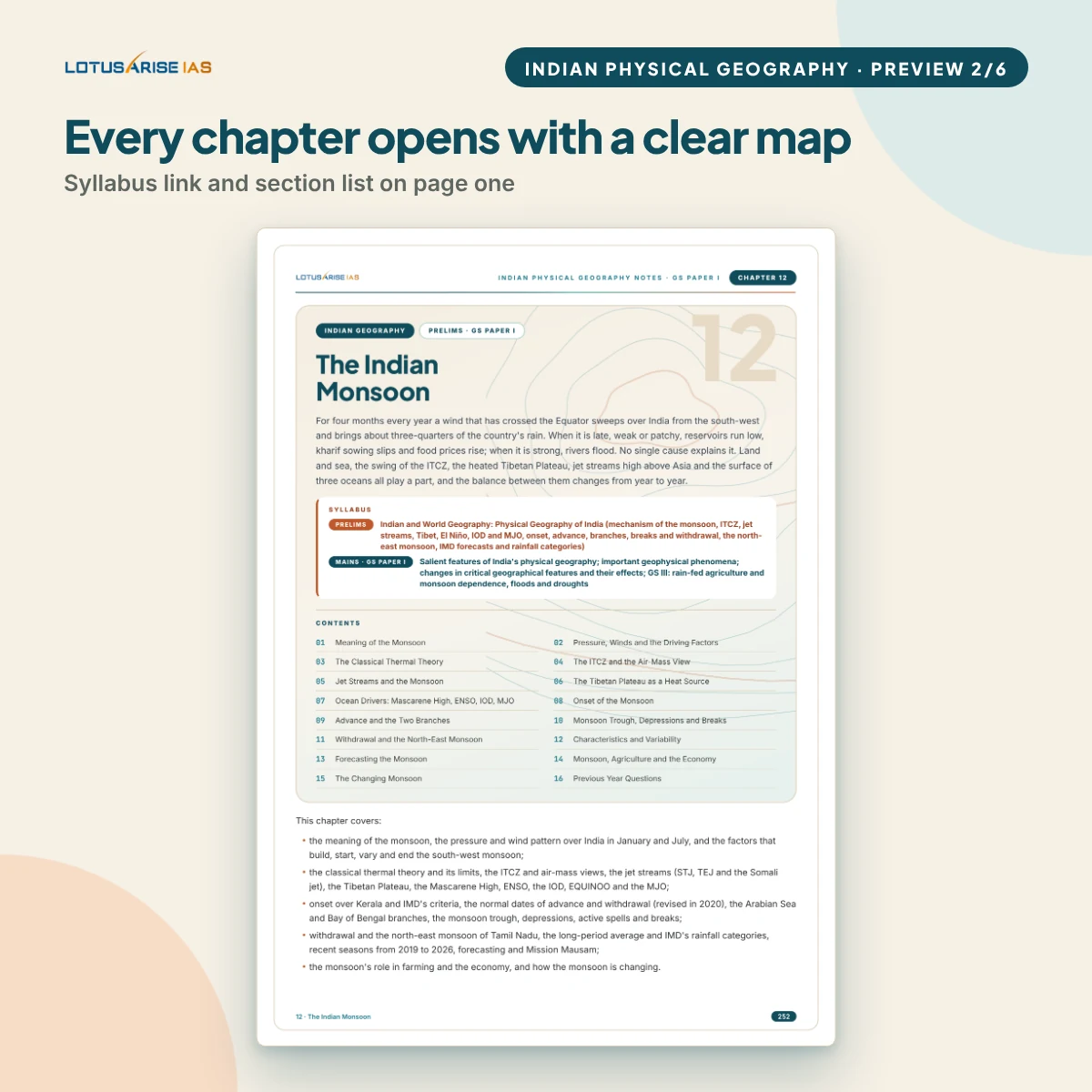
- The Land: Location, Structure and Relief — India’s location, size, frontiers, neighbours and Standard Time; geological history and rock systems; the Himalaya’s formation, structure, ranges, regions, valleys, glaciers and passes; the Northern Plains and the Thar; the Peninsular plateau and its hill ranges; coasts, coastal plains and islands
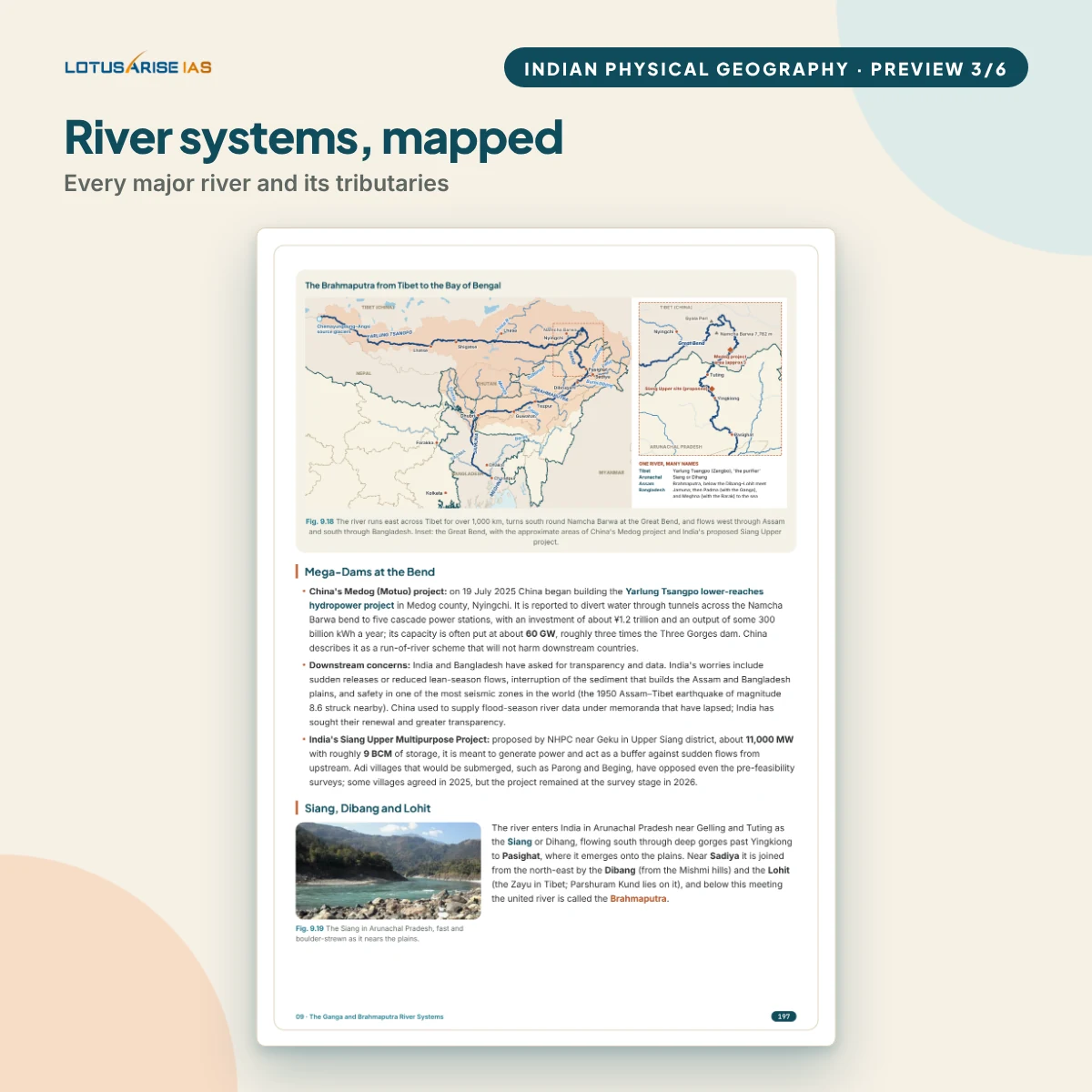
- Rivers and Water Bodies — the drainage of India and the Indus system; the Ganga and Brahmaputra systems; the rivers of Peninsular India; lakes, waterfalls, river disputes and the interlinking of rivers
- Monsoon and Climate — the mechanism of the Indian monsoon, onset and withdrawal, western disturbances, heatwaves; the seasons and climatic regions of India
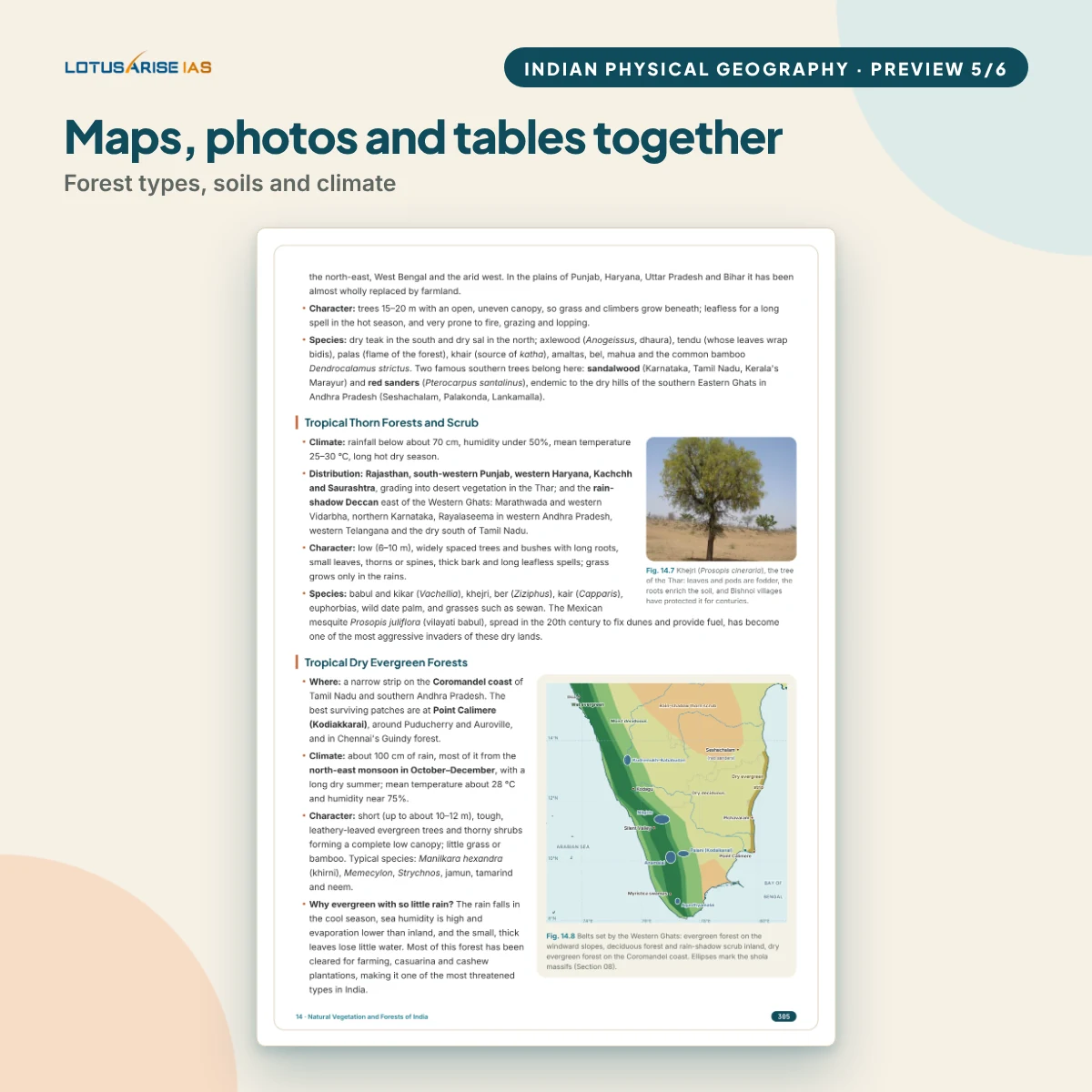
- Vegetation, Soils and Natural Hazards — forest types and the latest forest survey; the soils of India; floods, droughts, cyclones, earthquakes, landslides, cloudbursts, heatwaves and lightning
What makes this different from downloaded PDFs: every map is drawn on an accurate base with India’s official boundary, so what you learn is what you will be tested on. Chapters are written fresh for the exam, cross-referenced so that you never read the same topic twice, and each one closes with its own previous year questions.
📝 226 PYQs — Prelims 1994–2026 and Mains 2013–2026
Every Prelims question appears verbatim with all four options, the answer marked and a one-line reason. Every Mains question carries its paper and marks and a short answer approach. Both sit under the chapter that answers them.
🎨 350+ maps, diagrams and colour photographs
River systems with their tributaries, Himalayan passes, the physiographic divisions, monsoon wind patterns, rainfall and temperature maps, forest and soil maps, hazard zones — plus cross-sections and colour photographs of real places.
🗂️ Built for revision
A clickable contents page, part pages that list every topic before you begin, a bookmark panel that takes you to any section in one tap, and mapping tables you can revise in the last week.
The aspirant who buys this
First-time aspirants — you want one book that teaches India’s geography on the map from the start, instead of memorising lists you can’t place.
Repeaters who lost marks to map-based Prelims questions — rivers, passes, ranges and the order of places. The maps and chapter-wise PYQs are built for exactly those questions.
Mains aspirants preparing GS Paper I — monsoon mechanism, Himalayan and Peninsular rivers, floods and droughts, all with maps you can sketch in an answer.
State PSC aspirants — Indian Geography is a large part of most State PSC syllabi, so the same book serves both.
Self-study aspirants outside Delhi, Prayagraj or Jaipur — no classroom, no batch timings; one PDF on your phone that covers the whole subject.
Why not just use free notes from Telegram?
Free Indian Geography notes exist, and plenty of aspirants have folders full of them. The problem is not that they are bad. It is that they are mostly text, often years old, and rarely carry an accurate map. Many free maps even show India’s boundary incorrectly.
This book is one connected system: 16 chapters in learning order, a map for every region and river system, current data, and every PYQ placed where it belongs.
If you have the time and discipline to build that system yourself from scattered sources, you may not need this. If you want it already built — open it and start reading — this is what the book is for.
Price and delivery
A single printed geography of India guide usually costs more than this PDF, and it will not carry chapter-wise PYQs to 2026 or colour maps throughout.
MRP ₹300 → launch price ₹149 for 369 pages — about 40 paise a page.
Want to see it first? Download the free sample PDF — the cover, the full contents and two complete chapters (03 The Himalaya and 12 The Indian Monsoon).
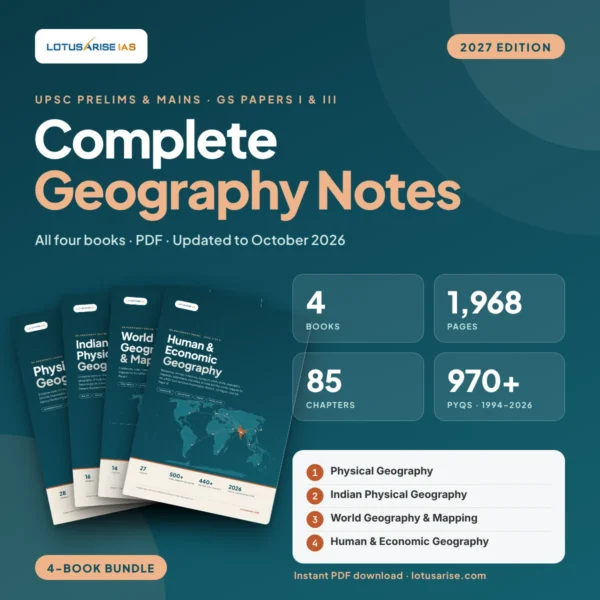
Also available: the Complete Geography Notes bundle — all four GS Geography books for ₹599.
One-time payment. No subscription. No recurring charge.
Instant PDF download after payment. The download link is also sent to your email — please check the spam folder if it does not arrive in a few minutes. Download it again any time from My Account.
For support: support@lotusarise.com
You may also like…
-

Complete Geography Notes for UPSC GS Prelims + Mains: 4-Book Bundle (2027 Edition) by LotusArise IAS
Original price was: ₹1,500.00.₹599.00Current price is: ₹599.00.