



Physical Geography Notes for UPSC: Prelims & Mains GS Paper I (2027 Edition) by LotusArise IAS
Original price was: ₹500.00.₹236.00Current price is: ₹236.00.
₹236 launch price for the 2027 Edition. MRP ₹500 — 706 pages, about 33 paise a page.
Most aspirants study Physical Geography the wrong way. NCERT for basics, a coaching handout for climate, a Telegram PDF for landforms, and no diagram they can actually draw. Then Prelims asks about a jet stream, a karst feature or a tidal bore, and none of the three sources explains it the same way.
Physical Geography Notes for UPSC puts the whole subject in one book.
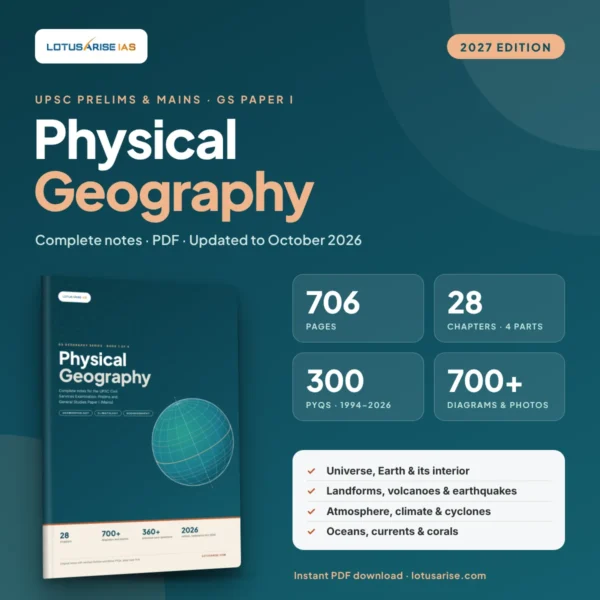
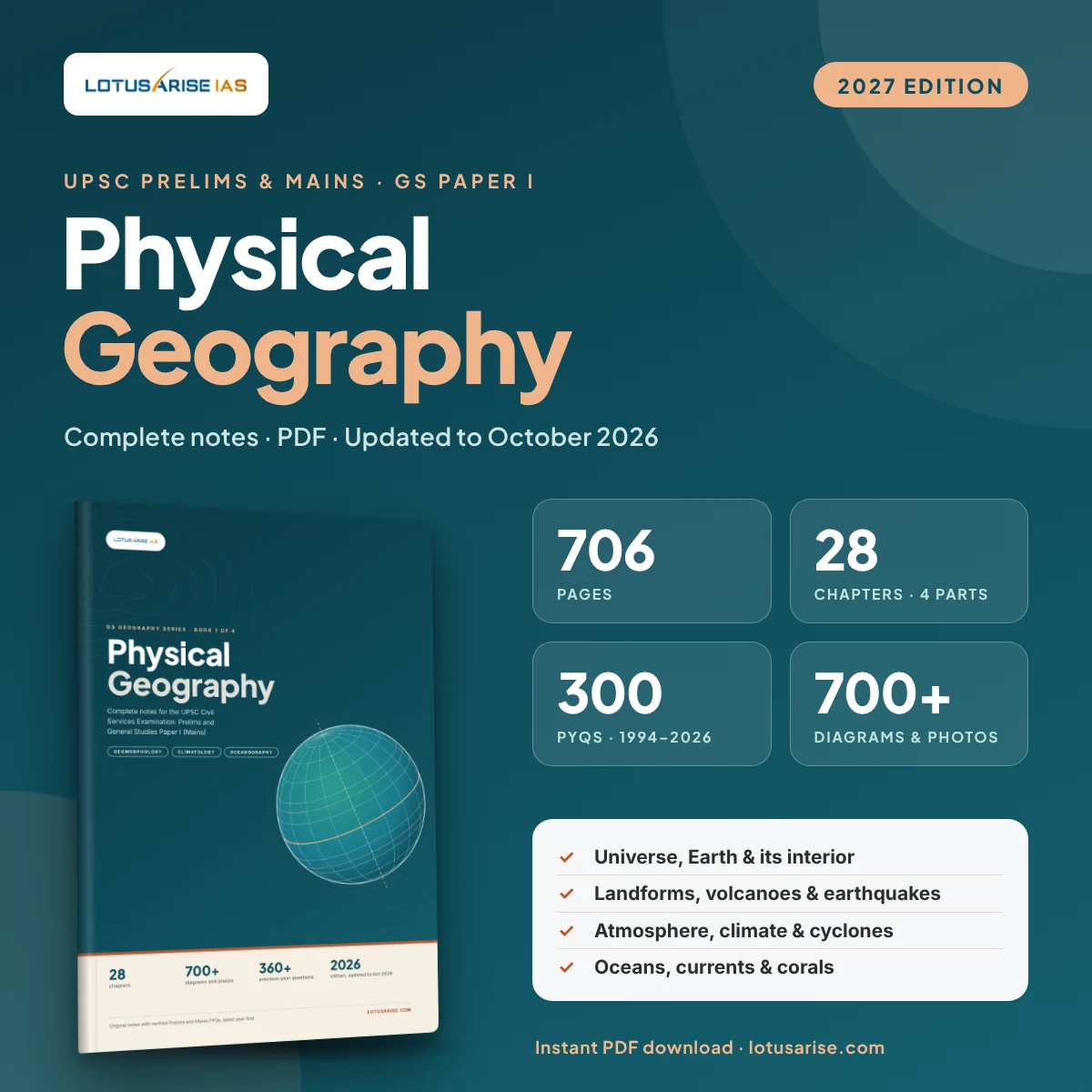
📘 28 chapters in 4 parts, 706 pages — the Universe, landforms, climate and the oceans, in the order you should learn them
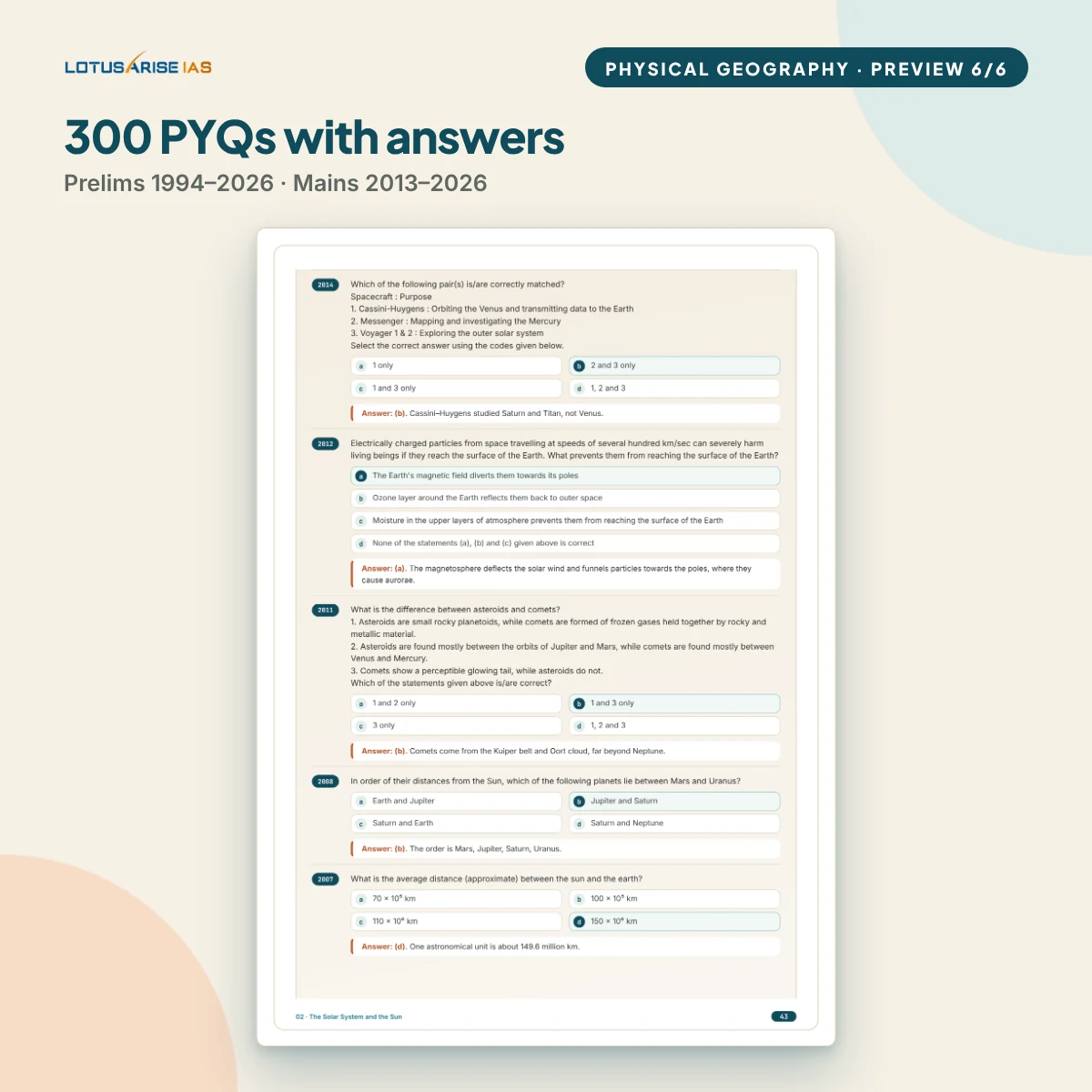
📝 300 PYQs — 212 Prelims (1994–2026) with answers and 88 Mains (2013–2026) with answer approaches, each under its chapter
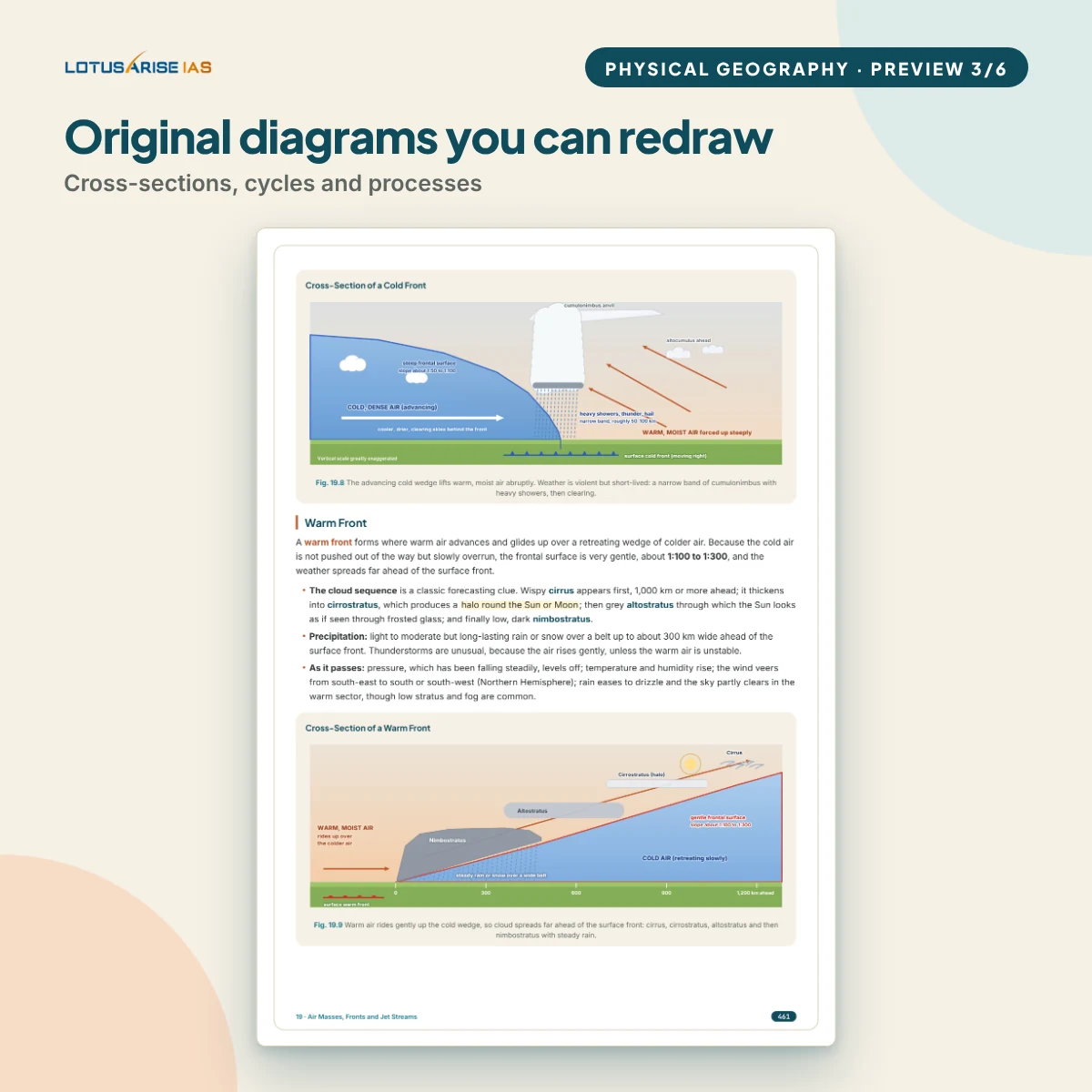
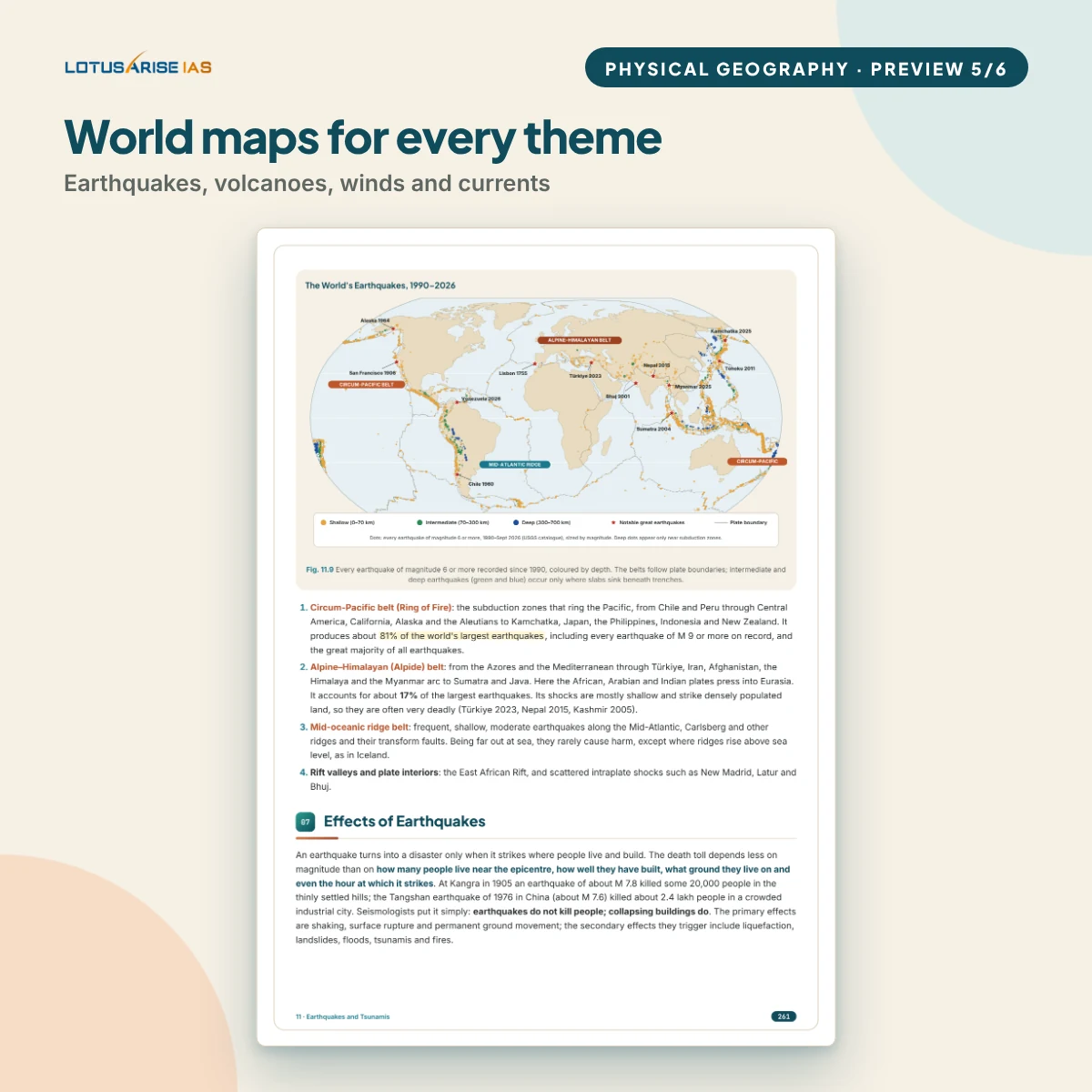
🎨 700+ original diagrams and colour photographs — cross-sections, cycles and world maps simple enough to redraw in Mains
🗓️ Updated to October 2026 — recent eruptions, earthquakes, cyclones, El Niño events and sea-level data
📱 Instant PDF download — laptop, mobile or tablet, offline, printable
One-time payment. No subscription. Unlimited downloads — the link does not expire.
⭐ Read by 300,000+ UPSC aspirants every month on LotusArise IAS
Features:
- Comprehensive Coverage
- Complete Syllabus
- Suitable for: UPSC & State PSCs exams
- Format: Digital PDF (Downloadable)
- 337,362+ aspirants visit every month
The problem nobody admits about Physical Geography
Ask an aspirant what they find hardest in GS Paper I, and Physical Geography is usually near the top. Not because they have never read it. They will say one of three things:
“I understand a jet stream when I read about it. A week later I can’t explain it, and I definitely can’t draw it.”
“I’ve read NCERT, a reference book and two sets of notes. Each one explains cyclones differently, and none of them uses 2025 or 2026 examples.”
“Mains asks me to ‘discuss with suitable illustrations’, and my answers have no diagrams at all.”
These are not ability problems. Physical Geography is a subject of processes, and processes are learnt through diagrams and examples, which scattered notes rarely give you. Physical Geography Notes for UPSC is one book built to fix exactly that.
Why Physical Geography deserves a book of its own
Physical Geography is the foundation of every other geography question. Plate tectonics explains the Himalaya, pressure belts explain the monsoon, ocean currents explain fishing grounds and deserts. The 212 Prelims questions from 1994 to 2026 inside this book show how steadily UPSC tests it, and the 88 Mains questions from 2013 to 2026 show the GS Paper I pattern: explain a process, give an example, draw a diagram.
It also feeds Environment (climate change, coral reefs, ocean acidification), Disaster Management (earthquakes, tsunamis, cyclones) and the Essay paper. Every hour on this subject pays back in at least three other places. The real challenge is not understanding the concepts. It is having one source that explains them clearly, illustrates them and ties them to what UPSC actually asks.
What’s inside
📘 The complete notes — 28 chapters, 706 pages
Four parts, in the order the subject is best learnt:
- The Earth in Space — the Big Bang, galaxies and stars; the Solar System and the Sun; latitudes, longitudes, time zones, rotation, revolution and seasons
- The Solid Earth and Its Landforms — origin of the Earth and the geological time scale; the interior and geomagnetism; minerals, rocks and the rock cycle; continental drift, sea-floor spreading and plate tectonics; plate boundaries and mountain building; endogenic forces, weathering and mass movement; volcanism; earthquakes and tsunamis; fluvial, glacial, aeolian, karst and coastal landforms; plateaus, plains and lakes
- The Atmosphere and Climate — composition and structure of the atmosphere; insolation, the heat budget and temperature; pressure belts, planetary and local winds; humidity, clouds and precipitation; air masses, fronts and jet streams; thunderstorms, tornadoes and tropical cyclones; temperate cyclones and anticyclones; El Niño, La Niña, the Indian Ocean Dipole and the MJO; climate classification and the world’s climatic regions
- The Oceans — ocean relief and islands; waves, tides and currents; temperature and salinity; ocean resources, coral reefs, sea-level change and the Law of the Sea
What makes this different from downloaded PDFs: every chapter is written fresh for the exam, not copied from a textbook. Each process is explained step by step and then drawn, so you can reproduce it in an answer. Examples are current — recent eruptions, earthquakes, cyclones and El Niño years — and each chapter closes with its own previous year questions, so you finish a topic and immediately see how UPSC has tested it.
📝 300 PYQs — Prelims 1994–2026 and Mains 2013–2026
Every Prelims question appears verbatim with all four options, the answer marked and a one-line reason. Every Mains question carries its paper and marks and a short answer approach that points you to the right diagram. Both sit under the chapter that answers them, not in a separate book at the end.
🎨 700+ original diagrams and colour photographs
Plate boundaries, the rock cycle, stages of a river, glacial valleys, the tricellular circulation, cyclone cross-sections, ocean currents, coral reef types — each drawn fresh and simple enough to sketch in a Mains answer in under a minute. Colour photographs of real landforms help you recognise what you are reading about.
🗂️ Built for revision
A clickable contents page, part pages that list every topic before you begin, a bookmark panel that takes you to any section in one tap, and page numbers that run through the whole book.
The aspirant who buys this
First-time aspirants — you want one trusted book that takes you from the Big Bang to the Law of the Sea, instead of stitching together NCERT, a reference book and three PDFs.
Repeaters who lost marks to Physical Geography in Prelims — you know the basics; what hurt you were the fine distinctions: types of rainfall, local winds, landforms that look alike. The chapter-wise PYQs show exactly where those questions come from.
Mains aspirants preparing GS Paper I — process questions are easier to score in when you can draw the process. Every major process here has a diagram built for that.
Geography Optional aspirants — this book is written for GS, but it is a fast, illustrated revision of the Paper I basics before you go into depth.
Self-study aspirants outside Delhi, Prayagraj or Jaipur — no classroom, no batch timings; one PDF on your phone that covers the whole subject.
Why not just use free notes from Telegram?
Free Physical Geography notes exist, and most aspirants already have folders full of them. The problem is not that they are bad. It is that they are scattered, rarely illustrated, often several years old, and never connected to the questions UPSC has actually asked. You read the same topic in four places and still cannot draw it.
This book is one connected system: 28 chapters in learning order, a diagram for every process, current examples, and every PYQ placed where it belongs.
If you have the time and discipline to build that system yourself from scattered sources, you may not need this. If you want it already built — open it and start reading — this is what the book is for.
Price and delivery
A single printed geography guide usually costs more than this PDF, and it will not carry chapter-wise PYQs to 2026 or 700+ colour figures.
MRP ₹500 → launch price ₹236 for 706 pages — about 33 paise a page.
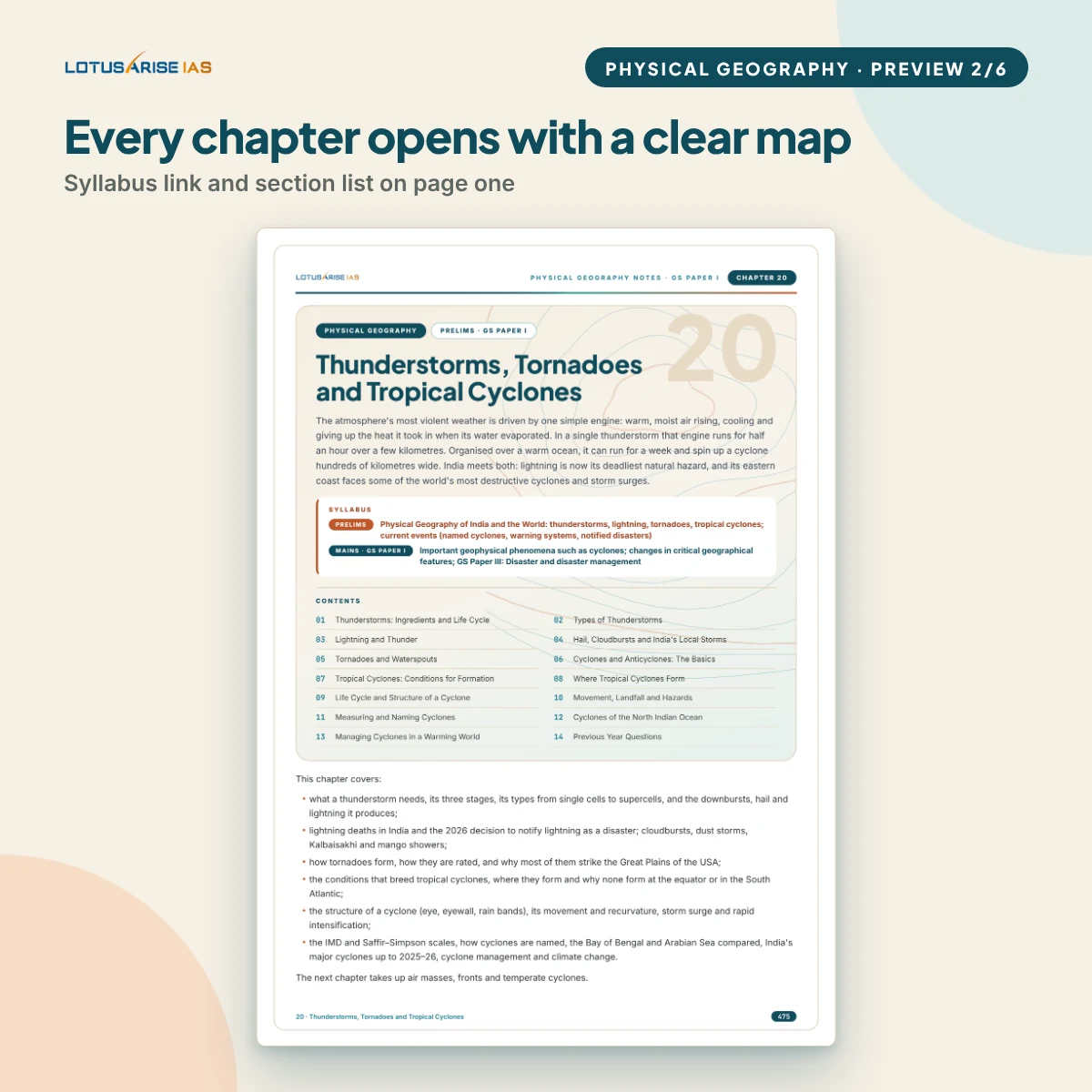
Want to see it first? Download the free sample PDF — the cover, the full contents and two complete chapters (01 The Universe and 20 Thunderstorms, Tornadoes and Tropical Cyclones).
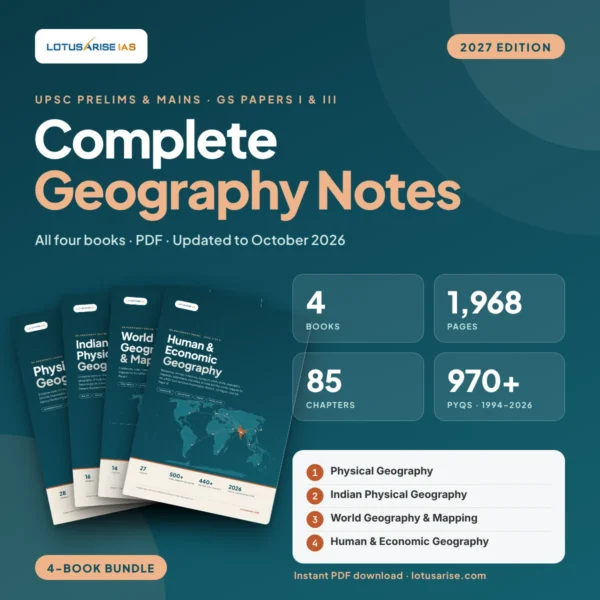
Also available: the Complete Geography Notes bundle — all four GS Geography books for ₹599.
One-time payment. No subscription. No recurring charge.
Instant PDF download after payment. The download link is also sent to your email — please check the spam folder if it does not arrive in a few minutes. Download it again any time from My Account.
For support: support@lotusarise.com
You may also like…
-

Complete Geography Notes for UPSC GS Prelims + Mains: 4-Book Bundle (2027 Edition) by LotusArise IAS
Original price was: ₹1,500.00.₹599.00Current price is: ₹599.00.

Related products
-
International Relations Notes for UPSC: Prelims & Mains GS Paper II (2027 Edition) by LotusArise IAS
Original price was: ₹500.00.₹236.00Current price is: ₹236.00. -
-
-