

International Relations Notes for UPSC: Prelims & Mains GS Paper II (2027 Edition) by LotusArise IAS
Original price was: ₹500.00.₹236.00Current price is: ₹236.00.
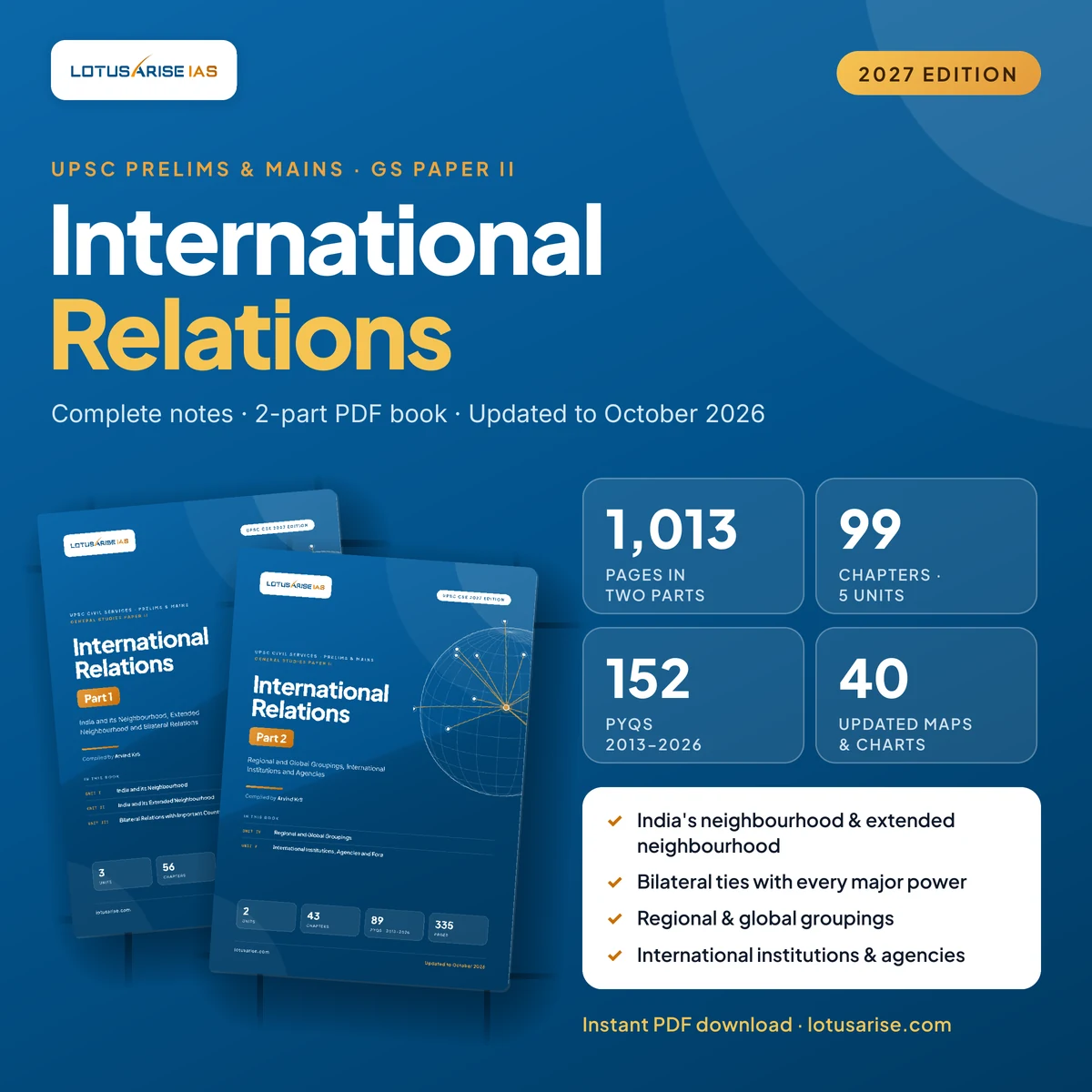
₹236 launch price for the 2027 Edition. MRP ₹500 — 1,013 pages in two parts, about 23 paise a page.
Most aspirants study International Relations the wrong way. Notes from 2022 that still count NATO at 30 members and BRICS at five. A news site for the latest summit, a Telegram PDF for the UN — and nothing that tells you what changed since. Then Mains asks about India–US tariffs or the Indus Waters Treaty, Prelims asks who is in which grouping, and the notes are three years behind the question.
International Relations Notes for UPSC puts the whole of GS Paper II IR in one updated book.
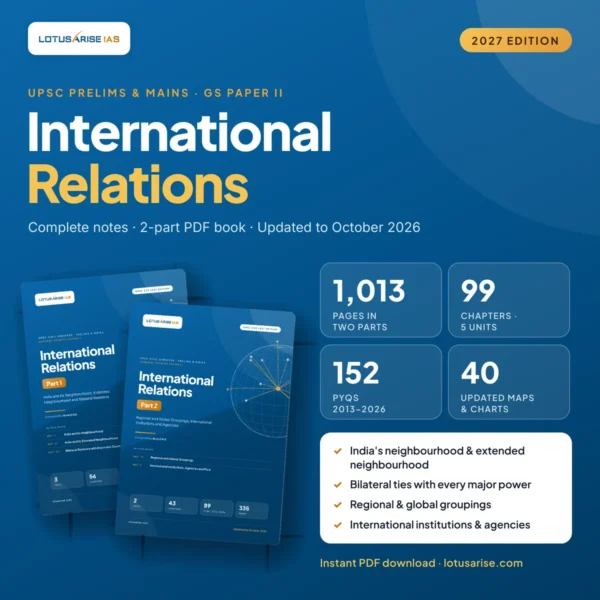
🌏 99 chapters in 5 units, 1,013 pages — neighbourhood, extended neighbourhood, major powers, groupings and institutions
🗓️ Updated to October 2026 — tariffs and trade deals, BRICS and SCO expansion, Operation Sindoor, the West Asia war, new partnerships
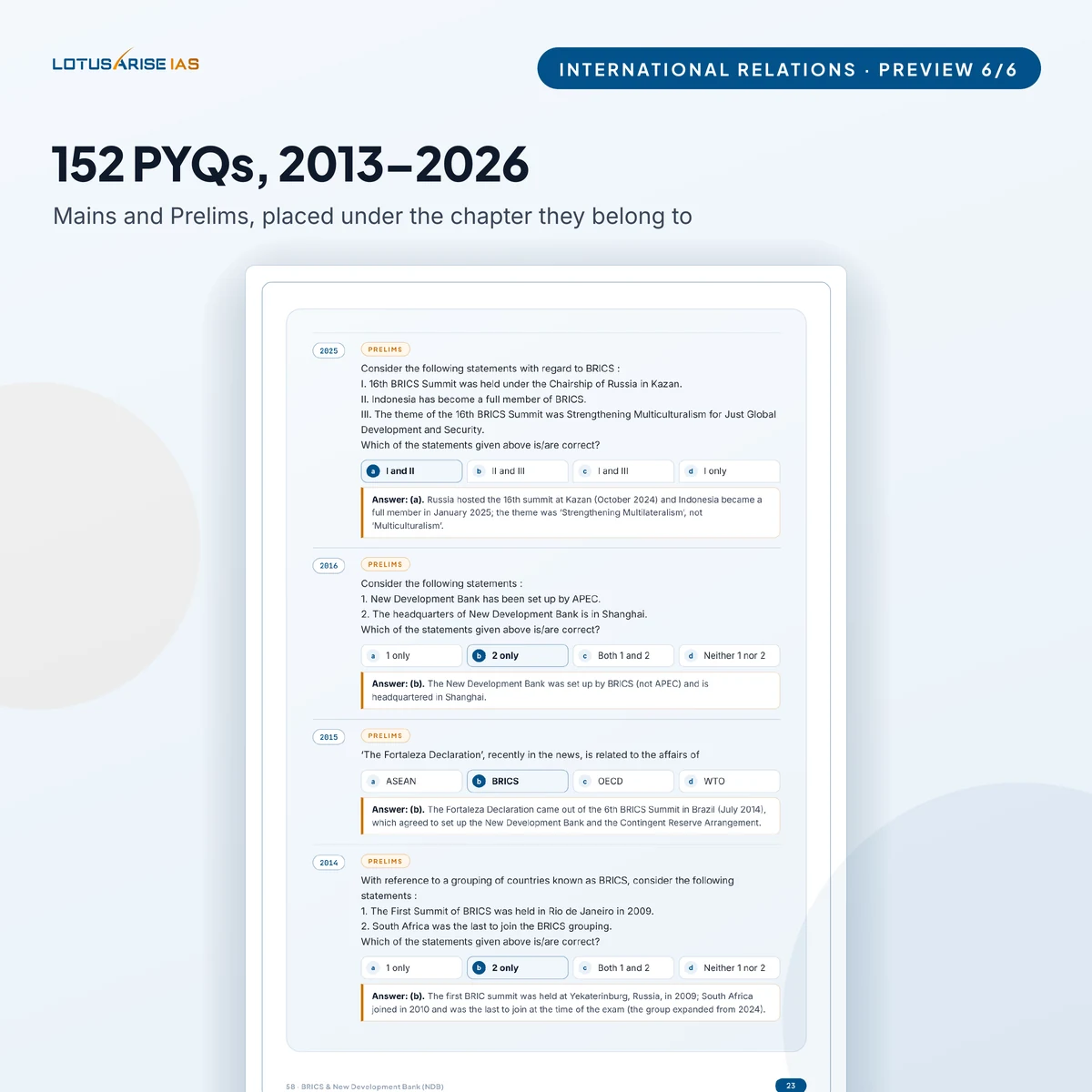
📝 152 PYQs (2013–2026) — 61 Mains and 91 Prelims, each placed under the chapter that answers it
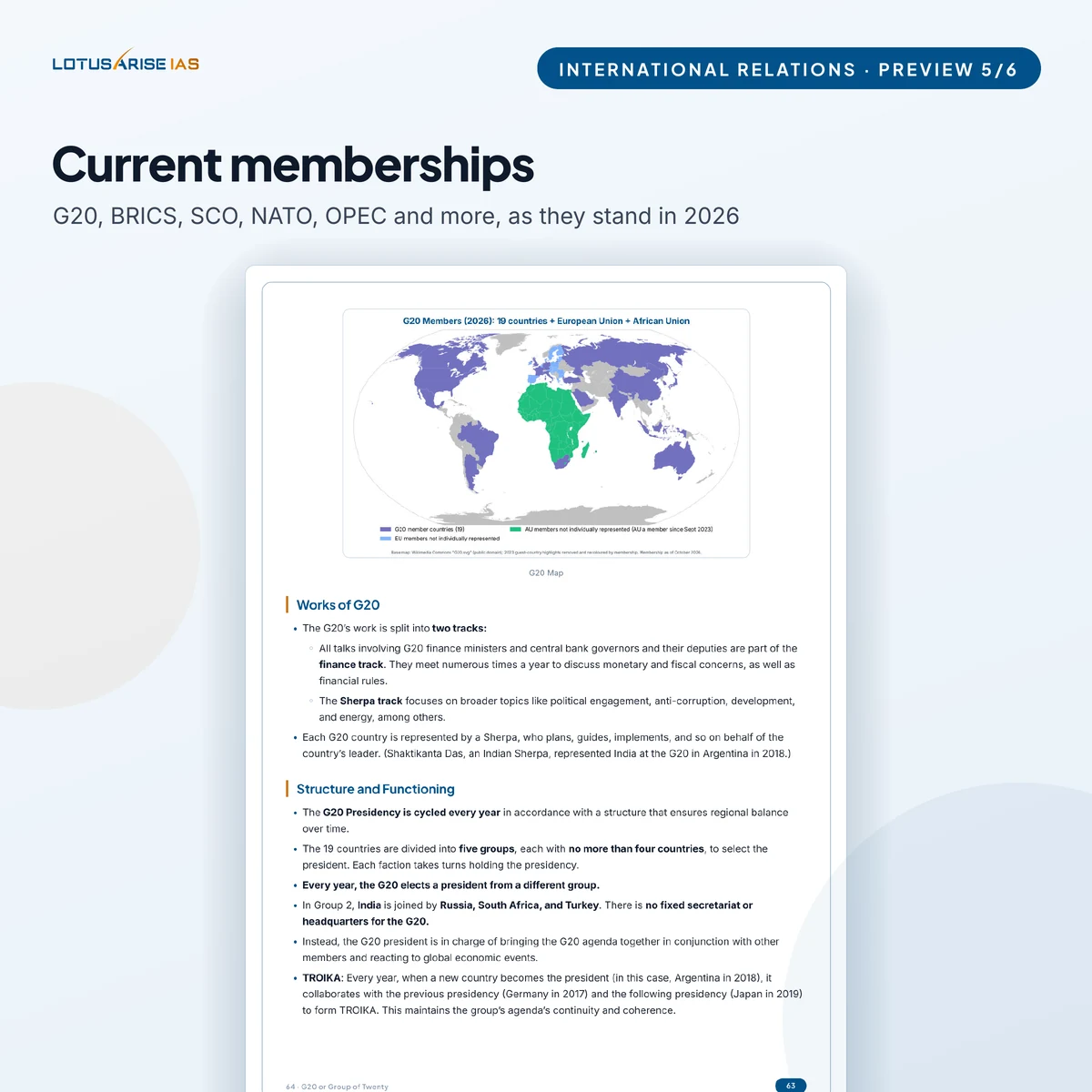
🗺️ 40 new maps and charts — current memberships of G20, BRICS, SCO, NATO, OPEC, ASEAN and more
📱 Instant PDF download — Part 1 and Part 2, on laptop, mobile or tablet, offline, printable
One-time payment. No subscription. Instant download after purchase.
Free sample: Part 1 (PDF)Free sample: Part 2 (PDF)
⭐ Read by 300,000+ UPSC aspirants every month on LotusArise IAS
Features:
- Comprehensive Coverage
- Complete Syllabus
- Suitable for: UPSC & State PSCs exams
- Format: Digital PDF (Downloadable)
- 337,362+ aspirants visit every month
The problem nobody admits about International Relations
Ask an aspirant a few months before Mains what worries them in GS Paper II, and International Relations comes up quickly. Not because the subject is hard. They will say one of three things:
“My notes stop around 2022. I don’t know what happened with Canada, Bangladesh or the Maldives after that, or which summits I’m supposed to know.”
“I can write a decent answer on India–China, but I don’t know the current numbers — trade, members, who chairs what this year.”
“I have one PDF for bilateral relations, another for organisations and a folder of current-affairs notes, and none of them agree with each other.”
These are not reading problems. IR is not conceptually difficult; what goes wrong is that the material ages fast, sits in scattered files, and is never tied to what UPSC actually asks. International Relations Notes for UPSC is one book built to fix exactly that.
Why IR deserves a book of its own
International Relations is a full part of the GS Paper II syllabus — India and its neighbourhood, bilateral, regional and global groupings, the effect of other countries’ policies on India’s interests, the Indian diaspora, and international institutions. Every year it brings direct Mains questions, and Prelims keeps returning to organisations, groupings and agreements. The 152 previous year questions inside this book, from 2013 to 2026, are the proof — every one placed in the chapter that answers it.
The same material feeds the Essay paper and the Interview, where a question on India’s foreign policy is almost certain. And it changes every year — a new member here, a summit there, a trade deal concluded, a treaty held in abeyance. So the challenge is not understanding IR. It is having one source that is complete, current and organised the way the syllabus reads.
What’s inside
🌏 The complete notes — 99 chapters, 1,013 pages, in two parts
Part 1 (678 pages) — India’s relations, unit by unit:
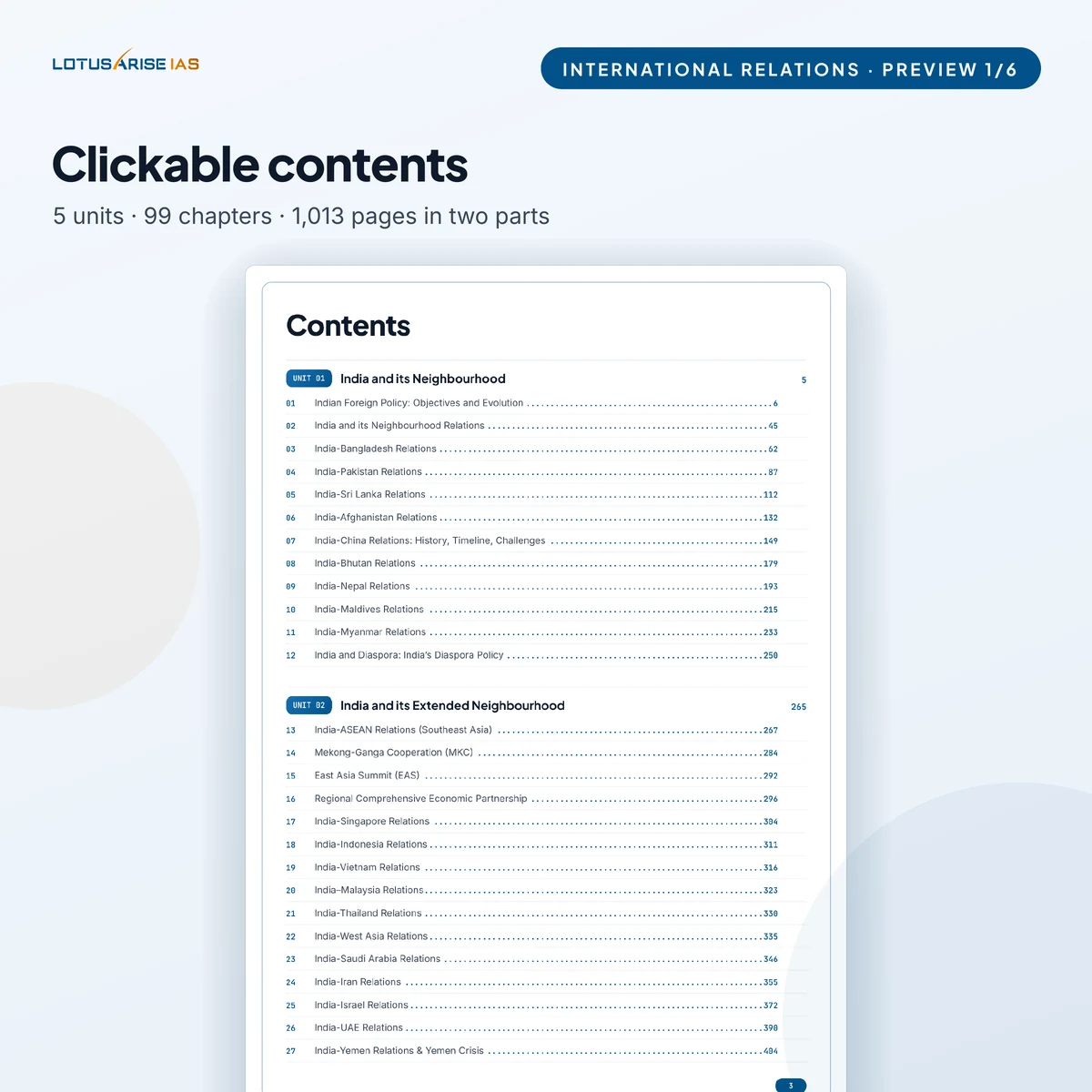
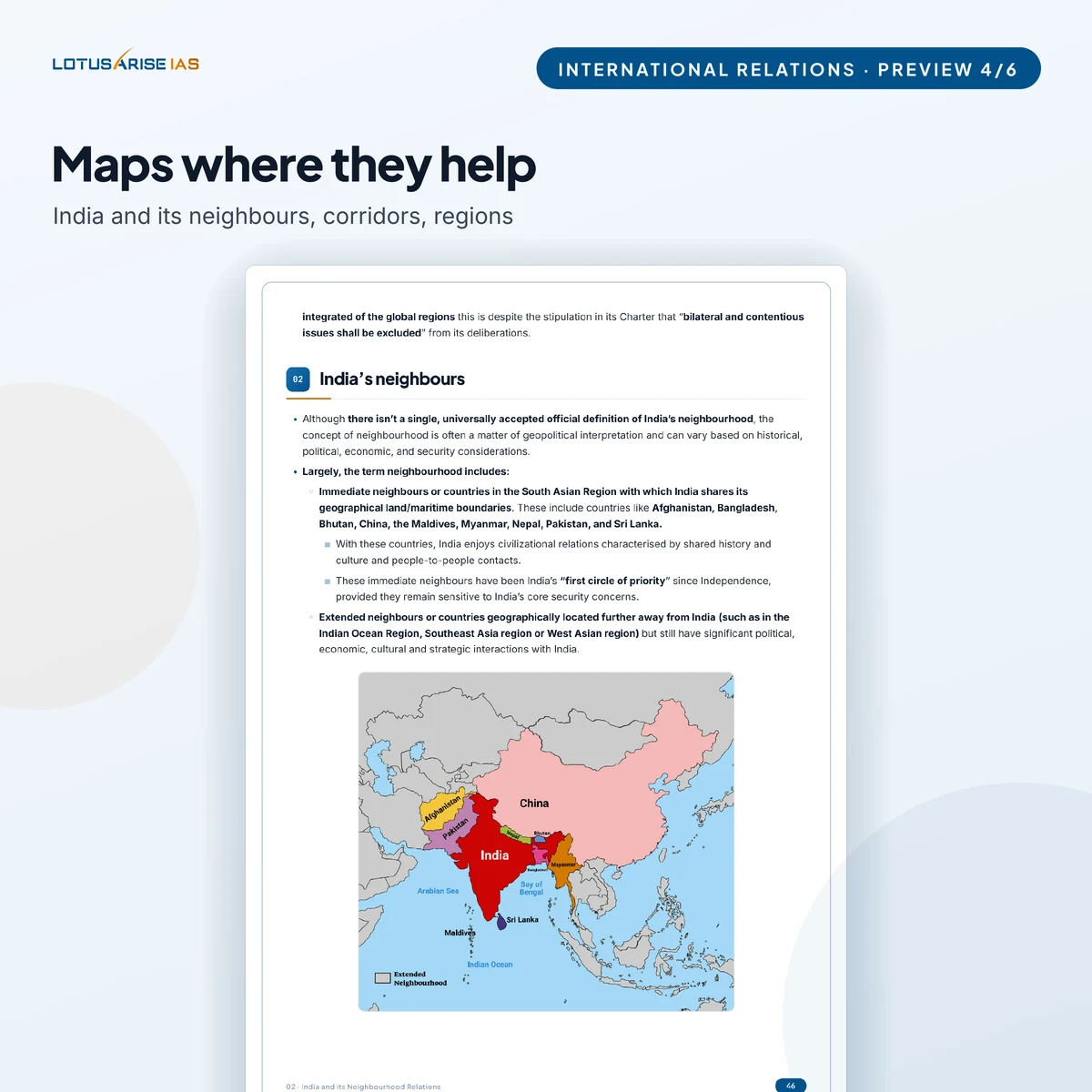
- India and its Neighbourhood — objectives and evolution of foreign policy, Neighbourhood First, and full chapters on Bangladesh, Pakistan, Sri Lanka, Afghanistan, China, Bhutan, Nepal, the Maldives and Myanmar, plus the diaspora policy
- India and its Extended Neighbourhood — ASEAN, Mekong-Ganga Cooperation, the East Asia Summit, RCEP, Singapore, Indonesia, Vietnam, Malaysia, Thailand; West Asia with Saudi Arabia, Iran, Israel, the UAE, Yemen, Bahrain, Qatar, Oman, the GCC and the OIC; Central Asia country by country, INSTC and TAPI
- Bilateral Relations with Important Countries — the US, Russia, Japan, South Korea, Australia, France, Germany, the UK, Italy, the EU, Canada, the Pacific Islands, Africa, Egypt, Latin America and Brazil
Part 2 (335 pages) — groupings and institutions:
- Regional and Global Groupings — regionalism and multilateralism, BRICS and the NDB, BIMSTEC, SAARC, SASEC, SCO, G7, G20, IBSA, AUKUS, the Quad, export control regimes, the Indian Ocean Region, NAM, G4, the Coffee Club, OPEC and the Paris Club
- International Institutions, Agencies and Fora — the UN, its principal organs and specialised agencies, the Security Council, the Human Rights Council, the ICJ and ICC, the World Bank, IMF, WTO, UNESCO, peacekeeping, WIPO, Interpol, AIIB, WHO, ILO, UNICEF, the International Solar Alliance, FATF, NATO, the Arctic Council, OECD, IAEA and CSTO
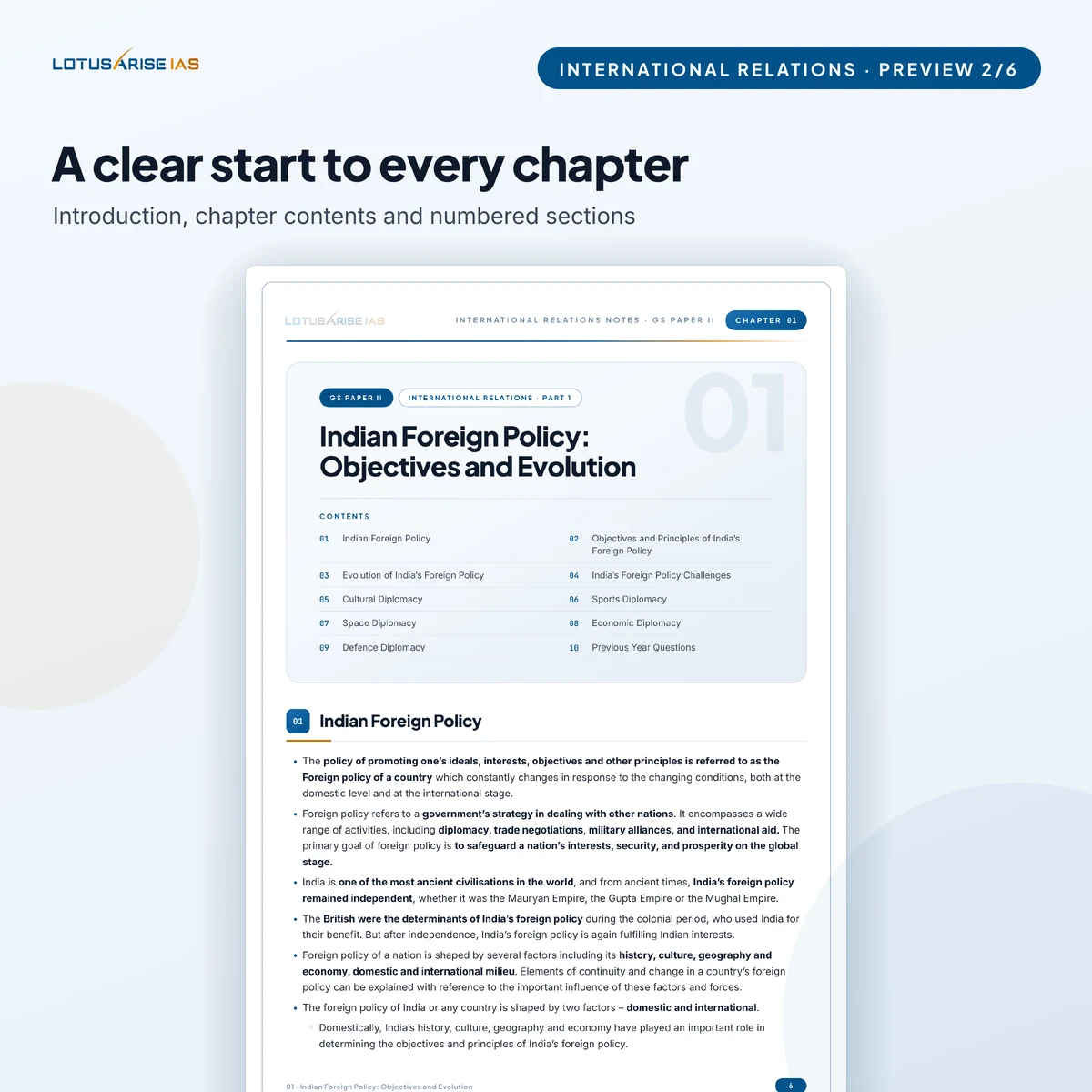
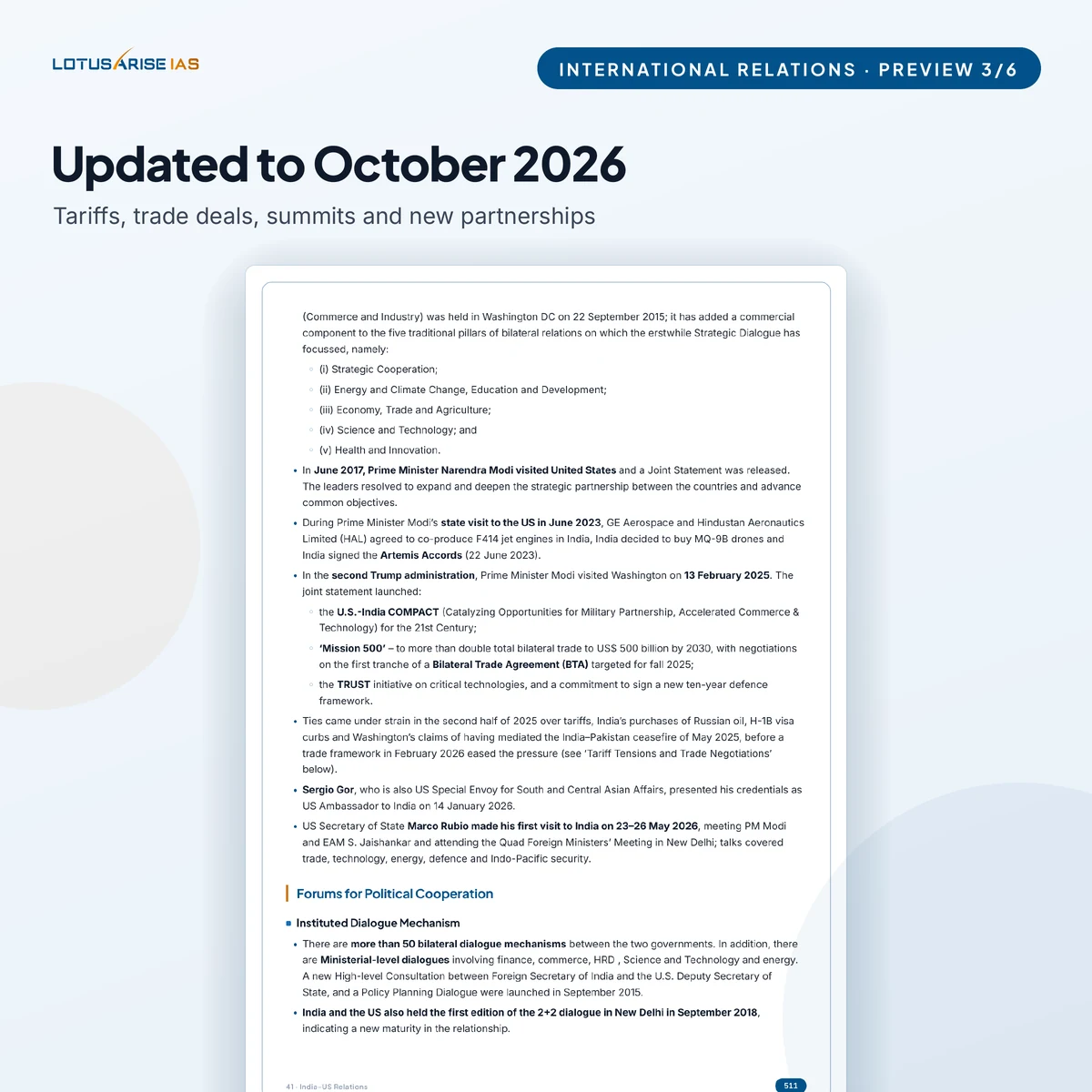
What makes this different from downloaded PDFs: every chapter has been brought up to date to October 2026 — new trade figures, memberships, summits, agreements signed or concluded, and the events that changed relationships, from the 2025 tariffs to Operation Sindoor and the West Asia war. The structure stays exam-first: short bullets, clear headings and key points in bold, so you can revise a chapter in one sitting.
📝 152 PYQs (2013–2026)
61 Mains GS Paper II questions and 91 Prelims questions, in UPSC’s own wording. Prelims questions carry all four options and the answer with a one-line reason. Each question sits at the end of the chapter it belongs to — read the chapter, then see exactly how UPSC has tested it.
🗺️ 40 new maps and charts
Outdated images have been replaced: current membership maps and charts for G20, BRICS, SCO, NATO, OPEC, ASEAN, MERCOSUR and the EU, fresh trade charts for major partners, and a corrected Central Asia map. Original maps that are still accurate are kept.
🗂️ Built for revision
A clickable contents page in each part, unit pages that list every chapter before you begin, and a bookmark panel that takes you to any chapter in one tap.
The aspirant who buys this
First-time aspirants — you want one trusted source for IR from start to finish, instead of stitching together five files in your first year.
Repeaters whose notes are from 2022 or 2023 — the basics are in your head; what you are missing is everything since. This edition carries those updates inside each chapter, where they belong.
Mains aspirants preparing GS Paper II — bilateral relations, groupings and institutions, with the facts and current examples a 250-word answer needs.
Self-study aspirants outside Delhi, Prayagraj or Jaipur — no classroom, no batch timings; two PDFs on your phone that cover the whole of IR.
State PSC aspirants — international relations in most State PSC syllabi overlaps heavily with UPSC, so the same book serves both.
Why not just use free notes from Telegram?
Free IR notes exist, and plenty of aspirants have folders full of them. The problem is not that they are bad. It is that most of them were written two or three years ago, they are spread across a dozen files, and nobody tells you which numbers have since changed. IR punishes old notes more than almost any other subject.
This book is one connected system: 99 chapters in syllabus order, updated to October 2026, with every PYQ placed where it belongs.
If you have the time to track every summit, trade figure and membership change yourself, you may not need this. If you want it already done — open it and start reading — this is what the book is for.
Price and delivery
MRP ₹500 → Launch price ₹236 for 1,013 pages in two parts — about 23 paise a page.
Want to see it first? Download the free samples — each has the cover, the full contents and two complete chapters:
Part 1 free sample (India and its Neighbourhood Relations, India–US Relations) · Part 2 free sample (BRICS and NDB, United Nations).
One-time payment. No subscription. No recurring charge.
Instant PDF download after payment — you get both Part 1 and Part 2. The download links are also sent to your email — please check the spam folder if they do not arrive in a few minutes. Download them again any time from My Account.
For support: support@lotusarise.com
Related products
-

-
-
Ethics, Integrity and Aptitude Notes for UPSC: Mains GS Paper IV (2027 Edition) by LotusArise IAS
Original price was: ₹500.00.₹295.00Current price is: ₹295.00. -