

Social Justice Notes for UPSC
₹236.00
₹236 for the 2027 Edition — 412 pages, about 57 paise a page.
Most aspirants prepare Social Justice the wrong way. An old notes PDF, a scheme list from a monthly magazine, and figures they cannot date. Then the paper asks about the law that replaced MGNREGA, the four Labour Codes or NFHS-6 — and their notes still describe the old system.
Social Justice Notes for UPSC puts the whole subject, current to October 2026, in one book.
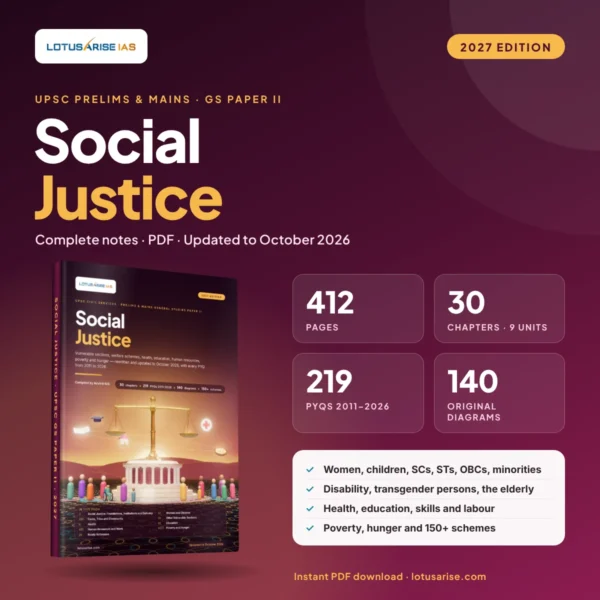
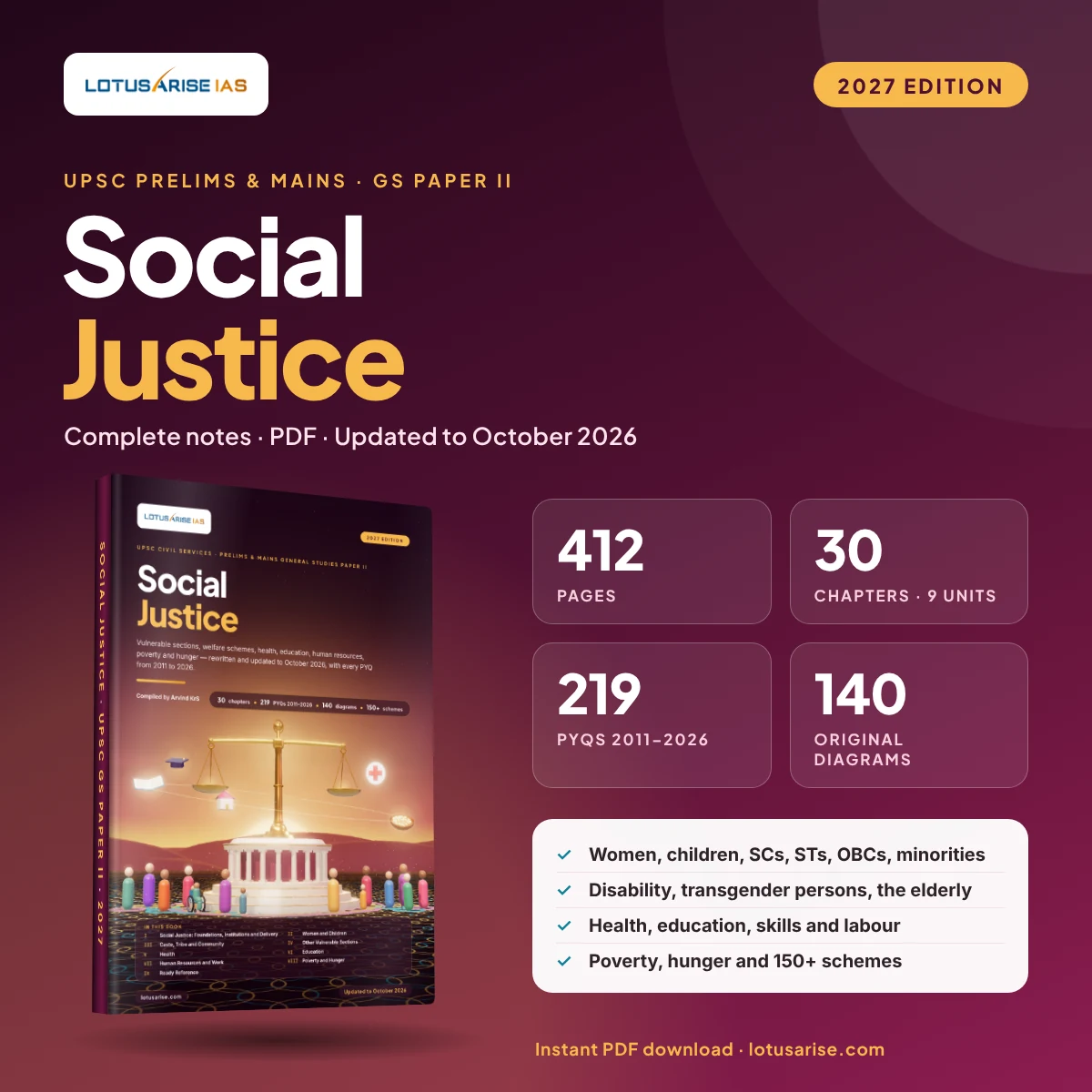
⚖️ 30 chapters in 9 units, 412 pages — women and children, SCs, STs, OBCs and minorities, disability, transgender persons, senior citizens, health, education, labour, poverty and hunger
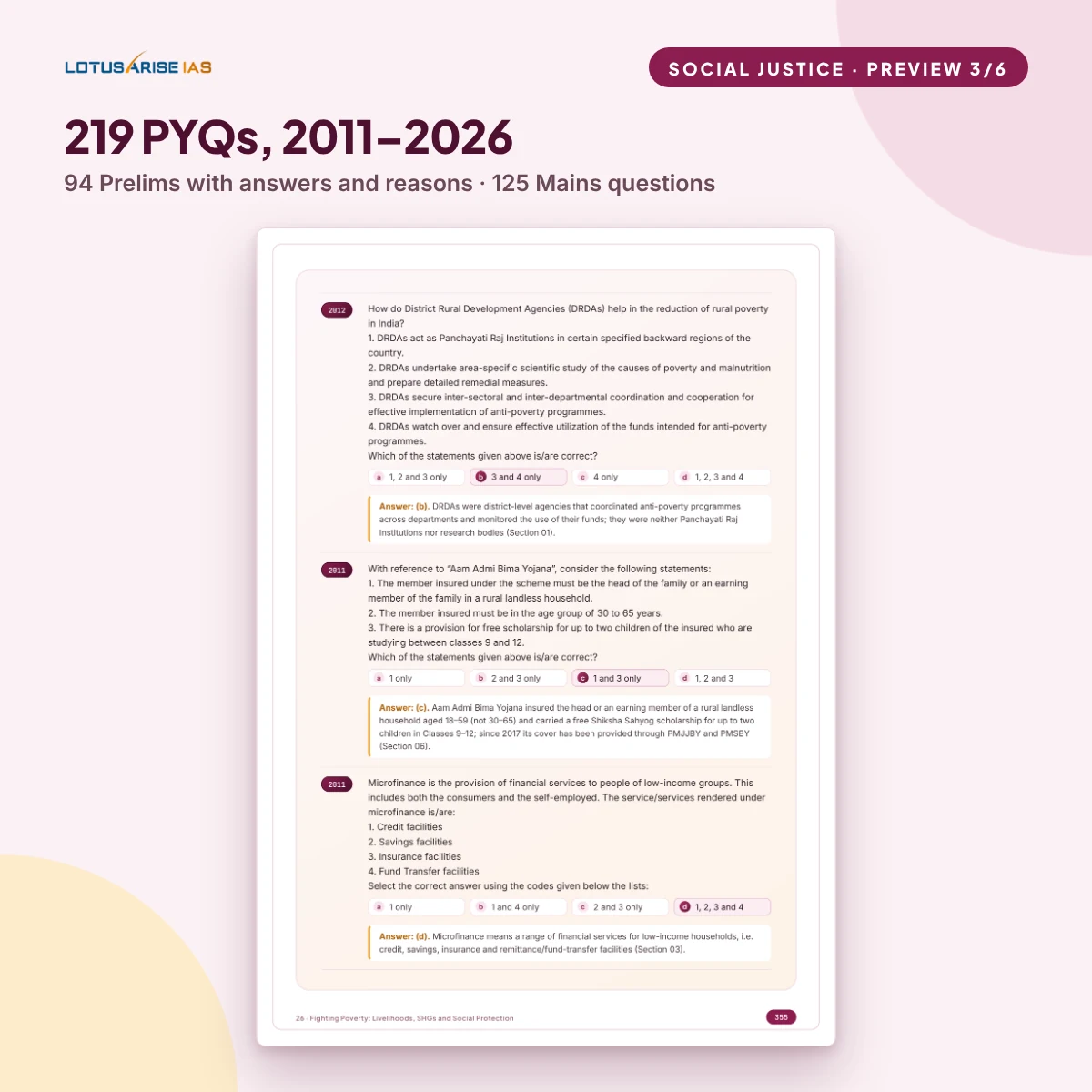
📝 219 PYQs in their chapters — 94 Prelims (2011–2026) with answers and explanations, 125 Mains (2013–2026, including Mains 2026) verbatim
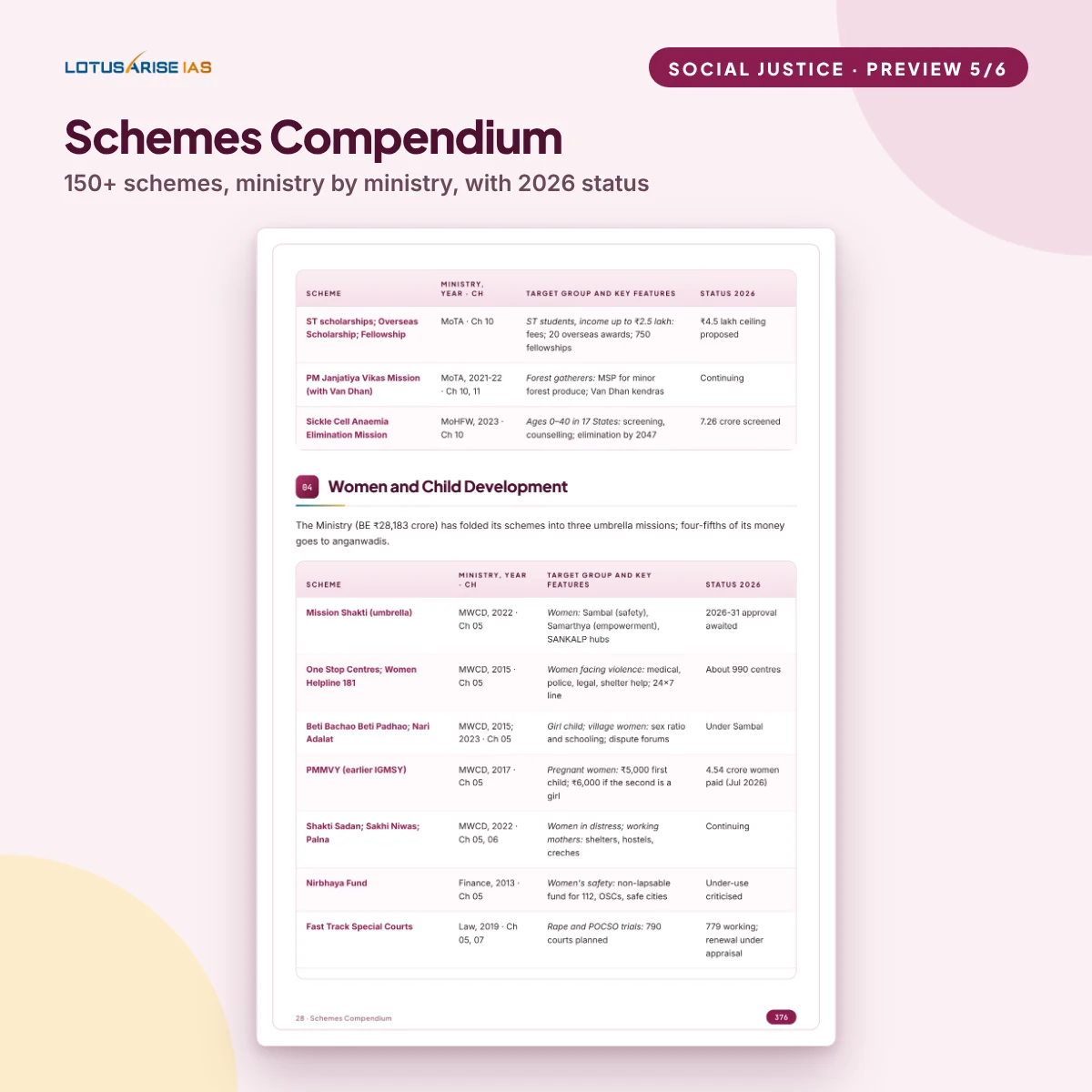
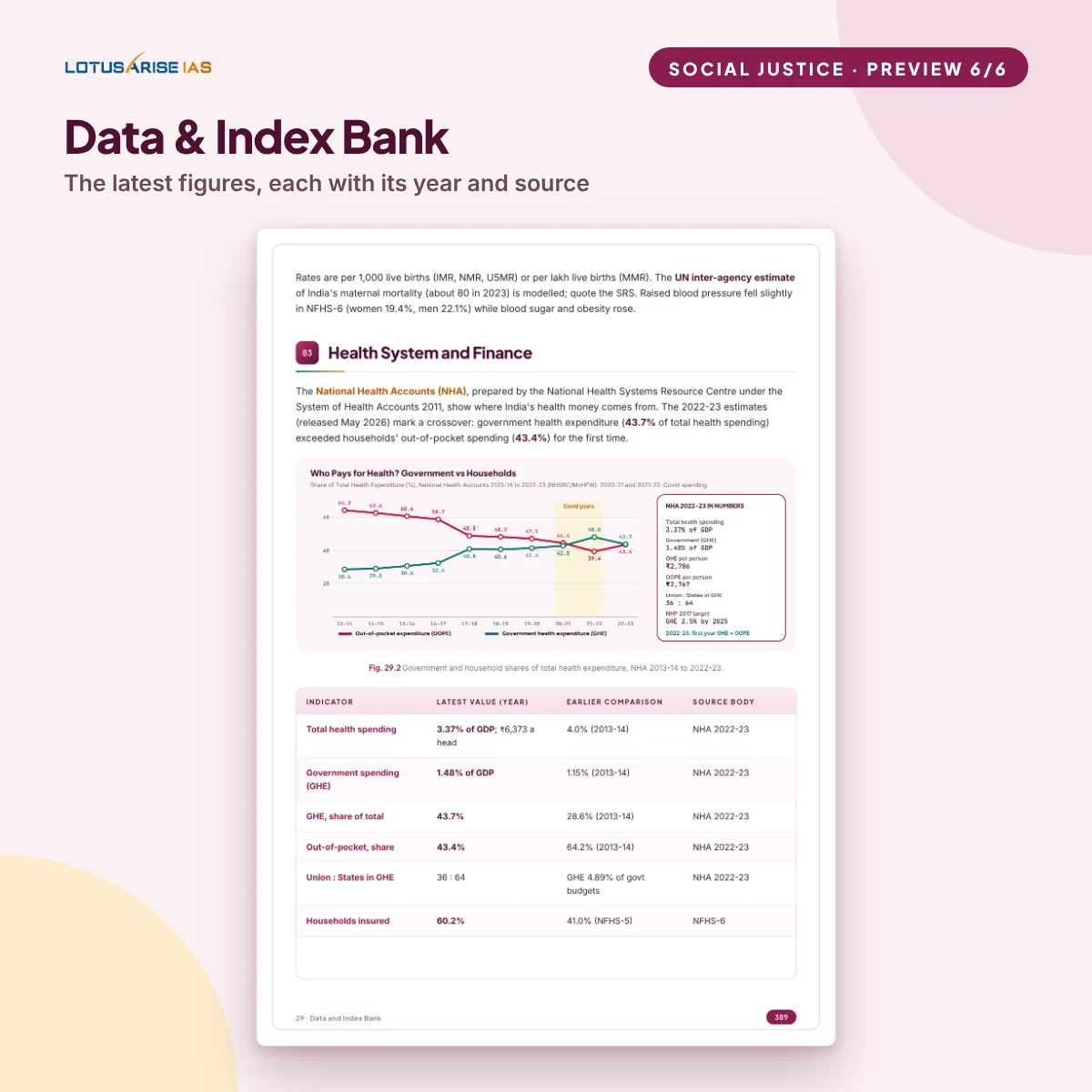
🗂️ Ready-reference unit — a Schemes Compendium of 150+ schemes, a Data & Index Bank, and a Judgments, Committees & Reports Bank
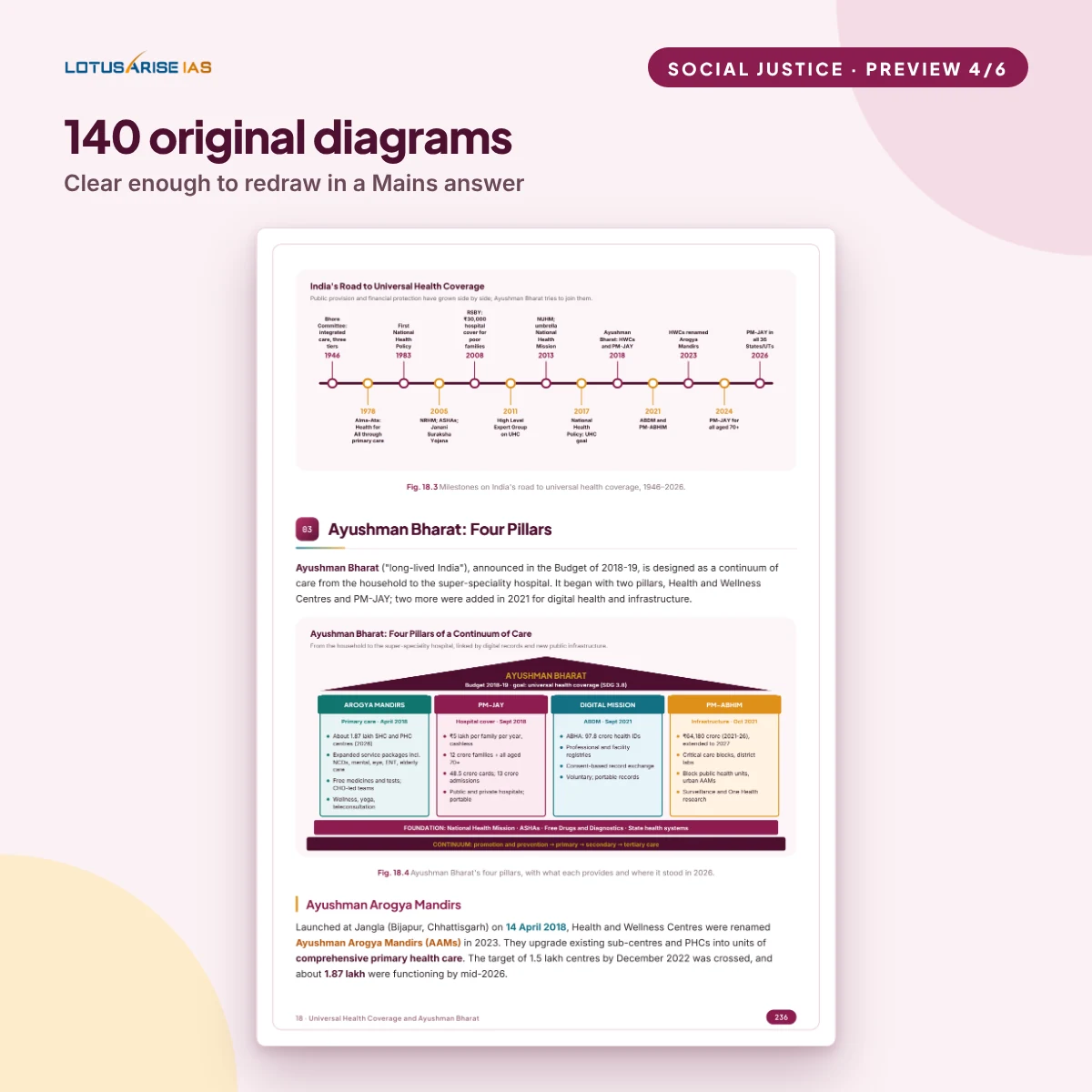
🎨 140 original diagrams — plus a “Schemes at a Glance” table and a Mains answer-writing box in every chapter
📱 Instant PDF download — laptop, mobile or tablet, offline, printable
One-time payment. No subscription. Unlimited downloads — the link does not expire.
⭐ Read by 300,000+ UPSC aspirants every month on LotusArise IAS
Features:
- Comprehensive Coverage
- Complete Syllabus
- Suitable for: UPSC & State PSCs exams
- Format: Digital PDF (Downloadable)
- 337,362+ aspirants visit every month
The problem nobody admits about Social Justice
Ask an aspirant a few months before the exam how they are preparing Social Justice, and the honest answer is “from my old notes and current affairs”. Push a little, and you hear one of three things:
“My notes still talk about MGNREGA and 29 labour laws. I know things have changed, but I don’t know exactly what replaced what, or from when.”
“I have lists of 200 schemes from three magazines. I can’t tell which are still running, which were merged, and which ones UPSC actually asks about.”
“I can write two lines on women’s empowerment or tribal rights. But a 15-mark question wants data, a judgment and a committee — and I have none of them ready.”
These are not effort problems. Most aspirants have read plenty on social justice. What they lack is one current source that joins the Constitution, the schemes, the data and the questions. Social Justice Notes for UPSC is that source, in one book.
Why Social Justice deserves a book of its own
Social Justice sits in GS Paper II, and it is tested on both stages. The 94 Prelims questions from 2011 to 2026 inside this book are the proof for Prelims — social sector initiatives, schemes and indices. The 125 Mains questions from 2013 to 2026 cover welfare schemes for vulnerable sections, health, education, human resources, poverty and hunger. The same material feeds GS Paper I topics on women and poverty, your Essay, and your Interview.
And it is the part of the syllabus that changes fastest. In 2025 and 2026 alone, a new law replaced MGNREGA, the four Labour Codes came into force, the transgender persons law was amended, NFHS-6 was released and the Census 2027 decision on caste enumeration was taken. The real challenge is not understanding social justice. It is having one source that explains the idea, tracks every change and shows how UPSC asks about it.
What’s inside
⚖️ The complete notes — 30 chapters in 9 units, 412 pages
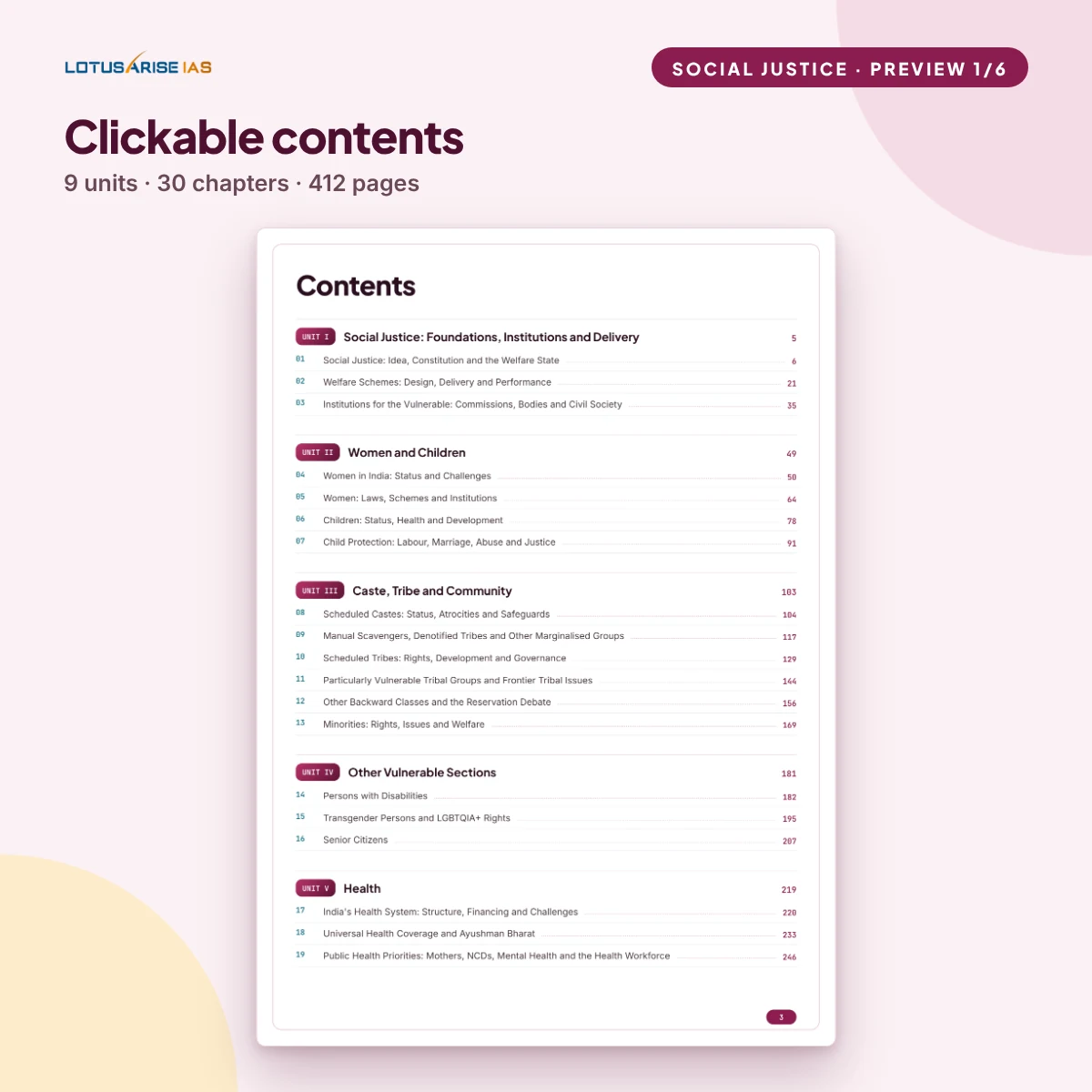
Every part of the GS Paper II social justice syllabus, in the order it is best learnt:
- Foundations, Institutions and Delivery — the idea of social justice and the Constitution; welfare schemes, their design, DBT and targeting; national commissions and civil society
- Women and Children — status and challenges; laws, schemes and institutions; child health and development; child labour, child marriage, abuse and juvenile justice
- Caste, Tribe and Community — Scheduled Castes and atrocities law; manual scavengers and denotified tribes; Scheduled Tribes, forest rights and PVTGs; OBCs and the reservation debate; minorities
- Other Vulnerable Sections — persons with disabilities; transgender persons and LGBTQIA+ rights; senior citizens
- Health — the health system and its financing; universal health coverage and Ayushman Bharat; public-health priorities
- Education — school education and the Right to Education; NEP 2020 and languages; higher education and examinations
- Human Resources and Work — human resource development, skills and youth; labour, gig and migrant workers
- Poverty and Hunger — poverty concepts and measurement; livelihoods, SHGs and social protection; hunger, malnutrition and food security
- Ready Reference — the Schemes Compendium, the Data & Index Bank, and the Judgments, Committees & Reports Bank
What makes this different from downloaded PDFs: every chapter is rewritten for the exam and current to October 2026. The VB-G RAM G Act 2025 (in force from 1 July 2026), the four Labour Codes, the Transgender Persons (Protection of Rights) Amendment Act 2026, the status of women’s reservation, NFHS-6 (2023-24), SRS 2024, National Health Accounts 2022-23, PLFS 2025, UDISE+ 2025-26, AISHE 2023-24, the World Bank’s April 2026 poverty estimates, NEET-UG 2026 and the Public Examinations amendment are already in their chapters. Every chapter was fact-checked independently against official sources.
📝 219 PYQs — Prelims 2011–2026 and Mains 2013–2026
All 94 Prelims questions come with their options, the answer and a one-line explanation. All 125 Mains questions, including Mains 2026, appear verbatim. Each one sits under the chapter that answers it, so you finish a topic and immediately see how UPSC has tested it.
🗂️ The Ready Reference unit
- Schemes Compendium — 150+ schemes, ministry by ministry plus notable State schemes, each with its year, target group, key features and status in 2026
- Data & Index Bank — demography, health, nutrition, education, employment, poverty, gender and crime data with their sources, and India’s ranks on the global indices
- Judgments, Committees & Reports Bank — landmark cases with their holding in one line, the committees and commissions with their key recommendations, and who publishes which report or index
🎨 140 original diagrams, and tools in every chapter
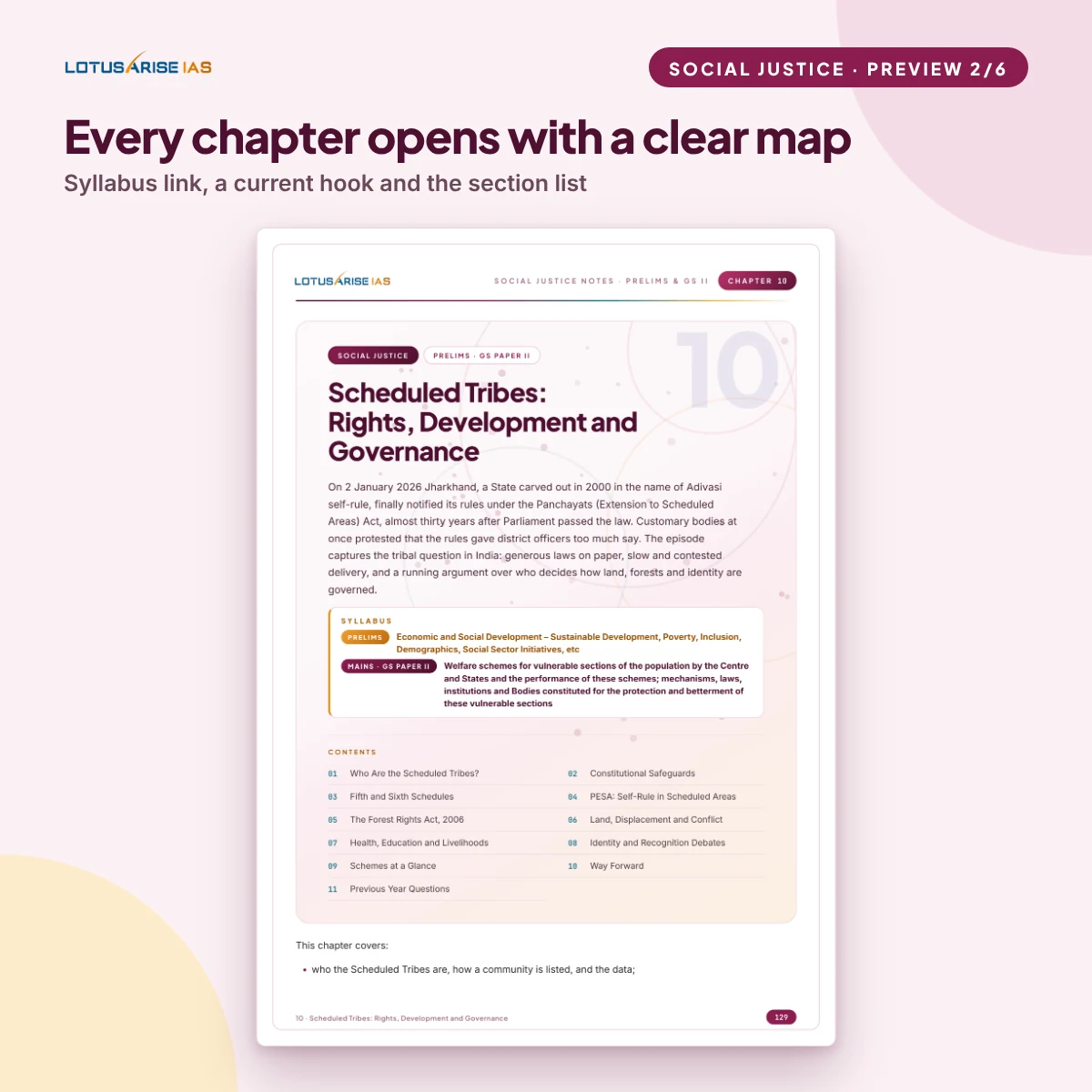
Original diagrams and charts drawn simple enough to reproduce in a Mains answer. Every chapter also has a “Schemes at a Glance” table for quick revision and a Mains answer-writing box that shows how to turn the chapter into marks.
The aspirant who buys this
First-time aspirants — you want one trusted book for Social Justice from day one, instead of stitching together old notes, magazines and scheme lists.
Repeaters whose GS II answers stayed general — you know the themes. What costs you marks is the missing data point, judgment or committee. The ready-reference banks and the chapter-wise PYQs fix exactly that.
Prelims-focused aspirants — schemes, indices and social-sector initiatives are tested every year. The Schemes Compendium and the Data & Index Bank are built for that revision.
Self-study aspirants outside Delhi, Prayagraj or Jaipur — no classroom, no batch timings; one PDF on your phone that covers the whole subject.
State PSC aspirants — welfare, health, education and vulnerable sections are part of most State PSC syllabi, so the same book serves both.
Why not just use free notes and current-affairs PDFs?
Free social justice material exists, and most aspirants have folders full of it. The problem is not that it is bad. It is that it is scattered and dated: the Constitution in one file, schemes in another, data from different years, and laws described as they were before 2025.
This book is one connected system: the whole syllabus in sequence, every PYQ placed where it belongs, the schemes, data and judgments collected for revision, and facts checked to October 2026.
If you have the time and discipline to build that system yourself from scattered sources, you may not need this. If you want it already built — open it and start — this is what the book is for.
Price and delivery
₹236 for 412 pages — about 57 paise a page, with 219 previous year questions and developments up to October 2026 that a printed guide cannot carry.
Want to see it first? Download the free sample PDF — the cover, the full contents, two unit pages and two complete chapters (01 and 26).
One-time payment. No subscription. No recurring charge.
Instant PDF download after payment. The download link is also sent to your email — please check the spam folder if it does not arrive in a few minutes. Download it again any time from My Account.
For support: support@lotusarise.com
Related products
-

-
Indian Physical Geography Notes for UPSC: Prelims & Mains GS Paper I (2027 Edition) by LotusArise IAS
Original price was: ₹300.00.₹149.00Current price is: ₹149.00. -
Science and Technology Notes for UPSC: Prelims & Mains GS Paper III (2027 Edition) by LotusArise IAS
Original price was: ₹500.00.₹295.00Current price is: ₹295.00. -
Complete Geography Notes for UPSC GS Prelims + Mains: 4-Book Bundle (2027 Edition) by LotusArise IAS
Original price was: ₹1,500.00.₹599.00Current price is: ₹599.00.