

Post-Independence Indian History Notes for UPSC
₹176.00
₹176 for the UPSC 2027 Edition — 255 pages, under 70 paise a page.
Post-independence India comes last in the GS Paper I syllabus, so it is the part most aspirants rush. Junagadh or Hyderabad first? Which commission rejected language as the basis for new states? What did the Gujral Doctrine say? A fifteen-mark Mains answer on the integration of the states needs these facts in order, and Prelims builds its options from the same chapters.
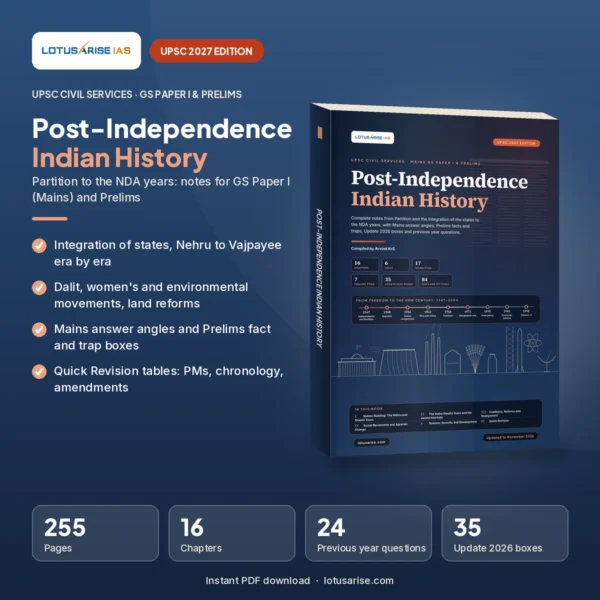
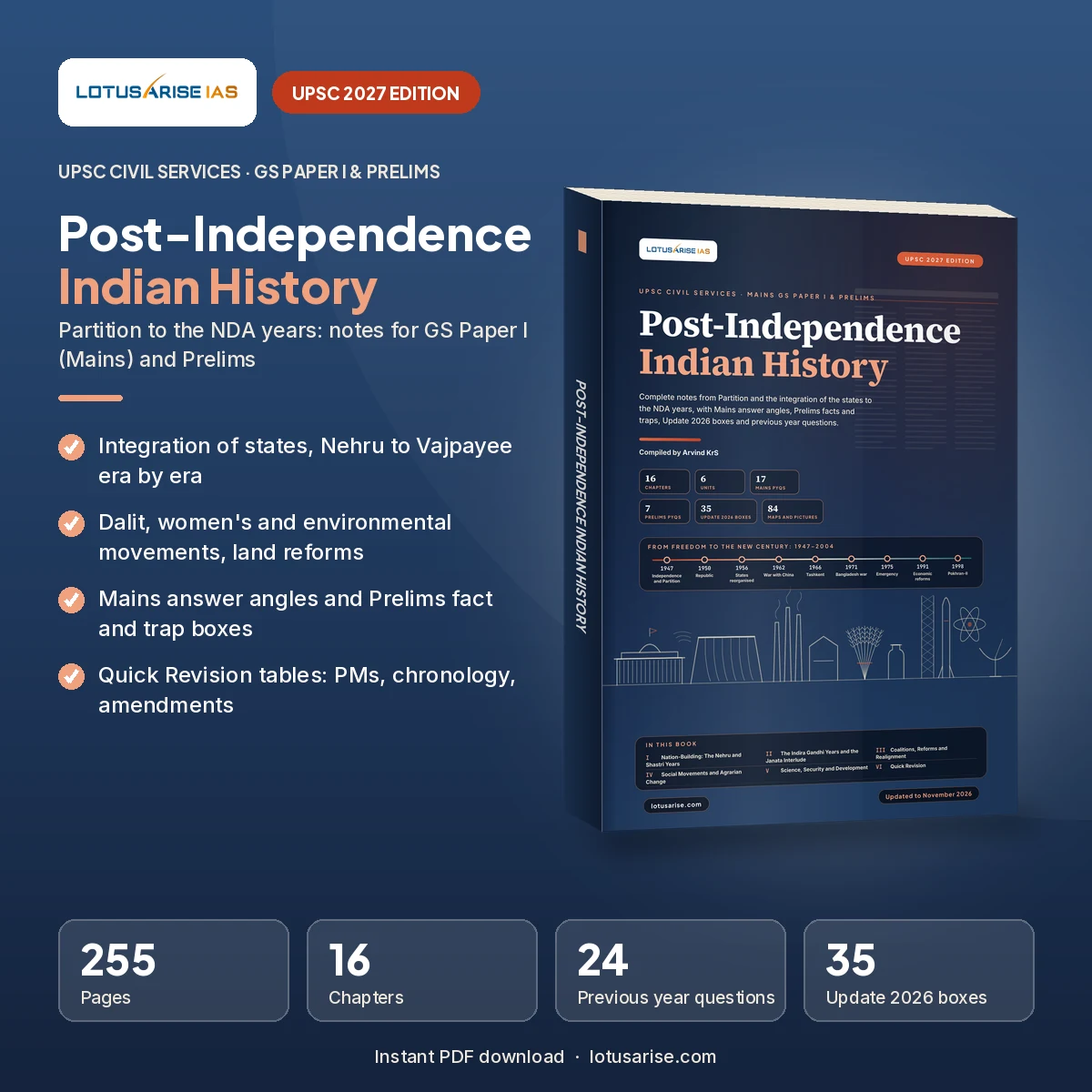
Post-Independence Indian History Notes for UPSC puts 1947 to 2004 in one revisable book.
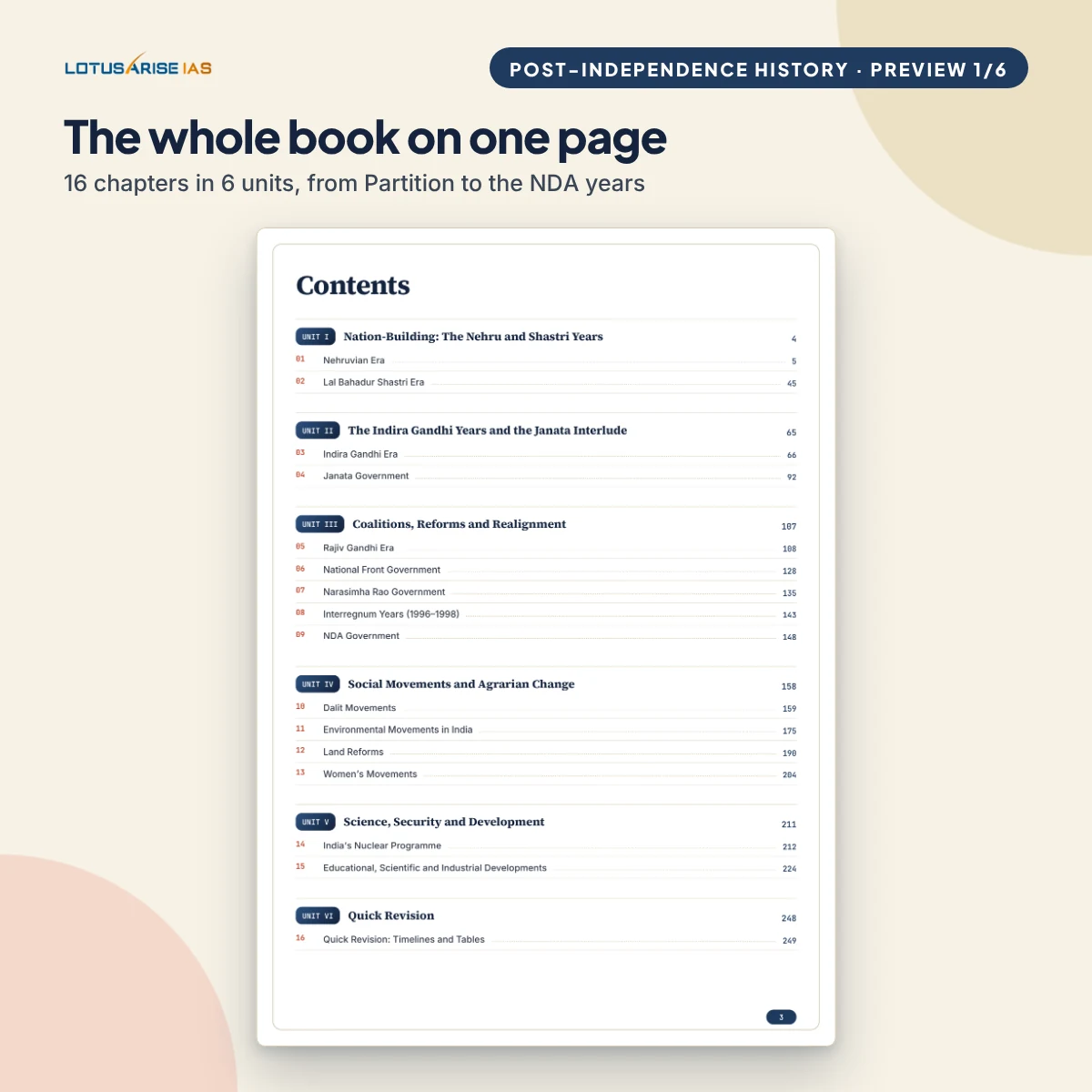
📜 16 chapters in 6 units, 255 pages — Partition and the integration of the states, Nehru to Vajpayee era by era, Dalit, women’s and environmental movements, land reforms, the nuclear programme and India’s development
✍️ 17 Mains PYQs, each with an approach, and 13 Mains Answer Angle boxes — how to frame a GS Paper I answer from the notes
🎯 71 Prelims Fact and Prelims Trap boxes, and 7 Prelims PYQs with answers — the names, dates and look-alike confusions options are built from
🆕 35 Update 2026 boxes — what has changed since the notes were written, from 28 states and 8 Union Territories to the Uttarakhand Uniform Civil Code
🗂️ Quick Revision panel in every chapter, plus revision tables — Prime Ministers, a 1947–2004 chronology, wars and agreements, amendments, commissions and movements
📱 Instant PDF download — laptop, mobile or tablet, offline, printable
One-time payment. No subscription. Unlimited downloads — the link does not expire.
⭐ Read by 300,000+ UPSC aspirants every month on LotusArise IAS
Features:
- Comprehensive Coverage
- Complete Syllabus
- Suitable for: UPSC & State PSCs exams
- Format: Digital PDF (Downloadable)
- 337,362+ aspirants visit every month
The part of GS Paper I most aspirants leave for last
Post-independence India sits at the very end of the GS Paper I history syllabus, after the freedom struggle, and that is exactly why it gets squeezed. Ask an aspirant about it a month before Mains and you usually hear one of three things:
“I know Sardar Patel integrated the princely states. Ask me about Junagadh, Hyderabad and Kashmir one by one and I start guessing.”
“The Nehru years are clear. After 1977 it is a blur of coalitions, short governments and Prime Ministers.”
“I have read about Chipko and the Narmada Bachao Andolan, but I cannot write fifteen marks on them without repeating myself.”
None of this is a reading problem. Fifty-seven years of politics, policy and protest overlap with one another — two wars with Pakistan within six years, three governments between 1996 and 1998, commissions and accords with similar names — and most notes are written to be read once, not revised ten times. Post-Independence Indian History Notes for UPSC is built to be revised.
Why post-independence India is worth the hours
Mains GS Paper I names it directly: “post-independence consolidation and reorganisation within the country”. Between 2013 and 2026, UPSC has asked about the integration of the princely states, linguistic reorganisation, the planned economy, the Tashkent Agreement, India’s role in the birth of Bangladesh, the Bhoodan movement and the women’s movement.
The same chapters pay again elsewhere. Land reforms and the nuclear programme come up in GS Paper III, and Prelims picks facts from them — the Satyashodhak Samaj, the Self-Respect Movement, IAEA safeguards. They also feed your Essay and your Interview.
The challenge is not the period. It is having one source that keeps 1947 to 2004 in order, with the Mains framing and the Prelims facts where you can find them again.
What’s inside — 255 pages
📜 The complete notes — 16 chapters in 6 units
- Nation-building: the Nehru and Shastri years — Partition and the integration of the princely states, linguistic reorganisation, the first general election, foreign policy and non-alignment, India–China relations, the 1965 war and Tashkent, the White and Green Revolutions
- The Indira Gandhi years and the Janata interlude — the Congress split, bank nationalisation, the abolition of privy purses, the 1971 war and the Simla Agreement, JP and the Emergency, the Janata government and the Shah Commission, Operation Bluestar
- Coalitions, reforms and realignment — the Punjab and Assam accords, Panchayati Raj, the National Front and the Mandal Commission, the 1991 economic reforms, the Gujral Doctrine, Pokhran-II and the Kargil war
- Social movements and agrarian change — Dalit movements, environmental movements from Chipko and Silent Valley to Narmada, land reforms and Bhoodan, and women’s movements
- Science, security and development — India’s nuclear programme, and educational, scientific and industrial development
- Quick Revision — timelines and tables for the last month
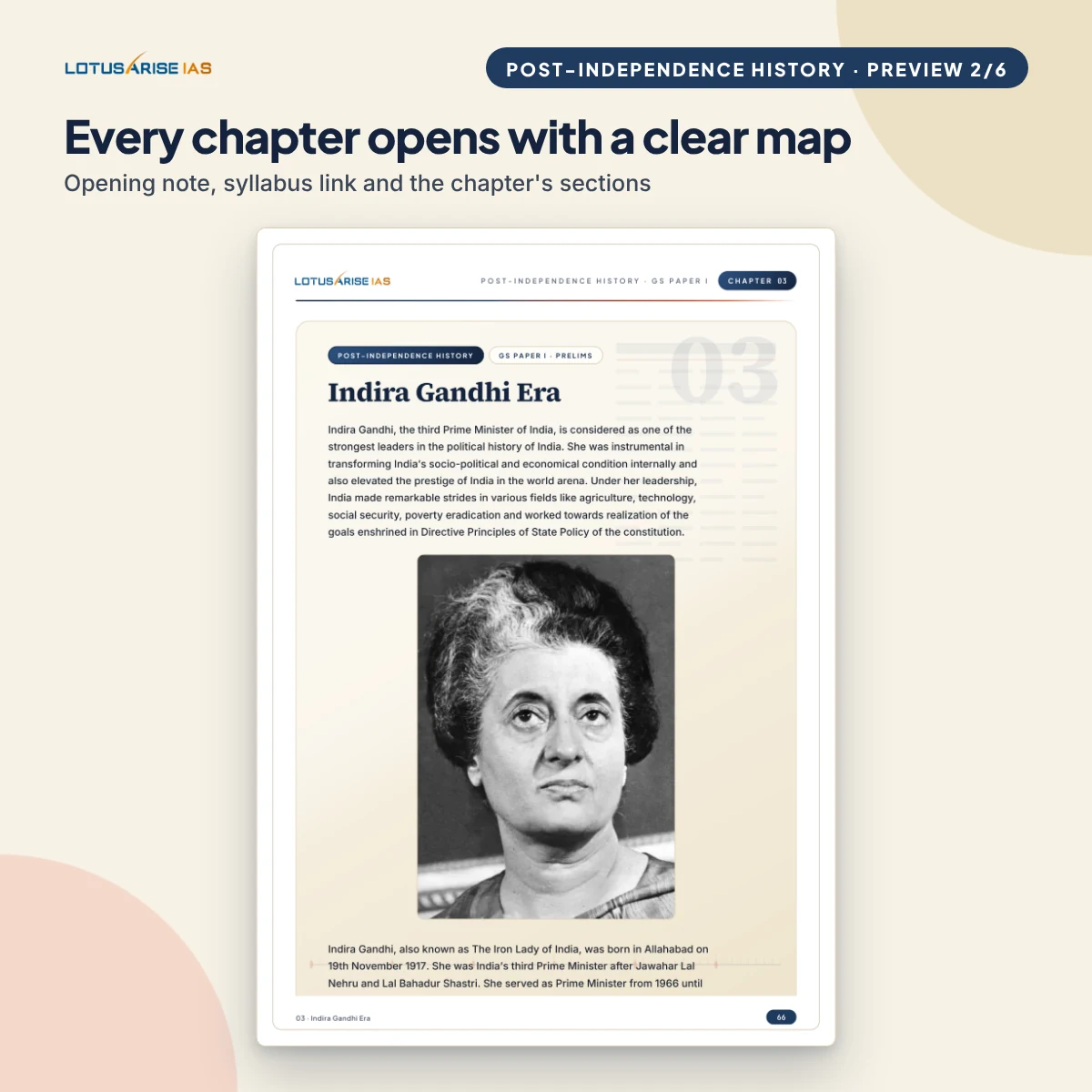
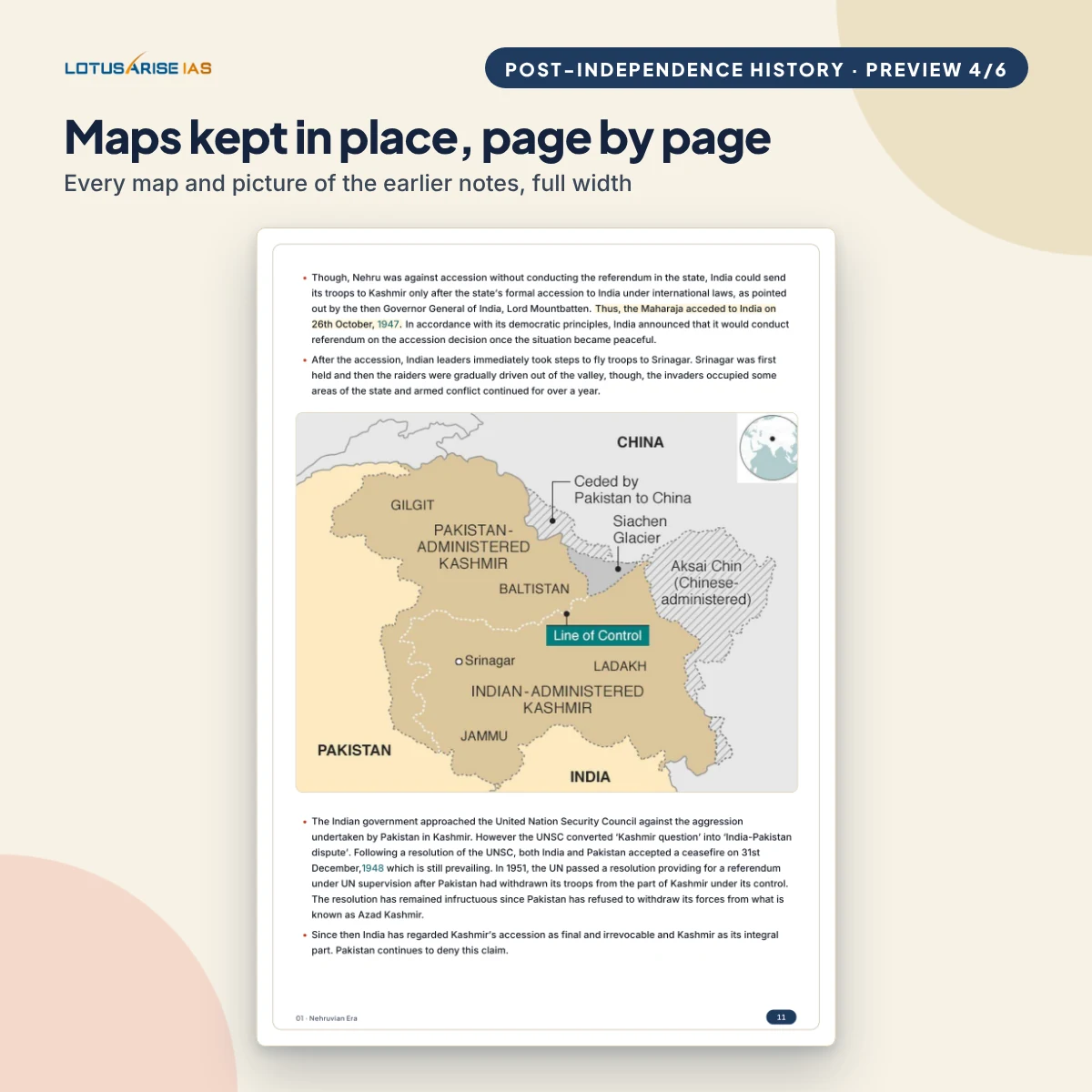
Every map and picture of the earlier edition is kept in its place.
What makes this different from downloaded PDFs: every chapter of this edition was fact-checked against reliable sources — dates, names, figures and spellings — and corrected where needed. Key sentences, definitions and the terms UPSC has asked about are lightly highlighted, and dates stand out in colour, so a second and third reading takes a fraction of the first.
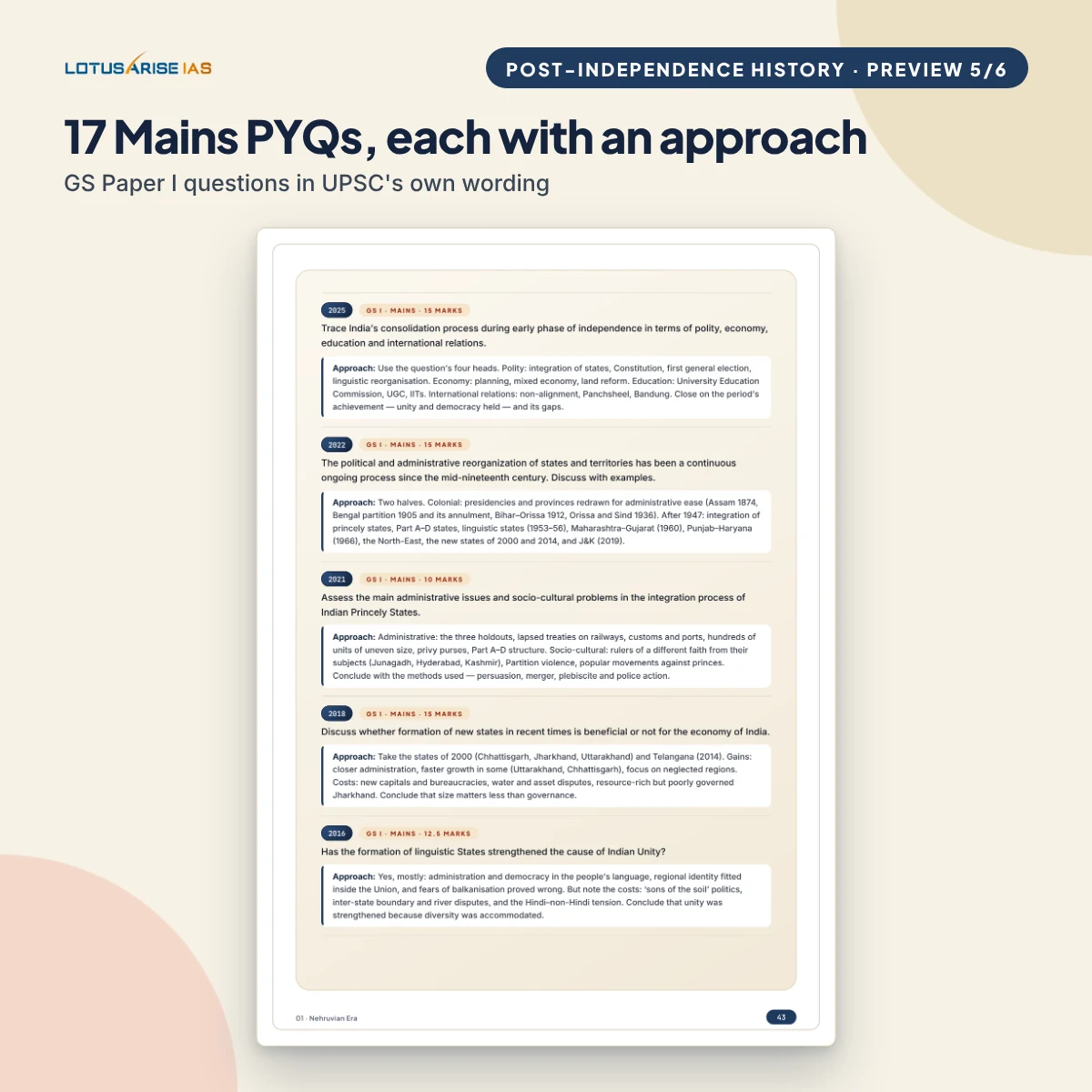
✍️ 17 Mains PYQs and 13 Mains Answer Angle boxes
Mains questions from 2013 to 2026, in UPSC’s own wording, placed in the chapter they belong to. Each comes with a short approach: the heads to use, the facts to bring in and how to close. The Mains Answer Angle boxes inside the chapters show how a topic turns into an answer — the dimensions to cover and the examples that carry marks.
🎯 71 Prelims Fact and Prelims Trap boxes, and 7 Prelims PYQs
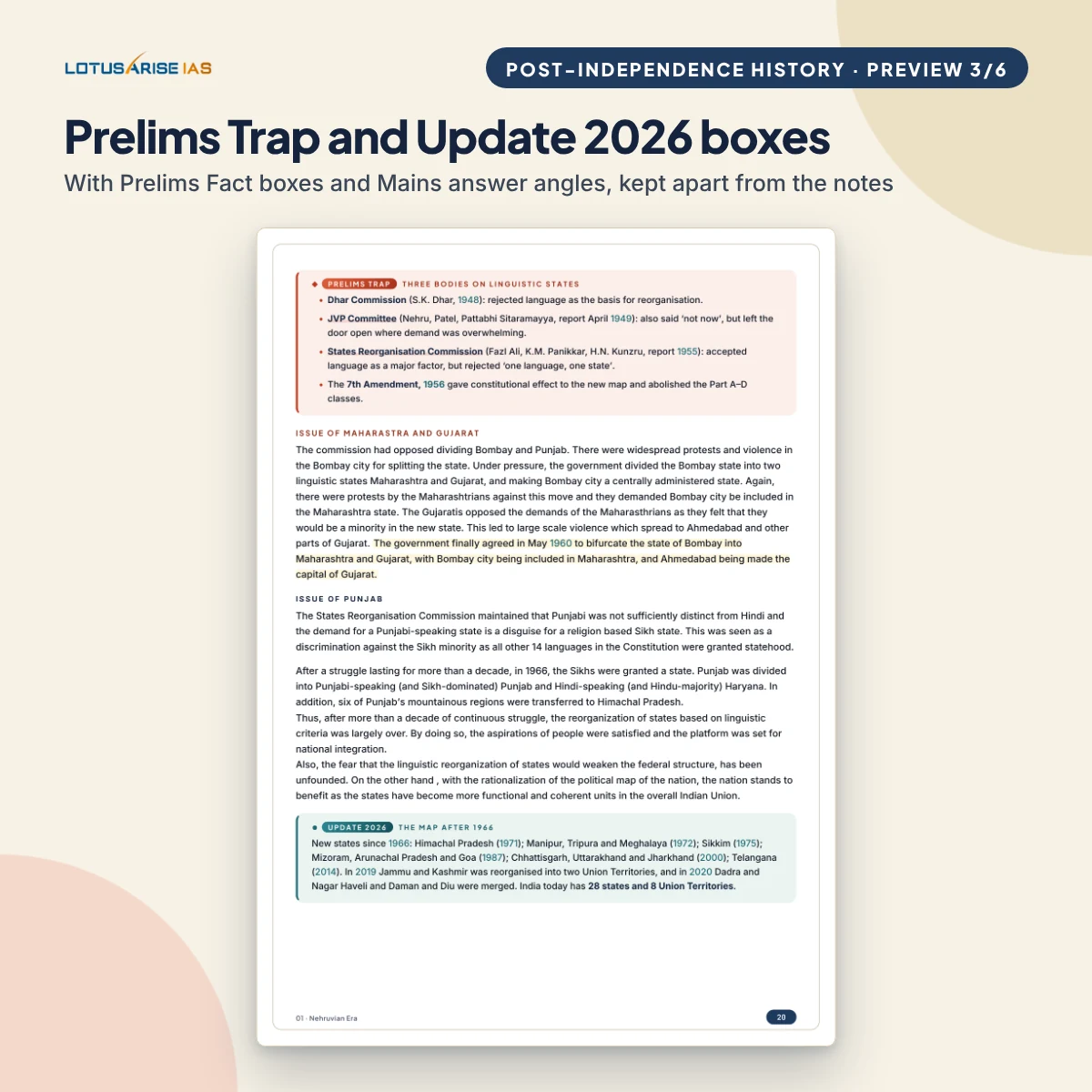
The Prelims Fact boxes add the dates, names and bodies that Prelims options are built from. The Prelims Trap boxes take the confusions head-on — the Dhar Commission, the JVP Committee and the States Reorganisation Commission; Tashkent and Simla; Pokhran-I and Pokhran-II; the 73rd and the 74th Amendments. Seven Prelims questions from 2012 to 2025 show the options, the right one marked, and a one-line reason.
🆕 35 Update 2026 boxes
The notes stop in 2004; the exam does not. The Update 2026 boxes bring each topic up to date without touching the original text: 28 states and 8 Union Territories, the Uttarakhand Uniform Civil Code, the Prototype Fast Breeder Reactor reaching criticality in April 2026, Pakistan holding the Simla Agreement in abeyance, recent Supreme Court rulings and more.
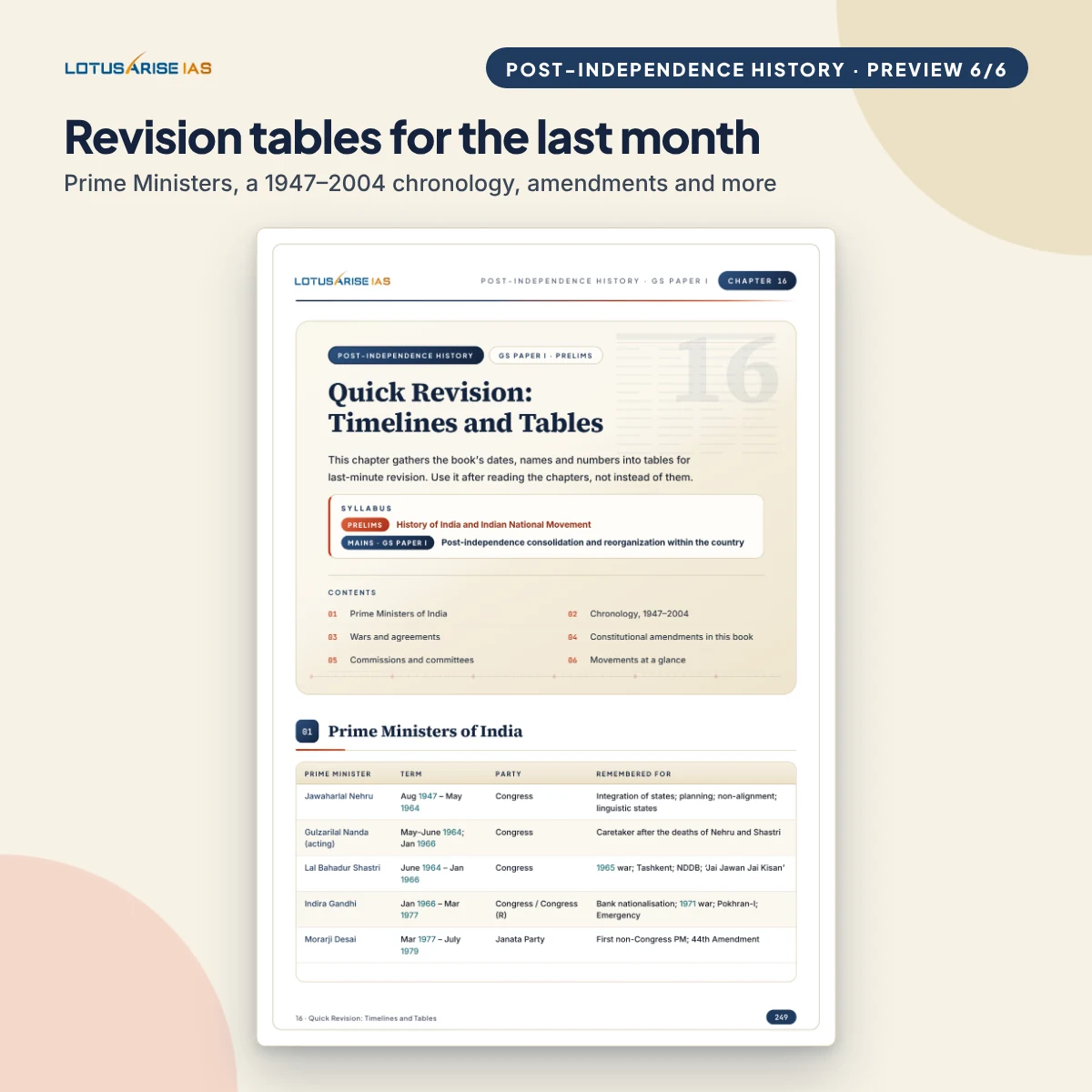
🗂️ Quick Revision panels and revision tables
Every chapter closes with a two-column Quick Revision panel of its highest-yield facts. The last chapter brings the whole period together in tables: every Prime Minister with term, party and key events, a chronology from 1947 to 2004, wars and agreements, the constitutional amendments in the book, commissions and committees, and the major movements at a glance.
The aspirant who buys this
First-time aspirants — you want one book for post-independence India, organised era by era, with the Mains framing and the Prelims facts already picked out.
Repeaters — you have read this period before and still write thin answers on it. The approaches, answer-angle boxes and revision tables are built for exactly that.
History Optional aspirants — Paper II covers India after independence. This book is your fast GS-level layer before the optional-depth reading.
Self-study aspirants outside Delhi, Prayagraj or Jaipur — no classroom and no batch timings; one PDF on your phone for the whole period.
State PSC aspirants — post-independence India is in most State PSC papers, so the same book serves both.
Why not just use free notes and a standard book?
Free post-independence notes are everywhere, and many aspirants already own a standard book. The problem is not that they are bad. It is that they are written to be read, not revised — long narrative chapters, nothing after the book went to print, and no link to what UPSC has actually asked.
This book is one checked, revisable system: the full notes era by era, the Prelims facts pulled out into boxes, the confusions resolved, the Mains questions with approaches, updates to 2026 and a revision section at the end.
If you have the time to build that system yourself from scattered sources, you may not need this. If you want it already built — open it and start — this is what the book is for.
Price and delivery
A single printed guide to post-independence India usually costs more than this PDF, and a printed book cannot carry updates to 2026.
₹176 for 255 pages — under 70 paise a page.
Want to see it first? Download the free sample PDF — the cover, the full contents and two complete chapters: Chapter 2 (Lal Bahadur Shastri Era) and Chapter 14 (India’s Nuclear Programme).
Already bought an earlier edition? Your download link now gives you this one.
One-time payment. No subscription. No recurring charge.
Instant PDF download after payment. The download link is also sent to your email — please check the spam folder if it does not arrive in a few minutes. Download it again any time from My Account.
For support: support@lotusarise.com
Related products
-

Ancient Indian History UPSC Notes
Original price was: ₹499.00.₹236.00Current price is: ₹236.00. -
-
World Geography & Mapping Notes for UPSC: Prelims & Mains GS Paper I (2027 Edition) by LotusArise IAS
Original price was: ₹300.00.₹149.00Current price is: ₹149.00. -