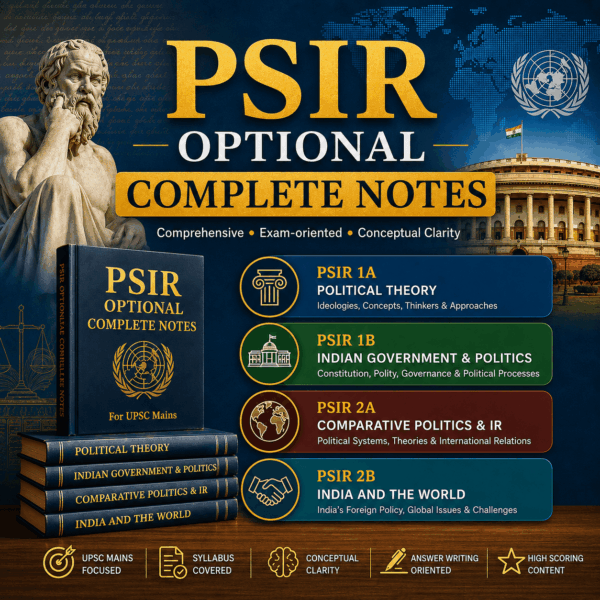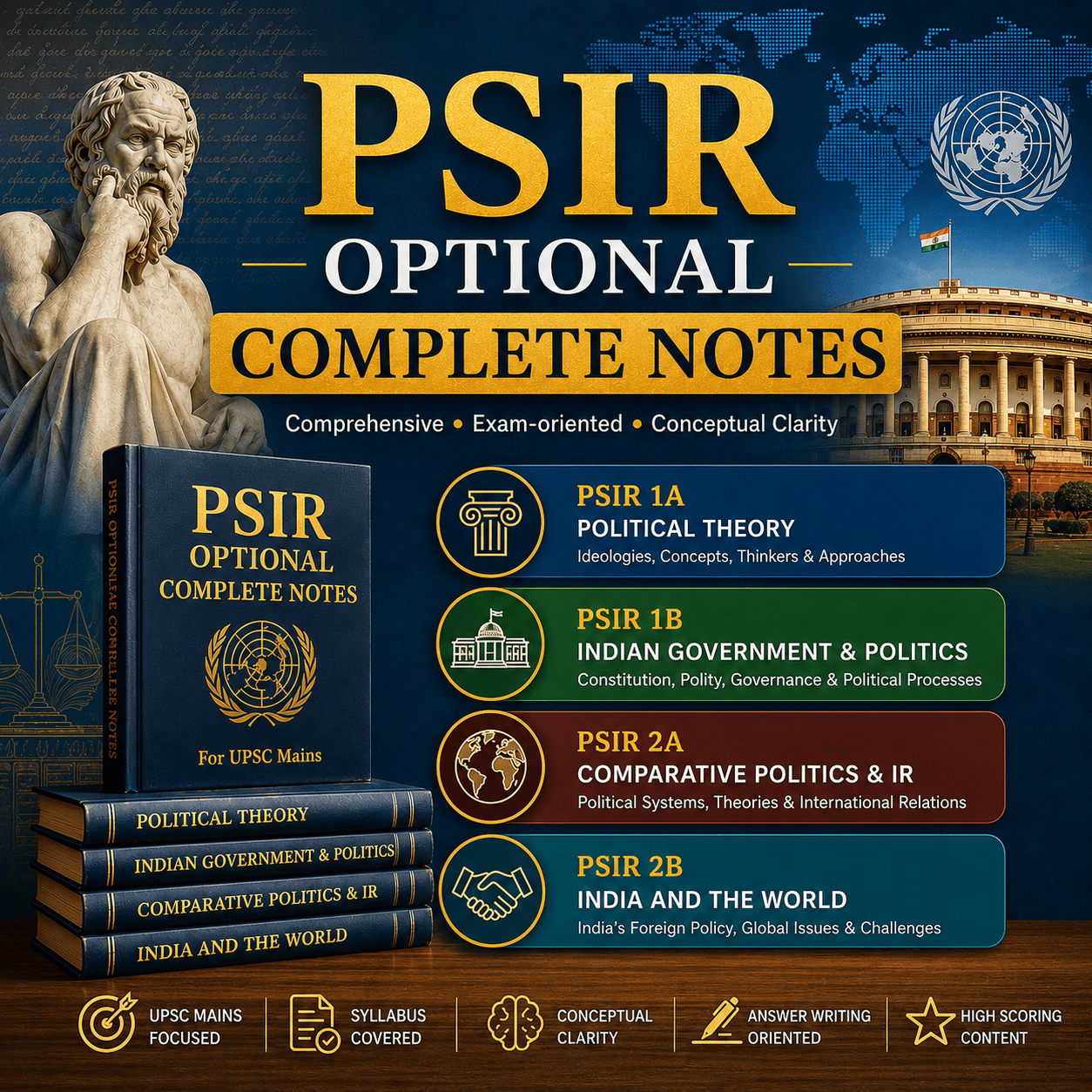
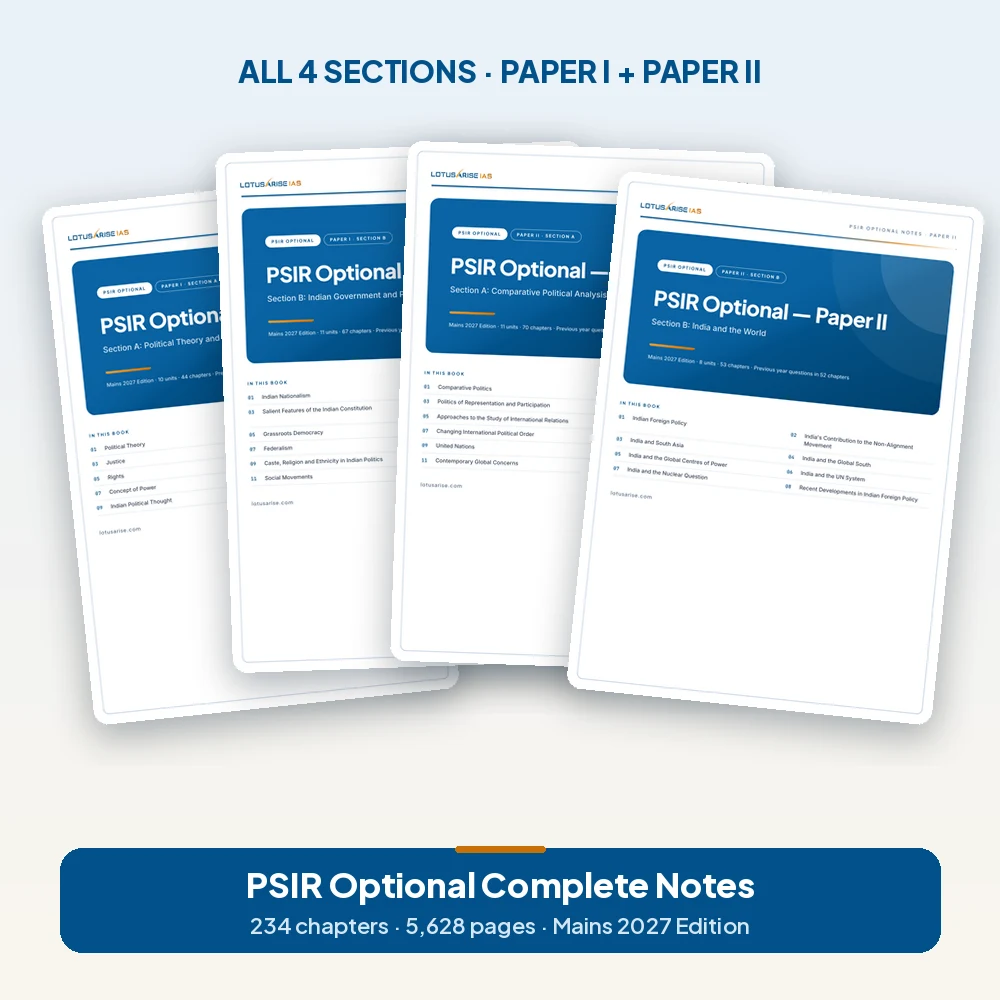


PSIR Optional Complete Notes: Paper I + Paper II (All 4 Sections) by LotusArise IAS
Original price was: ₹2,000.00.₹1,180.00Current price is: ₹1,180.00.
₹1,180 — ₹820 below the ₹2,000 regular price. Bought one by one, the same four sections and question papers cost ₹1,475.
Most PSIR aspirants build the optional out of pieces. Political theory from one coaching set, Indian polity from another, International Relations from the newspaper — and a folder of PDFs nobody has finished. Four voices, four orders, and no way to see the whole syllabus at once.
PSIR Optional Complete Notes is the whole syllabus in one voice.
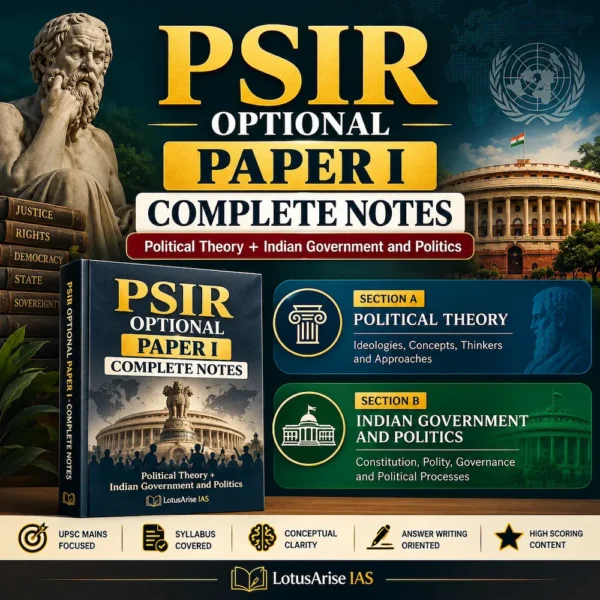
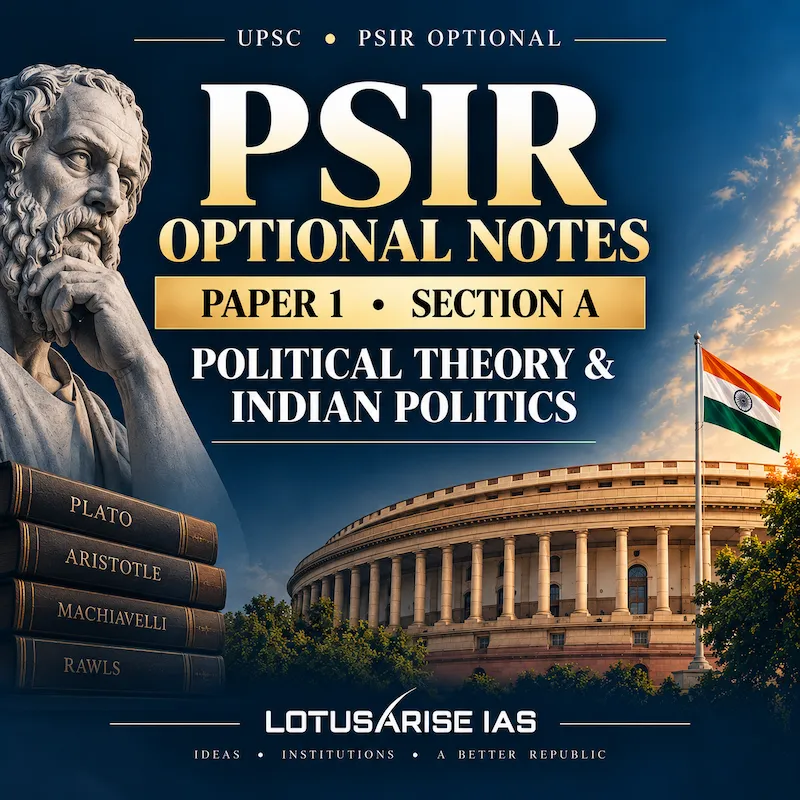
📘 Paper I, Section A — Political Theory and Indian Political Thought, 1,062 pages — thinker by thinker, built for comparison answers
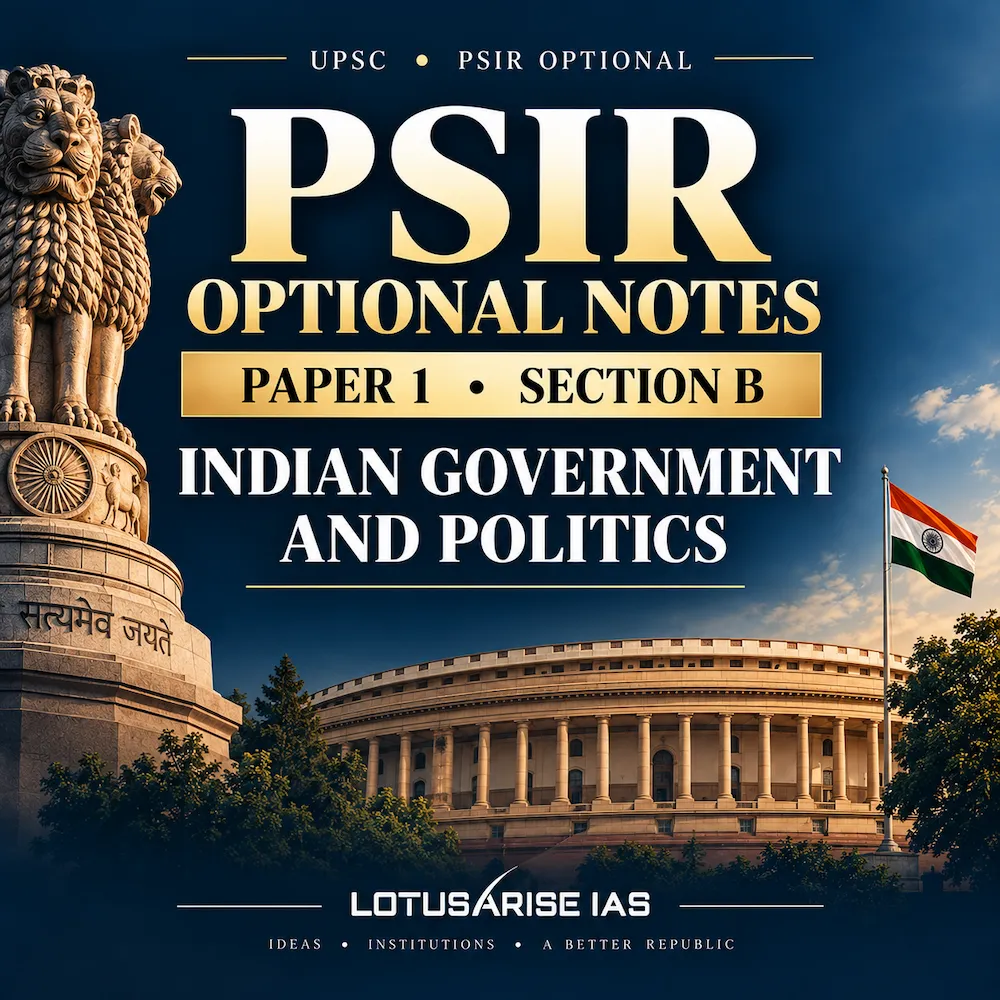
🏛️ Paper I, Section B — Indian Government and Politics, 1,632 pages — provisions, debates and how institutions actually work
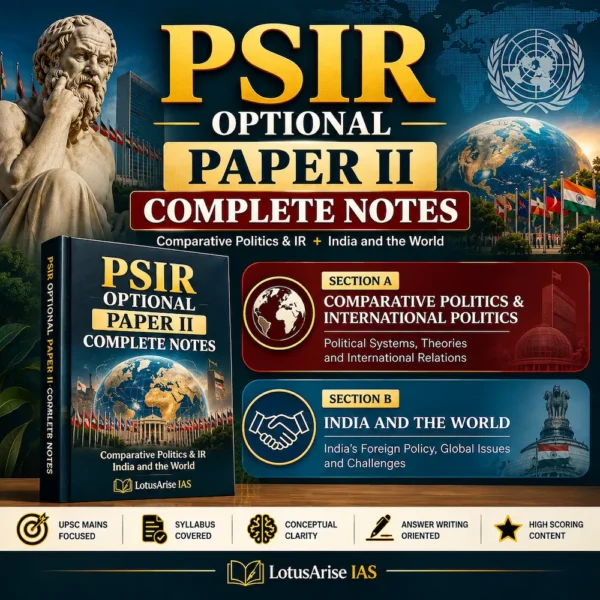
🌐 Paper II, Section A — Comparative Politics and International Politics, 1,657 pages — every IR approach, the world order, the UN, global concerns
🇮🇳 Paper II, Section B — India and the World, 1,277 pages — foreign policy, every neighbour, every major power
🎁 PSIR question papers, 1991–2025 — free inside — plus previous year questions after the chapters in all four sections
One-time payment. No subscription. Printable A4 PDFs for any device, offline. The download links are emailed the moment payment clears — check your spam folder if they are not in the inbox.
⭐ Trusted by the 300,000+ UPSC aspirants who read LotusArise IAS every month
Features:
- Comprehensive Coverage
- Complete Syllabus
- Suitable for: UPSC & State PSCs exams
- Format: Digital PDF (Downloadable)
- 337,362+ aspirants visit every month
The problem most PSIR aspirants don’t talk about
Ask a PSIR aspirant a year into preparation what is going wrong. They will not say the syllabus is too long. They will say one of these three things:
“I have notes for every unit — from five different places. I don’t know which one is complete, so I keep re-reading all of them.”
“My Paper I and my Paper II feel like two different subjects. I never use Marx or Gandhi in an IR answer, even when the question is asking for exactly that.”
“I finished Paper I properly. Paper II is newspaper cuttings and a coaching PDF I bought in a hurry.”
None of that is a discipline problem. It is a material problem. Most aspirants already own more PSIR content than they can read. What they do not own is one source that runs the entire syllabus — both papers, all four sections — in a single voice, in syllabus order, at answer-writing depth.
That is what these notes are.
Why the whole syllabus, in one place, matters
PSIR is 500 marks: two papers of 250, each with two sections, and UPSC expects you to answer from all four. A weak section is not a small gap. It is a quarter of the optional you walk into the hall unsure about.
The sections also lean on each other far more than separate PDFs let you see. The Marxism of Paper I is the Marxist approach to IR in Paper II. Gandhi and Nehru in Paper I are where non-alignment in Paper II begins. Federalism in Paper I is the state in comparative perspective in Paper II. Answers that make those links read as the work of someone who understands the subject — and that is the reading examiners reward.
The return does not stop at the optional. Paper I Section B is GS Paper II polity with the debates put back in. Paper II is GS Paper II international relations at optional depth. Political theory feeds your Essay and your interview. One set of notes, used across the whole examination.
What’s inside — 5,628 pages, 234 chapters, 40 syllabus units
📘 Paper I, Section A — Political Theory and Indian Political Thought, 1,062 pages
- Political theory and its approaches; theories of the state — liberal, neo-liberal, Marxist, pluralist, post-colonial and feminist
- Justice with Rawls and his communitarian critics; equality, rights, human rights, democracy and power
- Ideologies: liberalism, socialism, Marxism, fascism, Gandhism and feminism
- Indian political thought: Dharmashastra, Arthashastra, the Buddhist tradition, Sir Syed Ahmed Khan, Aurobindo, Gandhi, Ambedkar, M.N. Roy
- Western political thought: Plato, Aristotle, Machiavelli, Hobbes, Locke, Mill, Marx, Gramsci, Arendt
🏛️ Paper I, Section B — Indian Government and Politics, 1,632 pages
- Indian nationalism and the making of the Constitution, with the perspectives behind it
- Salient features: Preamble, rights and duties, Directive Principles, amendment, judicial review and the Basic Structure
- Union and State executive, legislature and judiciary — envisaged role and actual working
- Panchayati Raj and municipal government, statutory commissions, federalism and centre-state relations
- Planning and economic development, caste, religion and ethnicity, the party system, social movements
🌐 Paper II, Section A — Comparative Politics and International Politics, 1,657 pages
- Comparative politics: approaches, political economy and political sociology, the state across capitalist, socialist and developing societies
- Parties, pressure groups and social movements compared; globalisation and the responses to it
- IR approaches — Idealist, Realist, Marxist, Functionalist, Systems — and key concepts from power to collective security
- The Cold War, NAM, unipolarity, the rise of China; Bretton Woods to WTO; the UN and its reform
- EU, ASEAN, APEC, NAFTA, SAARC and global concerns: democracy, human rights, environment, gender, terrorism, proliferation
🇮🇳 Paper II, Section B — India and the World, 1,277 pages
- Determinants and institutions of Indian foreign policy, continuity and change, strategic autonomy
- India and non-alignment, from its making to multi-alignment
- South Asia: SAARC, SAFTA, Act East, river water and border disputes, and a chapter on each neighbour
- The Global South, and the centres of power: the USA, China, Russia, the EU and Japan, the Quad and the Indo-Pacific
- India and the UN, the nuclear question, West Asia, Afghanistan, Central Asia and India’s vision of a new world order
🎁 PSIR question papers, 1991–2025 — included free
The full question set, topic-wise and year-wise, sold separately at ₹59. On top of that, every section has previous year questions printed after the chapters, with the year marked — 232 of the 234 chapters carry them — so you finish a topic and immediately see how UPSC examines it.
What makes this different from the PDFs already on your laptop. Downloaded notes are written to be read. These are written to be answered from, and they are written as one body of work. The same design, the same order as the UPSC syllabus, the same depth in every section — so you always know where a topic lives, and the thinker you meet in Paper I is the thinker Paper II assumes. Five files from five sources cannot do that. That is the gap you have been filling by re-reading.
The aspirant who buys this
The first-timer who has just chosen PSIR. You want the whole optional sorted on day one, instead of assembling a reading list and discovering in month six that Paper II was never really covered.
The repeater whose optional score sat in the 230s and 240s. Your content is not the problem. The marks are in the section you under-prepared, in the missing counter-argument, and in the link between the papers you never made.
The aspirant whose optional is something else. Indian Government and Politics plus both halves of Paper II cover GS Paper II polity and international relations at a depth GS material rarely reaches.
The self-study aspirant far from a coaching city. You are not moving to Delhi, Prayagraj or Jaipur, and you are not paying ₹15,000–₹54,000 for an optional course. You need the material those courses are built on, at a price that does not decide your month.
The working professional. No batch timing, no live schedule you will miss. Printable, offline, and there at 11 pm when your preparation actually happens.
Why not just use the free PSIR PDFs from Telegram?
Free PSIR notes exist, and plenty of them circulate. Most aspirants already have several gigabytes of them, and most have never read a single set through to the end.
The difference is not that free material is worthless — some of it is genuinely good. The difference is that it is unsorted. No consistent voice across four sections, no way to know which file is current, and no link back to what has actually been asked since 1991. You end up doing the editorial work yourself, in the months you should be writing answers.
If you have the patience to build that system from scattered sources, you may not need this. If you would rather open one set of files and start, that is what these notes are for.
The price, twice over
An optional course elsewhere runs ₹15,000–₹54,000.
Bought piece by piece on this store: four sections at ₹354 each + question papers ₹59 = ₹1,475.
Together: ₹1,180 — against a regular price of ₹2,000. That is 5,628 pages for about 21 paise a page.
Read before you buy: free sample PDFs of the PSIR notes are open to everyone — see the design, the depth and the previous year questions for yourself.
One-time payment. No subscription. No recurring charge. The download links reach your email as soon as payment clears — check the spam folder if they are not in your inbox within a few minutes.
Questions before or after buying: support@lotusarise.com
Related products
-

PSIR Optional Paper II Complete Notes: Comparative Politics + India and the World by LotusArise IAS
Original price was: ₹1,000.00.₹599.00Current price is: ₹599.00. -
PSIR Optional Paper I Complete Notes: Political Theory + Indian Government and Politics by LotusArise IAS
Original price was: ₹1,000.00.₹599.00Current price is: ₹599.00. -
-
PSIR Optional Notes (Paper I): Section-A {Political Theory}
Original price was: ₹500.00.₹354.00Current price is: ₹354.00.