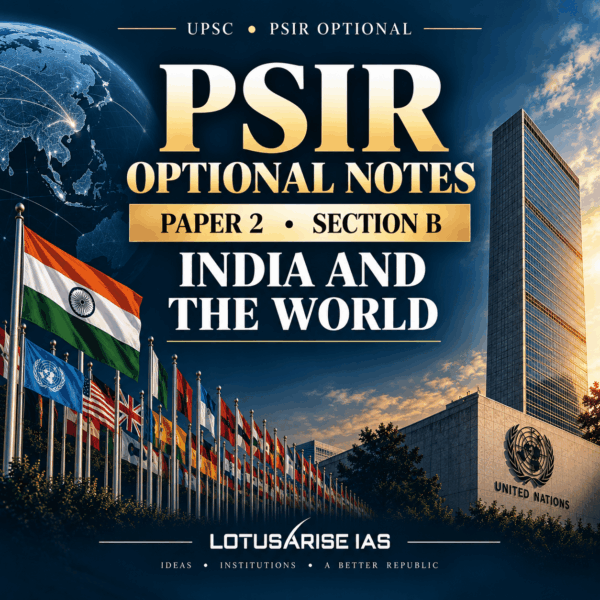


PSIR Optional Notes (Paper II): Section-B {India and the World}
Original price was: ₹500.00.₹354.00Current price is: ₹354.00.
₹354 — ₹146 below the ₹500 regular price, for 1,277 pages.
Most PSIR aspirants prepare India and the World from the newspaper. They know the latest visit, the latest agreement, the latest joint statement. Then the question asks whether non-alignment still describes Indian foreign policy, or what explains the ups and downs with a neighbour — and there is a timeline to write, but no argument.
PSIR Optional Notes (Paper II): Section-B gives you the argument.
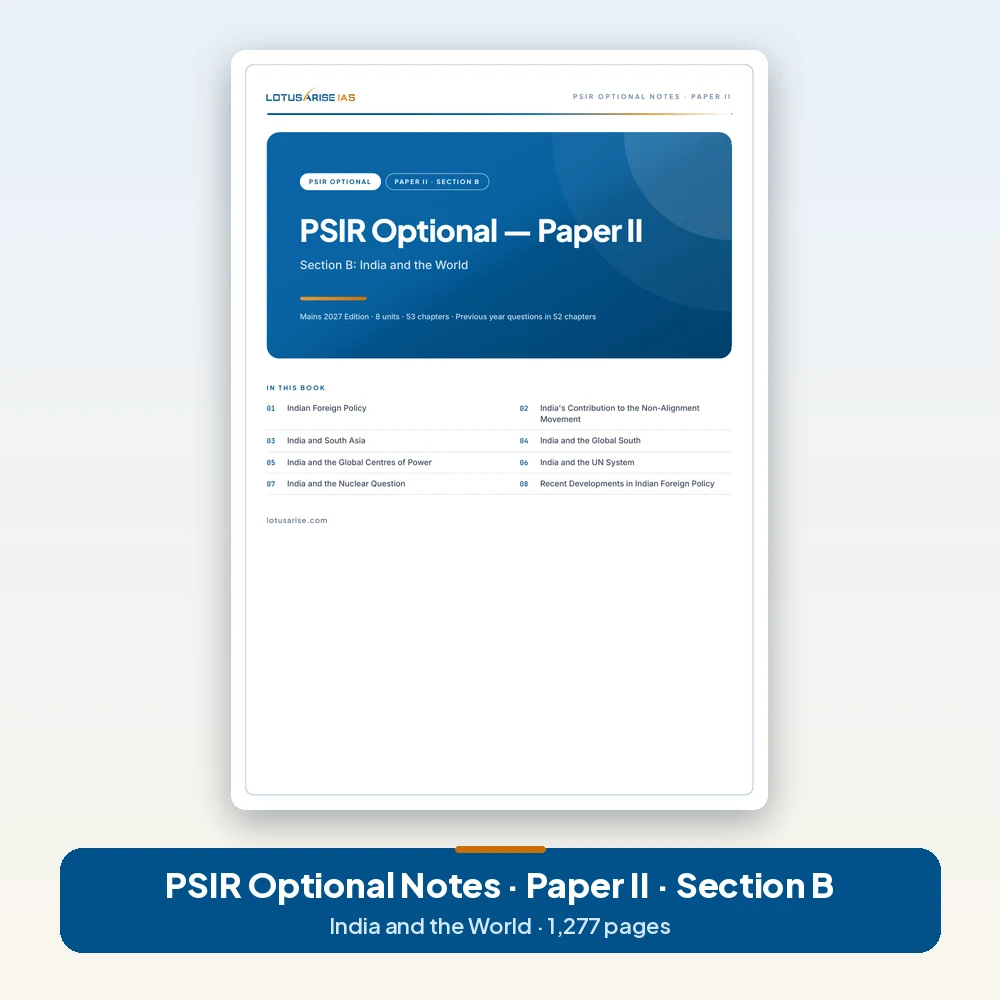
🇮🇳 53 chapters across all 8 syllabus units — from the determinants of foreign policy to India’s vision of a new world order
🤝 Every neighbour and every major power, one chapter each — Pakistan, China, Bangladesh, Nepal, Sri Lanka, Bhutan, Maldives, Afghanistan, Myanmar; the USA, Russia, the EU and Japan
📝 Previous year questions after the chapters — year marked on each, in 52 of the 53 chapters
🖨️ Printable A4 PDF, 1,277 pages — mark it up and write answers beside it
📱 Any device, offline — laptop, tablet or phone
One-time payment. No subscription. The download link is emailed the moment payment clears — check your spam folder if it is not in the inbox.
⭐ Trusted by the 300,000+ UPSC aspirants who read LotusArise IAS every month
Save ₹168: both Paper II sections plus the 1991–2025 question papers come together as PSIR Optional Paper II Complete Notes for ₹599 — or get all four PSIR sections in PSIR Optional Complete Notes for ₹1,180.
Features:
- Comprehensive Coverage
- Complete Syllabus
- Suitable for: UPSC & State PSCs exams
- Format: Digital PDF (Downloadable)
- 337,362+ aspirants visit every month
The problem most Section B aspirants don’t talk about
Ask a PSIR aspirant what goes wrong in India and the World. It is not a lack of information. It is usually one of these three things:
“I can list every India-China agreement since 1954. I can’t tell you what they add up to.”
“Non-alignment, strategic autonomy, multi-alignment — I use the words, but I couldn’t tell you where one ends and the next begins.”
“My Section B answers read like current affairs. They would score the same in GS Paper II.”
None of that is a discipline problem. Section B rewards judgement — why India chose a path, what changed and what stayed the same — and the newspaper gives you events, not judgement. These notes give you the frame the events fit into.
Why Section B is where Paper II is won or lost
Section B carries half of Paper II. Almost every question touches something recent, which makes it the section where the examiner can most easily tell a prepared answer from a well-read one. The prepared answer places the event in a pattern: the determinants, the institutions, the continuity and the change.
It is also the part of PSIR that travels furthest. India’s neighbourhood, the major powers, the UN, the nuclear question and West Asia are GS Paper II international relations, and foreign policy is a subject that often comes up at the interview. Prepared here once, used everywhere.
The subject is not the bottleneck. A consistent frame across 53 chapters is.
What’s inside — 1,277 pages, 53 chapters, 8 units
🧭 Foundations of Indian foreign policy — Units 1 and 2
- Determinants of foreign policy, and the institutions that make it: the executive core, Parliament, the states, informal actors, public diplomacy and soft power
- Continuity and change, strategic autonomy and multi-alignment
- Why India chose non-alignment, its phases during the Cold War, NAM after 1991, and NonAlignment 2.0
🌏 India and South Asia — Unit 3
- SAARC past and future, South Asia as a free trade area, from Look East to Act East, and China’s growing footprint in the region
- Impediments to cooperation: river water disputes, cross-border migration, ethnic conflicts and insurgencies, border disputes
- A chapter each on Bhutan, Nepal, Pakistan, Bangladesh, Sri Lanka, the Maldives, Afghanistan and Myanmar
🌍 The Global South and the centres of power — Units 4 and 5
- Africa and India’s development partnership, India and China in Africa, Latin America, and South-South cooperation
- India’s role in the demand for a New International Economic Order and in WTO negotiations
- The USA, China, Russia, the EU and Japan, and India in the Quad and the Indo-Pacific
🕊️ The UN, the nuclear question and recent developments — Units 6 to 8
- India in the UN system, UN peacekeeping and the demand for a permanent seat
- The evolution of India’s nuclear programme, its doctrine and deterrence, and the global nuclear regime
- Israel and the Palestine question, the Gulf and West Asia, Iran and the crises in Iraq and Yemen, Afghanistan, Central Asia, and India’s vision of a new world order
📝 Previous year questions after the chapters
52 of the 53 chapters close with the questions UPSC has set on that topic, with the year marked on each. You finish a relationship and immediately see how it has been examined.
What makes this different from the PDFs already on your laptop. Most India-and-the-World material is a stack of bilateral timelines, each written differently. Here every relationship is written against the same frame — interests, irritants, institutions, the turning points and where it stands now — and the thread of strategic autonomy runs from the first chapter to the last. So when a question asks you to compare India’s approach to two neighbours, the comparison is already half built.
Please note: this is Paper II Section B only. Section A — Comparative Politics and International Politics — is sold separately, and all four PSIR sections come together in PSIR Optional Complete Notes.
The aspirant who buys this
The first-timer who has just chosen PSIR. You want India and the World built on a frame from day one, instead of a year of newspaper cuttings you cannot turn into answers.
The repeater whose Paper II score stalled. You know the events. What is missing is the pattern behind them, and the judgement that makes an answer sound like analysis rather than a summary.
The aspirant whose optional is something else. This is GS Paper II international relations at optional depth — and a strong base for the foreign-policy questions that often come up at the interview.
The self-study aspirant far from a coaching city. You are not moving to Delhi, Prayagraj or Jaipur, and you are not paying ₹15,000–₹54,000 for an optional course. You need the material, at a price that does not decide your month.
The working professional. No batch timing, no live schedule you will miss. Printable, offline, and there at 11 pm when your preparation actually happens.
Why not just use free foreign-policy notes from Telegram?
Free notes exist, and plenty of them circulate. Most aspirants have folders full of them and have finished none.
The difference is not that free material is worthless — some of it is genuinely good. The difference is that it is unsorted: a different format for every country, no consistent order, no way to know which file is current, and no link to what UPSC has actually asked. You end up doing the editorial work yourself, in the months you should be writing answers.
If you have the patience to build that system from scattered sources, you may not need this. If you would rather open one file and start, that is what these notes are for.
The price, twice over
An optional course elsewhere runs ₹15,000–₹54,000.
This section: ₹354 — against a regular price of ₹500. That is 1,277 pages for under 28 paise a page.
Want both Paper II sections? PSIR Optional Paper II Complete Notes has Section A, Section B and the 1991–2025 question papers for ₹599. Want all of PSIR? The four sections bought separately come to ₹1,416. PSIR Optional Complete Notes has all four, plus the 1991–2025 question papers, for ₹1,180.
Read before you buy: free sample PDFs of the PSIR notes are open to everyone — see the design, the depth and the previous year questions for yourself.
One-time payment. No subscription. No recurring charge. The download link reaches your email as soon as payment clears — check the spam folder if it is not in your inbox within a few minutes.
Questions before or after buying: support@lotusarise.com
You may also like…
-

PSIR Optional Paper II Complete Notes: Comparative Politics + India and the World by LotusArise IAS
Original price was: ₹1,000.00.₹599.00Current price is: ₹599.00. -
PSIR Optional Complete Notes: Paper I + Paper II (All 4 Sections) by LotusArise IAS
Original price was: ₹2,000.00.₹1,180.00Current price is: ₹1,180.00.
Related products
-
PSIR Optional Notes (Paper I): Section-A {Political Theory}
Original price was: ₹500.00.₹354.00Current price is: ₹354.00. -
-
PSIR Optional Notes (Paper I): Section-B {Indian Government and Politics}
Original price was: ₹500.00.₹354.00Current price is: ₹354.00. -
PSIR Optional Paper I Complete Notes: Political Theory + Indian Government and Politics by LotusArise IAS
Original price was: ₹1,000.00.₹599.00Current price is: ₹599.00.