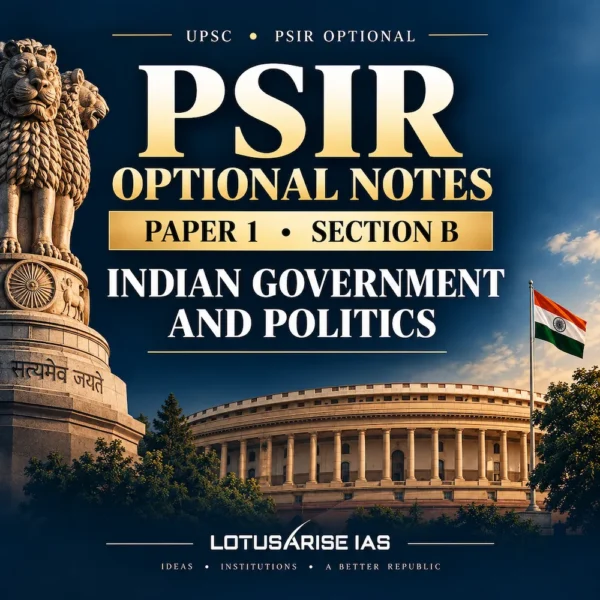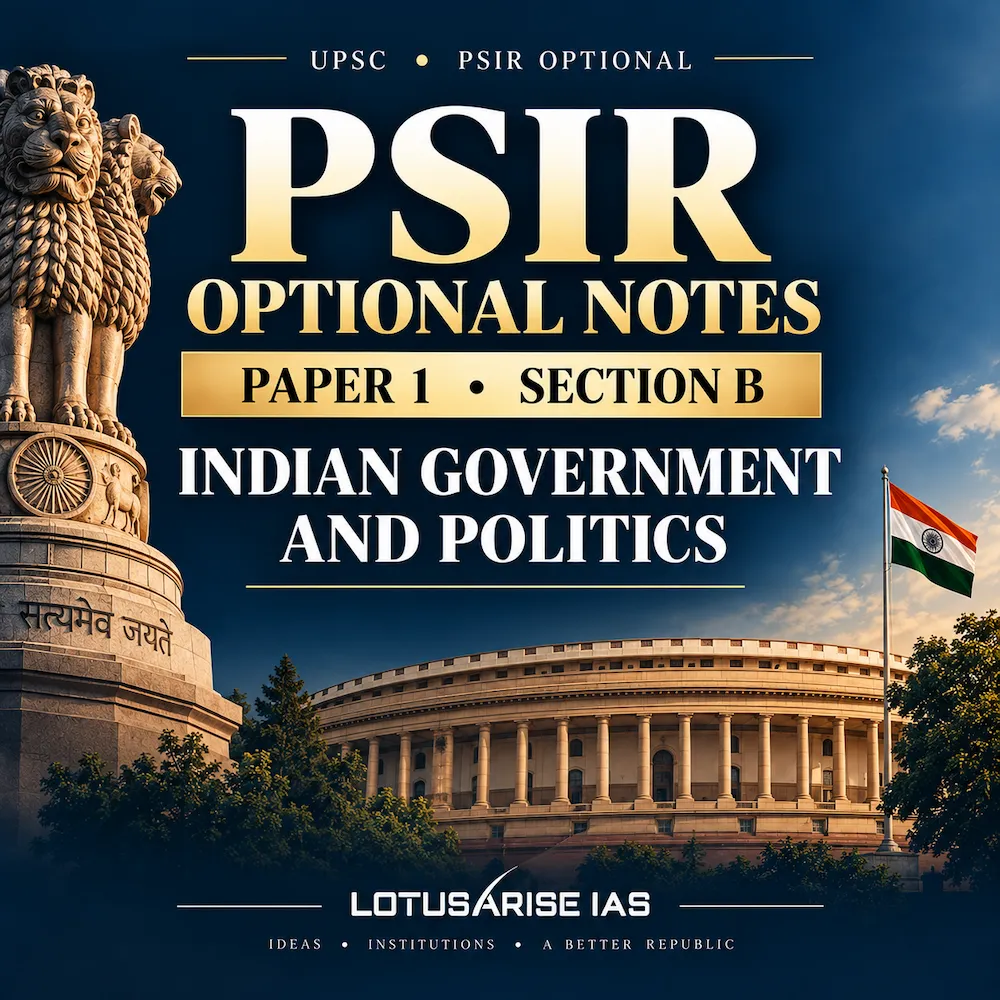
PSIR Optional Notes (Paper I): Section-B {Indian Government and Politics}
Original price was: ₹500.00.₹354.00Current price is: ₹354.00.
₹354 — ₹146 below the ₹500 regular price. That is about 22 paise a page for 1,632 pages.
Most PSIR aspirants prepare Indian Government and Politics like GS polity. Articles memorised, bodies listed, amendments numbered. Then the question asks whether Indian federalism has become more centralised, or how coalition politics changed Parliament — and the answer knows the provisions but not the politics.
PSIR Optional Notes (Paper I): Section-B puts the politics back.
🏛️ 67 chapters across all 11 syllabus units — from Indian nationalism to social movements, in UPSC syllabus order
⚖️ Envisaged role and actual working — Parliament, the executive, the Supreme Court, the Governor and the commissions: how the Constitution says they work, and how they actually do
📝 Previous year questions after the chapters — year marked on each, in 66 of the 67 chapters
🖨️ Printable A4 PDF, 1,632 pages — mark it up and write answers beside it
📱 Any device, offline — laptop, tablet or phone
One-time payment. No subscription. The download link is emailed the moment payment clears — check your spam folder if it is not in the inbox.
⭐ Trusted by the 300,000+ UPSC aspirants who read LotusArise IAS every month
Save ₹168: both Paper I sections plus the 1991–2025 question papers come together as PSIR Optional Paper I Complete Notes for ₹599 — or get all four PSIR sections in PSIR Optional Complete Notes for ₹1,180.
Features:
- Comprehensive Coverage
- Complete Syllabus
- Suitable for: UPSC & State PSCs exams
- Format: Digital PDF (Downloadable)
- 337,362+ aspirants visit every month
The problem most Section B aspirants don’t talk about
Ask a PSIR aspirant what goes wrong in Indian Government and Politics. It is not a lack of facts. It is usually one of these three things:
“I know every Article. My answers still read like a GS polity answer and score like one.”
“Federalism, the party system, caste in politics — I know the facts, but not the debates scholars have about them.”
“The syllabus says ‘envisaged role and actual working’. My notes only have the envisaged role.”
None of that is a discipline problem. Section B rewards judgement — what the Constitution intended, what actually happened, and why — and most polity material stops at the provision. These notes carry on to the politics.
Why Section B carries more than its share
Section B is half of Paper I, and it is the section where the difference between a GS answer and an optional answer is easiest for the examiner to see. The optional answer argues: whether the Basic Structure doctrine protects or constrains democracy, whether coalition politics strengthened federalism, whether the commissions are independent in practice.
It is also the part of PSIR with the biggest overlap outside the optional. The national movement feeds GS Paper I. The Constitution, Parliament, the judiciary, federalism, Panchayati Raj and the commissions are GS Paper II. Caste, religion, parties and movements run through the Essay. Prepared here once, used everywhere.
The subject is not the bottleneck. A source that gives you the debate along with the provision is.
What’s inside — 1,632 pages, 67 chapters, 11 units
🇮🇳 Nationalism and the Constitution — Units 1 to 3
- From constitutionalism to extremism; Gandhian mass satyagraha — Non-Cooperation, Civil Disobedience and Quit India
- Militant and revolutionary movements, peasant and workers’ movements, and the liberal, socialist, Marxist, radical humanist and Dalit perspectives on the national movement
- Legacies of British rule, the Constituent Assembly, and the social and political perspectives behind the Constitution
- The Preamble, Fundamental Rights, Fundamental Duties and Directive Principles, the parliamentary system, amendment, judicial review and the Basic Structure doctrine
🏛️ The organs of government — Unit 4
- The President and Vice-President, the Prime Minister and Council of Ministers, and the bureaucracy
- Parliament: structure, functions and decline; the Speaker, anti-defection law, privileges and committees
- The Supreme Court, judicial activism, PIL and judicial overreach
- The Governor and the state executive, the state legislature and the High Courts
🏘️ Grassroots democracy and statutory institutions — Units 5 and 6
- The evolution of Panchayati Raj, the 73rd and 74th Amendments in practice, women and marginalised sections, and grassroots movements
- The Election Commission, CAG, Finance Commission and UPSC
- The national commissions for Scheduled Castes, Scheduled Tribes, Women, Human Rights, Minorities and Backward Classes — one chapter each
🗺️ Federalism and development — Units 7 and 8
- Constitutional provisions and the Indian model, the changing nature of centre-state relations, and fiscal federalism
- Integrationist tendencies and regional aspirations, and inter-state disputes
- Nehruvian and Gandhian perspectives, planning and the public sector, the Green Revolution, land reforms and liberalisation
🗳️ Society, parties and movements — Units 9 to 11
- Caste, OBC and Dalit politics, religion, communalism and secularism, the Uniform Civil Code debate, ethnicity and the North-East
- The party system, national and regional parties, coalitions, pressure groups, electoral behaviour and the changing profile of legislators
- Civil liberties and human rights movements, women’s movements and environmental movements
📝 Previous year questions after the chapters
66 of the 67 chapters close with the questions UPSC has set on that topic, with the year marked on each. You finish an institution and immediately see how it has been examined.
What makes this different from the PDFs already on your laptop. Most polity material describes institutions as the Constitution designed them. Here every institution is written the way the syllabus asks — envisaged role and actual working — with the debates, the judgments and the criticism alongside the provision. That second half is where optional marks are, and it is the half GS notes leave out.
Please note: this is Paper I Section B only. Section A — Political Theory and Indian Political Thought — is sold separately, and both Paper I sections come together in PSIR Optional Paper I Complete Notes.
The aspirant who buys this
The first-timer who has just chosen PSIR. You want Indian Government and Politics prepared at optional depth from day one, instead of relying on GS polity notes and finding out late that they are not enough.
The repeater whose optional score sat in the 230s and 240s. You know the provisions. The marks are in the actual working, the scholarly debate and the judgement you did not offer.
The aspirant whose optional is something else. This is GS Paper II polity with the debates put back in, and it covers the national movement for GS Paper I. Bought once, used in two papers.
The self-study aspirant far from a coaching city. You are not moving to Delhi, Prayagraj or Jaipur, and you are not paying ₹15,000–₹54,000 for an optional course. You need the material, at a price that does not decide your month.
The working professional. No batch timing, no live schedule you will miss. Printable, offline, and there at 11 pm when your preparation actually happens.
Why not just use the free polity notes from Telegram?
Free notes exist, and plenty of them circulate. Most aspirants have folders full of them and have finished none.
The difference is not that free material is worthless — some of it is genuinely good. The difference is that it is unsorted: GS-level summaries mixed with optional-level debates, no consistent order, no way to know which file is current, and no link to what UPSC has actually asked. You end up doing the editorial work yourself, in the months you should be writing answers.
If you have the patience to build that system from scattered sources, you may not need this. If you would rather open one file and start, that is what these notes are for.
The price, twice over
An optional course elsewhere runs ₹15,000–₹54,000.
This section: ₹354 — against a regular price of ₹500. That is 1,632 pages for about 22 paise a page.
Want all of Paper I? PSIR Optional Paper I Complete Notes has Section A, Section B and the 1991–2025 question papers for ₹599.
Read before you buy: free sample PDFs of the PSIR notes are open to everyone — see the design, the depth and the previous year questions for yourself.
One-time payment. No subscription. No recurring charge. The download link reaches your email as soon as payment clears — check the spam folder if it is not in your inbox within a few minutes.
Questions before or after buying: support@lotusarise.com
You may also like…
-

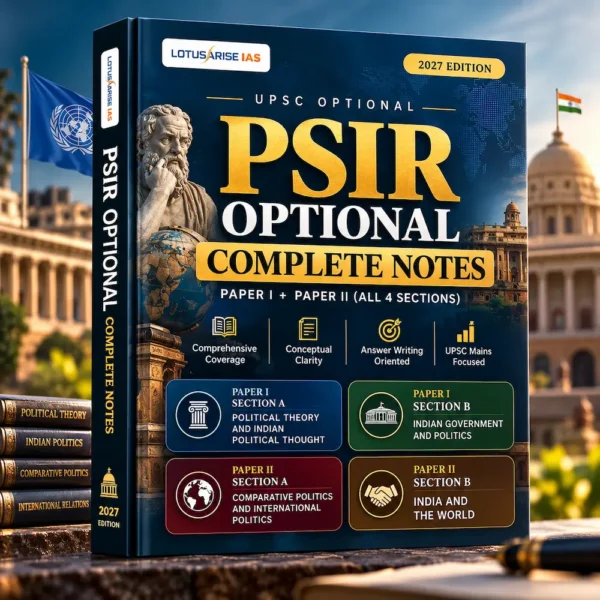
PSIR Optional Complete Notes: Paper I + Paper II (All 4 Sections) by LotusArise IAS
Original price was: ₹2,000.00.₹1,180.00Current price is: ₹1,180.00. -
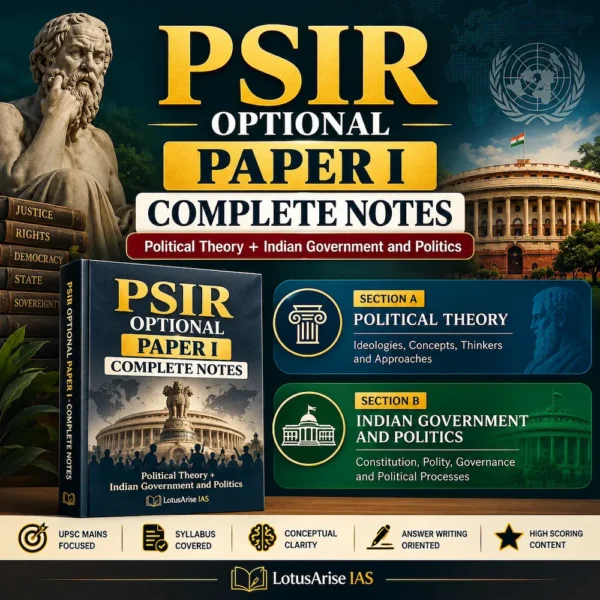
PSIR Optional Paper I Complete Notes: Political Theory + Indian Government and Politics by LotusArise IAS
Original price was: ₹1,000.00.₹599.00Current price is: ₹599.00.
Related products
-
-
-
PSIR Optional Paper II Complete Notes: Comparative Politics + India and the World by LotusArise IAS
Original price was: ₹1,000.00.₹599.00Current price is: ₹599.00. -
PSIR Optional Notes (Paper II): Section-B {India and the World}
Original price was: ₹500.00.₹354.00Current price is: ₹354.00.