



Indian Society — Notes for UPSC GS Paper I (Mains) and Prelims, 2027 Edition
₹199.00
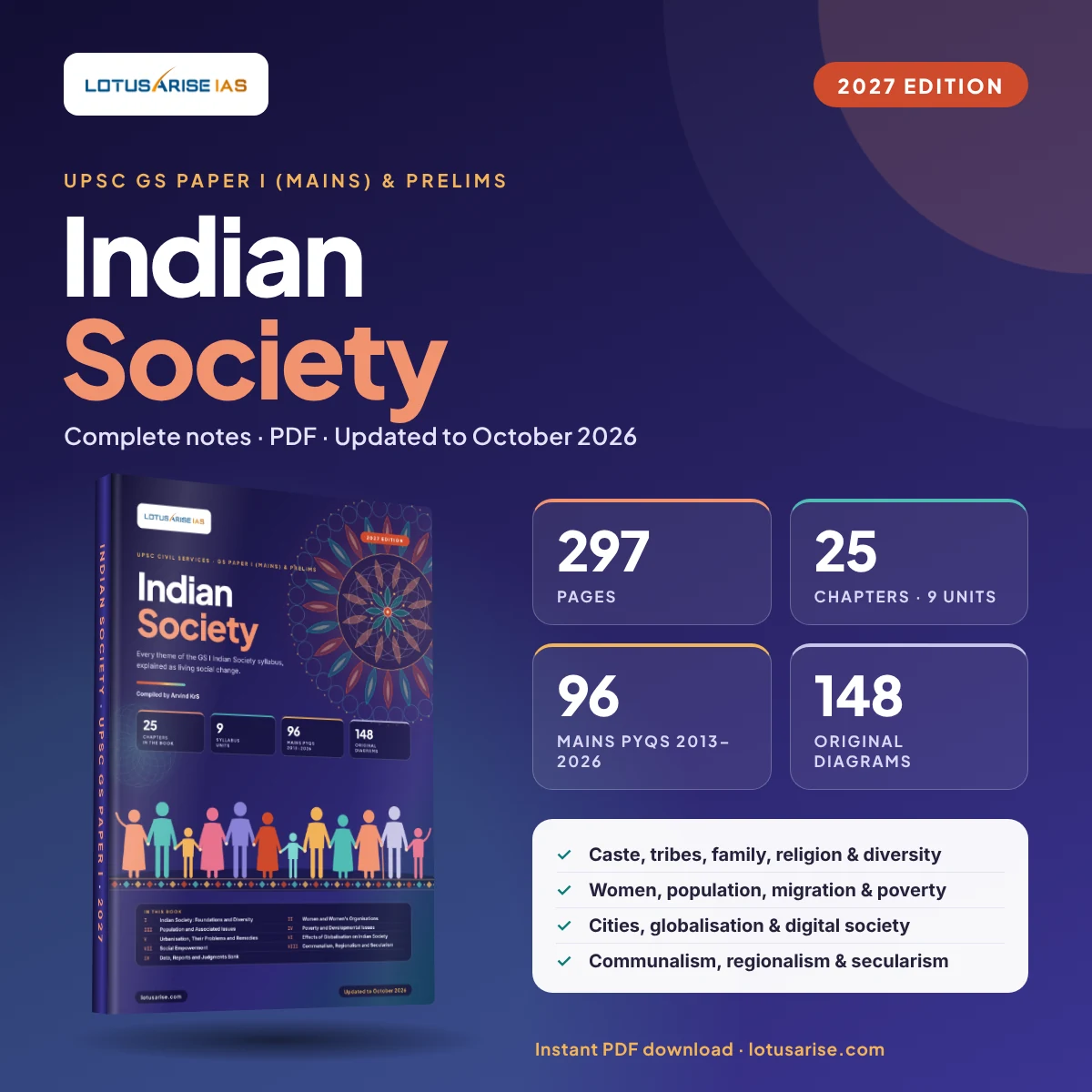
₹199 for the 2027 Edition — 297 pages, about 67 paise a page.
Most aspirants prepare Indian Society the wrong way. Old notes with Census 2011 figures, and the rest left to “common sense”. Then the paper asks whether caste is losing its grip in urban India — and they write opinion without a thinker, a figure or an example.
Indian Society — Notes for UPSC puts the whole subject, current to October 2026, in one book.
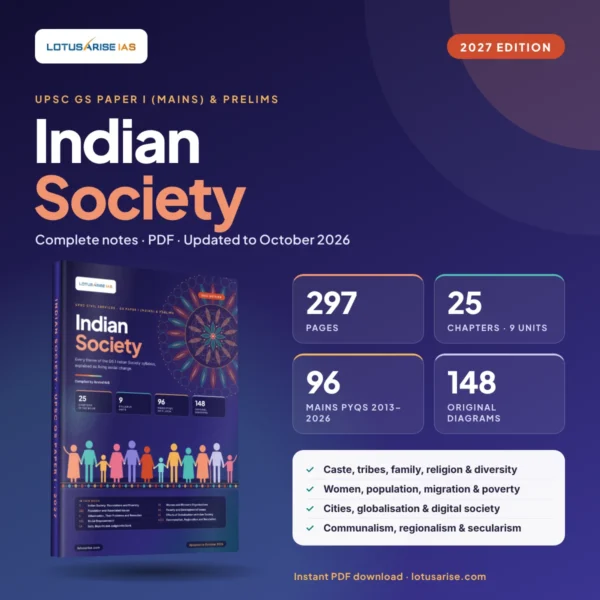
🧭 25 chapters in 9 units, 297 pages — caste, tribes, family, religion, women, population, migration, poverty, urbanisation, globalisation, digital society, communalism, regionalism, secularism
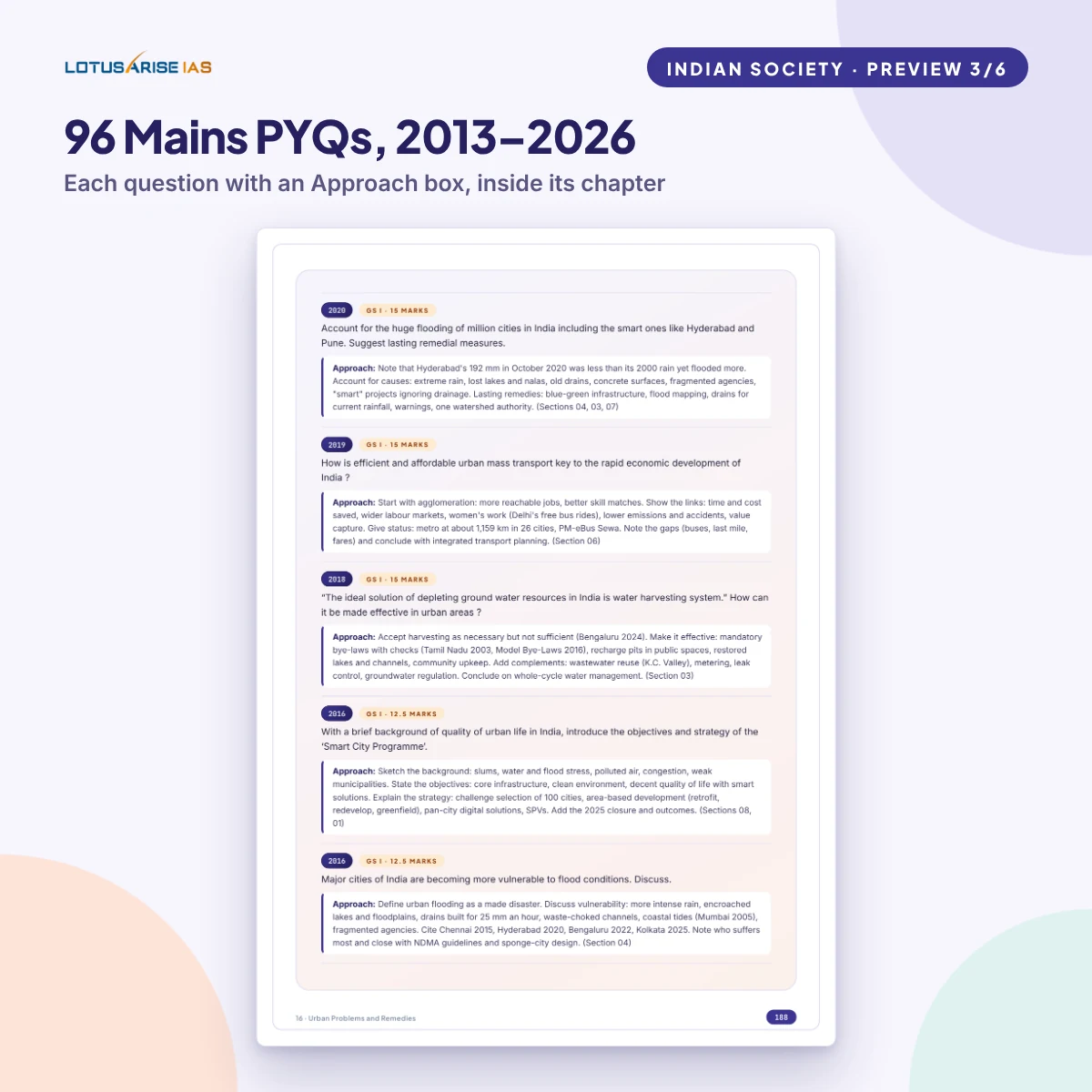
📝 All 96 GS I Indian Society PYQs (2013–2026) — each placed in its chapter, with an Approach box that shows how to answer it
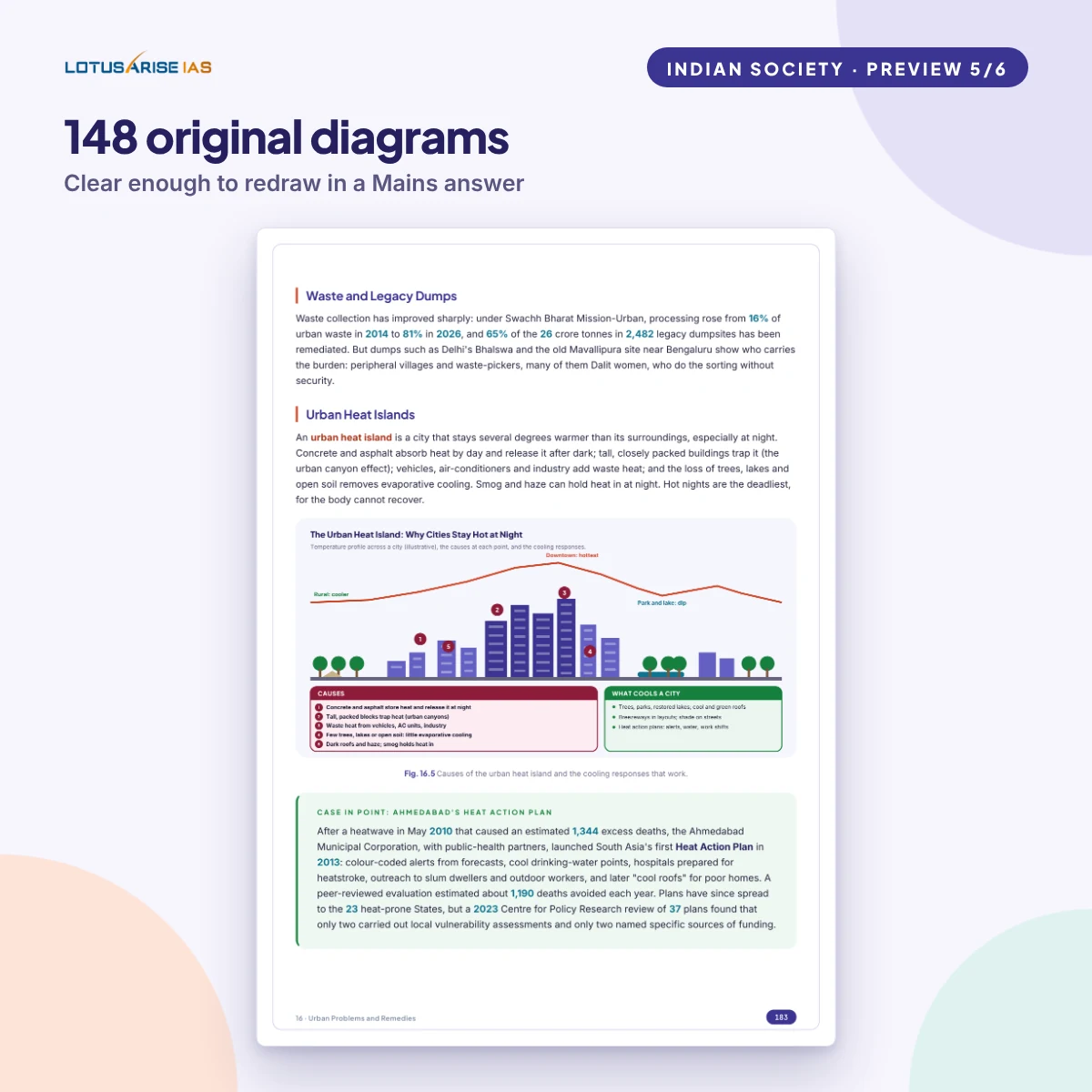
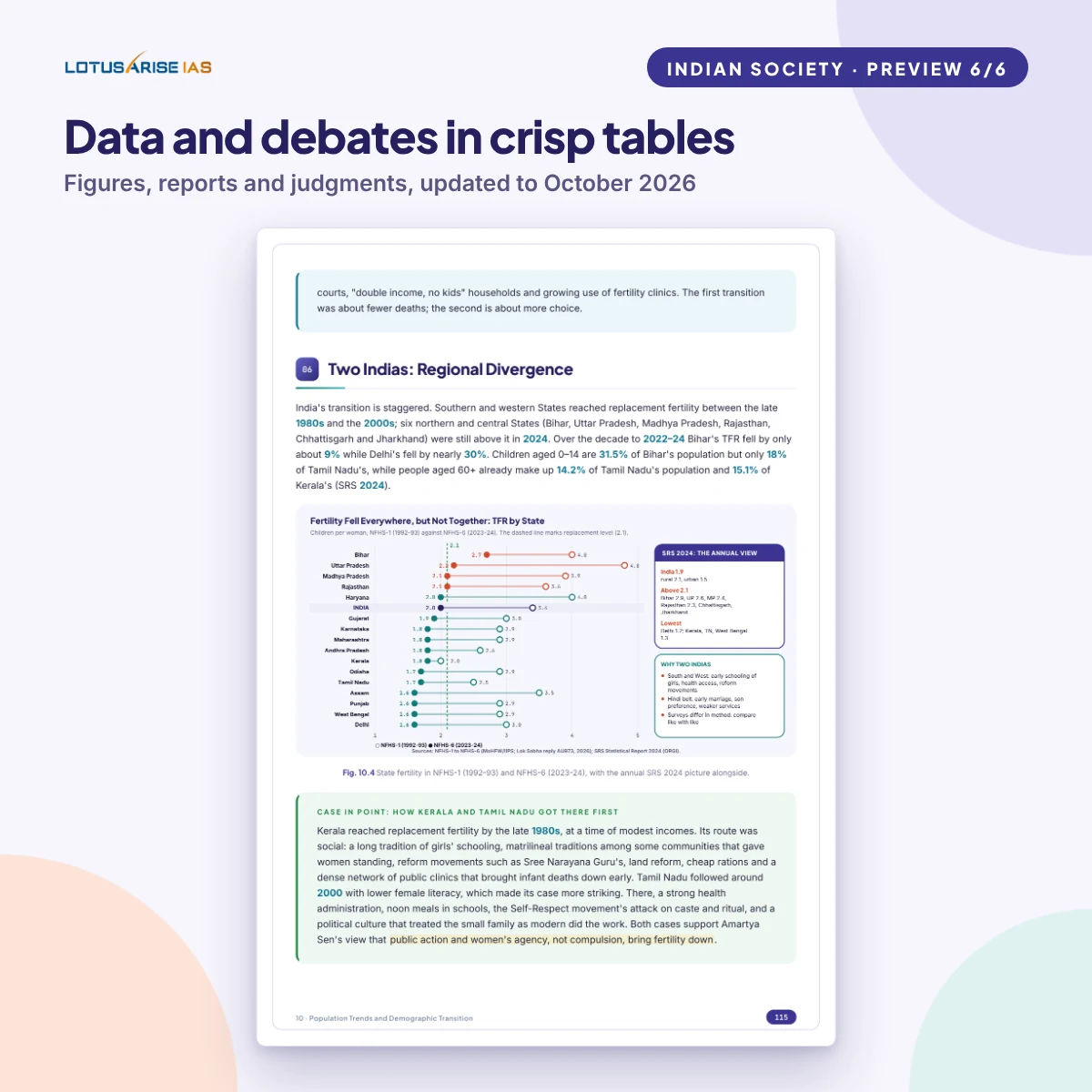
🎨 148 original diagrams + a “Chapter at a Glance” mind-map for each of the 24 study chapters
📊 Data, Reports & Judgments Bank — Census 2027 and caste enumeration, SRS 2024, NFHS-6, NCRB 2024
📱 Instant PDF download — laptop, mobile or tablet, offline, printable
One-time payment. No subscription. Unlimited downloads — the link does not expire.
⭐ Read by 300,000+ UPSC aspirants every month on LotusArise IAS
Features:
- Comprehensive Coverage
- Complete Syllabus
- Suitable for: UPSC & State PSCs exams
- Format: Digital PDF (Downloadable)
- 337,362+ aspirants visit every month
The problem nobody admits about Indian Society
Ask an aspirant a few months before Mains how they are preparing Indian Society, and the honest answer is “it’s mostly common sense”. Push a little, and you hear one of three things:
“My notes still quote Census 2011 and NFHS-4. I know the numbers have changed, but I don’t know which ones, or where to find them in one place.”
“I can write a paragraph on caste or the joint family. But I never know which thinker to cite, or how to show change and continuity in 250 words.”
“The questions keep moving — demographic winter, sects, cryptocurrency, digital empowerment. I never know which chapter of my notes they even belong to.”
These are not effort problems. Most aspirants have read plenty about Indian society. What they lack is one current source that joins the concepts, the data and the questions. Indian Society — Notes for UPSC is that source, in one book.
Why Indian Society deserves a book of its own
Indian Society is a full block of GS Paper I. Across the 14 papers from 2013 to 2026, UPSC set 96 questions on it — about 85 marks a paper on average, and more than 100 marks in both 2023 and 2024. On the Prelims side, the syllabus line on social development, poverty, inclusion and demographics draws on the same ground.
It is also the part of GS that pays back across the exam. The same ideas — caste and class, gender, migration, urbanisation, secularism — feed your Essay, your GS Paper II answers on social justice, and your Interview. The real challenge is not understanding Indian society. It is having one source that explains the concept, brings the latest data, and shows how UPSC has asked it.
What’s inside
🧭 The complete notes — 25 chapters in 9 units, 297 pages
Every part of the GS Paper I Indian Society syllabus, read through a society lens:
- Foundations and Diversity — salient features of Indian society; diversity and unity in diversity; caste — structure, change and persistence; tribal society and identity; family, marriage and kinship; religion, sect and belief
- Women and Women’s Organisations — gender, patriarchy and the status of women; women in work, the economy and public life; women’s movements and organisations
- Population — population trends and demographic transition; demographic dividend, ageing and population policy; migration and Indian society
- Poverty and Development — poverty as a social problem; development, inequality and displacement
- Urbanisation — trends and social change; urban problems and remedies
- Globalisation — globalisation and Indian culture; globalisation and social groups; technology, digital life and social change
- Social Empowerment — social empowerment and social exclusion; social movements in India
- Communalism, Regionalism and Secularism — one chapter each
- Data, Reports and Judgments Bank — the ready-reference chapter for revision
What makes this different from downloaded PDFs: every chapter is rewritten for the exam and updated to October 2026. Census 2027 and the decision to enumerate caste, SRS 2024, NFHS-6, PLFS, NCRB 2024, the World Bank’s 2026 poverty estimates and the India Ageing Report are already in their chapters. The sociological concepts — Sanskritisation, dominant caste, purity and pollution, change and continuity — are explained so you can use them in an answer, not just recognise them.
📝 All 96 GS I Indian Society PYQs, 2013–2026
Every Indian Society question from fourteen Mains papers, each placed under the chapter that answers it. Under each one is an Approach box: how to open, what to cover and how to close. You finish a topic and immediately see how UPSC has tested it — and how to answer it.
🎨 148 original diagrams and a mind-map for every content chapter
Original diagrams and flowcharts drawn simple enough to reproduce in a Mains answer. Each of the 24 study chapters ends with a one-page “Chapter at a Glance” mind-map, so revising the whole subject before the exam takes an evening, not a week.
📊 Data, Reports and Judgments Bank (Chapter 25)
The latest social data in one place — census and demography, health, employment, poverty, crime and ageing — with their sources, alongside the key committees, reports and judgments on Indian society. This is the chapter you open when an answer needs one figure or one judgment to stand out.
The aspirant who buys this
First-time aspirants — you want one trusted book for Indian Society from day one, instead of stitching together old notes, NCERT summaries and current-affairs PDFs.
Repeaters whose GS I society answers stayed general — you know the themes. What costs you marks is the missing thinker, data point or example. The chapter-wise Approach boxes and the Data Bank fix exactly that.
Aspirants with Sociology, Anthropology or PSIR optional — caste, tribes, family, religion and social movements overlap directly with your optional and your Essay.
Self-study aspirants outside Delhi, Prayagraj or Jaipur — no classroom, no batch timings; one PDF on your phone that covers the whole subject.
State PSC aspirants — Indian society, population and social issues are part of most State PSC syllabi, so the same book serves both.
Why not just use free notes and current-affairs PDFs?
Free Indian Society material exists, and most aspirants have folders full of it. The problem is not that it is bad. It is that it is scattered and dated: concepts in one file, data from different years in another, and questions you have never matched to a chapter.
This book is one connected system: the whole syllabus in sequence, every PYQ placed where it belongs with an approach, the data, reports and judgments collected for revision, and facts updated to October 2026.
If you have the time and discipline to build that system yourself from scattered sources, you may not need this. If you want it already built — open it and start — this is what the book is for.
Price and delivery
A single printed Indian Society guide usually costs more than this PDF, and a printed book cannot carry Census 2027, NFHS-6 or NCRB 2024.
₹199 for 297 pages — about 67 paise a page, with all 96 GS I Indian Society PYQs and their approaches.
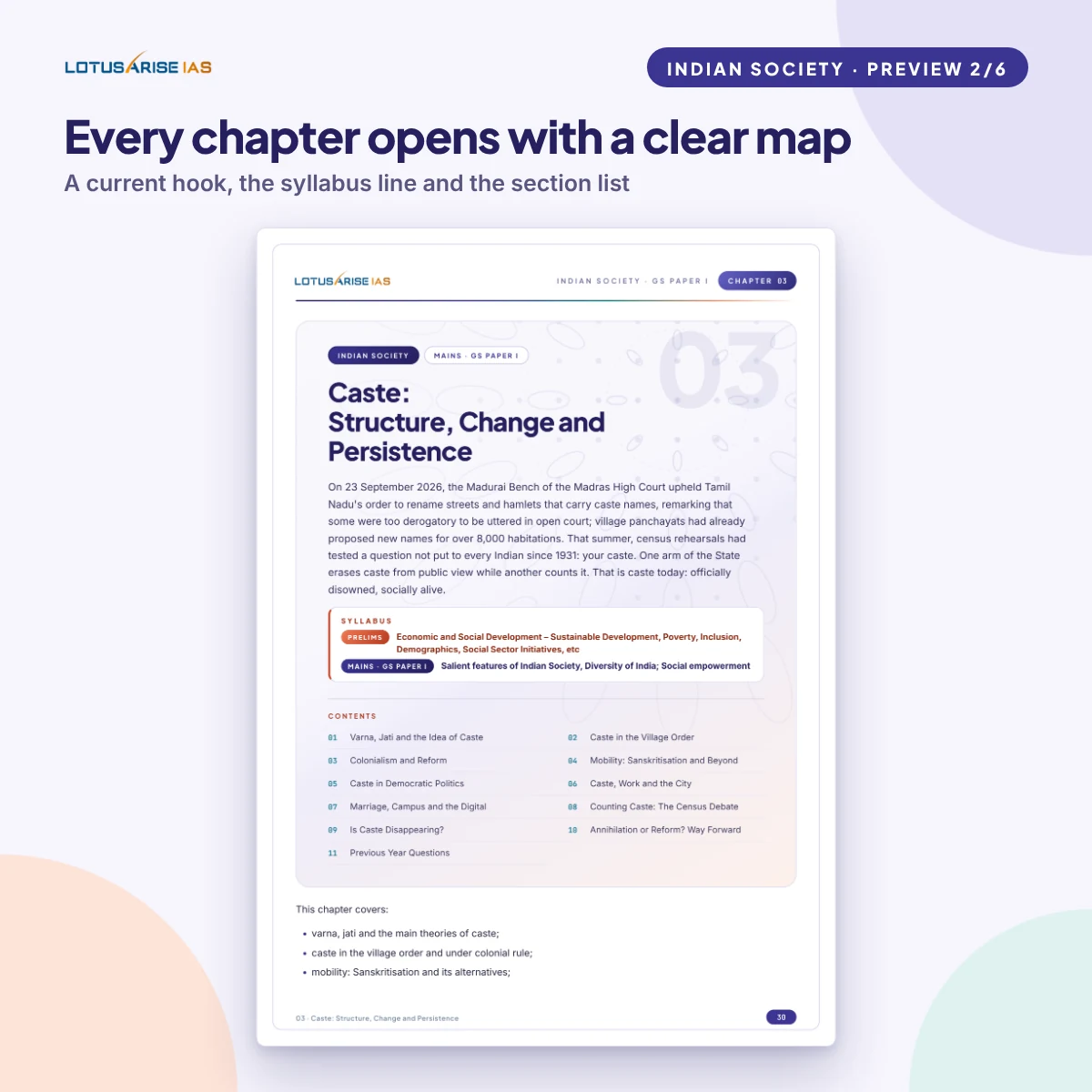
Want to see it first? Download the free sample PDF — Unit I with two complete chapters: Chapter 1 (Salient Features of Indian Society) and Chapter 3 (Caste: Structure, Change and Persistence).
One-time payment. No subscription. No recurring charge.
Instant PDF download after payment. The download link is also sent to your email — please check the spam folder if it does not arrive in a few minutes. Download it again any time from My Account.
For support: support@lotusarise.com
Related products
-

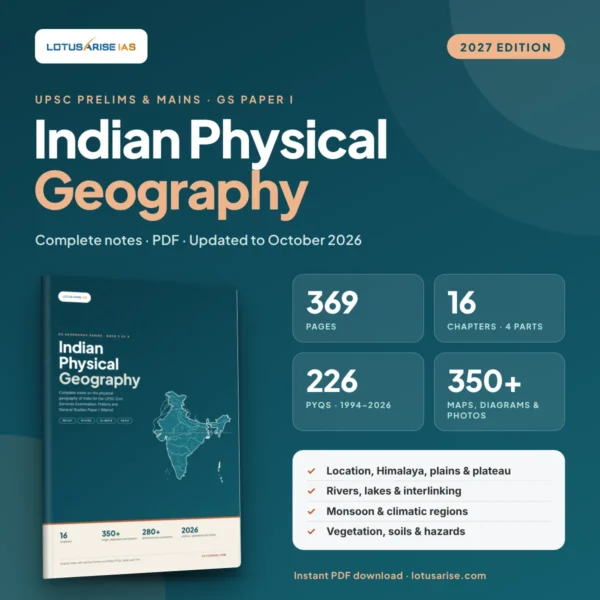
Indian Physical Geography Notes for UPSC: Prelims & Mains GS Paper I (2027 Edition) by LotusArise IAS
Original price was: ₹300.00.₹149.00Current price is: ₹149.00. -
-
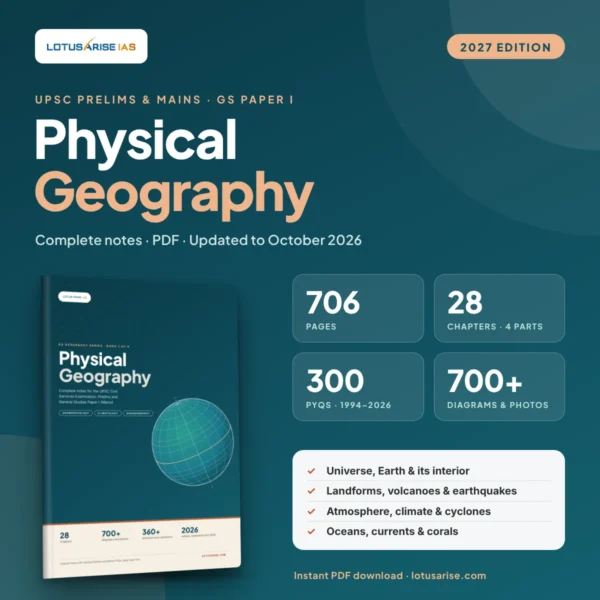
Physical Geography Notes for UPSC: Prelims & Mains GS Paper I (2027 Edition) by LotusArise IAS
Original price was: ₹500.00.₹236.00Current price is: ₹236.00. -