

World History Notes for UPSC
₹177.00
₹177 for the Mains 2027 Edition — 424 pages, under 42 paise a page.
Most aspirants read World History once, like a story — 1789, 1848, 1914, 1945 — and then cannot use it in the exam. Was the First World War fought for the balance of power? Was the American Revolution an economic revolt against mercantilism? GS Paper I asks for causes, consequences and comparisons, and a story read once does not give you them in order.
World History Notes for UPSC turns it into one book you can revise.
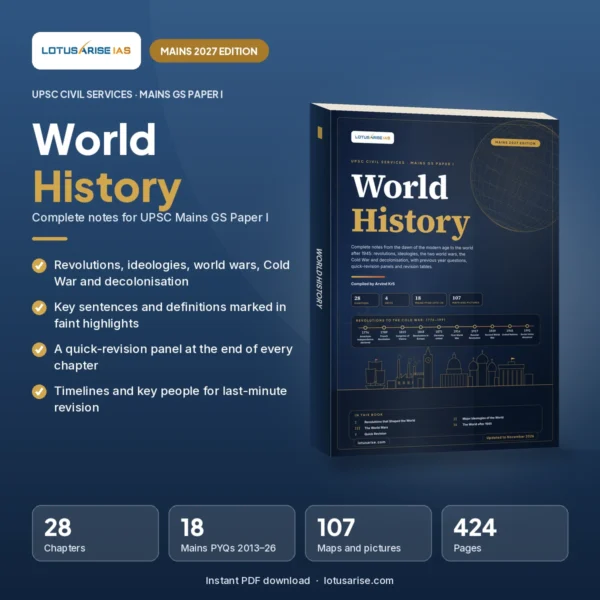
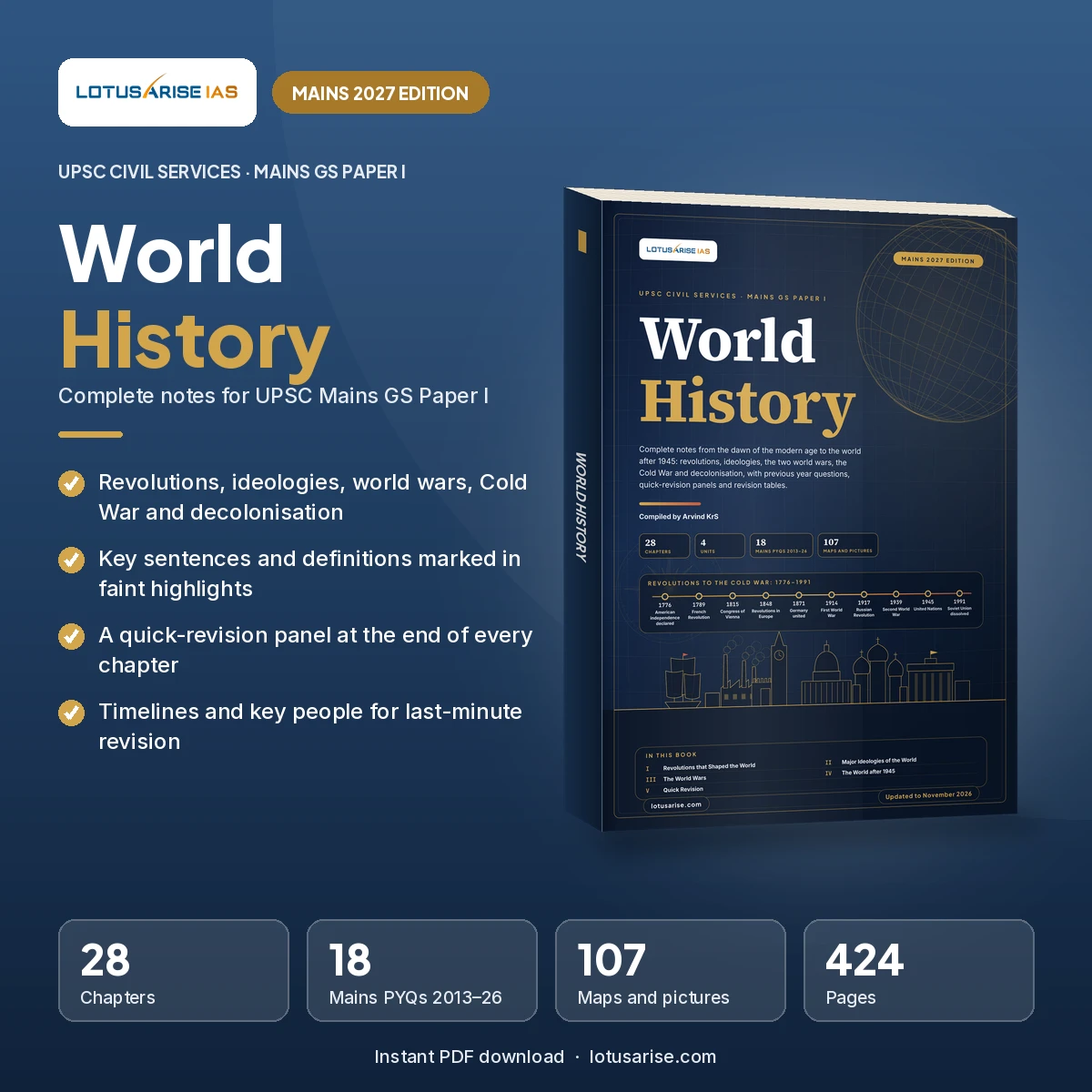
📜 28 chapters, 424 pages — the Renaissance and the voyages of discovery, the American, French and Industrial Revolutions, socialism, communism and fascism, imperialism, both World Wars, the Cold War and decolonisation
✍️ 18 Mains PYQs, 2013–2026 — in UPSC’s own wording, placed in the chapter they belong to
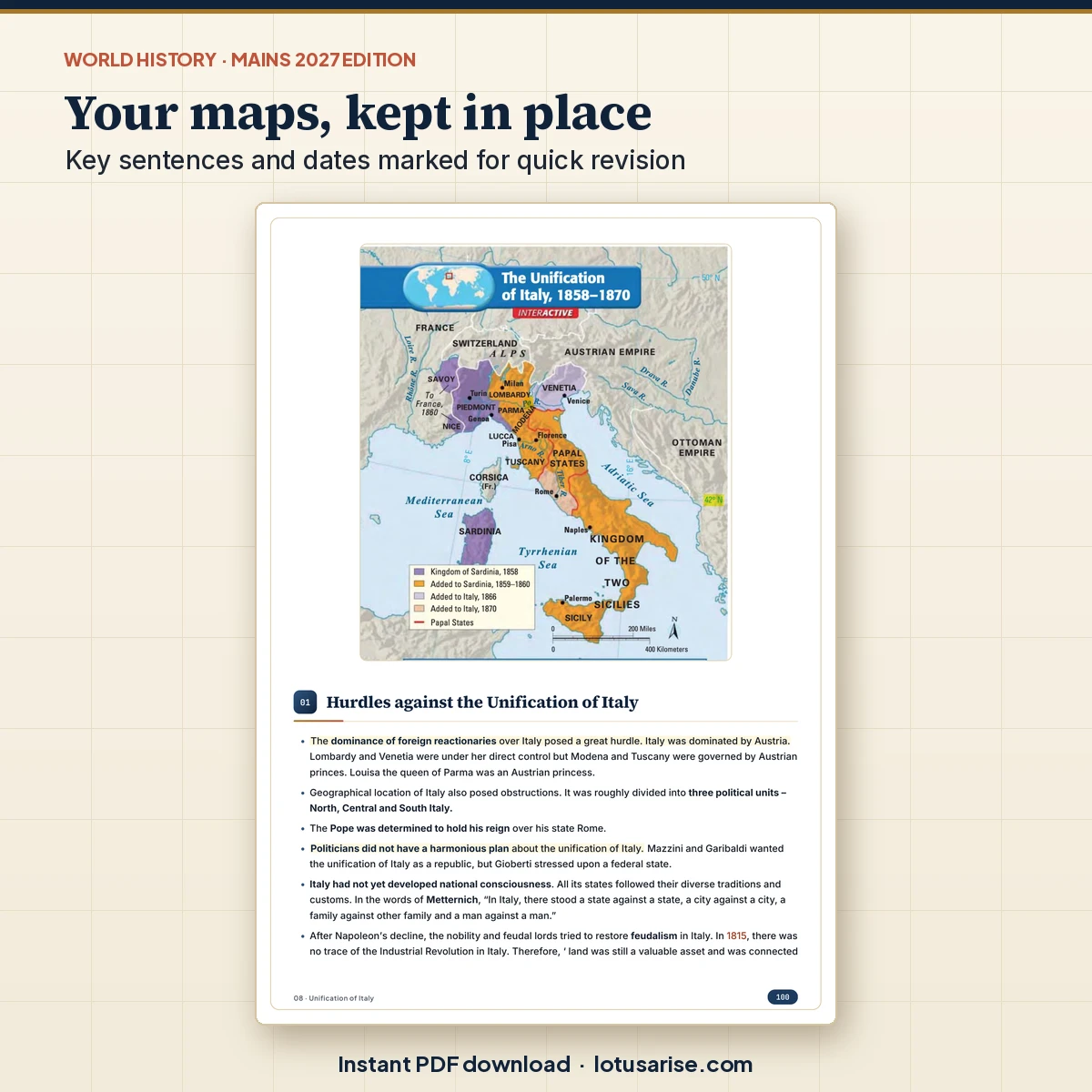
🗺️ 107 maps and pictures — the scramble for Africa, the unification of Italy and Germany, Europe before and after the wars
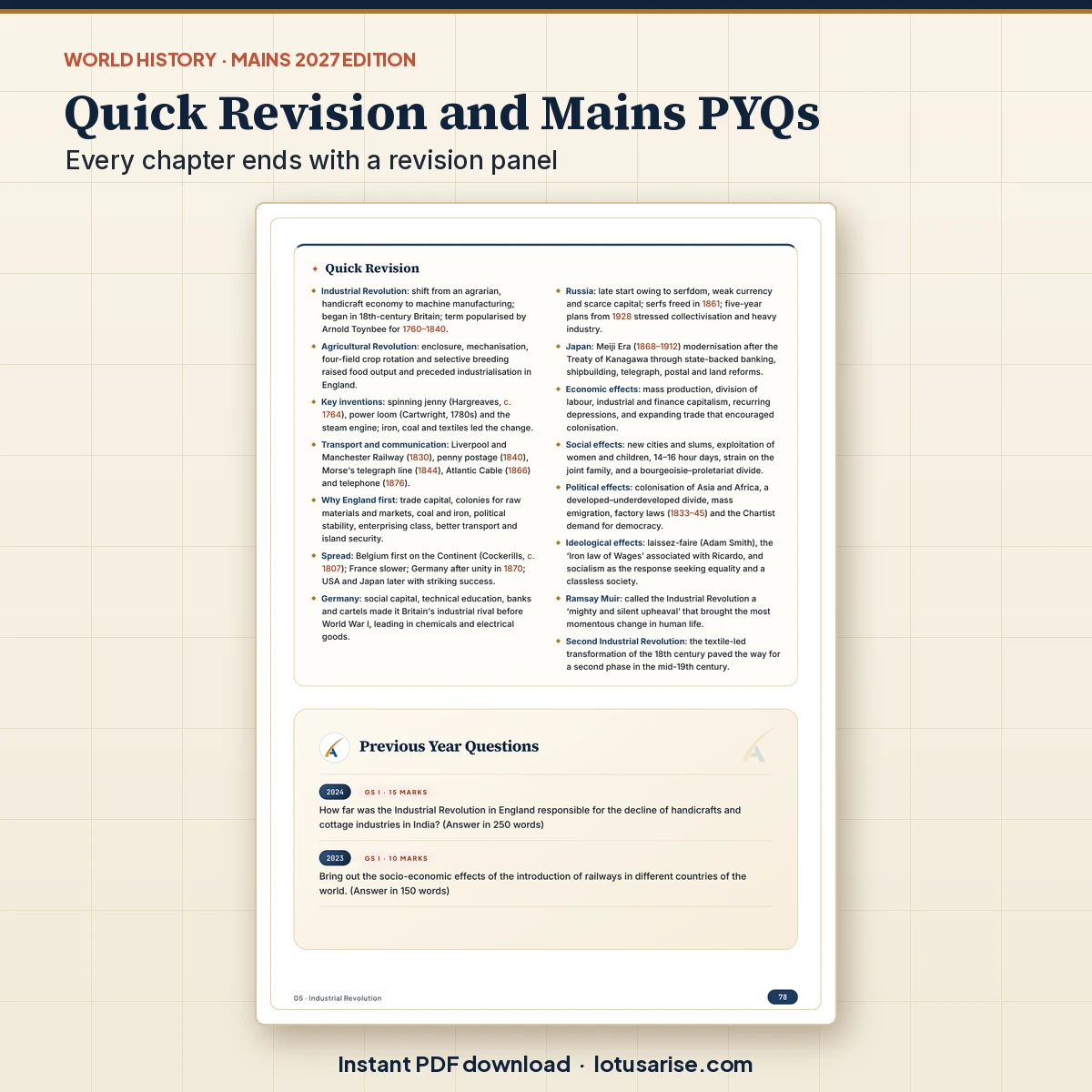
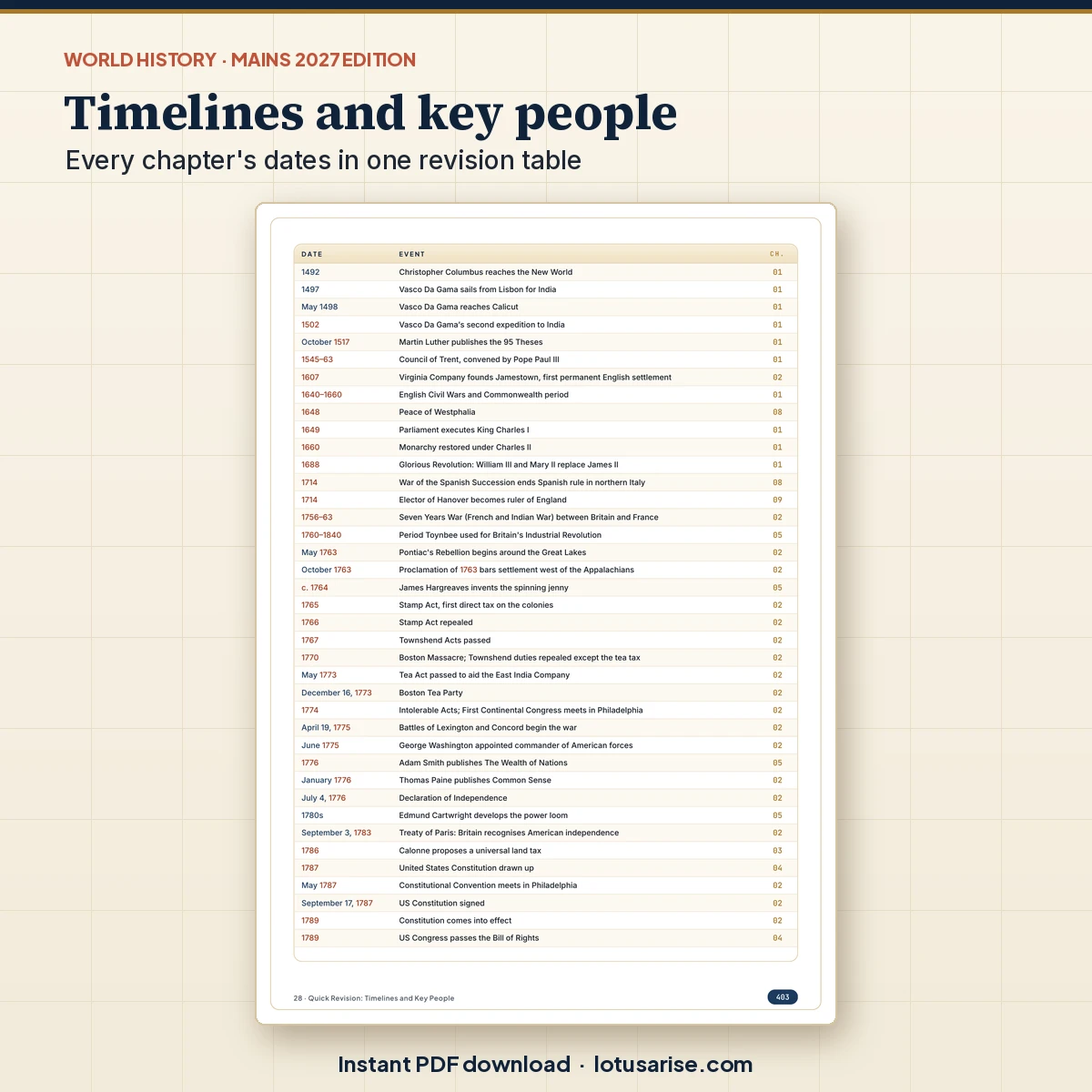
🗂️ Quick Revision panel in every chapter, plus a timelines chapter — every date and key person in the book, unit by unit
📱 Instant PDF download — laptop, mobile or tablet, offline, printable
One-time payment. No subscription. Unlimited downloads — the link does not expire.
⭐ Read by 300,000+ UPSC aspirants every month on LotusArise IAS
Features:
- Comprehensive Coverage
- Complete Syllabus
- Suitable for: UPSC & State PSCs exams
- Format: Digital PDF (Downloadable)
- 337,362+ aspirants visit every month
The part of GS Paper I that reads like a story and is examined like an argument
World history is the one part of GS Paper I that most aspirants enjoy reading. It is also the part they find hardest to write on. Ask an aspirant about it a month before Mains and you usually hear one of three things:
“I know the French Revolution began in 1789. Ask me how it laid the foundations of the modern world and I write a timeline, not an answer.”
“The unification of Italy and Germany, the revolutions of 1830 and 1848, the Moroccan and Bosnian crises — a week before the exam they all blur together.”
“I have read about socialism, communism and fascism, but I cannot say clearly how they differ or what each did to society.”
None of this is a reading problem. Three centuries of revolutions, ideologies and wars overlap with one another — treaties with similar names, crises a few years apart, ideas that changed meaning from one country to the next — and most notes are written to be read once, not revised ten times. World History Notes for UPSC is built to be revised.
Why world history is worth the hours
The GS Paper I syllabus names it directly: “events from 18th century such as industrial revolution, world wars, redrawal of national boundaries, colonization, decolonization, political philosophies like communism, capitalism, socialism etc.” Between 2013 and 2025, UPSC has asked about the Industrial Revolution in England and in Japan, the American Revolution and mercantilism, how Africa was “chopped into States”, the Suez Crisis, Lenin’s New Economic Policy, Germany’s responsibility for the two World Wars, decolonisation in West Africa and the Malay Peninsula, indentured labour, the democratic state system between the wars, the railways, and the enduring relevance of the French Revolution.
The same chapters pay again elsewhere. They give your Essay its examples, your GS Paper II answers on international relations their background, and your Interview its depth. If History is your optional, Paper II examines world history in far more detail, and this book is the GS-level layer underneath it.
The challenge is not the period. It is having one source that keeps the revolutions, the ideologies and the wars in order, with the causes and consequences where you can find them again.
What’s inside — 424 pages
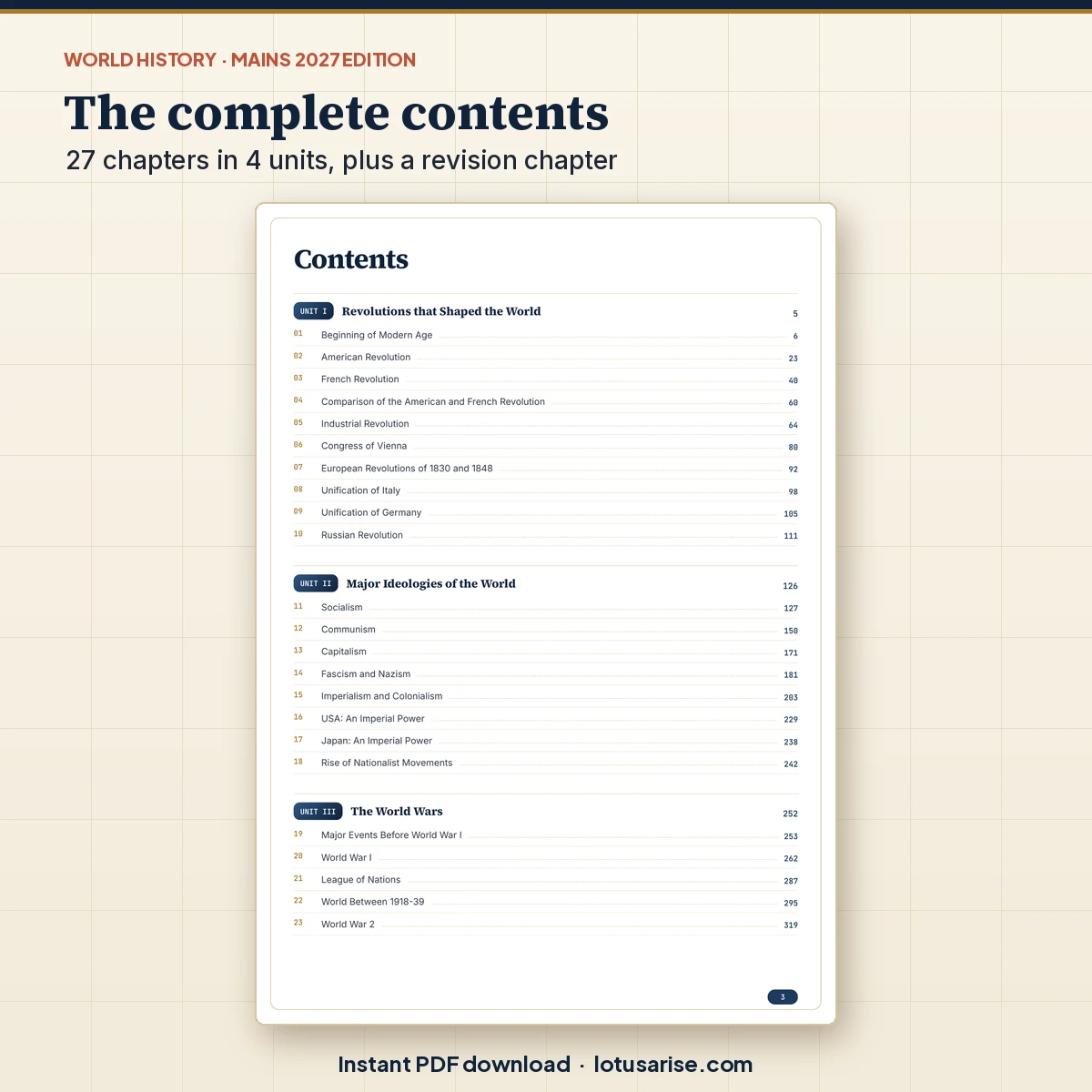
📜 The complete notes — 27 chapters in 4 units
- Revolutions that Shaped the World — feudalism and the Church, the Renaissance and the Reformation, the voyages of discovery and the rise of nation states; the American Revolution and the Civil War; the French Revolution and Napoleon; the two revolutions compared; the Industrial Revolution in England and beyond; the Congress of Vienna; the revolutions of 1830 and 1848; the unification of Italy and of Germany; the Russian Revolution
- Major Ideologies of the World — socialism; communism in Russia, China and beyond Europe; capitalism; fascism and Nazism; imperialism and colonialism, the scramble for Africa and colonialism in Asia and the Pacific; the USA and Japan as imperial powers; nationalist movements in Asia, Africa and Latin America
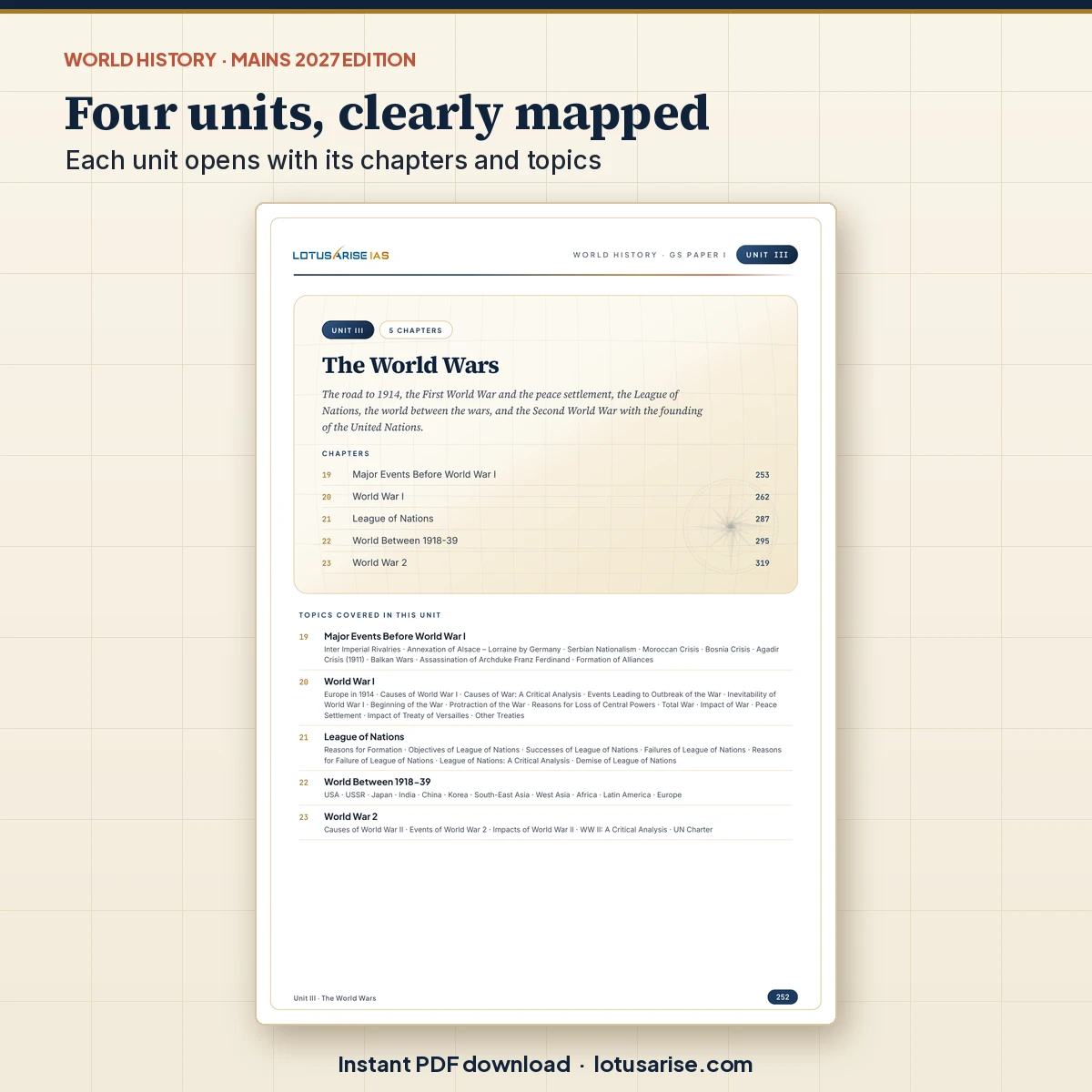
- The World Wars — the alliances and crises before 1914, the First World War and the peace settlement, the League of Nations, the world between 1918 and 1939, and the Second World War with the UN Charter
- The World after 1945 — the Cold War from the Marshall Plan to its end, the Arab-Israel conflict, the decolonisation of Asia and Africa, and Latin America and Europe after 1945
All 107 maps and pictures of the earlier edition are kept in place.
What makes this different from downloaded PDFs: every chapter of this edition was fact-checked against reliable sources — dates, names, figures and spellings — and corrected where needed. Key sentences, definitions and the terms that matter in Mains are lightly highlighted, and dates stand out in colour, so a second and third reading takes a fraction of the first.
✍️ 18 Mains PYQs, 2013–2026
Every GS Paper I world-history question from 2013 onwards, in UPSC’s own wording, placed at the end of the chapter it belongs to — the Industrial Revolution questions with the Industrial Revolution, the Suez Crisis with the Middle East, the balance-of-power question with the First World War. You read a chapter and see straight away how UPSC has asked about it.
🗂️ Quick Revision panels and the timelines chapter
Every chapter closes with a two-column Quick Revision panel of its main points. The last chapter brings the whole book together: a timeline for each unit, from the fall of the Western Roman Empire to the early 2000s, every row pointing to the chapter that explains it, and a table of the key people in each unit — who they were and why they matter.
The aspirant who buys this
First-time aspirants — you want one book for world history, organised unit by unit, with the questions UPSC has asked already placed beside each topic.
Repeaters — you have read world history before and still write thin answers on it. The highlights, revision panels and timelines are built for exactly that.
History Optional aspirants — Paper II goes deep into world history. This book gives you the full sweep first, before the optional-depth reading.
Self-study aspirants outside Delhi, Prayagraj or Jaipur — no classroom and no batch timings; one PDF on your phone for the whole subject.
State PSC aspirants — world history appears in several State PSC papers, so the same book serves both.
Why not just use free notes and a standard book?
Free world history notes are everywhere, and many aspirants already own a standard book. The problem is not that they are bad. It is that they are written to be read, not revised — long narrative chapters, no quick way back to a date or a name, and no link to what UPSC has actually asked.
This book is one checked, revisable system: the full notes unit by unit, the key points marked, the Mains questions in their chapters, a revision panel at the end of every chapter and the timelines at the end of the book.
If you have the time to build that system yourself from scattered sources, you may not need this. If you want it already built — open it and start — this is what the book is for.
Price and delivery
A single printed world history guide usually costs more than this PDF, and it will not be checked, highlighted and laid out for revision like this edition.
₹177 for 424 pages — under 42 paise a page.
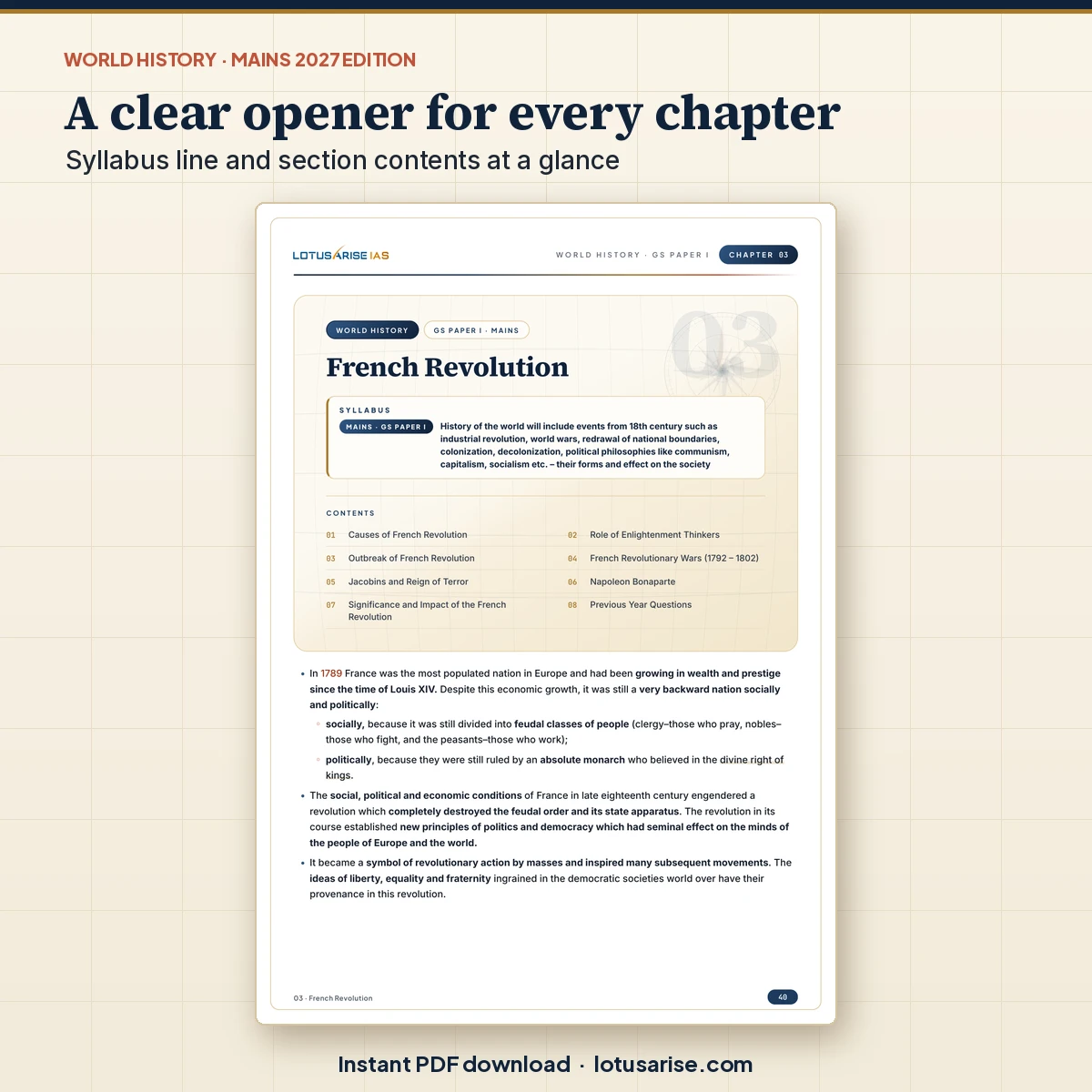
Want to see it first? Download the free sample PDF — the cover, the full contents and two complete chapters: Chapter 3 (French Revolution) and Chapter 20 (World War I).
Already bought an earlier edition? Your download link now gives you this one.
One-time payment. No subscription. No recurring charge.
Instant PDF download after payment. The download link is also sent to your email — please check the spam folder if it does not arrive in a few minutes. Download it again any time from My Account.
For support: support@lotusarise.com
Related products
-

Human & Economic Geography Notes for UPSC: Prelims & Mains GS Papers I and III (2027 Edition) by LotusArise IAS
Original price was: ₹400.00.₹199.00Current price is: ₹199.00. -
-
-
Environment and Ecology Notes for UPSC: Prelims & Mains GS Paper III (2027 Edition) by LotusArise IAS
Original price was: ₹500.00.₹236.00Current price is: ₹236.00.