

Indian Art and Culture Notes
₹236.00
₹236 for the UPSC 2027 Edition — 664 pages, under 36 paise a page.
Most aspirants read Art and Culture as one long list — temples, dances, paintings, festivals — and then Prelims puts two lookalikes side by side. Nagara or Dravida. Gandhara or Mathura. Krishnanattam or Ramanattam. The list gives way at exactly that moment.
Indian Art and Culture Notes turns the list into a book you can revise.
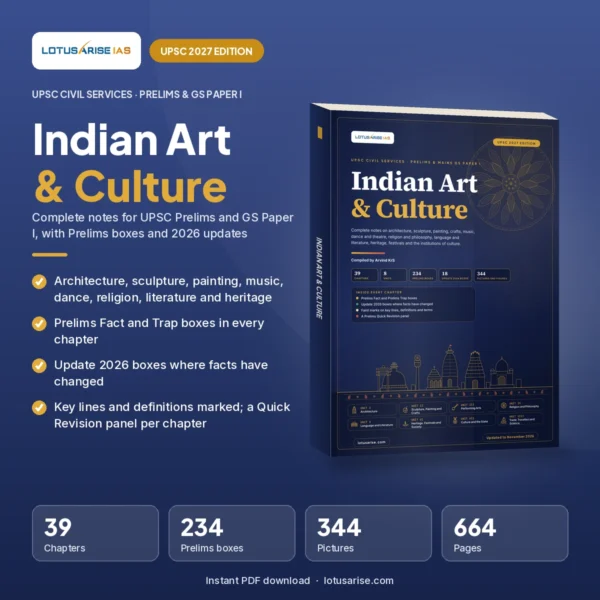
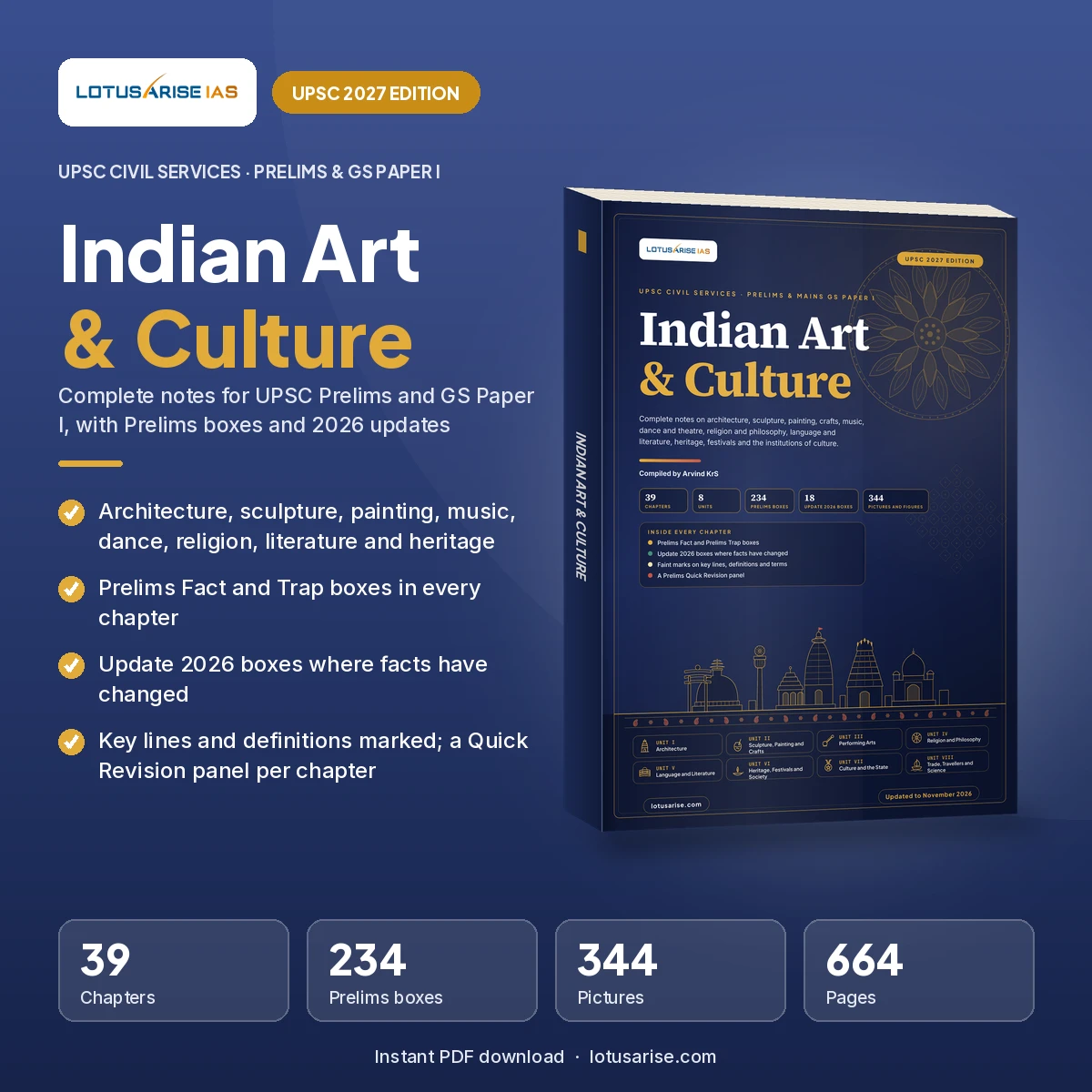
🏛️ 39 chapters, 664 pages — architecture, sculpture, painting, crafts, music, dance, theatre, religion, philosophy, languages, literature, heritage, festivals and the institutions of culture
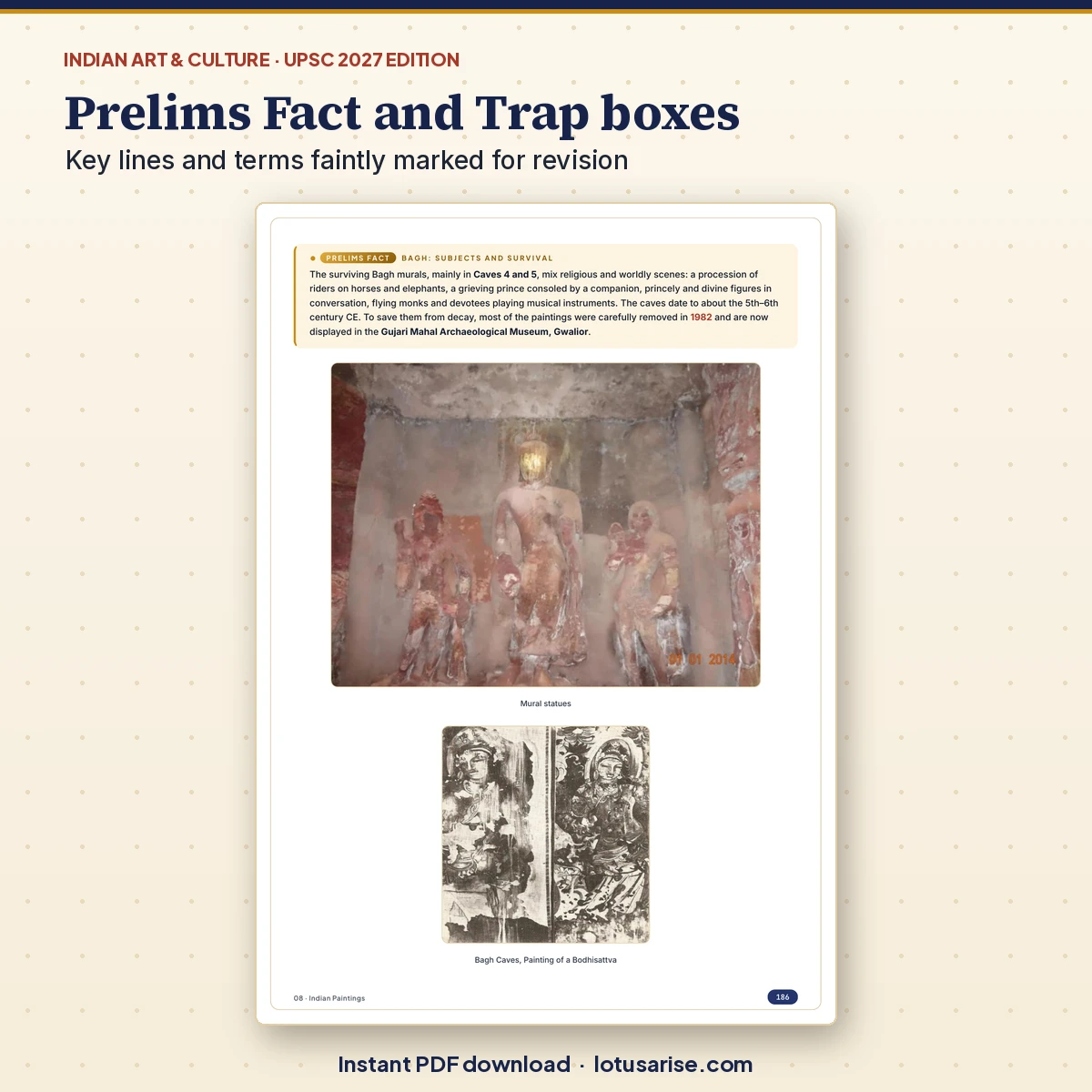
🎯 234 Prelims Fact and Trap boxes — the extra facts and the lookalike pairs question-setters use, each checked against reliable sources
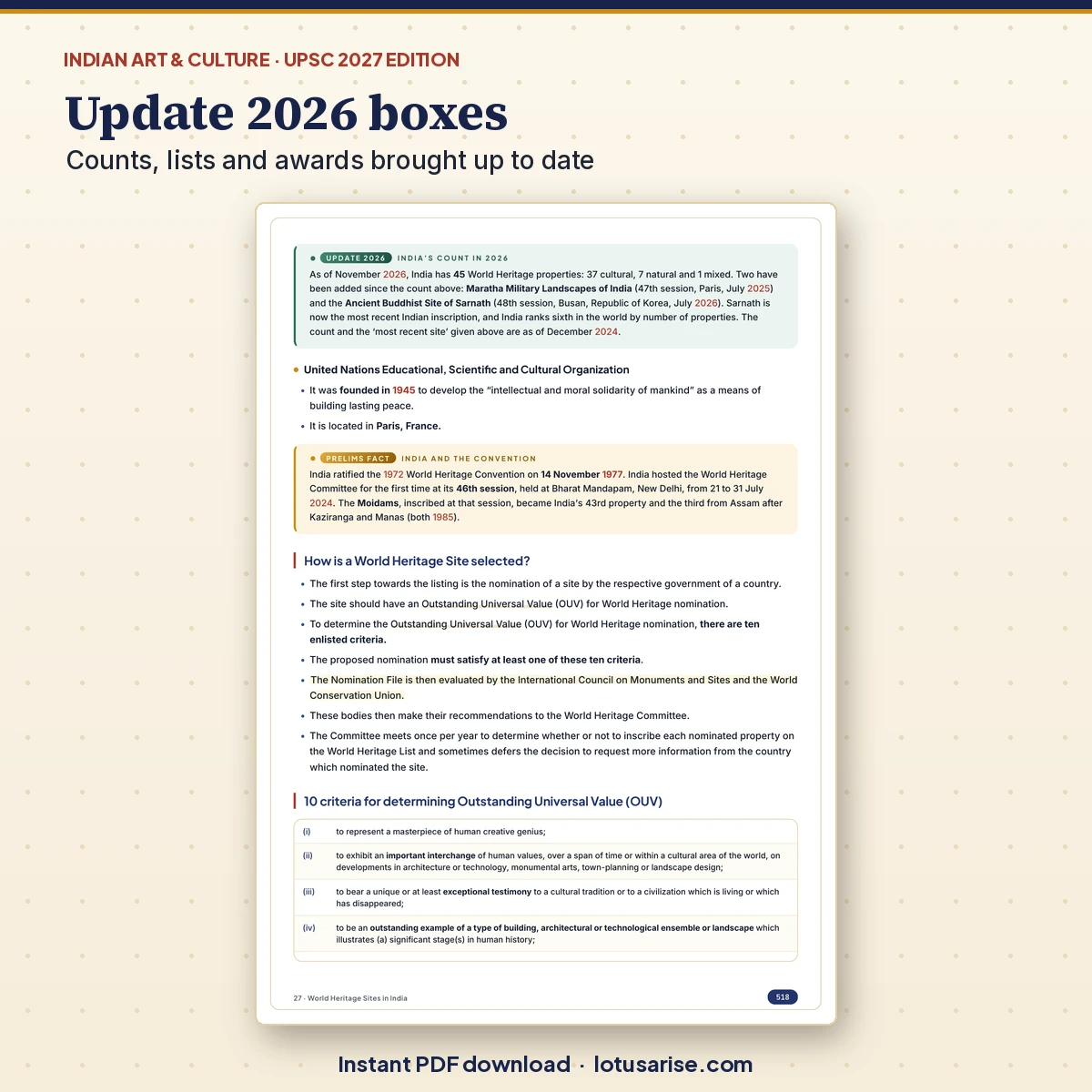
🗓️ 18 Update 2026 boxes — Sarnath on the World Heritage List, Deepavali on UNESCO’s list, the Padma Awards 2026 and more
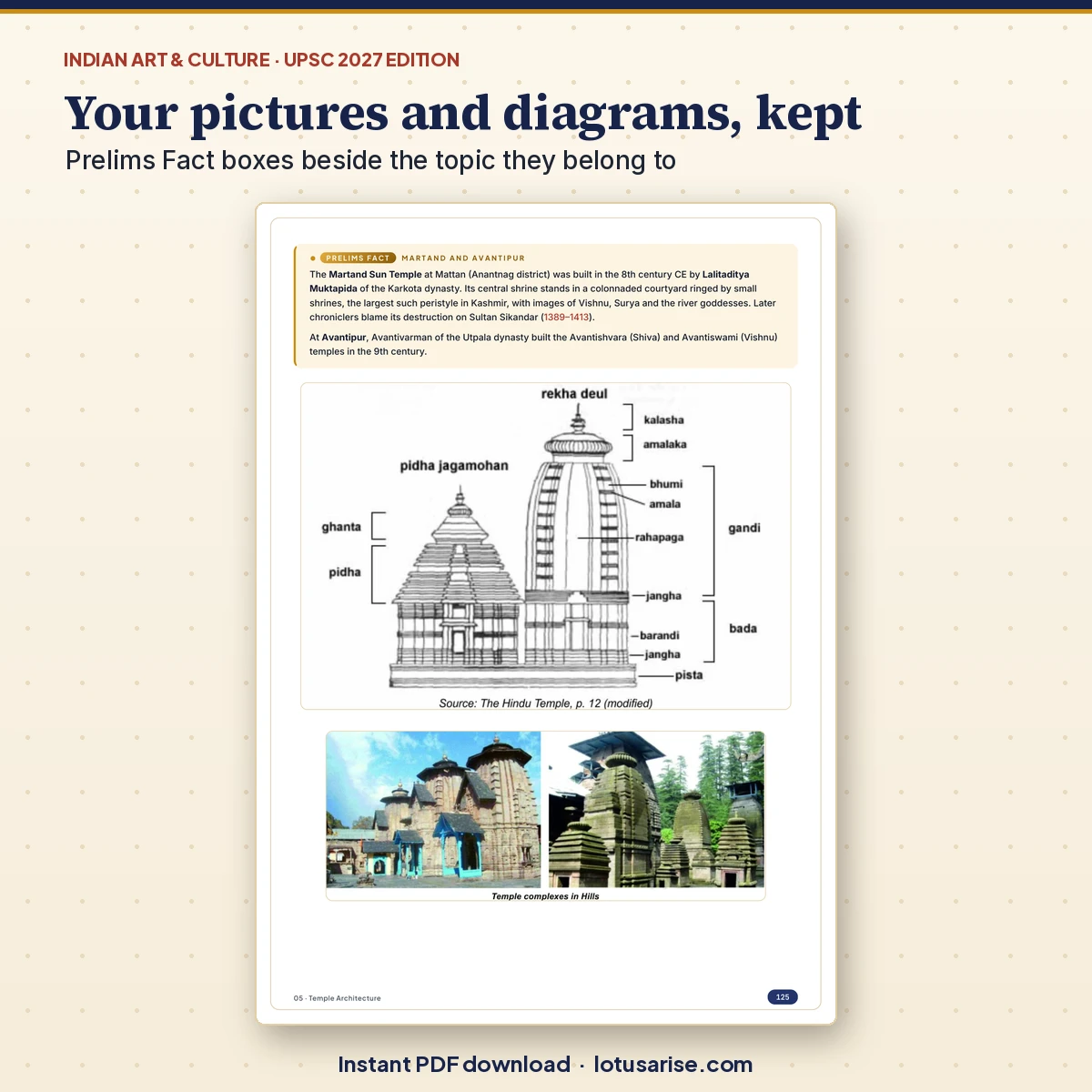
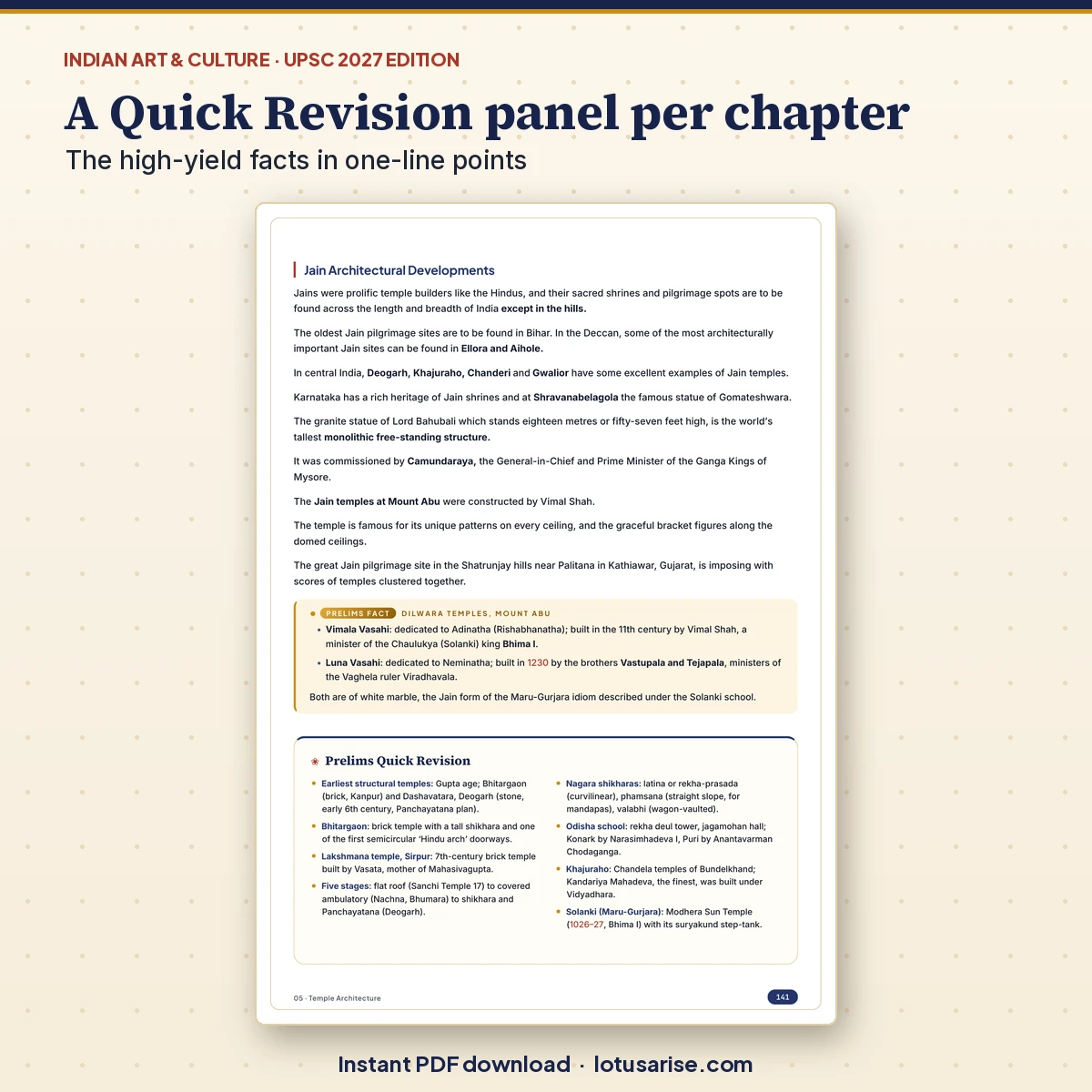
🖼️ 344 pictures and figures, plus a Quick Revision panel in every chapter — see the temple, the cave, the painting; revise the chapter in two minutes
📱 Instant PDF download — laptop, mobile or tablet, offline, printable
One-time payment. No subscription. Unlimited downloads — the link does not expire.
⭐ Read by 300,000+ UPSC aspirants every month on LotusArise IAS
Features:
- Comprehensive Coverage
- Complete Syllabus
- Suitable for: UPSC & State PSCs exams
- Format: Digital PDF (Downloadable)
- 337,362+ aspirants visit every month
The subject everyone reads and few can recall
Art and Culture is the part of the syllabus aspirants enjoy most and trust least. Ask anyone a month before Prelims and you usually hear one of three things:
“I have read about every classical dance. Put Sattriya and Manipuri in the same question and I hesitate.”
“Ajanta, Ellora, Bagh, Badami — I know all of them. A week before the exam I cannot say which is Buddhist, which is Jain and who built what.”
“My notes say India has 43 World Heritage Sites. Is that still true?”
None of this is a reading problem. Art and Culture is thousands of small facts that look alike — styles, schools, states, dynasties, festivals — and most notes are written to be read once, not revised ten times, and are never brought up to date. Indian Art and Culture Notes is built to be revised, and this edition is current to November 2026.
Why Art and Culture is worth the hours
Prelims asks about it every year, and almost always as a match: a dance to its state, a painting school to its region, a temple to its dynasty, a festival to its community, a script or a text to its period. These are marks that reward accurate recall more than any other part of the paper.
Mains asks for it by name. The GS Paper I syllabus says: “Indian culture will cover the salient aspects of Art Forms, Literature and Architecture from ancient to modern times.” The same chapters give your Essay its examples and your Interview its depth, and they carry straight into the ancient and medieval culture of History Optional and most State PSC papers.
The challenge is not the subject. It is having one source that keeps the lookalikes apart and tells you what has changed.
What’s inside — 664 pages
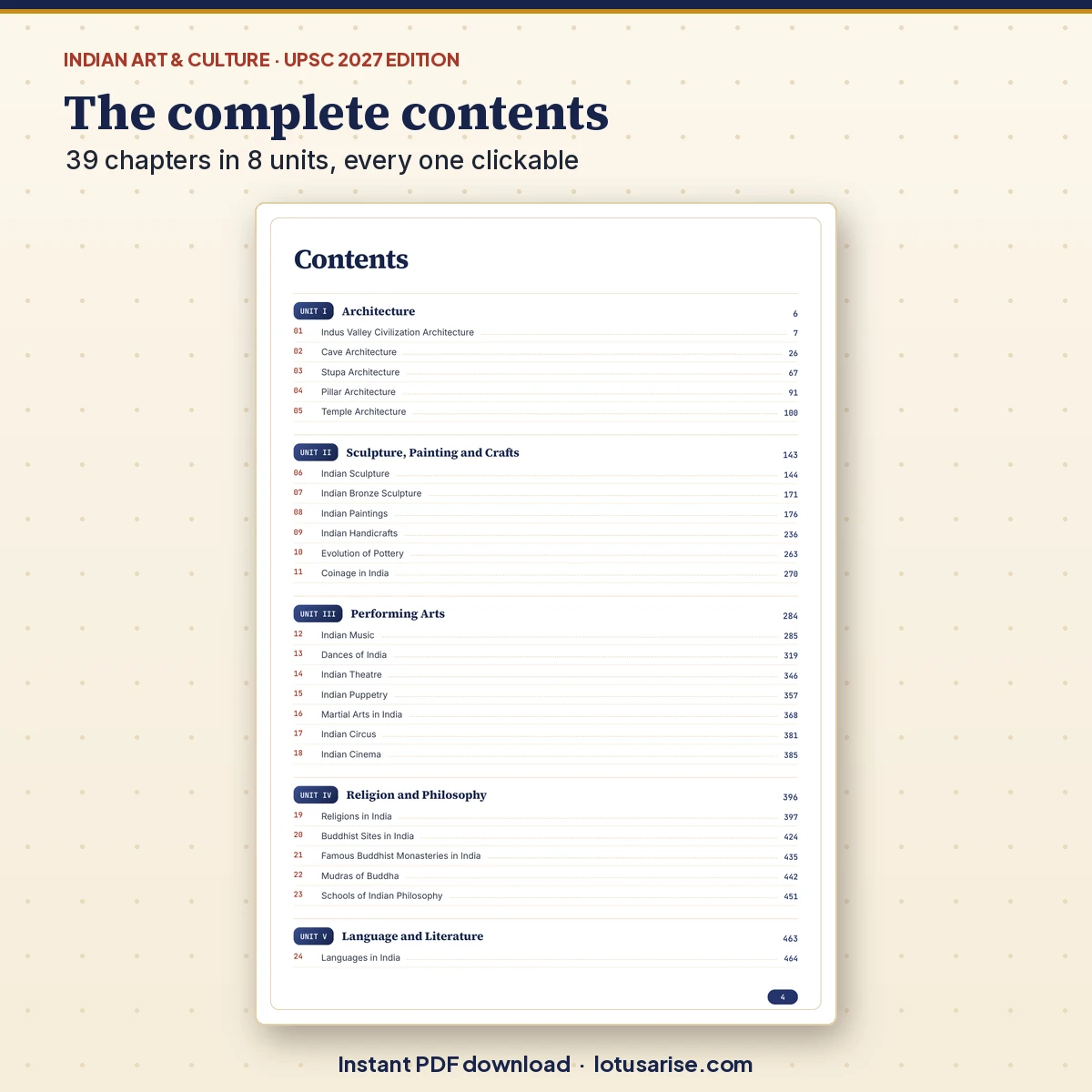
🏛️ The complete notes — 39 chapters in 8 units
- Architecture — Harappan town planning, rock-cut caves, stupas, Mauryan and later pillars, and the Nagara, Dravida and Vesara styles of temple architecture
- Sculpture, Painting and Crafts — stone and bronze sculpture, the Gandhara, Mathura and Amaravati schools, mural, miniature and folk painting, the handicrafts and textiles of every region, the evolution of pottery, and Indian coinage
- Performing Arts — Hindustani, Carnatic and folk music and musical instruments, the classical and folk dances, theatre, puppetry, martial arts, the circus and Indian cinema
- Religion and Philosophy — the religions of India, Buddhist sites and monasteries, the mudras of the Buddha, and the schools of Indian philosophy
- Language and Literature — the languages of India, official and classical languages, ancient scripts, and literature from ancient to modern times
- Heritage, Festivals and Society — World Heritage Sites, India’s elements of intangible cultural heritage, tribes, fairs and festivals, calendars and the national symbols
- Culture and the State — awards and honours, the law that protects culture, cultural institutions and the National Culture Fund
- Trade, Travellers and Science — the ports of ancient India, foreign travellers who wrote about India, and science and technology through the ages
All 344 pictures and figures are kept in place — temples, caves, paintings, crafts and maps.
What makes this different from downloaded PDFs: every chapter of this edition was proofread and fact-checked against reliable sources, and then re-checked by a second, independent check. Dates, names, places and attributions were corrected where needed. Key lines and definitions are faintly marked, terms UPSC asks about are underlined, and dates stand out in colour, so a second and third reading takes a fraction of the first.
🎯 234 Prelims Fact and Trap boxes
Small boxes placed beside the topic they belong to. A Prelims Fact box adds what the chapter does not already say — the patron, the state, the year, the matching pair. A Prelims Trap box sets two lookalikes side by side and settles them: gopuram or vimana, the three Udayagiris, the Gandhara, Mathura and Amaravati schools, Kuchipudi or Bharatanatyam, Onge or Jarawa.
🗓️ 18 Update 2026 boxes
Where something has changed since the notes were first written, a short box gives the current position with its month and year, right after the line it updates: Sarnath’s inscription as India’s 45th World Heritage Site in July 2026, Deepavali on UNESCO’s list of intangible heritage, the Padma Awards 2026, the latest National Film Awards and Dadasaheb Phalke Award, and more.
🗂️ A Quick Revision panel in every chapter
Every chapter closes with a two-column panel of its high-yield facts, one line each — the chapter in two minutes, for the last week before Prelims.
The aspirant who buys this
First-time aspirants — you want one book for Art and Culture, organised by theme, already up to date, with the Prelims angle marked for you.
Repeaters who lost marks on culture questions — you have read this before and still hesitate on the matching questions. The Trap boxes and the Quick Revision panels are built for exactly that.
History Optional aspirants — ancient and medieval culture runs through both papers. This book gives you the full sweep before the optional-depth reading.
State PSC aspirants — art, culture and heritage appear in almost every State PSC paper, so the same book serves both.
Self-study aspirants outside Delhi, Prayagraj or Jaipur — no classroom and no batch timings; one PDF on your phone for the whole subject.
Why not just use free notes and a standard book?
Free Art and Culture notes are everywhere, and most aspirants already own a standard book. The problem is not that they are bad. They are written to be read, not revised; they rarely say which facts are lookalikes; and they are not updated when a site is inscribed, an element is added to UNESCO’s list or an award is announced.
This book is one checked, current, revisable system: the full notes by theme, the key lines marked, the Prelims facts and traps beside each topic, the 2026 updates where they belong and a revision panel at the end of every chapter.
If you have the time to build that system yourself from scattered sources, you may not need this. If you want it already built — open it and start — this is what the book is for.
Price and delivery
A single printed Art and Culture guide usually costs more than this PDF, and it will not be checked, updated, highlighted and laid out for revision like this edition.
₹236 for 664 pages — under 36 paise a page.
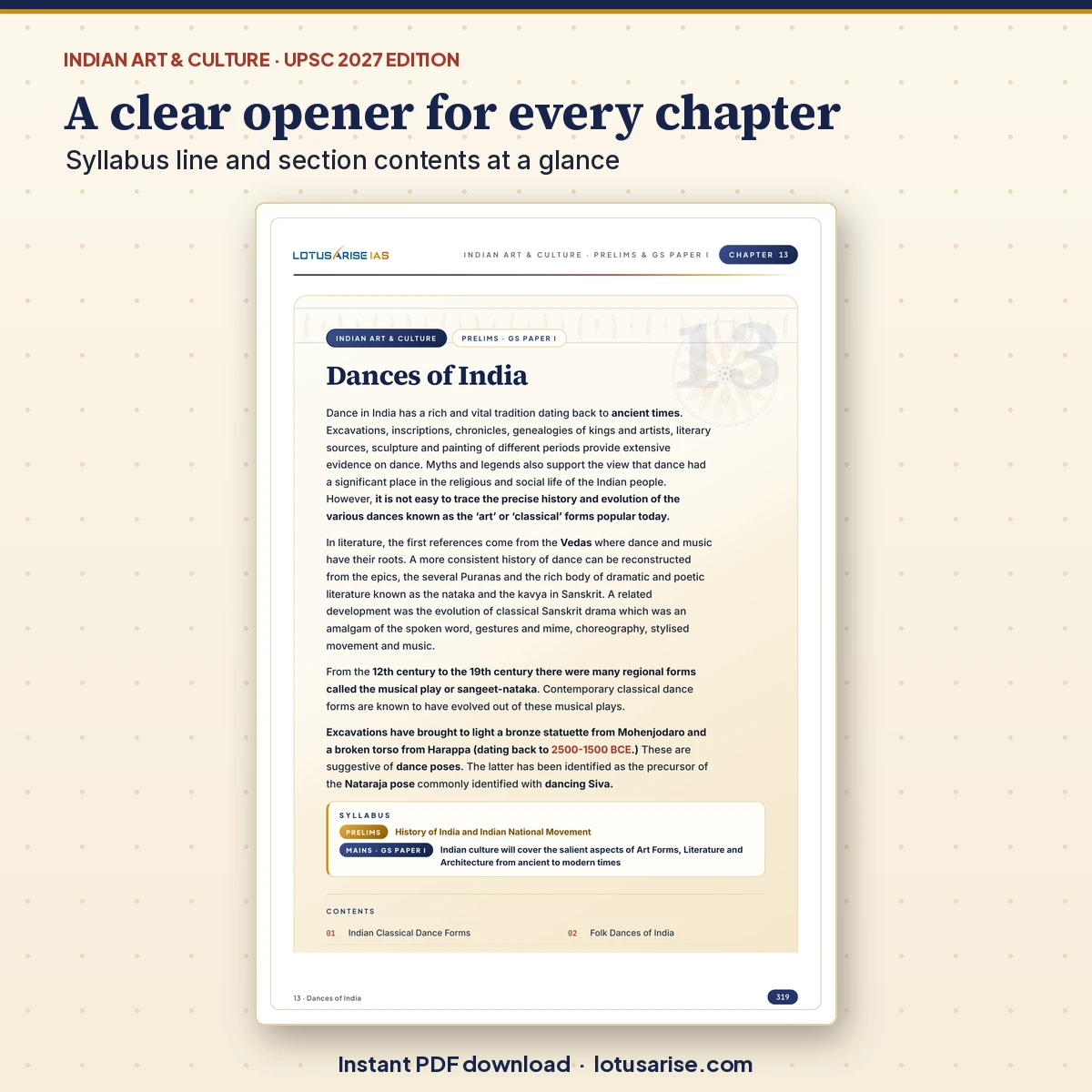
Want to see it first? Download the free sample PDF — the cover, the full contents, the reading guide and two complete chapters: Chapter 3 (Stupa Architecture) and Chapter 13 (Dances of India).
Already bought an earlier edition? Your download link now gives you this one.
One-time payment. No subscription. No recurring charge.
Instant PDF download after payment. The download link is also sent to your email — please check the spam folder if it does not arrive in a few minutes. Download it again any time from My Account.
For support: support@lotusarise.com
You may also like…


Related products
-

-
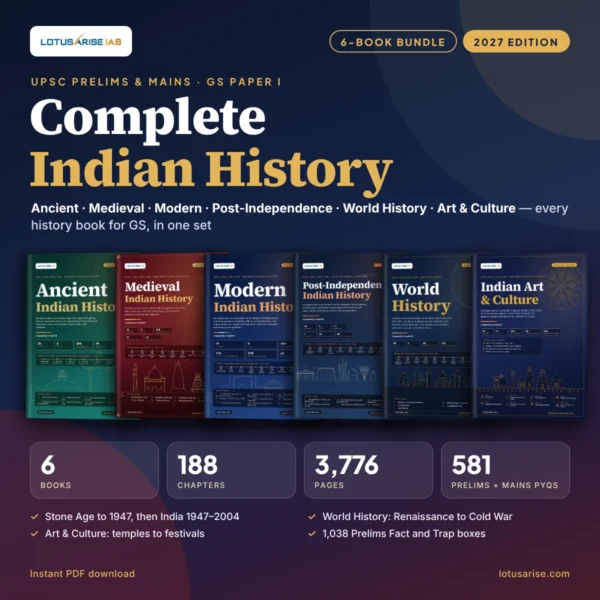
Complete Indian History Notes for GS Prelims and Mains: 6-Book Bundle with Art & Culture (2027 Edition) by LotusArise IAS
Original price was: ₹1,999.00.₹799.00Current price is: ₹799.00. -
-