


Contemporary Issues | Geography Optional UPSC Notes
₹118.00
₹118 for 274 pages — about 43 paise a page. Mains 2027 Edition.
Most Geography Optional aspirants write this section out of general knowledge. Causes, effects, remedies. The same three headings for every flood and every pollutant, no place named, no map drawn, data from some earlier year. Then UPSC asks why winter air is so hard to clean in the Gangetic plain, and the general answer fits nowhere.
Contemporary Issues puts each issue on the map of India: where it happens, why there, and what the recent data say.
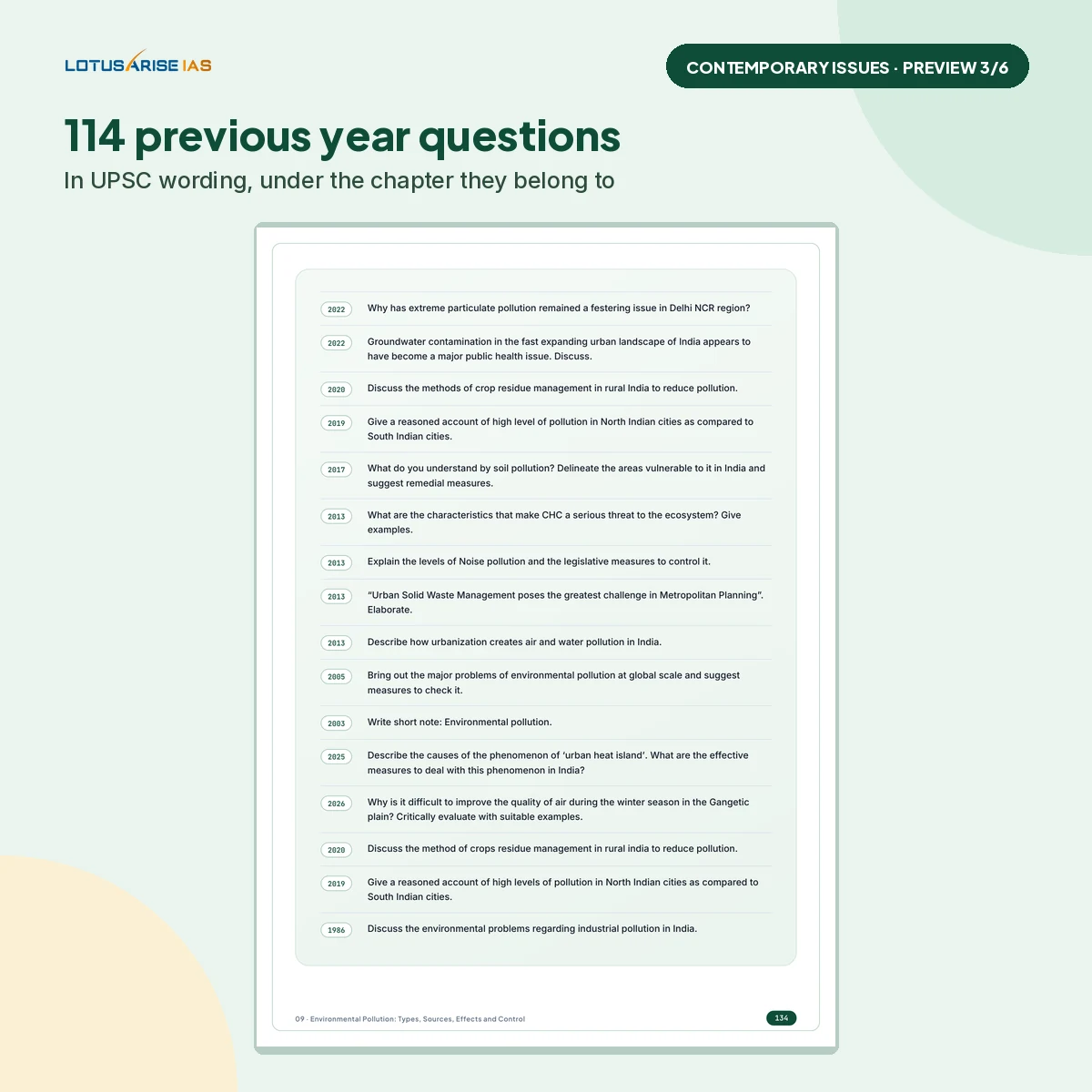
📝 114 PYQs, updated to Mains 2026 — in UPSC’s wording, under the chapter each belongs to
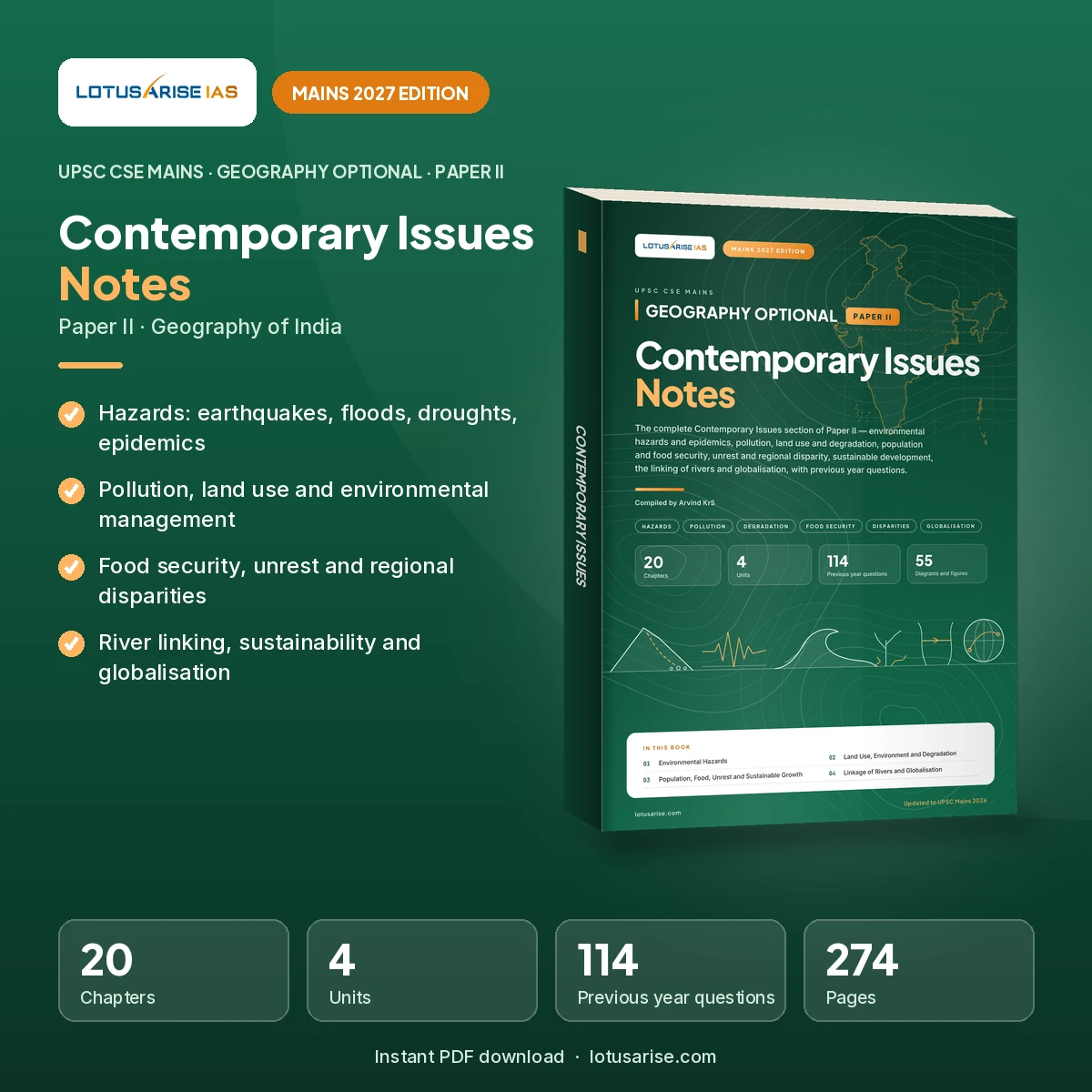
🧭 20 chapters in 4 units — hazards, pollution, land degradation, food security, disparities, river linking, globalisation
🗺️ 55 diagrams and figures — full width, clear enough to redraw in an answer
🌧️ Data carried into 2026 — the monsoon at 87% of average, State drought declarations, river-link status
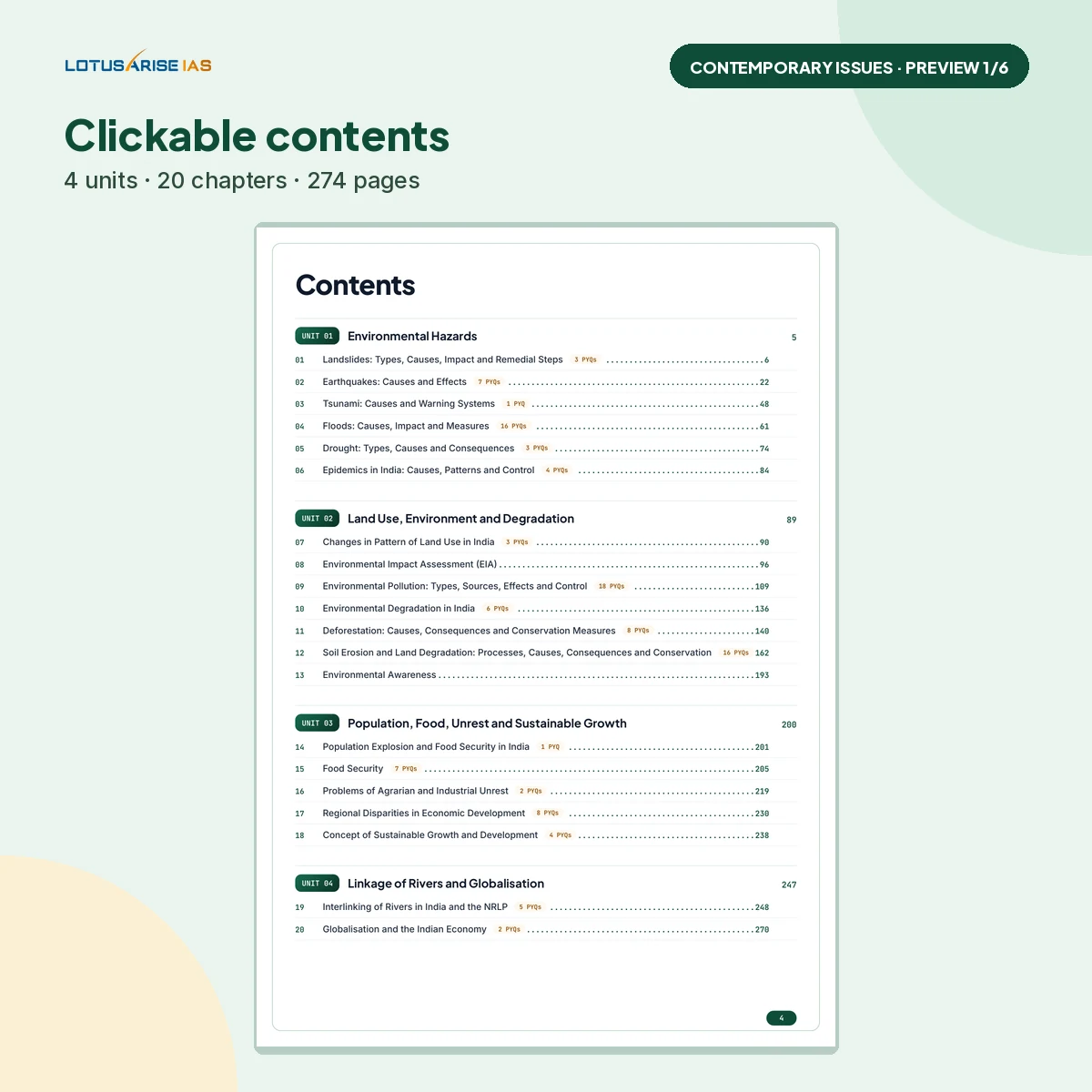
📱 Instant PDF download, 274 pages — clickable contents, laptop, mobile or tablet, offline, printable
One-time payment. No subscription. Unlimited downloads — the link does not expire.
⭐ Read by 300,000+ UPSC aspirants every month on LotusArise IAS
Features:
- Comprehensive Coverage
- Complete Syllabus
- Suitable for: UPSC & State PSCs exams
- Format: Digital PDF (Downloadable)
- 337,362+ aspirants visit every month
The problem most aspirants don’t talk about
Ask a Geography Optional aspirant about this section a few months into preparation. They won’t say the topics are too hard to understand. They will say one of three things:
“I can write causes, effects and remedies of floods from memory. When the question names Mumbai or the middle Ganga plain, my answer stays the same.”
“My hazards are from one place, my pollution from general environment notes and my river linking from an old article. No two have the same year’s data.”
“There are so many topics here that I skim them at the end. Then a question asks me to mark the desertified areas on a sketch map.”
None of this is a lack of effort. These topics look familiar, so most material on them stays general, and the data age quickly. What is missing is one book that ties each issue to its places and gives the recent position. Contemporary Issues is that book.
Why this section is a smart place to spend your hours
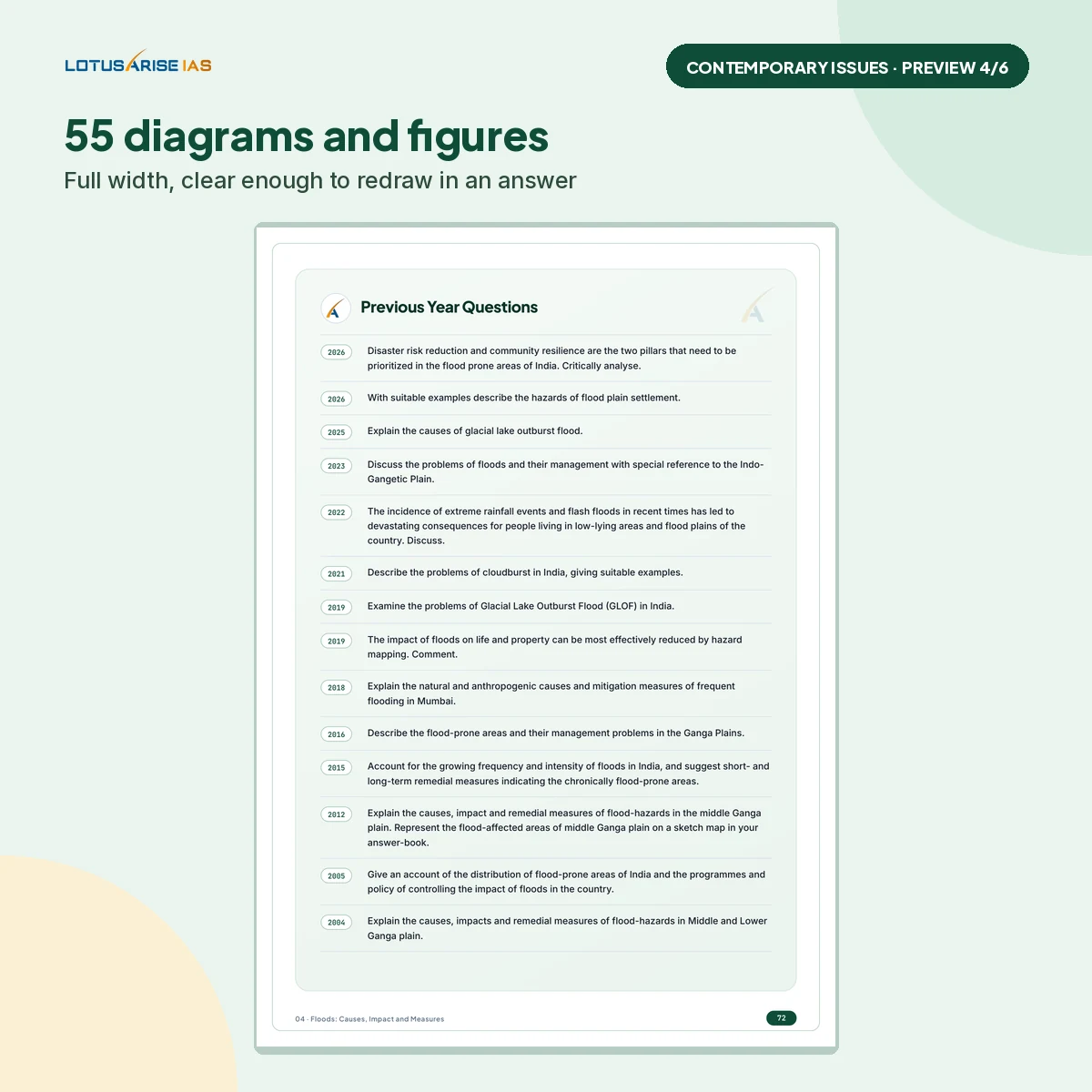
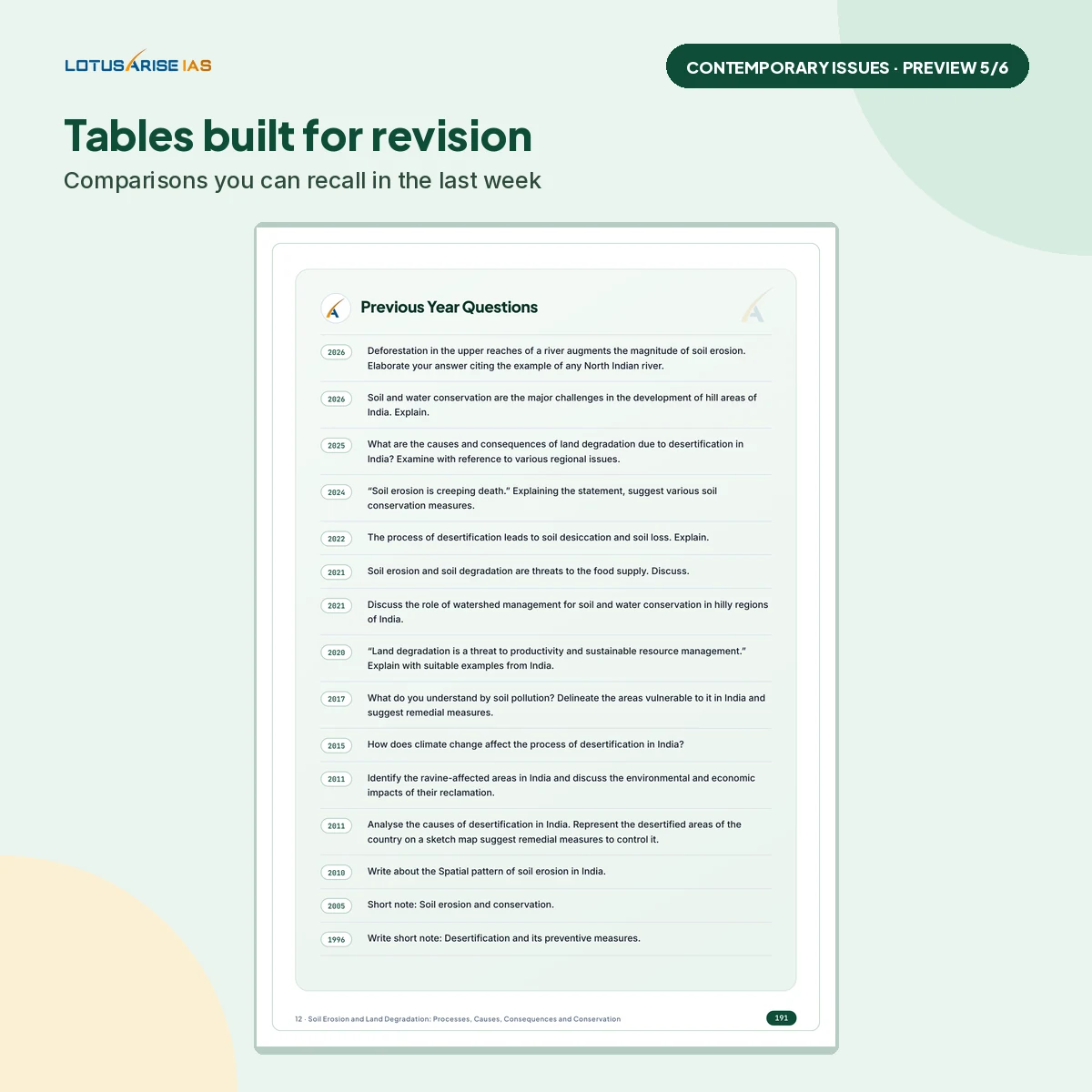
The book carries 114 questions, from 1986 to 2026, with at least two in every year’s papers from 2013 to 2026. The heaviest chapters are environmental pollution with 18, floods with 16, and soil erosion and land degradation with 16. Deforestation and regional disparities follow with 8 each.
The questions are tied to places. Frequent flooding in Mumbai (2018). Particulate pollution in Delhi NCR (2022). North Indian cities against South Indian ones (2019). Glacial lake outbursts (2019 and 2025). Winter air in the Gangetic plain (2026).
It also pays back across the paper. Earthquakes and tsunamis draw on your physical geography. Soil erosion and food security support your answers on agriculture. River linking meets the inter-State water disputes of Political Aspects, and sustainable development goes back to the Limits to Growth.
The challenge is not understanding the issues. It is having one current account of each, tied to a place.
What’s inside — 274 pages in 4 units
⛰️ Environmental Hazards — 6 chapters
- Landslides: types, causes, India’s vulnerability, snow avalanches
- Earthquakes: magnitude and intensity, causes, seismic regions, management
- Tsunami: causes, the 2004 and 2011 events, warning systems
- Floods: causes, flood-prone areas, cloudbursts, glacial lake outbursts, management
- Drought: types, drought-prone areas, severe years, the 2026 monsoon
- Epidemics: how disease diffuses, Chikungunya, Nipah, COVID-19
🌱 Land Use, Environment and Degradation — 7 chapters
- Changes in land use: the five categories of 1950-51 and how shares moved
- Environmental impact assessment: process, the 2006 Notification, shortcomings
- Pollution: air, water, soil, noise, thermal, radioactive, waste, Delhi NCR, crop residue
- Environmental degradation: Himalaya, industrial areas, urban wastes, coasts
- Deforestation: jhum, Amazon and Congo, India’s forest cover, conservation
- Soil erosion and land degradation: water and wind erosion, desertification, watersheds
- Environmental awareness: its growth and how to promote it
🌾 Population, Food, Unrest and Sustainable Growth — 5 chapters
- Population explosion and food security in India
- Food security: four pillars, regional patterns, India’s policy
- Agrarian and industrial unrest: farm suicides, the farm laws, labour codes
- Regional disparities: evolution, present pattern, causes, government interventions
- Sustainable development: Brundtland, Limits to Growth, SDGs, green architecture
🌊 Linkage of Rivers and Globalisation — 2 chapters
- Interlinking of rivers: Himalayan and Peninsular components, Ken–Betwa, the individual links
- Globalisation and the Indian economy: advantages, impacts, effects by sector
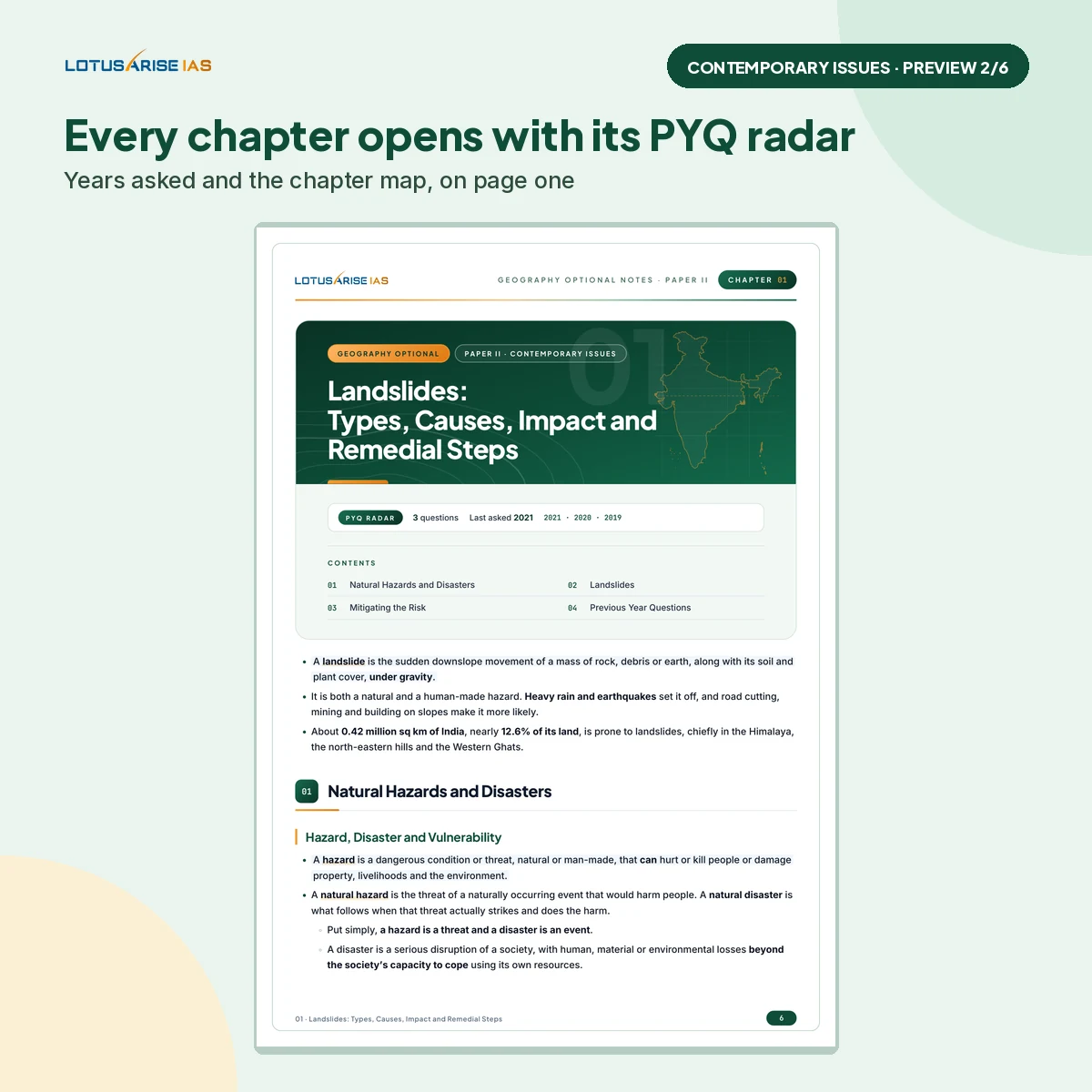
What makes this different from a downloaded PDF? Each chapter is marked against the questions UPSC has actually asked on it. A PYQ radar at the start shows how many times the topic has come and when it last did. Year tags sit on the headings UPSC has asked about. Faint highlights pick out key points, definitions and PYQ terms, so your second reading takes far less time than your first. The two chapters with no direct question yet, EIA and environmental awareness, say so on their radar. Recent cases are dated: Wayanad in 2024, Dharali in 2025, and the drought declarations of 2026.
One thing to be clear about: the book gives the previous year questions, not model answers. Solved answers are in the Geography Optional 300+ Score Pack.
The aspirant who buys this
First-timers — You want one account of these topics from the start, instead of collecting them from general environment notes and the news.
Repeaters — You know the causes and remedies, but your answers could be about anywhere. Use the regional patterns and dated cases, then go through the PYQ list at the end of each chapter.
Aspirants short of time before Mains — Pollution, floods and soil erosion carry 50 of the 114 questions. The radar, year tags and highlights show you what to read first.
Self-study aspirants outside Delhi, Prayagraj and Jaipur — No classroom and no batch. You get one organised book that you can read anywhere, and print for handwritten practice.
Working professionals — One chapter at a time on your phone, offline, with no schedule and no expiry.
State PSC aspirants with Geography — Hazards, pollution and regional disparity are common ground, so the same chapters serve your paper too.
Why not just use free notes from Telegram?
Free notes exist, and most aspirants already have several. Many of these topics are also on our own website, free to read.
The difference is not that free material is wrong. It is that nothing ties it together. A forwarded PDF rarely tells you which of its pages UPSC has asked about, it seldom names the places a question will ask for, and nobody tells you when its data have gone out of date. Here you get one order, dated cases, every PYQ placed under its chapter, and a file you can keep and print.
If you have the time to build and maintain your own file from scattered sources, you may not need this. If you would rather open one book and start revising, this is what it is for.
The price
274 pages, 20 chapters, 114 PYQs and 55 diagrams and figures — ₹118. That is about 43 paise a page.
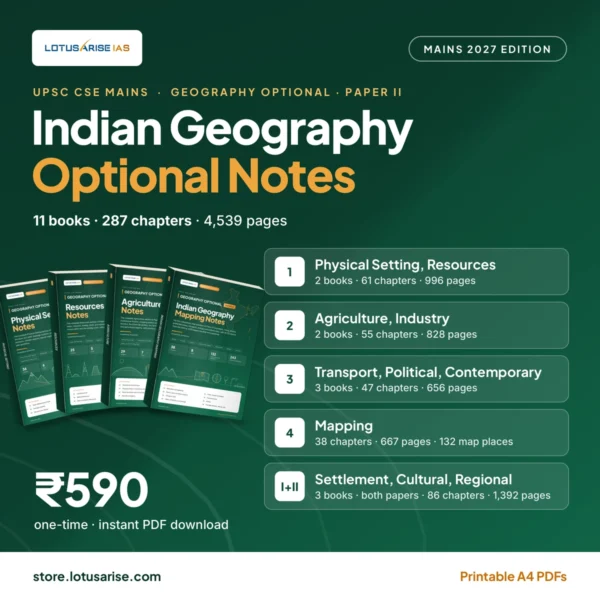
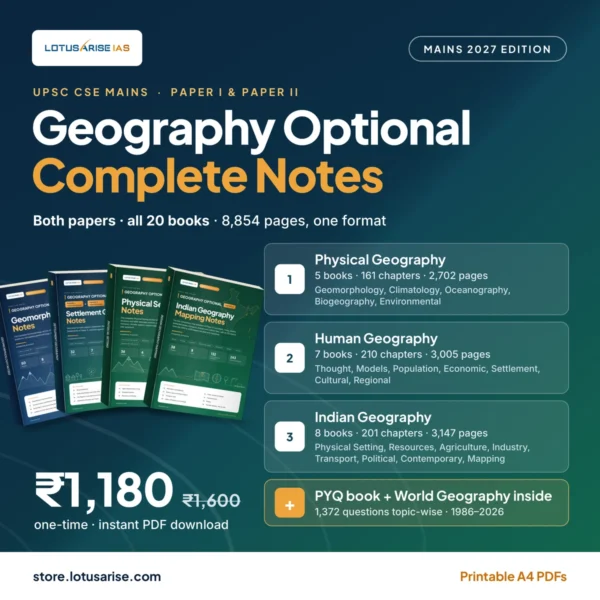
This book is also part of the Indian Geography: Geography Optional Notes bundle at ₹590 and of Geography Optional Complete Notes at ₹1,180.
One-time payment. No subscription. No recurring charge.
The download link reaches your email right after payment — please check your spam folder if you do not see it. Unlimited downloads, no expiry. English medium.
Read the free sample first (PDF)
For support: support@lotusarise.com
You may also like…
-

-
#OFFER: Geography Optional Complete Notes (PDF) – UPSC Mains (Paper I & II)
Original price was: ₹1,600.00.₹1,180.00Current price is: ₹1,180.00.