

Resources | Geography Optional UPSC Notes
₹118.00
₹118 for 372 pages — about 32 paise a page. Mains 2027 Edition.
Most Geography Optional aspirants read this section as a table of reserves. Which State leads in iron ore, where the coalfields lie, capacity from an old chart. Then UPSC asks what ocean ranching has to do with aqua-cowboys, or why critical minerals matter for national security, and the table has nothing to say.
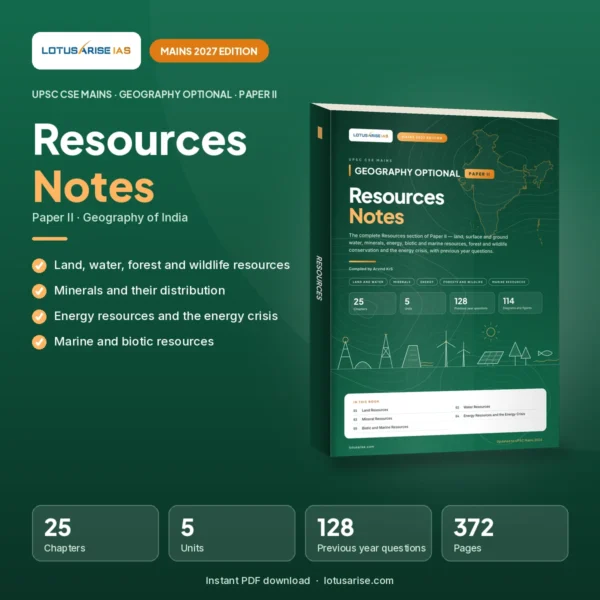
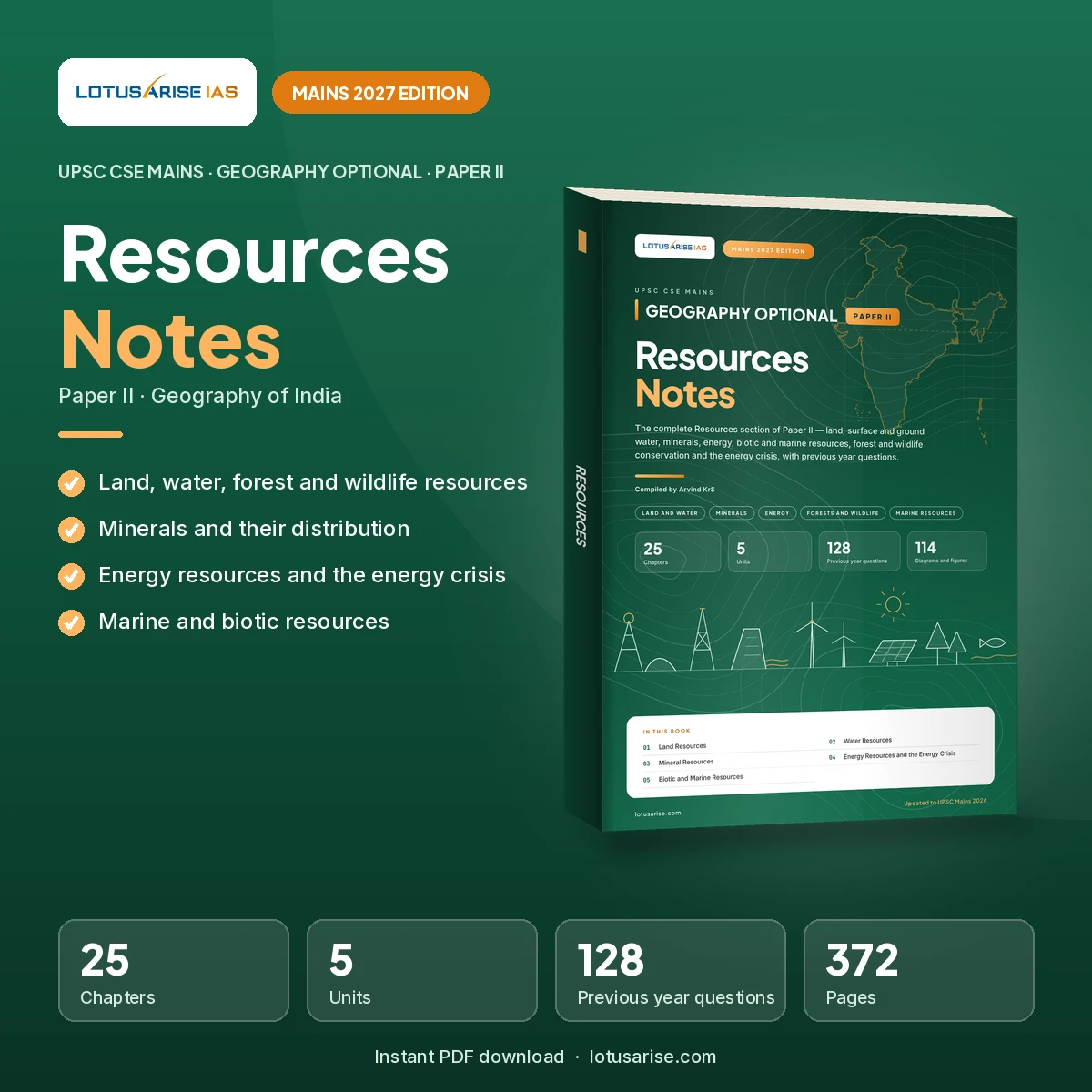
Resources puts the whole Paper II section into one book: where each resource lies, how it is used, what has gone wrong.
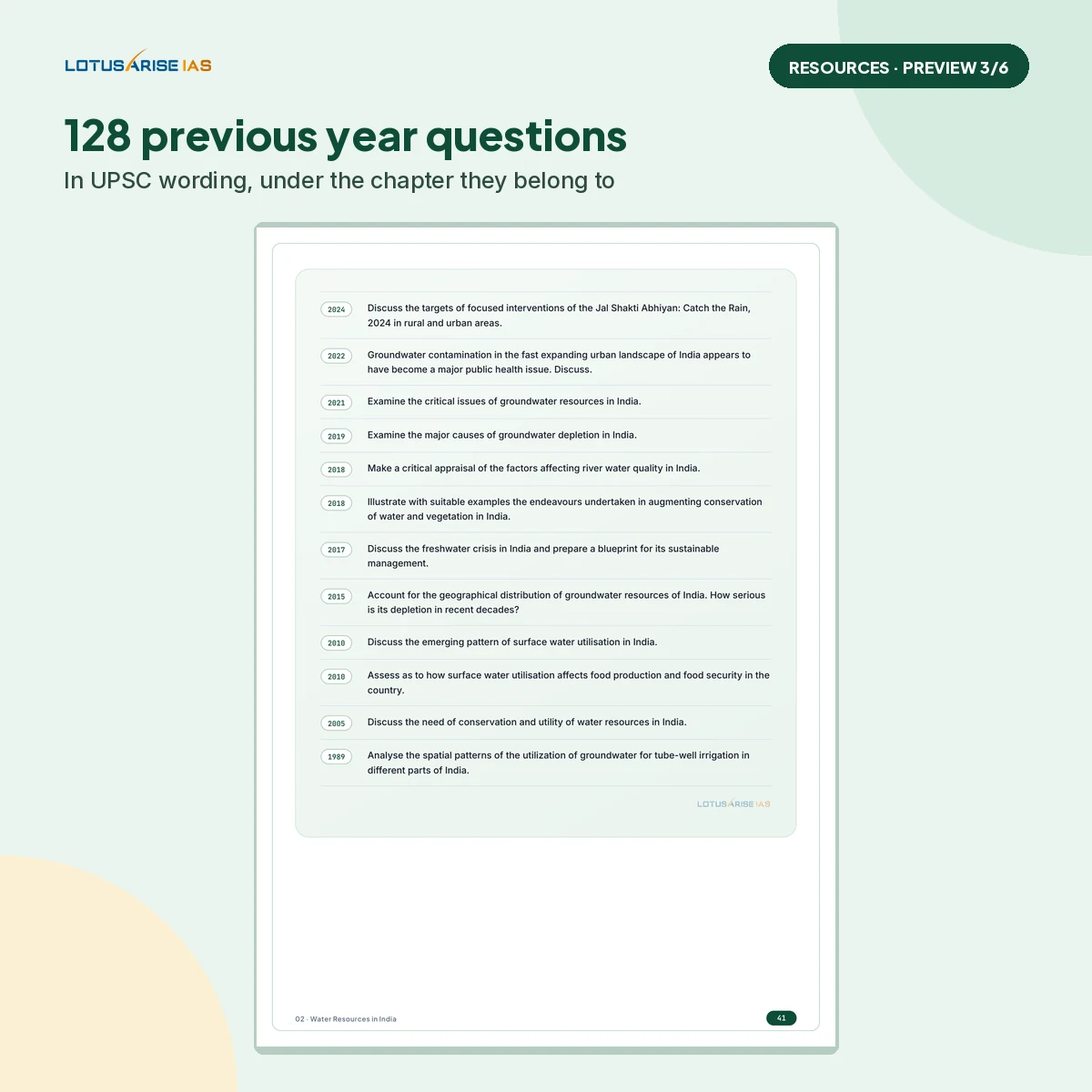
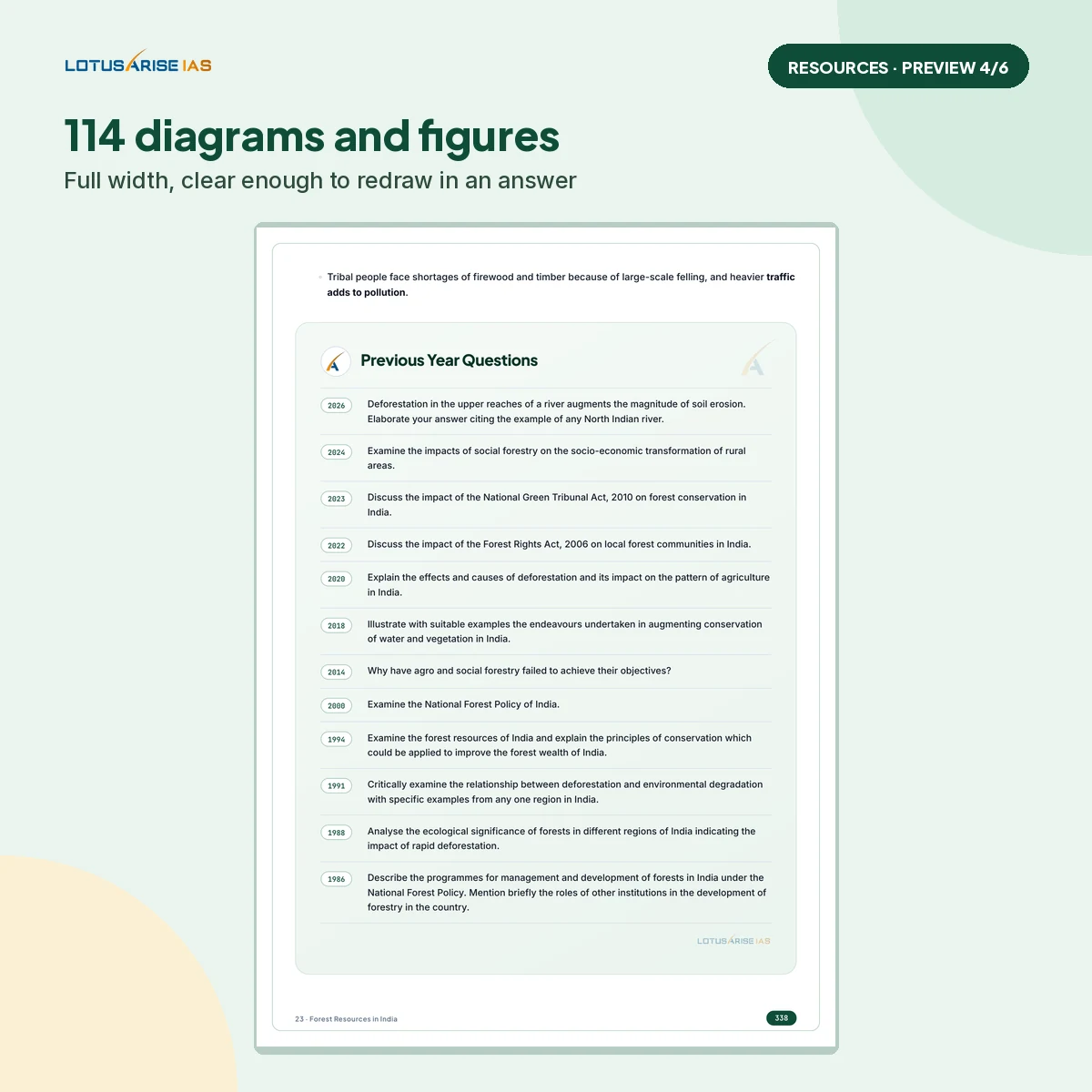
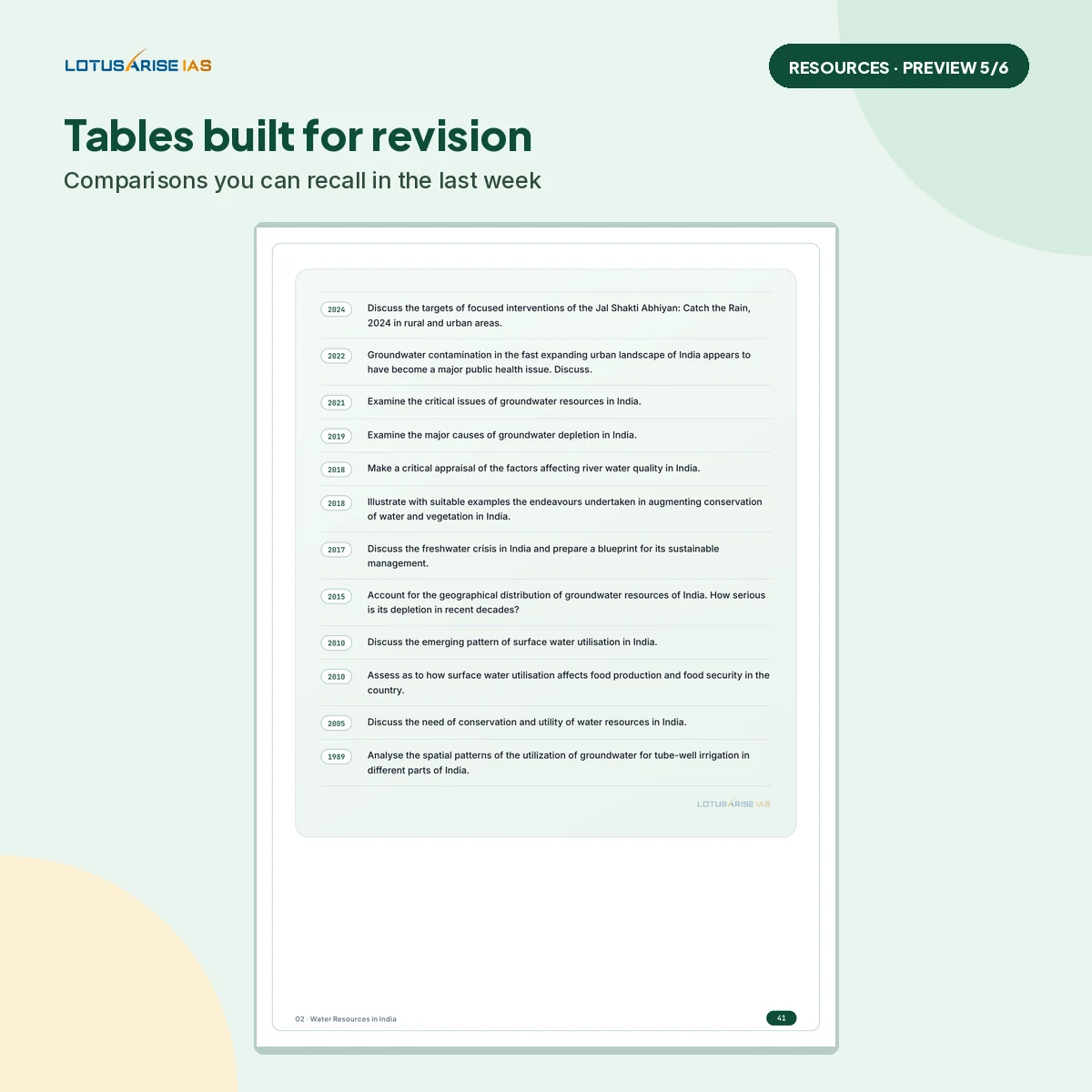
📝 128 PYQs, updated to Mains 2026 — in UPSC’s wording, map items included, placed by chapter
🧭 25 chapters in 5 units — land, water, minerals, energy and the energy crisis, biotic and marine resources
🗺️ 114 diagrams and figures — full width, maps included, clear enough to redraw
⚡ Energy figures into 2026 — hydro capacity as on 30 September, the gas grid, the Hormuz shock
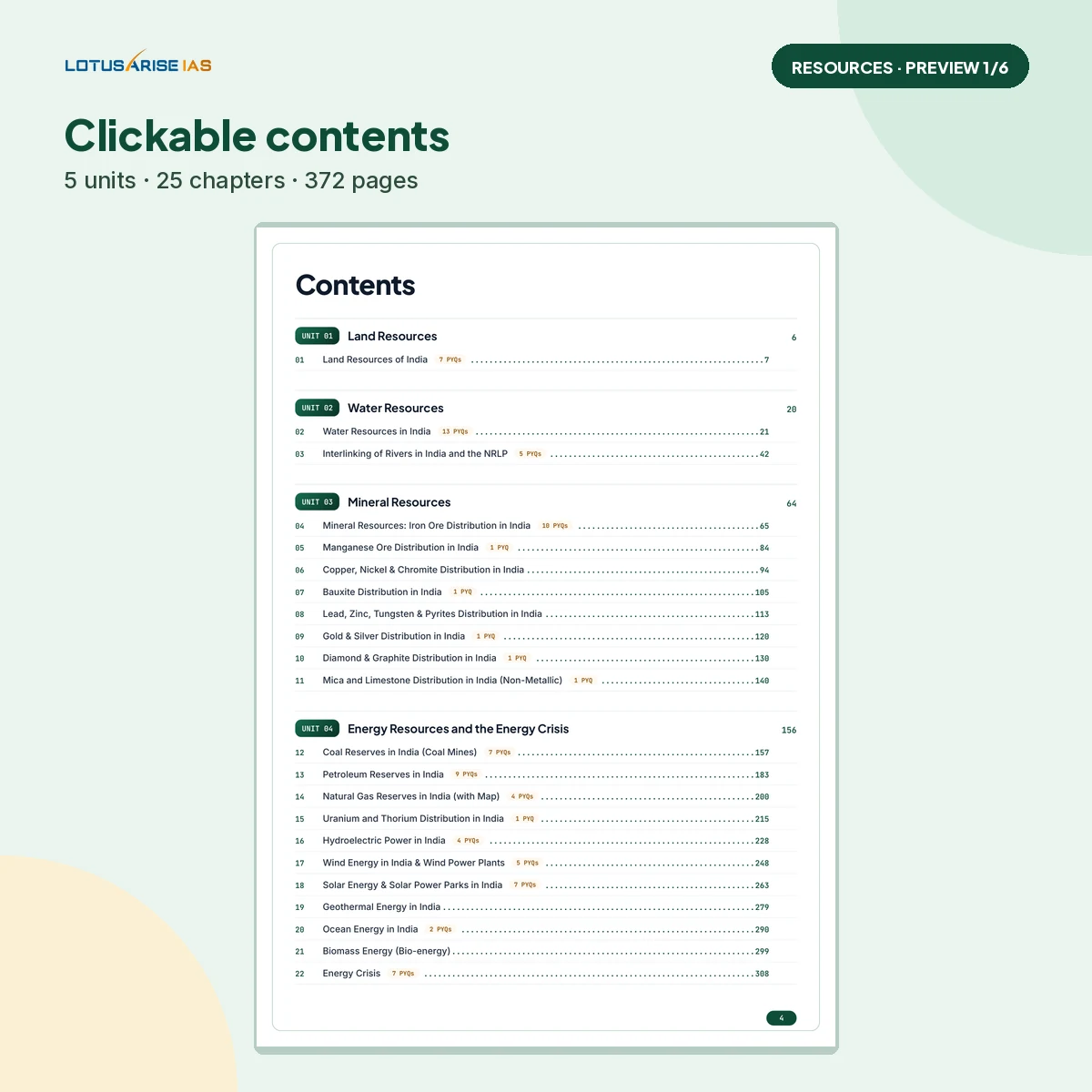
📱 Instant PDF download, 372 pages — clickable contents, laptop, mobile or tablet, offline, printable
One-time payment. No subscription. Unlimited downloads — the link does not expire.
⭐ Read by 300,000+ UPSC aspirants every month on LotusArise IAS
Features:
- Comprehensive Coverage
- Complete Syllabus
- Suitable for: UPSC & State PSCs exams
- Format: Digital PDF (Downloadable)
- 337,362+ aspirants visit every month
The problem most aspirants don’t talk about
Ask a Geography Optional aspirant about this section a few months into preparation. They won’t say the distribution of minerals is too hard to learn. They will say one of three things:
“I can name the iron ore belts and the top coal States, but the question on critical minerals and national security left me with nothing.”
“My solar and wind figures are from an old chart, and I no longer know which of them are still right.”
“I kept marine and wildlife for the end because they looked like side topics. Then deep-sea mining and the Blue Economy came, and I had a paragraph at most.”
None of this is a lack of effort. Resource facts date quickly and sit in scattered places, and most notes stop at where a thing is found. What is missing is one book that takes every resource from location to use to problem, with the figures brought forward and the questions marked. Resources is that book.
Why this section is a smart place to spend your hours
This section has a long record. The book carries 128 questions from it, from 1986 to 2026, with at least two in every year’s papers from 2013 to 2026.
Where they fall is the useful part. The eight mineral chapters together carry 15 PYQs. Marine Resources alone carries 16, Wildlife 14, Water 13 and Forests 12, with Petroleum next at 9.
The questions have also moved from “where” to “why”. Mains 2023 asked about critical minerals and ocean ranching, Mains 2025 about deep-sea mining and man and wildlife conflict, Mains 2026 about energy pipelines and regional imbalance. The map still comes too, with Kuno National Park in 2026 and Gua and Panna in 2024.
It pays back across the paper. Mineral belts rest on the rock systems of Physical Setting. Social forestry runs into Agriculture. Coal, ore and pipelines explain the location of Industry.
The challenge is not the distribution. It is having one current account of each resource that you can actually revise.
What’s inside — 372 pages in 5 units
🏞️ Land Resources — 1 chapter
- Land use classes and how the budget has changed
- Land degradation, wastelands and the karewa deposits of Kashmir
💧 Water Resources — 2 chapters
- Surface water and ground water, depletion, water stress, quality, water footprint and disputes
- Rainwater harvesting and national schemes, including Jal Shakti Abhiyan: Catch the Rain
- Interlinking of rivers: the Himalayan and Peninsular components, priority links and Ken–Betwa
⛏️ Mineral Resources — 8 chapters
- Mineral belts, iron ore and critical minerals
- Manganese, copper, nickel, chromite, bauxite, lead, zinc, tungsten and pyrites
- Gold, silver, diamond and graphite
- Mica, limestone and the other non-metallic minerals
⚡ Energy Resources and the Energy Crisis — 11 chapters
- Coal, petroleum and natural gas: fields, pipelines, strategic reserves and LNG terminals
- Uranium, thorium and the atomic minerals
- Hydroelectric, wind, solar, geothermal, ocean and biomass energy, with the major solar parks
- The energy crisis: oil shocks, regional variation, efficiency and energy security
🌳 Biotic and Marine Resources — 3 chapters
- Forests: products, problems, conservation, forest policy and law
- Wildlife: biotic resource regions, protected areas, Project Tiger and Project Cheetah
- Marine: fisheries, ocean ranching, deep-sea mining, the Blue Economy and coral reefs
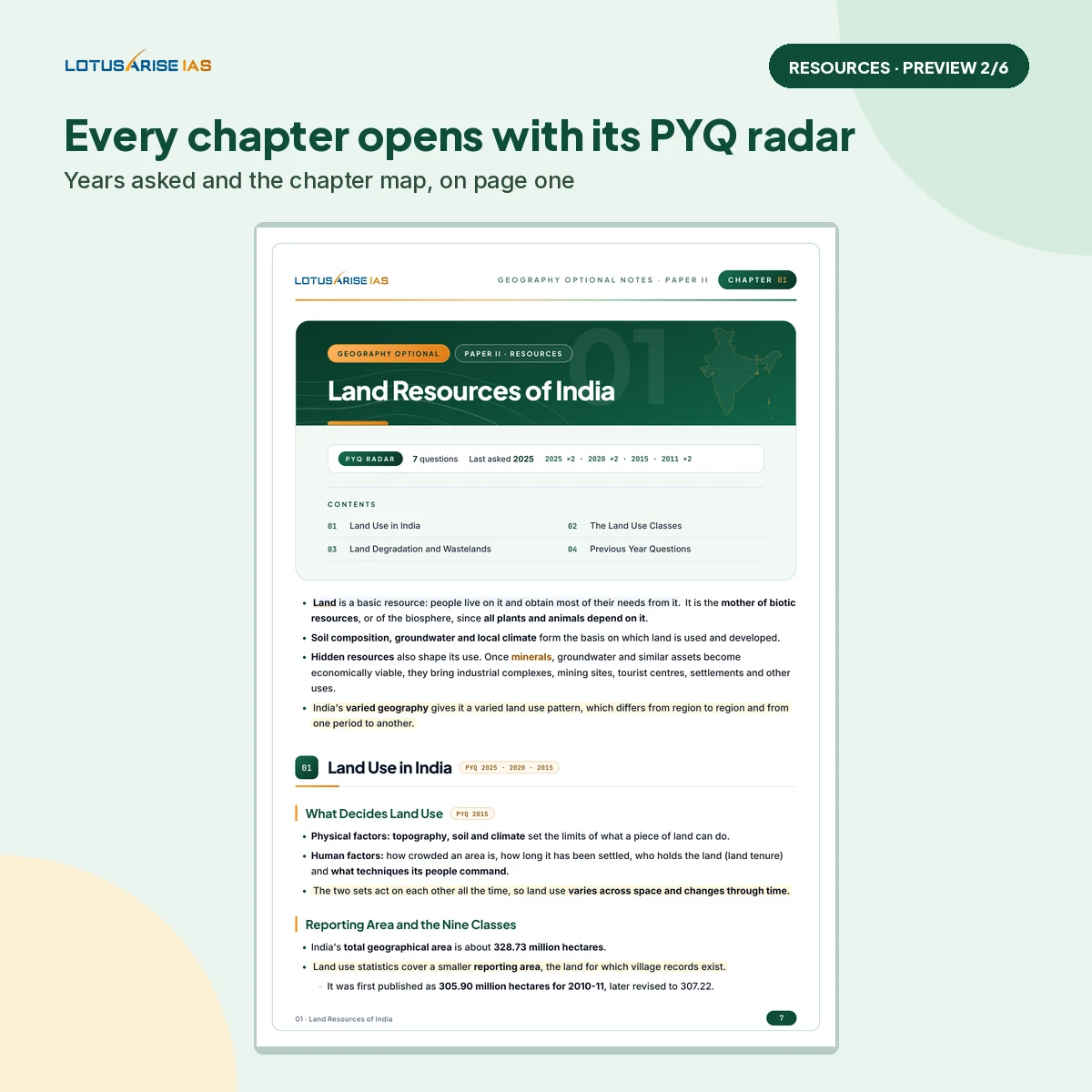
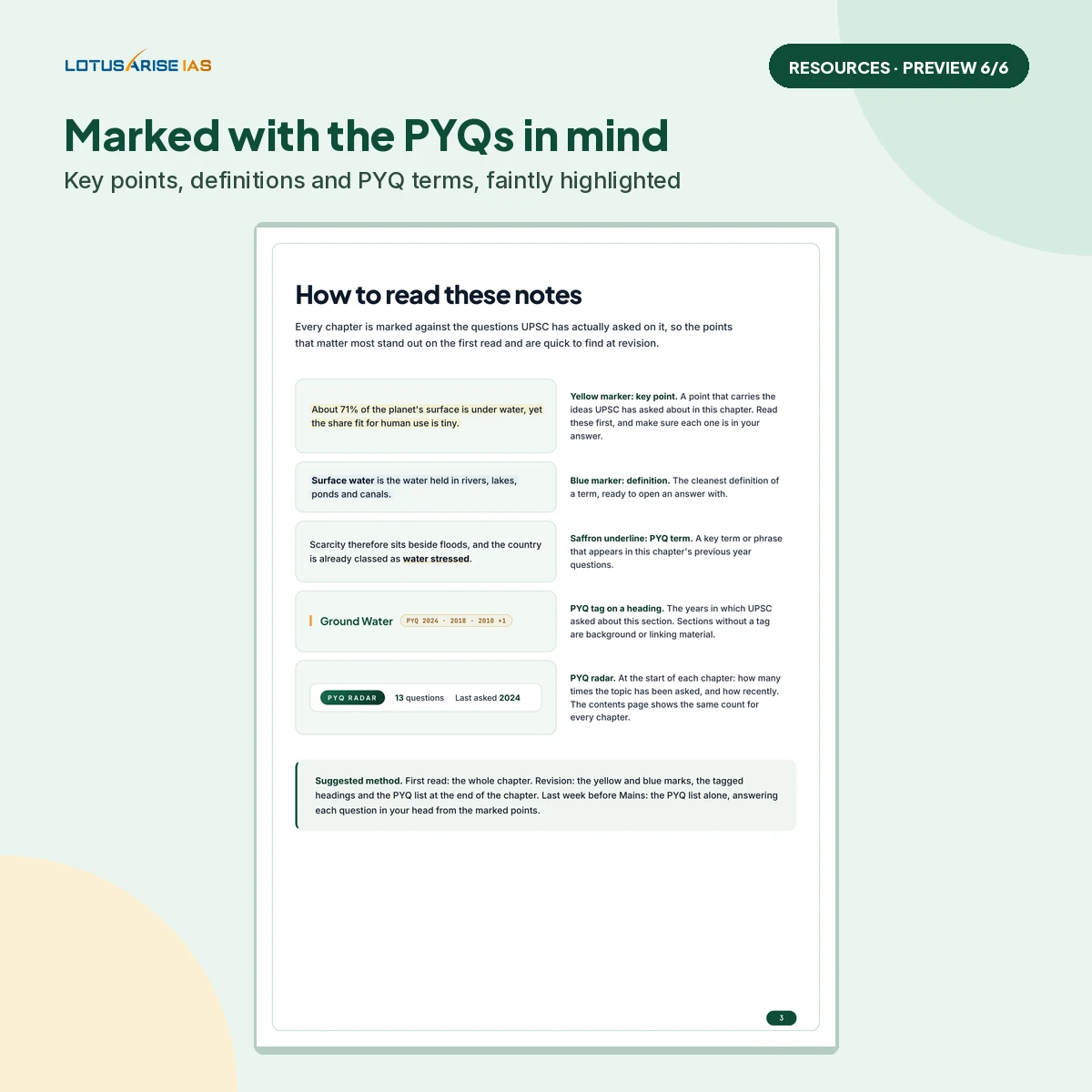
What makes this different from a downloaded PDF? Each chapter is marked against the questions UPSC has actually asked on it. A PYQ radar at the start shows how many times the topic has come and when it last did. Year tags sit on the headings UPSC has asked about. Faint highlights pick out key points, definitions and PYQ terms, so your second reading takes far less time than your first. The figures run into 2026: hydro capacity as on 30 September, the National Gas Grid as on 31 March, and the Ken–Betwa position as of August.
One thing to be clear about: the book gives the previous year questions, not model answers. Solved answers are in the Geography Optional 300+ Score Pack.
The aspirant who buys this
First-timers — You want one trusted account of India’s resources from the start instead of collecting it from reports and yearbooks. Read it after Physical Setting and the distributions begin to make sense.
Repeaters — You know the distribution, but your answers stop at the map. Go to the problem and policy sections of each chapter, then to the PYQ list at the end.
Aspirants short of time before Mains — Start with marine, wildlife, water and forests, where the PYQ counts are highest. The radar, year tags and highlights show you what to read first in each.
Self-study aspirants outside Delhi, Prayagraj and Jaipur — No classroom and no batch. You get one organised book that you can read anywhere, and print for handwritten practice.
Working professionals — One mineral or one energy source at a time on your phone, offline, with no schedule and no expiry.
State PSC aspirants with Geography — India’s resources are common ground, so the same chapters serve your paper too.
Why not just use free notes from Telegram?
Free notes exist, and most aspirants already have several. Many of these topics are also on our own website, free to read.
The difference is not that free material is wrong. It is that nothing ties it together. A forwarded PDF rarely tells you which of its pages UPSC has asked about, it seldom goes past reserves to problems and policy, and nobody tells you when its capacity figures have gone out of date. Here you get one order, every PYQ placed under its chapter, and a file you can keep and print.
If you have the time to build and maintain your own file from scattered sources, you may not need this. If you would rather open one book and start revising, this is what it is for.
The price
372 pages, 25 chapters, 128 PYQs and 114 diagrams and figures — ₹118. That is about 32 paise a page.
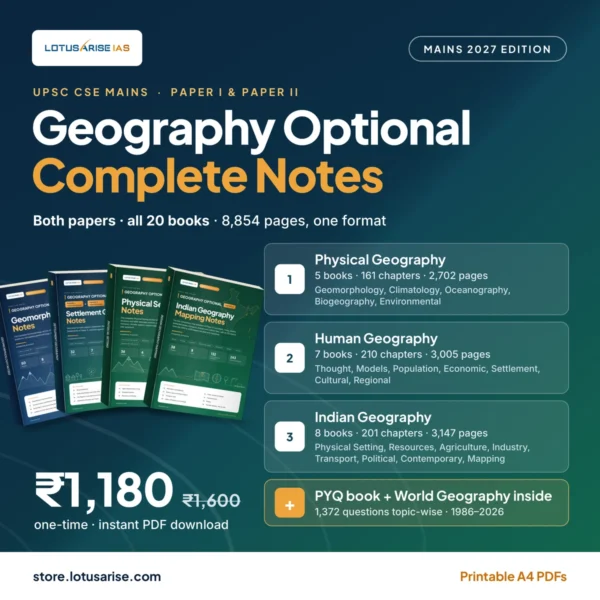
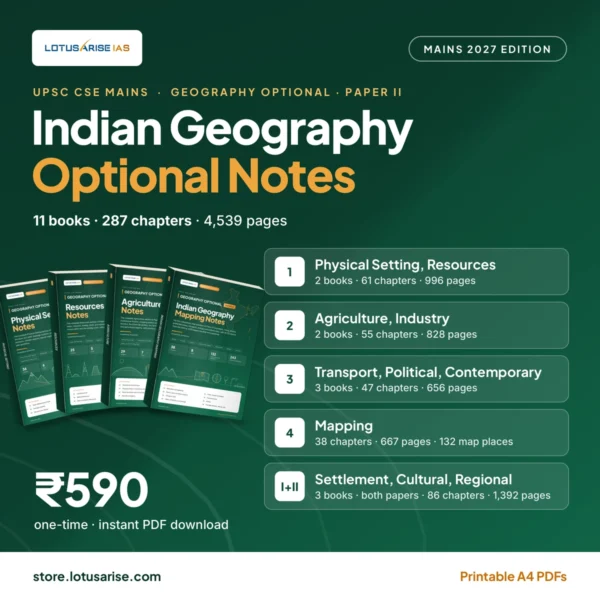
This book is also part of the Indian Geography: Geography Optional Notes bundle at ₹590 and of Geography Optional Complete Notes at ₹1,180.
One-time payment. No subscription. No recurring charge.
The download link reaches your email right after payment — please check your spam folder if you do not see it. Unlimited downloads, no expiry. English medium.
Read the free sample first (PDF)
For support: support@lotusarise.com
You may also like…
-

#OFFER: Geography Optional Complete Notes (PDF) – UPSC Mains (Paper I & II)
Original price was: ₹1,600.00.₹1,180.00Current price is: ₹1,180.00. -