



Geomorphology | Geography Optional UPSC Notes
₹118.00
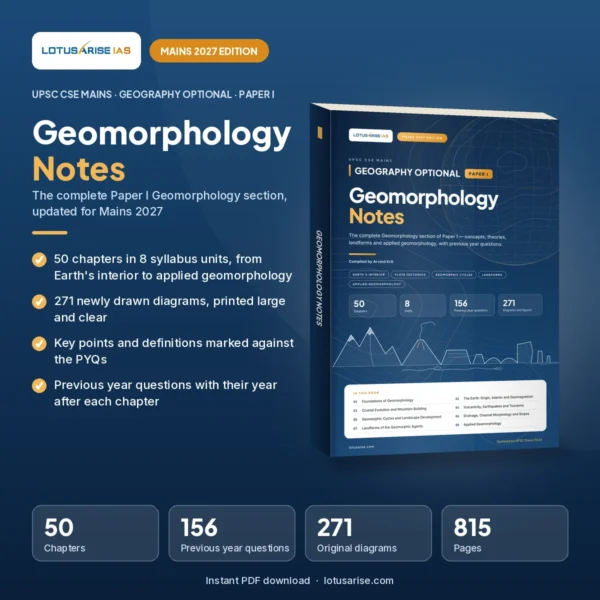
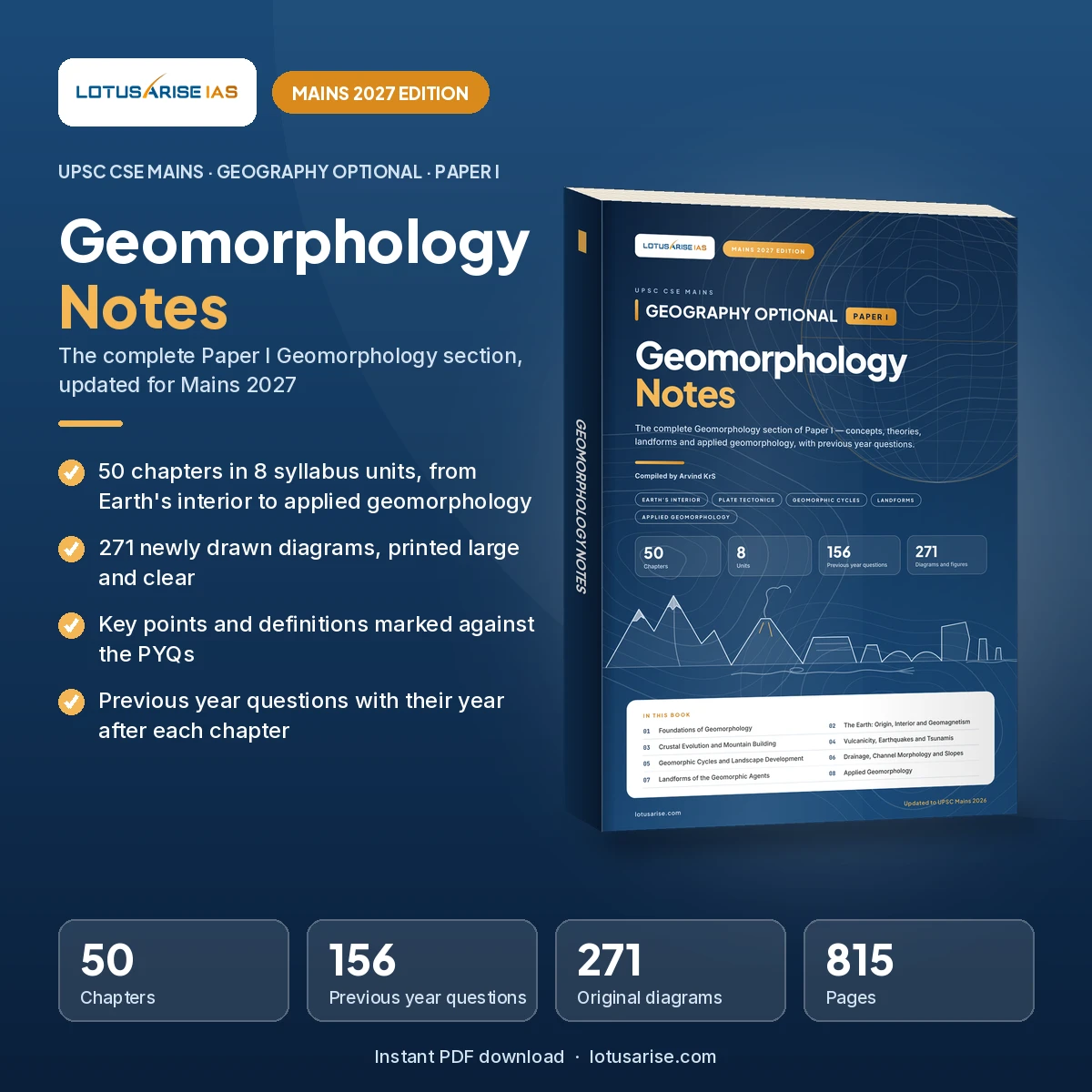
₹118 for 815 pages — about 14 paise a page. Mains 2027 Edition.
Most Geography Optional aspirants keep Geomorphology in two piles: theories and landforms. Davis in one notebook, Penck in another, King nowhere. Diagrams half remembered, no Indian example. Then UPSC asks what helical flow is, or wants “The Himalaya is still rising” expanded with sketches, and the answer stops at the definition.
Geomorphology takes the whole Paper I section in one order, from the Earth’s interior to applied geomorphology, with rival theories compared.
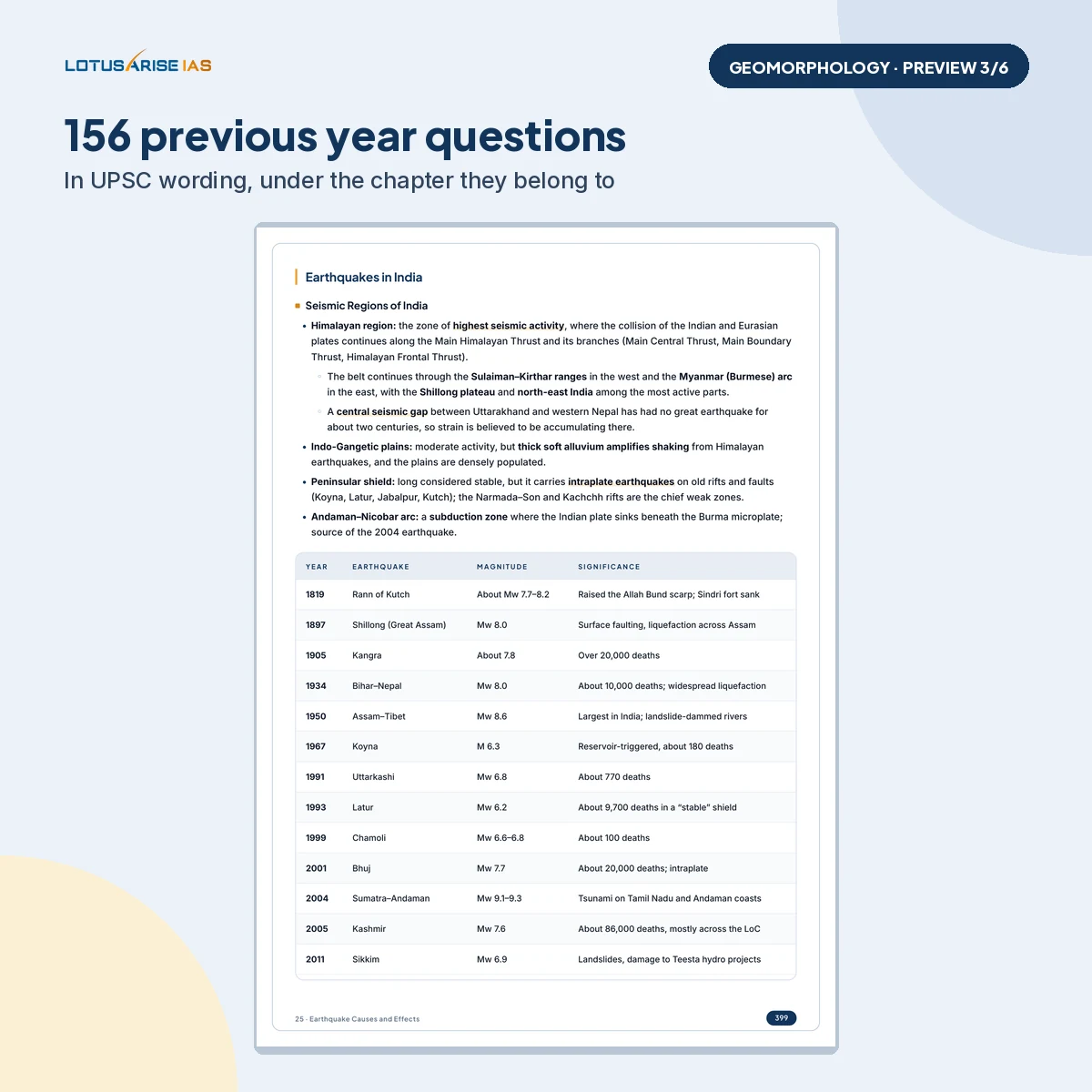
📝 156 PYQs, updated to Mains 2026 — in UPSC’s wording from 1986 on, under the chapter each belongs to
🧭 50 chapters in 8 units — interior, mountain building, vulcanicity, cycles, slopes, landforms, applied
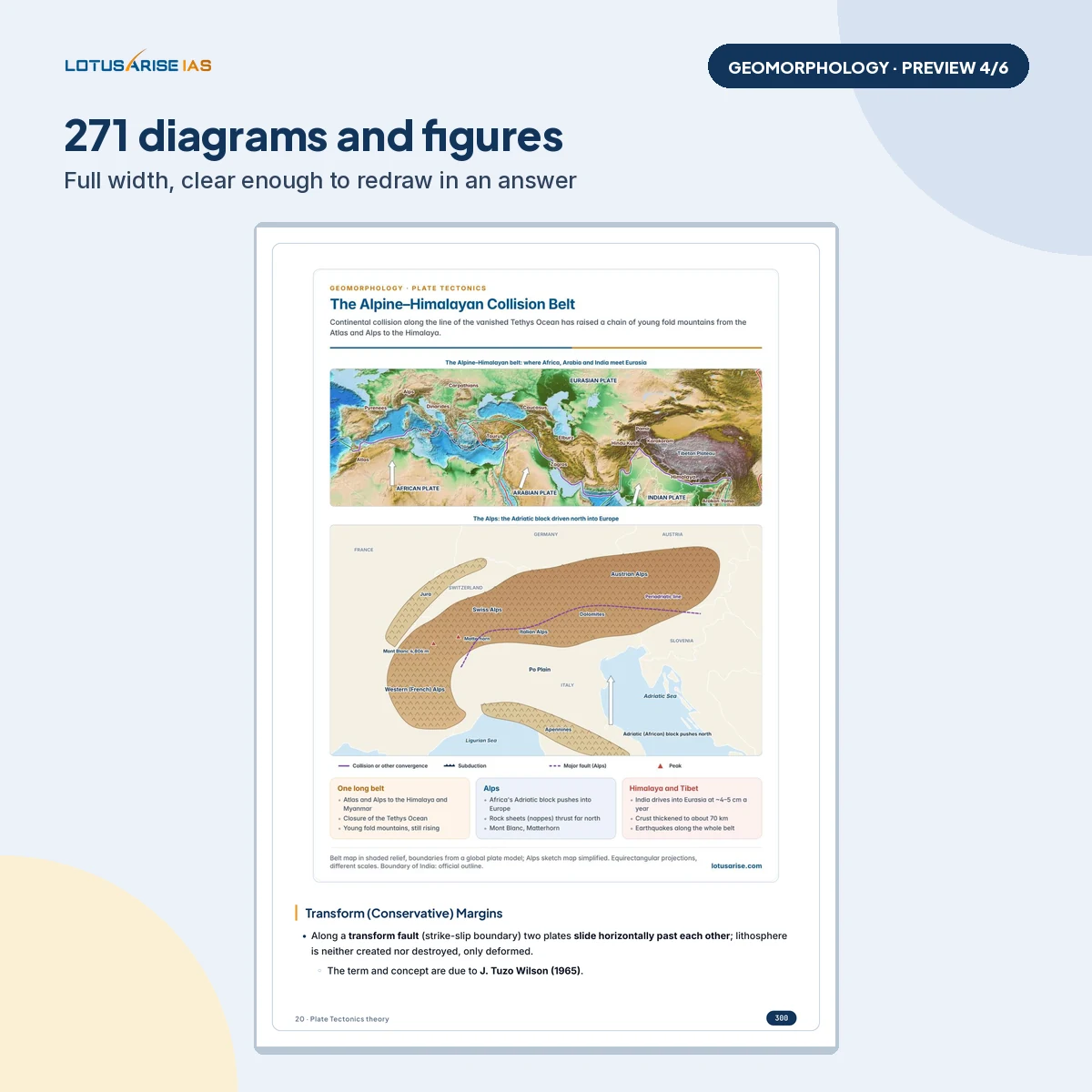
🗺️ 271 diagrams and figures — clear enough to redraw in an answer
🏔️ Indian cases throughout — origin of the Himalaya, Joshimath, South Lhonak, seismic zones as they stand in 2026
📱 Instant PDF download, 815 pages — clickable contents, laptop, mobile or tablet, offline, printable
One-time payment. No subscription. Unlimited downloads — the link does not expire.
⭐ Read by 300,000+ UPSC aspirants every month on LotusArise IAS
Features:
- Comprehensive Coverage
- Complete Syllabus
- Suitable for: UPSC & State PSCs exams
- Format: Digital PDF (Downloadable)
- 337,362+ aspirants visit every month
The problem most aspirants don’t talk about
Ask a Geography Optional aspirant about Geomorphology a few months into preparation. They won’t say landforms are too hard to picture. They will say one of three things:
“I can explain Davis. But when a question puts Davis, Penck and King together, my answer turns into three separate summaries.”
“I prepared the big theories, and then the paper asked about a Yazoo stream, solifluction and scarification. I had not read a line on them.”
“My Earth’s interior is from one place, my plate tectonics from another and my landforms from a third. None of them follow the same order.”
None of this is a lack of effort. The section is huge, its theories are usually learnt one at a time, and the small terms fall between the big chapters. What is missing is one book that runs from the Earth’s interior to applied geomorphology in a single order. Geomorphology is that book.
Why this section is a smart place to spend your hours
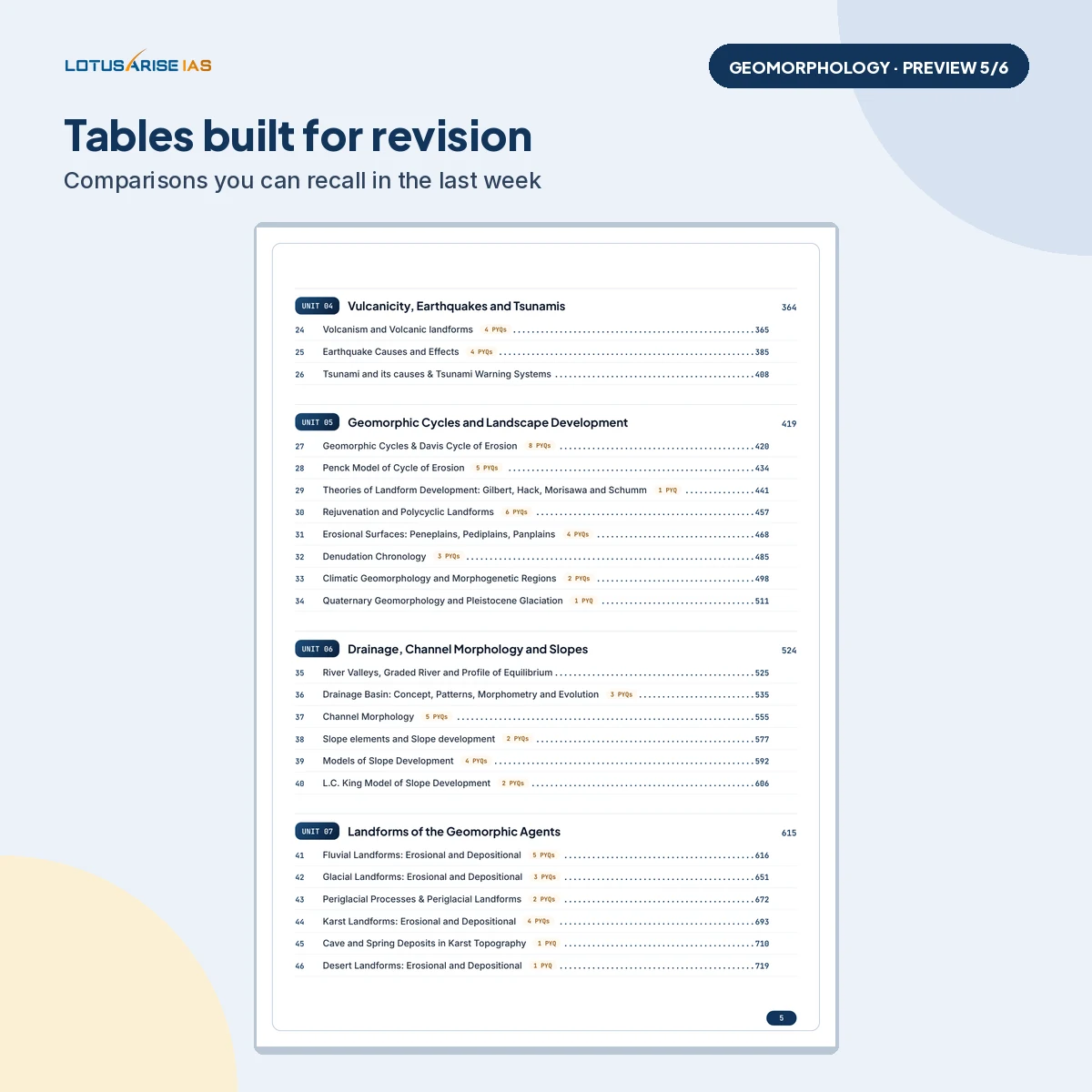
Geomorphology has a long record in the paper. The book carries 156 PYQs from 1986 to 2026, and the contents page shows where they fall: 11 on plate tectonics, 8 on the geomorphic cycle and Davis, 6 each on rejuvenation and marine landforms. UPSC rarely asks you to state a theory and stop. It asks you to critique “Landscape is a function of structure, process and stage”, or to evaluate how far Kober’s geosyncline theory explains mountain building.
It also pays back across the paper. Plate tectonics and the origin of the Himalaya carry into India’s structure and relief in Paper II. The Deccan Plateau, Peninsular drainage, Himalayan landslides, glacial lake outburst floods and India’s seismic zones have all come with India in the question.
The challenge is not the theory. It is having one current account, in one order, that you can actually revise.
What’s inside — 815 pages in 8 units
🧱 Foundations of Geomorphology — 6 chapters
- Nature, scope and fundamental concepts; structure, process, time and relief
- Endogenic and exogenic forces; folds, faults and nappes
- Weathering and mass movement, with landslides in India
🌍 The Earth: Origin, Interior and Geomagnetism — 9 chapters
- Solar system, origin of the Earth, latitude and longitude, geological time scale, rocks
- Interior of the Earth, seismic waves, discontinuities, geomagnetic reversals
⛰️ Crustal Evolution and Mountain Building — 8 chapters
- Geosyncline theory, continental drift, seafloor spreading, isostasy with Airy and Pratt
- Plate tectonics; classical and recent views on mountain building
- Mountains, plateaus and plains
🌋 Vulcanicity, Earthquakes and Tsunamis — 3 chapters
- Volcanic landforms and pseudo-volcanic features
- Earthquake causes, measurement and management; tsunami warning systems
🔄 Geomorphic Cycles and Landscape Development — 8 chapters
- Davis and Penck; Gilbert, Hack, Morisawa and Schumm
- Rejuvenation, peneplains and pediplains, denudation chronology with Indian case studies
- Climatic geomorphology; Quaternary and Pleistocene glaciation
🏞️ Drainage, Channel Morphology and Slopes — 6 chapters
- Graded rivers, drainage patterns and morphometry, channel morphology
- Slope elements, models of slope development, King and pediplanation
🧊 Landforms of the Geomorphic Agents — 8 chapters
- Fluvial, glacial, periglacial, karst, desert and marine landforms
- Cave and spring deposits; lakes and glacial lake outburst floods
🛠️ Applied Geomorphology — 2 chapters
- Applications and techniques; anthropogenic geomorphology and scarification
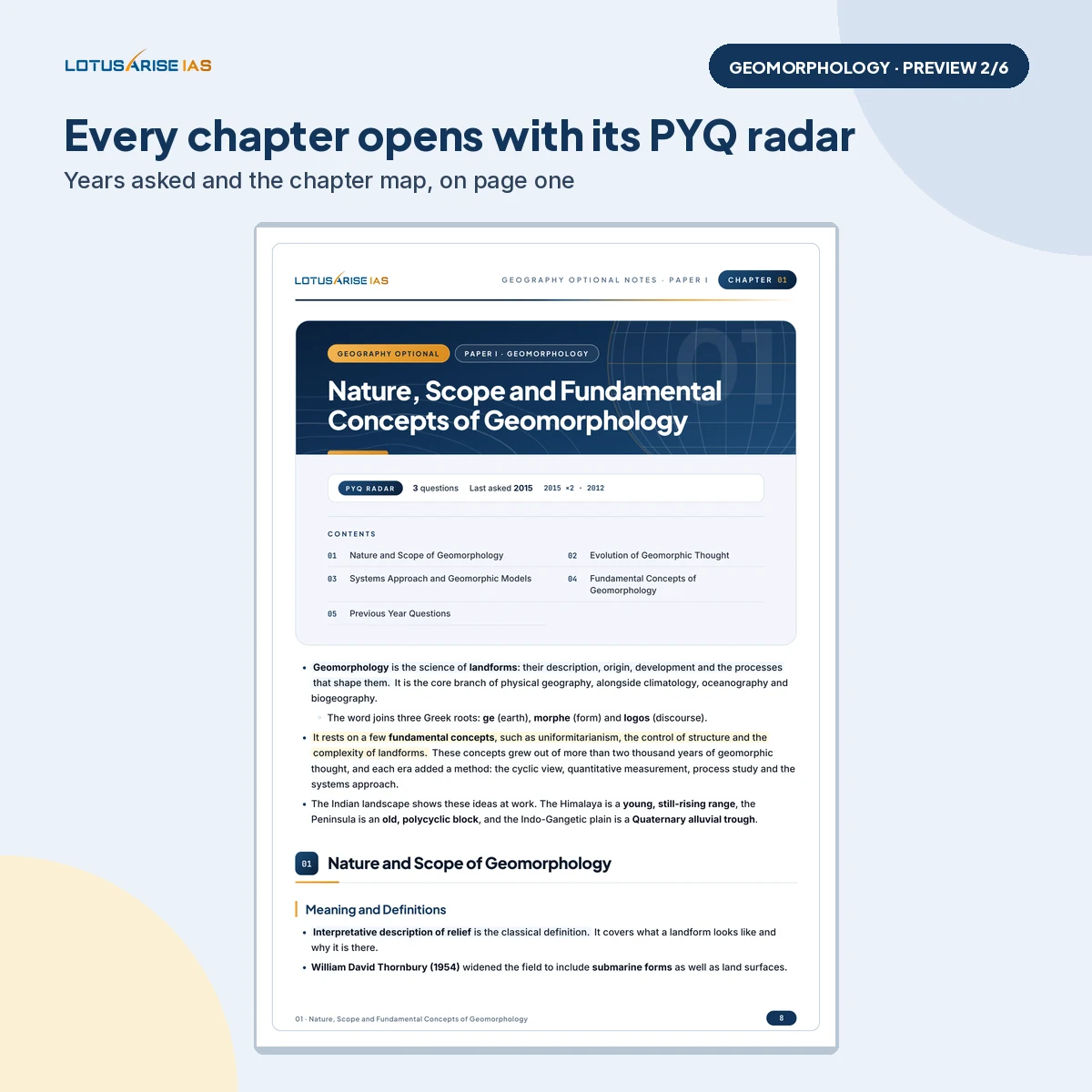
What makes this different from a downloaded PDF? Each chapter is marked against the questions UPSC has actually asked on it. A PYQ radar at the start shows how many times the topic has come and when it last did. Year tags sit on the headings UPSC has asked about. Faint highlights pick out key points, definitions and PYQ terms, so your second reading takes far less time than your first. A question that touches two chapters is listed under both. In a book this long, the honest markers matter: seven chapters have no direct question yet, and their radars say so.
One thing to be clear about: the book gives the previous year questions, not model answers. Solved answers are in the Geography Optional 300+ Score Pack.
The aspirant who buys this
First-timers — You want the whole section in one order from the start instead of collecting it piece by piece. Begin with Unit 1, then read the theories in sequence.
Repeaters — You know Davis and Penck, but your answers stop at the description. Use the sections on evaluation and current view, then go through the PYQ list at the end of each chapter.
Aspirants short of time before Mains — Do not read 815 pages front to back. The contents page shows the count for every chapter, so start where the questions are.
Self-study aspirants outside Delhi, Prayagraj and Jaipur — No classroom and no batch. You get one organised book that you can read anywhere, and print for sketch practice.
Working professionals — One chapter at a time on your phone, offline, with no schedule and no expiry.
State PSC aspirants with Geography — Landforms and plate tectonics are common ground, so the same chapters serve your paper too.
Why not just use free notes from Telegram?
Free notes exist, and most aspirants already have several. Many of these topics are also on our own website, free to read.
The difference is not that free material is wrong. It is that nothing ties it together. A forwarded PDF rarely tells you which of its pages UPSC has asked about, it seldom sets one theory against another, and nobody tells you when it has gone out of date. This book was compiled in October 2026. It already has the South Lhonak flood of 2023 and the seismic zone notification withdrawn in March 2026.
If you have the time to build and maintain your own file from scattered sources, you may not need this. If you would rather open one book and start revising, this is what it is for.
The price
815 pages, 50 chapters, 156 PYQs and 271 diagrams and figures — ₹118. That is about 14 paise a page.
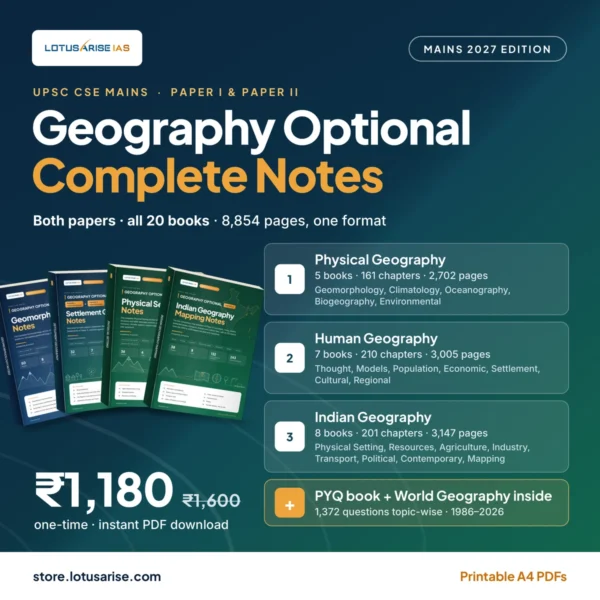
This book is also part of Physical Geography: Geography Optional Notes (₹413) and Geography Optional Complete Notes (₹1,180).
One-time payment. No subscription. No recurring charge.
The download link reaches your email right after payment — please check your spam folder if you do not see it. Unlimited downloads, no expiry. English medium.
Read the free sample first (PDF)
For support: support@lotusarise.com
You may also like…
-

-
#OFFER: Geography Optional Complete Notes (PDF) – UPSC Mains (Paper I & II)
Original price was: ₹1,600.00.₹1,180.00Current price is: ₹1,180.00.