

Population Geography | Geography Optional UPSC Notes
₹118.00
₹118 for 359 pages — about 33 paise a page. Mains 2027 Edition.
Most Geography Optional aspirants read this section as a set of definitions and census tables. TFR, sex ratio, dependency ratio, migration streams. Figures from one old census, no spatial pattern, no reason why one state differs from the next. Then UPSC asks how fertility below replacement will change India’s population structure, and the answer stops at the definition.
Population Geography takes the whole section in one order: measure, world pattern, India’s pattern, causes and consequences.
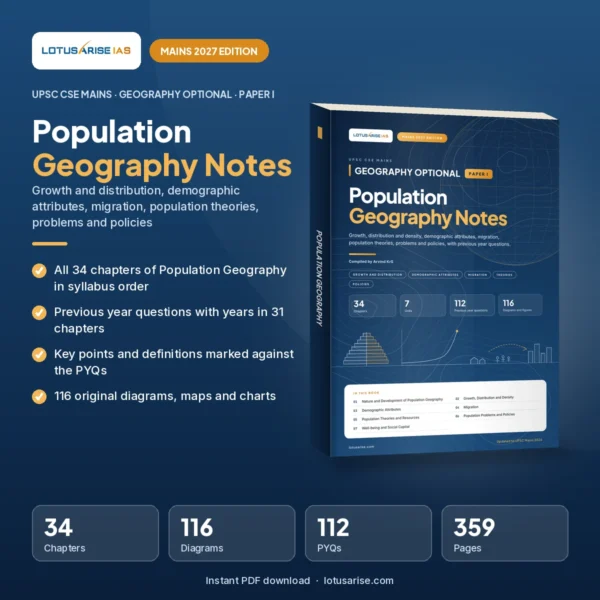
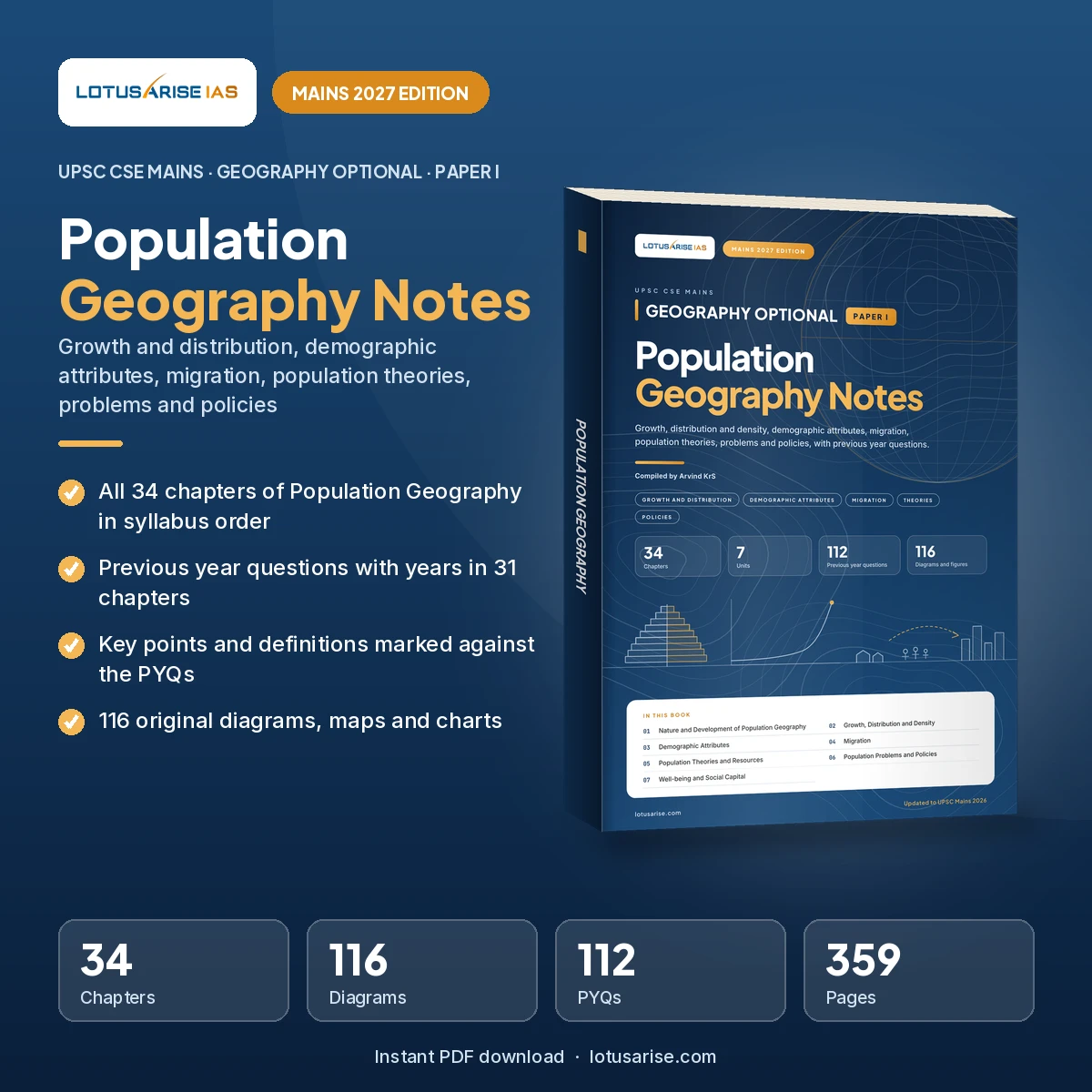
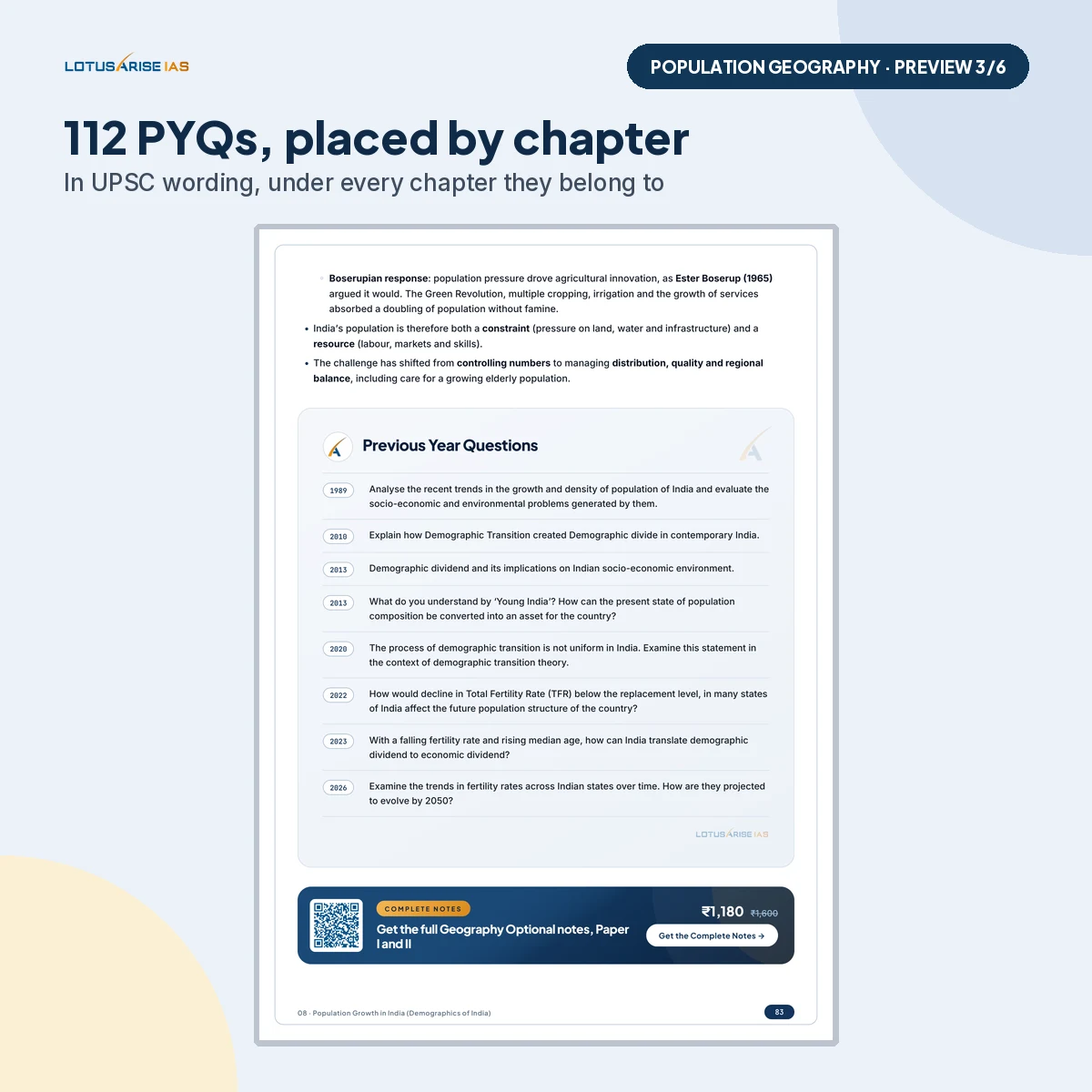
📝 112 PYQs, updated to Mains 2026 — in UPSC’s wording, under the chapter each belongs to
🧭 34 chapters in 7 units — growth and distribution, demographic attributes, migration, population theories, problems and policies
🚶 Migration in full — world, India and theories, up to circular migration and climate migrants
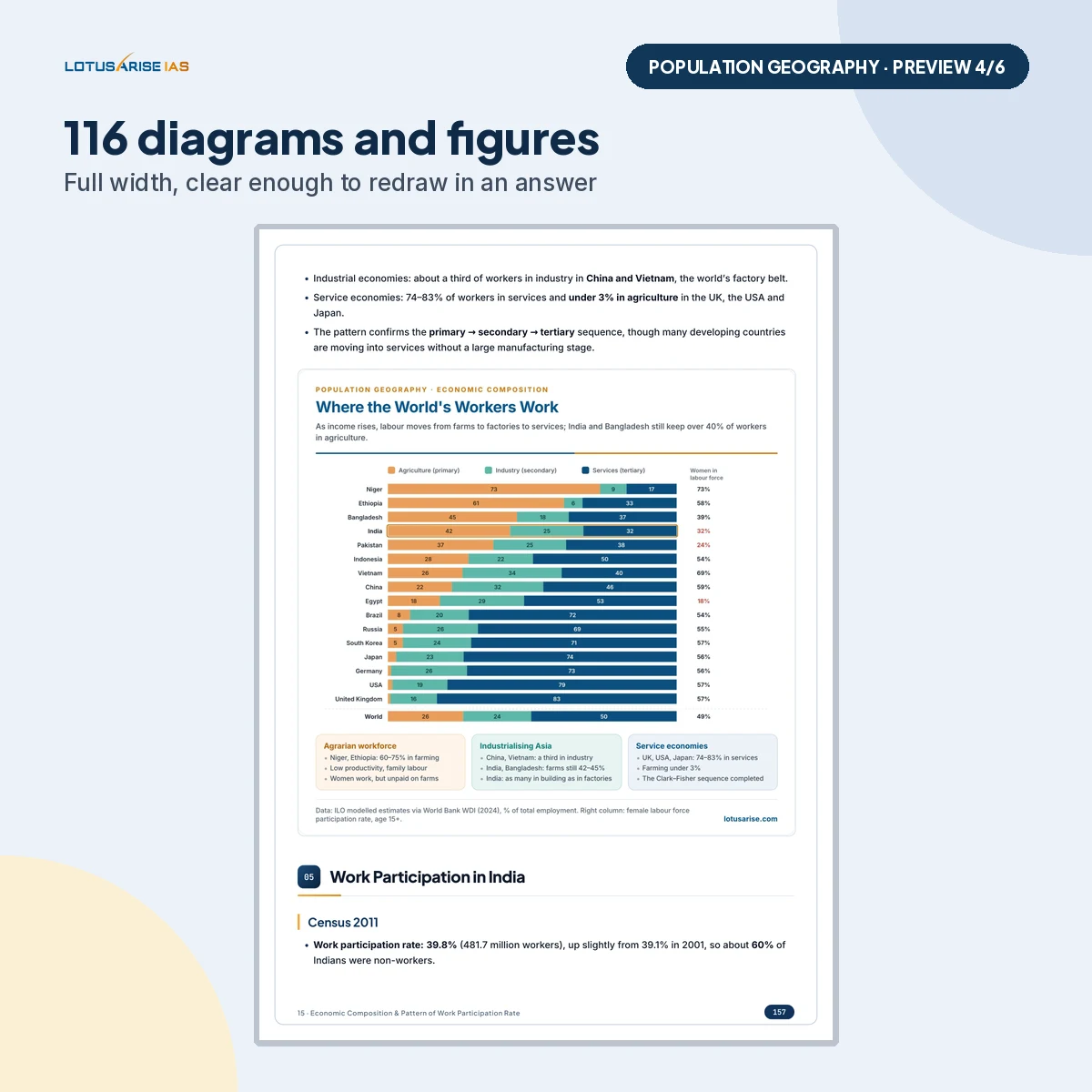
🗺️ 116 diagrams and figures — full width, clear enough to redraw in an answer
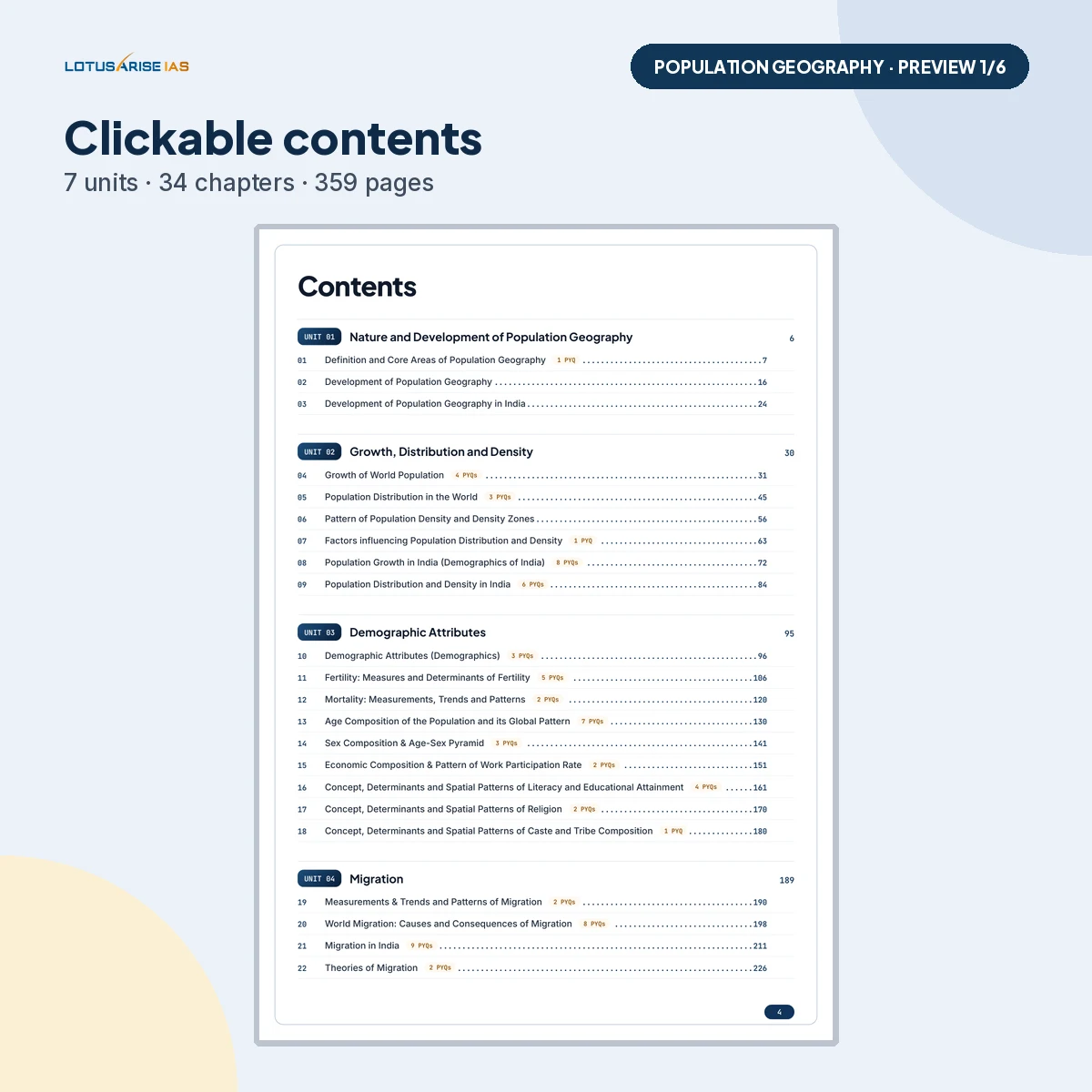
📱 Instant PDF download, 359 pages — clickable contents, laptop, mobile or tablet, offline, printable
One-time payment. No subscription. Unlimited downloads — the link does not expire.
⭐ Read by 300,000+ UPSC aspirants every month on LotusArise IAS
Features:
- Comprehensive Coverage
- Complete Syllabus
- Suitable for: UPSC & State PSCs exams
- Format: Digital PDF (Downloadable)
- 337,362+ aspirants visit every month
The problem most aspirants don’t talk about
Ask a Geography Optional aspirant about population geography a few months into preparation. They won’t say the concepts are hard. They will say one of three things:
“My figures stop at Census 2011, and I don’t know what I can safely write about fertility, ageing or migration today.”
“I can define TFR and the dependency ratio. Ask for the pattern across Indian states and I have a table, not an explanation.”
“Migration sits in three sets of notes, world, India and theories, and none of them speak to each other.”
None of this is a lack of effort. Population data dates quickly, and most notes treat the subject as demography with a map or two. UPSC keeps asking where, why there, and with what consequence. What is missing is one book that takes every attribute through its measure, its pattern and its causes. Population Geography is that book.
Why this section is a smart place to spend your hours
The book lists 112 PYQs under their chapters (93 distinct questions) from 1987 to 2026, with at least one in every year’s papers from 2013 to 2026. Migration in India alone has 9. Population growth in India, world migration and social well-being have 8 each. Age composition, ageing and health indicators have 7 each.
The questions keep moving: climate migrants, circular migration, transnationalism, the demographic divide, pro-natalist policies.
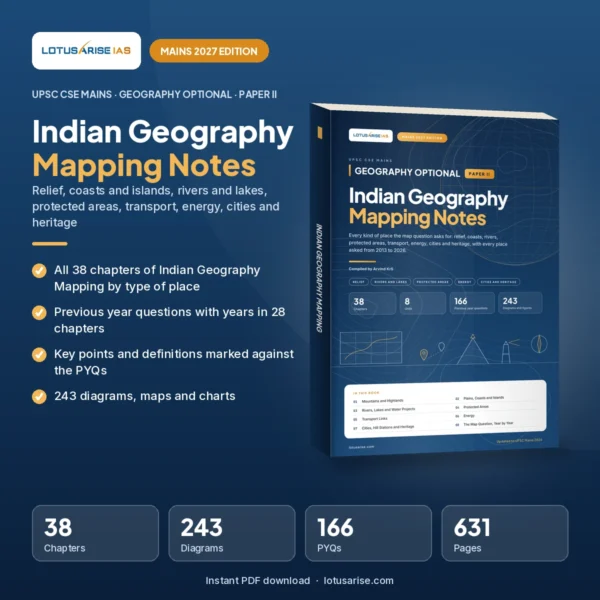
It pays back across the optional. Growth, density, sex ratio, literacy, migration and health indicators return in Paper II, and interstate migration runs into regional disparity.
The challenge is not the concepts. It is having one current account of them that you can actually revise.
What’s inside — 359 pages in 7 units
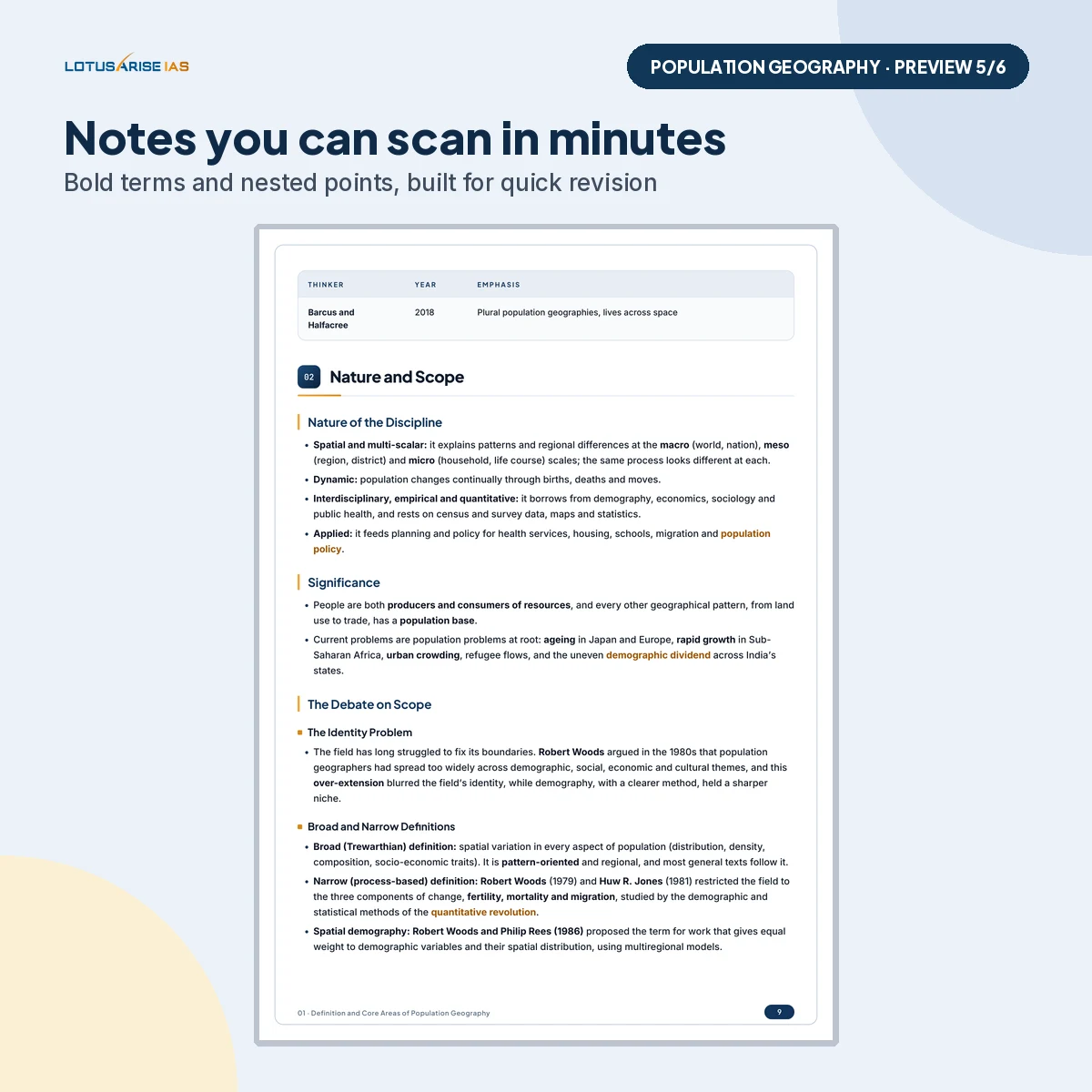
🌍 Nature and Development of Population Geography — 3 chapters
- Definitions, core areas and data sources, including Census 2027
- Development of the field, world and India
📈 Growth, Distribution and Density — 6 chapters
- World growth: phases, growth curves, projections
- World distribution: ecumene, non-ecumene, latitudinal and coastal patterns
- Density measures, world density zones, the factors behind them
- India’s five phases of growth since 1901, EAG and non-EAG States, the demographic dividend
- India’s density regions and the two highest-density zones
👥 Demographic Attributes — 9 chapters
- Fertility: CBR to NRR, with its determinants
- Mortality: infant and maternal mortality, life tables
- Age composition, sex ratio, child sex ratio and the age-sex pyramid
- Work participation and literacy, with PLFS trends
- Religion, caste and tribe: spatial patterns
🚶 Migration — 4 chapters
- Measurement, trends and patterns
- World migration: refugees, remittances, diaspora, brain circulation
- Migration in India: streams, inter-state disparity, circular migration, Kerala
- Theories: Ravenstein, Lee, Zelinsky, Todaro, network theory
📚 Population Theories and Resources — 6 chapters
- Mercantilist and physiocratic views
- Over-, under- and optimum population, and whether India is over-populated
- Cannan’s optimum population theory and Dalton’s measure
- Neo-Malthusian theory: Ehrlich, Hardin, the I = P × A × T identity
- Ackerman’s population-resource regions
- Omran’s epidemiological transition
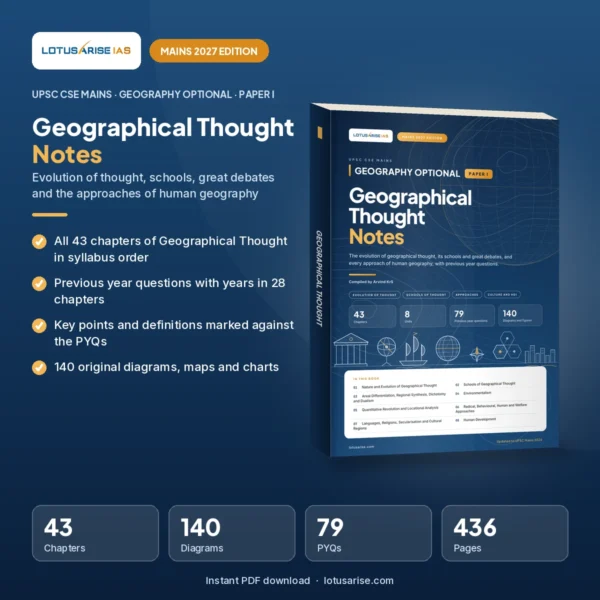
This book treats Malthus, Marx and demographic transition in brief. Their full chapters are in Models, Theories and Laws.
🏥 Population Problems and Policies — 4 chapters
- Health indicators, world and Indian States, stunting and wasting
- Ageing: dependency ratio, longevity and the geriatric challenge
- Population policy: rationale, elements, India’s policies, the two-child norm
🌱 Well-being and Social Capital — 2 chapters
- Quality of life, PQLI, HDI and the Multidimensional Poverty Index
- Social capital, and population as social capital
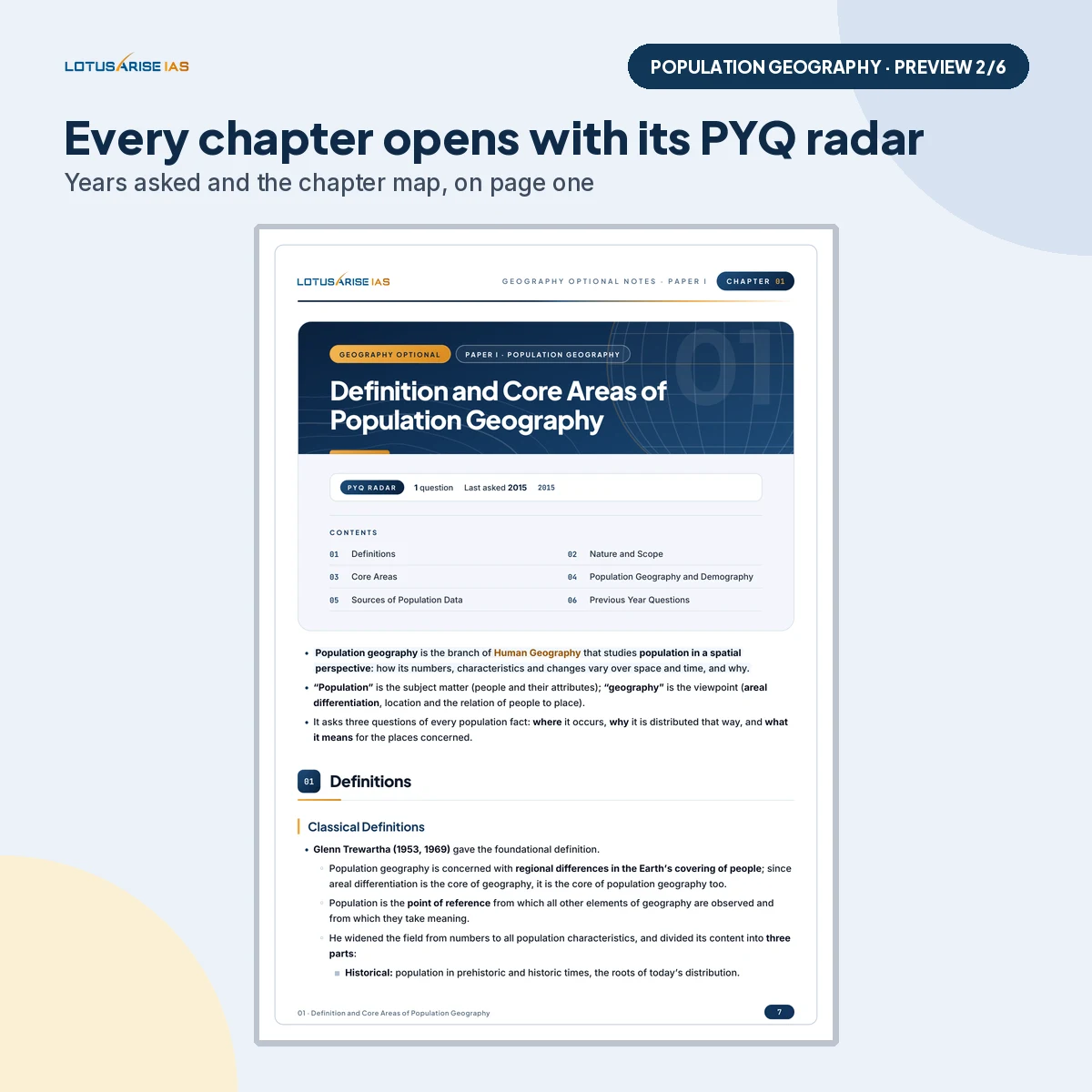
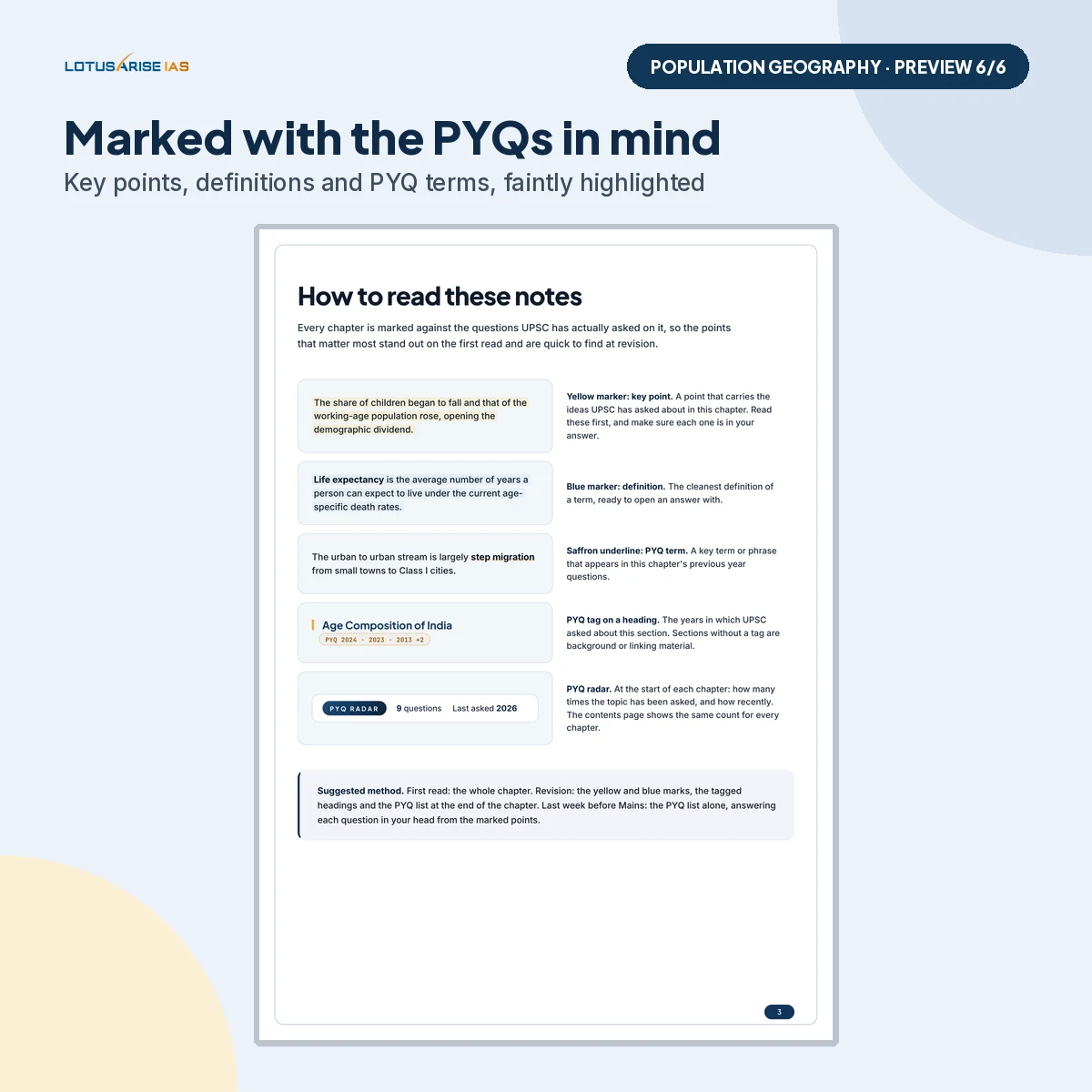
What makes this different from a downloaded PDF? Each chapter is marked against the questions UPSC has actually asked on it. A PYQ radar at the start shows how many times the topic has come and when it last did. Year tags sit on the headings UPSC has asked about. Faint highlights pick out key points, definitions and PYQ terms, so your second reading takes far less time than your first.
One thing to be clear about: the book gives the previous year questions, not model answers. Solved answers are in the Geography Optional 300+ Score Pack.
If you are buying more than one book: 16 of these chapters, on India’s growth, attributes, migration, health and policy, also appear in our combined Cultural Setting book.
The aspirant who buys this
First-timers — You want one trusted order for a section full of measures and data.
Repeaters — You have the definitions, but your answers stop before the spatial pattern. Use the world and India sections, then go through the PYQ list at the end of each chapter.
Aspirants short of time before Mains — Start with migration, India’s growth and ageing. The radar, year tags and highlights show you what to read first.
Self-study aspirants outside Delhi, Prayagraj and Jaipur — No classroom and no batch. You get one organised book that you can read anywhere, and print for handwritten practice.
Working professionals — One chapter at a time on your phone, offline, with no schedule and no expiry.
State PSC aspirants with Geography — Population concepts and India’s patterns are common ground, so the same chapters serve your paper too.
Why not just use free notes from Telegram?
Free notes exist, and most aspirants already have several. Many of these topics are also on our own website, free to read.
The difference is not that free material is wrong. It is that nothing ties it together. A forwarded PDF rarely tells you which of its pages UPSC has asked about, it seldom explains the pattern behind its figures, and nobody tells you when those figures have gone out of date. Here you get one order, every PYQ placed under its chapter, and a file you can keep and print.
If you have the time to build and maintain your own file from scattered sources, you may not need this. If you would rather open one book and start revising, this is what it is for.
The price
359 pages, 34 chapters, 112 PYQs and 116 diagrams and figures — ₹118. That is about 33 paise a page.
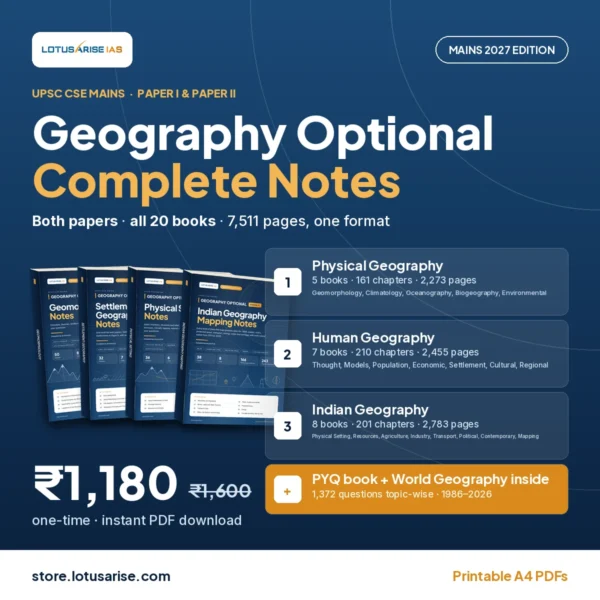
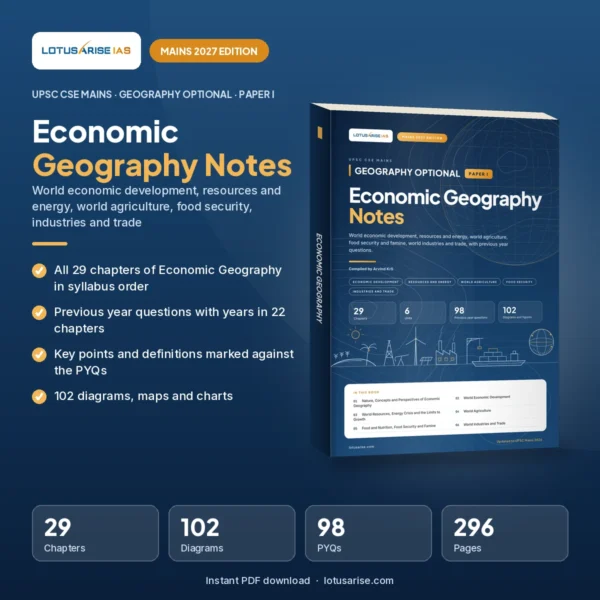
The book is also part of the Human Geography: Geography Optional Notes bundle at ₹471 and of Geography Optional Complete Notes at ₹1,180.
One-time payment. No subscription. No recurring charge.
The download link reaches your email right after payment — please check your spam folder if you do not see it. Unlimited downloads, no expiry. English medium.
Read the free sample first (PDF)
For support: support@lotusarise.com
You may also like…
-

#OFFER: Geography Optional Complete Notes (PDF) – UPSC Mains (Paper I & II)
Original price was: ₹1,600.00.₹1,180.00Current price is: ₹1,180.00. -
-