Economic Geography | Geography Optional Notes
₹118.00
₹118 for 374 pages — about 32 paise a page. Mains 2027 Edition.
Most Geography Optional aspirants read this section as a list of what is produced where. Mineral belts, crop regions, industrial regions, trade tables. One map, old figures, nothing on why the pattern is shifting. Then UPSC asks whether Whittlesey’s regions are relevant even today, or why critical minerals matter, and the answer stops at the distribution.
Economic Geography takes each world pattern in one order: distribution, cause, problem, present shift.
📝 97 PYQs, updated to Mains 2026 — in UPSC’s wording, under the chapter each belongs to
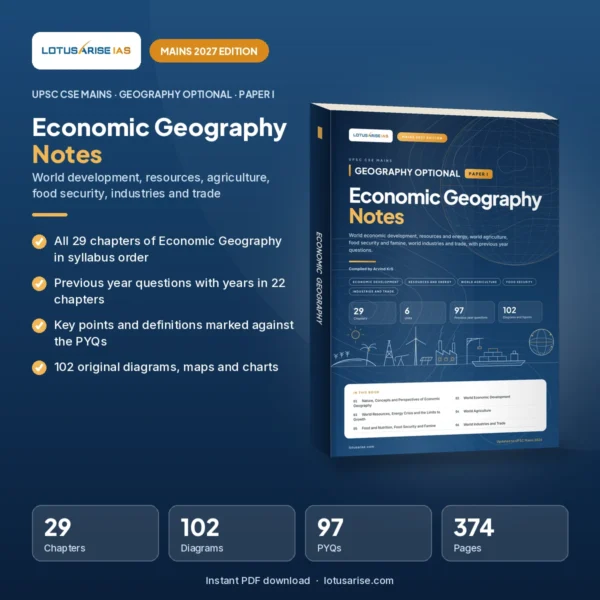
🧭 29 chapters in 6 units — economic development, resources and energy, world agriculture, food security, industries and trade
⛽ Energy and trade read into 2026 — the 2026 Hormuz shock, India’s solar capacity to September, trade deals to October
🗺️ 102 diagrams and figures — full width, clear enough to redraw in an answer
📱 Instant PDF download, 374 pages — clickable contents, laptop, mobile or tablet, offline, printable
One-time payment. No subscription. Unlimited downloads — the link does not expire.
⭐ Read by 300,000+ UPSC aspirants every month on LotusArise IAS
Features:
- Comprehensive Coverage
- Complete Syllabus
- Suitable for: UPSC & State PSCs exams
- Format: Digital PDF (Downloadable)
- 337,362+ aspirants visit every month
The problem most aspirants don’t talk about
Ask a Geography Optional aspirant about economic geography a few months into preparation. They won’t say it is hard to understand. They will say one of three things:
“I know where the iron ore and coal are. I don’t know what to write when the question is about critical minerals or energy security.”
“I can list Whittlesey’s thirteen regions. Ask for his five functioning forms, or whether the scheme still holds, and I am guessing.”
“My trade and energy figures are years old, and these are the parts of the paper that move fastest.”
None of this is a lack of effort. The section is wide, its data dates quickly, and most notes stop at distribution, when UPSC is asking about cause, consequence and change. What is missing is one current book that takes each world pattern through to its problems and its present shift. Economic Geography is that book.
Why this section is a smart place to spend your hours
The book carries 97 questions from 1987 to 2026, with at least one in every year’s papers from 2013 to 2026. World agricultural typology and patterns of world trade have 8 each. Energy transition, agricultural productivity, dryland farming and protected cultivation, and food security have 7 each. The energy crisis and the Limits to Growth have 6 each. The seven opening chapters carry one direct question between them, and the radar shows you that before you start.
The questions keep up with the world: energy transition and zero carbon by 2050, semiconductor manufacturing, automation and trade, critical minerals and national security.
It pays back across the optional. The India sections on mineral belts, energy, food security and dryland farming carry straight into Paper II.
The challenge is not the width. It is having one current account of it that you can actually revise.
What’s inside — 374 pages in 6 units
🧭 Nature, Concepts and Perspectives of Economic Geography — 7 chapters
- Meaning, scope, evolution and approaches
- Themes, and space, place and scale
- Theoretical perspectives, the New Economic Geography
- Geographical bases of economic activities, primary to quinary sectors, the Clark-Fisher model
📉 World Economic Development — 3 chapters
- Growth and development, income and composite measures, the North-South divide
- Problems: poverty, debt, the resource curse, the digital divide
- Colonialism, neo-colonialism and Lebensraum
⛏️ World Resources, Energy Crisis and the Limits to Growth — 7 chapters
- World distribution of minerals and energy, and the global resource dilemma
- Regional resource profiles, critical minerals, India’s mineral belts
- Global water scarcity and groundwater
- World fisheries and aquaculture
- Energy crisis: the oil shocks to the Iran war fuel crisis of 2026
- Energy transition and security: the Four As, energy mix, net zero 2050, nuclear shutdowns
- Limits to Growth: Club of Rome, five variables, criticism, present relevance
🌾 World Agriculture — 4 chapters
- Whittlesey’s five functioning forms and thirteen regions, with other typologies
- Plantation agriculture and regional specialisation
- Inputs and productivity: measures, agricultural efficiency, land capability, yield gap
- Dryland farming and protected cultivation
🍚 Food and Nutrition, Food Security and Famine — 3 chapters
- World pattern of hunger, the double burden of malnutrition
- Food security: four pillars, climate change, India’s position
- Famine: Amartya Sen’s entitlement explanation, the IPC definition, man-made famine
🏭 World Industries and Trade — 5 chapters
- Industrial location, footloose industries, major world industries and their problems
- World industrial regions, the Pacific Rim and China
- The New International Division of Labour
- Global shift: value chains, deindustrialisation, China plus one, automation, semiconductors
- World trade: composition, direction, the WTO, trade blocs, India’s agreements to October 2026
What makes this different from a downloaded PDF? Each chapter is marked against the questions UPSC has actually asked on it. A PYQ radar at the start shows how many times the topic has come and when it last did. Year tags sit on the headings UPSC has asked about. Faint highlights pick out key points, definitions and PYQ terms, so your second reading takes far less time than your first.
One thing to be clear about: the book gives the previous year questions, not model answers. Solved answers are in the Geography Optional 300+ Score Pack.
The aspirant who buys this
First-timers — You want one trusted account of world resources, agriculture, industry and trade instead of collecting them piece by piece.
Repeaters — You know the distributions, but your answers stop there. Use the sections on problems and emerging trends, then go through the PYQ list at the end of each chapter.
Aspirants short of time before Mains — Start with energy, agriculture and world trade. The radar, year tags and highlights show you what to read first.
Self-study aspirants outside Delhi, Prayagraj and Jaipur — No classroom and no batch. You get one organised book that you can read anywhere, and print for handwritten practice.
Working professionals — One chapter at a time on your phone, offline, with no schedule and no expiry.
State PSC aspirants with Geography — World resources, agriculture and industry are common ground, so the same chapters serve your paper too.
Why not just use free notes from Telegram?
Free notes exist, and most aspirants already have several. Many of these topics are also on our own website, free to read.
The difference is not that free material is wrong. It is that nothing ties it together. A forwarded PDF rarely tells you which of its pages UPSC has asked about, it seldom goes past the distribution to the cause and the current shift, and nobody tells you when its figures have gone out of date. Here you get one order, every PYQ placed under its chapter, and a file you can keep and print.
If you have the time to build and maintain your own file from scattered sources, you may not need this. If you would rather open one book and start revising, this is what it is for.
The price
374 pages, 29 chapters, 97 PYQs and 102 diagrams and figures — ₹118. That is about 32 paise a page.
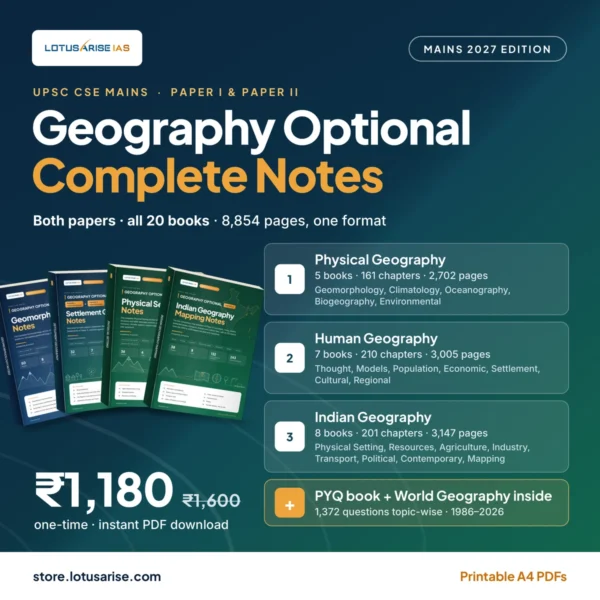
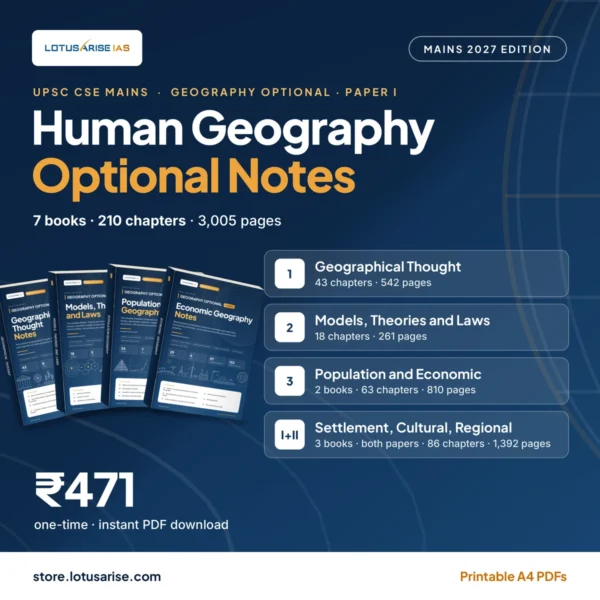
The book is also part of the Human Geography: Geography Optional Notes bundle at ₹471 and of Geography Optional Complete Notes at ₹1,180.
One-time payment. No subscription. No recurring charge.
The download link reaches your email right after payment — please check your spam folder if you do not see it. Unlimited downloads, no expiry. English medium.
Read the free sample first (PDF)
For support: support@lotusarise.com
You may also like…
-

#OFFER: Geography Optional Complete Notes (PDF) – UPSC Mains (Paper I & II)
Original price was: ₹1,600.00.₹1,180.00Current price is: ₹1,180.00.