


Transport, Communication and Trade | Geography Optional UPSC Notes
₹118.00
₹118 for 208 pages — about 57 paise a page. Mains 2027 Edition.
Most Geography Optional aspirants revise this section as a list. Highway numbers, major ports, national waterways, satellite names. Figures from three different years, nothing on what a network does for a region. Then UPSC asks about the role of energy pipelines in reducing regional imbalances, and the list has no answer.
Transport, Communication and Trade turns those lists into the geography UPSC asks for: what each network connects, and which regions gain or lose.
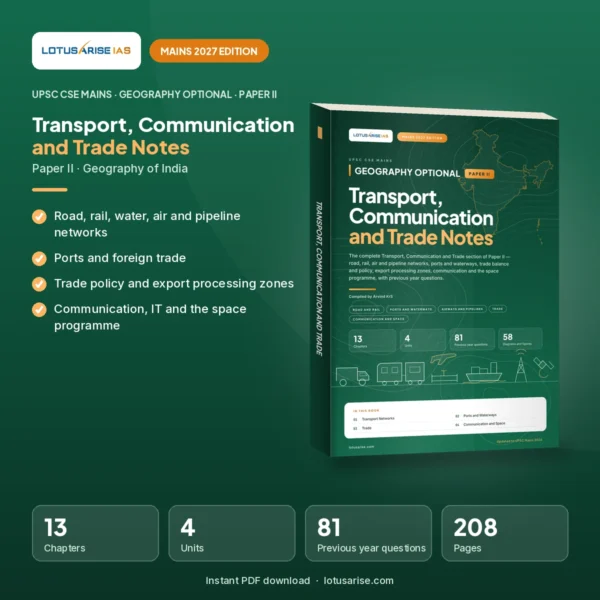
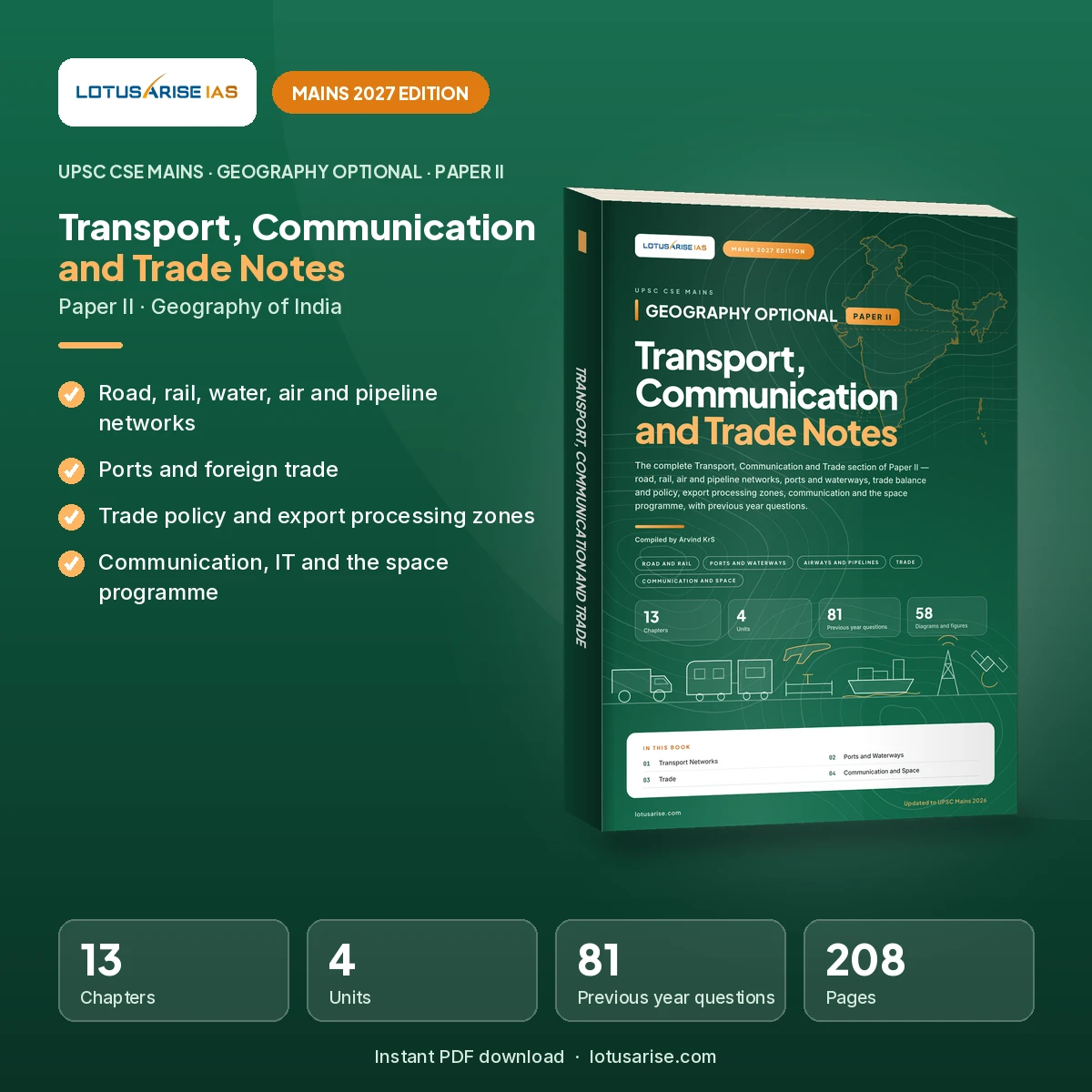
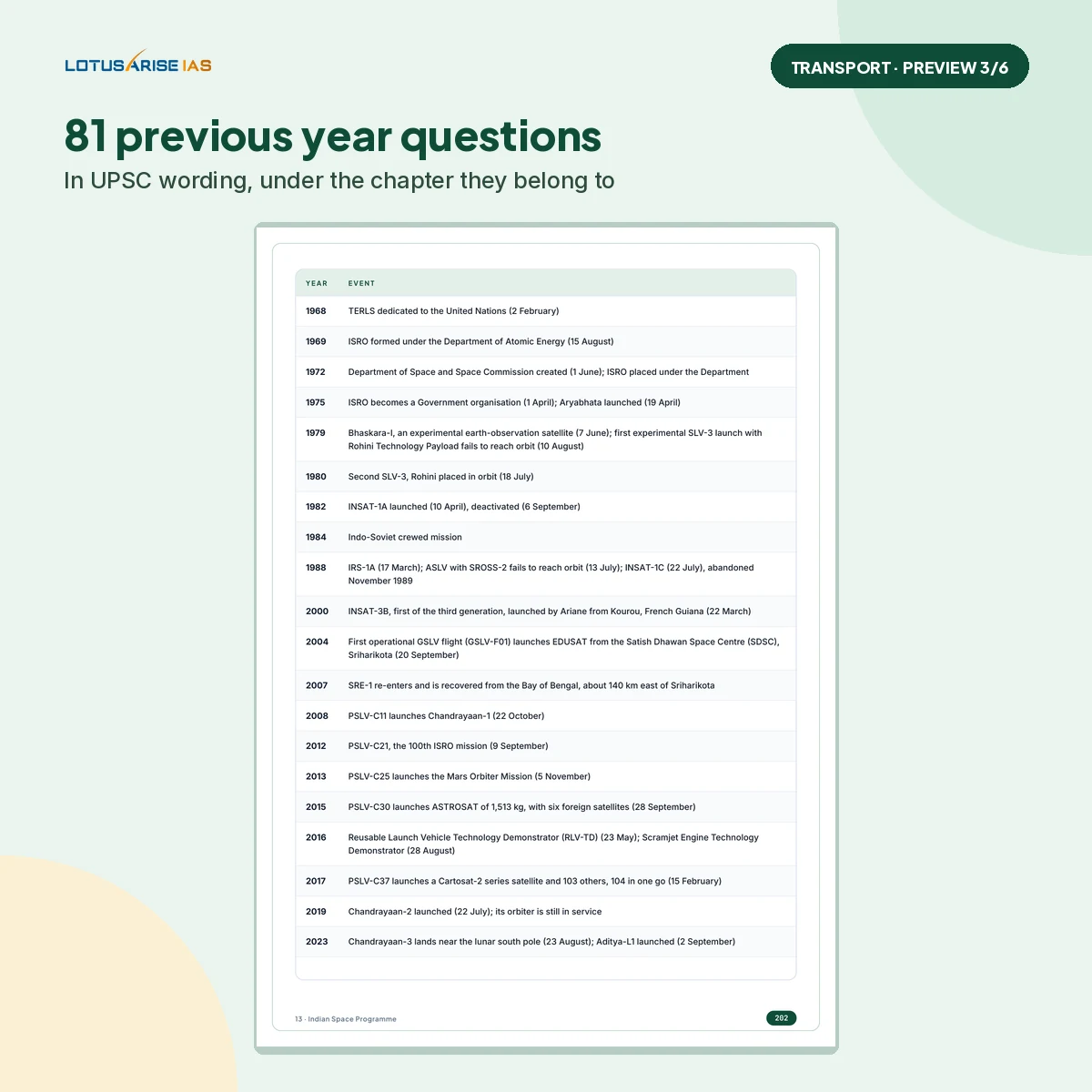
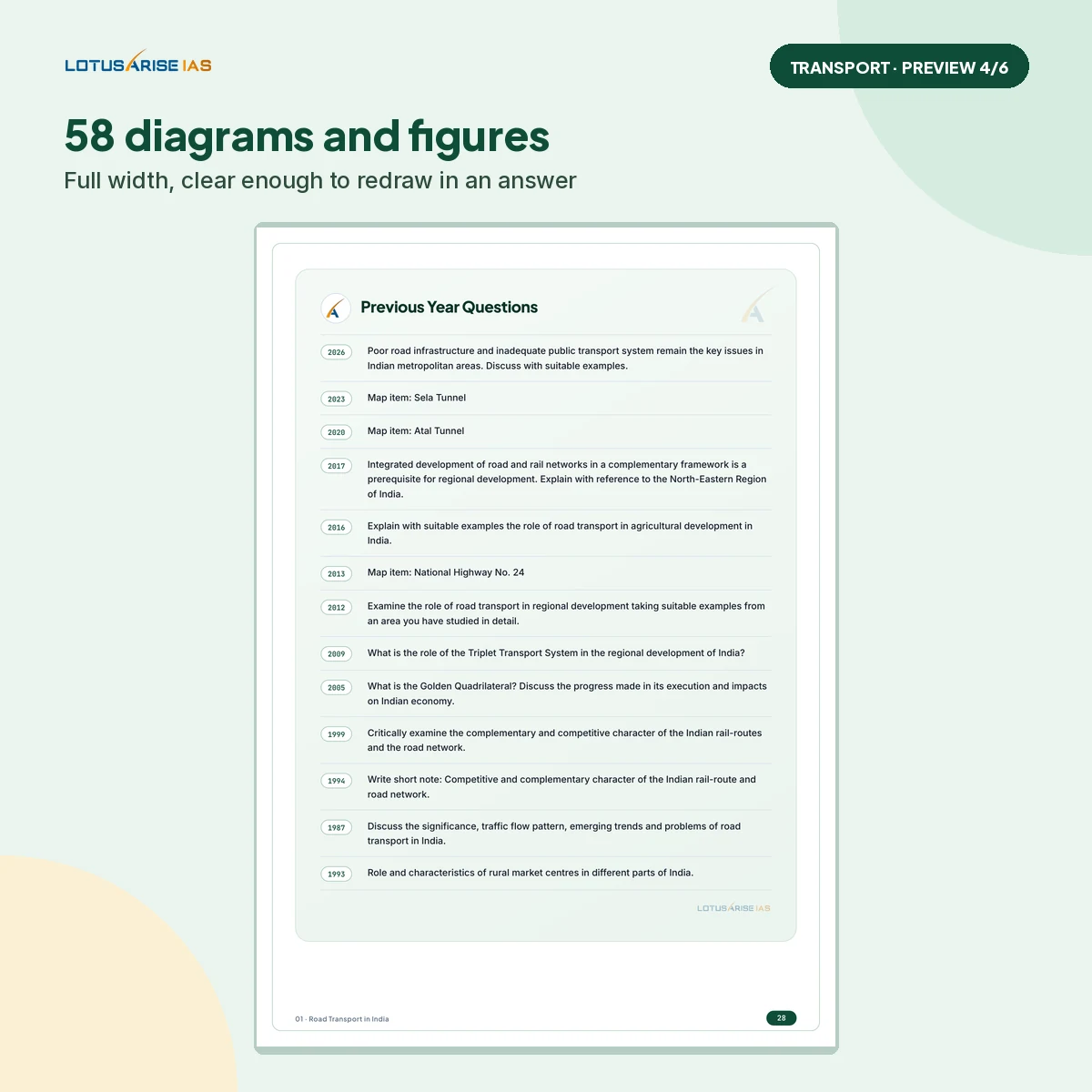
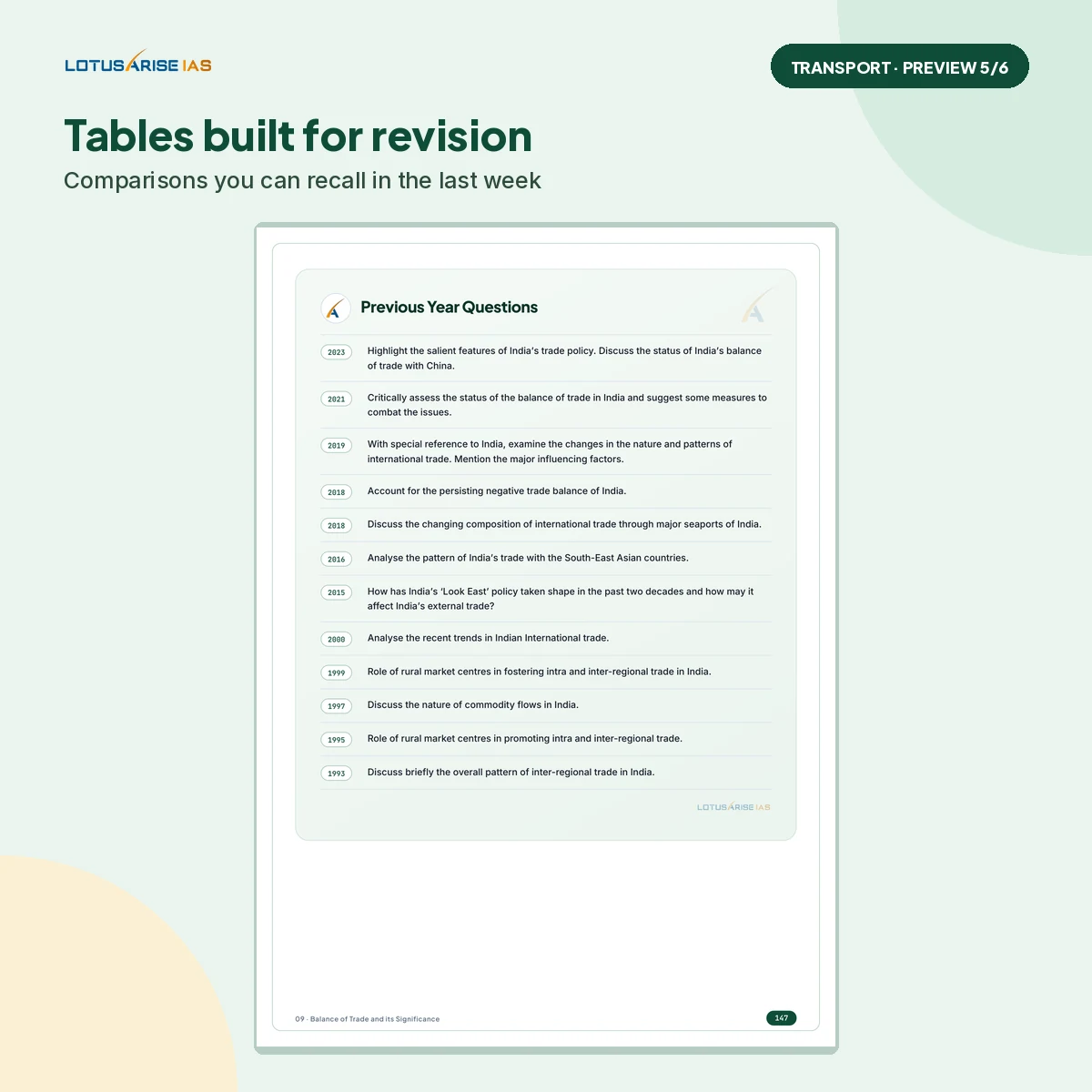
📝 81 PYQs, updated to Mains 2026 — in UPSC’s wording, under the chapter each belongs to, with 12 map items
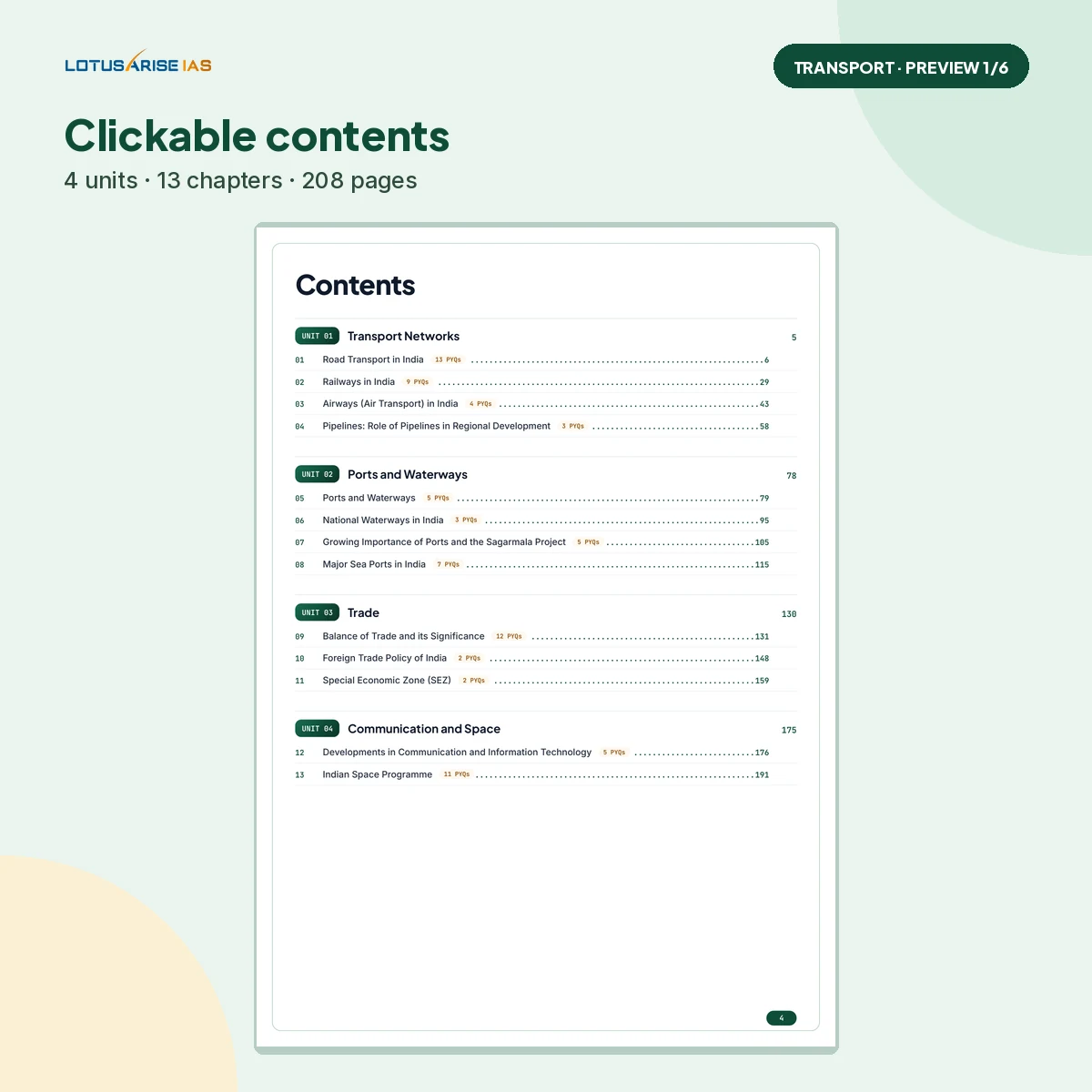
🧭 13 chapters in 4 units — road, rail, air, pipelines, ports, waterways, trade, communication and space
🗺️ 58 diagrams and figures — full width, clear enough to redraw in an answer
🚢 Figures carried into 2026 — freight corridors, port cargo, SEZs, the China trade gap, private launches
📱 Instant PDF download, 208 pages — clickable contents, laptop, mobile or tablet, offline, printable
One-time payment. No subscription. Unlimited downloads — the link does not expire.
⭐ Read by 300,000+ UPSC aspirants every month on LotusArise IAS
Features:
- Comprehensive Coverage
- Complete Syllabus
- Suitable for: UPSC & State PSCs exams
- Format: Digital PDF (Downloadable)
- 337,362+ aspirants visit every month
The problem most aspirants don’t talk about
Ask a Geography Optional aspirant about this section a few months into preparation. They won’t say it is too hard to understand. They will say one of three things:
“I can name the highways, the major ports and the national waterways, but once the question says ‘role in regional development’ I run out of things to write.”
“My road figures are from one place, my ports from another and my space notes from a current-affairs sheet. No two are from the same year.”
“I treat trade and the space programme as economy and science topics, so they drop out of my revision. Then a question comes on NavIC or the trade balance with China.”
None of this is a lack of effort. The material is scattered across transport, economy and science notes, its figures age quickly, and little of it is written around regions. What is missing is one book that takes each network from its pattern to its regional effect, with the figures dated. Transport, Communication and Trade is that book.
Why this section is a smart place to spend your hours
The book carries 81 questions, from 1986 to 2026, with at least one in every year’s papers from 2013 to 2026. Twelve are map items, among them Sela Tunnel, Along Airport, Mundra, Vadhawan, Byalalu and Thumba.
The written questions keep returning to one idea. Air transport (2011), road transport (2012), river transport (2016), seaports (2024) and energy pipelines (2018 and 2026) have all been asked through regional development. The heaviest chapters are road transport with 13 questions, balance of trade with 12, the space programme with 11 and railways with 9.
It also pays back across the paper. Pipelines as growth poles support your answers on industry. The digital divide runs straight into regional disparity. Choke-points, asked in 2026, lead into the geopolitics of the Indian Ocean.
The challenge is not the facts. It is having one current account of what each network does for a region.
What’s inside — 208 pages in 4 units
🛣️ Transport Networks — 4 chapters
- Road transport: national highways, the Golden Quadrilateral, Bharatmala, PM GatiShakti, rural market centres
- Railways: zones, gauge, Dedicated Freight Corridors, metro and rapid transit, privatisation, the plan periods
- Airways: routes, UDAN, the civil aviation policy, and whether a comprehensive network is feasible
- Pipelines: major oil and gas lines, the National Gas Grid, refineries, pipelines as growth poles
⚓ Ports and Waterways — 4 chapters
- Water transport: types of waterways, ocean routes, Sethusamudram, choke-points
- National waterways: the 2016 Act, operational waterways, National Waterway 1, river transport and regional development
- Growing importance of ports and Sagarmala: objectives, six mega ports, Coastal Economic Zones
- Major sea ports: each port on both coasts, the landlord model, hinterlands, Vadhavan, Mundra and Vizhinjam
📈 Trade — 3 chapters
- Balance of trade: the long trend, why the deficit persists, composition and direction, inter-regional trade
- Foreign Trade Policy: its framework, FTP 2023, export promotion and trade agreements
- Special Economic Zones: the 2005 Act, the Baba Kalyani Committee, reforms since 2019, SWOT, export processing zones
🛰️ Communication and Space — 2 chapters
- Communication and IT: postal system, telecommunications, mass media, Digital India and the digital divide
- Indian space programme: launch vehicles, INSAT and GSAT, IRS, NavIC, crewed flight, the Indian Space Policy, national security
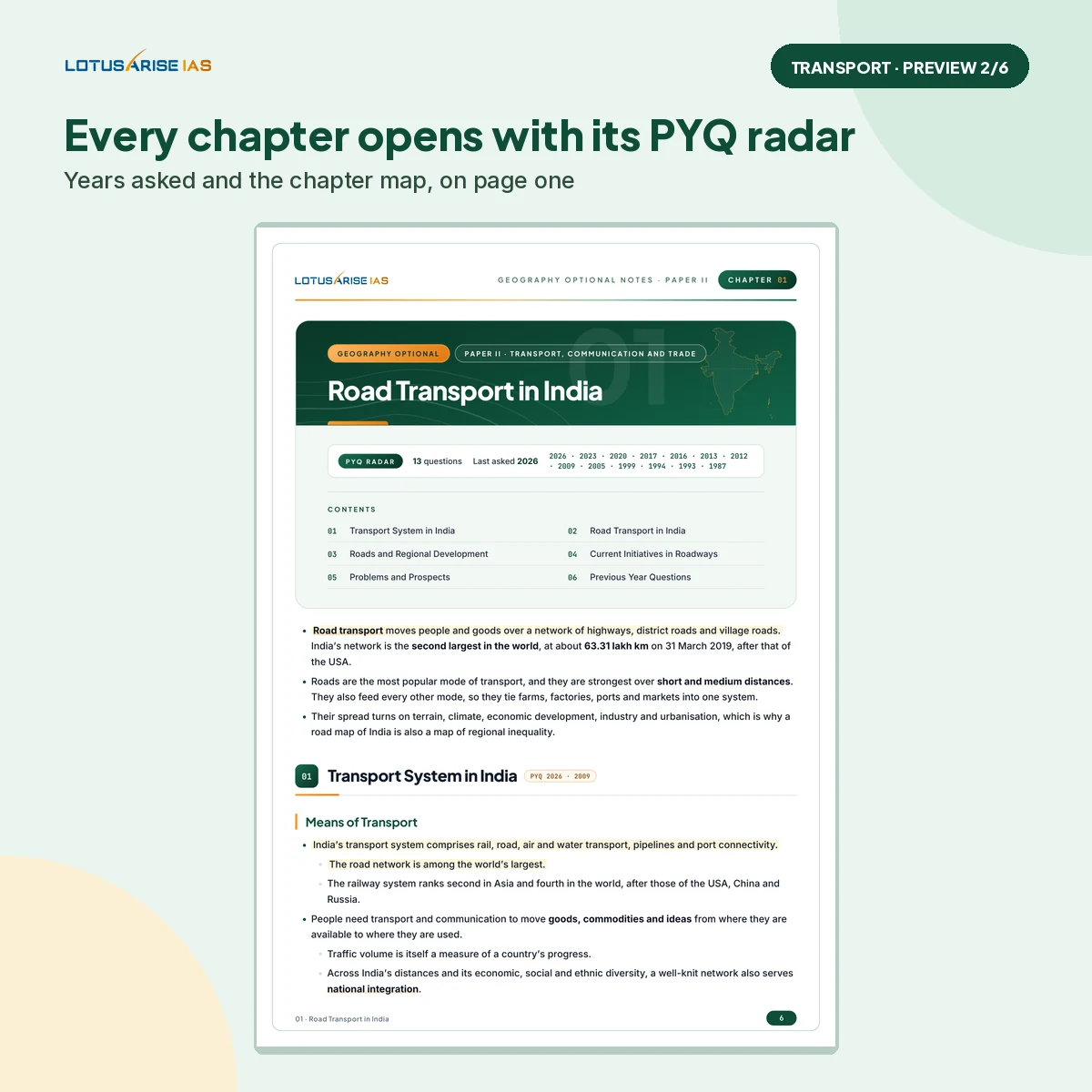
What makes this different from a downloaded PDF? Each chapter is marked against the questions UPSC has actually asked on it. A PYQ radar at the start shows how many times the topic has come and when it last did. Year tags sit on the headings UPSC has asked about. Faint highlights pick out key points, definitions and PYQ terms, so your second reading takes far less time than your first. Where an older figure is still quoted, the book gives the current one beside it: the coast long given as 7,516.6 km, re-assessed at 11,098.81 km in 2025.
One thing to be clear about: the book gives the previous year questions, not model answers. Solved answers are in the Geography Optional 300+ Score Pack.
The aspirant who buys this
First-timers — You want one account of India’s transport and trade from the start, instead of collecting it from economy notes and the news.
Repeaters — You know the networks, but your answers stop at lengths and tonnages. Use the regional development sections and the table of what each network does best, then go through the PYQ list at the end of each chapter.
Aspirants short of time before Mains — Road, balance of trade and space carry 36 of the 81 questions. The radar, year tags and highlights show you what to read first.
Self-study aspirants outside Delhi, Prayagraj and Jaipur — No classroom and no batch. You get one organised book that you can read anywhere, and print for handwritten practice.
Working professionals — One chapter at a time on your phone, offline, with no schedule and no expiry.
State PSC aspirants with Geography — India’s transport, ports and trade are common ground, so the same chapters serve your paper too.
Why not just use free notes from Telegram?
Free notes exist, and most aspirants already have several. Many of these topics are also on our own website, free to read.
The difference is not that free material is wrong. It is that nothing ties it together. A forwarded PDF rarely tells you which of its pages UPSC has asked about, and in this section its figures may be years old with no date on them. Here you get one order, dated figures, every PYQ placed under its chapter, and a file you can keep and print.
If you have the time to build and maintain your own file from scattered sources, you may not need this. If you would rather open one book and start revising, this is what it is for.
The price
208 pages, 13 chapters, 81 PYQs and 58 diagrams and figures — ₹118. That is about 57 paise a page.
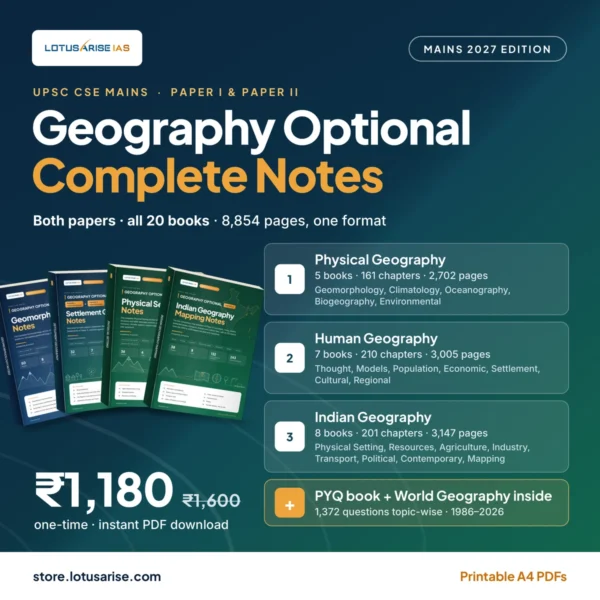
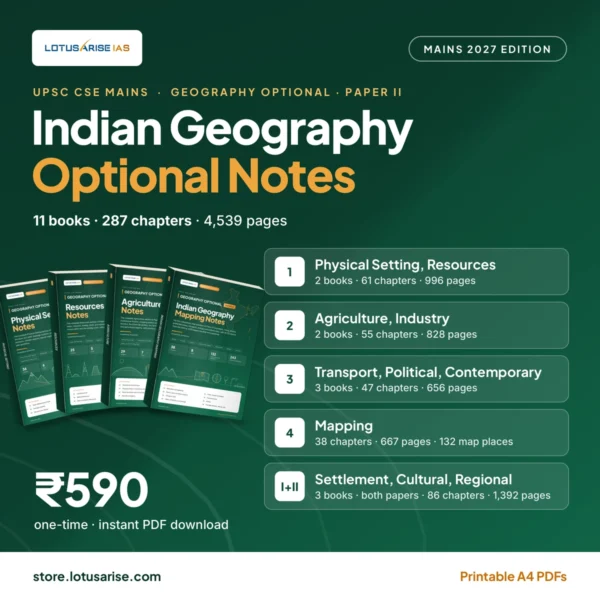
This book is also part of the Indian Geography: Geography Optional Notes bundle at ₹590 and of Geography Optional Complete Notes at ₹1,180.
One-time payment. No subscription. No recurring charge.
The download link reaches your email right after payment — please check your spam folder if you do not see it. Unlimited downloads, no expiry. English medium.
Read the free sample first (PDF)
For support: support@lotusarise.com
You may also like…
-

#OFFER: Geography Optional Complete Notes (PDF) – UPSC Mains (Paper I & II)
Original price was: ₹1,600.00.₹1,180.00Current price is: ₹1,180.00. -