

Political Aspects | Geography Optional UPSC Notes
₹118.00
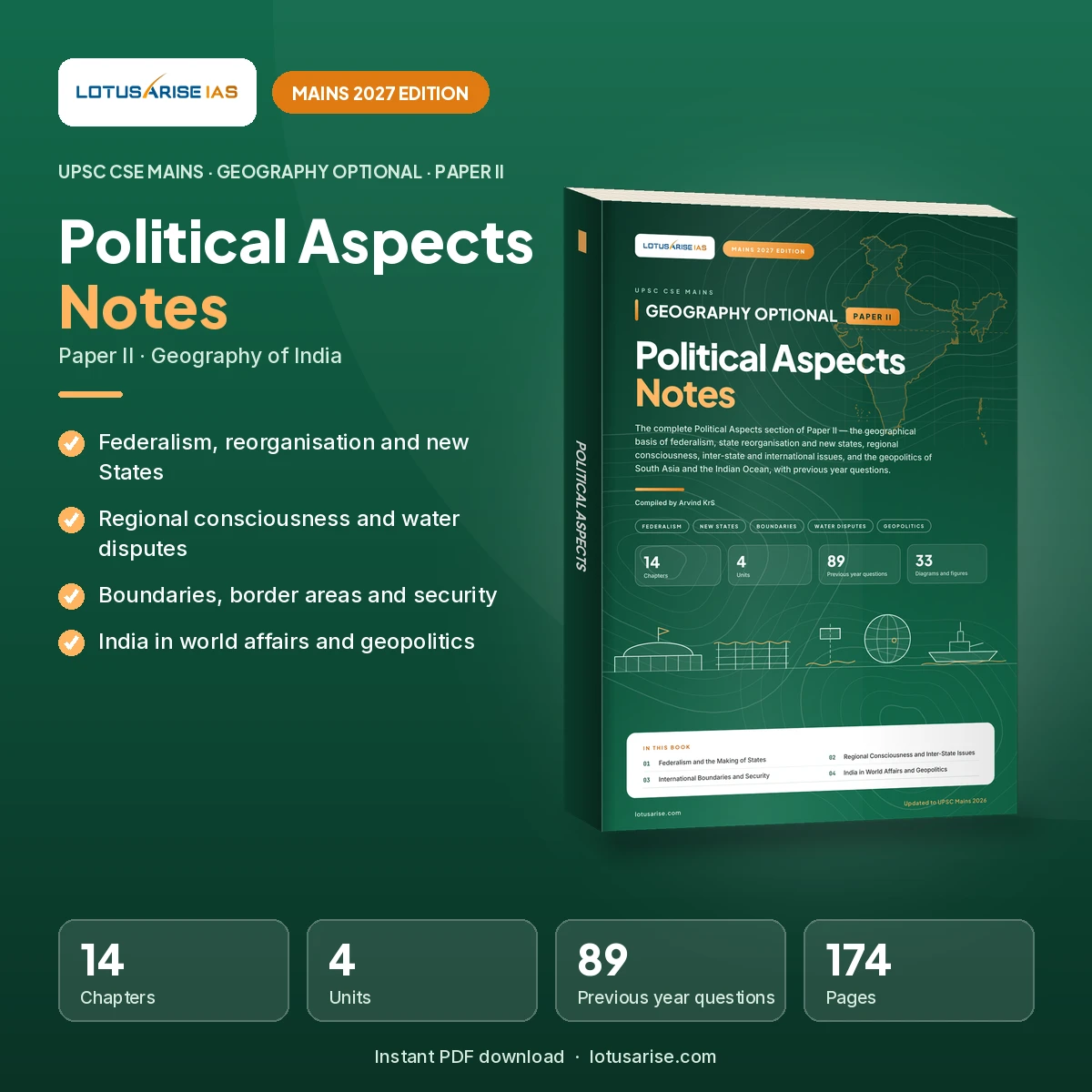
₹118 for 174 pages — about 68 paise a page. Mains 2027 Edition.
Most Geography Optional aspirants write this section as polity or as the news. Articles and tribunals in one answer, last month’s headlines in the next, no map under either. Then UPSC asks whether India’s land boundary is a cultural divide or a divided culture, and the answer has nowhere to start.
Political Aspects puts this Paper II section back on its geography: terrain, rivers, frontiers and sea lanes, and the disputes they shape.
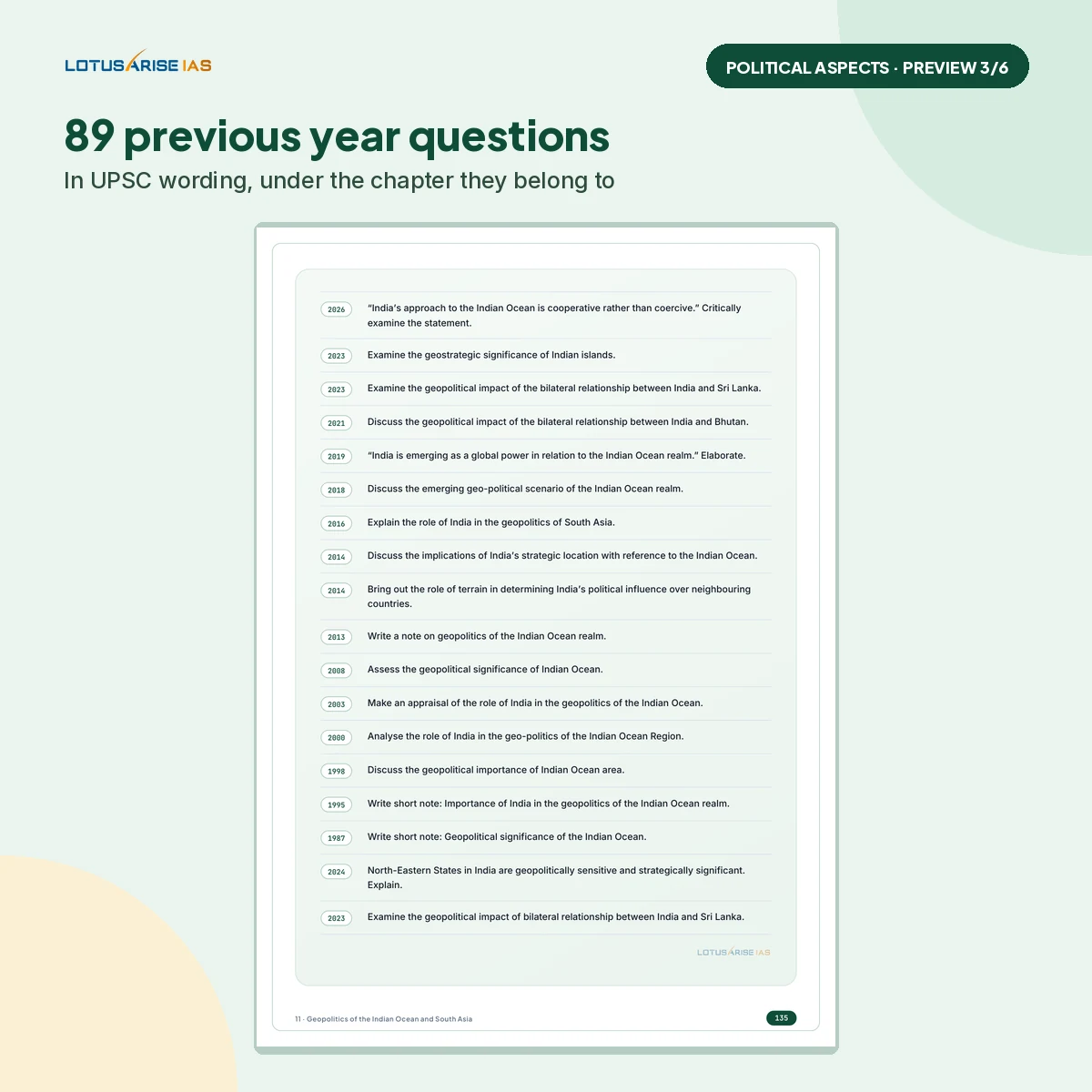
📝 89 PYQs, updated to Mains 2026 — in UPSC’s wording, under the chapter each belongs to
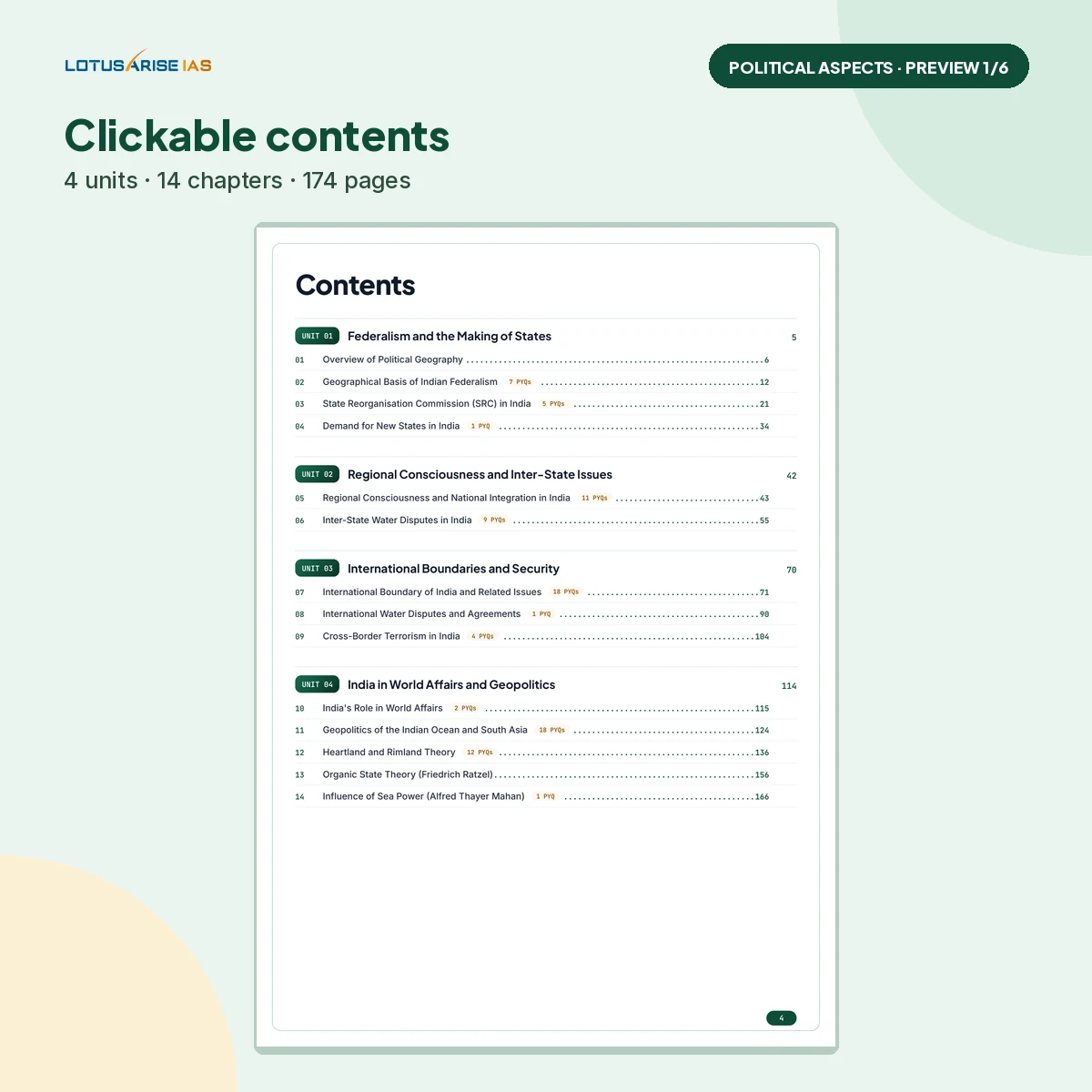
🧭 14 chapters in 4 units — federalism, new States, water disputes, boundaries, cross-border terrorism, geopolitics
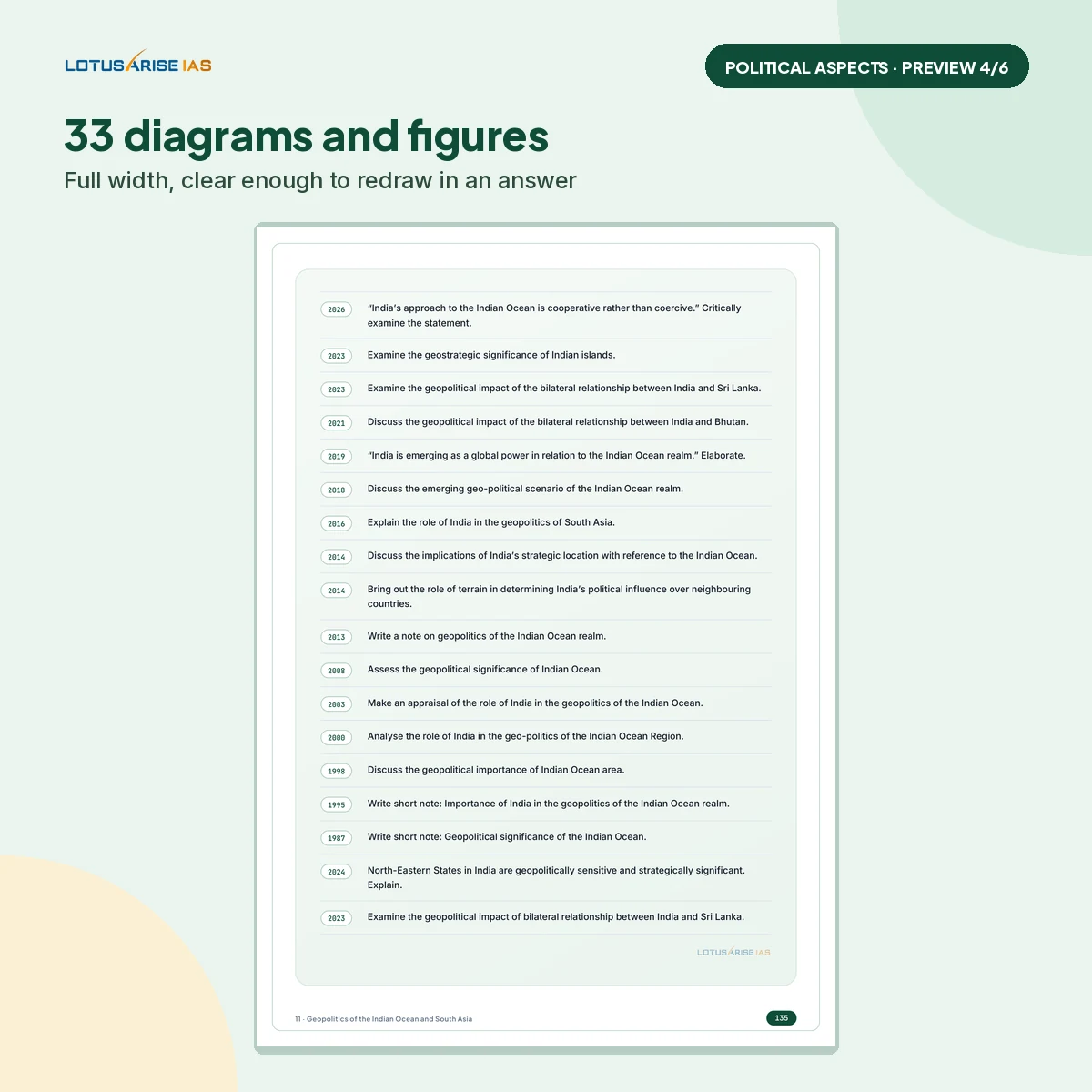
🗺️ 33 diagrams and figures — full width, clear enough to redraw in an answer
🌏 Geopolitics updated to October 2026 — Heartland and Rimland read against Hormuz, the Red Sea and today’s corridors
📱 Instant PDF download, 174 pages — clickable contents, laptop, mobile or tablet, offline, printable
One-time payment. No subscription. Unlimited downloads — the link does not expire.
⭐ Read by 300,000+ UPSC aspirants every month on LotusArise IAS
Features:
- Comprehensive Coverage
- Complete Syllabus
- Suitable for: UPSC & State PSCs exams
- Format: Digital PDF (Downloadable)
- 337,362+ aspirants visit every month
The problem most aspirants don’t talk about
Ask a Geography Optional aspirant about this section a few months into preparation. They won’t say the topics are too hard to understand. They will say one of three things:
“My federalism answer reads like a polity answer. Articles and lists, and very little geography.”
“My boundaries are from an old map, my Indian Ocean from last year’s news and my Heartland from a video. None of them meet.”
“I keep this section for the last month because it feels like current affairs. Then the question asks whether the North East is geo-political or geo-cultural.”
None of this is a lack of effort. The material sits between polity, international relations and the daily news, its dates keep moving, and few accounts start from the map. What is missing is one book that reads each issue through its geography and states where it stands now. Political Aspects is that book.
Why this section is a smart place to spend your hours
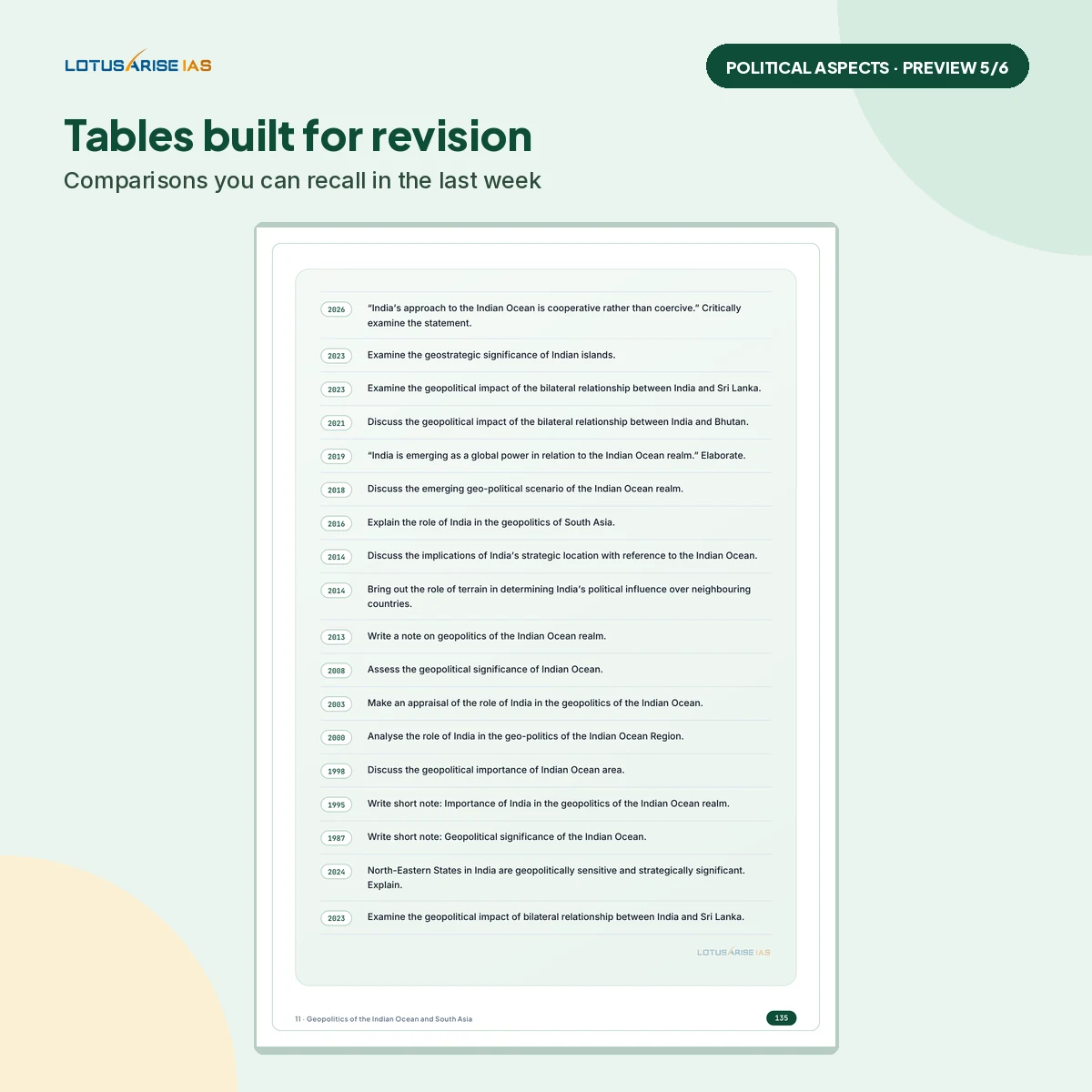
The book carries 89 questions, from 1986 to 2026, with at least one in every year’s papers from 2013 to 2026. Four chapters hold most of them: the international boundary with 18, the Indian Ocean and South Asia with 18, Heartland and Rimland with 12, and regional consciousness with 11.
UPSC also returns to the same ground in harder words. The Sino-Indian border came in 1988, 1992, 2004, 2012 and 2016. The Indian Ocean began as a short note in 1987. In 2026 the question was whether India’s approach is cooperative rather than coercive. Heartland in 2024 and Rimland in 2026 were both asked against today’s world.
It also pays back across the paper. Heartland, Rimland, Ratzel and Mahan serve the models and theories of Paper I as well. Water disputes meet river linking under Contemporary Issues. Chokepoints connect to ports and trade.
The challenge is not the reading. It is having one account that stays geographical and stays current.
What’s inside — 174 pages in 4 units
🏛️ Federalism and the Making of States — 4 chapters
- Overview of political geography: the discipline and its history
- Geographical basis of Indian federalism: centripetal and centrifugal forces, GST
- State Reorganisation Commission: the linguistic question, Fazl Ali, the map from 1956 to Telangana and Ladakh
- Demand for new States: Bundelkhand and other live demands, the autonomy route, a second commission
🤝 Regional Consciousness and Inter-State Issues — 2 chapters
- Regional consciousness and national integration: ethnicity, caste, language, the North East, Naxal-affected areas
- Inter-State water disputes: the law, nine tribunals, Cauvery, Satluj–Yamuna Link, Krishna, Godavari, Mahadayi, Mullaperiyar
🧭 International Boundaries and Security — 3 chapters
- International boundary: neighbour by neighbour, maritime limits, Sir Creek, Tin Bigha, Siachen, border area development
- International water disputes: China, Bangladesh, Pakistan, Nepal and Bhutan, with the Indus Waters Treaty in abeyance
- Cross-border terrorism: the role of physiography, who guards what, strategies to control it
🌏 India in World Affairs and Geopolitics — 5 chapters
- India’s role in world affairs: world bodies, diaspora, the South China Sea, multi-alignment
- Indian Ocean and South Asia: strategic location, Indian islands, China in the ocean, the North-East, Sri Lanka
- Heartland and Rimland: Mackinder, Spykman, later views and the scenario as of October 2026
- Organic state theory: Ratzel’s seven laws, Lebensraum, evaluation and contemporary relevance
- Influence of sea power: Mahan’s six conditions, chokepoints today, the maritime strategies of China and India
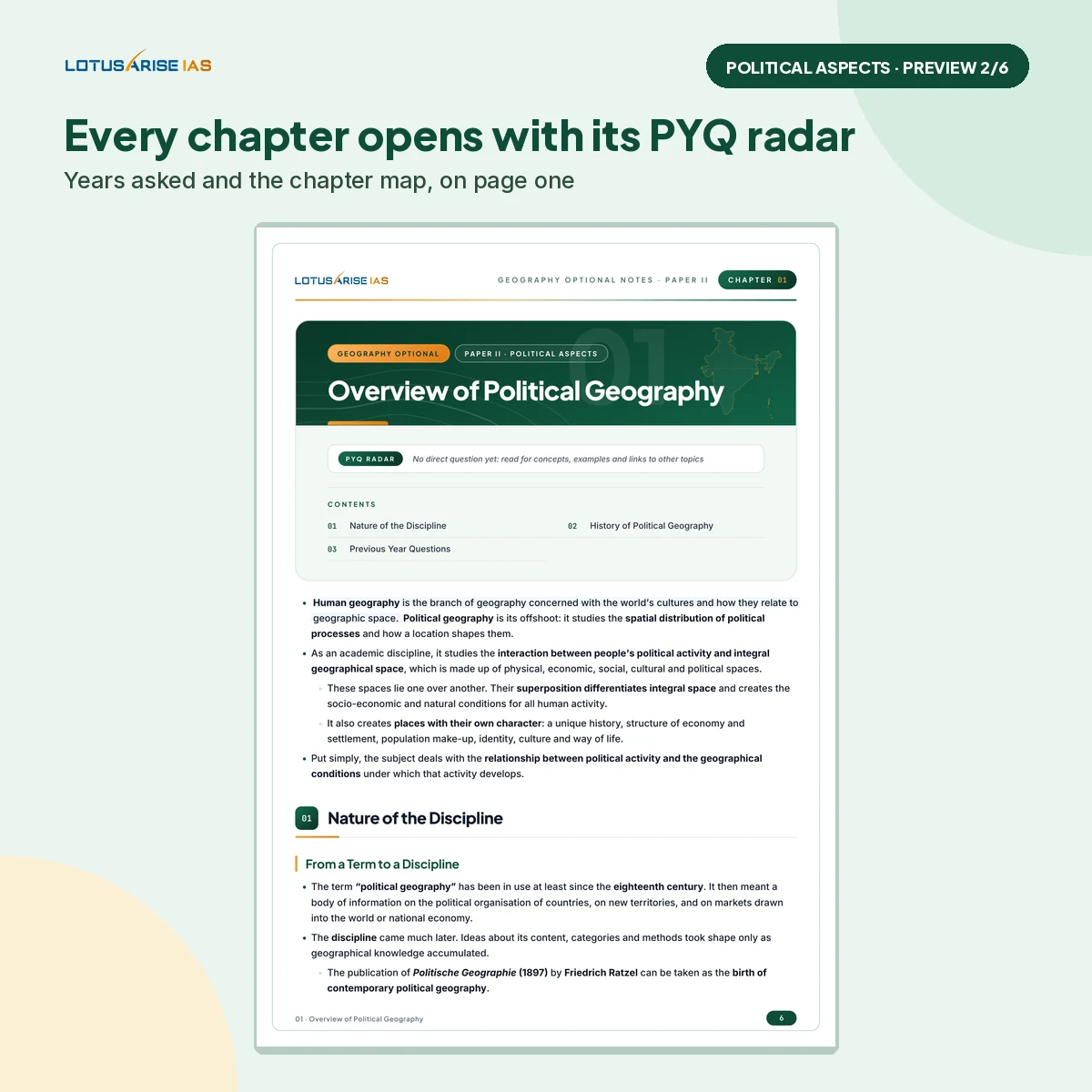
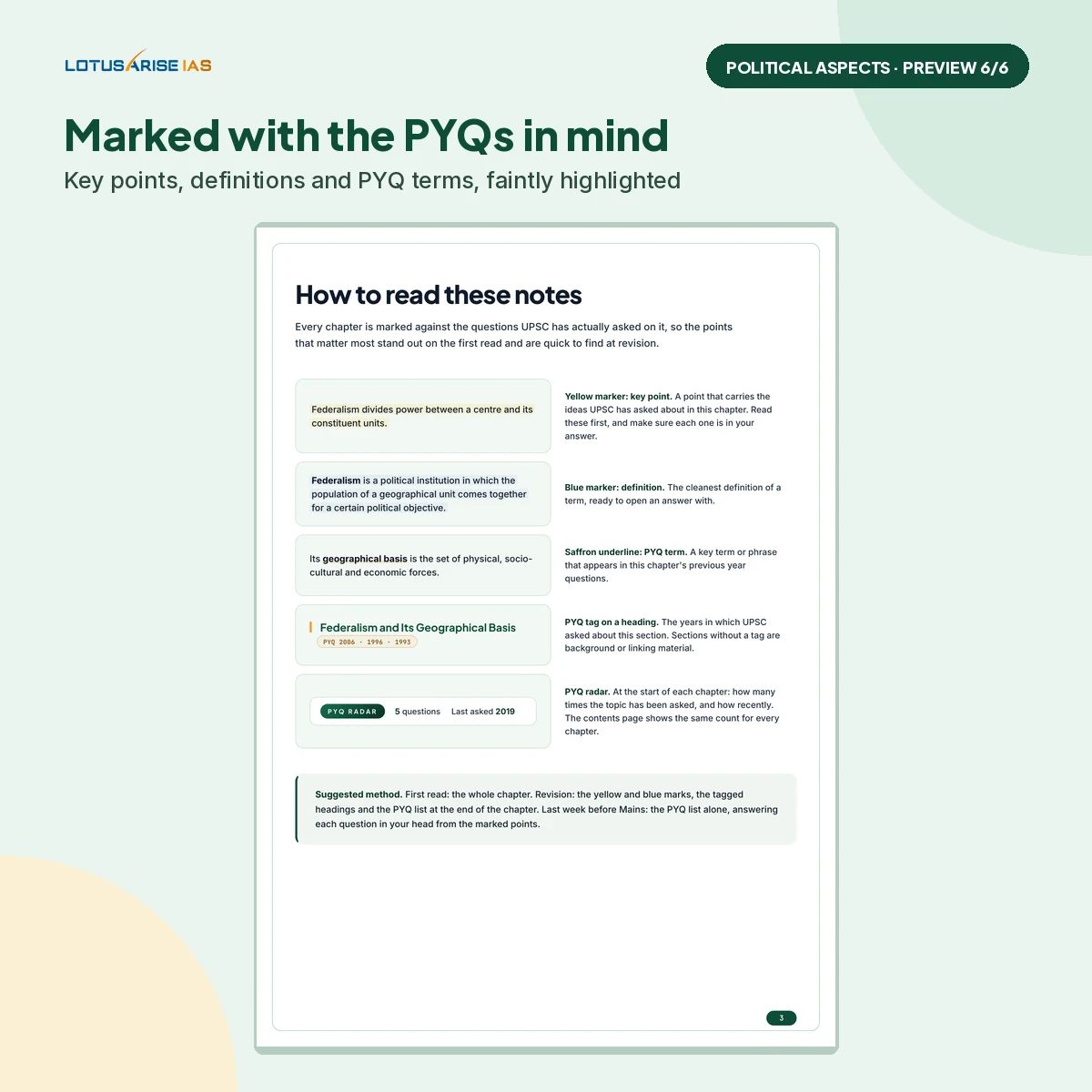
What makes this different from a downloaded PDF? Each chapter is marked against the questions UPSC has actually asked on it. A PYQ radar at the start shows how many times the topic has come and when it last did. Year tags sit on the headings UPSC has asked about. Faint highlights pick out key points, definitions and PYQ terms, so your second reading takes far less time than your first. The two chapters with no direct question yet say so on their radar. Live matters carry their dates, down to the Supreme Court on Kachchatheevu, 6 October 2026.
One thing to be clear about: the book gives the previous year questions, not model answers. Solved answers are in the Geography Optional 300+ Score Pack.
The aspirant who buys this
First-timers — You want one account of this section from the start, instead of piecing it together from polity notes and the news.
Repeaters — You know the disputes, but your answers read like polity or current affairs. Use the terrain and regional sections, then go through the PYQ list at the end of each chapter.
Aspirants short of time before Mains — Four chapters carry 59 of the 89 questions, and the radar, year tags and highlights show you what to read first.
Self-study aspirants outside Delhi, Prayagraj and Jaipur — No classroom and no batch. You get one organised book that you can read anywhere, and print for handwritten practice.
Working professionals — One chapter at a time on your phone, offline, with no schedule and no expiry.
State PSC aspirants with Geography — Federalism, new States and water disputes are common ground, so the same chapters serve your paper too.
Why not just use free notes from Telegram?
Free notes exist, and most aspirants already have several. Many of these topics are also on our own website, free to read.
The difference is not that free material is wrong. It is that nothing ties it together. A forwarded PDF rarely tells you which of its pages UPSC has asked about, it seldom ties a dispute to its terrain, and nobody tells you when events have overtaken it. Here you get one order, dated positions, every PYQ placed under its chapter, and a file you can keep and print.
If you have the time to build and maintain your own file from scattered sources, you may not need this. If you would rather open one book and start revising, this is what it is for.
The price
174 pages, 14 chapters, 89 PYQs and 33 diagrams and figures — ₹118. That is about 68 paise a page.
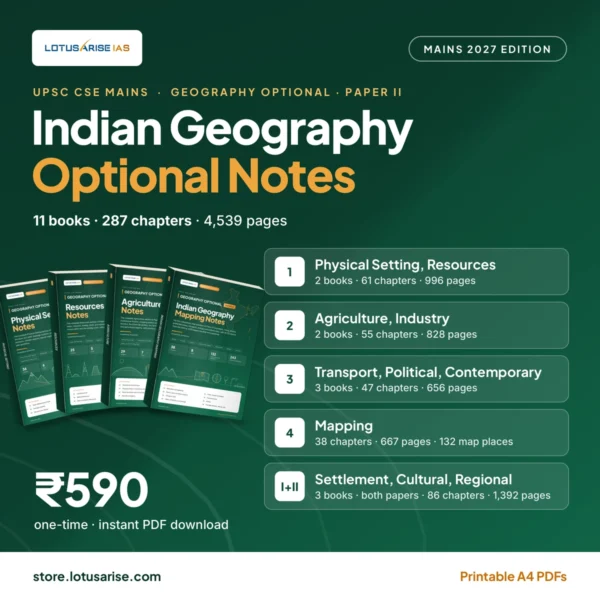
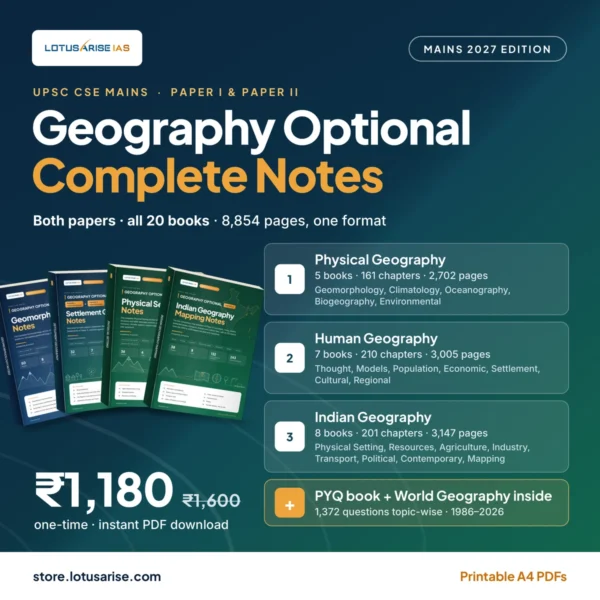
This book is also part of the Indian Geography: Geography Optional Notes bundle at ₹590 and of Geography Optional Complete Notes at ₹1,180.
One-time payment. No subscription. No recurring charge.
The download link reaches your email right after payment — please check your spam folder if you do not see it. Unlimited downloads, no expiry. English medium.
Read the free sample first (PDF)
For support: support@lotusarise.com
You may also like…
-

-
#OFFER: Geography Optional Complete Notes (PDF) – UPSC Mains (Paper I & II)
Original price was: ₹1,600.00.₹1,180.00Current price is: ₹1,180.00.