


Agriculture | Geography Optional UPSC Notes
₹118.00
₹118 for 417 pages — about 28 paise a page. Mains 2027 Edition.
Most Geography Optional aspirants read this section crop by crop. Rice here, wheat there, the Green Revolution story, a list of schemes. Then UPSC asks to distinguish agricultural productivity from agricultural efficiency, or to correlate agro-climatic zones with agro-ecological regions, and the answer has no geography in it.
Agriculture is the Geography Optional Paper II book: the whole section in one order, through regions, methods and PYQs. The store’s separate GS book is Agriculture Notes for UPSC.
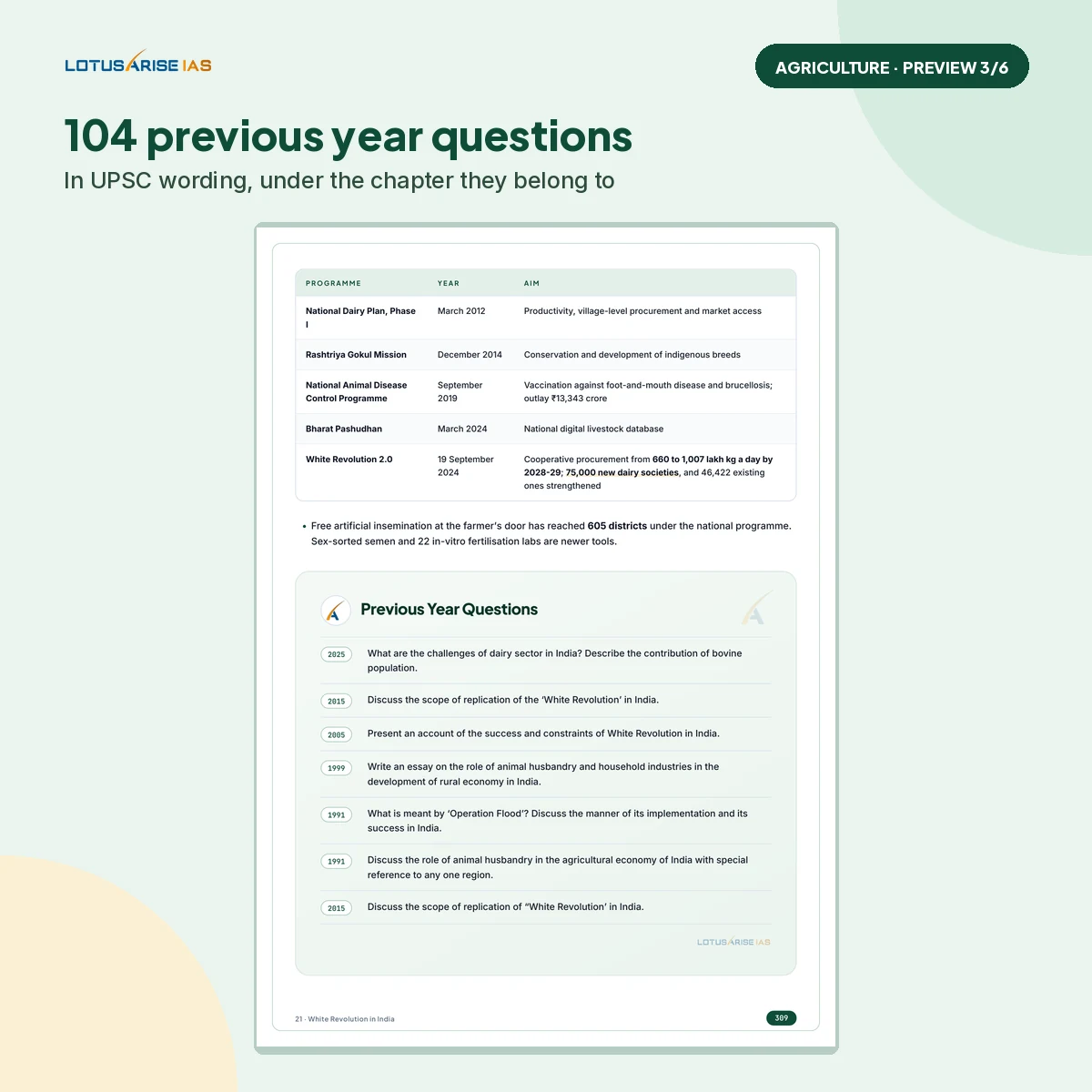
📝 104 PYQs, updated to Mains 2026 — in UPSC’s wording, placed by chapter
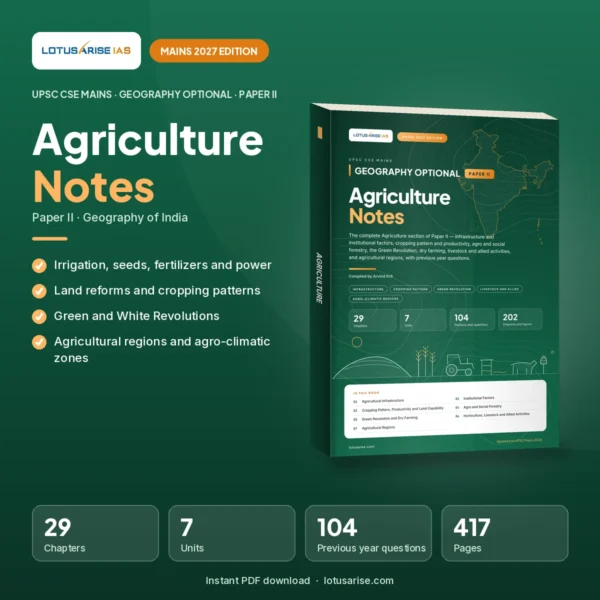
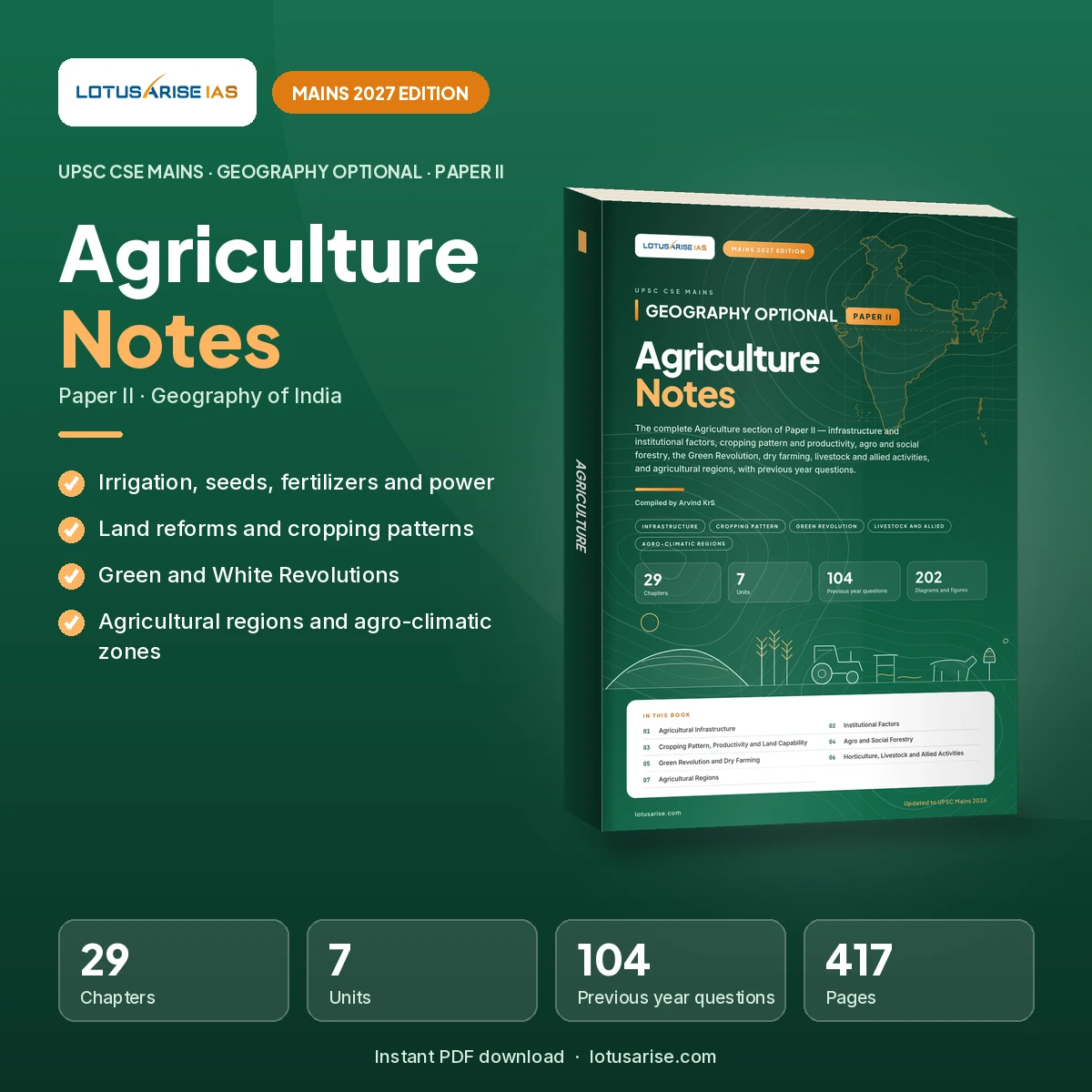
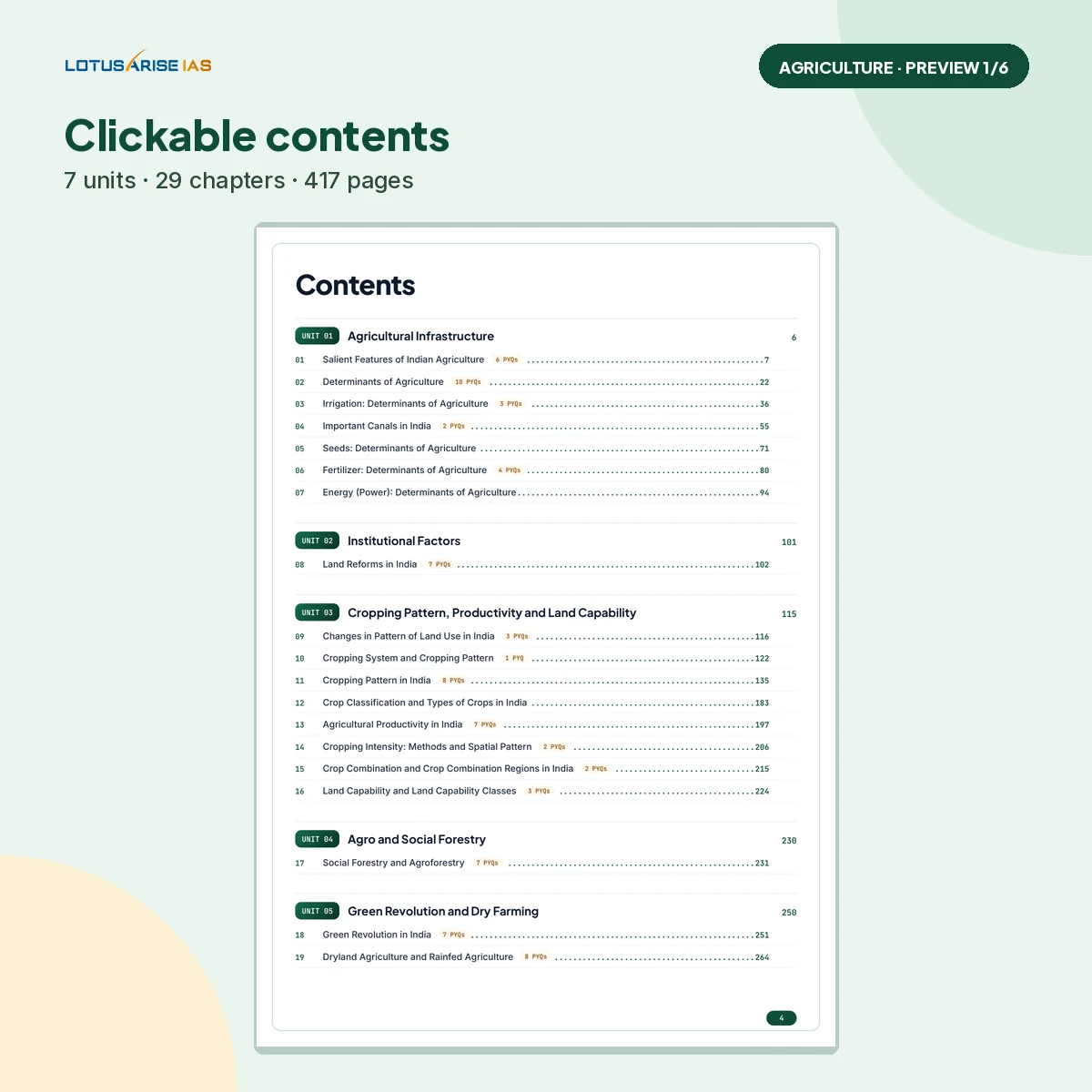
🧭 29 chapters in 7 units — infrastructure, land reforms, cropping pattern, forestry, Green Revolution, livestock, regions
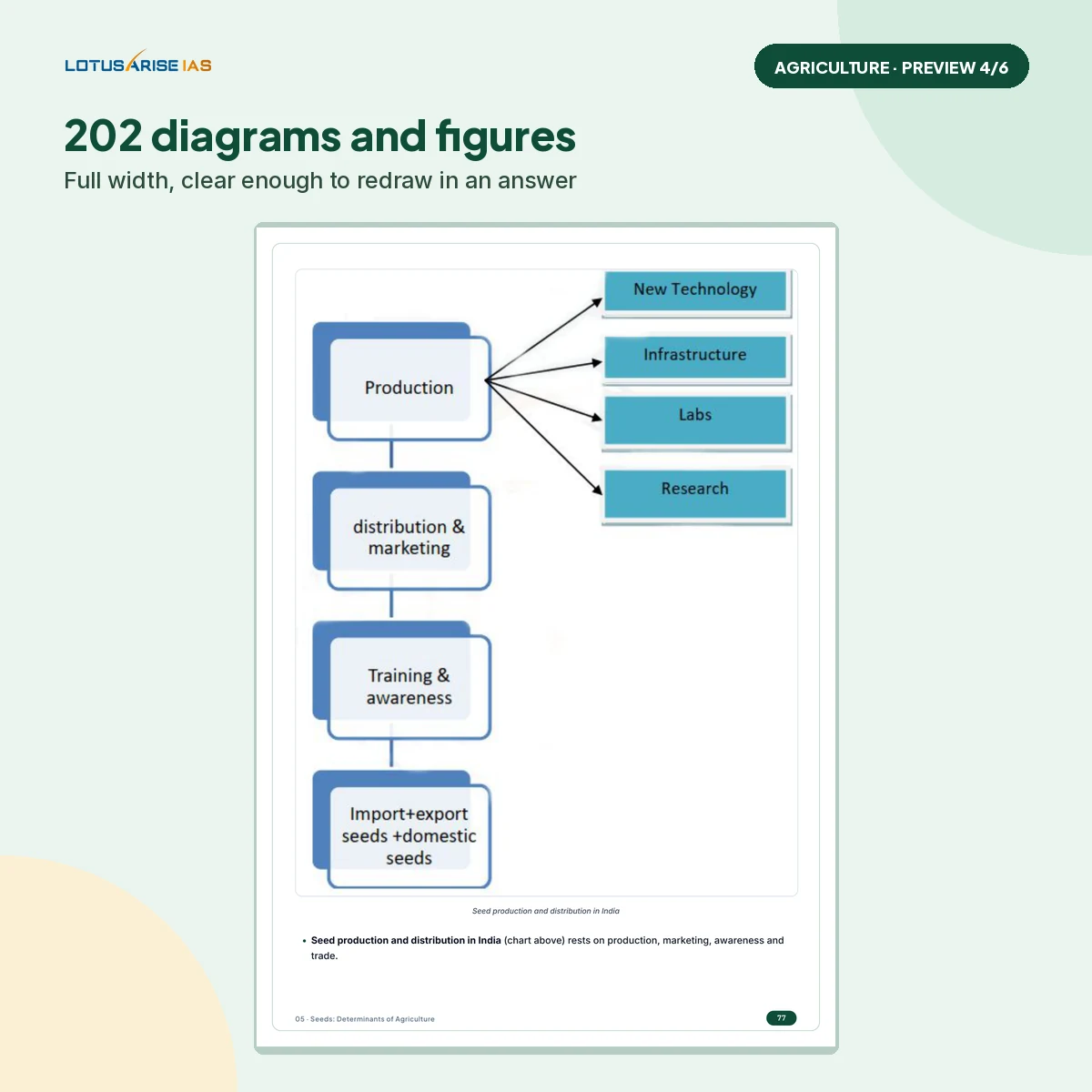
🗺️ 202 diagrams and figures — full width, maps included, clear enough to redraw
🌾 Data to 2025-26 — foodgrain output and fertiliser mix, with the 2026-27 subsidy budget
📱 Instant PDF download, 417 pages — clickable contents, laptop, mobile or tablet, offline, printable
One-time payment. No subscription. Unlimited downloads — the link does not expire.
⭐ Read by 300,000+ UPSC aspirants every month on LotusArise IAS
Features:
- Comprehensive Coverage
- Complete Syllabus
- Suitable for: UPSC & State PSCs exams
- Format: Digital PDF (Downloadable)
- 337,362+ aspirants visit every month
The problem most aspirants don’t talk about
Ask a Geography Optional aspirant about this section a few months into preparation. They won’t say farming is too hard to understand. They will say one of three things:
“I covered agriculture for GS, so I assumed Paper II was done. Then the question asked for the disparity in agricultural efficiency across regions.”
“I know the Green Revolution story, but ‘why have agro and social forestry failed’ and ‘why does India lag in productivity’ need more than a story.”
“Crop combination, agricultural regions and agro-ecological zones all sit in my ‘later’ pile. I still cannot say how an agro-climatic zone differs from an agro-ecological region.”
None of this is a lack of effort. Most reading follows crops and schemes rather than places and methods. What is missing is one book that takes the section the way Paper II asks it, from determinants to regions, with the questions marked. Agriculture is that book.
Why this section is a smart place to spend your hours
This section has a long record. The book carries 104 questions from it, from 1986 to 2026. Mains 2026 alone asked about crop diversification, the fertiliser supply chain, agricultural productivity and agro-ecological regions.
No single chapter carries the load. Determinants of Agriculture has 10 PYQs, Cropping Pattern in India and Dryland Agriculture 8 each, and Land Reforms, Productivity, Social Forestry, Green Revolution and White Revolution 7 each. UPSC has also gone to fresh ground: millets as nutri-cereals in 2023, poultry in 2023, fox nuts and dairy in 2025.
It pays back across the paper. Soils and the monsoon from Physical Setting explain cropping pattern. Social forestry runs into Forest Resources. The 2026 fertiliser question belongs as much to Industry as to farming.
The challenge is not the crops. It is having one current account of the regions and methods that you can actually revise.
What’s inside — 417 pages in 7 units
🚜 Agricultural Infrastructure — 7 chapters
- Salient features, cropping seasons, zero tillage, problems and India’s world position
- Determinants of agriculture: physical, institutional and infrastructural
- Irrigation and important canals, from the Indira Gandhi Canal to the Satluj–Yamuna Link
- Seeds, fertiliser, neem-coated urea, farm power and electricity
🏛️ Institutional Factors — 1 chapter
- Land reforms: zamindari abolition, tenancy, ceilings, consolidation and current status
🌱 Cropping Pattern, Productivity and Land Capability — 8 chapters
- Changes in land use, cropping systems and cropping pattern with its controls
- Major crops: rice, wheat, millets, pulses, cotton, jute, sugarcane, fox nut
- Productivity and efficiency, with Kendall’s ranking coefficient method
- Cropping intensity, crop combination with Weaver’s method, land capability classes
🌳 Agro and Social Forestry — 1 chapter
- Social forestry and agroforestry: systems, benefits, shortcomings and policy
🌾 Green Revolution and Dry Farming — 2 chapters
- Green Revolution: phases, core areas, economic, social and ecological repercussions, the Second Green Revolution
- Dryland and rainfed farming: the dry farming belt, methods and programmes
🐄 Horticulture, Livestock and Allied Activities — 6 chapters
- Horticulture, including the Himalayan belt
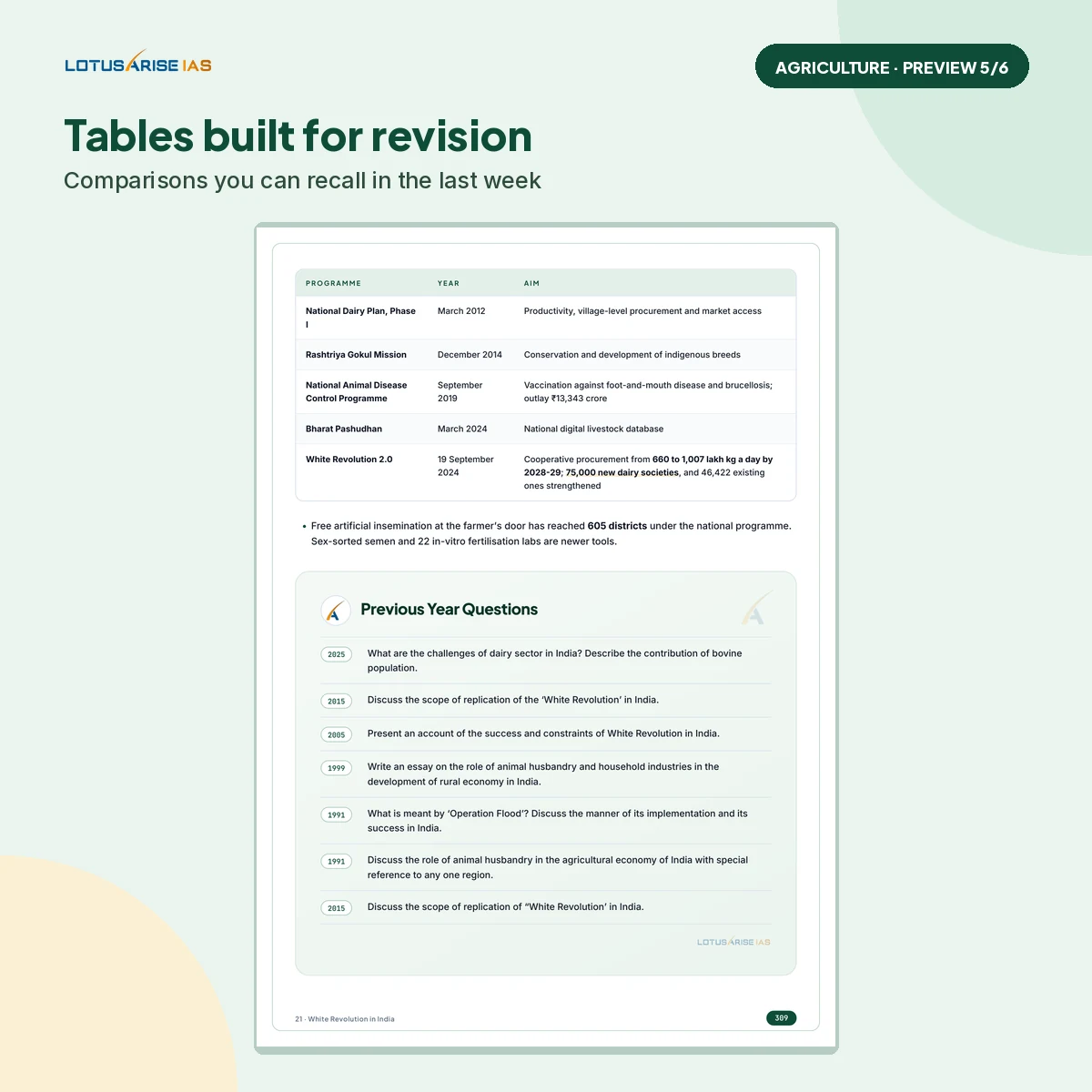
- White Revolution and Operation Flood, Blue Revolution, poultry
- Sericulture and apiculture
🗺️ Agricultural Regions — 4 chapters
- Regionalisation techniques, Randhawa’s regions and the ICAR classification
- The 15 agro-climatic zones and the 20 agro-ecological regions, one by one
- Agro-biodiversity hotspots
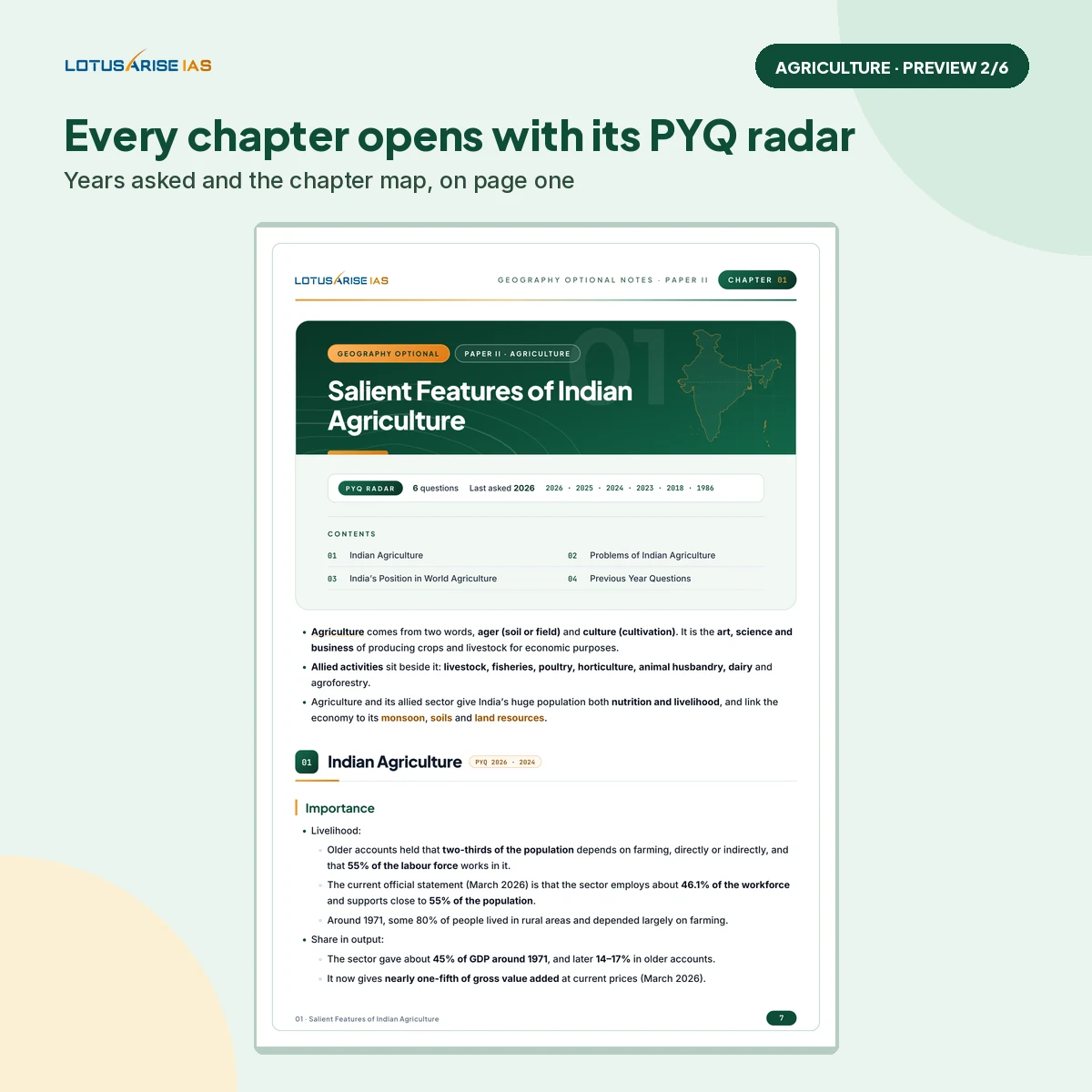
What makes this different from a downloaded PDF? Each chapter is marked against the questions UPSC has actually asked on it. A PYQ radar at the start shows how many times the topic has come and when it last did. Year tags sit on the headings UPSC has asked about. Faint highlights pick out key points, definitions and PYQ terms, so your second reading takes far less time than your first.
Which agriculture book is this? This is the Geography Optional Paper II book, built on this section’s syllabus and PYQs. If you want agriculture for General Studies, the store sells a separate GS book, Agriculture Notes for UPSC.
One thing to be clear about: the book gives the previous year questions, not model answers. Solved answers are in the Geography Optional 300+ Score Pack.
The aspirant who buys this
First-timers — You want one account of Indian agriculture for the optional from the start. Read it after Physical Setting and the regions stop looking arbitrary.
Repeaters — You know the crops and schemes, but your answers lack regions and methods. Use the productivity, cropping intensity and regionalisation chapters, then go through the PYQ list at the end of each.
Aspirants short of time before Mains — The contents page shows every chapter’s PYQ count. The radar, year tags and highlights show you what to read first.
Self-study aspirants outside Delhi, Prayagraj and Jaipur — No classroom and no batch. You get one organised book that you can read anywhere, and print for handwritten practice.
Working professionals — One chapter at a time on your phone, offline, with no schedule and no expiry.
State PSC aspirants with Geography — Indian agriculture is common ground, so the same chapters serve your paper too.
Why not just use free notes from Telegram?
Free notes exist, and most aspirants already have several. Many of these topics are also on our own website, free to read.
The difference is not that free material is wrong. It is that nothing ties it together. A forwarded PDF rarely tells you which of its pages UPSC has asked about, it seldom shows the methods behind a productivity map or a crop region, and nobody tells you when its output figures have gone out of date. Here you get one order, every PYQ placed under its chapter, and a file you can keep and print.
If you have the time to build and maintain your own file from scattered sources, you may not need this. If you would rather open one book and start revising, this is what it is for.
The price
417 pages, 29 chapters, 104 PYQs and 202 diagrams and figures — ₹118. That is about 28 paise a page.
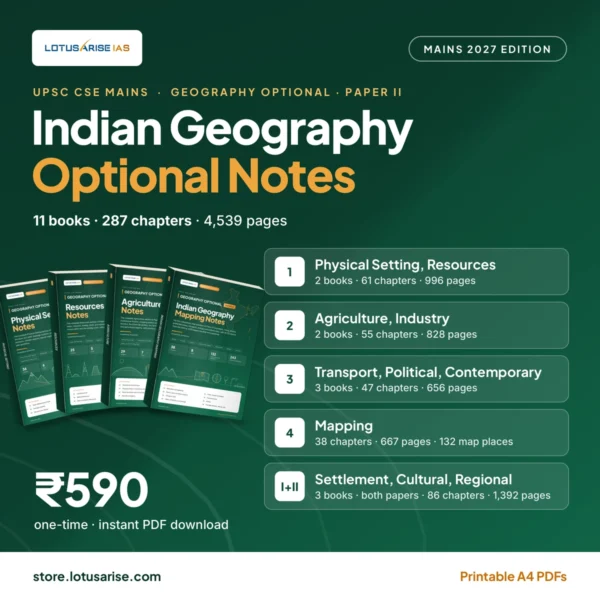
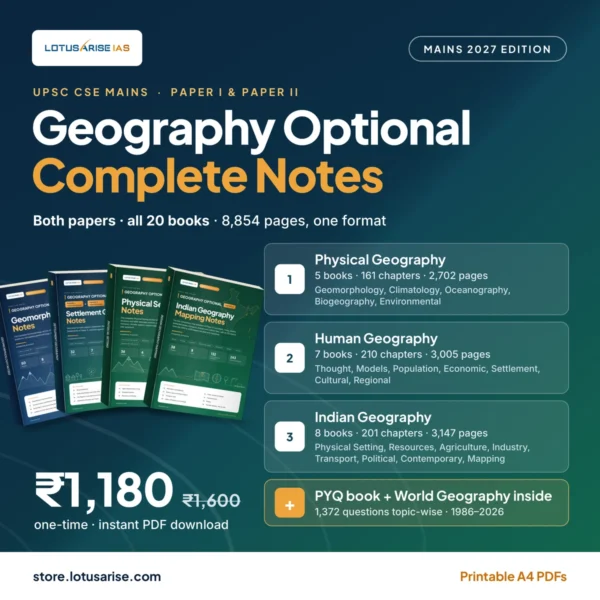
This book is also part of the Indian Geography: Geography Optional Notes bundle at ₹590 and of Geography Optional Complete Notes at ₹1,180.
One-time payment. No subscription. No recurring charge.
The download link reaches your email right after payment — please check your spam folder if you do not see it. Unlimited downloads, no expiry. English medium.
Read the free sample first (PDF)
For support: support@lotusarise.com
You may also like…
-

-
#OFFER: Geography Optional Complete Notes (PDF) – UPSC Mains (Paper I & II)
Original price was: ₹1,600.00.₹1,180.00Current price is: ₹1,180.00.