

Oceanography | Geography Optional UPSC Notes
₹118.00
₹118 for 335 pages — about 35 paise a page. Mains 2027 Edition.
Most Geography Optional aspirants leave Oceanography for the end. A sketch of the Atlantic floor, a list of currents, Darwin on coral reefs. Then UPSC asks about deep-sea mining, India’s Blue Economy or an AMOC collapse, and the old notes have nothing to say.
Oceanography takes the whole Paper I section in one order, from the ocean floor to the law of the sea, up to the present.
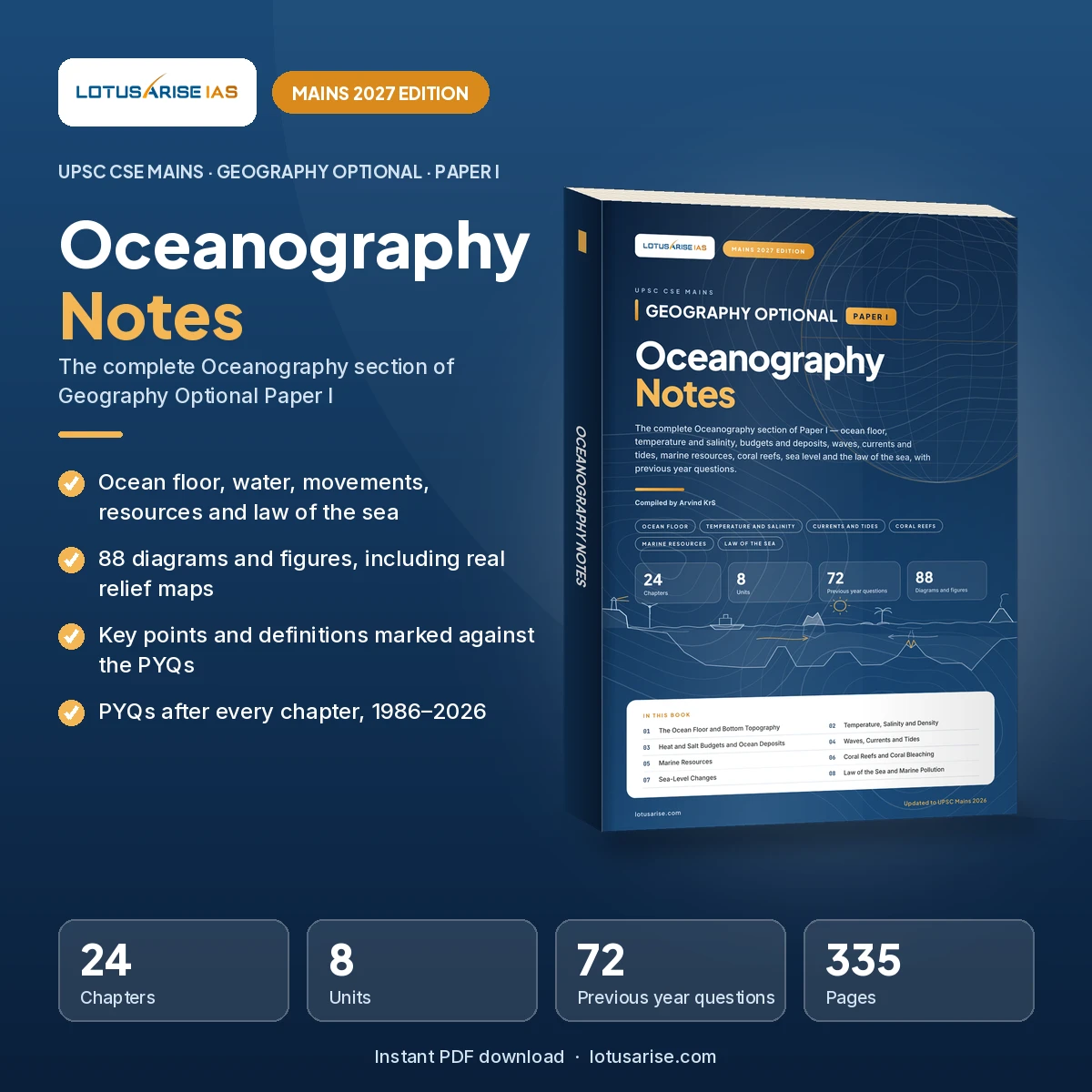
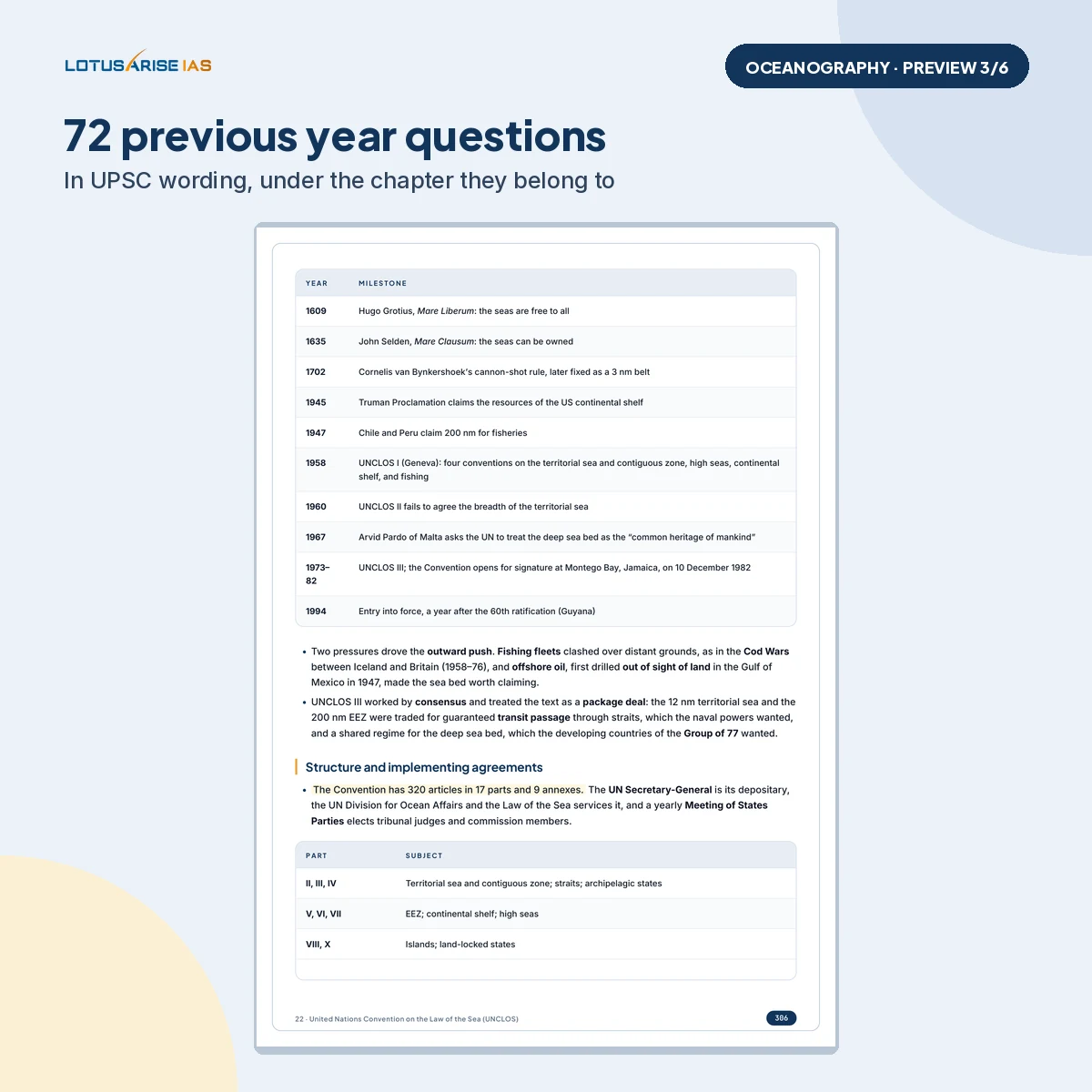
📝 72 PYQs, updated to Mains 2026 — in UPSC’s wording from 1986 on, under the chapter each belongs to
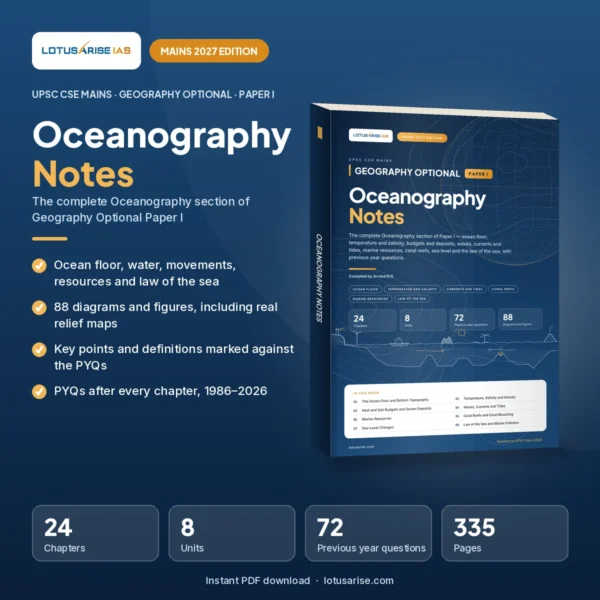
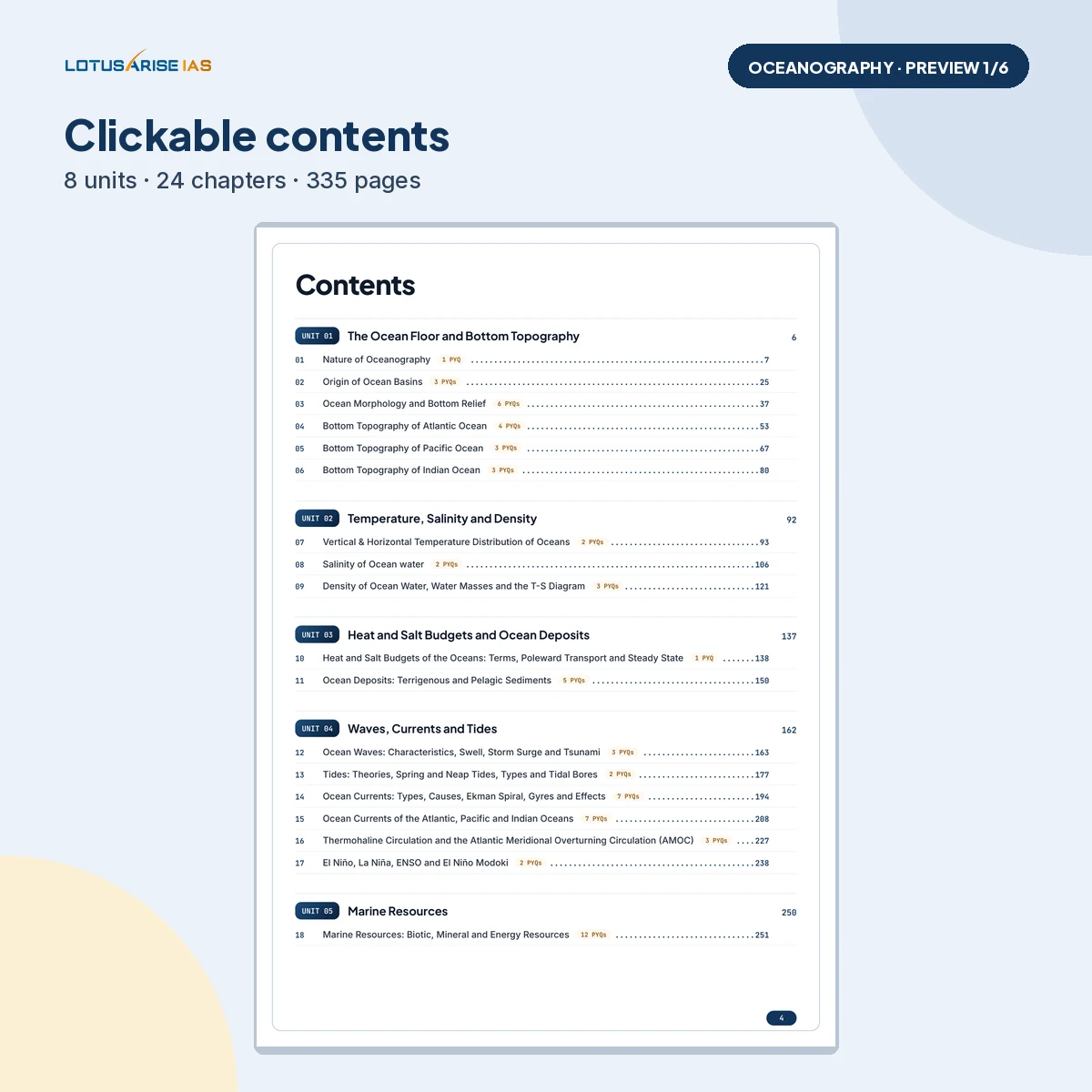
🧭 24 chapters in 8 units — ocean floor, salinity, deposits, currents, tides, resources, corals, sea level, law
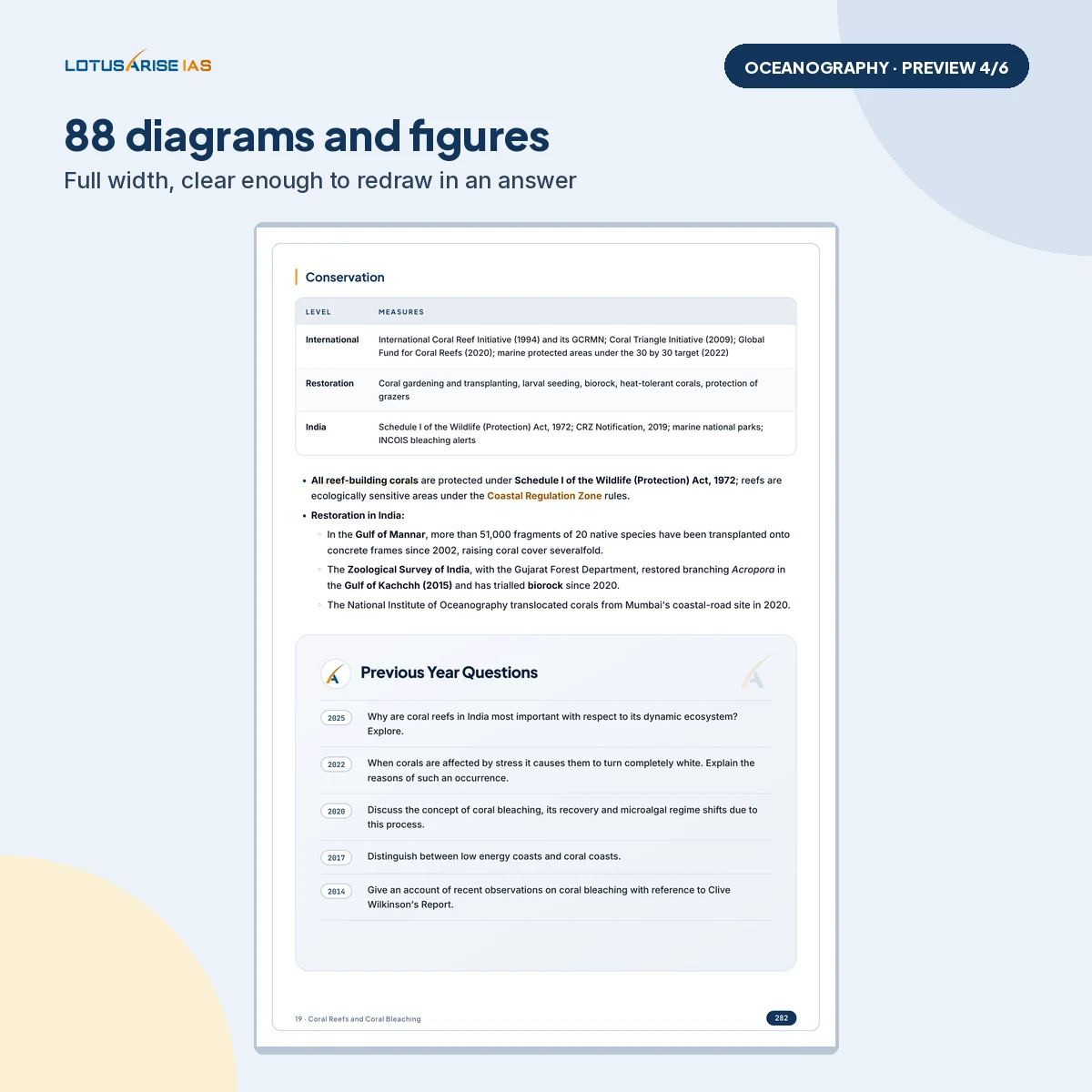
🗺️ 88 diagrams and figures — clear enough to redraw in an answer
🌊 Current to 2026 — the High Seas Treaty in force, deep-sea mining, Samudrayaan and the 2026 El Niño
📱 Instant PDF download, 335 pages — clickable contents, laptop, mobile or tablet, offline, printable
One-time payment. No subscription. Unlimited downloads — the link does not expire.
⭐ Read by 300,000+ UPSC aspirants every month on LotusArise IAS
Features:
- Comprehensive Coverage
- Complete Syllabus
- Suitable for: UPSC & State PSCs exams
- Format: Digital PDF (Downloadable)
- 337,362+ aspirants visit every month
The problem most aspirants don’t talk about
Ask a Geography Optional aspirant about Oceanography a few months into preparation. They won’t say the ocean is too hard to understand. They will say one of three things:
“I can sketch the Mid-Atlantic Ridge, but recent questions are on deep-sea mining, ocean ranching and the Blue Economy. My notes stop at the relief.”
“I learnt the currents as names on a map. I cannot say what drives them, or how a gyre in the north differs from one in the south.”
“I keep this section for the end because it looks small. Then the paper asks how seamounts and guyots differ, and I have only half an answer.”
None of this is a lack of effort. Most material on the oceans describes the floor and the currents and stops there, while the paper has moved on to resources, law and a warming sea. What is missing is one book that takes the whole section in order and brings it up to date. Oceanography is that book.
Why this section is a smart place to spend your hours
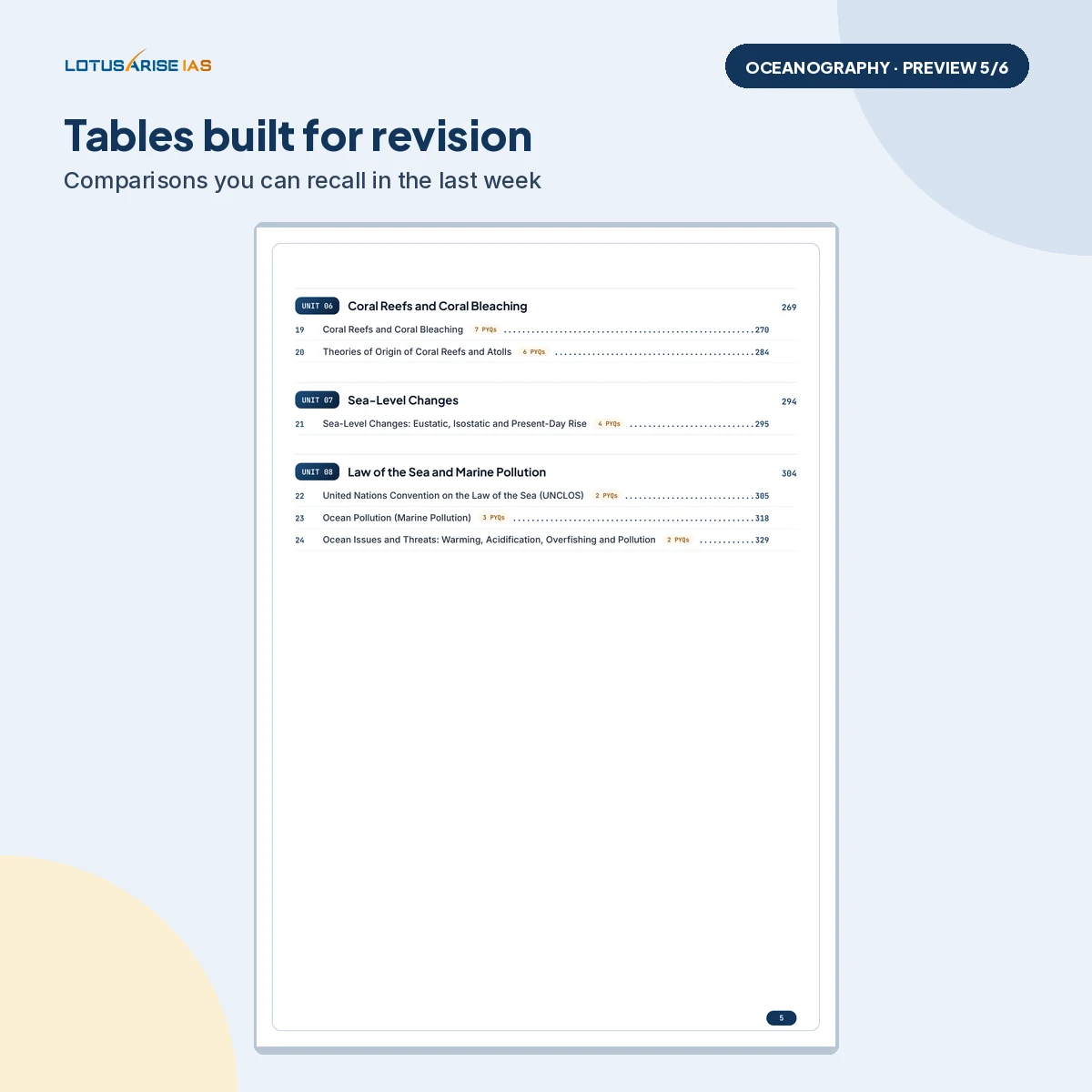
This section has a modest syllabus and a long record. The book carries 72 PYQs from 1986 to 2026, and every one of its 24 chapters has at least one. The contents page shows where they gather: 12 on marine resources, 7 on coral reefs, 7 on each chapter on currents, 6 each on ocean morphology and reef theories.
The older questions ask you to explain and illustrate the ocean floor. The recent ones ask for the benefits and risks of deep-sea mining, the validity of India’s Blue Economy initiatives, the consequences of an AMOC collapse.
It also pays back across the paper. Marine resources returns in Paper II under India’s resources. El Niño runs straight into the monsoon. Sea-level rise and coral reefs both come with India in view.
The challenge is not the theory. It is having one current account of the oceans that you can actually revise.
What’s inside — 335 pages in 8 units
🌐 The Ocean Floor and Bottom Topography — 6 chapters
- Nature of oceanography and ocean exploration
- Origin of ocean basins; continental margin and deep ocean floor
- Bottom topography of the Atlantic, Pacific and Indian Oceans
🌡️ Temperature, Salinity and Density — 3 chapters
- Horizontal and vertical distribution of temperature; a warming ocean
- Salinity: controls, distribution and trends
- Density, water masses and the T-S diagram
🪨 Heat and Salt Budgets and Ocean Deposits — 2 chapters
- Heat and salt budgets
- Terrigenous and pelagic deposits
🌊 Waves, Currents and Tides — 6 chapters
- Waves, swell, storm surge and tsunami; theories and types of tides, tidal bores
- Causes of currents, Ekman spiral and gyres; currents of each ocean
- Thermohaline circulation and the AMOC
- El Niño, La Niña, ENSO, El Niño Modoki and the Indian Ocean Dipole
⚓ Marine Resources — 1 chapter
- Biotic, mineral and energy resources; the Blue Economy and sustainable use
🪸 Coral Reefs and Coral Bleaching — 2 chapters
- Reef growth, types and distribution; coral bleaching, threats and conservation
- Subsidence and non-subsidence theories of reefs and atolls, tested by drilling
📏 Sea-Level Changes — 1 chapter
- Eustatic and isostatic change; present-day rise
📜 Law of the Sea and Marine Pollution — 3 chapters
- UNCLOS, maritime zones and India
- Marine pollution: sources, pollutants, case studies, governance
- Warming, acidification and overfishing
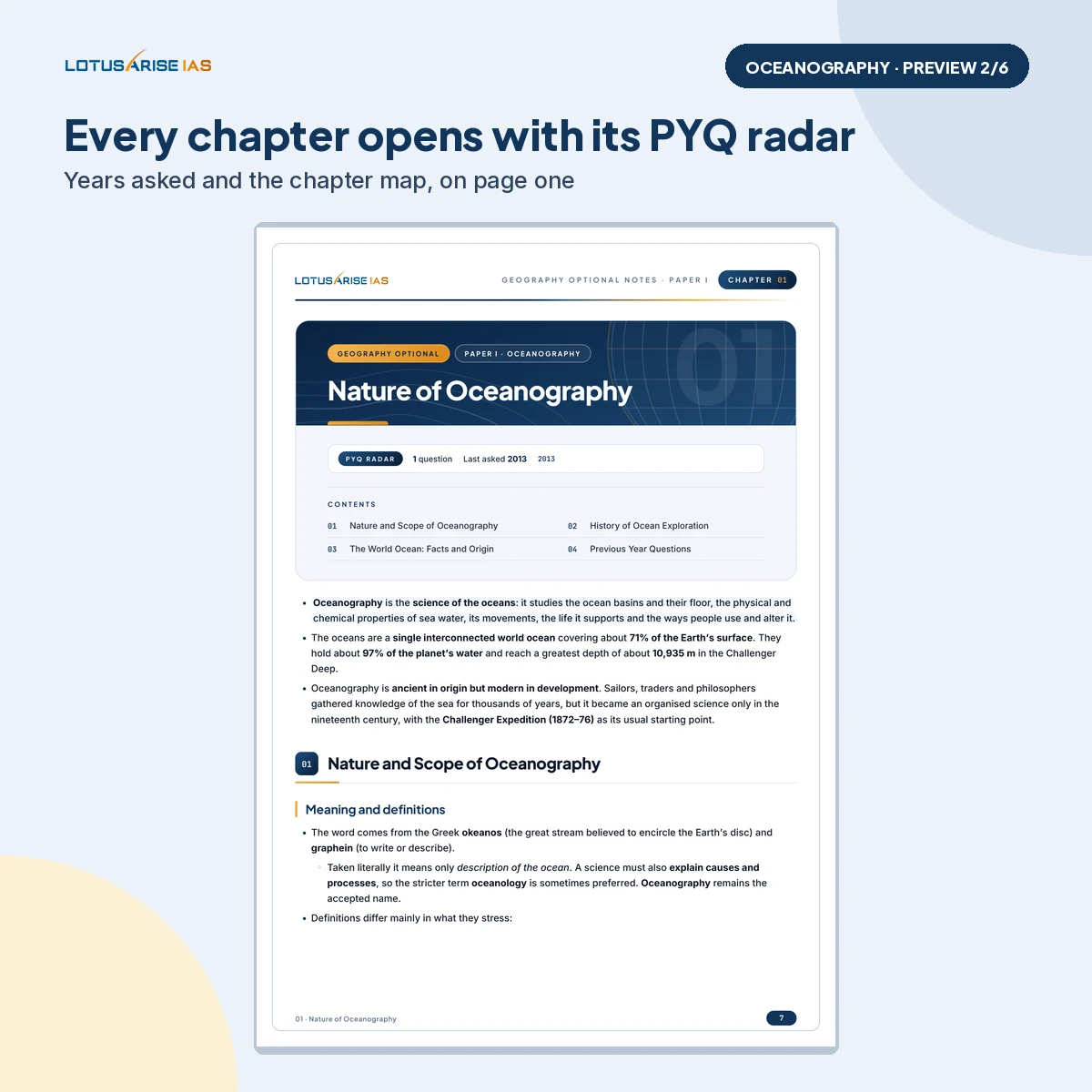
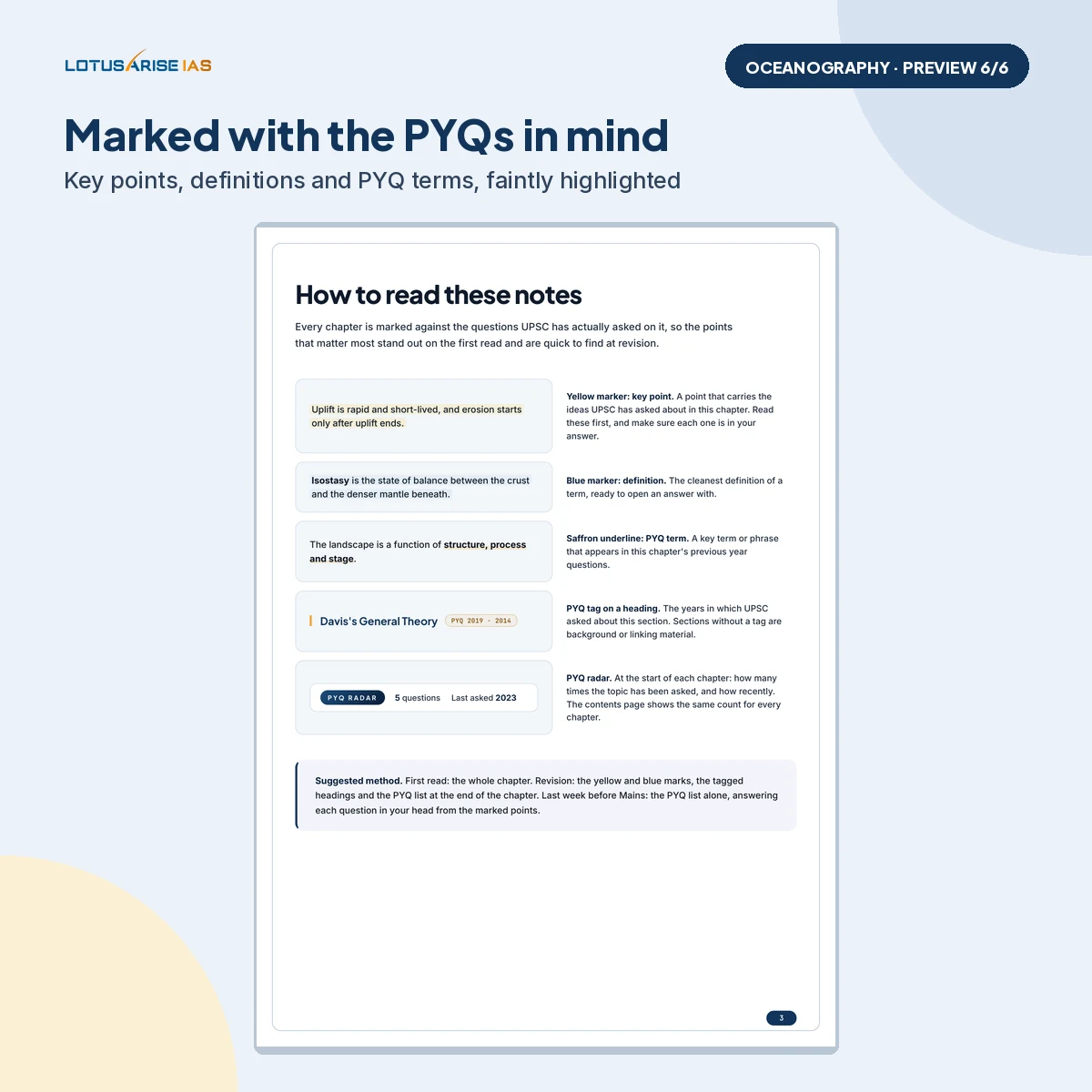
What makes this different from a downloaded PDF? Each chapter is marked against the questions UPSC has actually asked on it. A PYQ radar at the start shows how many times the topic has come and when it last did. Year tags sit on the headings UPSC has asked about. Faint highlights pick out key points, definitions and PYQ terms, so your second reading takes far less time than your first. A question that touches two chapters is listed under both, which is why the chapter counts add up to more than 72.
One thing to be clear about: the book gives the previous year questions, not model answers. Solved answers are in the Geography Optional 300+ Score Pack.
The aspirant who buys this
First-timers — You want the oceans in one order from the start. Read the floor, then the water, then its movements.
Repeaters — You have the relief and the currents, but not the recent turn. Go to marine resources, the AMOC and the law of the sea, then to the PYQ list at the end of each chapter.
Aspirants short of time before Mains — This section is compact, and it can be finished. The radar, year tags and highlights show you what to read first.
Self-study aspirants outside Delhi, Prayagraj and Jaipur — No classroom and no batch. You get one organised book that you can read anywhere, and print for sketch practice.
Working professionals — One chapter at a time on your phone, offline, with no schedule and no expiry.
State PSC aspirants with Geography — Ocean relief, currents and coral reefs are common ground, so the same chapters serve your paper too.
Why not just use free notes from Telegram?
Free notes exist, and most aspirants already have several. Many of these topics are also on our own website, free to read.
The difference is not that free material is wrong. It is that nothing ties it together. A forwarded PDF rarely tells you which of its pages UPSC has asked about, it seldom goes past the classical account, and nobody tells you when it has gone out of date. This book was compiled in October 2026. It already has the High Seas Treaty, in force from January 2026.
If you have the time to build and maintain your own file from scattered sources, you may not need this. If you would rather open one book and start revising, this is what it is for.
The price
335 pages, 24 chapters, 72 PYQs and 88 diagrams and figures — ₹118. That is about 35 paise a page.
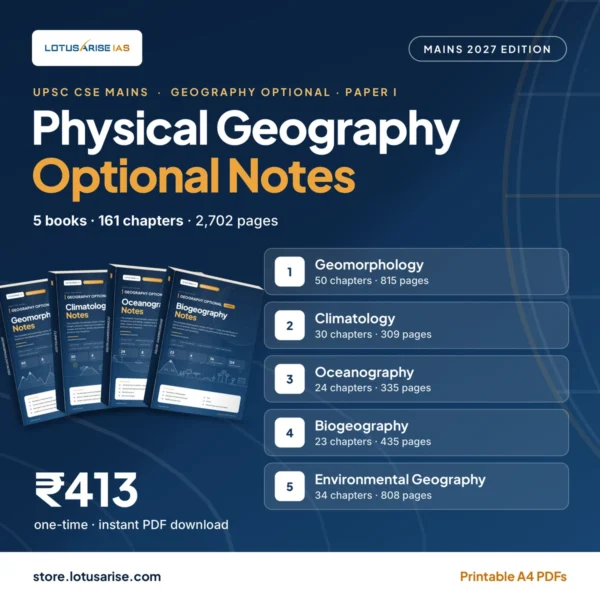
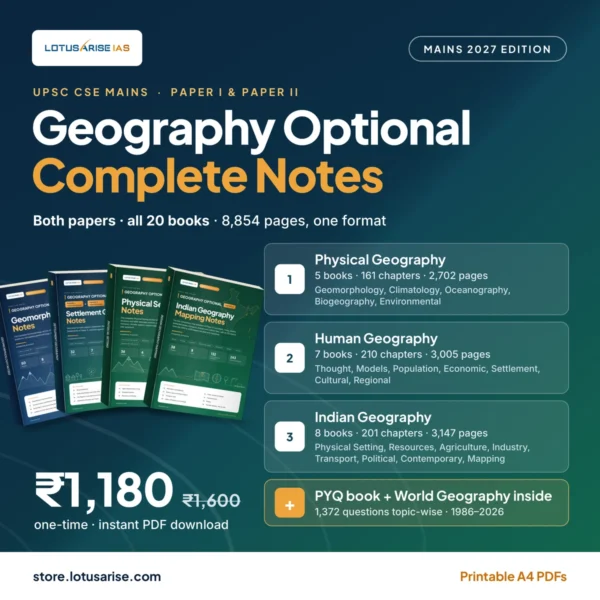
This book is also part of Physical Geography: Geography Optional Notes (₹413) and Geography Optional Complete Notes (₹1,180).
One-time payment. No subscription. No recurring charge.
The download link reaches your email right after payment — please check your spam folder if you do not see it. Unlimited downloads, no expiry. English medium.
Read the free sample first (PDF)
For support: support@lotusarise.com
You may also like…
-

-
#OFFER: Geography Optional Complete Notes (PDF) – UPSC Mains (Paper I & II)
Original price was: ₹1,600.00.₹1,180.00Current price is: ₹1,180.00.