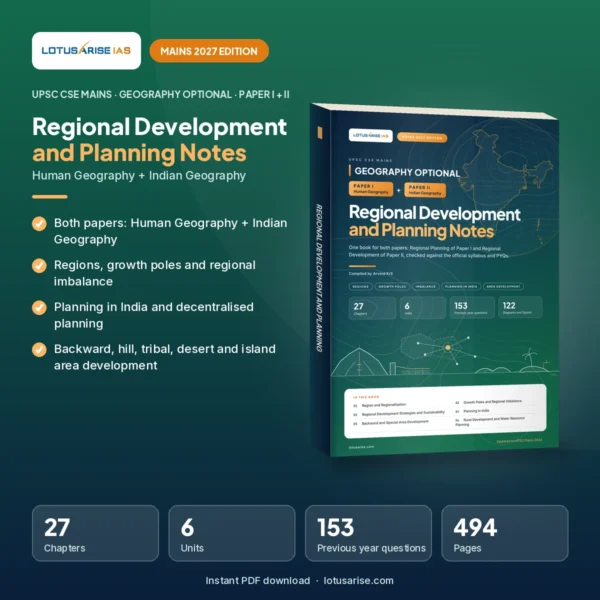
Regional Development and Planning | Geography Optional UPSC Notes
₹118.00
₹118 for 494 pages — about 24 paise a page. Mains 2027 Edition.
Most Geography Optional aspirants meet this section as a list of acronyms. DPAP, DDP, IRDP, CADP, IWMP. A launch year, one objective, nothing on what worked or what came next. Then UPSC asks why tribal areas still lag despite the programmes, and the answer repeats the objectives.
Regional Development and Planning is one book for both papers, Regional Planning of Paper I Human Geography and Regional Development of Paper II Indian Geography, so you need no separate PDF.
📝 153 PYQs, updated to Mains 2026 — in UPSC’s wording, under the chapter each belongs to
📚 One book for both papers — checked against the official syllabus, each unit marked by its paper
🧭 27 chapters in 6 units — regions, growth poles, imbalance, planning in India, area development
🗺️ 122 diagrams and figures — full width, clear enough to redraw in an answer
📱 Instant PDF download, 494 pages — clickable contents, laptop, mobile or tablet, offline, printable
One-time payment. No subscription. Unlimited downloads — the link does not expire.
⭐ Read by 300,000+ UPSC aspirants every month on LotusArise IAS
Features:
- Comprehensive Coverage
- Complete Syllabus
- Suitable for: UPSC & State PSCs exams
- Format: Digital PDF (Downloadable)
- 337,362+ aspirants visit every month
The problem most aspirants don’t talk about
Ask a Geography Optional aspirant about regional planning a few months into preparation. They won’t say the theory is too hard. They will say one of three things:
“I know Perroux, Myrdal and Hirschman as three separate paragraphs. I can’t use them to explain why India’s regional gaps persist.”
“Every scheme I learnt seems to have been merged or renamed, and my notes don’t say into what.”
“Paper I wants the theory and Paper II wants India’s record, so I keep two files that never meet.”
None of this is a lack of effort. The syllabus splits one subject across two papers, and most notes stop at a scheme’s objectives, when UPSC asks what it achieved and why it fell short. What is missing is one book that runs from the theory of regions to the evaluation of India’s programmes. Regional Development and Planning is that book: Paper I Human Geography and Paper II Indian Geography in one PDF, so nobody needs a separate one.
Why this section is a smart place to spend your hours
The book carries 153 questions from 1986 to 2026, with at least three in every year’s papers from 2013 to 2026. Multi-level and decentralised planning has 17, the most of any chapter. Regional imbalance and sustainable development have 11 each. Tribal area development has 9. Growth poles, planning regions and watershed management have 8 each, and island territories 7.
The questions stay close to current policy: the Great Nicobar Project, the Aspirational Districts Programme, the geostrategic significance of India’s islands.
Since it is one subject in two papers, an hour here counts twice.
The challenge is not the schemes. It is having one current account of what they did that you can actually revise.
What’s inside — 494 pages in 6 units
Units 1 to 3 are Paper I. Units 4 to 6 are Paper II.
🗺️ Region and Regionalisation — 4 chapters
- Concept of region, Whittlesey’s compage, region as a system
- Formal, functional, vernacular and planning regions
- Methods: composite indices, gravity model, Thiessen polygons
- Planning regions of India: macro, meso, micro, agro-climatic and river basin
📈 Growth Poles and Regional Imbalance — 4 chapters
- Perroux, Boudeville, Hägerstrand’s diffusion, growth centres in India
- Regional imbalance: causes, world and Indian patterns, balanced and unbalanced growth
- Theories: Myrdal, Hirschman, Friedmann, Williamson’s inverted-U
- Backwash and spread effects
🌱 Regional Development Strategies and Sustainability — 4 chapters
- Strategies: top-down and bottom-up, integrated area, target group
- Environmental issues in regional planning
- Sustainable development: intergenerational equity, SDG India Index
- Gender-sensitive planning, development-induced displacement
🏛️ Planning in India — 5 chapters
- Planning Commission to NITI Aayog
- The Five Year Plans, First to Twelfth
- Experience of regional planning: Damodar Valley, National Capital Region, Bundelkhand
- Tools against imbalance: the 16th Finance Commission, Hill Transport Subsidy, freight equalisation
- Multi-level planning: 73rd and 74th Amendments, Kerala’s People’s Plan Campaign
⛰️ Backward and Special Area Development — 7 chapters
- Backward area planning: criteria, the Backward Regions Grant Fund, clusters of villages
- Aspirational Districts and Blocks: 3Cs, delta ranking
- Drought Prone Areas Programme: identification, evaluation
- Desert Development Programme: hot and cold deserts, desertification
- Hill areas, the Western Ghats, soil and water conservation
- Tribal area development: Tribal Sub-Plan, Bastar, Dandakaranya
- Island territories: Lakshadweep, Great Nicobar clearances and litigation to October 2026
💧 Rural Development and Water Resource Planning — 3 chapters
- IRDP to the Livelihoods Mission, and MGNREGA to VB-G RAM G from 1 July 2026
- Command area development: Indira Gandhi Canal, waterlogging and salinity
- Watershed management: delineation, IWMP, WDC-PMKSY, the Gurugram case study
What makes this different from a downloaded PDF? Each chapter is marked against the questions UPSC has actually asked on it. A PYQ radar at the start shows how many times the topic has come and when it last did. Year tags sit on the headings UPSC has asked about. Faint highlights pick out key points, definitions and PYQ terms, so your second reading takes far less time than your first.
One thing to be clear about: the book gives the previous year questions, not model answers. Solved answers are in the Geography Optional 300+ Score Pack.
The aspirant who buys this
First-timers — You want to learn planning once, not once per paper.
Repeaters — You know the schemes, but your answers stop at the objectives. Use the evaluation sections, then go through the PYQ list at the end of each chapter.
Aspirants short of time before Mains — Start with decentralised planning, regional imbalance and tribal areas. The radar, year tags and highlights show you what to read first.
Self-study aspirants outside Delhi, Prayagraj and Jaipur — No classroom and no batch. You get one organised book that you can read anywhere, and print for handwritten practice.
Working professionals — One programme at a time on your phone, offline, with no schedule and no expiry.
State PSC aspirants with Geography — Regional theory and India’s programmes are common ground, so the same chapters serve your paper too.
Why not just use free notes from Telegram?
Free notes exist, and most aspirants already have several. Many of these topics are also on our own website, free to read.
The difference is not that free material is wrong. It is that nothing ties it together. A forwarded PDF rarely tells you which of its pages UPSC has asked about, it seldom says what became of a scheme, and nobody tells you when it has gone out of date. Here you get one order, every PYQ placed under its chapter, and a file you can keep and print.
If you have the time to build and maintain your own file from scattered sources, you may not need this. If you would rather open one book and start revising, this is what it is for.
The price
494 pages, 27 chapters, 153 PYQs and 122 diagrams and figures — ₹118. That is about 24 paise a page.
The book is also part of the Human Geography: Geography Optional Notes bundle at ₹471, the Indian Geography: Geography Optional Notes bundle at ₹590, and Geography Optional Complete Notes at ₹1,180.
One-time payment. No subscription. No recurring charge.
The download link reaches your email right after payment — please check your spam folder if you do not see it. Unlimited downloads, no expiry. English medium.
Read the free sample first (PDF)
For support: support@lotusarise.com