

Ancient Indian History UPSC Notes
Original price was: ₹499.00.₹236.00Current price is: ₹236.00.
₹236 for the Prelims 2027 Edition ₹499 — 660 pages, about 36 paise a page.
Most aspirants learn Ancient History as a list. They memorise Harappan sites, Vedic terms, the sixteen mahajanapadas and Ashoka’s edicts one by one, and by May they have mixed them up. Which edict talks about Kalinga? Who ruled at Nasik: the Satavahanas or the Shakas? In the exam, every option looks right.
Ancient Indian History UPSC Notes tells the whole period as one connected story, so the facts stay with you.
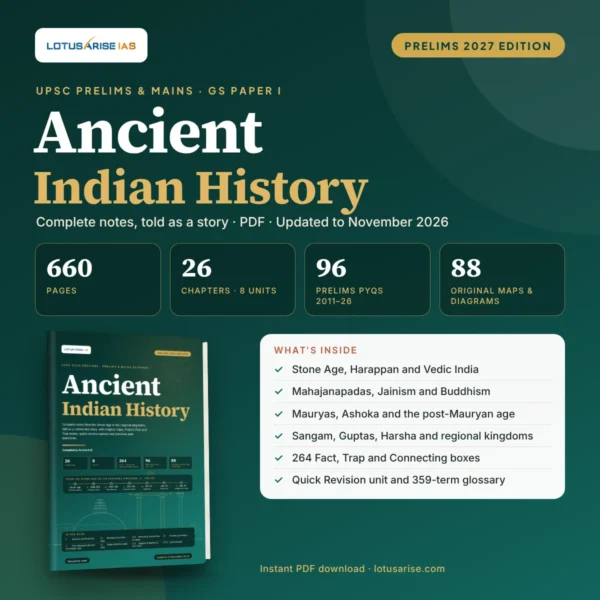
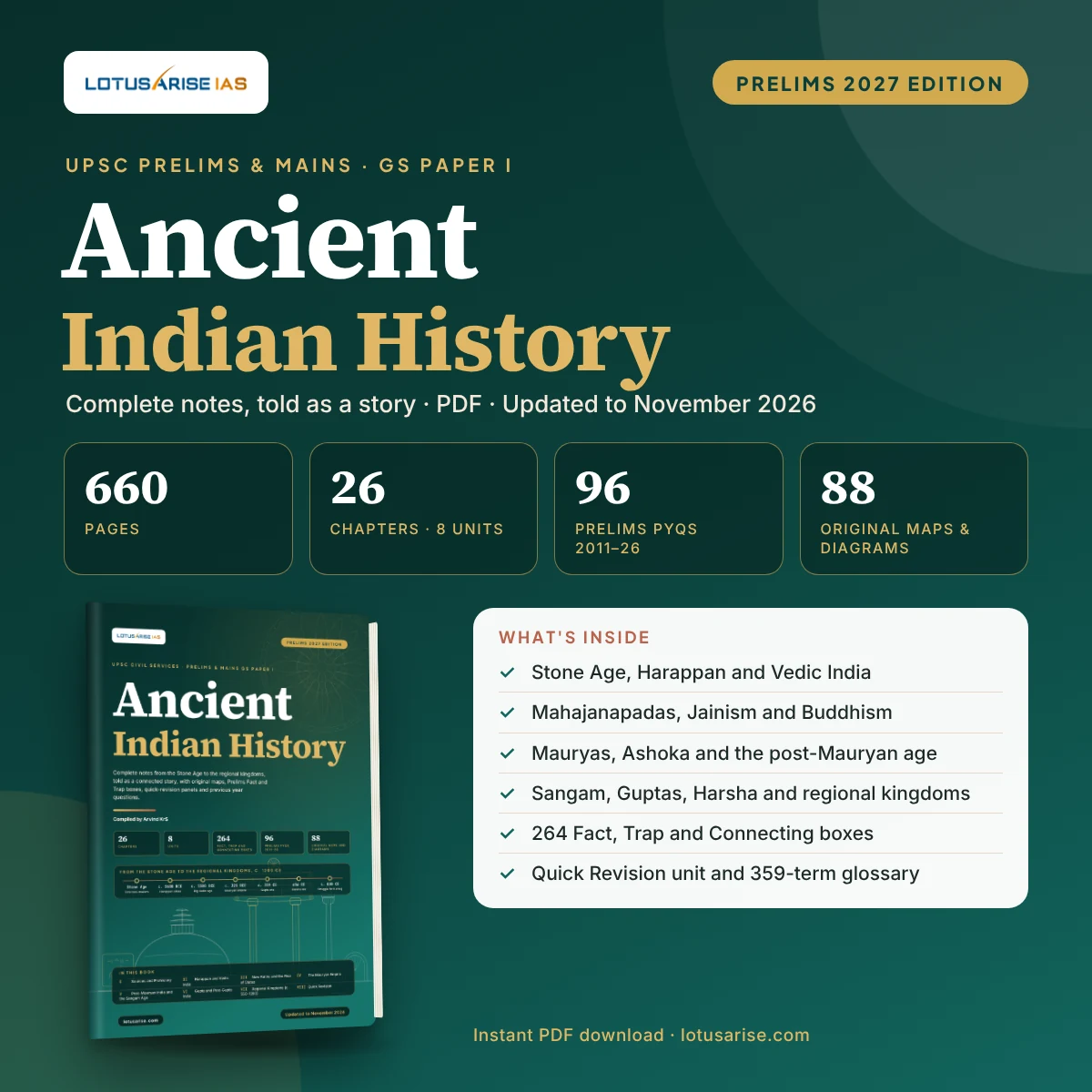
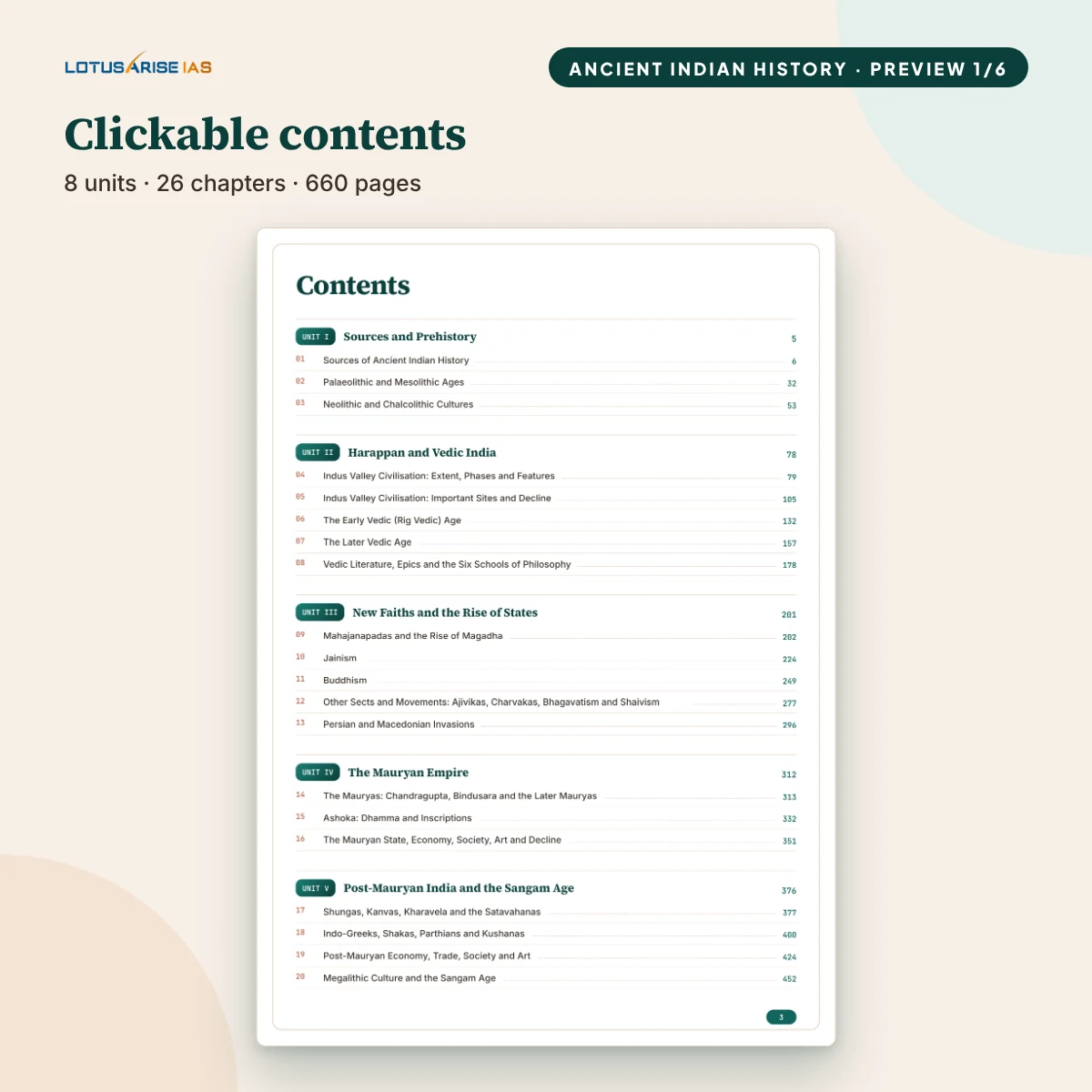
📜 26 chapters in 8 units, 660 pages — from the first tool-makers and the Harappan cities to the Mauryas, the Guptas and the regional kingdoms (c. 1200 CE)
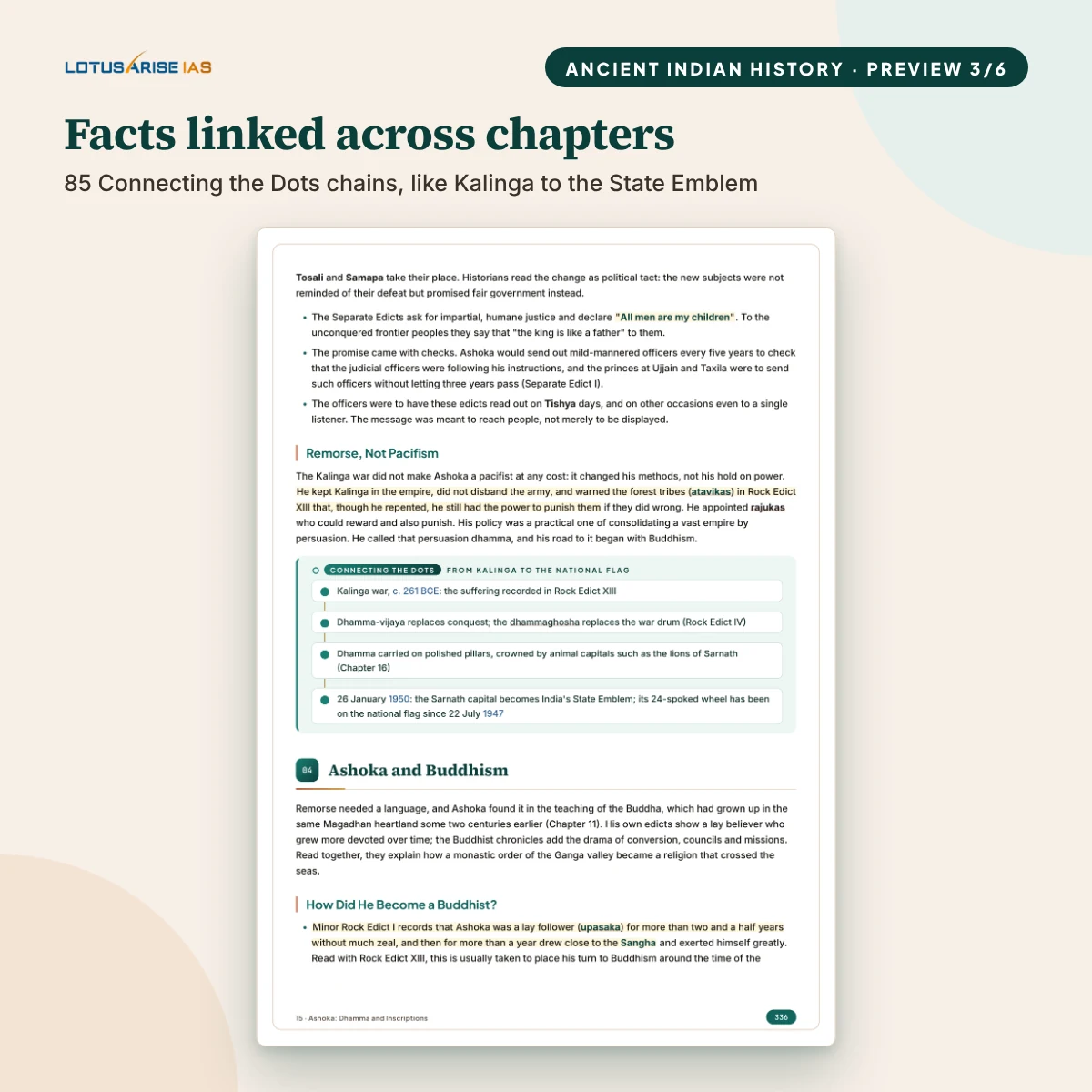
🎯 179 Prelims Fact and Trap boxes + 85 Connecting the Dots chains — the names, sites, dates and look-alike confusions that Prelims options are built from, linked across chapters
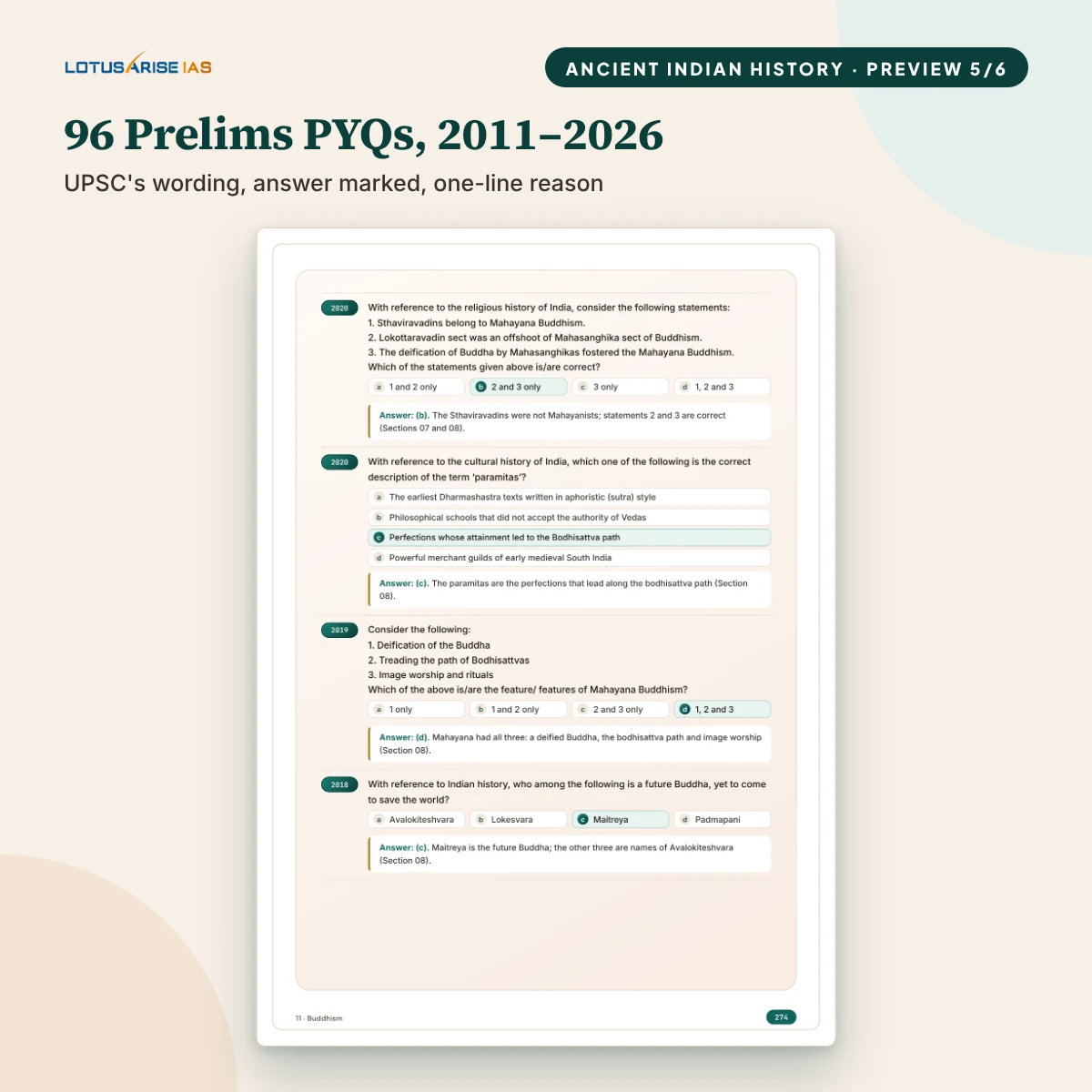
📝 96 Prelims PYQs, 2011–2026 — in UPSC’s wording, right option marked, one-line reason; plus 21 Mains questions
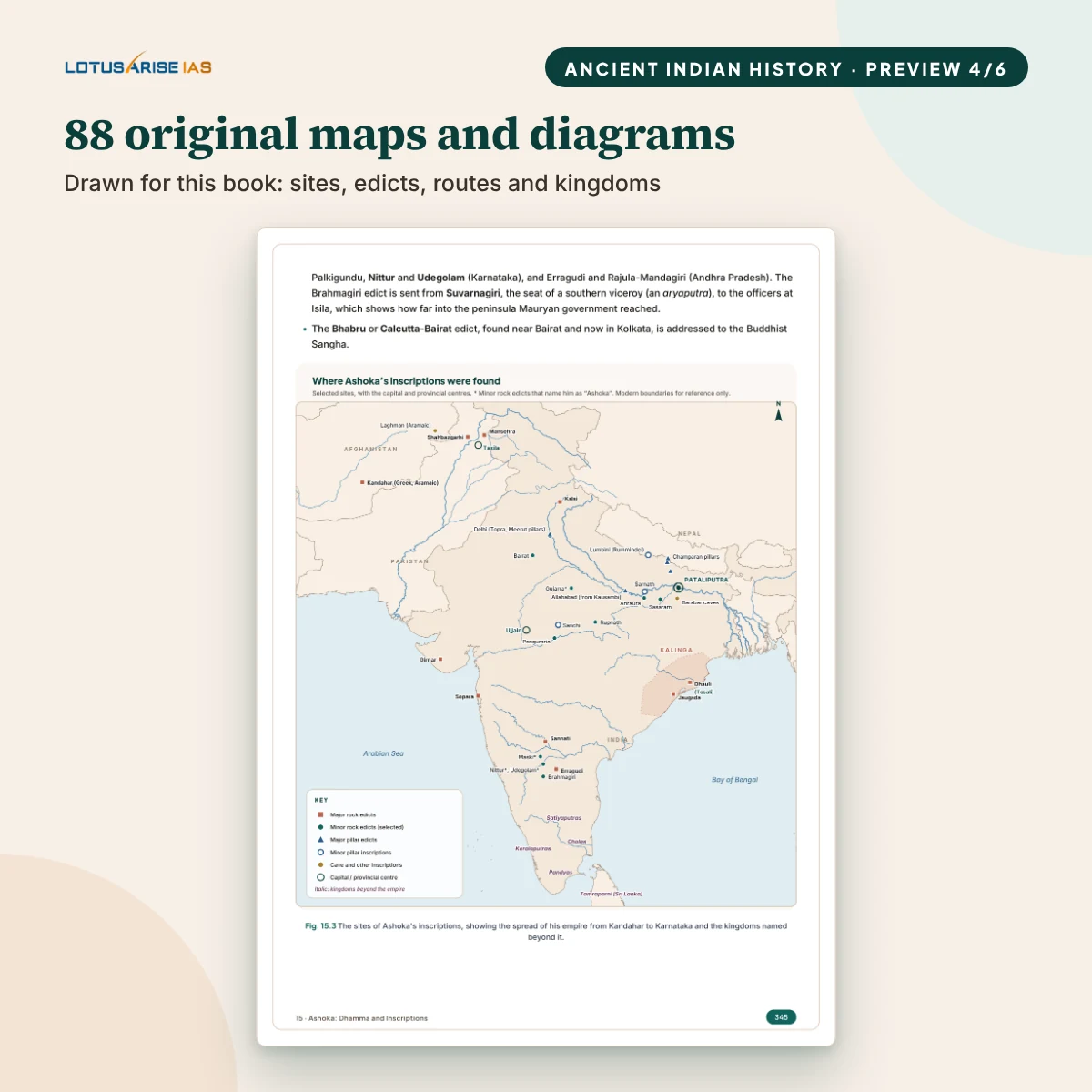
🗺️ 88 original maps and diagrams — sites, edicts, routes and kingdoms, drawn for this book
📱 Instant PDF download — laptop, mobile or tablet, offline, printable
One-time payment. No subscription. Unlimited downloads — the link does not expire.
⭐ Read by 300,000+ UPSC aspirants every month on LotusArise IAS
Features:
- Comprehensive Coverage
- Complete Syllabus
- Suitable for: UPSC & State PSCs exams
- Format: Digital PDF (Downloadable)
- 337,362+ aspirants visit every month
The Ancient History problem most aspirants don’t talk about
Ask an aspirant how Ancient History is going, and you will rarely hear “I haven’t read it”. You will hear one of three things:
“I’ve read the Harappan chapter three times. Ask me which site had the dockyard and which had the ploughed field, and I still hesitate.”
“Buddhism and Jainism I know. It’s the Shakas, Kushanas, Satavahanas and Kharavela that blur into one another.”
“I read the whole thing in October. By May, all I remember is that Ashoka fought the Kalinga war.”
None of this is a memory problem. Ancient India covers thousands of years of cultures, dynasties and texts. It has look-alike names: three Chandraguptas, three Kumaraguptas, two Udayagiris and two Shaka houses. And most notes present it as a list of disconnected facts. Lists are forgotten. Stories are remembered. Ancient Indian History UPSC Notes is written as a story.
Why Ancient History is worth the hours
UPSC has asked ancient history in every Prelims paper from 2011 to 2026, and this book carries 13 questions from Prelims 2026 alone. The questions are rarely about the famous events everyone remembers. They ask about kulyavapa and vishti, the Kanganahalli relief, and which edict sites lie in which state.
The same chapters pay again in Mains. Harappan architecture, Mauryan art, Gandhara and Mathura sculpture, Gupta temples, and Ashoka’s inscriptions are all part of the “Indian culture” section of GS Paper I. They also feed your Essay and your Interview.
The challenge is not the period. It is having one source that keeps the whole story in order and puts the Prelims-level facts where you can find them again.
What’s inside — 660 pages
📜 The complete notes — 26 chapters in 8 units
- Sources and Prehistory — literary, foreign, archaeological, epigraphic and numismatic sources; the Palaeolithic, Mesolithic, Neolithic and Chalcolithic cultures, from Bhimbetka to Mehrgarh, Burzahom and Inamgaon
- Harappan and Vedic India — extent, phases, town planning, trade, the script, the great sites and the decline; Rig Vedic and Later Vedic society and polity; Vedic literature, the epics and the six schools of philosophy
- New Faiths and the Rise of States — the sixteen mahajanapadas and the rise of Magadha, Jainism, Buddhism, the Ajivikas and Charvakas, early Bhagavatism and Shaivism, and the Persian and Macedonian invasions
- The Mauryan Empire — Chandragupta and Bindusara, Ashoka’s dhamma and every major group of inscriptions, the Mauryan state, economy, art and decline
- Post-Mauryan India and the Sangam Age — the Shungas, Kharavela and the Satavahanas; the Indo-Greeks, Shakas, Parthians and Kushanas; guilds, Roman trade, and the Gandhara, Mathura and Amaravati art schools; the megaliths and the Sangam age
- Gupta and Post-Gupta India — Gupta rulers and administration, land grants, temples, Ajanta, Kalidasa, Aryabhata, Nalanda, the Vakatakas and Harshavardhana
- Regional Kingdoms (c. 550–1200) — the Chalukyas of Badami and the Pallavas of Kanchi, the struggle for Kanauj, the Rashtrakutas, Palas, Senas, Kalachuris and Gangas, and the coming of the Arabs
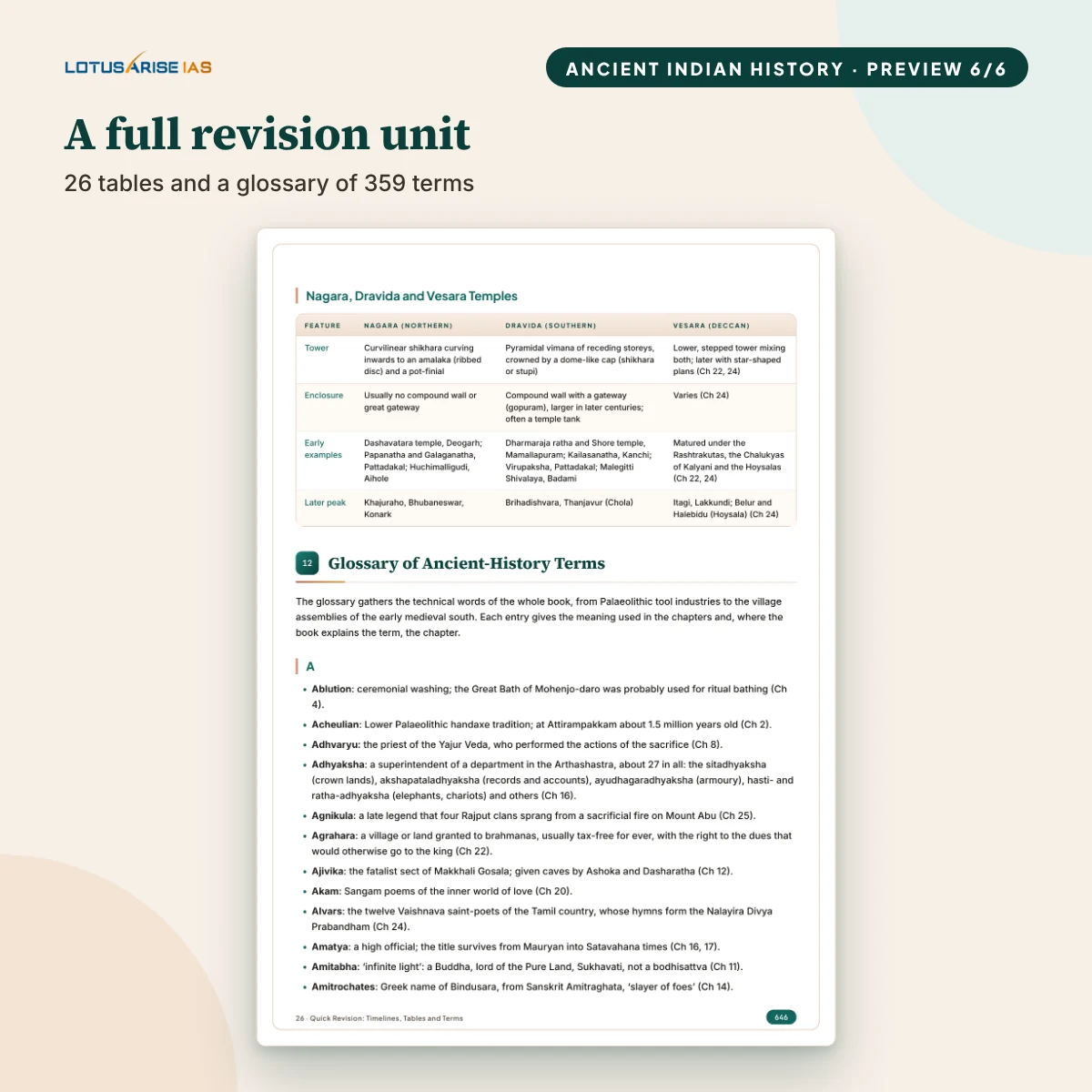
- Quick Revision — a master timeline, a dynasty chart, 26 tables and a glossary of 359 terms
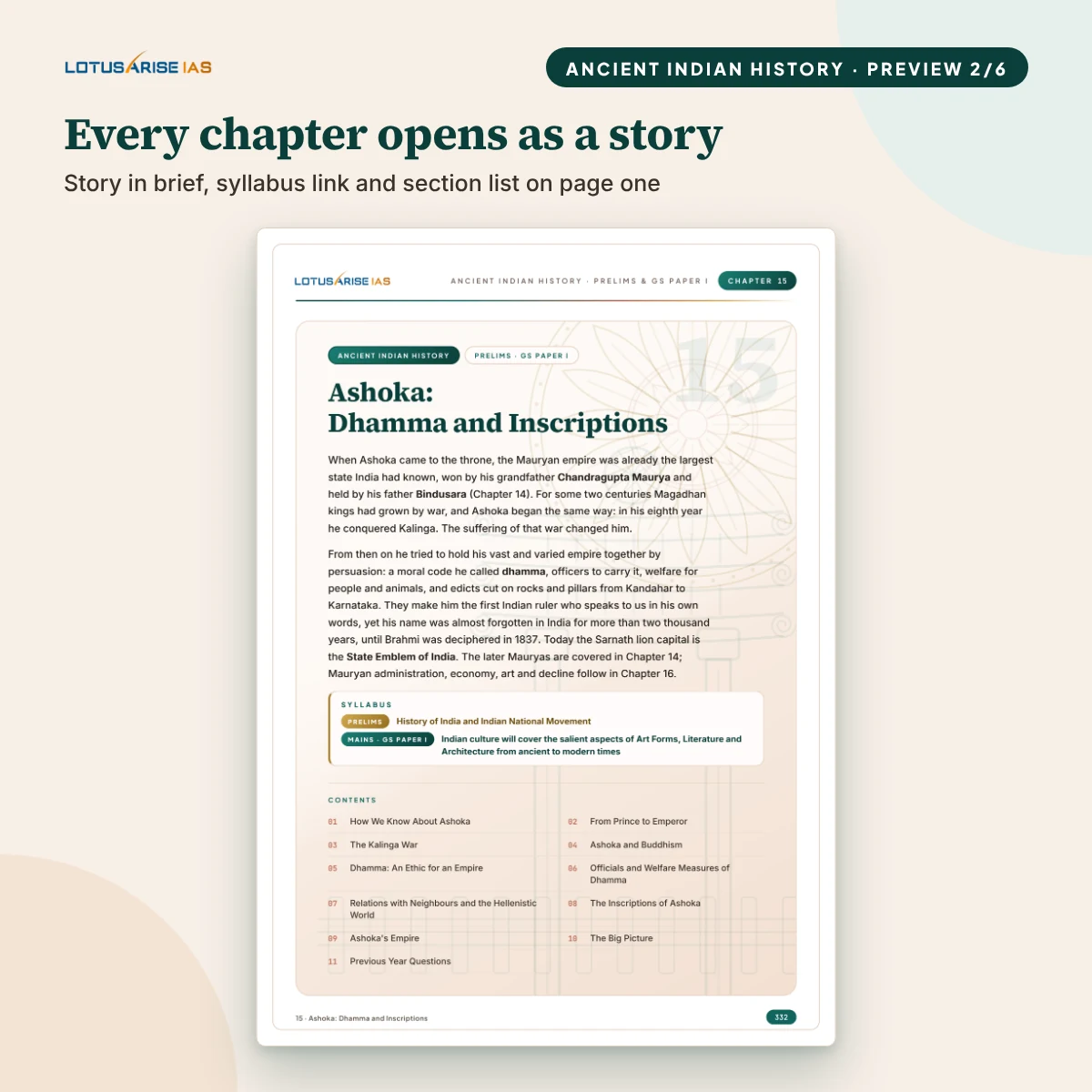
What makes this different from downloaded PDFs: every chapter is written as a connected story. Each opens with the story in brief, each section links back to the one before, and many headings are the questions the chapter answers: Why Kalinga? Who ruled the Harappan cities? Was dhamma Buddhism? Every chapter was then fact-checked sentence by sentence against reliable sources, with dates, rulers, places and attributions corrected where needed. Key sentences and definitions are lightly highlighted, so your second and third readings take a fraction of the time of the first.
🎯 179 Prelims Fact and Trap boxes
Six to eight boxes in each chapter add the facts that Prelims options are built from: inscriptions and their kings, sites and their states, texts and their authors, eras, councils and travellers. The Prelims Trap boxes take the confusions head-on: the three Chandraguptas, the two Udayagiris, Kanaganahalli versus Sannati, and which era was started by whom.
🔗 85 Connecting the Dots chains
These chains link facts across chapters, so one fact recalls the next: from the Kalinga war to the State Emblem, from Mehrgarh to Mohenjo-daro, from the Gupta land grants to the samanta order. Every main chapter also has a story flowchart that shows how its pieces fit together.
📝 96 Prelims PYQs, 2011–2026, and 21 Mains questions
Each question appears in UPSC’s own wording, in the chapter it belongs to, with the options, the correct one marked and a one-line reason. Answers for 2026 follow the consensus of answer keys and are marked provisional until UPSC publishes its final key. The Mains questions from 2013–2026 are placed in the same way.
🗺️ 88 original maps and diagrams
Maps of Harappan sites, Ashoka’s edicts, the sixteen mahajanapadas, Alexander’s route, the Satavahana and Kushana worlds, Indo-Roman trade and the Gupta empire. Diagrams cover temple styles, the Vedic corpus, the six darshanas and the Four Noble Truths. All were drawn for this book.
🗂️ Quick Revision in every chapter, plus a revision unit
Every chapter closes with a two-column Quick Revision panel of its highest-yield facts. The final unit brings the whole period together: a master timeline, a dynasty chart by region, and tables of sites, inscriptions, travellers, texts, councils, ports and eras. It ends with a glossary of 359 terms, each pointing to the chapter that explains it.
The aspirant who buys this
First-time aspirants — you want one book for the whole ancient period, in syllabus order, with the Prelims facts already picked out and the story already joined up.
Repeaters — you have read Ancient History before and still lose marks on close options. The boxes, chains and revision tables are built for exactly the facts you keep mixing up.
History Optional aspirants — Paper I, Section A covers this same period. This book is your fast Prelims-level layer before the optional-depth reading.
Self-study aspirants outside Delhi, Prayagraj or Jaipur — no classroom and no batch timings; one PDF on your phone covers the whole period.
State PSC aspirants — ancient India is in every State PSC paper, so the same book serves both.
Why not just use free notes and a standard book?
Free ancient history notes are everywhere, and most aspirants already own a standard book. The problem is not that they are bad. It is that they are written to be read once, not revised ten times. The Prelims facts are buried inside long paragraphs, nothing links one chapter to the next, and nothing ties the text to what UPSC has actually asked.
This book is one checked, revisable system. It gives you the whole period as a story, the Prelims facts pulled out into boxes, the confusions resolved, the links drawn, the PYQs in place and a revision unit at the end.
If you have the time to build that system yourself from scattered sources, you may not need this. If you want it already built, so you can open it and start, this is what the book is for.
Price and delivery
A single printed ancient history guide usually costs more than this PDF, and a printed book cannot carry questions up to Prelims 2026.
₹236 ₹499 for 660 pages — about 36 paise a page.
Want to see it first? Download the free sample PDF. It has the cover, the full contents and two complete chapters: Chapter 4 (Indus Valley Civilisation: Extent, Phases and Features) and Chapter 15 (Ashoka: Dhamma and Inscriptions).
One-time payment. No subscription. No recurring charge.
Instant PDF download after payment. The download link is also sent to your email; please check the spam folder if it does not arrive in a few minutes. You can download it again any time from My Account.
For support: support@lotusarise.com
Related products
-

Human & Economic Geography Notes for UPSC: Prelims & Mains GS Papers I and III (2027 Edition) by LotusArise IAS
Original price was: ₹400.00.₹199.00Current price is: ₹199.00. -
Science and Technology Notes for UPSC: Prelims & Mains GS Paper III (2027 Edition) by LotusArise IAS
Original price was: ₹500.00.₹295.00Current price is: ₹295.00. -
-
Agriculture Notes for UPSC: Prelims & Mains GS Papers I and III (2027 Edition) by LotusArise IAS
Original price was: ₹250.00.₹149.00Current price is: ₹149.00.