

Modern Indian History UPSC Notes
Original price was: ₹599.00.₹299.00Current price is: ₹299.00.
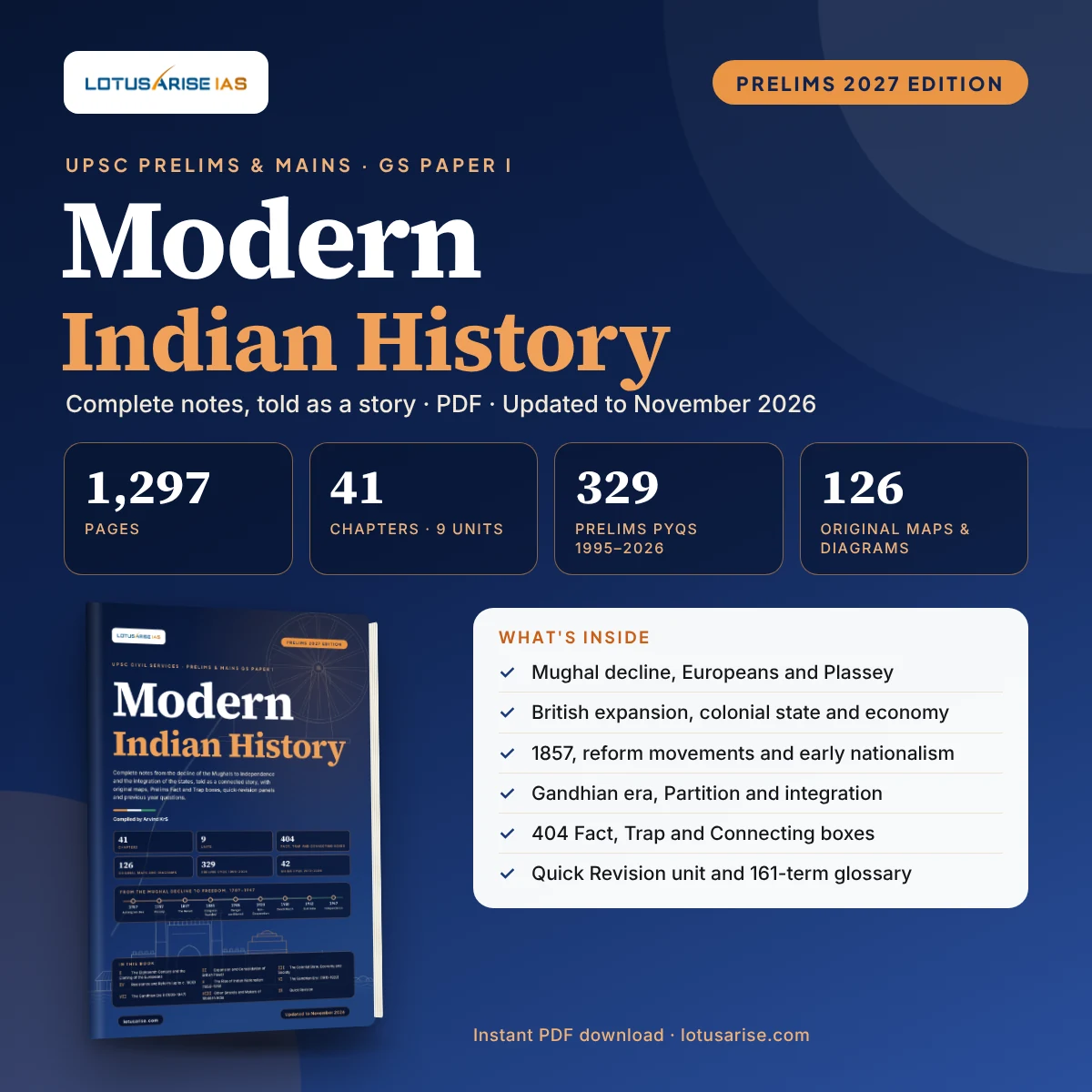
₹299 for the Prelims 2027 Edition ₹599 — 1,297 pages, about 23 paise a page.
Most aspirants know Modern History as a pile of dates. Rowlatt, Jallianwala, Khilafat. Simon, Nehru Report, Lahore. Cripps, Quit India, Cabinet Mission. Ask which session demanded Purna Swaraj, or what the August Offer gave that Cripps did not, and the options all start to look right.
Modern Indian History UPSC Notes tells 1707 to 1947 as one connected story, so each event stays tied to the one that caused it.
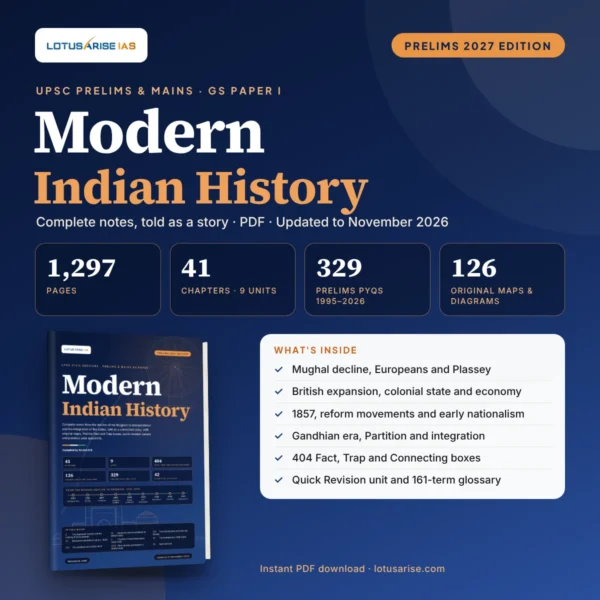
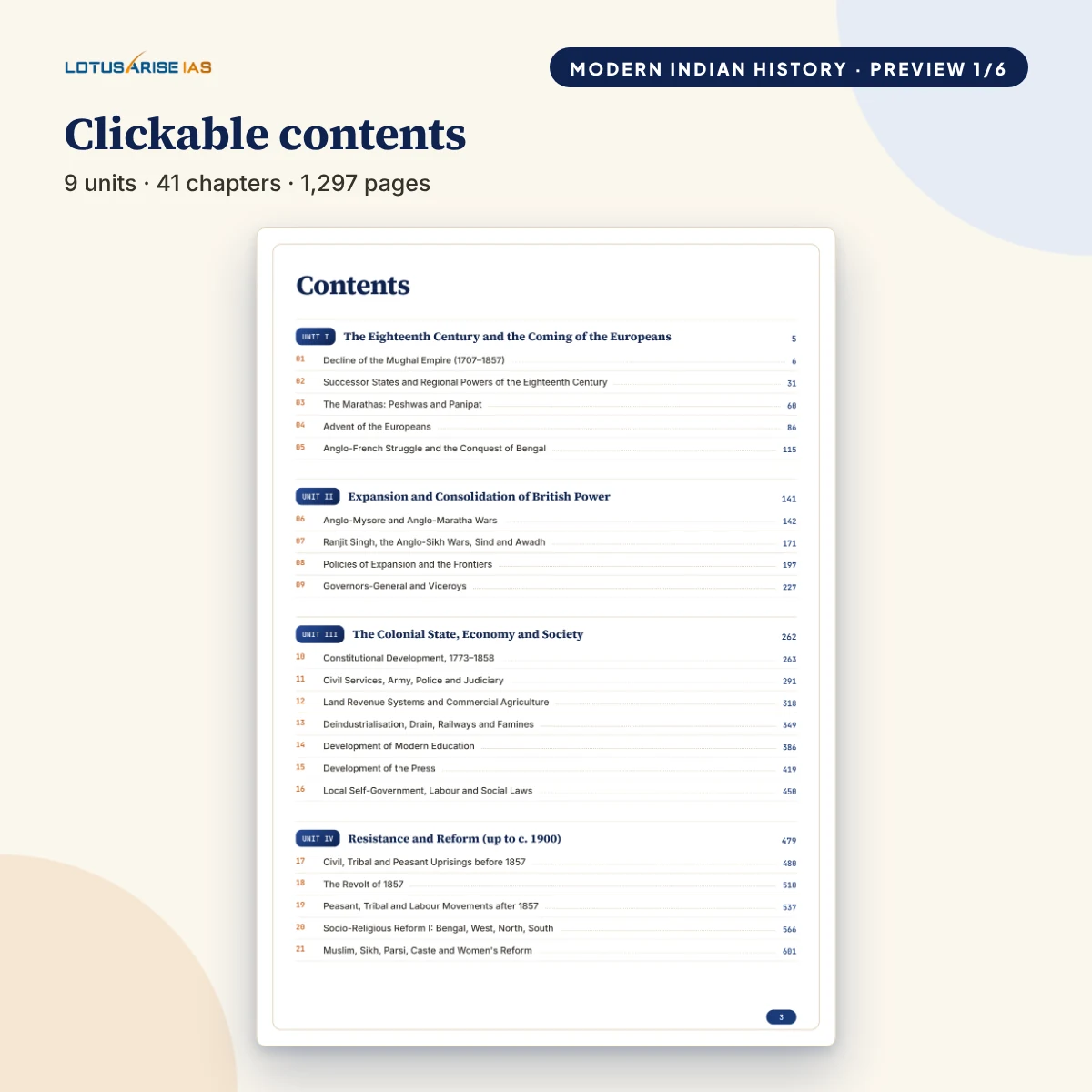
📜 41 chapters in 9 units, 1,297 pages — from the Mughal decline and Plassey to 1857, the Congress, the Gandhian movements, Partition and the integration of the states
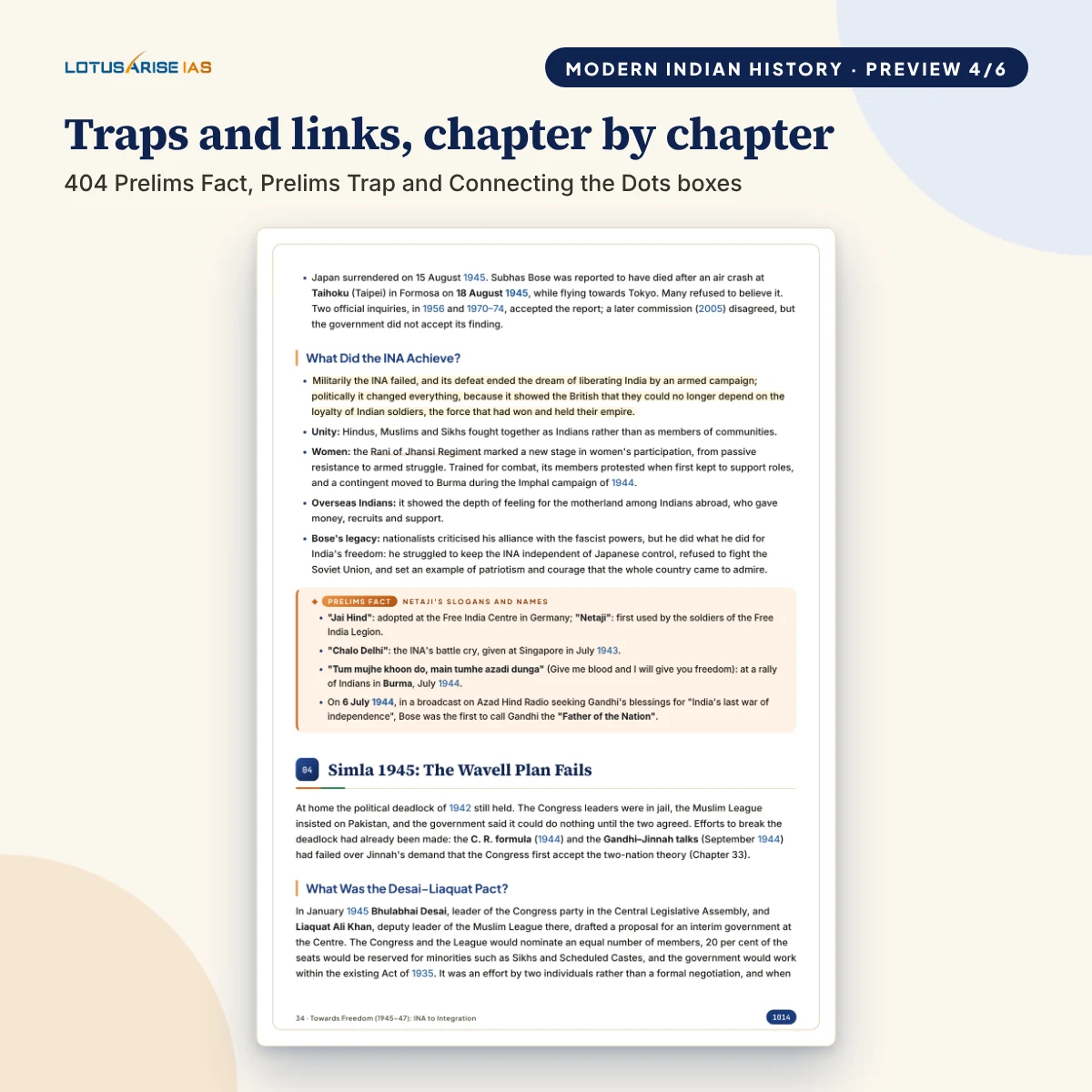
🎯 286 Prelims Fact and Trap boxes + 118 Connecting the Dots chains — the sessions, acts, papers, founders and look-alike names that options are built from
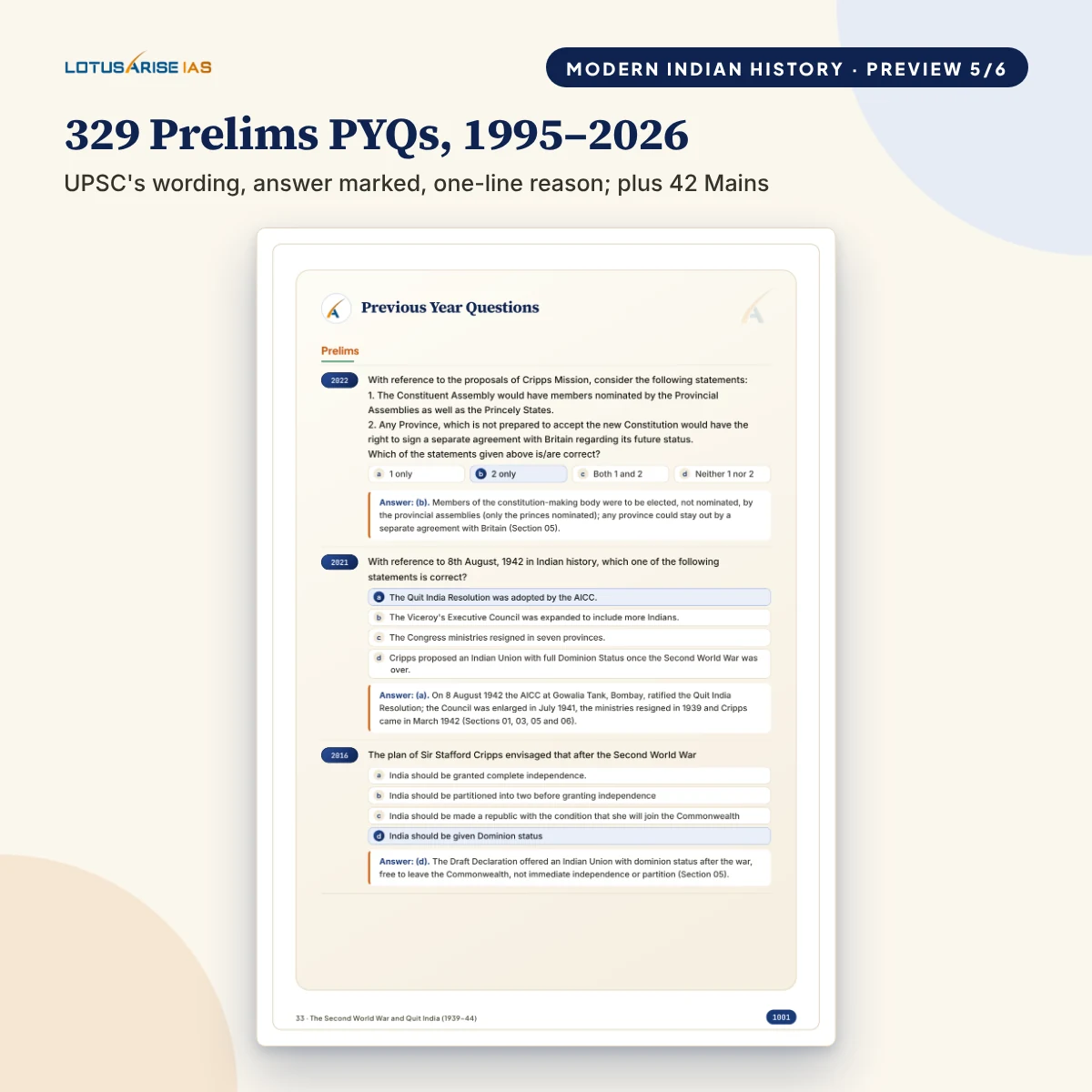
📝 329 Prelims PYQs, 1995–2026 — in UPSC’s wording, right option marked, one-line reason; plus 42 Mains questions
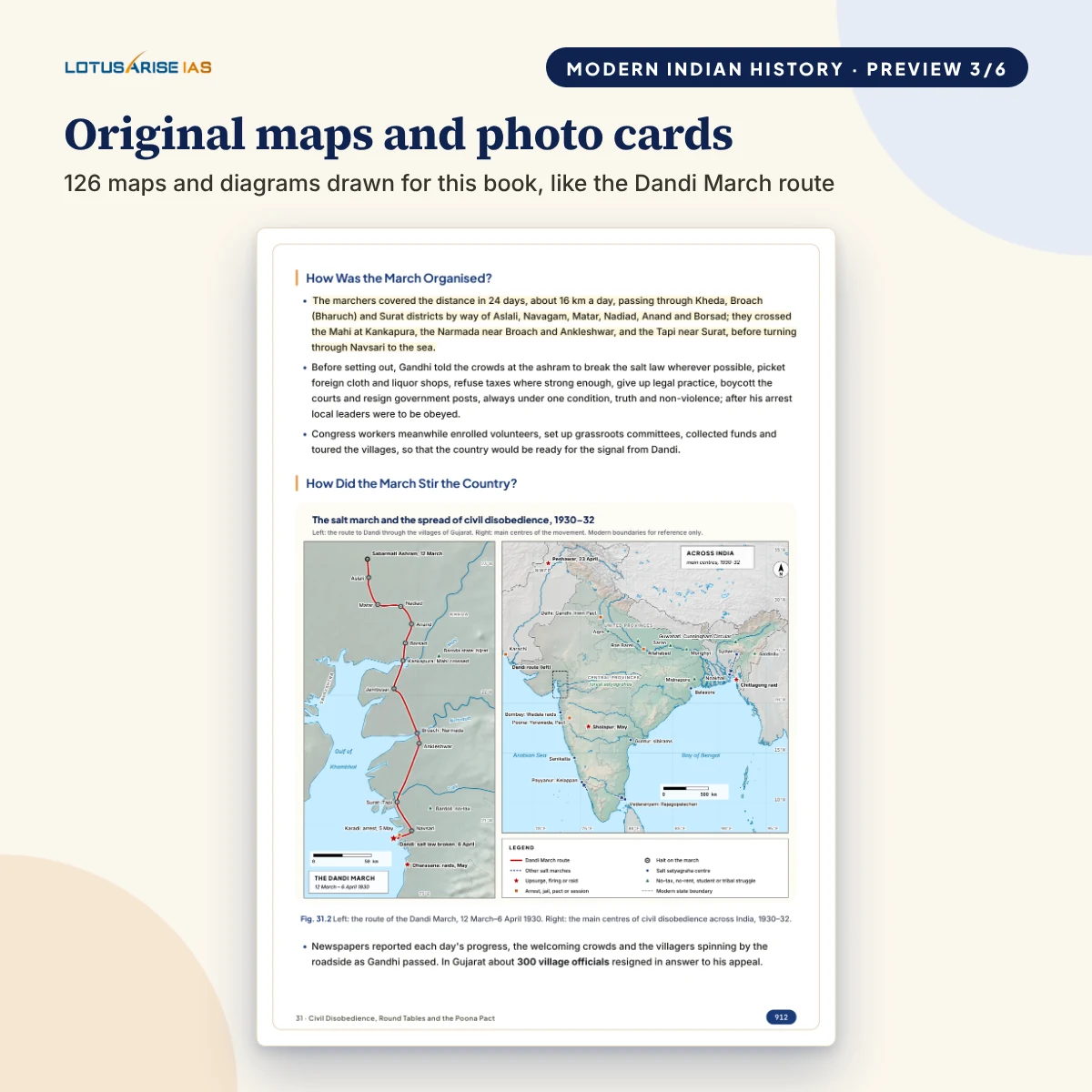
🗺️ 126 original maps and diagrams + 148 archival photo cards — routes, campaigns, provinces and movements, drawn for this book
📱 Instant PDF download — laptop, mobile or tablet, offline, printable
One-time payment. No subscription. Unlimited downloads — the link does not expire.
⭐ Read by 300,000+ UPSC aspirants every month on LotusArise IAS
Features:
- Comprehensive Coverage
- Complete Syllabus
- Suitable for: UPSC & State PSCs exams
- Format: Digital PDF (Downloadable)
- 337,362+ aspirants visit every month
The Modern History problem most aspirants don’t talk about
Ask an aspirant how Modern History is going, and you will rarely hear “I haven’t read it”. You will hear one of three things:
“I know the freedom struggle. But put the Delhi Proposals, the Nehru Report and Jinnah’s Fourteen Points side by side and I can’t tell which said what.”
“The Governors-General, the Acts of 1773 to 1935, the commissions and the Congress presidents all blur into one long list.”
“I can tell you about Gandhi and the Congress. It’s the Ghadar, the peasant and tribal risings, the states’ people and the Left that I skip — and that is exactly where the questions come from.”
None of this is a memory problem. Modern India packs two and a half centuries of wars, laws, sessions, newspapers, organisations and movements into a period where every date sits close to another. And most notes present it as a list. Lists are forgotten. Stories are remembered. Modern Indian History UPSC Notes is written as a story.
Why Modern History is worth the hours
Modern History is the most consistently asked part of history in Prelims. This book alone carries 107 Prelims questions from 2011–2026 — six or seven a paper on average — and 222 more from 1995–2010, because UPSC keeps returning to the same ground in new forms.
It pays again in Mains. GS Paper I asks for “modern Indian history from about the middle of the eighteenth century until the present” and “the Freedom Struggle — its various stages and important contributors”. The same chapters feed your Essay and your Interview.
The challenge is not the period. It is having one source that keeps the whole story in order and puts the Prelims-level facts where you can find them again.
What’s inside — 1,297 pages
📜 The complete notes — 41 chapters in 9 units
- The Eighteenth Century and the Europeans — the Mughal decline, Nadir Shah and Abdali, the successor states, the Marathas and Panipat, the European companies, the Carnatic wars, Plassey and Buxar
- Expansion and Consolidation of British Power — the Anglo-Mysore, Anglo-Maratha and Anglo-Sikh wars, Sind and Awadh, subsidiary alliance and lapse, the frontiers, and every Governor-General and Viceroy
- The Colonial State, Economy and Society — the Acts from 1773 to 1858, the civil services, army, police and courts, the land revenue systems, the drain and deindustrialisation, railways and famines, education, the press and social legislation
- Resistance and Reform (up to c. 1900) — civil, tribal and peasant risings, the Revolt of 1857, the movements after it, and the reform movements across communities and regions
- The Rise of Indian Nationalism (1858–1918) — the early associations, the Congress and the Moderates, the Partition of Bengal and Swadeshi, the revolutionaries, Ghadar and Home Rule, and the reforms of 1861 to 1919
- The Gandhian Era I (1915–1929) — Gandhi’s ideas and early satyagrahas, Rowlatt, Jallianwala and Khilafat–Non-Cooperation, the Swarajists and the revolutionaries of the 1920s, the Simon Commission and Purna Swaraj
- The Gandhian Era II (1930–1947) — Civil Disobedience and the Round Tables, the 1935 Act and the Congress ministries, the war and Quit India, the INA, the Cabinet Mission, Mountbatten and integration, and Partition
- Other Strands and Makers of Modern India — the Left, peasants and workers, the states’ peoples’ movements, women, tribals, Dalits and the North-East, literature, painting and music, and about 190 personalities
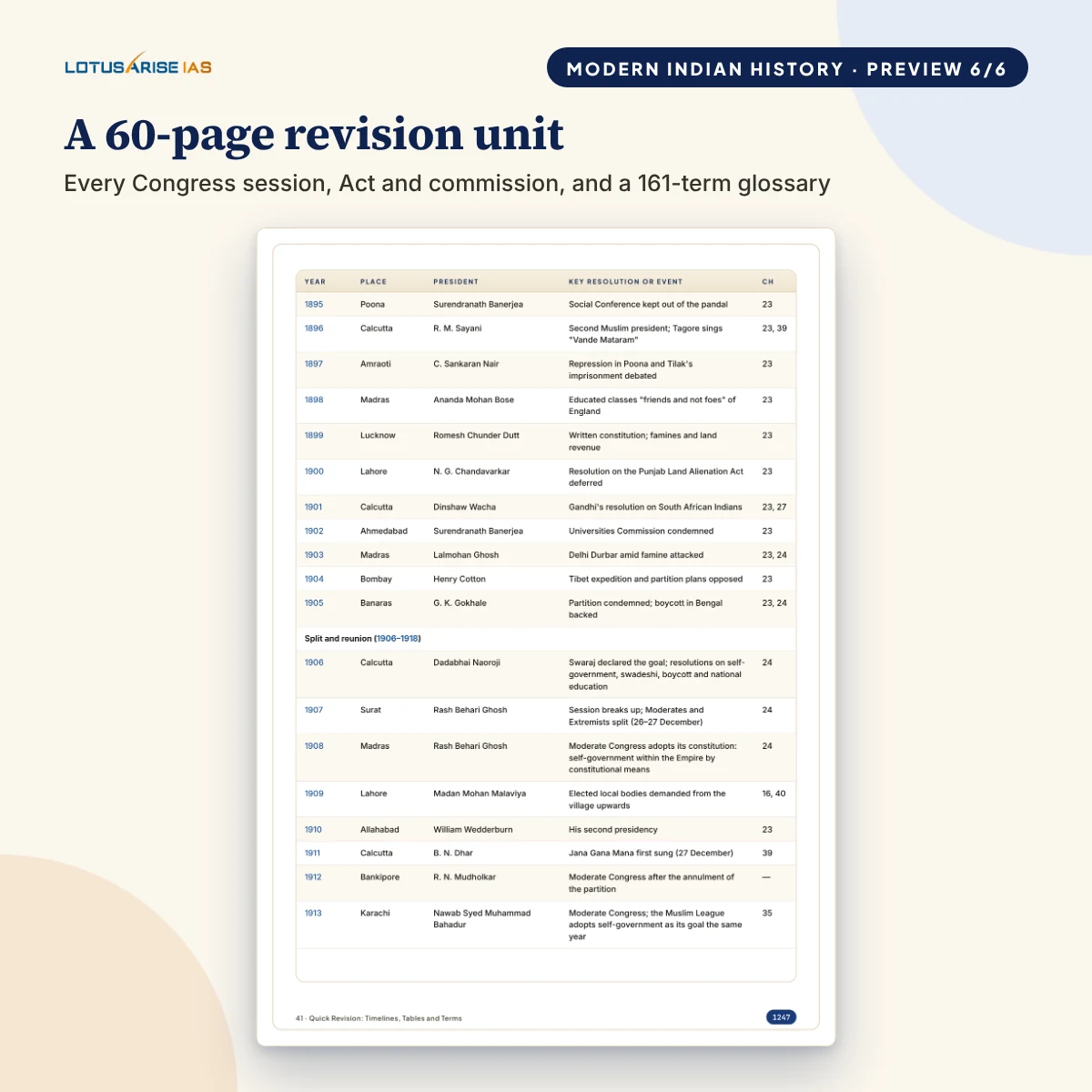
- Quick Revision — a master timeline, every Congress session, the Acts, commissions, newspapers, organisations and movements in 21 tables, and a glossary of 161 terms
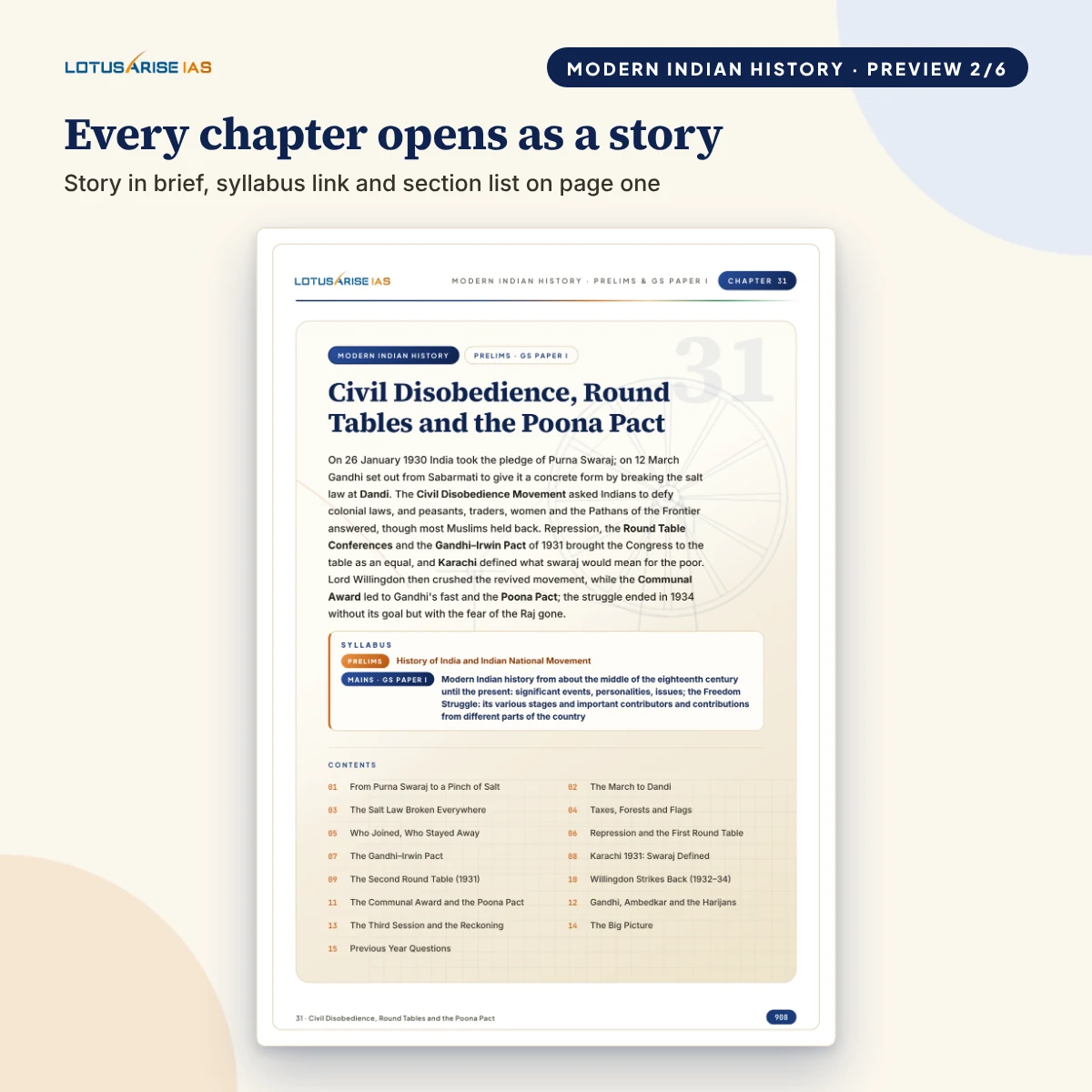
What makes this different from downloaded PDFs: every chapter is written as a connected story. Each opens with the story in brief, each section links back to the one before, and many headings are the questions the chapter answers: Why did the Moderates lose their hold? Was 1857 a war of independence? Why did the Congress accept Partition? Each chapter was checked point by point against the standard sources, and their errors were corrected rather than copied — wrong dates, mixed-up names, misattributed slogans. Key sentences and definitions are lightly highlighted, so your second and third readings take a fraction of the time of the first.
🎯 286 Prelims Fact and Trap boxes
Boxes in every chapter pull out the facts that Prelims options are built from: sessions and their presidents, Acts and their provisions, papers and their founders, organisations and their years. The Prelims Trap boxes take the confusions head-on: the three Bardolis, the two Boses, Lal–Bal–Pal, the August Offer versus Cripps, the Communal Award versus the Poona Pact.
🔗 118 Connecting the Dots chains
These chains link facts across chapters, so one fact recalls the next: from the Charter Act of 1833 to the civil services, from the 1935 Act to the Constitution, from the Bengal famine to the Green Revolution. Every chapter also has a story flowchart that shows how its pieces fit together.
📝 329 Prelims PYQs, 1995–2026, and 42 Mains questions
Each question appears in UPSC’s own wording, in the chapter it belongs to, with the options, the correct one marked and a one-line reason that points to the section covering it. Answers for 2026 follow the consensus of answer keys and are marked provisional until UPSC publishes its final key. The Mains questions from GS Paper I, 2013–2026, are placed the same way.
🗺️ 126 original maps and diagrams, and 148 photo cards
Maps of Panipat, Plassey and the Carnatic, British India in 1765, 1805 and 1857, the centres of 1857, the Dandi March, the Ghadar network and the Komagata Maru, the INA’s road to Imphal, the provinces of 1937, the Radcliffe line and the integration of the states. Diagrams cover the Acts as a ladder, dyarchy, the 1935 federation and the organisations of the Left. Photo cards show the places, buildings and documents of the period, each with its key facts beside it.
🗂️ Quick Revision in every chapter, plus a revision unit
Every chapter closes with a two-column Quick Revision panel of its highest-yield facts. The final unit brings the period together in 60 pages: a master timeline from 1707 to 1947, every Congress session from 1885, the Acts, commissions, newspapers, organisations, movements, battles and books in tables, side-by-side comparisons of commonly confused pairs, and a glossary of 161 terms, each pointing to the chapter that explains it.
The aspirant who buys this
First-time aspirants — you want one book for the whole modern period, in syllabus order, with the Prelims facts already picked out and the story already joined up.
Repeaters — you have read Modern History before and still lose marks on close options. The boxes, chains and revision tables are built for exactly the sessions, Acts and names you keep mixing up.
History Optional aspirants — Paper II covers this period. This book is your fast Prelims-level layer before the optional-depth reading.
Self-study aspirants outside Delhi, Prayagraj or Jaipur — no classroom and no batch timings; one PDF on your phone covers the whole period.
State PSC aspirants — the freedom struggle is in every State PSC paper, so the same book serves both.
Why not just use free notes and a standard book?
Free modern history notes are everywhere, and most aspirants already own a standard book. The problem is not that they are bad. It is that they are written to be read once, not revised ten times. The Prelims facts are buried inside long paragraphs, nothing links one chapter to the next, and nothing ties the text to what UPSC has actually asked.
This book is one checked, revisable system. It gives you the whole period as a story, the Prelims facts pulled out into boxes, the confusions resolved, the links drawn, the PYQs in place and a revision unit at the end.
If you have the time to build that system yourself from scattered sources, you may not need this. If you want it already built, so you can open it and start, this is what the book is for.
Price and delivery
A single printed modern history guide usually costs more than this PDF, and a printed book cannot carry questions up to Prelims 2026.
₹299 ₹599 for 1,297 pages — about 23 paise a page.
Want to see it first? Download the free sample PDF. It has the cover, the full contents and two complete chapters: Chapter 18 (The Revolt of 1857) and Chapter 28 (Rowlatt, Jallianwala and the Khilafat–Non-Cooperation Movement).
One-time payment. No subscription. No recurring charge.
Instant PDF download after payment. The download link is also sent to your email; please check the spam folder if it does not arrive in a few minutes. You can download it again any time from My Account.
For support: support@lotusarise.com
Related products
-

-
Environment and Ecology Notes for UPSC: Prelims & Mains GS Paper III (2027 Edition) by LotusArise IAS
Original price was: ₹500.00.₹236.00Current price is: ₹236.00. -
-
International Relations Notes for UPSC: Prelims & Mains GS Paper II (2027 Edition) by LotusArise IAS
Original price was: ₹500.00.₹236.00Current price is: ₹236.00.