

Governance Notes for UPSC: GS Paper II (2027 Edition) by LotusArise IAS
₹236.00
₹236 for the 2027 Edition — 391 pages, about 60 paise a page.
Most aspirants prepare Governance from a 2021 PDF and a pile of current-affairs cuttings. Then the paper asks about the Interactive Service Model of e-governance, the Tribunals Reforms Act, CBI consent or the Special Intensive Revision of electoral rolls — and the answer has a definition, two vague points and no law, judgment or data behind it.
Governance Notes for UPSC gives you the whole GS Paper II governance syllabus in one current book.
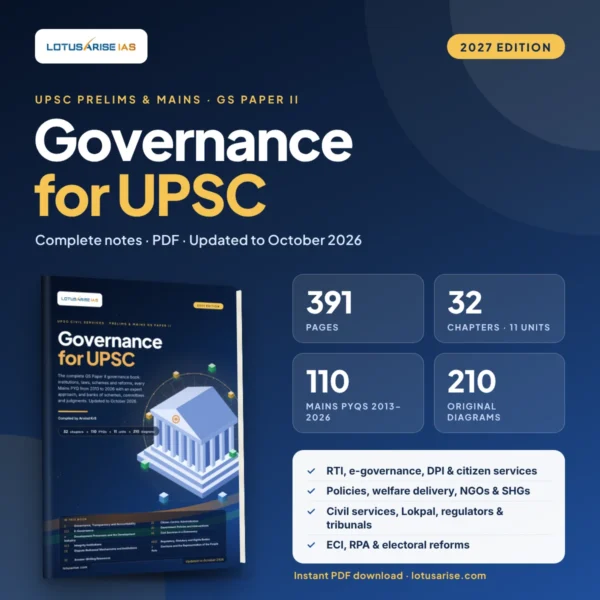
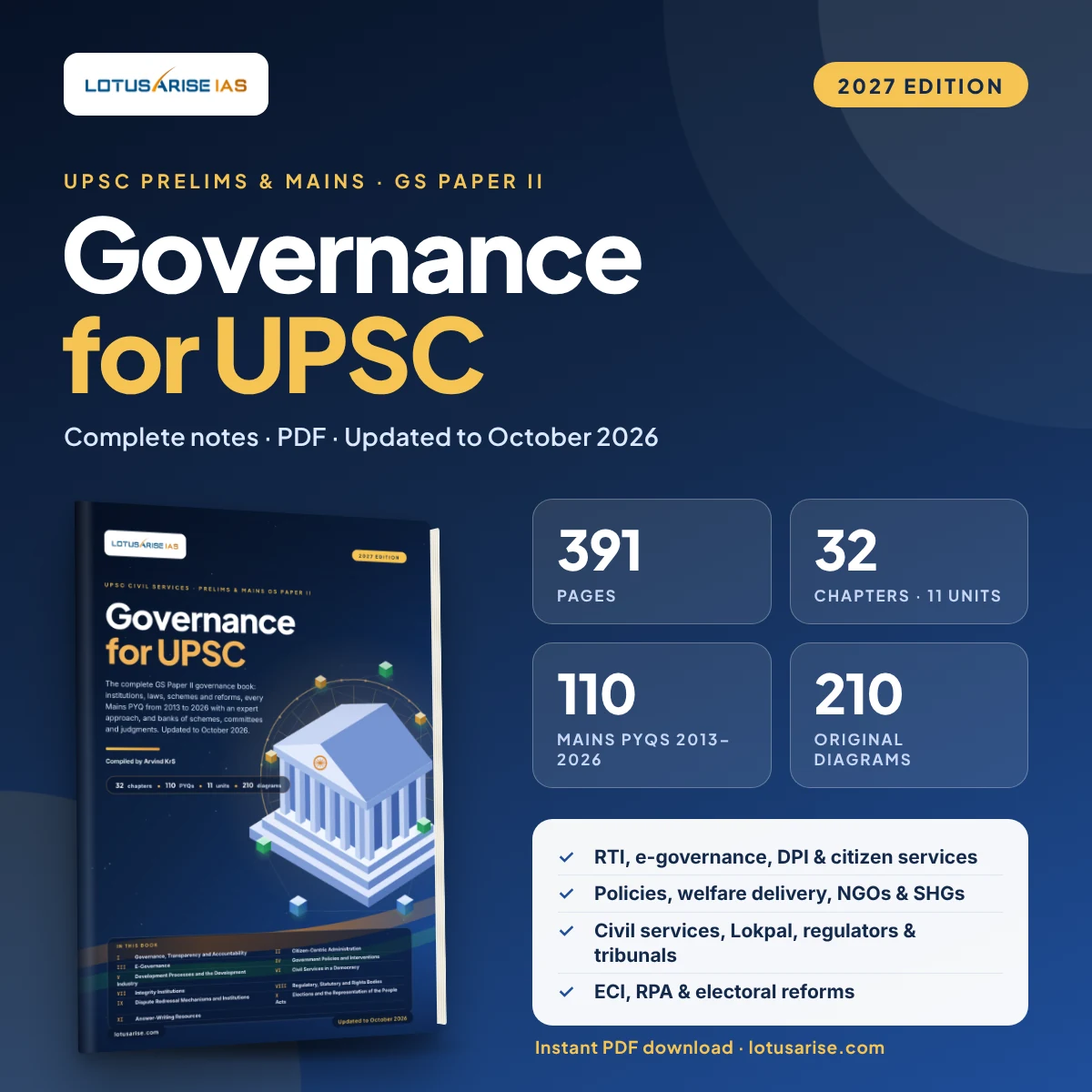
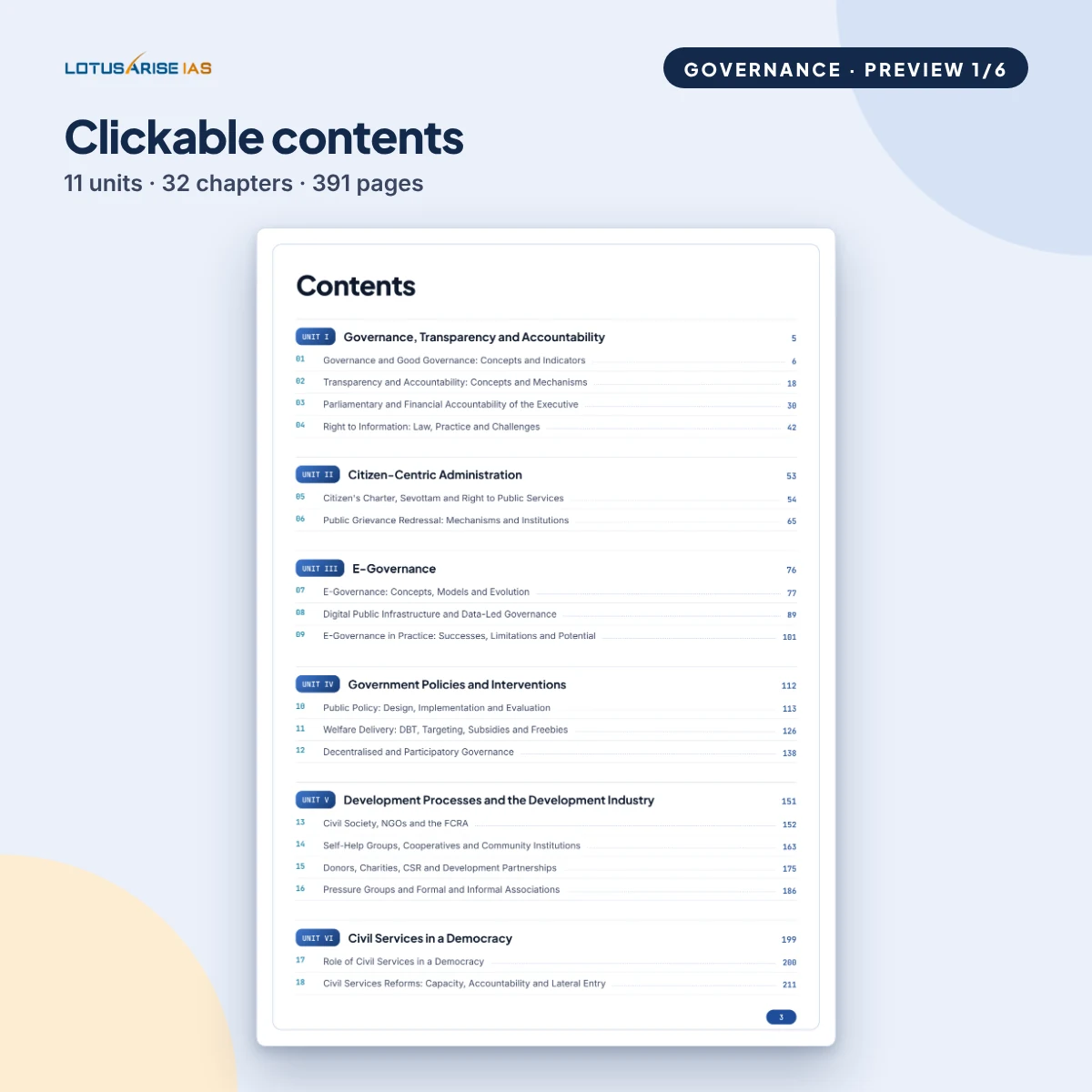
🏛️ 32 chapters in 11 units, 391 pages — RTI, citizen’s charters, e-governance and DPI, policy design and welfare delivery, NGOs and SHGs, civil services, Lokpal, CBI and ED, regulators, tribunals, ADR, ECI and electoral reforms
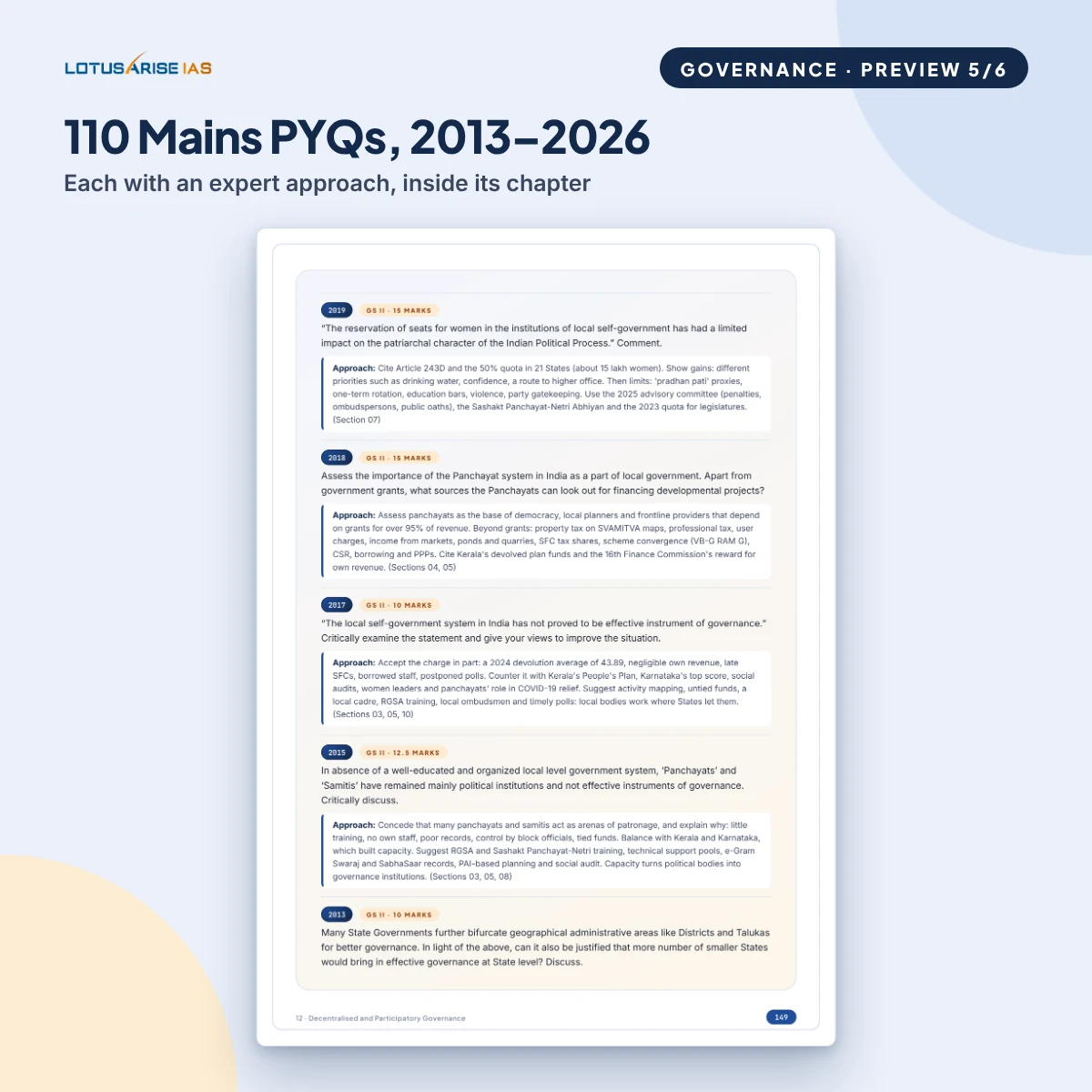
📝 110 Mains PYQs (2013–2026) — every governance question verbatim, with an answer approach, placed under the chapter that answers it
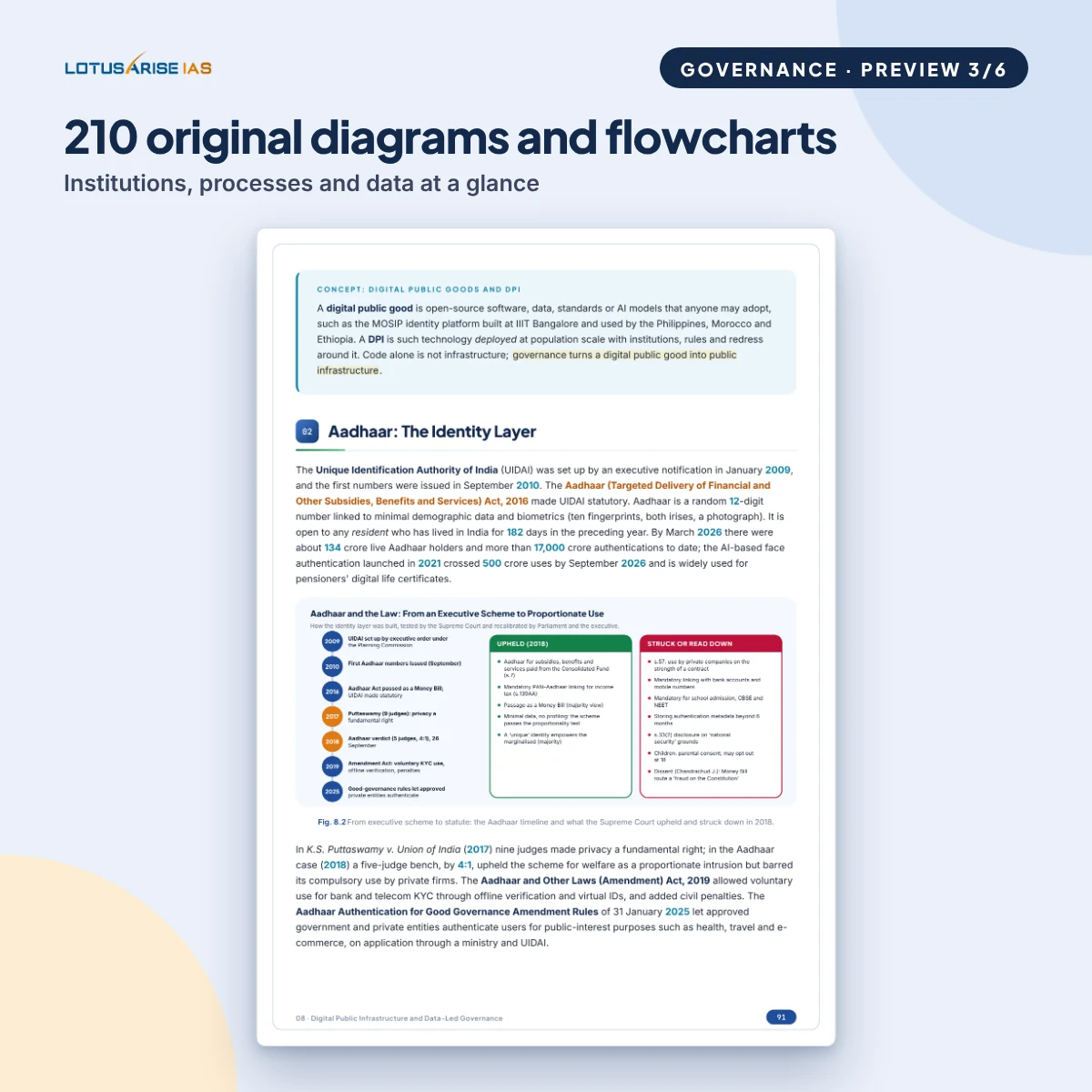
🎨 210 original diagrams and flowcharts + a mind-map for every chapter — simple enough to redraw in your answers
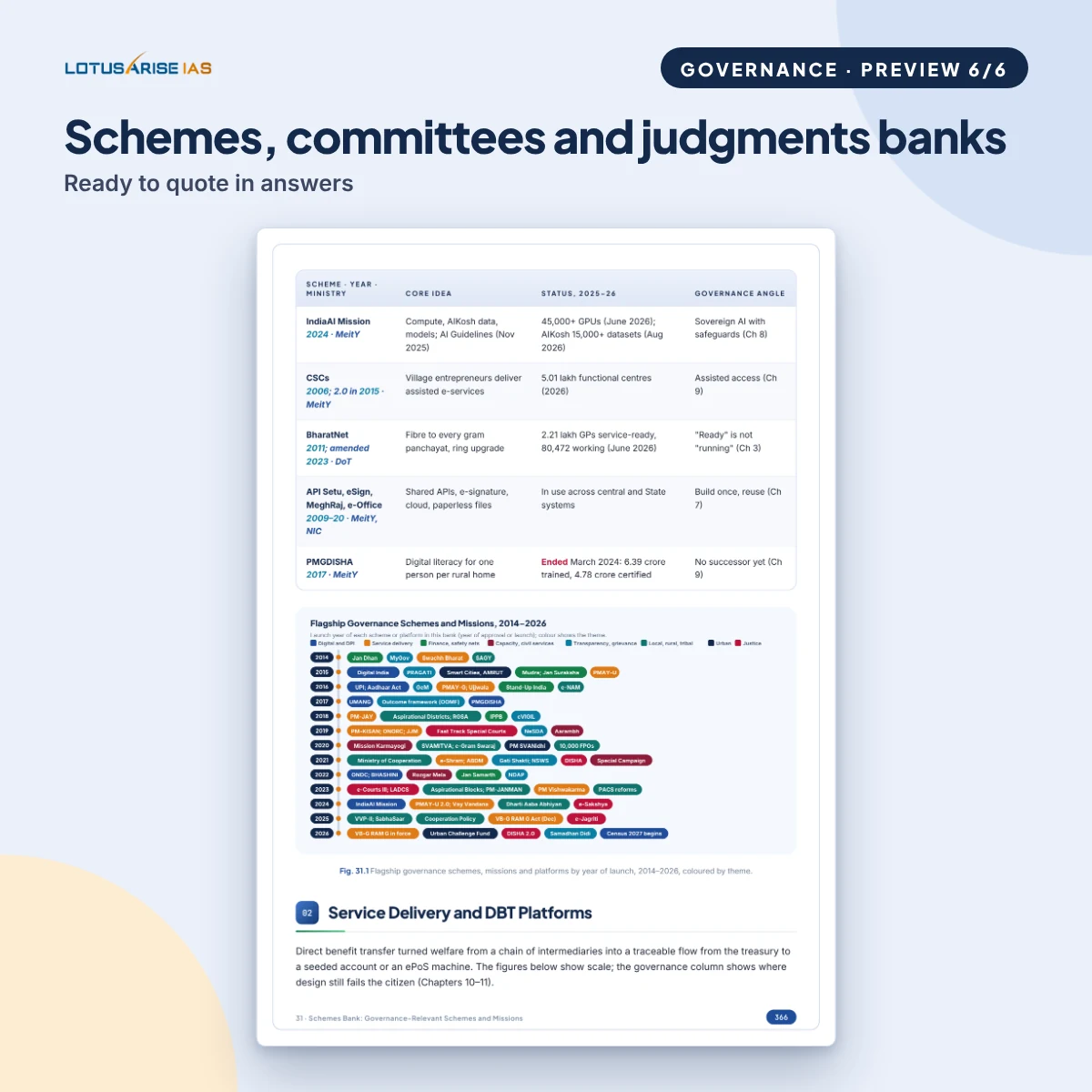
📚 Schemes Bank and Committees, Reports & Judgments Bank — about 135 schemes and platforms, all 15 2nd ARC reports, around 90 judgments and the indices worth quoting
📱 Instant PDF download, updated to October 2026 — laptop, mobile or tablet, offline, printable
One-time payment. No subscription. Unlimited downloads — the link does not expire.
⭐ Read by 300,000+ UPSC aspirants every month on LotusArise IAS
Features:
- Comprehensive Coverage
- Complete Syllabus
- Suitable for: UPSC & State PSCs exams
- Format: Digital PDF (Downloadable)
- 337,362+ aspirants visit every month
The problem nobody admits about Governance
Ask an aspirant how ready they are for the governance part of GS Paper II, and the honest answer is “it’s mostly current affairs, I’ll manage”. Push a little, and you hear one of three things:
“My notes explain the RTI Act. They don’t tell me what the 2019 amendment and the data protection law changed, or why commissions are sitting on four lakh pending appeals.”
“I know e-governance is good for transparency. When the question asks about models, back-end bias or user-centric design, I write the same three points every time.”
“I have monthly magazines on Lokpal, tribunals, CBI consent and electoral bonds. None of it is joined up, and half of it has changed since I saved it.”
These are not knowledge problems. Governance is the part of GS II that changes fastest — new laws, new judgments, new data every few months — and old notes quietly go wrong. Governance Notes for UPSC puts the concepts, the institutions and the latest developments in one current book.
Why Governance deserves a proper book
Governance questions turn up in every GS Paper II, year after year: transparency and accountability, e-governance, citizen’s charters, civil services, NGOs and SHGs, regulators, tribunals and the Representation of the People Act. They are also the questions where a specific law, judgment, committee or data point lifts an answer from average to good.
The same material feeds your Essay, your GS Paper IV answers on probity and accountability, your Prelims polity-and-governance questions, and your Interview, where boards ask about administration, elections and reforms. The real challenge is not the subject. It is having one source that is current, organised the way UPSC asks, and full of the facts that make an answer credible.
What’s inside
🏛️ The complete notes — 32 chapters in 11 units, 391 pages
- Governance, Transparency and Accountability — good governance and how it is measured; accountability mechanisms and social audit; Parliament, committees and the CAG; the Right to Information
- Citizen-Centric Administration — citizen’s charters, Sevottam and Right to Services laws; CPGRAMS and grievance redressal
- E-Governance — concepts and all five models; digital public infrastructure, data-led governance and AI; successes, limitations and user-centric design
- Government Policies and Interventions — policy design, implementation and evaluation; DBT, targeting, subsidies and the freebies debate; decentralised and participatory governance
- Development Processes and the Development Industry — NGOs, civil society and the FCRA; SHGs, cooperatives and FPOs; donors, charities, CSR and partnerships; pressure groups
- Civil Services in a Democracy — role, values and the political–executive interface; reforms, Mission Karmayogi and lateral entry
- Integrity Institutions — Lokpal, CVC and the anti-corruption laws; CBI, ED and the consent question
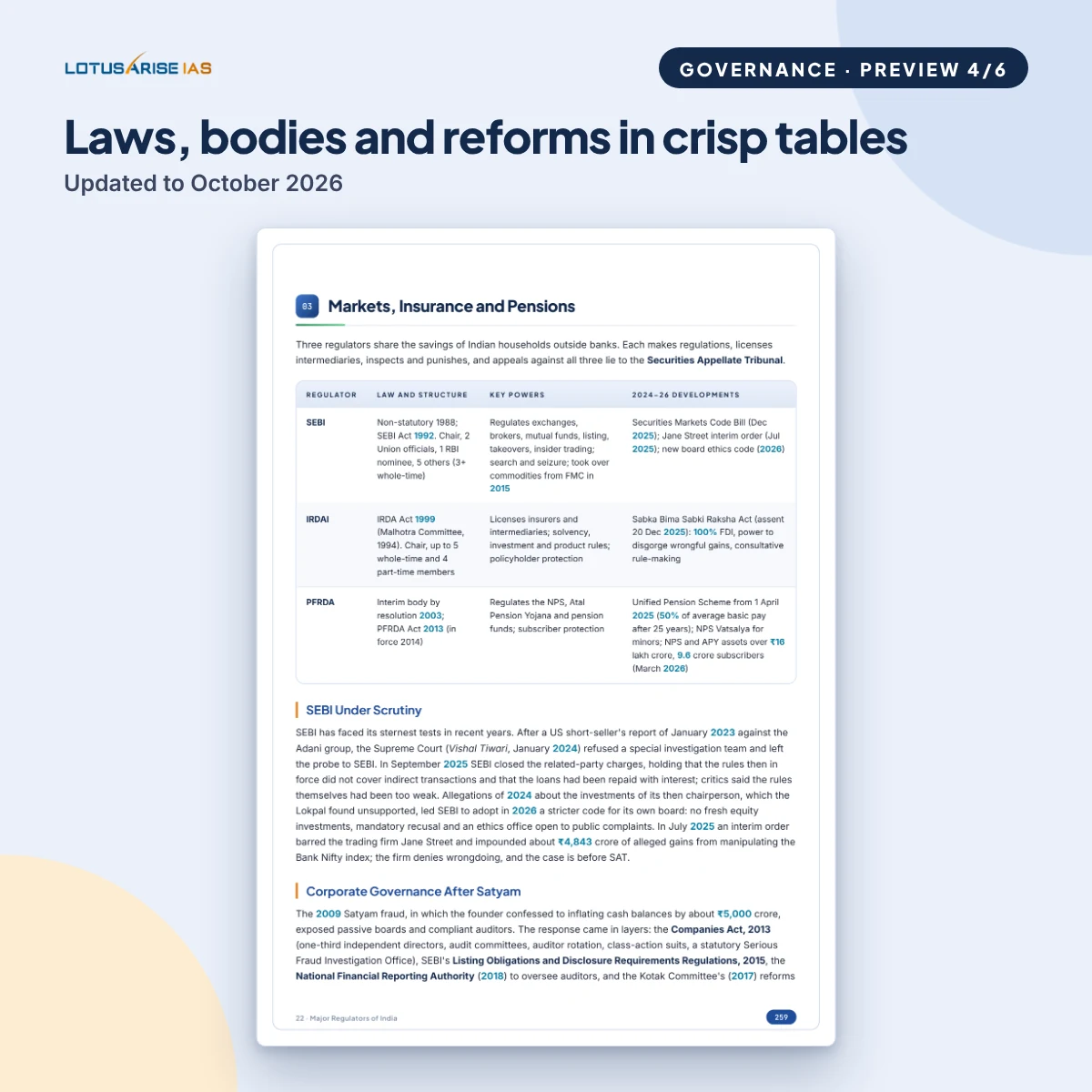
- Regulatory, Statutory and Rights Bodies — principles of regulation; India’s major regulators; NHRC, NCW, NCPCR and other commissions
- Dispute Redressal — tribunals; fast-track and family courts, Gram Nyayalayas and Lok Adalats; arbitration and mediation; consumer protection and inter-State water disputes
- Elections — the Election Commission and electoral rolls; the RPA 1951, disqualification and the Model Code; electoral reforms, funding and simultaneous elections
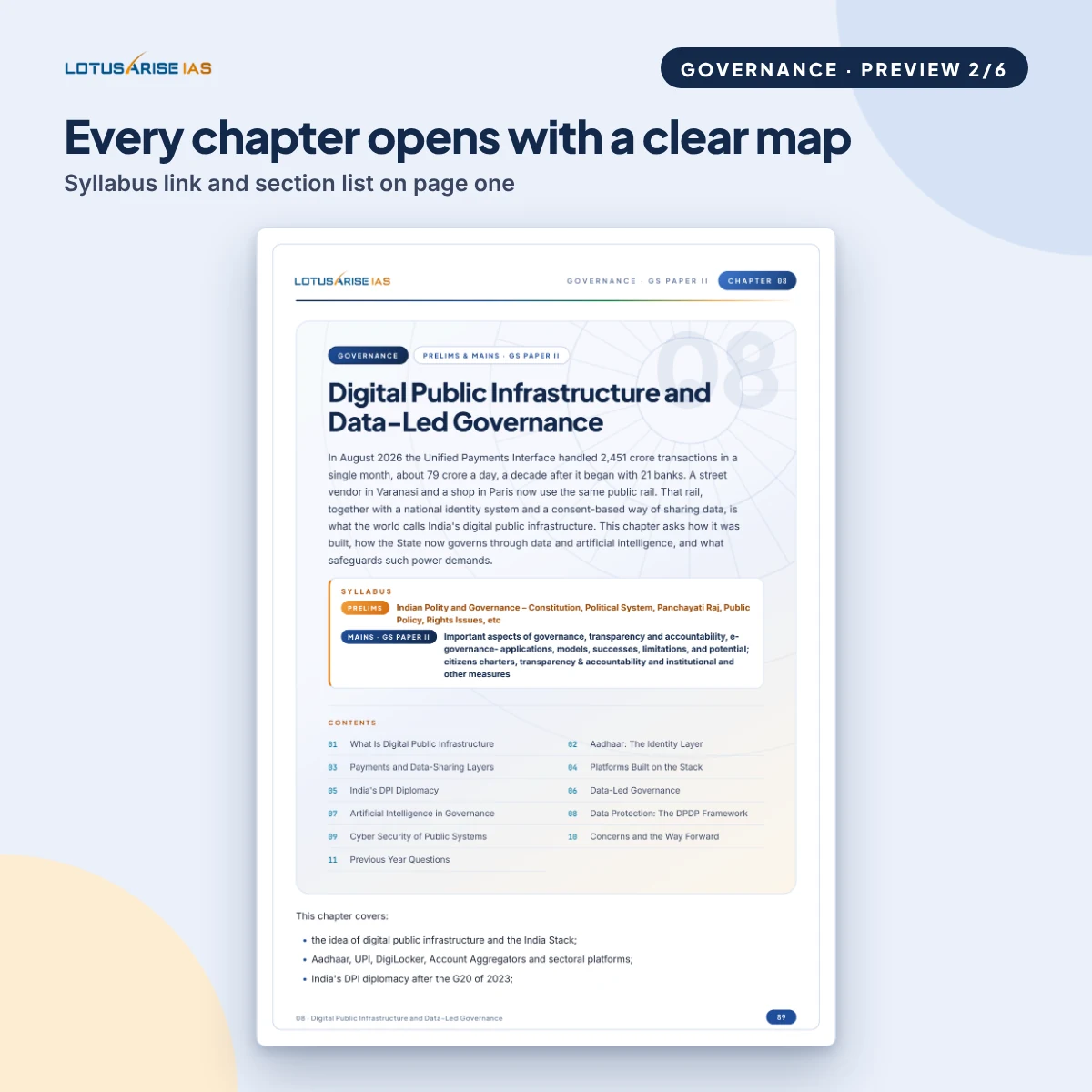
What makes this different from downloaded PDFs: every chapter is written fresh for the exam and current to October 2026 — the Tribunals Reforms Act 2026, the new rural employment guarantee law, the DPDP Rules and their effect on RTI, the Special Intensive Revision judgment, the Section 17A split verdict, the 16th Finance Commission’s local-body grants and the latest CPGRAMS, Lokpal and CBI data are already in their chapters. Facts were checked independently against primary sources such as Supreme Court judgments, Parliament replies and official releases. Each chapter ends with a one-page mind-map and a “Using this chapter in Mains” box.
📝 110 Mains PYQs, 2013–2026
110 governance questions from fourteen GS Paper II papers, verbatim, with its marks and an answer approach that points to the sections of the book that answer it. Each question sits under the chapter it belongs to, so you finish a topic and immediately see how UPSC has tested it.
🎨 210 original diagrams and flowcharts
The RTI request-to-appeal path, the five e-governance models, the DPI stack, the policy cycle, the Lokpal complaint path, CBI consent rules as a decision tree, tribunal appeal routes, the election-petition route and many more — each drawn fresh and simple enough to reproduce in a 150-word answer.
📚 Schemes Bank and Committees, Reports & Judgments Bank
A theme-wise ready reckoner of about 135 governance-relevant schemes, missions and platforms, with their current status. A second bank lists the administrative-reform committees from 1951 to 2026, all 15 reports of the 2nd ARC with their key recommendations, around 90 landmark judgments by theme, and the governance indices worth quoting — each linked to the chapter that explains it.
The aspirant who buys this
First-time aspirants — you want one trusted book for the governance half of GS II from day one, instead of stitching together old notes and monthly magazines.
Repeaters — you know the topics. What costs you marks is that your answers lack current laws, judgments and data. This book gives you all three, already organised by topic.
Aspirants with PSIR or Public Administration optional — the institutions, civil-services and policy chapters overlap with your optional.
Self-study aspirants outside Delhi, Prayagraj or Jaipur — no classroom, no batch timings; one PDF on your phone that covers the whole syllabus.
State PSC aspirants — governance, RTI, e-governance and electoral topics are common to most State PSC papers, so the same book serves both.
Why not just use free notes and current-affairs magazines?
Free governance material exists, and most aspirants already have folders of it. The problem is not that it is bad. It is that it is scattered and it dates quickly: a law that has since been amended, a judgment later reviewed, a scheme that was replaced, figures from three years ago.
This book is one connected system: the whole syllabus in sequence, every PYQ placed where it belongs, the latest developments woven into the chapter they change, and facts checked to October 2026.
If you have the time to rebuild that yourself every year from scattered sources, you may not need this. If you want it already built — open it and start — this is what the book is for.
Price and delivery
A single printed governance guide usually costs more than this PDF, and a printed book cannot carry developments up to October 2026.
₹236 for 391 pages — about 60 paise a page.
Want to see it first? Download the free sample PDF — the cover, the full contents, Chapter 1 (Governance and Good Governance) and Chapter 8 (Digital Public Infrastructure and Data-Led Governance).
One-time payment. No subscription. No recurring charge.
Instant PDF download after payment. The download link is also sent to your email — please check the spam folder if it does not arrive in a few minutes. Download it again any time from My Account.
For support: support@lotusarise.com
Related products
-

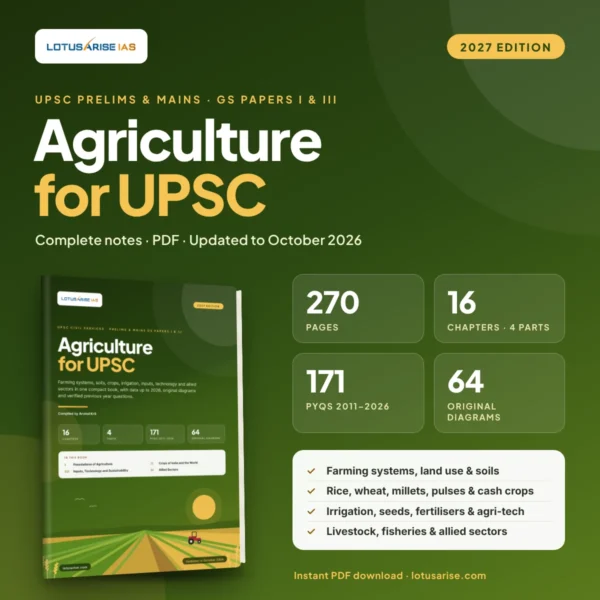
Agriculture Notes for UPSC: Prelims & Mains GS Papers I and III (2027 Edition) by LotusArise IAS
Original price was: ₹250.00.₹149.00Current price is: ₹149.00. -
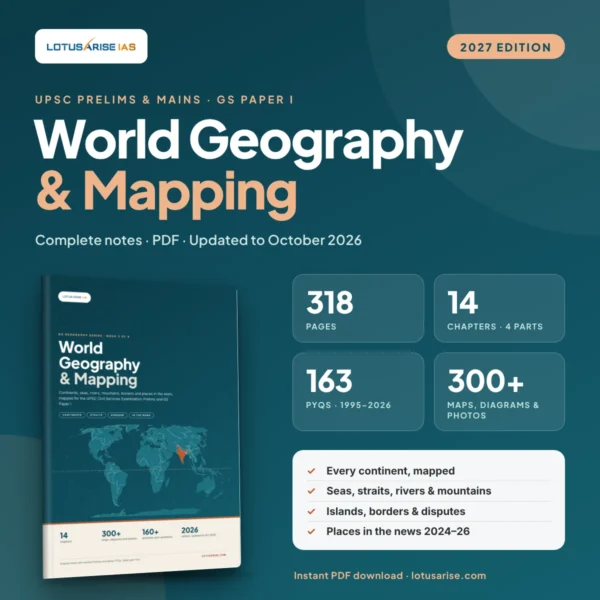
World Geography & Mapping Notes for UPSC: Prelims & Mains GS Paper I (2027 Edition) by LotusArise IAS
Original price was: ₹300.00.₹149.00Current price is: ₹149.00. -
-
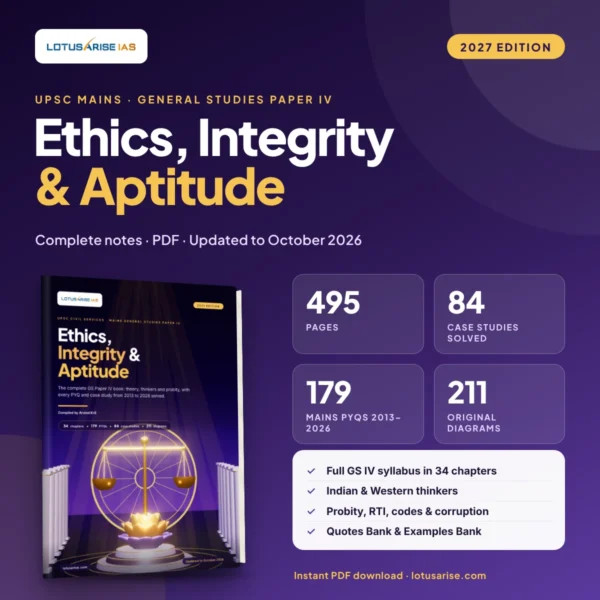
Ethics, Integrity and Aptitude Notes for UPSC: Mains GS Paper IV (2027 Edition) by LotusArise IAS
Original price was: ₹500.00.₹295.00Current price is: ₹295.00.