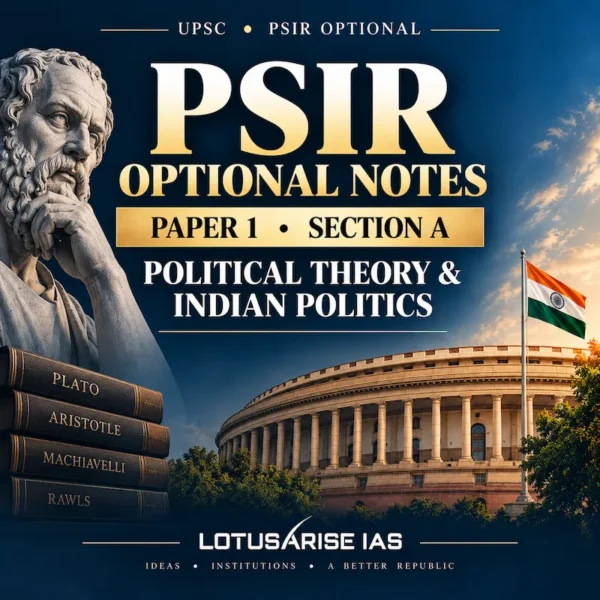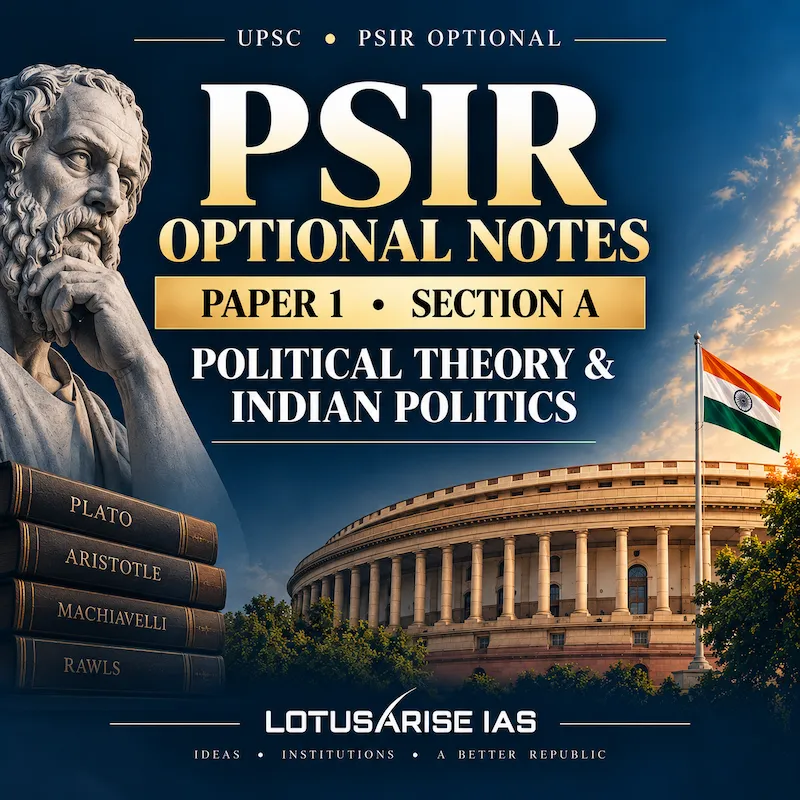
PSIR Optional Notes (Paper I): Section-A {Political Theory}
Original price was: ₹500.00.₹354.00Current price is: ₹354.00.
₹354 — ₹146 below the ₹500 regular price, for 1,062 pages.
Most PSIR aspirants read Political Theory like philosophy. Thinkers summarised one after another, concepts memorised as definitions. Then the question asks you to weigh Rawls against his communitarian critics, or to say what Gramsci adds to the idea of power — and there is nothing to write past the summary.
PSIR Optional Notes (Paper I): Section-A turns the summary into an argument.
📘 44 chapters across all 10 syllabus units — from political theory and the state to Western political thought, in UPSC syllabus order
🧠 Every thinker in the syllabus, one chapter each — Plato to Hannah Arendt, Kautilya to M.N. Roy
📝 Previous year questions after every chapter — year marked on each, so you see what UPSC keeps asking
🖨️ Printable A4 PDF, 1,062 pages — mark it up and write answers beside it
📱 Any device, offline — laptop, tablet or phone
One-time payment. No subscription. The download link is emailed the moment payment clears — check your spam folder if it is not in the inbox.
⭐ Trusted by the 300,000+ UPSC aspirants who read LotusArise IAS every month
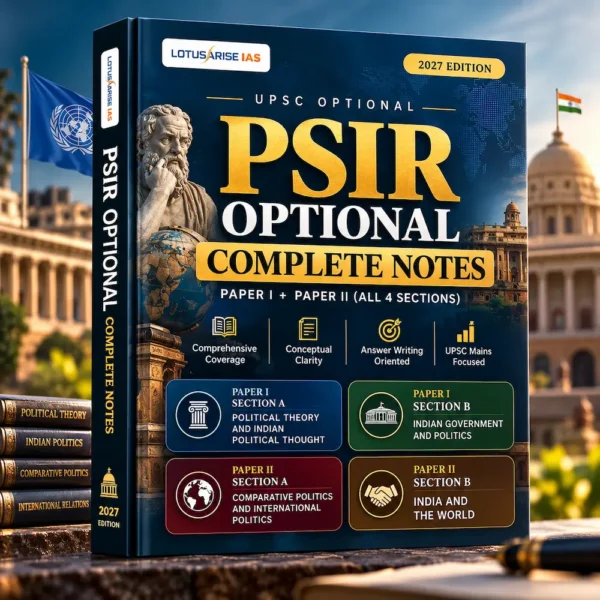
Save ₹168: both Paper I sections plus the 1991–2025 question papers come together as PSIR Optional Paper I Complete Notes for ₹599 — or get all four PSIR sections in PSIR Optional Complete Notes for ₹1,180.
Features:
- Comprehensive Coverage
- Complete Syllabus
- Suitable for: UPSC & State PSCs exams
- Format: Digital PDF (Downloadable)
- 337,362+ aspirants visit every month
The problem most Section A aspirants don’t talk about
Ask a PSIR aspirant what goes wrong in Political Theory. It is rarely the reading. It is usually one of these three things:
“I can summarise every thinker in the syllabus. When the question asks me to compare two, I have nothing.”
“I know what liberty, equality and justice mean. I don’t know who disagrees with whom, and why.”
“Indian Political Thought is my weakest part. Dharmashastra and the Buddhist tradition read like history, not political theory.”
None of that is a discipline problem. Section A rewards conceptual precision and the ability to set one position against another — and most material gives you positions one at a time. These notes give you the argument between them.
Why Section A is the foundation of the whole optional
Paper I carries 250 of the optional’s 500 marks, and Section A is where the examiner checks whether you can think in concepts: what liberty means to Berlin and why Rawls disagrees, what Marx means by the state and what Gramsci changes.
It is also the vocabulary of everything else. The state, power, ideology, rights and democracy you define here are the words you use in Indian politics, comparative politics and IR. Get them precise once and every other section gets easier.
The return goes beyond PSIR. Thinkers and concepts feed your Essay, the moral thinkers in GS Paper IV, and the interview, where the ability to argue a position calmly is exactly what is being tested.
What’s inside — 1,062 pages, 44 chapters, 10 units
🏛️ Political theory and the state — Units 1 and 2
- Political theory: meaning and approaches
- Theories of the state, each in its own chapter: liberal, neo-liberal, Marxist, pluralist, postcolonial and feminist
⚖️ Justice, equality, rights, democracy and power — Units 3 to 7
- Conceptions of justice, and Rawls’ theory of justice with its communitarian critique
- Equality — social, political and economic — its relationship with liberty, and affirmative action in India: reservation, judgments and debates
- Rights: meaning, theories and kinds; human rights, their generations and the universalism debate
- Democracy: classical and contemporary theories; representative, participatory and deliberative models
- Power: meaning, bases and dimensions; hegemony, ideology and legitimacy
💡 Political ideologies — Unit 8
- Liberalism, socialism, Marxism, fascism and feminism
- The end of ideology, the end of history and postmodernism
🇮🇳 Indian political thought — Unit 9
- Dharmashastra, Kautilya’s Arthashastra and Buddhist political thought
- Sir Syed Ahmad Khan, Sri Aurobindo, M.K. Gandhi, B.R. Ambedkar and M.N. Roy
📜 Western political thought — Unit 10
- Socrates, Plato, Aristotle, Machiavelli, Hobbes, Locke, J.S. Mill, Marx, Gramsci and Hannah Arendt — one chapter each
📝 Previous year questions after every chapter
Each of the 44 chapters closes with the questions UPSC has set on that topic, with the year marked on each. You finish a thinker and immediately see how the thinker is examined.
What makes this different from the PDFs already on your laptop. Downloaded notes treat thinkers and concepts as separate lists. These are written as one body of work, in syllabus order, so the Locke of Unit 10 is the liberal theory of the state in Unit 2, and the Gramsci of Unit 10 is the hegemony of Unit 7. That is how a comparison answer gets built, and it is the connection scattered files cannot make for you.
Please note: this is Paper I Section A only. Section B — Indian Government and Politics — is sold separately, and both Paper I sections come together in PSIR Optional Paper I Complete Notes.
The aspirant who buys this
The first-timer who has just chosen PSIR. You want Political Theory built properly from day one, instead of a pile of thinker summaries you cannot turn into answers.
The repeater whose optional score sat in the 230s and 240s. Your content is not the problem. The marks are in the comparison you did not make and the critic you did not cite.
The aspirant whose optional is something else. Justice, rights, democracy and the great thinkers feed your Essay, GS Paper IV and the interview. Bought once, used across the examination.
The self-study aspirant far from a coaching city. You are not moving to Delhi, Prayagraj or Jaipur, and you are not paying ₹15,000–₹54,000 for an optional course. You need the material, at a price that does not decide your month.
The working professional. No batch timing, no live schedule you will miss. Printable, offline, and there at 11 pm when your preparation actually happens.
Why not just use the free Political Theory notes from Telegram?
Free notes exist, and plenty of them circulate. Most aspirants have folders full of them and have finished none.
The difference is not that free material is worthless — some of it is genuinely good. The difference is that it is unsorted: a different author for every thinker, no consistent order, no way to know which file is current, and no link to what UPSC has actually asked. You end up doing the editorial work yourself, in the months you should be writing answers.
If you have the patience to build that system from scattered sources, you may not need this. If you would rather open one file and start, that is what these notes are for.
The price, twice over
An optional course elsewhere runs ₹15,000–₹54,000.
This section: ₹354 — against a regular price of ₹500. That is 1,062 pages for about 33 paise a page.
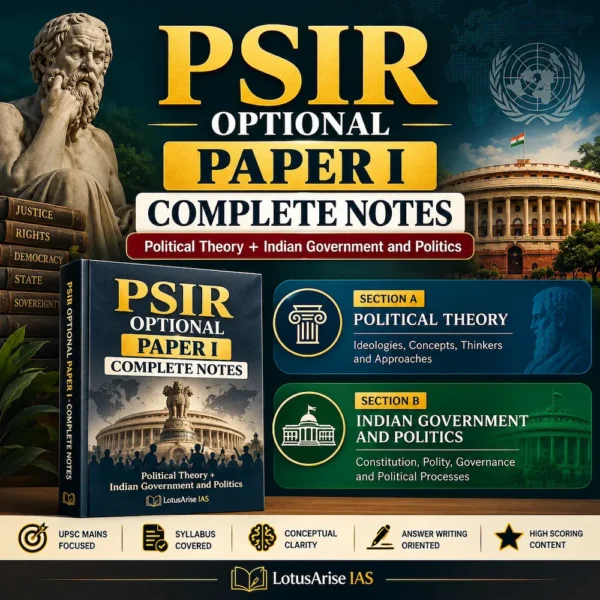
Want all of Paper I? PSIR Optional Paper I Complete Notes has Section A, Section B and the 1991–2025 question papers for ₹599.
Read before you buy: free sample PDFs of the PSIR notes are open to everyone — see the design, the depth and the previous year questions for yourself.
One-time payment. No subscription. No recurring charge. The download link reaches your email as soon as payment clears — check the spam folder if it is not in your inbox within a few minutes.
Questions before or after buying: support@lotusarise.com
You may also like…
-

PSIR Optional Paper I Complete Notes: Political Theory + Indian Government and Politics by LotusArise IAS
Original price was: ₹1,000.00.₹599.00Current price is: ₹599.00. -
PSIR Optional Complete Notes: Paper I + Paper II (All 4 Sections) by LotusArise IAS
Original price was: ₹2,000.00.₹1,180.00Current price is: ₹1,180.00.
Related products
-
PSIR Optional Notes (Paper II): Section-B {India and the World}
Original price was: ₹500.00.₹354.00Current price is: ₹354.00. -
PSIR Optional Notes (Paper I): Section-B {Indian Government and Politics}
Original price was: ₹500.00.₹354.00Current price is: ₹354.00. -
-