


Physical Setting | Geography Optional UPSC Notes
₹118.00
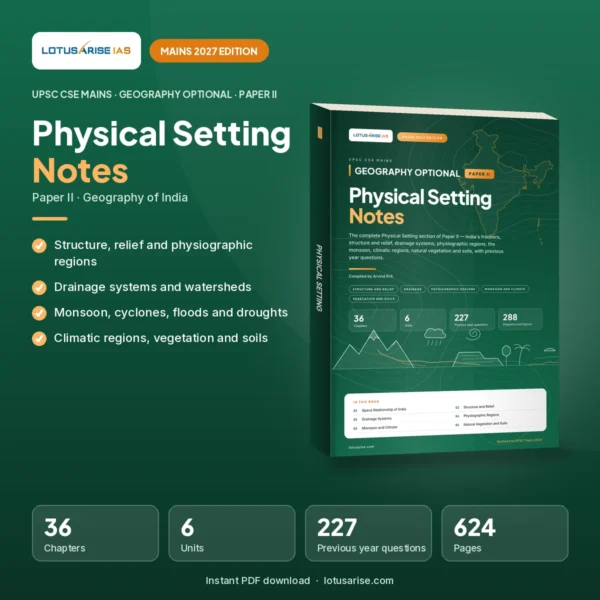
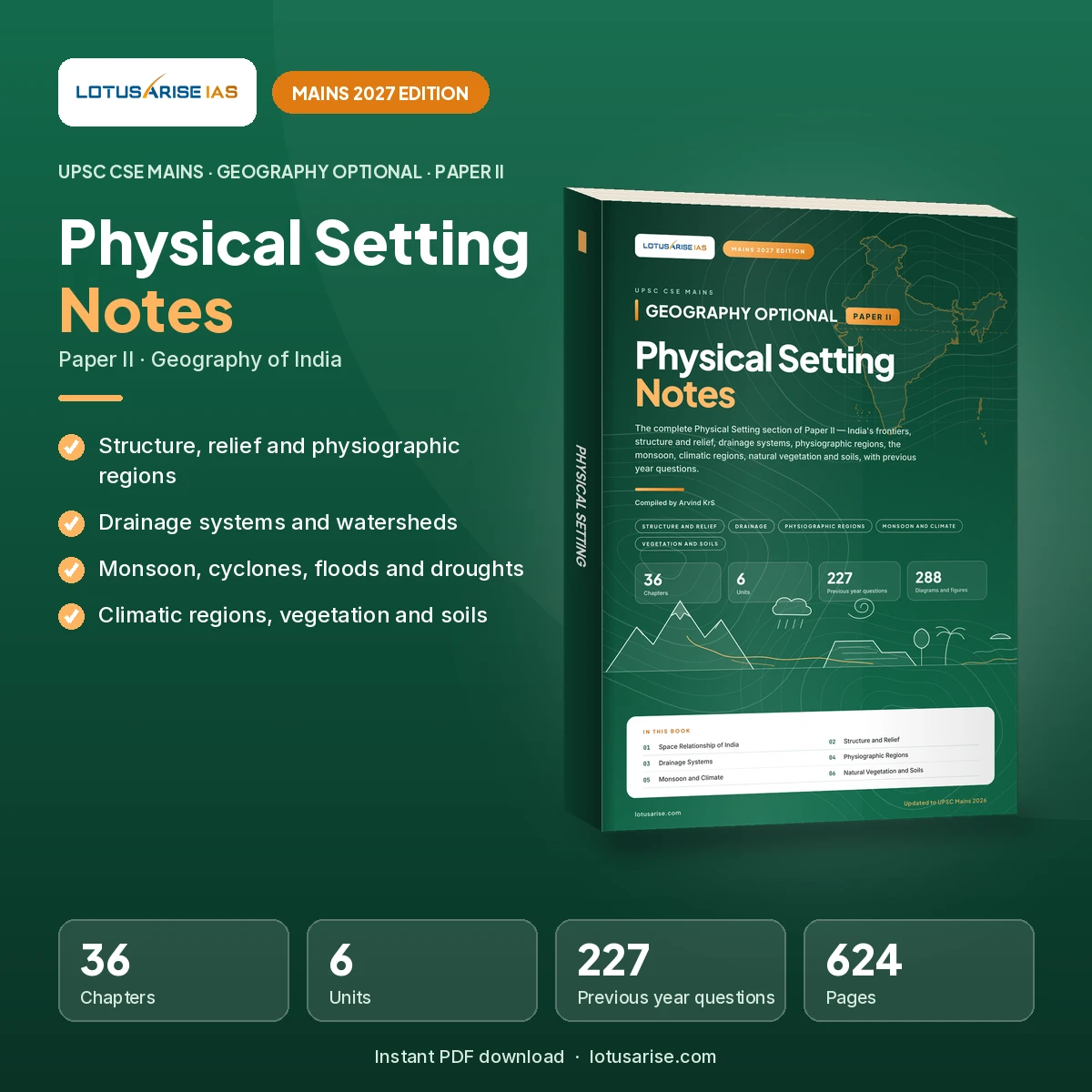
₹118 for 624 pages — about 19 paise a page. Mains 2027 Edition.
Most Geography Optional aspirants read this section like an atlas. Tributaries by rote, passes and ranges in a list, the monsoon as one diagram of arrows. Then UPSC asks why the link between El Niño and the monsoon is growing complex, or to examine the Great Nicobar Project, and the answer stops after the definitions.
Physical Setting puts the whole Paper II section into one book: how India’s land, rivers and climate work, and what follows.
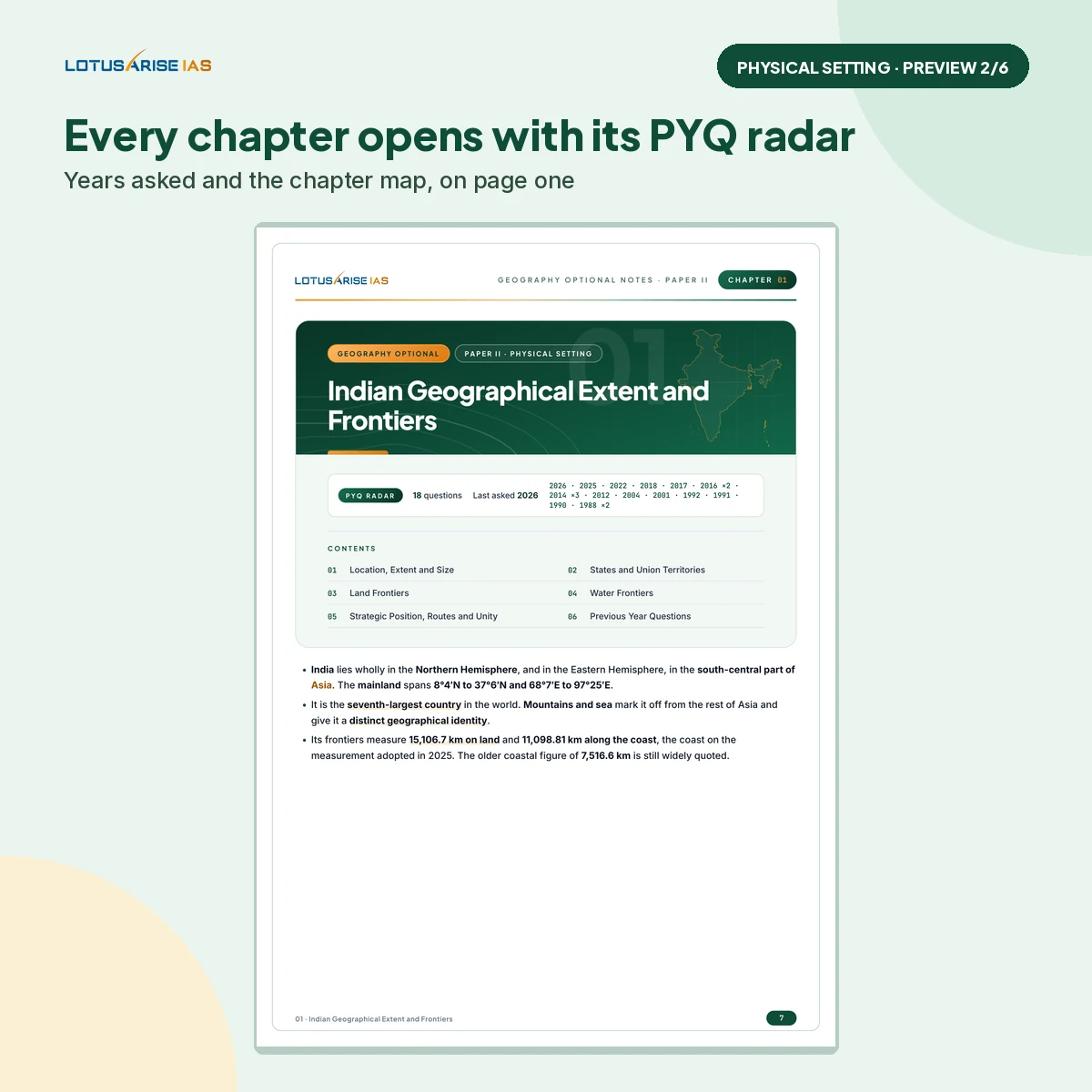
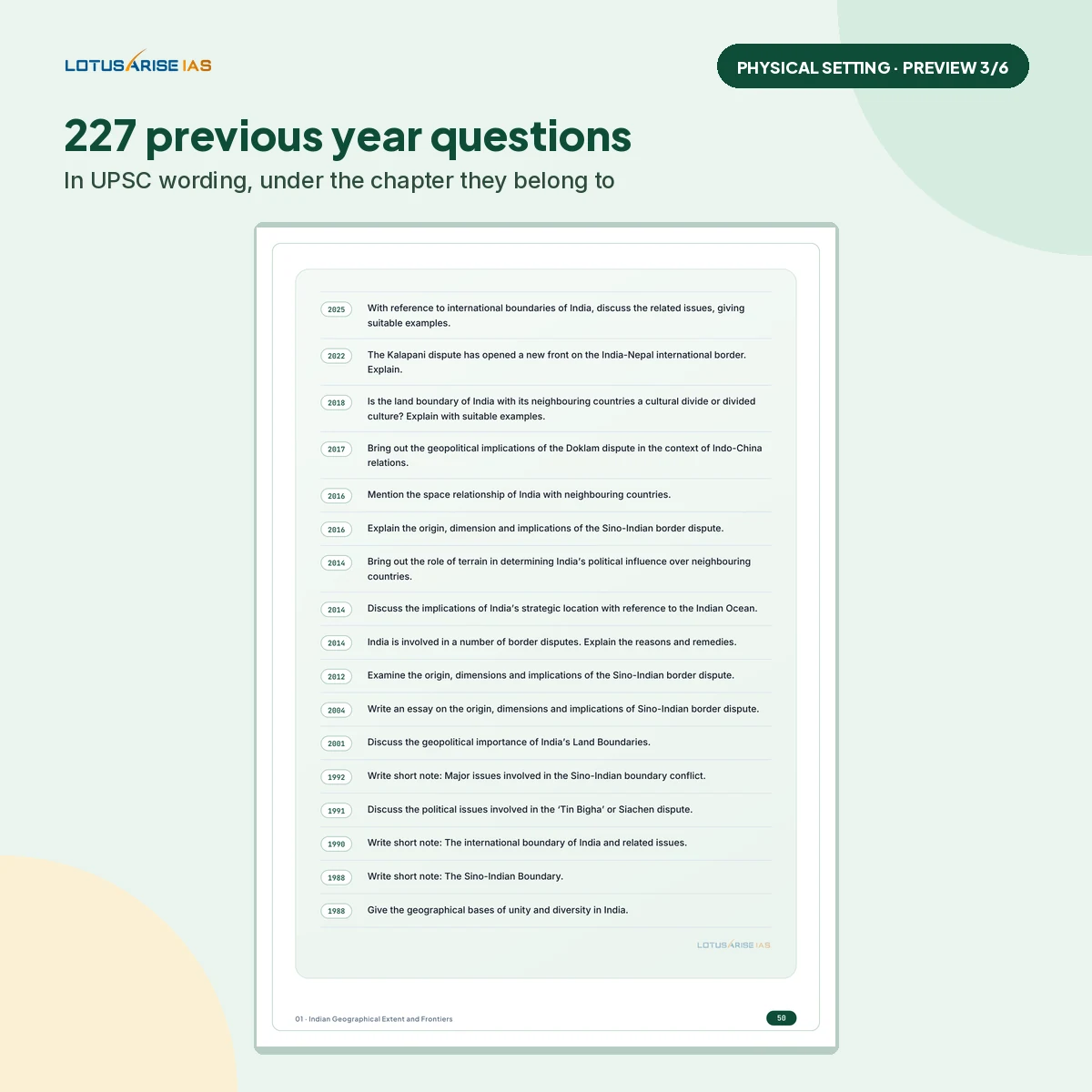
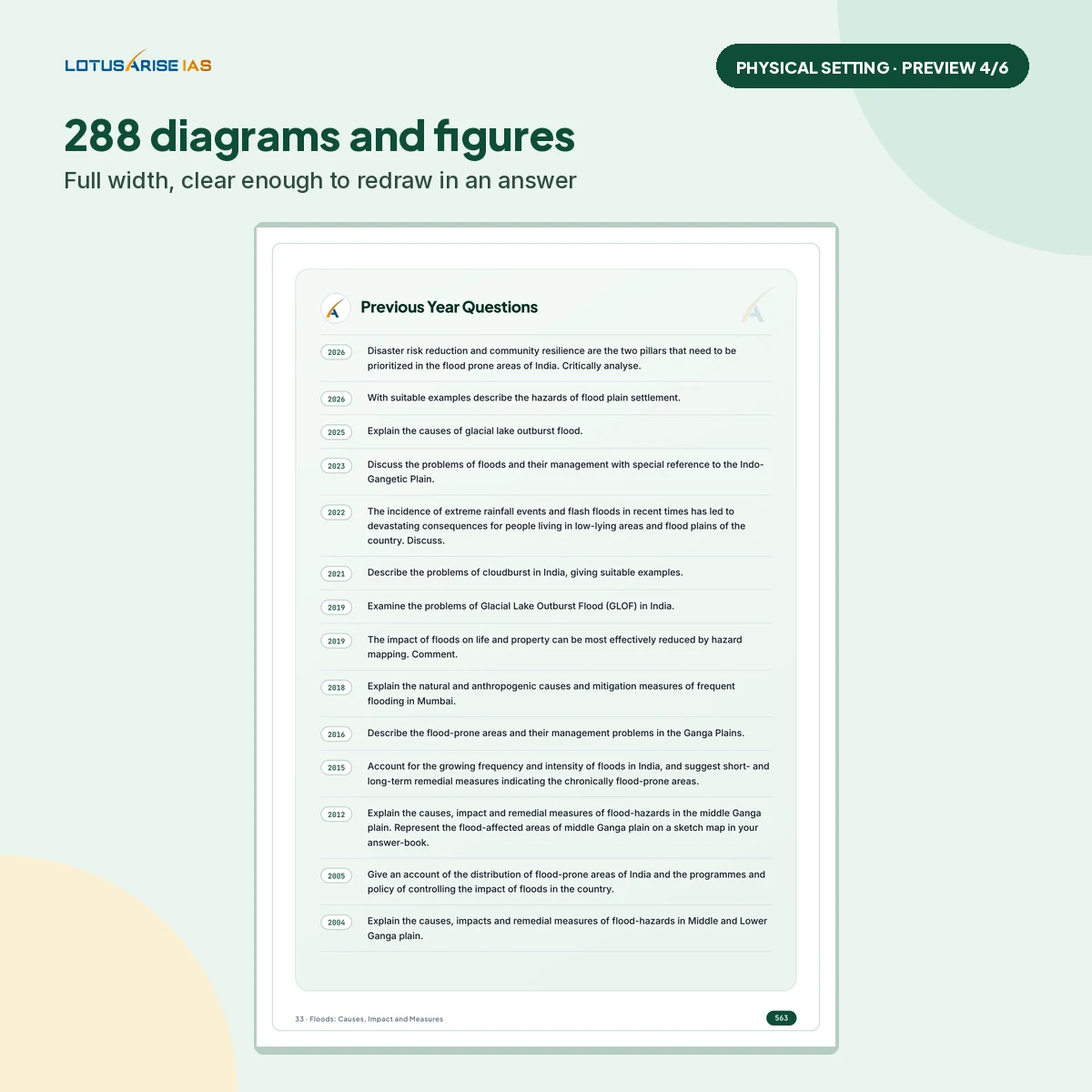
📝 227 PYQs, updated to Mains 2026 — in UPSC’s wording, map items included, placed by chapter
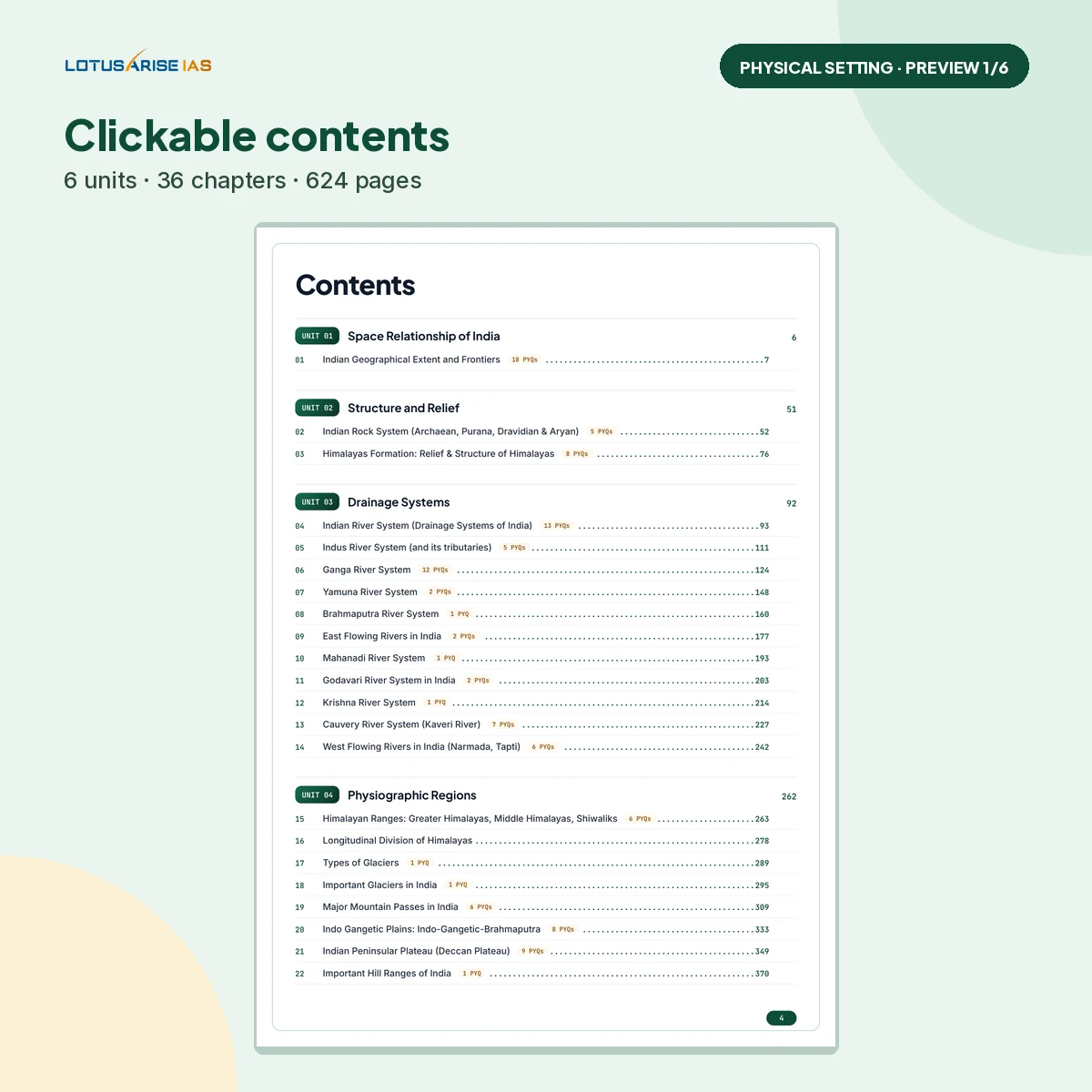
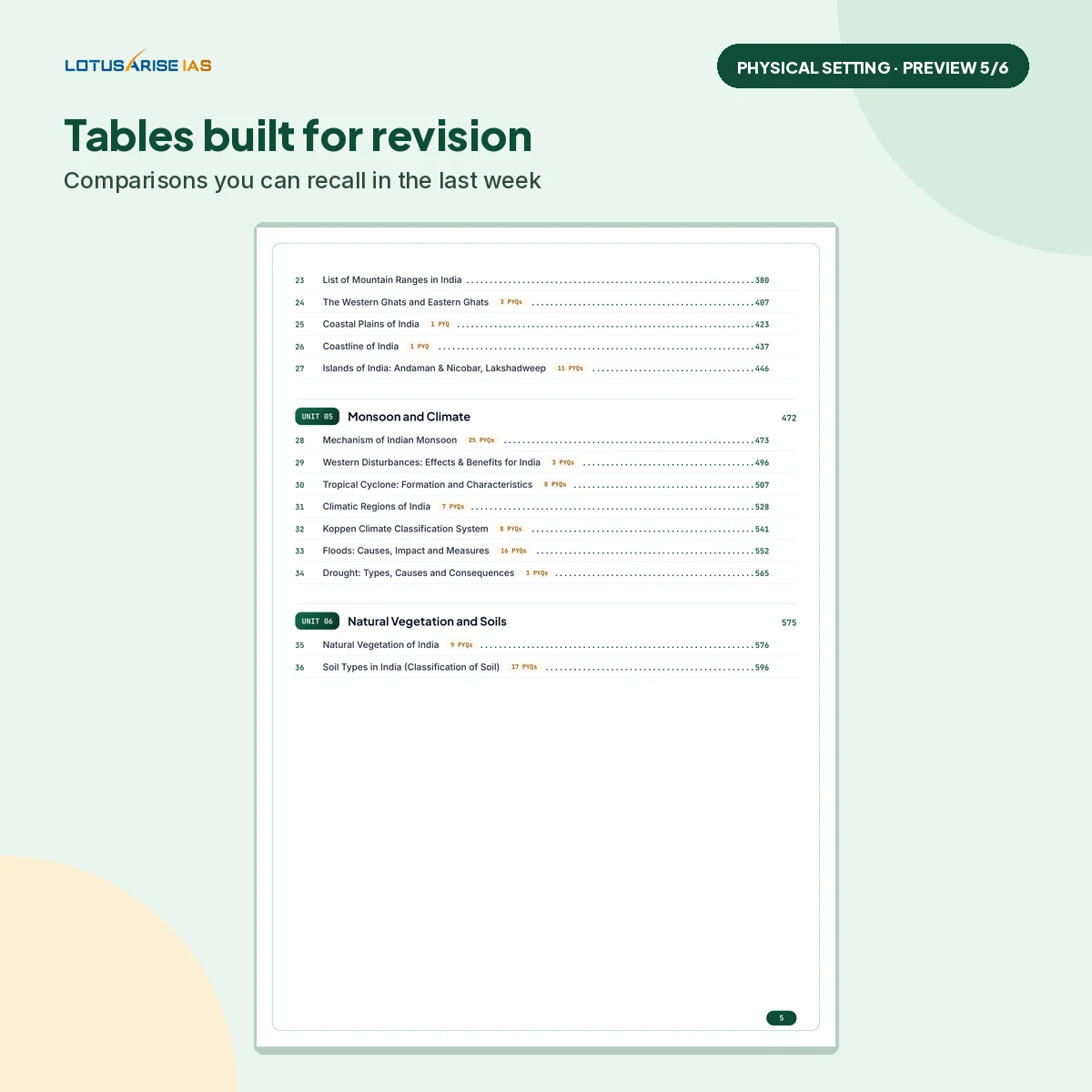
🧭 36 chapters in 6 units — frontiers, structure, drainage, physiographic regions, monsoon and climate, vegetation and soils
🗺️ 288 diagrams and figures — full width, maps included, clear enough to redraw
🌀 Current to October 2026 — Cyclone Arnab, the Ganga Waters Treaty deadline, the Great Nicobar plan
📱 Instant PDF download, 624 pages — clickable contents, laptop, mobile or tablet, offline, printable
One-time payment. No subscription. Unlimited downloads — the link does not expire.
⭐ Read by 300,000+ UPSC aspirants every month on LotusArise IAS
Features:
- Comprehensive Coverage
- Complete Syllabus
- Suitable for: UPSC & State PSCs exams
- Format: Digital PDF (Downloadable)
- 337,362+ aspirants visit every month
The problem most aspirants don’t talk about
Ask a Geography Optional aspirant about this section a few months into preparation. They won’t say the rivers are too hard to learn. They will say one of three things:
“I can list every tributary of the Ganga, but when the question says ‘shifting of river courses and river capturing’, I have no argument to make.”
“My monsoon is one page of old theory. UPSC now asks why it is erratic and what El Niño is doing to it under global warming.”
“My rivers are from one place, my passes from another and my soils from a video. Then a map item like Bitra Island comes and I cannot find it in any of them.”
None of this is a lack of effort. Physical India is the first thing everyone reads, so it gets stored as facts and rarely as processes. What is missing is one book that takes relief, drainage and climate in one order, from mechanism to consequence, with the questions marked. Physical Setting is that book.
Why this section is a smart place to spend your hours
This section has a long record. The book carries 227 questions from it, from 1986 to 2026, with at least five in every year’s papers from 2013 to 2026. The monsoon chapter alone carries 25, frontiers 18, soils 17 and floods 16.
The question has also moved past description. UPSC now asks about hazard mapping, glacial lake outbursts, the Kalapani dispute and the Great Nicobar Project, while still setting places for the map: Lohit River and Bitra Island in 2026, Sri Vijayapuram in 2025.
It pays back across the paper too. The rock systems explain the mineral belts in Resources. Soils, rivers and the monsoon sit under your answers on Agriculture.
The challenge is not the facts. It is having one current account of each process that you can actually revise.
What’s inside — 624 pages in 6 units
🧭 Space Relationship of India — 1 chapter
- Extent, land and water frontiers, and the boundaries with China, Nepal, Pakistan and Bangladesh, including Doklam and Kalapani
🪨 Structure and Relief — 2 chapters
- Archaean, Purana, Dravidian and Aryan rock systems
- Himalayan formation, its phases, and whether the Himalaya is still rising
🌊 Drainage Systems — 11 chapters
- Himalayan and Peninsular drainage compared, drainage patterns, antecedent origin and river capture
- Indus, Ganga, Yamuna and Brahmaputra, with the Indus Waters Treaty and the Ganga Waters Treaty
- Mahanadi, Godavari, Krishna and Cauvery, with the Krishna and Cauvery disputes
- East-flowing and west-flowing rivers, Narmada and Tapti
⛰️ Physiographic Regions — 13 chapters
- Himalayan ranges, longitudinal divisions, glaciers and mountain passes
- Indo-Gangetic plains: Bhabar, Terai, Bangar, Khadar
- Peninsular plateau, hill and mountain ranges, Western and Eastern Ghats
- Coastal plains, coastline, Andaman and Nicobar, Lakshadweep
🌧️ Monsoon and Climate — 7 chapters
- Mechanism of the monsoon: thermal and ITCZ concepts, jet stream, ENSO, Indian Ocean Dipole
- Western disturbances, cloudbursts and tropical cyclones
- Climatic regions: Stamp, Trewartha and Köppen
- Floods, glacial lake outbursts and drought
🌿 Natural Vegetation and Soils — 2 chapters
- Forest types, vertical zonation in the Himalaya, current forest cover
- The ICAR eight-group scheme, erosion, salinity, desertification and waterlogging
What makes this different from a downloaded PDF? Each chapter is marked against the questions UPSC has actually asked on it. A PYQ radar at the start shows how many times the topic has come and when it last did. Year tags sit on the headings UPSC has asked about. Faint highlights pick out key points, definitions and PYQ terms, so your second reading takes far less time than your first. The dated sections run into 2026: the Special Representatives’ talks of August, the Ganga Waters Treaty’s expiry on 12 December, Cyclone Arnab of October.
One thing to be clear about: the book gives the previous year questions, not model answers. Solved answers are in the Geography Optional 300+ Score Pack.
The aspirant who buys this
First-timers — You want one account of physical India from the start instead of collecting it piece by piece. Read it before Resources and Agriculture, and those sections stop feeling separate.
Repeaters — You know the rivers and ranges, but your answers stop at description. Use the marked sections on the monsoon, floods and frontiers, then go through the PYQ list at the end of each chapter.
Aspirants short of time before Mains — This is a big book, so do not start at page one. The contents page shows every chapter’s PYQ count, and the radar and year tags show you what to read first.
Self-study aspirants outside Delhi, Prayagraj and Jaipur — No classroom and no batch. You get one organised book that you can read anywhere, and print for handwritten practice.
Working professionals — One river system at a time on your phone, offline, with no schedule and no expiry.
State PSC aspirants with Geography — The physical geography of India is common ground, so the same chapters serve your paper too.
Why not just use free notes from Telegram?
Free notes exist, and most aspirants already have several. Many of these topics are also on our own website, free to read.
The difference is not that free material is wrong. It is that nothing ties it together. A forwarded PDF rarely tells you which of its pages UPSC has asked about, it seldom explains why a monsoon fails as well as how it arrives, and nobody tells you when a treaty lapses or a place is renamed. Here you get one order, every PYQ placed under its chapter, and a file you can keep and print.
If you have the time to build and maintain your own file from scattered sources, you may not need this. If you would rather open one book and start revising, this is what it is for.
The price
624 pages, 36 chapters, 227 PYQs and 288 diagrams and figures — ₹118. That is about 19 paise a page.
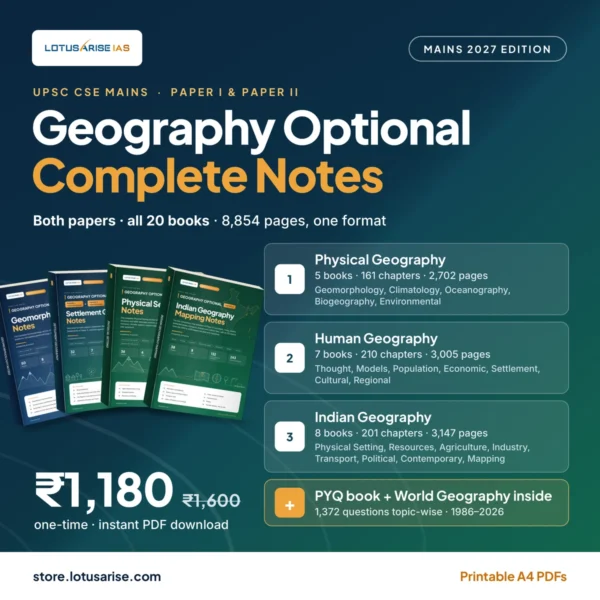
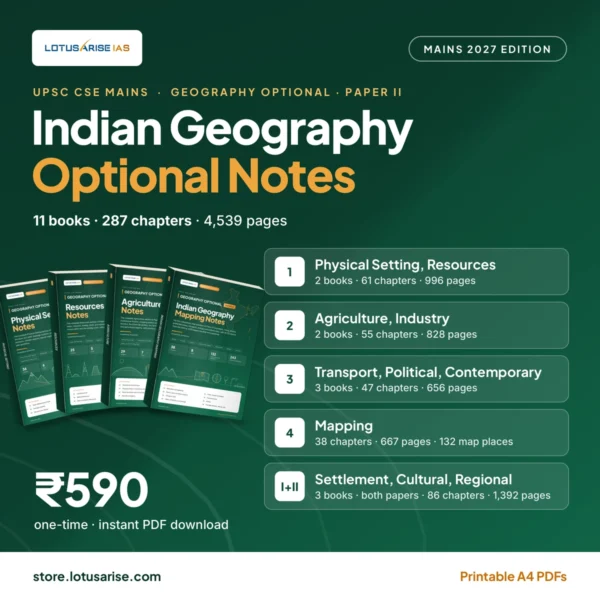
This book is also part of the Indian Geography: Geography Optional Notes bundle at ₹590 and of Geography Optional Complete Notes at ₹1,180.
One-time payment. No subscription. No recurring charge.
The download link reaches your email right after payment — please check your spam folder if you do not see it. Unlimited downloads, no expiry. English medium.
Read the free sample first (PDF)
For support: support@lotusarise.com
You may also like…
-

#OFFER: Geography Optional Complete Notes (PDF) – UPSC Mains (Paper I & II)
Original price was: ₹1,600.00.₹1,180.00Current price is: ₹1,180.00. -