

Indian Polity Notes for UPSC: Prelims & Mains GS Paper II (2027 Edition) by LotusArise IAS
Original price was: ₹700.00.₹349.00Current price is: ₹349.00.
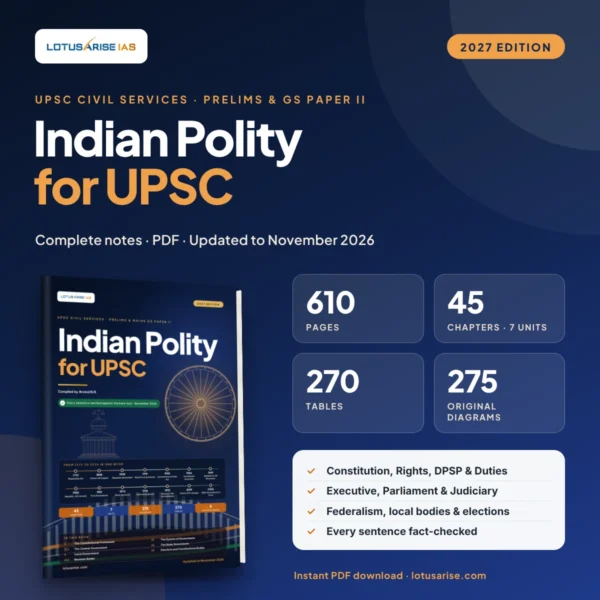
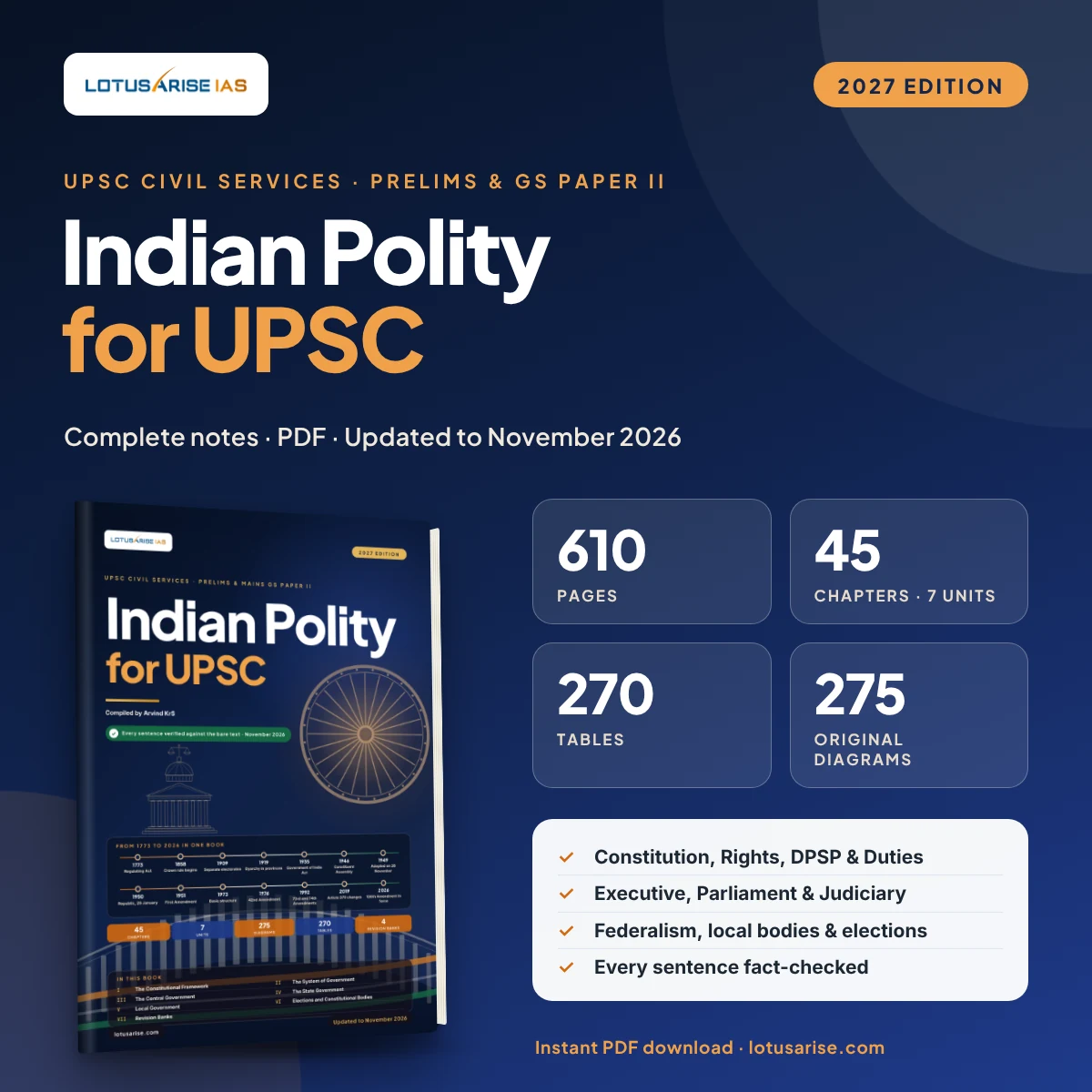
₹349 for the 2027 Edition (launch price, ₹700) — 610 pages, about 57 paise a page.
Most aspirants prepare Polity from a book they bought two editions ago, a handful of PDFs and a memory of “the President can’t do X”. Then Prelims asks which Article, which amendment, which case — and the options are all close enough to confuse you. One wrong year, one wrong clause, and the mark is gone.
Indian Polity Notes for UPSC gives you the whole Polity syllabus in one current, fact-checked book.
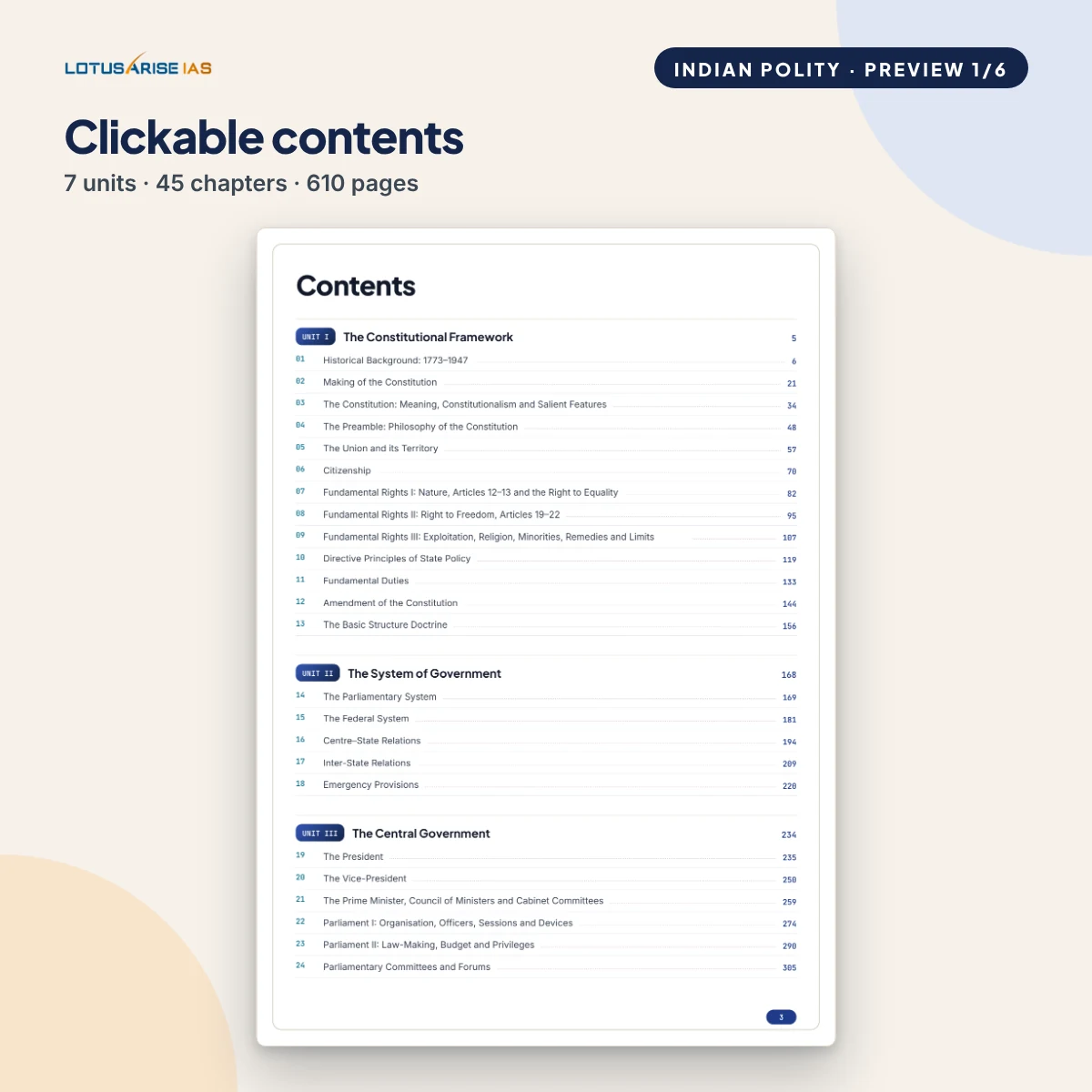
📜 45 chapters in 7 units, 610 pages — from the Regulating Act of 1773 to the 106th Amendment in force in 2026: Rights, DPSP, Parliament, the Executive, the courts, federalism, local bodies, elections and every constitutional body
✅ Every sentence checked against the bare text of the Constitution — Articles, clauses, amendments, case years, Bench splits and current status, current to November 2026
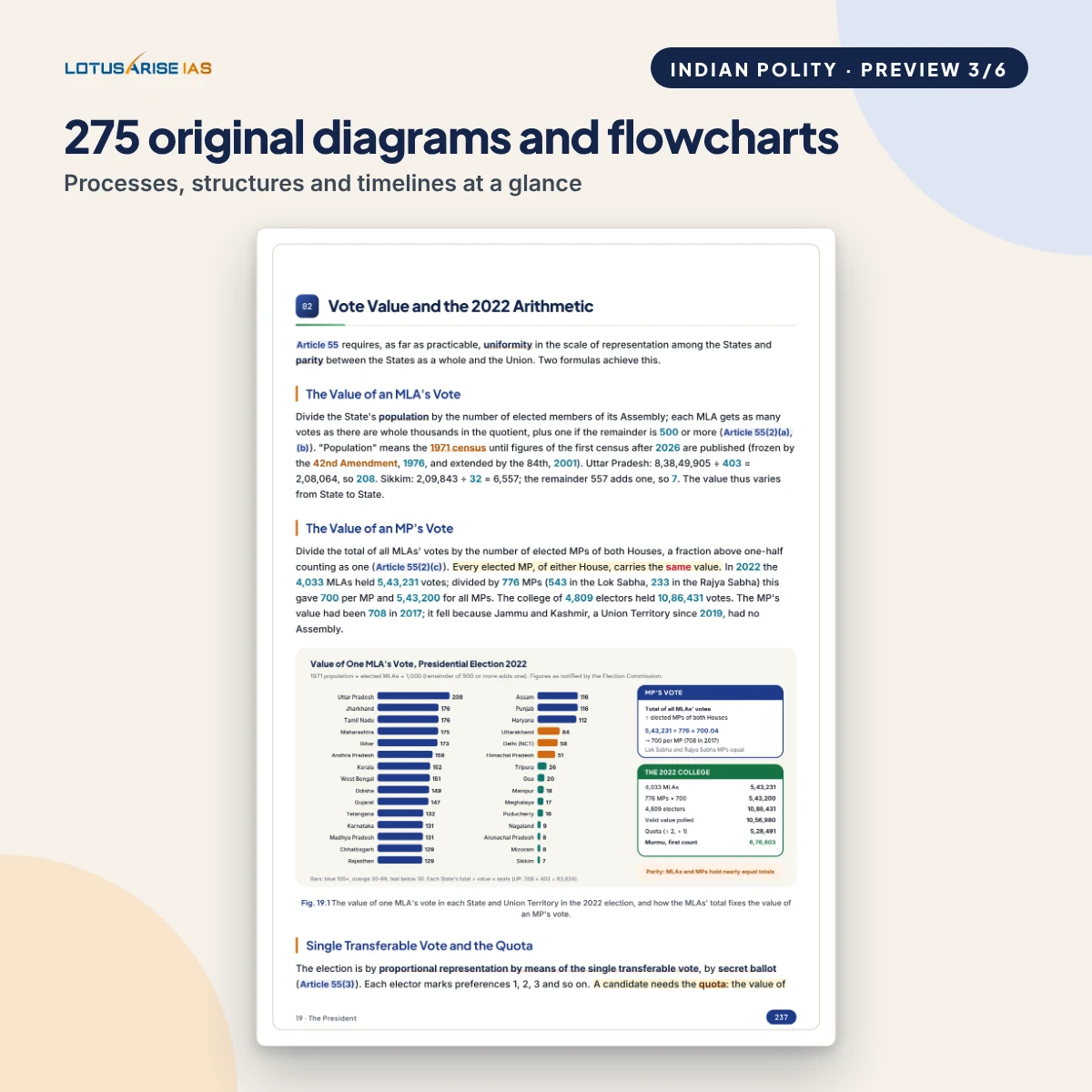
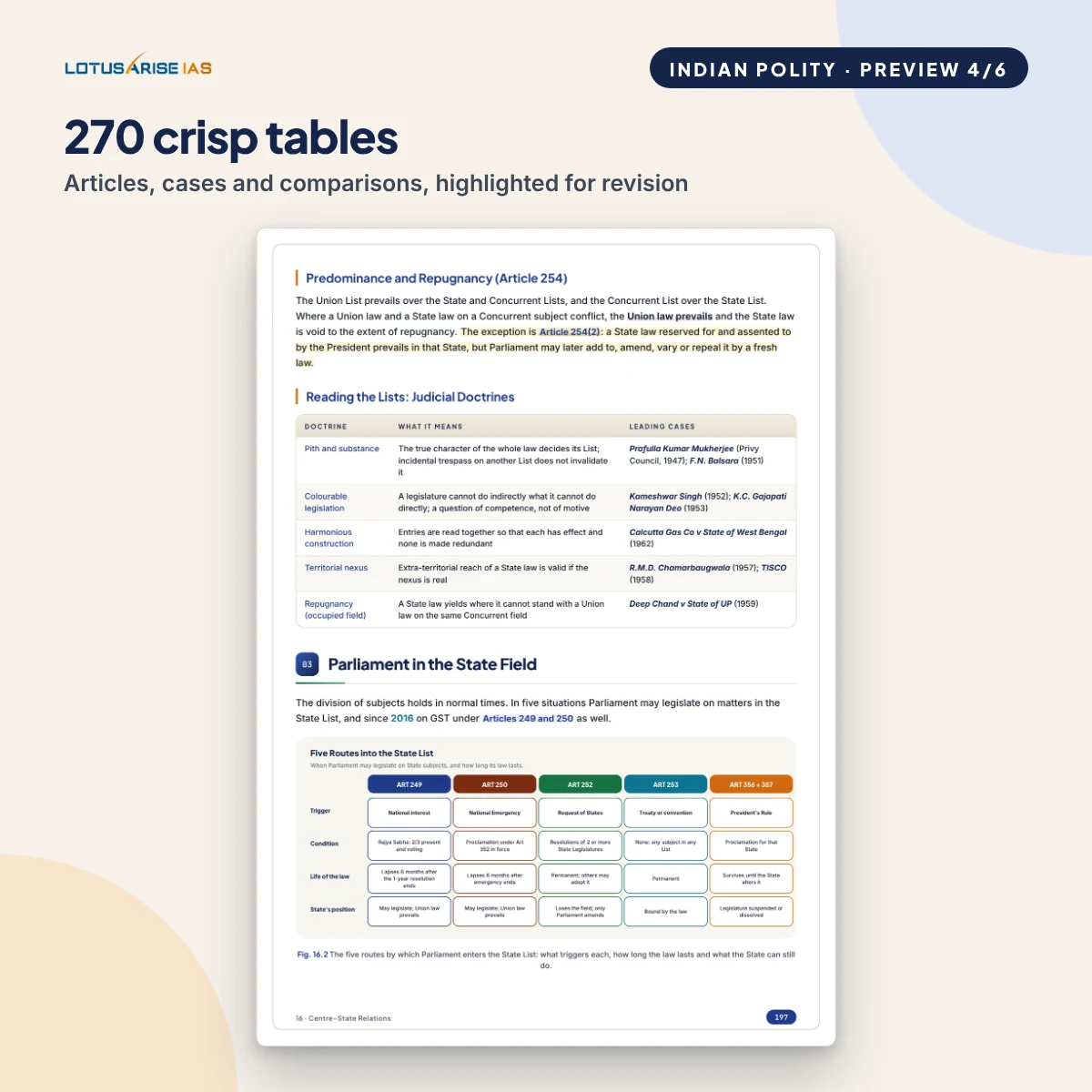
🎨 275 original diagrams, 270 tables and a mind-map in every chapter — procedures, comparisons and timelines you can redraw in an answer
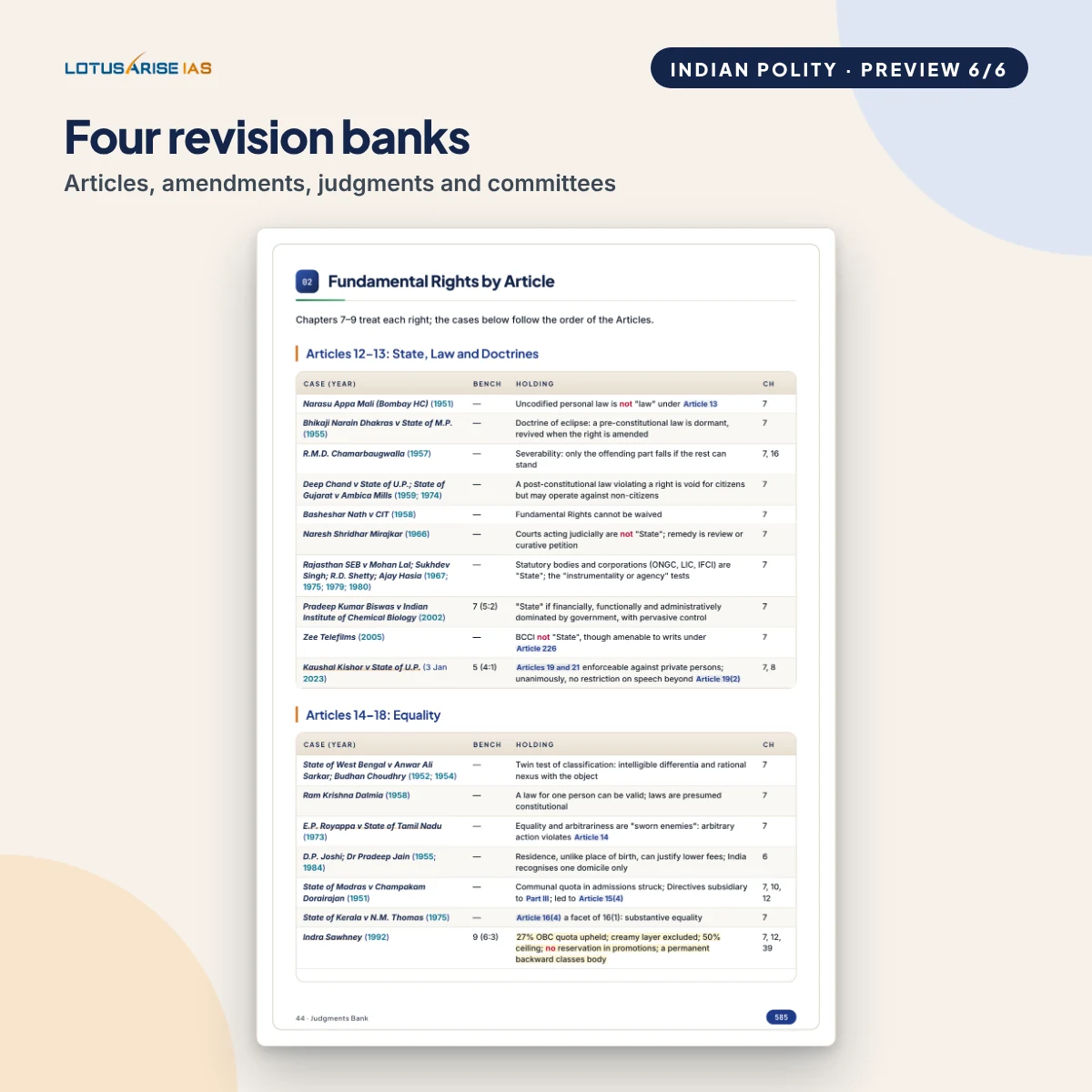
📚 Four revision banks — every important Article, all 106 amendments, about 350 landmark judgments and about 120 committees and commissions
📱 Instant PDF download — laptop, mobile or tablet, offline, printable
One-time payment. No subscription. Unlimited downloads — the link does not expire.
⭐ Read by 300,000+ UPSC aspirants every month on LotusArise IAS
Features:
- Comprehensive Coverage
- Complete Syllabus
- Suitable for: UPSC & State PSCs exams
- Format: Digital PDF (Downloadable)
- 337,362+ aspirants visit every month
The problem nobody admits about Polity
Ask an aspirant how ready they are for Polity, and the first answer is usually “it’s my strongest subject”. Push a little, and you hear one of three things:
“I’ve read the standard book twice. In the exam I still couldn’t tell whether that power came from Article 123 or Article 213, or which amendment added it.”
“My notes say the Deputy Speaker must be elected, the Governor has to sign within a month, the women’s quota is pending. I know some of it has changed. I just don’t know which part.”
“For Mains I can explain federalism in general. When the question asks about the Governor and State Bills, I have no judgment, no date and no committee to quote.”
These are not knowledge problems. Polity looks static, but its facts move every year — new judgments, new amendments, new Bills, Presidential references, changed numbers. A single outdated sentence costs a Prelims mark and weakens a Mains answer. Indian Polity Notes for UPSC puts the whole subject, current to November 2026, in one book in which every sentence has been checked.
Why Polity deserves a book you can trust line by line
Polity carries a steady block of Prelims questions every year, and UPSC’s questions are built on precise wording: “only”, “all”, “which Article”, “which amendment”. It also runs through GS Paper II in Mains — the Constitution, federalism, Parliament, the Executive and the Judiciary, constitutional and statutory bodies — and feeds your Essay and your Interview.
The challenge is not understanding Polity. It is having one source in which every Article number, clause, amendment, case year and current status is right — so that you can revise with confidence instead of second-guessing every line.
What’s inside
📜 The complete notes — 45 chapters in 7 units, 610 pages
- The Constitutional Framework — historical background from 1773 to 1947, the making of the Constitution, salient features, the Preamble, Union and territory, citizenship, Fundamental Rights in three chapters, Directive Principles, Fundamental Duties, amendment and the basic structure
- The System of Government — the parliamentary and federal systems, Centre–State and inter-State relations, emergency provisions
- The Central Government — the President, Vice-President, Prime Minister and Council of Ministers, Parliament in two chapters, parliamentary committees, the Supreme Court, judicial review and PIL
- The State Government — the Governor, Chief Minister, State Legislature, High Courts, subordinate courts and tribunals, Union Territories and special provisions, Scheduled and Tribal Areas
- Local Government — Panchayati Raj and municipalities after the 73rd and 74th Amendments
- Elections and Constitutional Bodies — elections and the Election Commission, parties and the anti-defection law, the Finance Commission, GST Council, PSCs, CAG, law officers, the commissions for SCs, STs and BCs, NITI Aayog, NHRC, CIC, CVC, CBI, Lokpal, NIA, NDMA and the Law Commission, official language and the services
- Revision Banks — Articles, amendments, judgments, committees and commissions
What makes this different from downloaded PDFs: every chapter was written fresh for the exam and then checked sentence by sentence against the bare text of the Constitution, the standard reference books and primary sources — Supreme Court judgments, India Code, the Gazette and Parliament’s own records. Errors that are common even in the standard books were corrected along the way, and current developments sit in the chapter they change: the 106th Amendment in force from April 2026 and the defeat of the 131st Amendment Bill, the 2025 Presidential reference on Governors and Bills, the 16th Finance Commission, the Supreme Court’s raised strength of 38, the One Nation One Election and 130th Amendment Bills, the 2026 Tribunals Act, and the latest judgments on rights. Articles are highlighted throughout and the key sentences of each chapter are marked, so revision is fast.
🎨 275 original diagrams and flowcharts
How a Bill becomes law, the election of the President with the 2022 vote arithmetic, impeachment and removal procedures, the collegium, Article 356 after Bommai, the three Lists, the Panchayati Raj tiers, the anti-defection law and many more — each drawn fresh and simple enough to reproduce in an answer.
📊 270 tables and a mind-map in every chapter
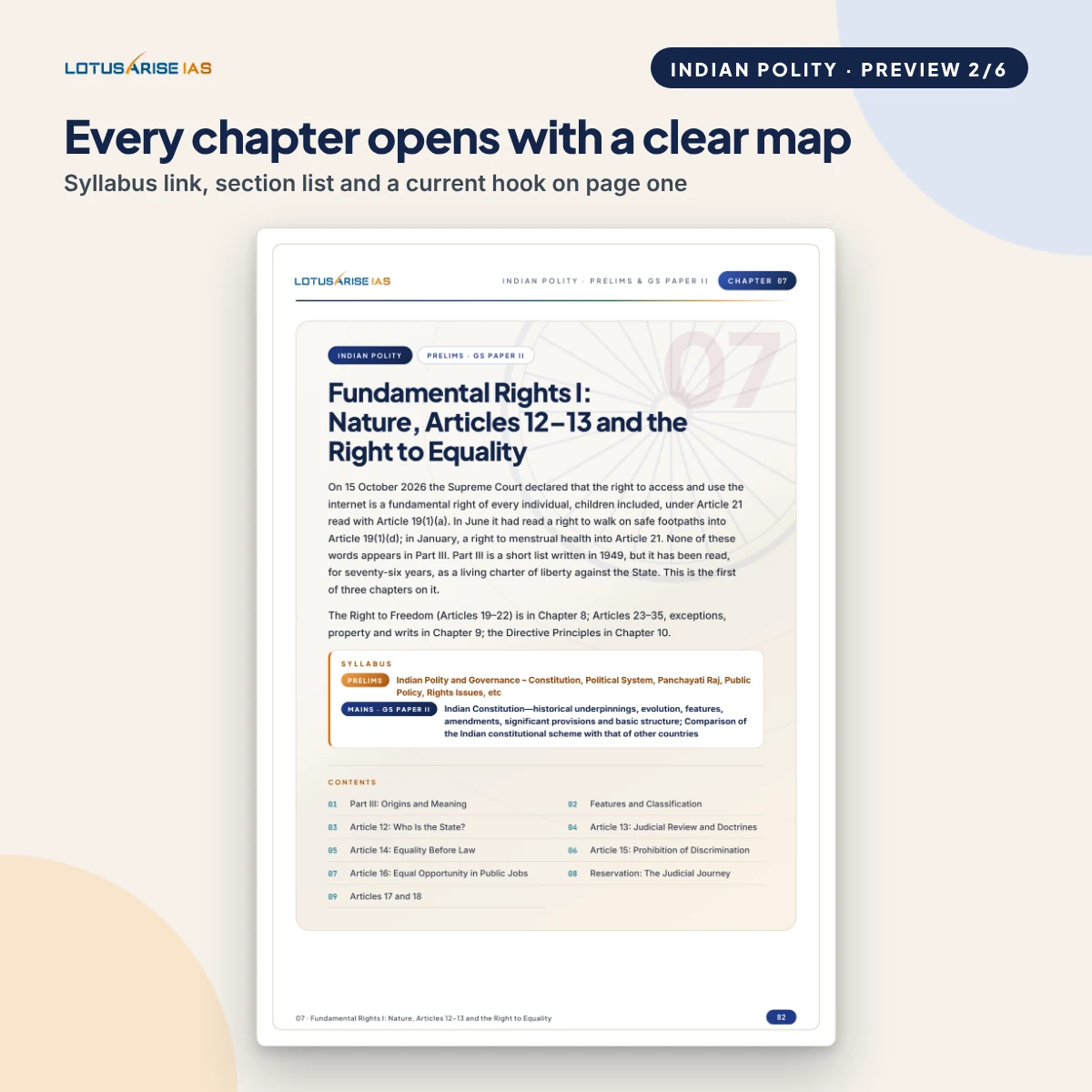
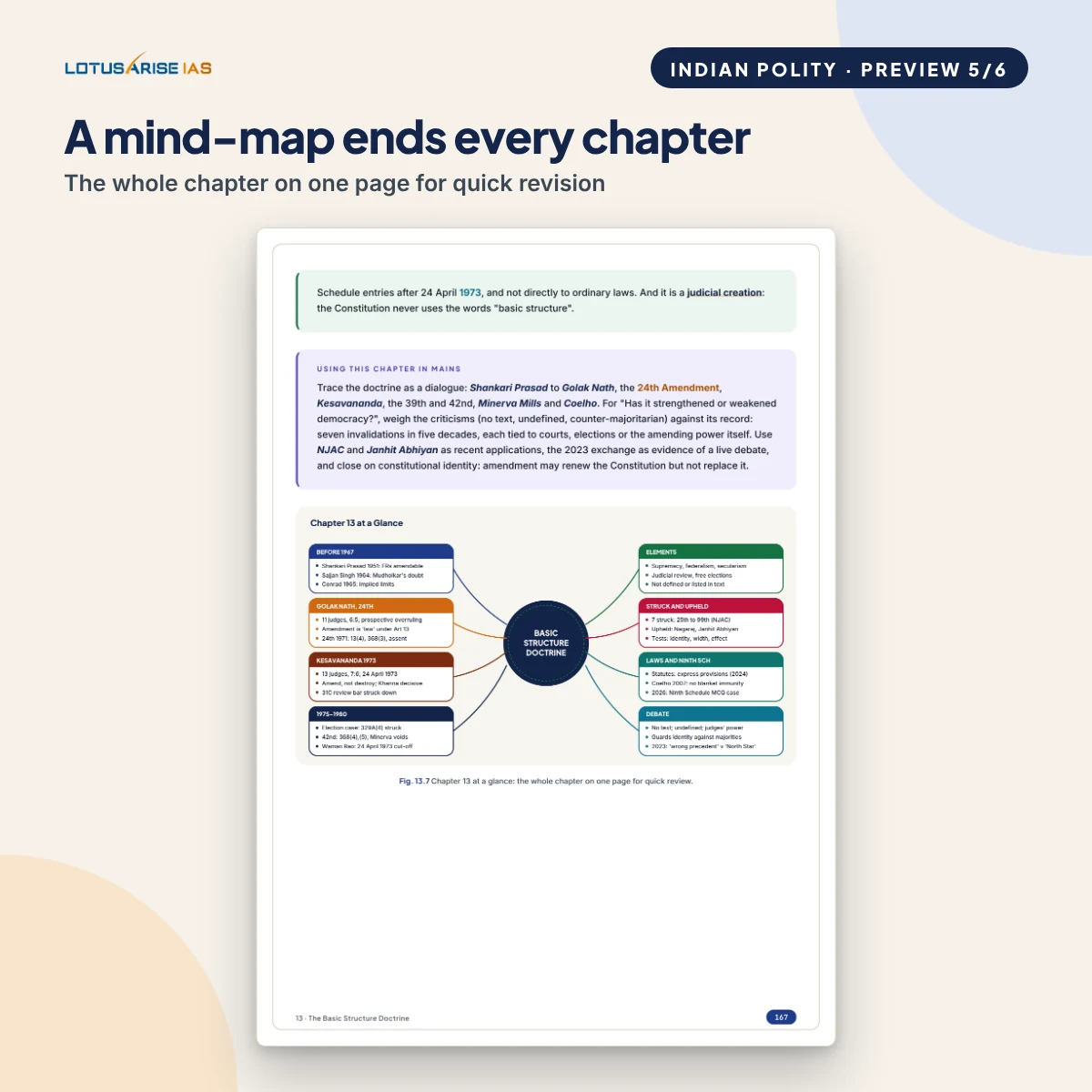
Article-by-Article summaries, comparisons such as President and Governor, Lok Sabha and Rajya Sabha, Article 32 and Article 226, the 73rd and 74th Amendments, and timelines of case law. Every chapter ends with a one-page mind-map and a short “Using this chapter in Mains” box.
📚 Four revision banks
- Articles Bank — every important Article, Part by Part, with the 12 Schedules
- Amendments Bank — all 106 Amendment Acts, plus the Bills still pending
- Judgments Bank — about 350 landmark cases by theme, with year, Bench and holding
- Committees and Commissions Bank — about 120 committees and commissions with chair, year and key recommendation
The aspirant who buys this
First-time aspirants — you want one trusted Polity book from day one, current and complete, instead of an old edition plus a folder of updates.
Repeaters — you know Polity, yet you lose Prelims marks on the close options and Mains marks on answers without a case or a committee. This book gives you the exact facts and where to use them.
Aspirants with PSIR, Public Administration or Law optional — the Indian government and politics chapters overlap directly with your optional.
Self-study aspirants outside Delhi, Prayagraj or Jaipur — no classroom, no batch timings; one PDF on your phone that covers the whole syllabus.
State PSC aspirants — Polity is in every State PSC paper, so the same book serves both.
Why not just use free notes and a standard textbook?
Free Polity notes exist, and most aspirants already own a standard book. The problem is not that they are bad. It is that a printed book dates the day after it is printed, and free notes are rarely checked — a wrong Article number, an amendment’s year, a case decided last year or a Bill that has since failed.
This book is one connected, checked system: the whole syllabus in sequence, current to November 2026, every sentence checked against the Constitution and primary sources, with diagrams, tables, mind-maps and four revision banks built for the last month before the exam.
If you have the time to check every fact yourself against the bare text and the latest judgments, you may not need this. If you want it already done — open it and start — this is what the book is for.
Price and delivery
A printed Polity guide usually costs more than this PDF, and a printed book cannot carry developments up to November 2026.
₹349 at launch (₹700) for 610 pages — about 57 paise a page.
Want to see it first? Download the free sample PDF — the cover, the full contents, and three complete chapters: Chapter 4 (The Preamble), Chapter 10 (Directive Principles of State Policy) and Chapter 19 (The President).
One-time payment. No subscription. No recurring charge.
Instant PDF download after payment. The download link is also sent to your email — please check the spam folder if it does not arrive in a few minutes. Download it again any time from My Account.
For support: support@lotusarise.com
Related products
-

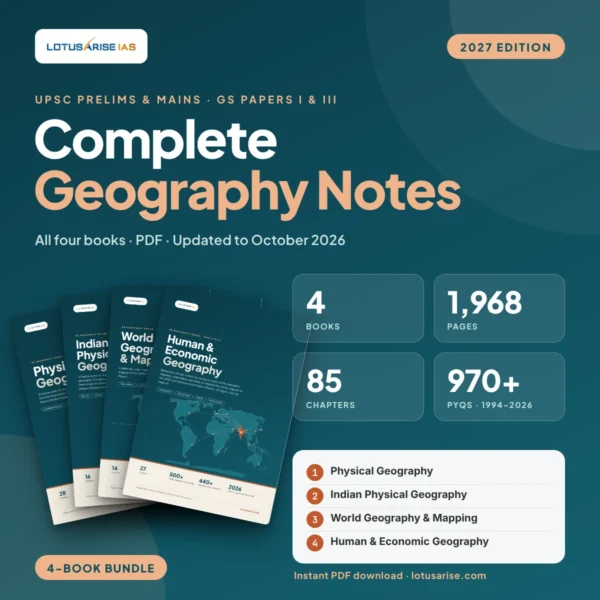
Complete Geography Notes for UPSC GS Prelims + Mains: 4-Book Bundle (2027 Edition) by LotusArise IAS
Original price was: ₹1,500.00.₹599.00Current price is: ₹599.00. -
-
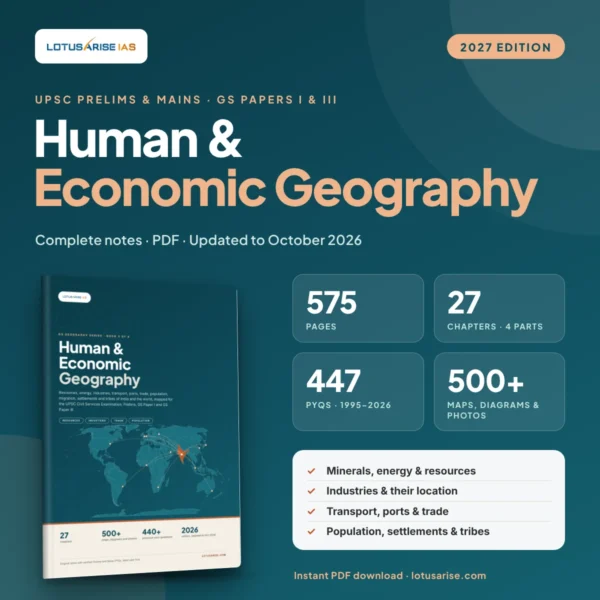
Human & Economic Geography Notes for UPSC: Prelims & Mains GS Papers I and III (2027 Edition) by LotusArise IAS
Original price was: ₹400.00.₹199.00Current price is: ₹199.00. -
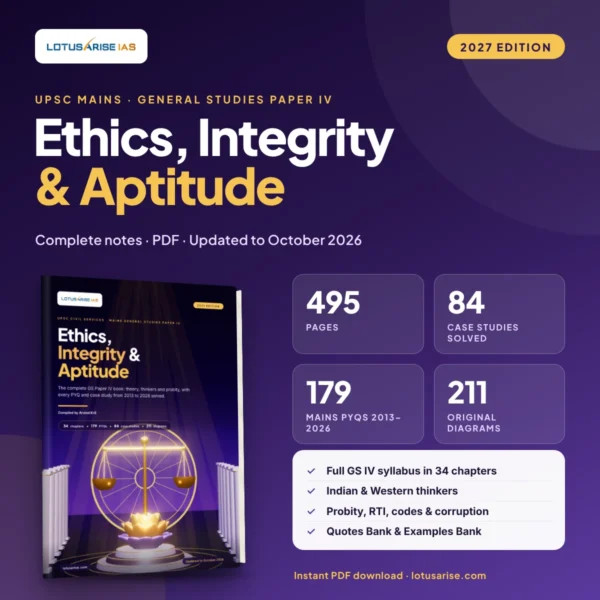
Ethics, Integrity and Aptitude Notes for UPSC: Mains GS Paper IV (2027 Edition) by LotusArise IAS
Original price was: ₹500.00.₹295.00Current price is: ₹295.00.