

Agriculture Notes for UPSC: Prelims & Mains GS Papers I and III (2027 Edition) by LotusArise IAS
Original price was: ₹250.00.₹149.00Current price is: ₹149.00.
₹149 for the 2027 Edition. MRP ₹250 — 270 pages, about 55 paise a page.
Most aspirants study Agriculture the wrong way. A Geography chapter for crops, an Economy chapter for schemes, a Telegram PDF for soils, and current data from nowhere. Then Prelims asks which crop fixes nitrogen, which soil needs gypsum or what a new mission promises — and none of the three sources has the answer in one place.
Agriculture Notes for UPSC puts the whole subject in one book.
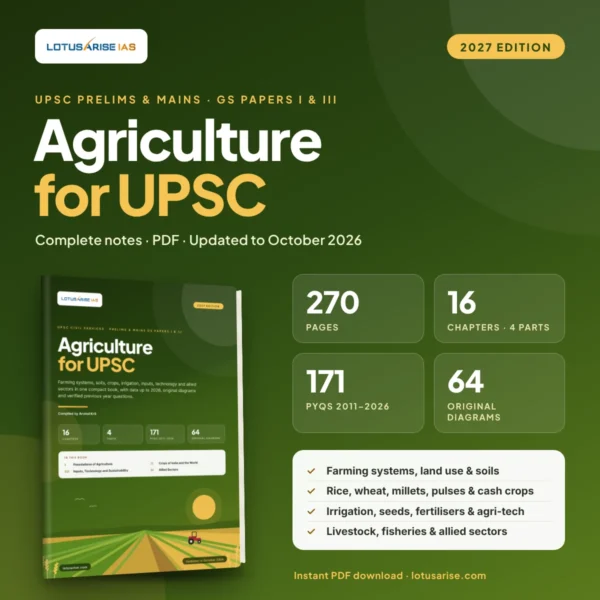
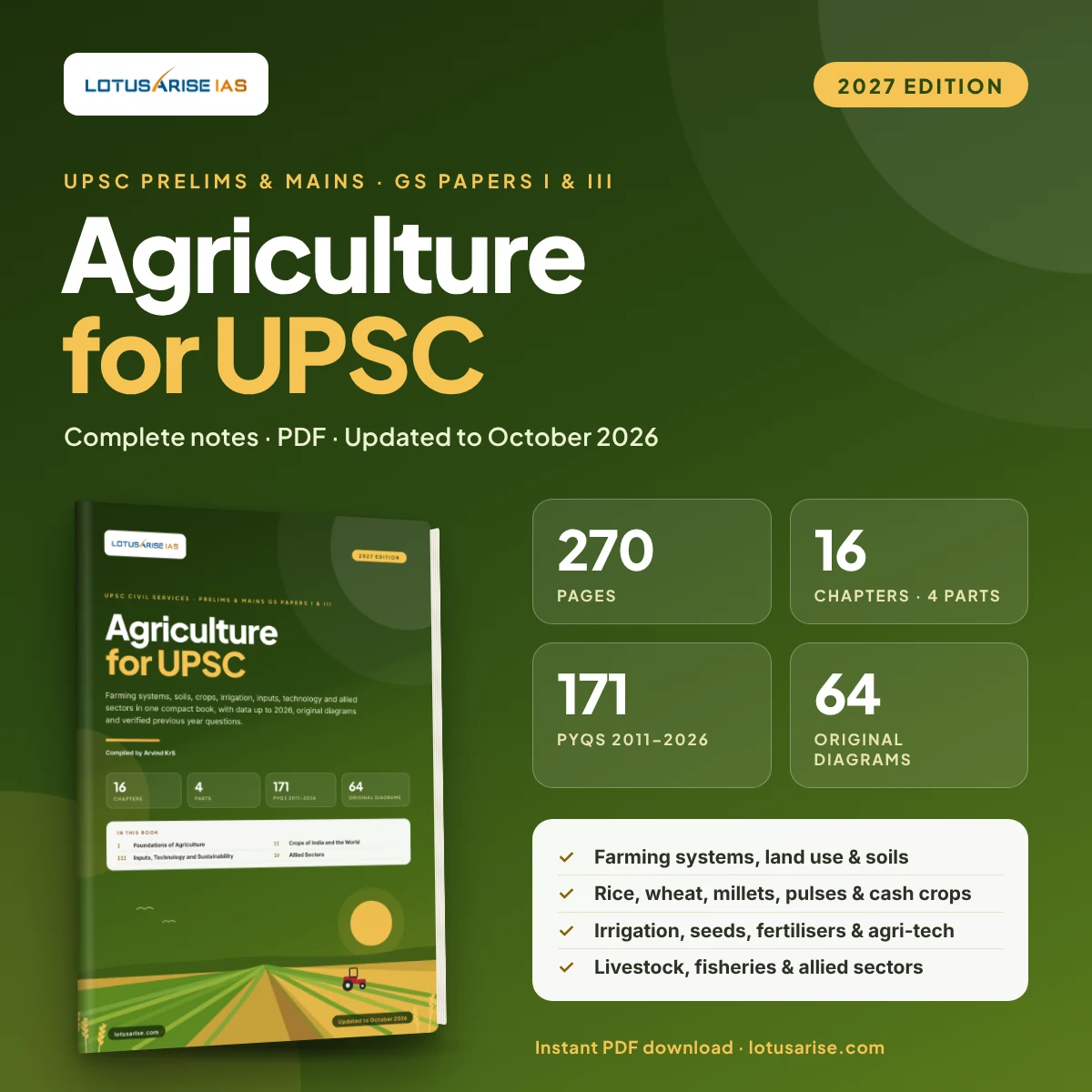
🌾 16 chapters in 4 parts, 270 pages — farming systems, soils, crops, irrigation, seeds, fertilisers, agri-tech, livestock and fisheries
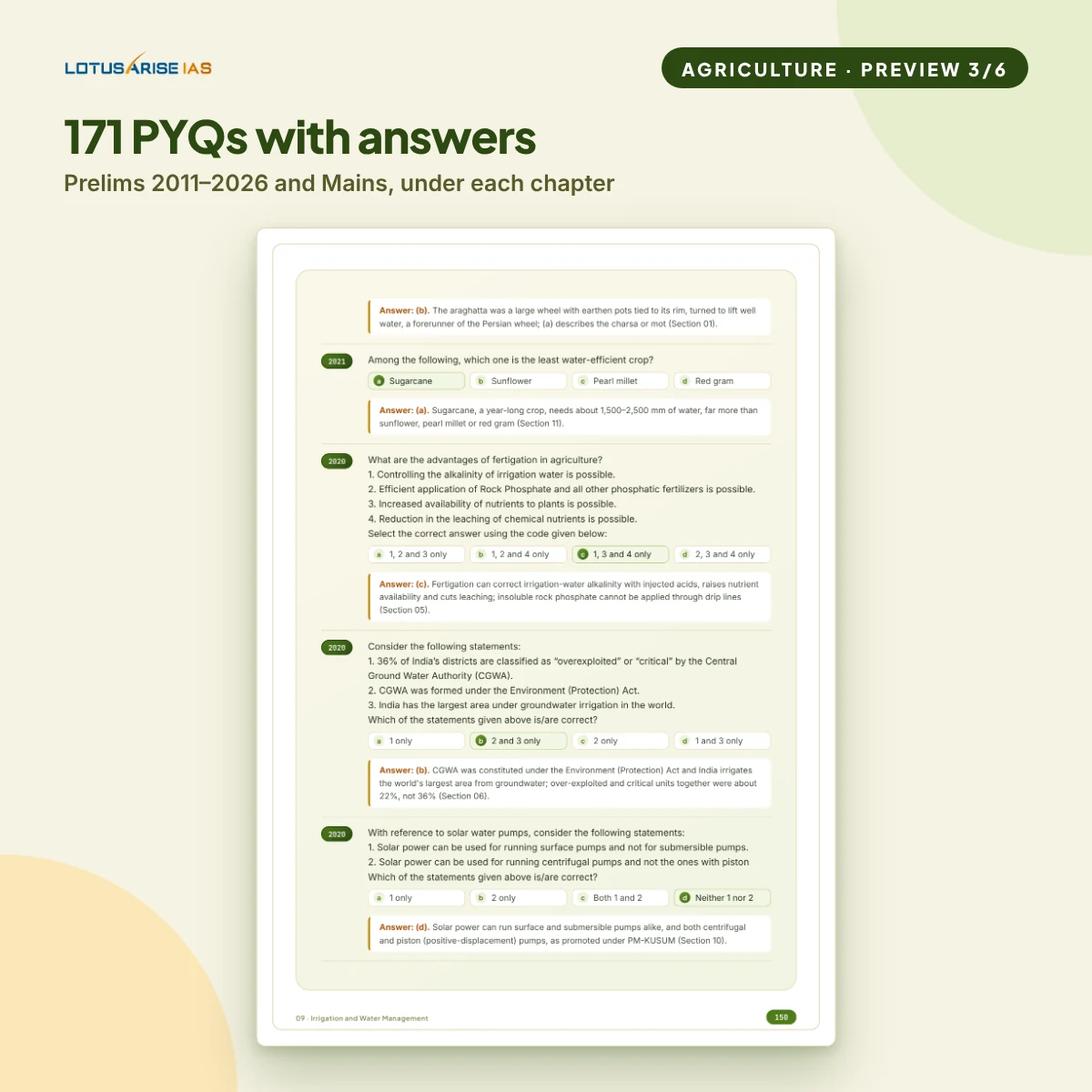
📝 171 PYQs — 123 Prelims (2011–2026) with answers and 48 Mains (2013–2026) with answer approaches, each under its chapter
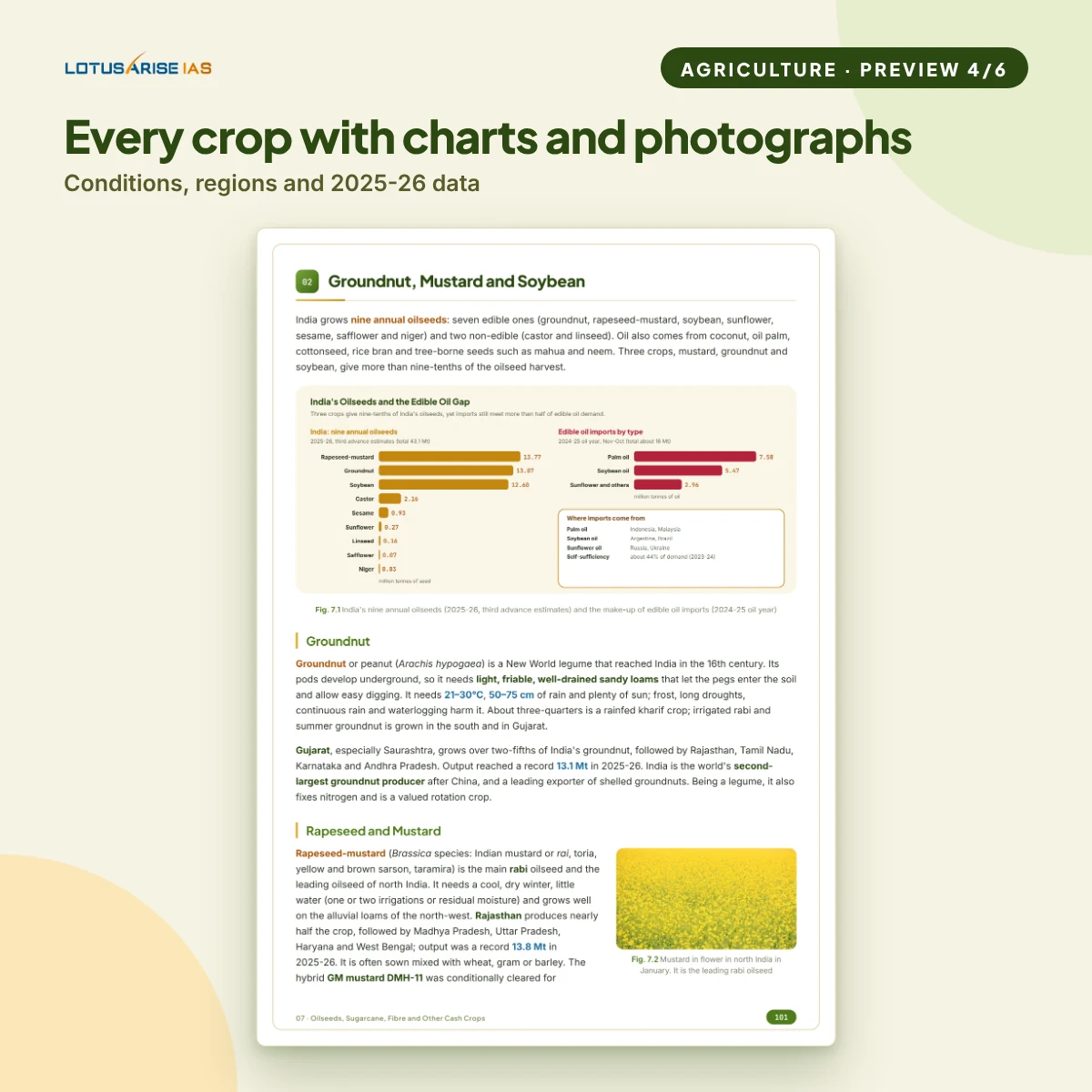
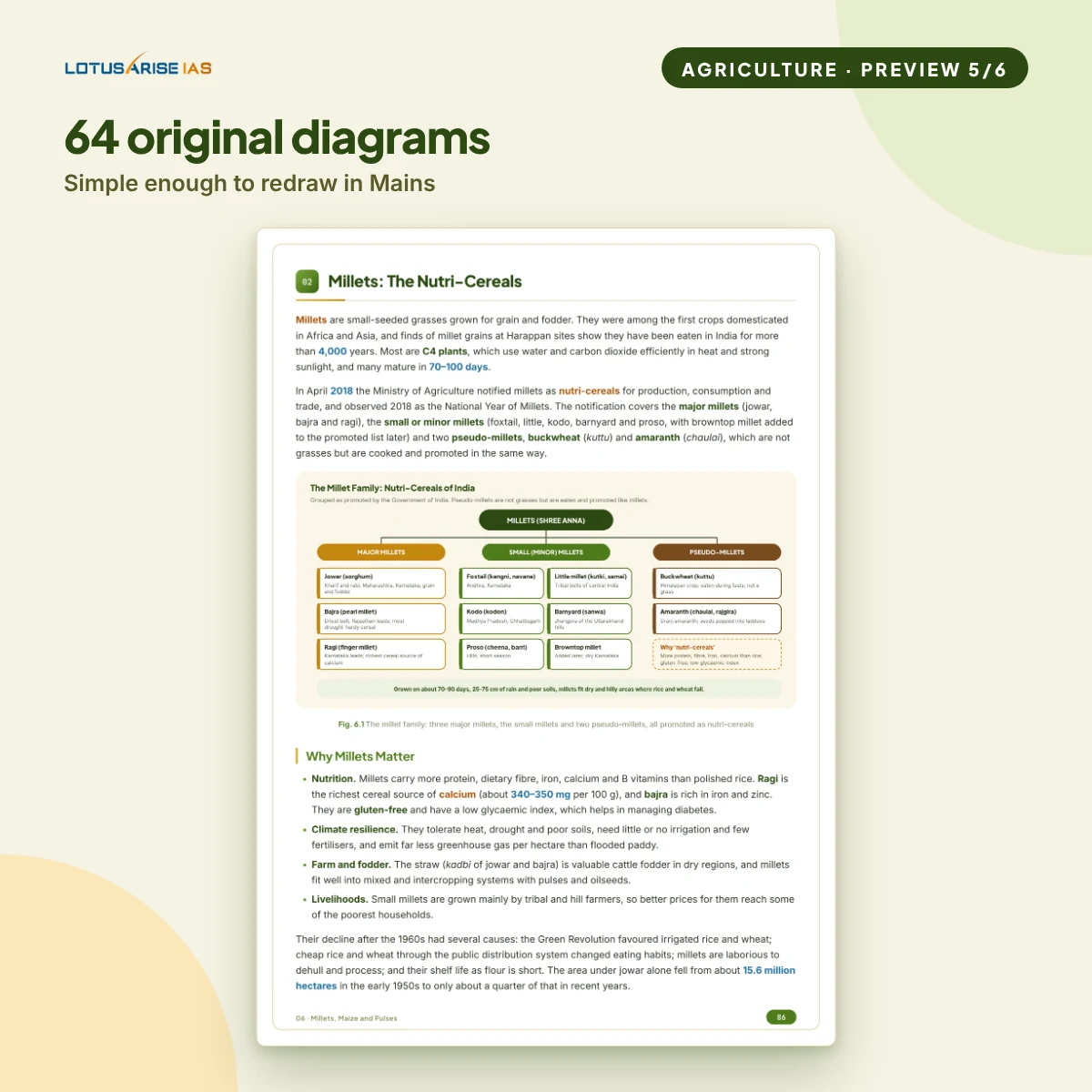
🎨 64 original diagrams + colour photographs — crop calendars, cycles and charts you can redraw in Mains
🗓️ Data updated to October 2026 — 2025-26 crop estimates, Budget 2026-27, new missions for cotton, pulses and oilseeds
📱 Instant PDF download — laptop, mobile or tablet, offline, printable
One-time payment. No subscription. Unlimited downloads — the link does not expire.
⭐ Read by 300,000+ UPSC aspirants every month on LotusArise IAS
Features:
- Comprehensive Coverage
- Complete Syllabus
- Suitable for: UPSC & State PSCs exams
- Format: Digital PDF (Downloadable)
- 337,362+ aspirants visit every month
The problem nobody admits about Agriculture
Ask an aspirant three months before Prelims where Agriculture sits in their plan, and the honest answer is “everywhere and nowhere”. They will say one of three things:
“Crops are in my Geography notes, schemes are in Economy, soils and fertilisers are in Science — I’ve never read Agriculture as one subject.”
“My agriculture notes are from 2022. I don’t know the current production figures, which missions are new, or what changed with fertilisers and seeds.”
“I can answer a question on the Green Revolution, but not one on nano urea, genome-edited rice or sericulture.”
These are not reading problems. Agriculture is not a hard subject; what goes wrong is that it is split across three subjects and never updated. Agriculture Notes for UPSC is one book built to fix exactly that.
Why Agriculture deserves a book of its own
Agriculture questions turn up in GS Prelims almost every year — the 123 Prelims questions from 2011 to 2026 inside this book are the proof, from mixed farming and laterite soils to Bt cotton, millets and sericulture. In Mains, the same material feeds GS Paper I (distribution of crops and resources, location of agro-industries) and GS Paper III (cropping patterns, irrigation, e-technology for farmers, technology missions and the economics of animal rearing), and the 48 Mains questions from 2013 to 2026 show how often it is asked.
The subject also moves every year: new crop estimates, new missions, new fertiliser and seed rules, new technology on the farm. The real challenge is not understanding Agriculture. It is having one source that is complete, current and organised the way the exam tests it.
What’s inside
🌾 The complete notes — 16 chapters, 270 pages
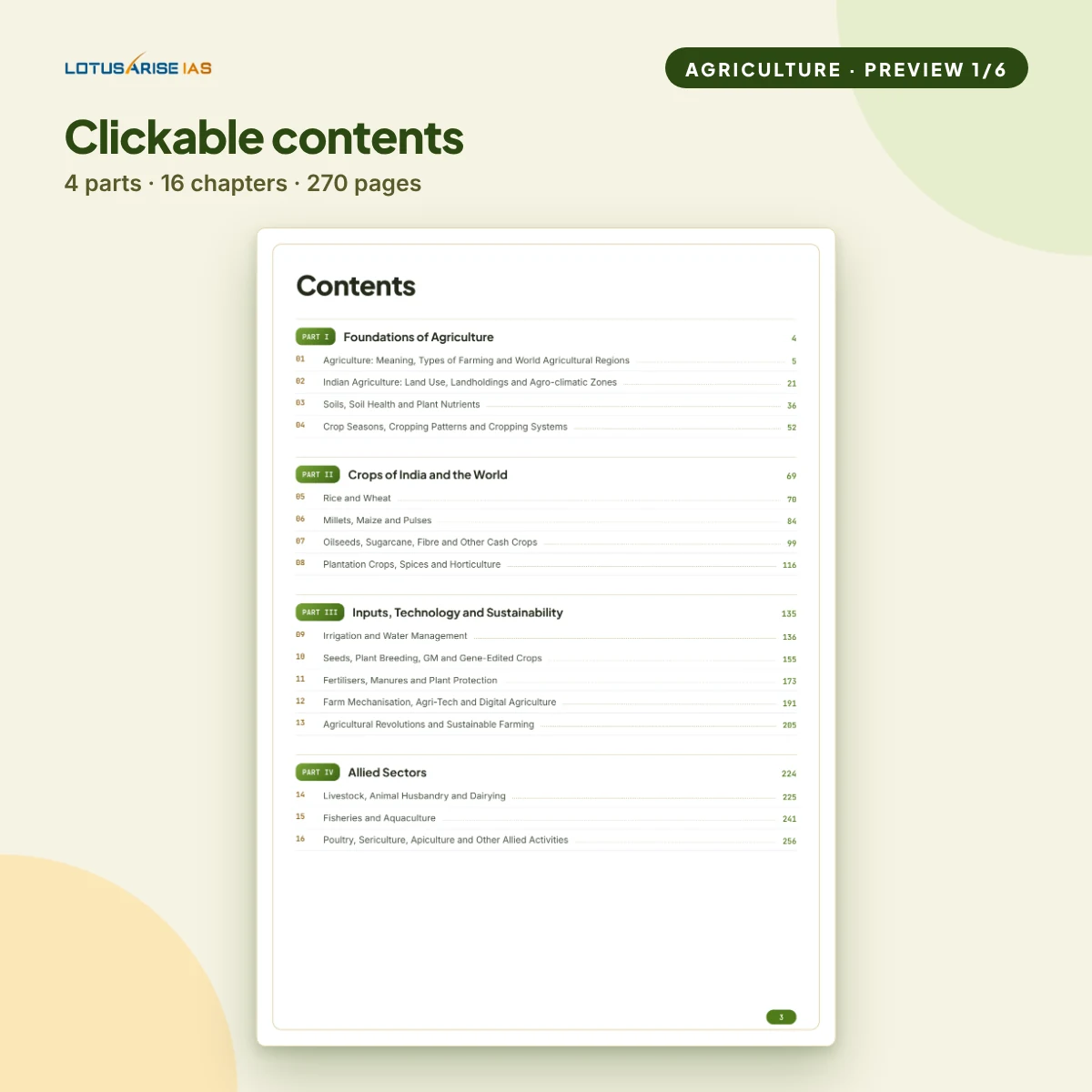
Four parts, in the order the subject is best learnt:
- Foundations of Agriculture — types of farming and world agricultural regions, shifting cultivation, plantation and Mediterranean farming, von Thünen’s model; India’s land use, landholdings and agro-climatic zones; soils, soil health, problem soils and plant nutrients; crop seasons, cropping patterns, cropping systems and Integrated Farming Systems
- Crops of India and the World — rice and wheat; millets (Shree Anna), maize and pulses; oilseeds, sugarcane, cotton, jute and tobacco; tea, coffee, rubber, coconut, spices and horticulture — growing conditions, leading states and countries, and the latest output
- Inputs, Technology and Sustainability — irrigation, micro-irrigation and watershed development; seeds, plant breeding, GM and gene-edited crops; fertilisers, manures, biofertilisers and plant protection; farm mechanisation, drones, AgriStack and digital agriculture; the Green Revolution and other revolutions, organic, natural and conservation farming
- Allied Sectors — livestock, indigenous breeds and dairying; fisheries and aquaculture; poultry, sericulture, apiculture, lac, mushrooms and other allied activities
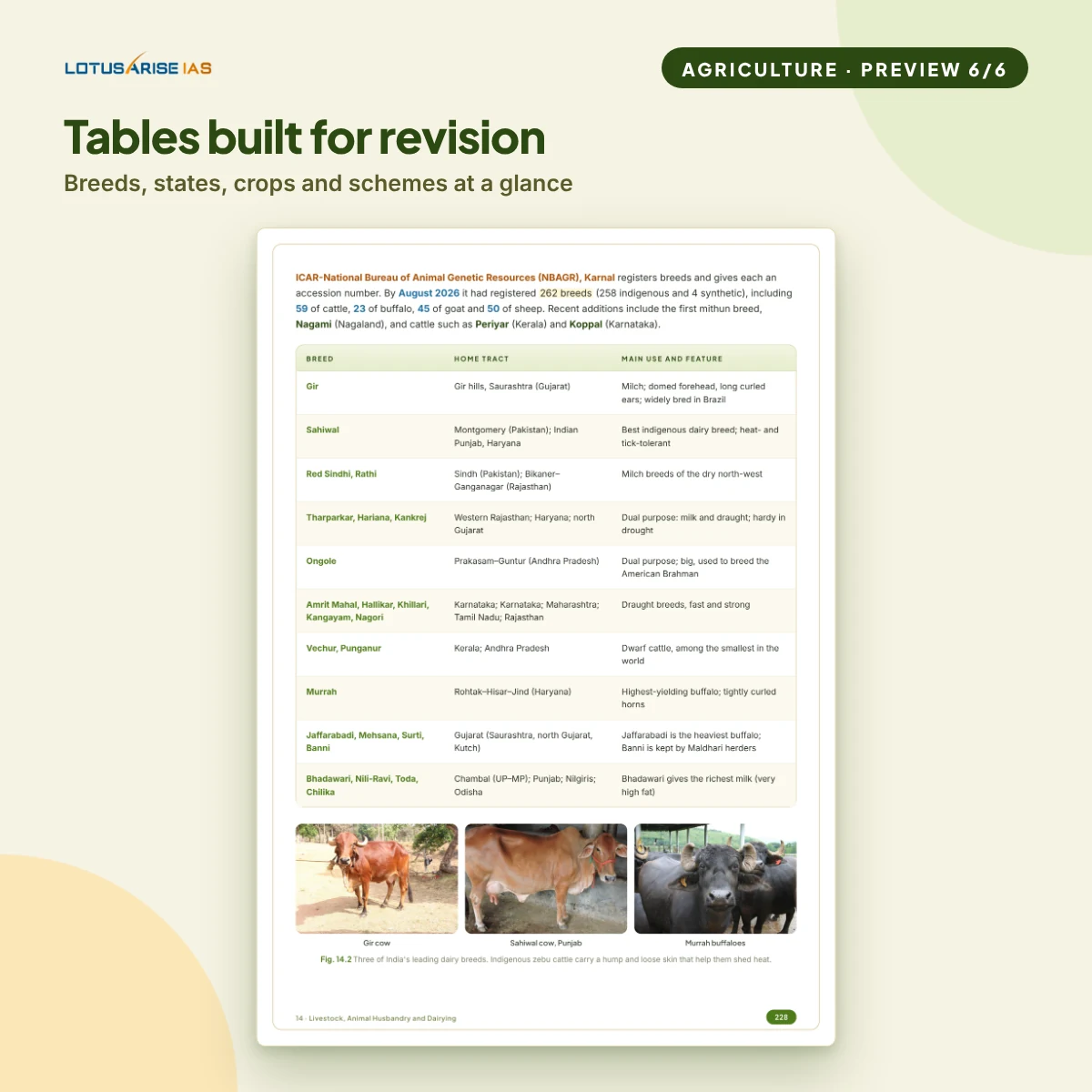
What makes this different from downloaded PDFs: every chapter is written fresh for the exam, not copied from a textbook. Figures are checked against current official data, so production numbers are the 2025-26 estimates and the schemes are the ones running now. Each chapter closes with its own previous year questions, so you finish a topic and immediately see how UPSC has tested it. The language is plain: short paragraphs, clear headings, comparison tables and “common confusion” boxes rather than dense academic prose.
📝 171 PYQs — Prelims 2011–2026 and Mains 2013–2026
Every Prelims question appears verbatim with all four options and the answer marked, plus a one-line reason. Every Mains question carries its paper and marks and a short answer approach. Both sit under the chapter that answers them, not in a separate book at the end.
🎨 64 original diagrams and colour photographs
Crop calendars, the shifting-cultivation cycle, nitrogen fixation, the tea-making process, watershed treatment, the life cycle of the silkworm, producer charts for rice, wheat, maize and cotton — each drawn fresh and simple enough to reproduce in a Mains answer. Colour photographs of crops, farms and animals help you recognise what you are reading about.
🗂️ Built for revision
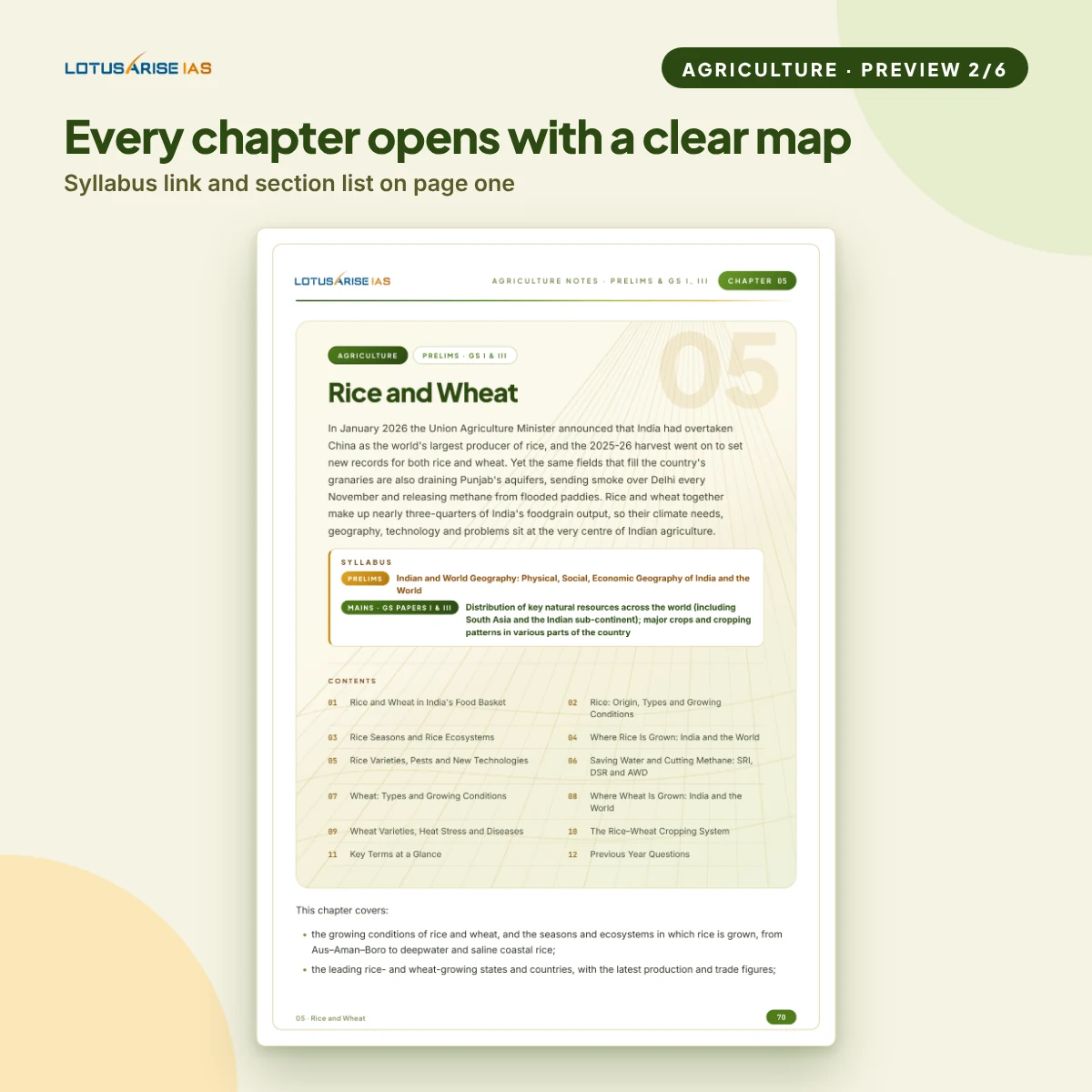
A clickable contents page, part pages that list every topic before you begin, and a bookmark panel that takes you to any section in one tap. A “Key Terms at a Glance” table closes most chapters for quick last-week revision.
The aspirant who buys this
First-time aspirants — you want one trusted book that covers Agriculture from farming systems to fisheries, instead of collecting it from three subjects.
Repeaters who lost marks to Agriculture questions in Prelims — you know the basics; what hurt you were the crop facts, soil and fertiliser science, breeds and schemes. The chapter-wise PYQs show exactly where those questions come from.
Mains aspirants preparing GS Papers I and III — cropping patterns, irrigation, technology missions, e-technology and animal rearing are all here, with diagrams you can draw in an answer.
Self-study aspirants outside Delhi, Prayagraj or Jaipur — no classroom, no batch timings; one PDF on your phone that covers the whole subject.
State PSC aspirants — agriculture is a large part of most State PSC syllabi, so the same book serves both.
Why not just use free notes from Telegram?
Free agriculture notes exist, and many aspirants have folders full of them. The problem is not that they are bad. It is that they are scattered across a dozen files, often several years old, and never connected to the questions UPSC has actually asked. Production figures from 2021 are still printed as current, and new missions and technologies are missing altogether.
This book is one connected system: one sequence of 16 chapters, current data, and every PYQ placed where it belongs.
If you have the time and discipline to build that system yourself from scattered sources, you may not need this. If you want it already built — open it and start reading — this is what the book is for.
Price and delivery
A single printed agriculture guide usually costs more than this PDF, and it will not carry chapter-wise PYQs to 2026 or 2025-26 data.
MRP ₹250 → ₹149 for 270 pages — about 55 paise a page.
Want to see it first? Download the free sample PDF — the cover, the full contents and two complete chapters (01 and 05).
One-time payment. No subscription. No recurring charge.
Instant PDF download after payment. The download link is also sent to your email — please check the spam folder if it does not arrive in a few minutes. Download it again any time from My Account.
For support: support@lotusarise.com
Related products
-

-
Human & Economic Geography Notes for UPSC: Prelims & Mains GS Papers I and III (2027 Edition) by LotusArise IAS
Original price was: ₹400.00.₹199.00Current price is: ₹199.00. -
International Relations Notes for UPSC: Prelims & Mains GS Paper II (2027 Edition) by LotusArise IAS
Original price was: ₹500.00.₹236.00Current price is: ₹236.00. -