

Internal Security Notes for UPSC: GS Paper III (2027 Edition) by LotusArise IAS
₹199.00
₹199 for the 2027 Edition — 377 pages, about 53 paise a page.
Most aspirants prepare Internal Security from a 2022 PDF and a folder of news clippings. Then the paper asks about narco-terrorism, the DPDP Act, the peace accords of the North-East, the plan to end Left-Wing Extremism by 2026 or the new IT Rules on fake news — and the answer has a definition, two vague points and no law, operation or data behind it.
Internal Security Notes for UPSC gives you the whole GS Paper III security syllabus in one current book.
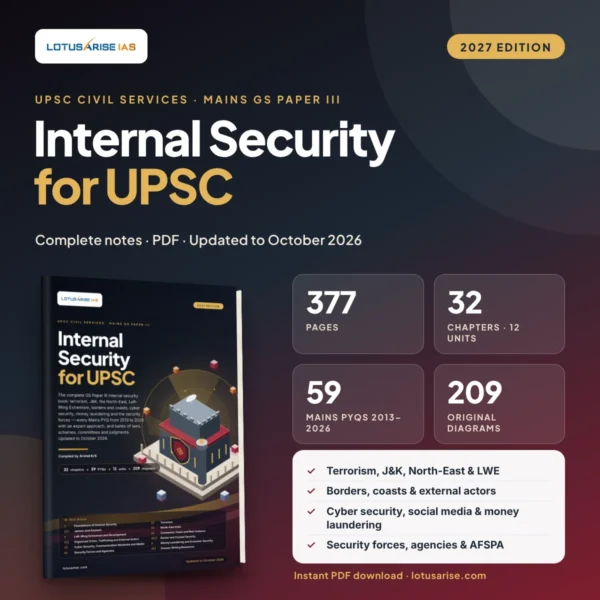
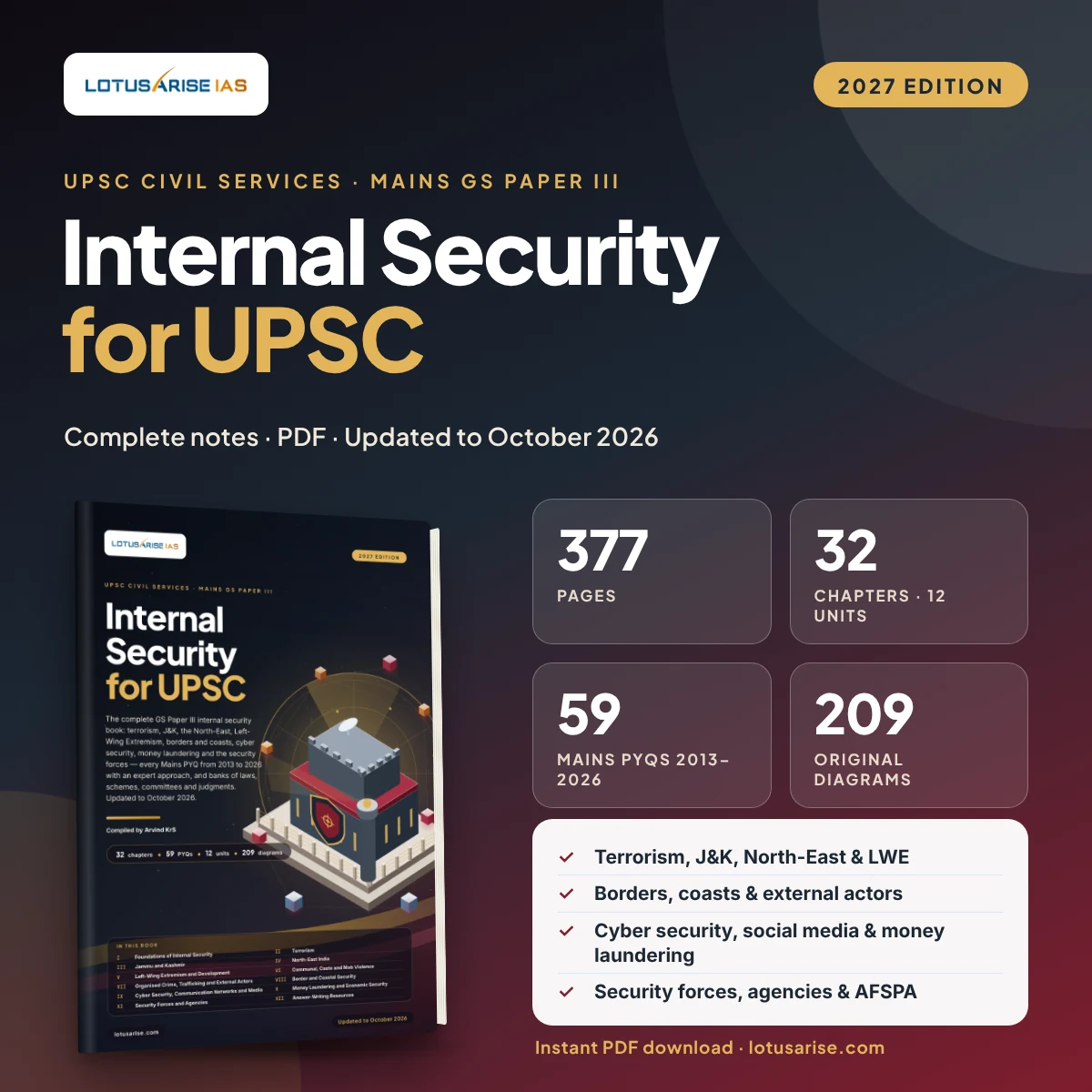
🛡️ 32 chapters in 12 units, 377 pages — terrorism and UAPA, J&K from Article 370 to Pahalgam and Operation Sindoor, the North-East and Manipur, Left-Wing Extremism, borders and coasts, cyber security, social media, money laundering, and the security forces and agencies
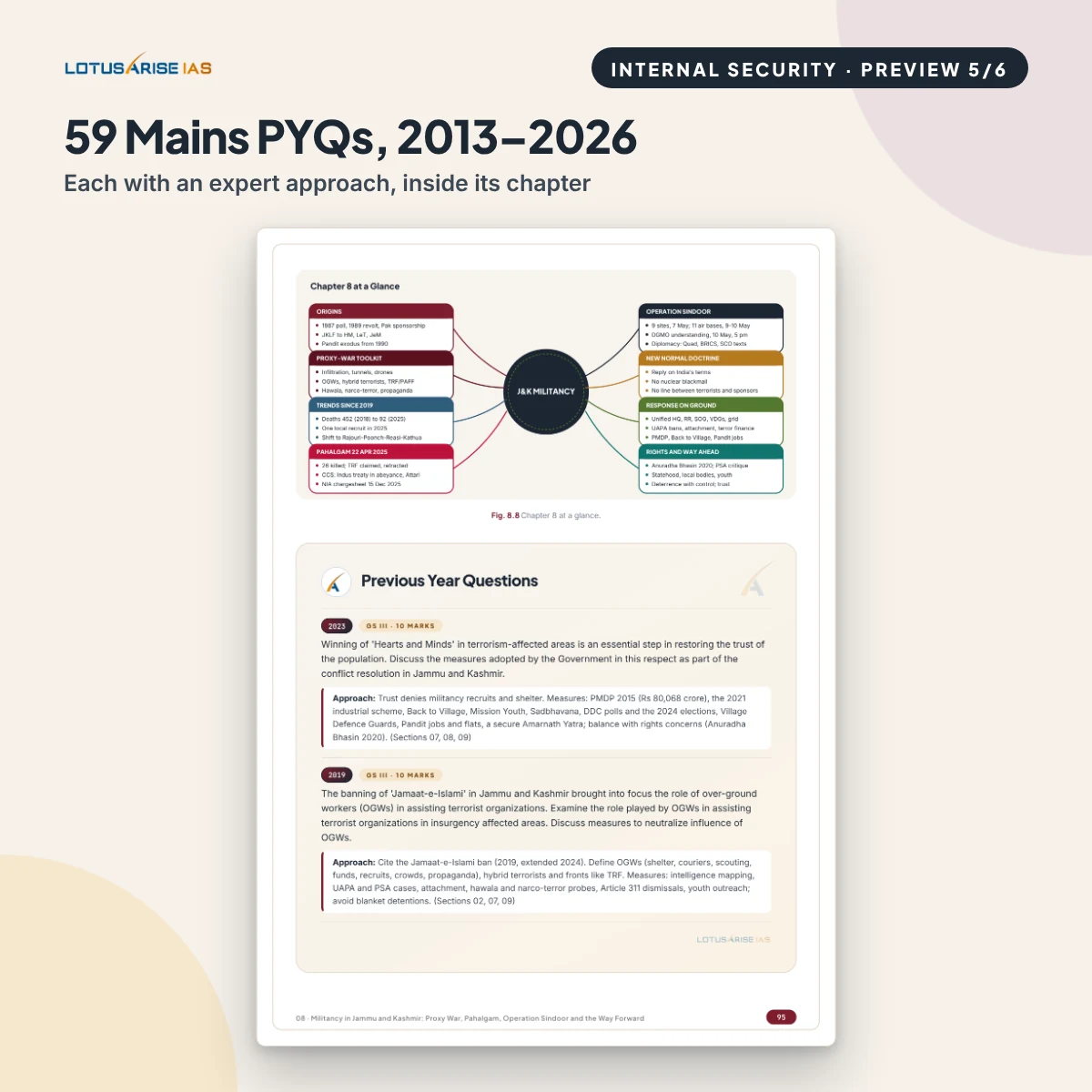
📝 59 Mains PYQs (2013–2026) — every internal security question verbatim, with an answer approach, placed under the chapter that answers it
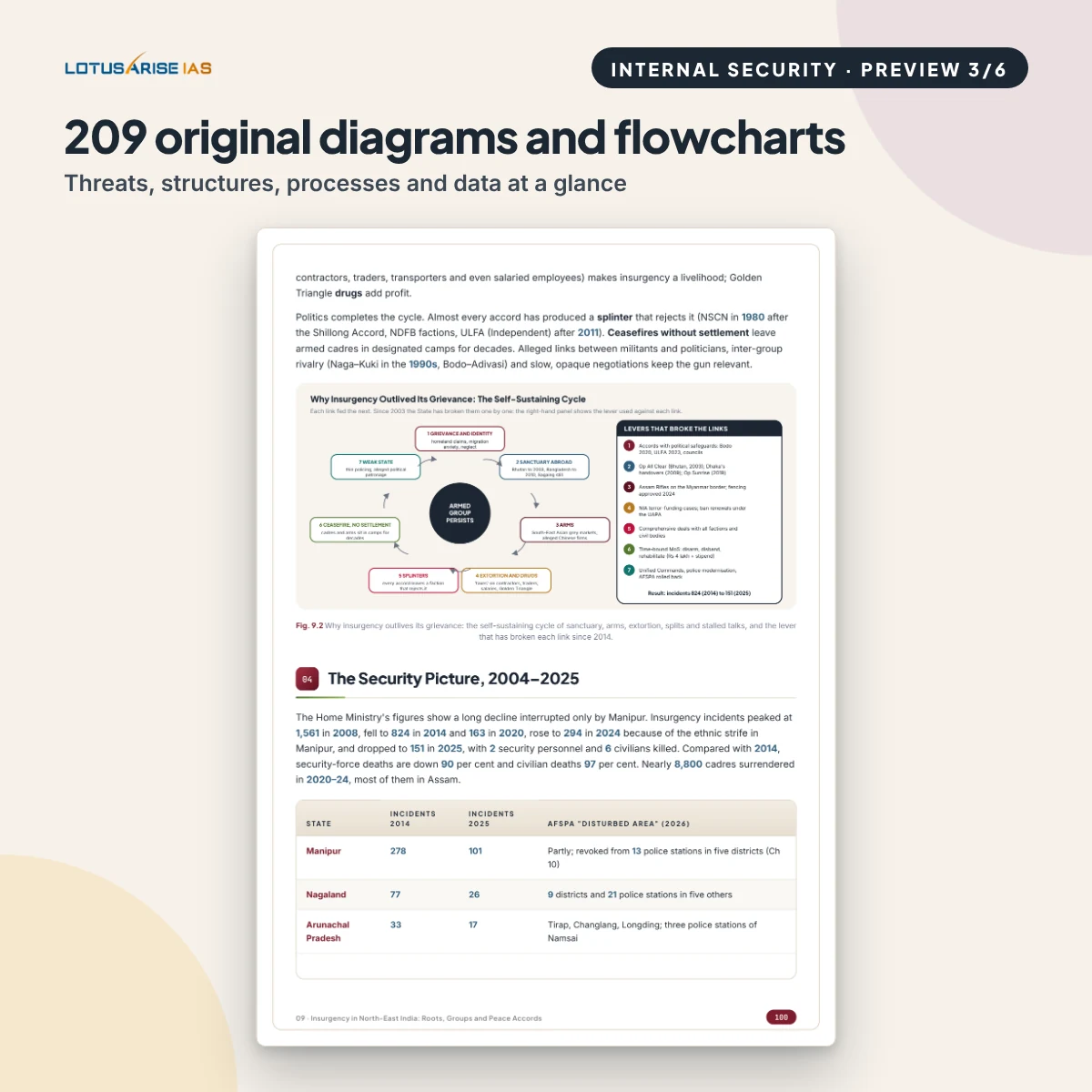
🎨 209 original diagrams and flowcharts + a mind-map for every chapter — simple enough to redraw in your answers
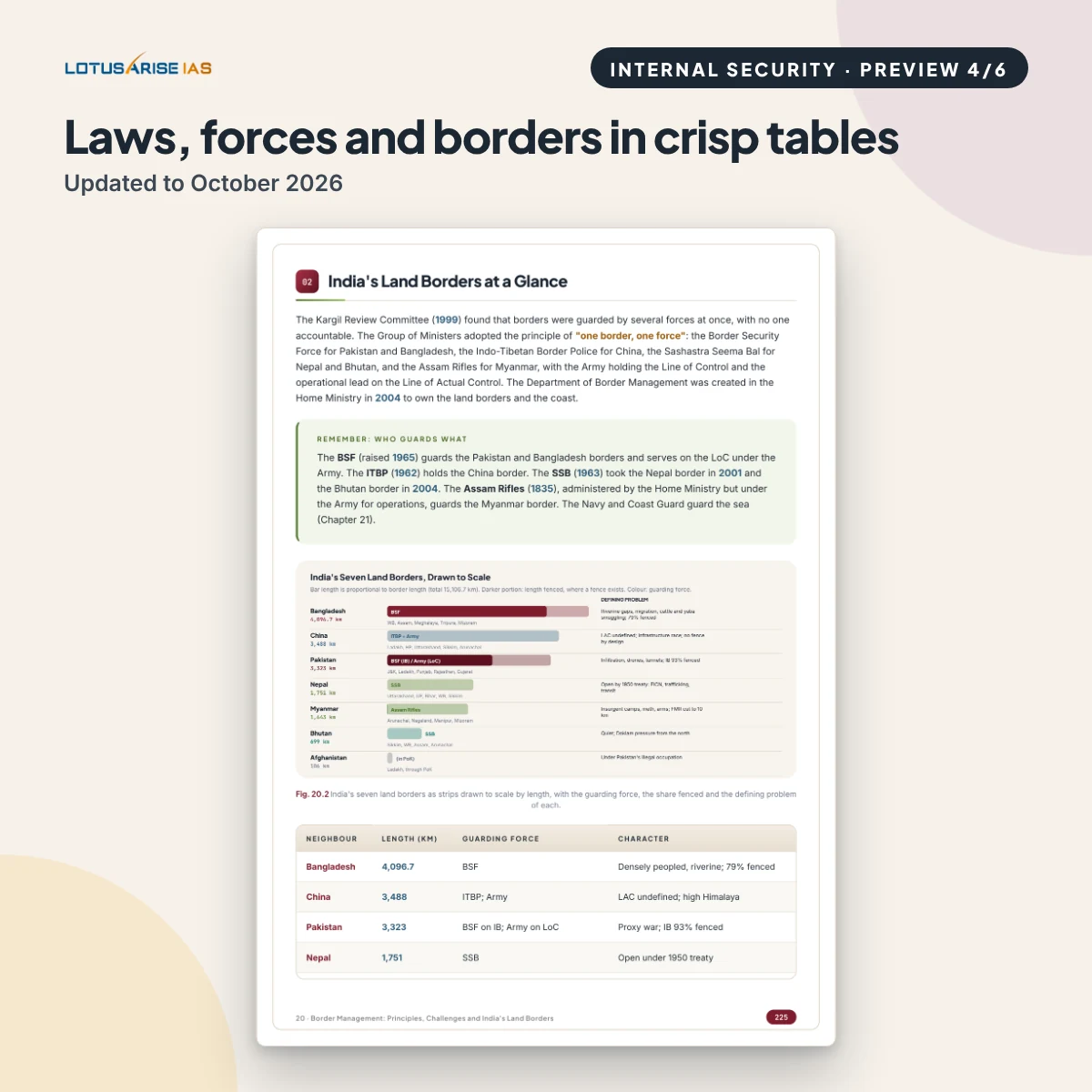
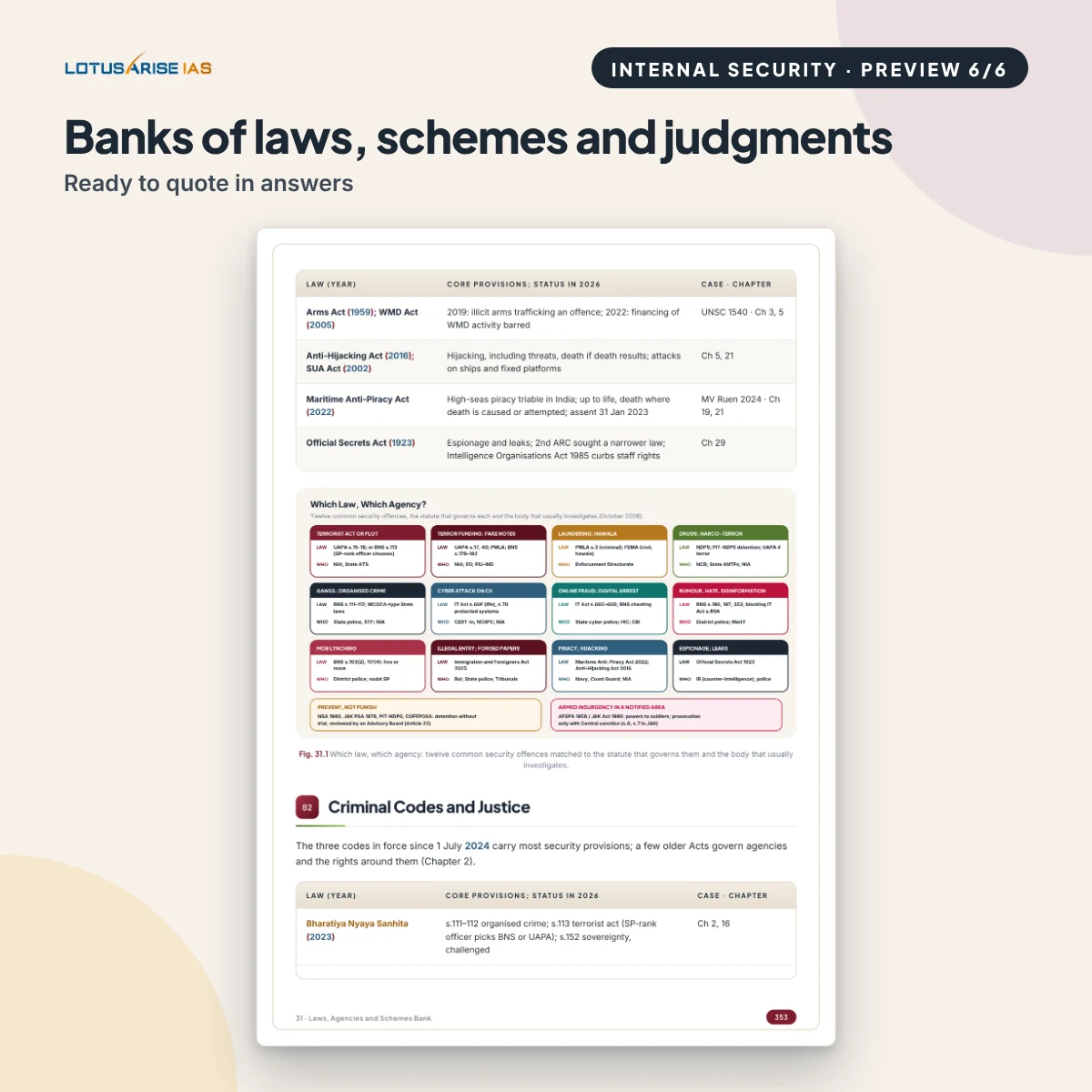
📚 Laws, Agencies & Schemes Bank and Committees, Reports & Judgments Bank — about 170 laws, forces, agencies and schemes, 36 committees and around 70 landmark judgments, ready to quote
📱 Instant PDF download, updated to October 2026 — laptop, mobile or tablet, offline, printable
One-time payment. No subscription. Unlimited downloads — the link does not expire.
⭐ Read by 300,000+ UPSC aspirants every month on LotusArise IAS
Features:
- Comprehensive Coverage
- Complete Syllabus
- Suitable for: UPSC & State PSCs exams
- Format: Digital PDF (Downloadable)
- 337,362+ aspirants visit every month
The problem nobody admits about Internal Security
Ask an aspirant how ready they are for the security section of GS Paper III, and the honest answer is “it’s two questions, I’ll manage with current affairs”. Push a little, and you hear one of three things:
“My notes say the Red Corridor covers ninety districts. I know that changed, but I don’t know what the 2026 position actually is.”
“I can write about terrorism in general. When the question asks about narco-terrorism, terror financing and the FATF, or the over-ground workers in Kashmir, I write the same three points every time.”
“I have saved articles on Pahalgam, Manipur, digital arrests and the new criminal laws. None of it is joined up, and half of it has changed since I saved it.”
These are not knowledge problems. Internal Security is the part of GS III that changes fastest — new operations, accords, laws, rules and data every few months — and old notes quietly go wrong. Internal Security Notes for UPSC puts the concepts, the institutions and the latest developments in one current book.
Why Internal Security deserves a proper book
Every GS Paper III since 2013 has carried internal security questions: terrorism and its financing, Left-Wing Extremism and development, the North-East, borders and coasts, cyber security, social media, money laundering and the security forces. They are also the questions where a specific law, operation, accord, judgment or data point lifts an answer from average to good.
The same material feeds your Essay, your GS Paper II answers on J&K, federalism and the neighbourhood, your Prelims current-affairs questions, and your Interview, where boards ask about Manipur, Operation Sindoor, AFSPA and cyber fraud. The real challenge is not the subject. It is having one source that is current, organised the way UPSC asks, and full of the facts that make an answer credible — and written in neutral, balanced language on sensitive topics.
What’s inside
🛡️ The complete notes — 32 chapters in 12 units, 377 pages
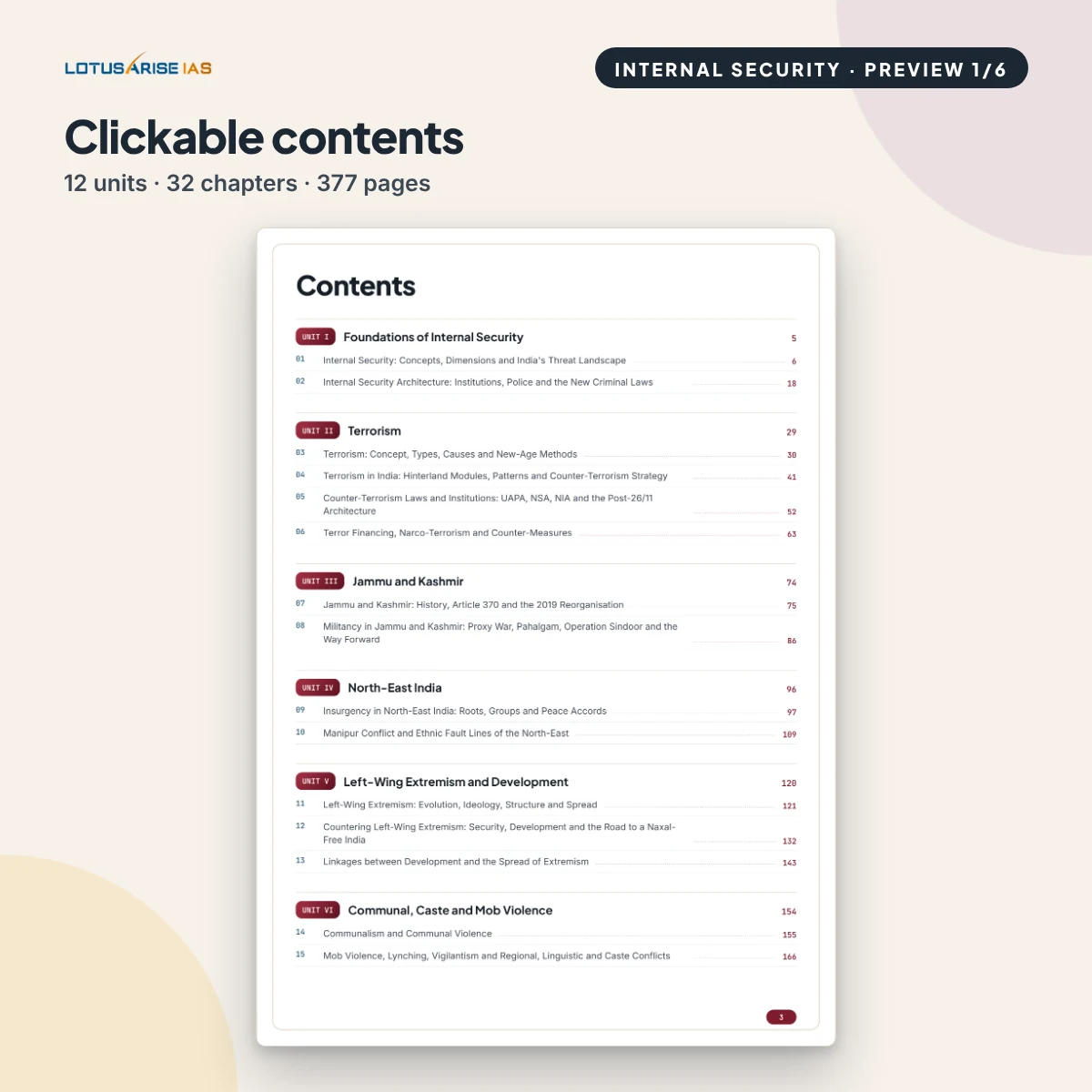
- Foundations of Internal Security — concepts, dimensions and India’s threat landscape; the security architecture, police reform and the security provisions of the new criminal laws
- Terrorism — concept, types and new-age methods; terrorism in India’s hinterland; UAPA, NSA, NIA and the post-26/11 architecture; terror financing and narco-terrorism
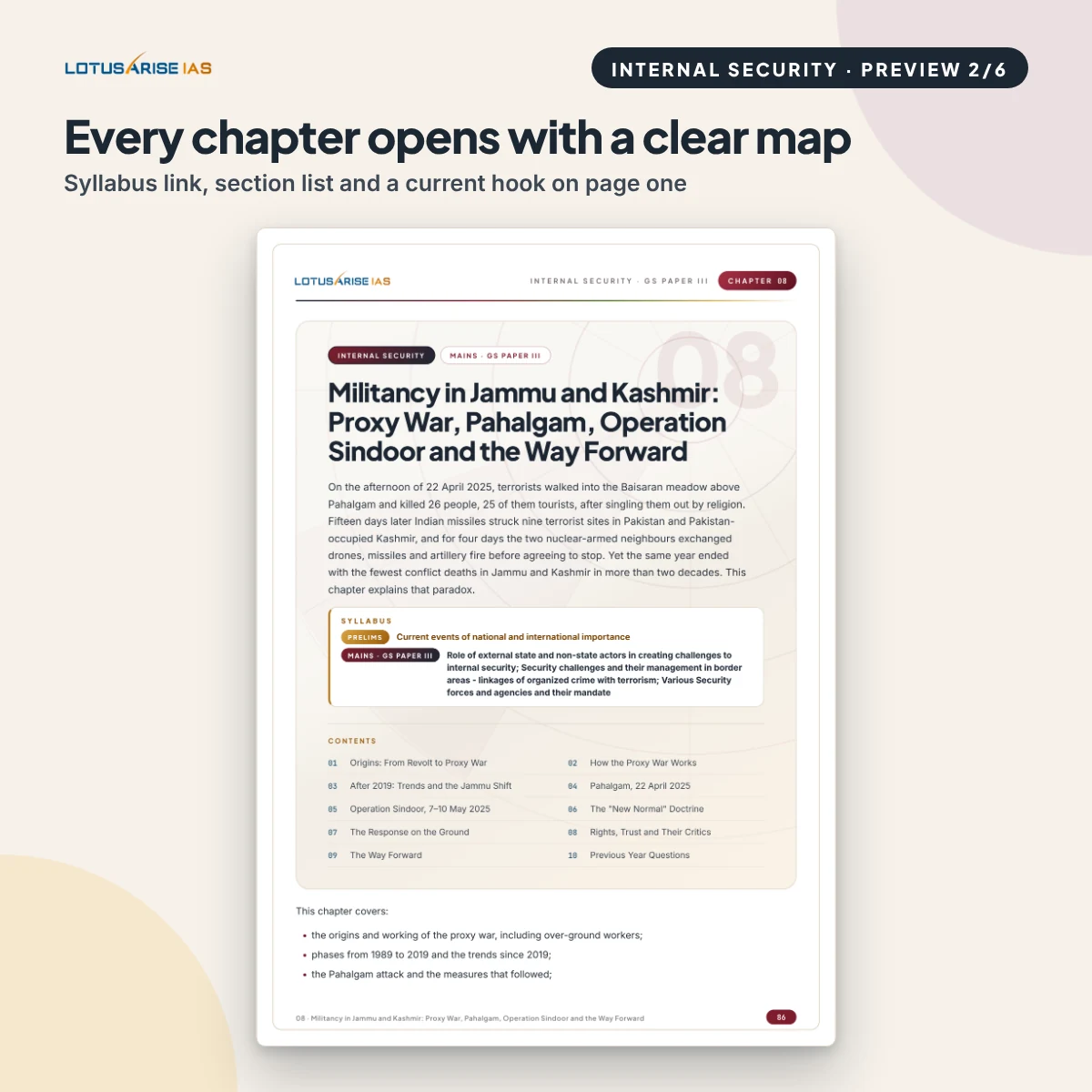
- Jammu and Kashmir — history, Article 370 and the 2019 reorganisation; the proxy war, Pahalgam and Operation Sindoor
- North-East India — insurgencies, groups and the peace accords of the past decade; the Manipur conflict and the region’s ethnic fault lines
- Left-Wing Extremism and Development — evolution and spread; security, development and the road to a Naxal-free India; the development–extremism debate
- Communal, Caste and Mob Violence — communalism and communal violence; lynching, vigilantism and regional, linguistic and caste conflicts
- Organised Crime, Trafficking and External Actors — the crime–terror nexus; trafficking, illegal migration and refugees; Pakistan, China and the neighbourhood; non-state actors
- Border and Coastal Security — India’s land borders and their management; coastal and maritime security
- Cyber Security, Communication Networks and Media — threats and critical infrastructure; India’s cyber laws and institutions; social media and fake news; radicalisation and de-radicalisation
- Money Laundering — the process, techniques and effects of money laundering and black money; the PMLA, FIU-IND, FATF and global cooperation
- Security Forces and Agencies — armed forces, CAPFs and paramilitary; intelligence and investigative agencies; AFSPA and the use of armed forces in aid of civil power
What makes this different from downloaded PDFs: every chapter is written fresh for the exam and current to October 2026 — PRAHAAR (the national counter-terrorism policy), the 31 March 2026 Left-Wing Extremism outcome and the new district categories, Pahalgam and Operation Sindoor from official briefings, the Manipur position after President’s Rule, the 2026 CAPF law, the IT Rules amendments on synthetic content, the DPDP Rules, India’s signature of the UN Convention against Cybercrime and the latest NCRB, MHA and ED data are already in their chapters. Facts were checked independently against primary sources such as Home Ministry reports, Parliament replies, gazette notifications and Supreme Court judgments. Sensitive topics are written in neutral, balanced language. Each chapter ends with a one-page mind-map and a “Using this chapter in Mains” box.
📝 59 Mains PYQs, 2013–2026
Every internal security question from fourteen GS Paper III papers, verbatim as UPSC set it, with its marks and an answer approach that points to the sections of the book that answer it. Each question sits under the chapter it belongs to, so you finish a topic and immediately see how UPSC has tested it.
🎨 209 original diagrams and flowcharts
The security architecture from the Cabinet Committee on Security down to the police station, the UAPA bail route, the stages of money laundering, the terror-financing chain, the three tiers of coastal security, India’s borders drawn to scale with their guarding forces, the shrinking Red Corridor, the North-East peace accords on one timeline, the cyber-incident response chain and many more — each drawn fresh and simple enough to reproduce in a 150-word answer.
📚 Laws, Agencies & Schemes Bank and Committees, Reports & Judgments Bank
A theme-wise ready reckoner of about 170 laws, forces, agencies, schemes and international instruments, with their current status and a “which law, which agency” guide. A second bank lists the security committees and commissions from 1974 to 2026, including the Kargil Review Committee, around 70 landmark judgments by theme, and the data and indices worth quoting — each linked to the chapter that explains it.
The aspirant who buys this
First-time aspirants — you want one trusted book for the security section of GS III from day one, instead of stitching together old notes and monthly magazines.
Repeaters — you know the topics. What costs you marks is that your answers lack current laws, operations and data. This book gives you all three, already organised by topic.
Aspirants with PSIR or Public Administration optional — the neighbourhood, J&K, intelligence and police-reform chapters overlap with your optional.
Self-study aspirants outside Delhi, Prayagraj or Jaipur — no classroom, no batch timings; one PDF on your phone that covers the whole syllabus.
State PSC aspirants — internal security, cyber crime, Left-Wing Extremism and border management appear in most State PSC papers, so the same book serves both.
Why not just use free notes and current-affairs magazines?
Free internal security material exists, and most aspirants already have folders of it. The problem is not that it is bad. It is that it is scattered and it dates quickly: a district list that no longer exists, an accord since signed, a law since replaced, figures from three years ago.
This book is one connected system: the whole syllabus in sequence, every PYQ placed where it belongs, the latest developments woven into the chapter they change, and facts checked to October 2026.
If you have the time to rebuild that yourself every year from scattered sources, you may not need this. If you want it already built — open it and start — this is what the book is for.
Price and delivery
A single printed internal security guide usually costs more than this PDF, and a printed book cannot carry developments up to October 2026.
₹199 for 377 pages — about 53 paise a page.
Want to see it first? Download the free sample PDF — the cover, the full contents, Chapter 1 (Internal Security: Concepts, Dimensions and India’s Threat Landscape) and Chapter 8 (Militancy in Jammu and Kashmir: Proxy War, Pahalgam, Operation Sindoor and the Way Forward).
One-time payment. No subscription. No recurring charge.
Instant PDF download after payment. The download link is also sent to your email — please check the spam folder if it does not arrive in a few minutes. Download it again any time from My Account.
For support: support@lotusarise.com
Related products
-

-
-
Indian Physical Geography Notes for UPSC: Prelims & Mains GS Paper I (2027 Edition) by LotusArise IAS
Original price was: ₹300.00.₹149.00Current price is: ₹149.00. -
International Relations Notes for UPSC: Prelims & Mains GS Paper II (2027 Edition) by LotusArise IAS
Original price was: ₹500.00.₹236.00Current price is: ₹236.00.