

UPSC International Relations PYQs Solutions 2014–2026 (Prelims Research Notes)
₹59.00
₹59 for 118 pages — about 50 paise a page. Prelims 2026 Edition.
Most aspirants study International Relations PYQs the wrong way — reading groupings and summits as news, then mixing up which country is in BRICS, SCO or ASEAN on exam day. Membership and geography questions are where the marks leak.
UPSC International Relations PYQs Solutions 2014–2026 fixes this.
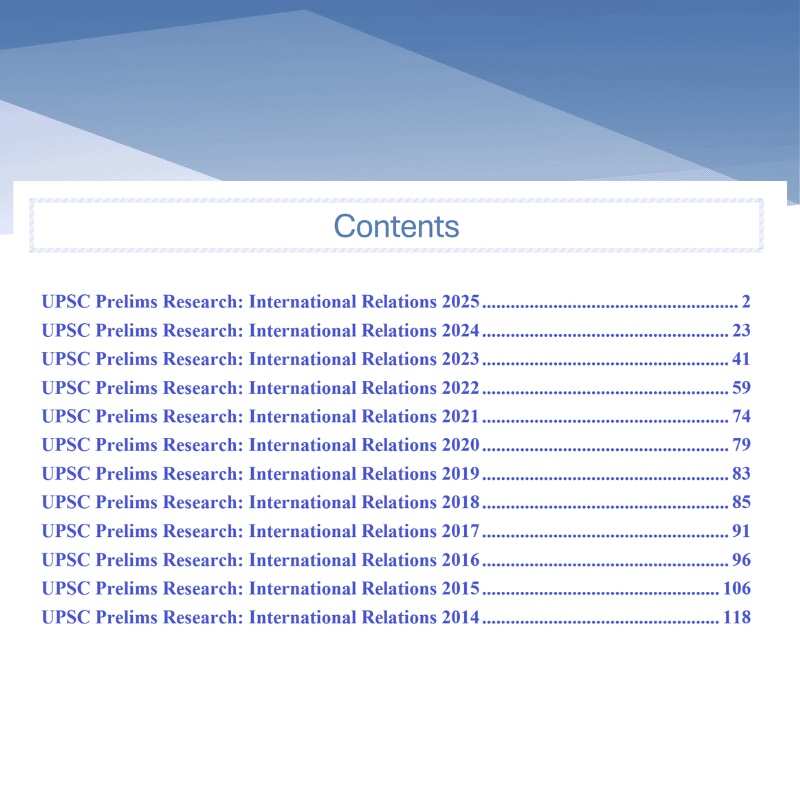
📜 98 questions, 2014–2026 — every International Relations question of UPSC Prelims, year-wise, latest paper first
✅ Every option explained — why the answer is right and why each of the other three is wrong
🆕 2026 paper solved — added in November 2026, in the same in-depth style
🗺️ 54 maps and figures — key points highlighted, print-friendly
📱 Instant PDF download — laptop, mobile or tablet, offline, printable
📄 View the free sample PDF — the 2026 and 2018 papers in full, before you buy
📅 Updated November 2026 with the UPSC Prelims 2026 paper.
One-time payment. No subscription. Instant download after purchase.
⭐ Trusted by 300,000+ UPSC aspirants monthly on LotusArise IAS
Features:
- Comprehensive Coverage
- Complete Syllabus
- Suitable for: UPSC & State PSCs exams
- Format: Digital PDF (Downloadable)
- 337,362+ aspirants visit every month
📄 See it before you buy: free sample
Open the sample and read real pages from the book, with the correct answer, an explanation of every option and the topic notes, exactly as they appear in the full PDF.
- Free sample PDF — the 2026 and 2018 papers in full
The problem most aspirants don’t talk about
Ask any aspirant a month before Prelims what worries them about International Relations. They won’t say they haven’t read enough. They will say one of three things:
- “I have solved the PYQs once — but I only checked the answer key, not why the other options were wrong.”
- “The same kind of question catches me every year, and I only notice after the result.”
- “I read the news every day, but I still confuse which country is a member of which grouping.”
These are not personal failings. Most aspirants have read the content. What is missing is a way to see how UPSC actually builds its questions, year after year. UPSC International Relations PYQs Solutions 2014–2026 is that way.
Why previous year questions are the smartest place to start
International Relations questions overlap with map-based Geography in Prelims and form the core of GS Paper II in Mains. UPSC repeats themes, traps and even options across years. A topic asked in 2016 comes back in 2023 with one statement changed. When you have worked through every question since 2014 with the reasoning laid out, you stop reading the subject blind — you read it the way the paper is set.
The challenge is not the subject. It is having every question, every option and every explanation in one place, in order.
What’s inside
📜 98 questions, 2014–2026 — 118 pages
Every International Relations question of UPSC Prelims from 2014 to 2026, arranged year-wise with the latest paper first. The questions span areas such as:
- BRICS, SCO, Quad and G20
- ASEAN and regional groupings
- United Nations bodies
- NATO and global security
- Indian Ocean and the Gulf
- Places in the news, with maps
✅ Every option explained, not just the answer
Each question gives the correct answer and then takes every option in turn: what is true, what is false, and the concept behind it. You learn four facts from each question instead of one — which is exactly what you need when UPSC reuses an old option in a new question.
🆕 The 2026 paper, solved in depth
The UPSC Prelims 2026 International Relations questions are added in the same style as earlier years: the correct answer, an in-depth explanation of the other options, and notes on the topic.
🗺️ 54 maps and figures, key points highlighted
Maps, diagrams and figures sit beside the questions they explain. Key points are highlighted so revision on the last day is a skim, not a re-read. The layout is print-friendly for anyone who revises on paper.
What makes this different from a free answer key
An answer key tells you the letter. This tells you why — for every option. It is arranged year-wise so you can watch how UPSC’s questions on International Relations have shifted, and it is written to be revised, not just read once.
The aspirant who buys this
- First-timers — want to see what UPSC actually asks before building notes, so every later hour is spent on tested ground.
- Repeaters who missed the cut-off by a few marks — the content is there; the gap is the elimination skill that the option-by-option explanations build.
- Aspirants revising in the last 60 days — one book per subject, latest paper first, highlights for a fast final pass.
- Self-study aspirants outside Delhi, Prayagraj and Jaipur — a complete PYQ system without a test-series fee.
- State PSC aspirants — the International Relations core is shared, and so are the question patterns.
Why not just use free PYQ PDFs from Telegram?
Free PYQ PDFs exist, and most aspirants have several. Most of them give a question and a letter. Some give a line of reason. Very few explain every option, carry the latest paper, or put a map beside a location question. The difference is not the questions — they are public. It is the explanation and the order.
If you are happy to research every option of 98 questions yourself, you may not need this. If you want that work already done — open it and start revising — this is what it is for.
Price
Coaching PYQ courses and test series charge thousands of rupees for this kind of explanation. This book is ₹59 — 118 pages, 98 questions, 2014–2026.
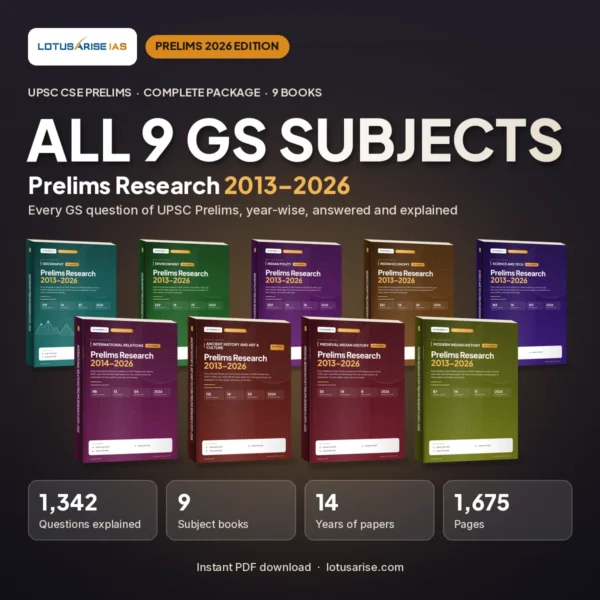
Want every GS subject? The Complete Package has all nine Prelims Research books at a discounted price.
One-time payment. No subscription. No recurring charge.
Instant PDF download after payment — the link also arrives by email (check your spam folder if you don’t see it).
For support: support@lotusarise.com
Related products
-

-
-
-
#OFFER: UPSC Prelims PYQs Solutions 2013–2026 (Prelims Research Notes) | Complete Package
Original price was: ₹826.00.₹590.00Current price is: ₹590.00.