

Geographical Thought | Geography Optional Notes
₹118.00
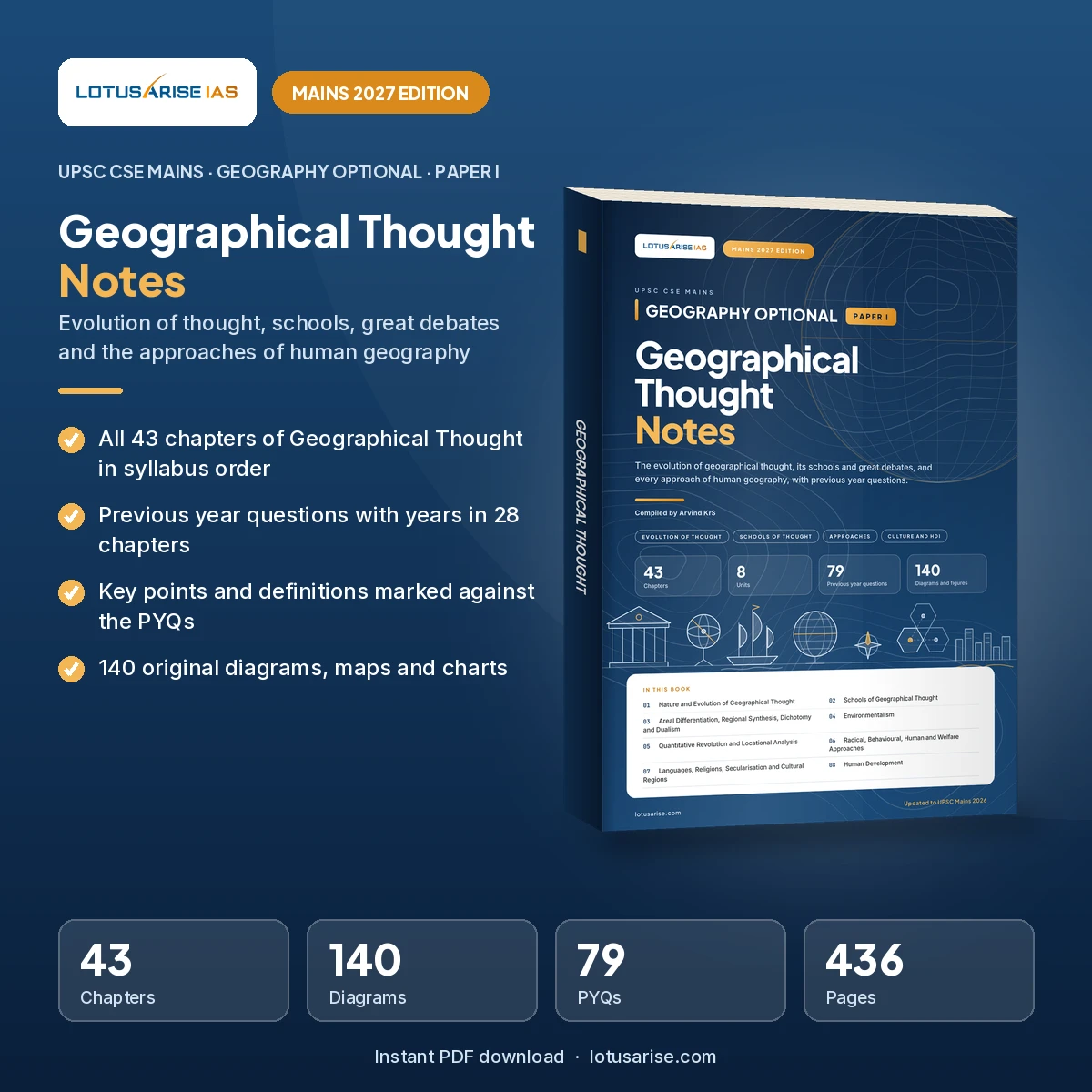
₹118 for 436 pages — about 27 paise a page. Mains 2027 Edition.
Most Geography Optional aspirants read this section as a timeline of names. Humboldt, Ritter, Vidal, Hartshorne, Schaefer. A date for each, one line of what each said, nothing on why the next generation rejected it. Then UPSC asks why radicalism is seen as a paradigm shift, and the answer turns into a list.
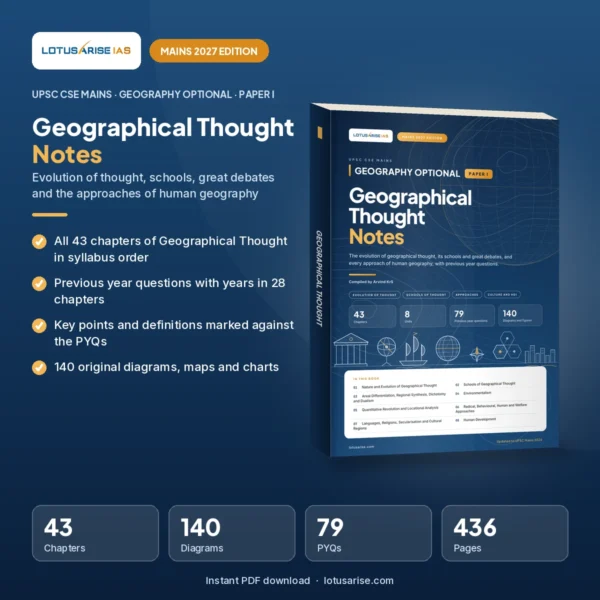
Geographical Thought follows every school, debate and approach as one argument. It is the new edition of what this store sold as Perspectives in Human Geography.
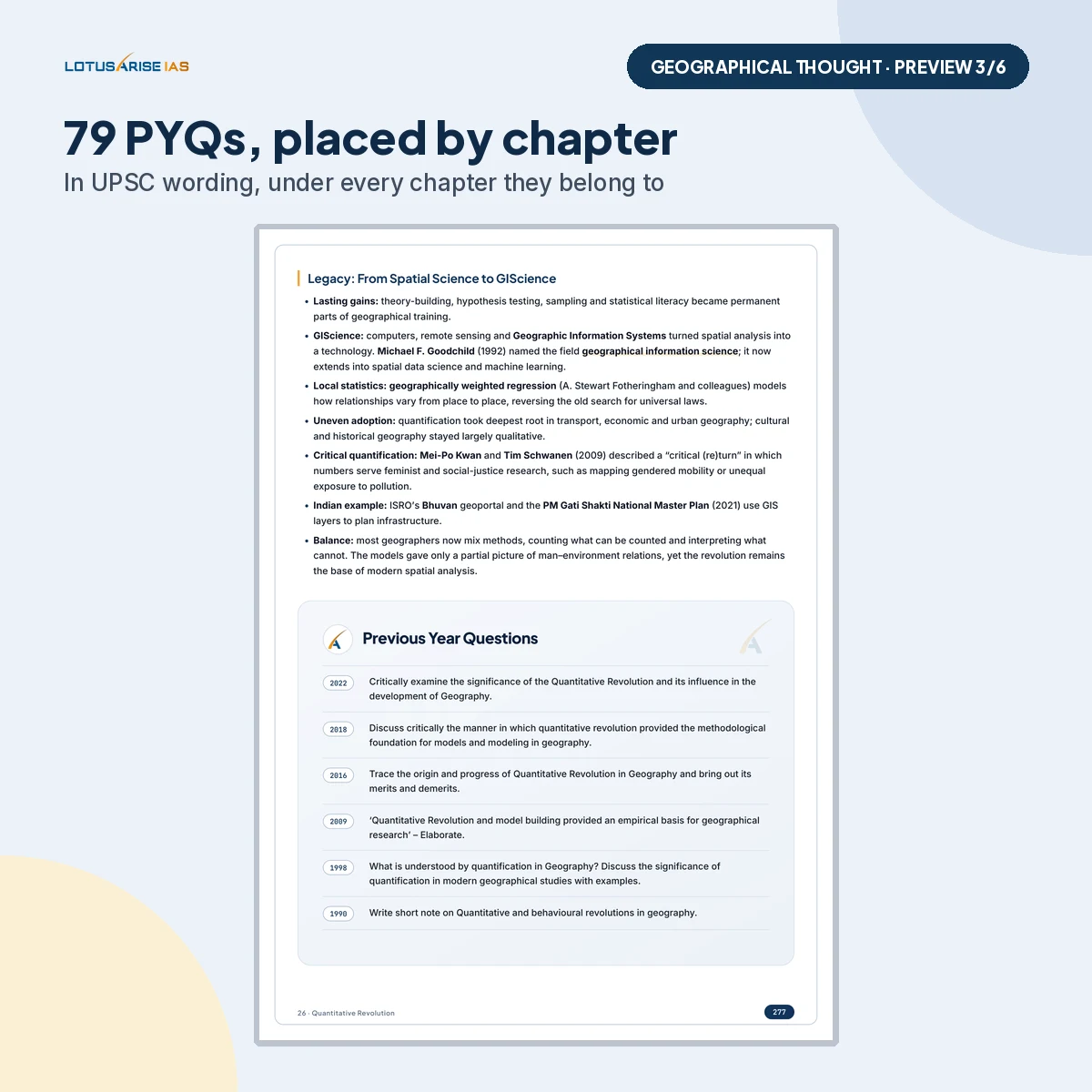
📝 79 PYQs, updated to Mains 2026 — in UPSC’s wording, under the chapter each belongs to
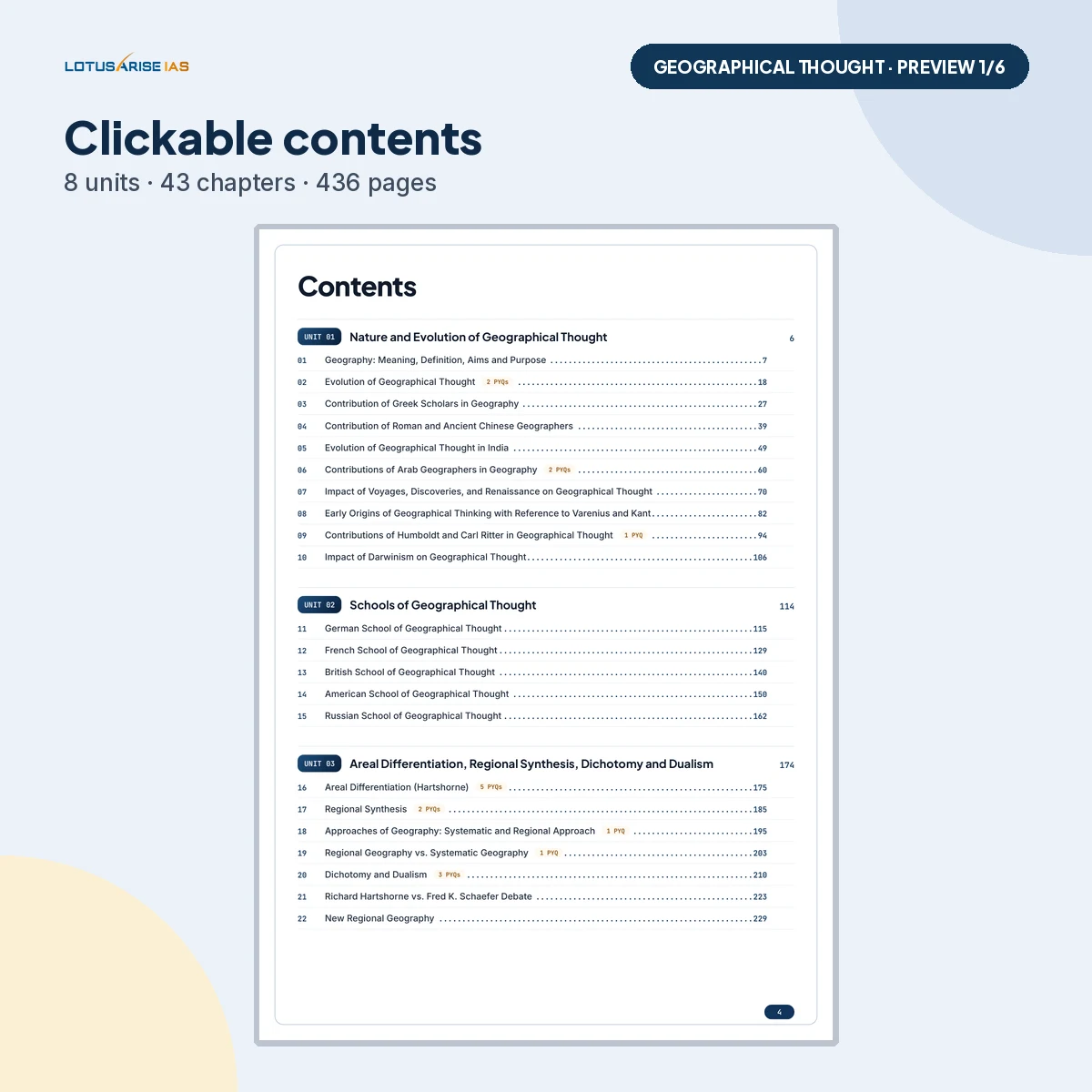
🧭 43 chapters in 8 units — evolution of thought, five national schools, the great debates, culture and HDI
⚖️ Every approach from emergence to evaluation — radical, behavioural, humanistic and welfare
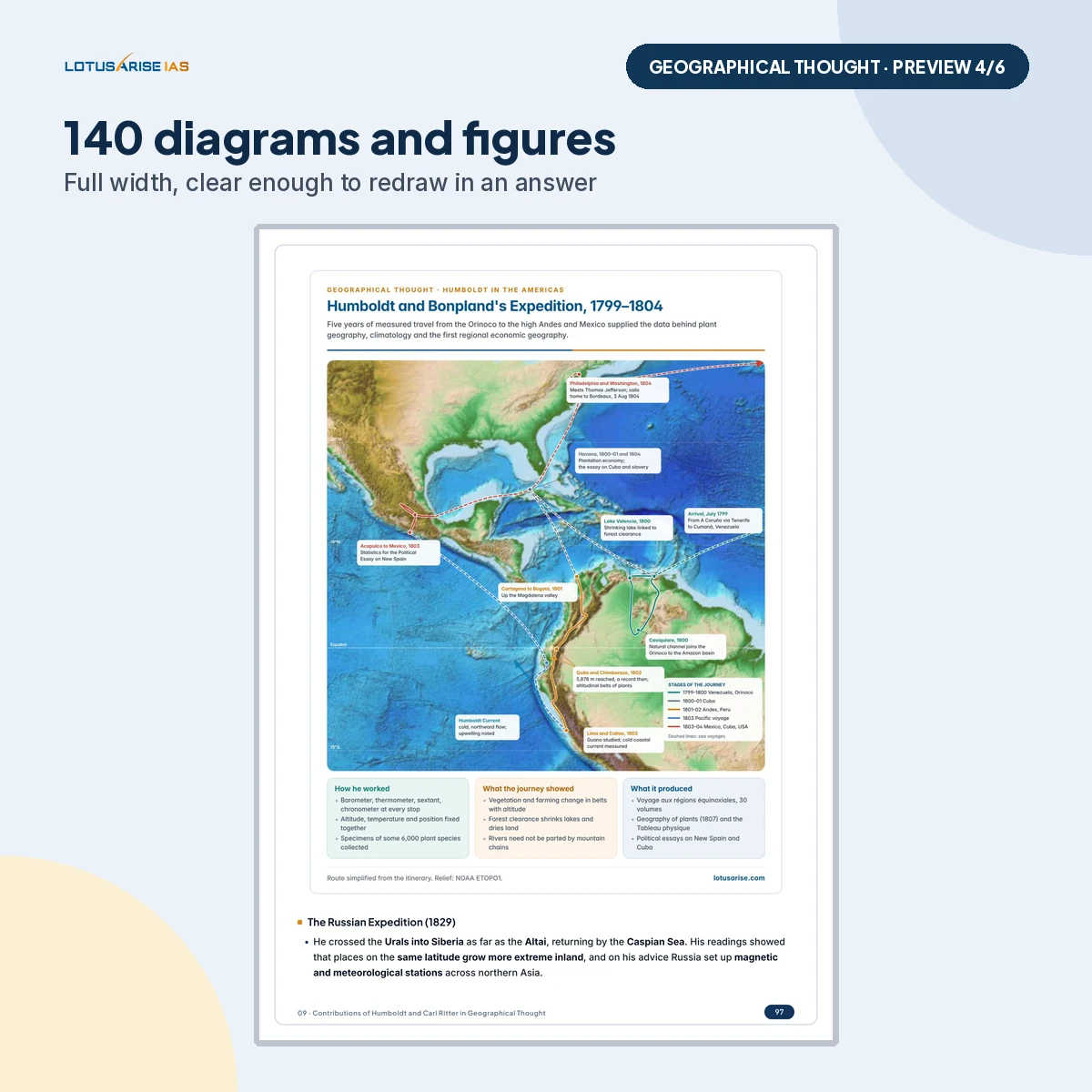
🗺️ 140 diagrams and figures — full width, clear enough to redraw in an answer
📱 Instant PDF download, 436 pages — clickable contents, laptop, mobile or tablet, offline, printable
One-time payment. No subscription. Unlimited downloads — the link does not expire.
⭐ Read by 300,000+ UPSC aspirants every month on LotusArise IAS
Features:
- Comprehensive Coverage
- Complete Syllabus
- Suitable for: UPSC & State PSCs exams
- Format: Digital PDF (Downloadable)
- 337,362+ aspirants visit every month
The problem most aspirants don’t talk about
Ask a Geography Optional aspirant about geographical thought a few months into preparation. They won’t say the ideas are beyond them. They will say one of three things:
“I can give you the names and the dates. When the question says ‘critically examine’, I have a timeline and no argument.”
“I know what behaviouralism is. I can’t say why it arose, what it was reacting against, or what came after it.”
“I spent weeks on the Greeks and the national schools, and then the paper asked about areal differentiation and the quantitative revolution.”
None of this is a lack of effort. Thought is usually read as a chronology, and a chronology hides the thing UPSC is testing: why one way of doing geography gave way to another. What is missing is one book that follows the argument through and shows you where the questions actually fall. Geographical Thought is that book.
Why this section is a smart place to spend your hours
The book lists 79 PYQs under their chapters (66 distinct questions) from 1986 to 2026, with at least one in every year’s papers from 2013 to 2026. Most go past a definition. They ask why the welfare approach emerged in the 1970s, how dichotomy and dualism affected the subject’s methods, and what the limitations of HDI are.
The questions cluster. The quantitative revolution has 7, the behavioural approach and cultural regions 6 each, and areal differentiation, radicalism, welfare and cultural change 5 each. The national schools in Unit 2 have no direct question yet, and the radar says so plainly.
It pays back across the optional. The debates frame your answers on models and regions in Paper I, and India’s cultural regions and human development carry into Paper II.
The challenge is not the reading. It is having one account of the argument that you can actually revise.
What’s inside — 436 pages in 8 units
🧭 Nature and Evolution of Geographical Thought — 10 chapters
- Meaning, aims and nature of geography
- Greek, Roman, Chinese and Indian geographical thought
- Arab geographers, from Al-Khwarizmi to Ibn Khaldun
- Voyages, discoveries and the Renaissance
- Varenius, Kant, Humboldt, Ritter and the impact of Darwinism
🏛️ Schools of Geographical Thought — 5 chapters
- German school: Ratzel, Richthofen, Hettner, Schlüter
- French school: Vidal de la Blache and la tradition Vidalienne
- British, American and Russian schools, with territorial production complexes
⚖️ Areal Differentiation, Regional Synthesis, Dichotomy and Dualism — 7 chapters
- Areal differentiation: sequential development, decline and revival
- Regional synthesis, and systematic against regional geography
- Dichotomy and dualism, idiographic and nomothetic
- The Hartshorne–Schaefer debate and exceptionalism
- New regional geography
🌱 Environmentalism — 2 chapters
- Environmentalism as a paradigm through history, and neo-environmentalism
- Griffith Taylor’s stop-and-go determinism, Spate’s probabilism
📊 Quantitative Revolution and Locational Analysis — 6 chapters
- Kuhn, positivism and the sequence of paradigm shifts
- Quantitative revolution: methods, merits, demerits and criticism
- Locational analysis, Haggett’s model, spatial organisation
- Time geography: Hägerstrand’s paths, prisms and constraints
🔥 Radical, Behavioural, Human and Welfare Approaches — 8 chapters
- The critical revolution, radical and Marxist geography
- Behavioural geography: Wolpert’s satisficer, mental maps, Pred’s matrix
- Humanistic geography: phenomenology, topophilia, Tuan’s five themes
- Welfare geography: who gets what, where and how
- Postmodern and feminist geography, the socio-spatial dialectic
🌐 Languages, Religions, Secularisation and Cultural Regions — 3 chapters
- Language hotspots, diffusion of religions, secularisation
- Cultural change, folk and popular culture under globalisation
- World culture realms and the Indo-Gangetic hearth
📈 Human Development — 2 chapters
- HDI: calculation, world pattern, India in the Human Development Report 2025, limitations
- Social well-being and gender equity in India
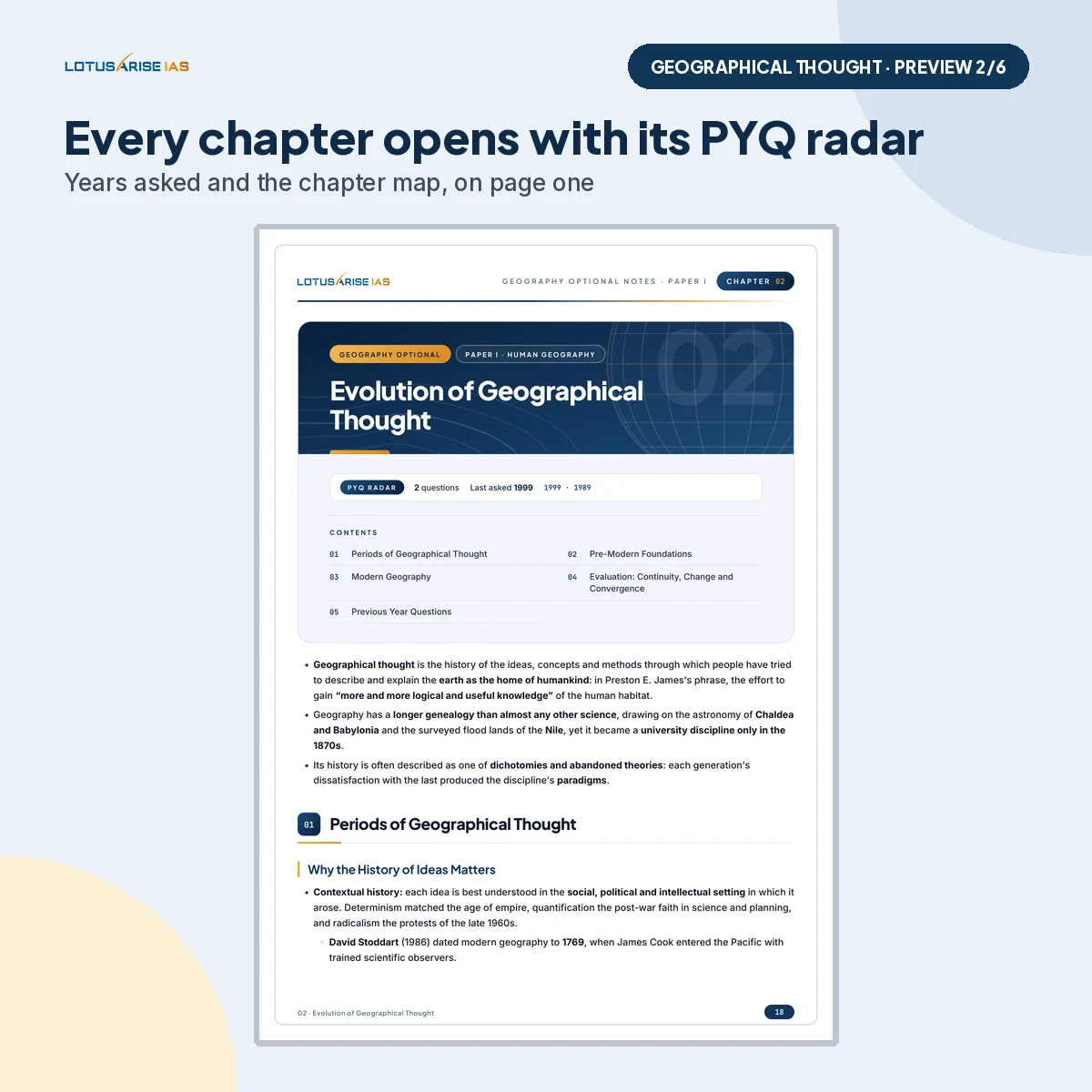
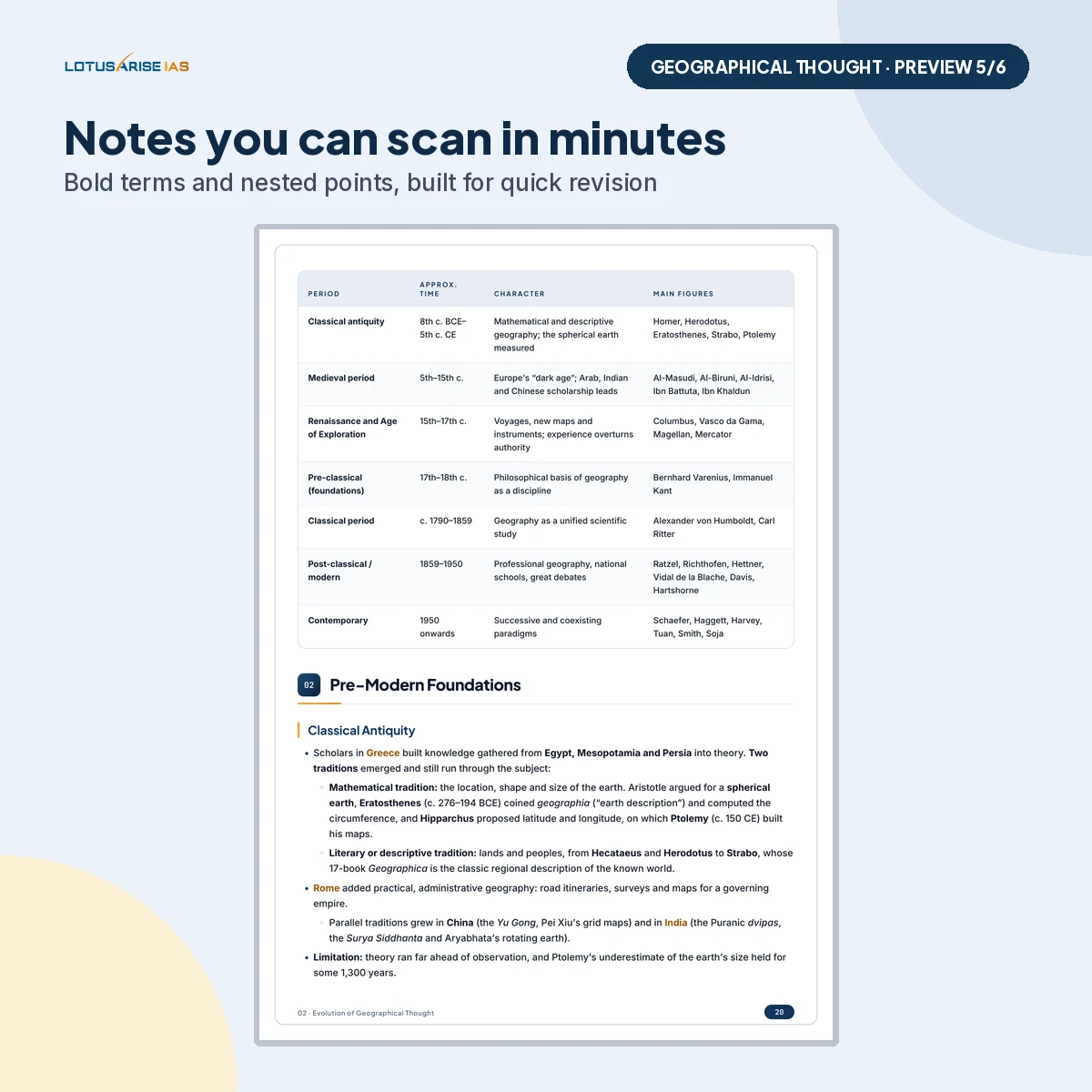
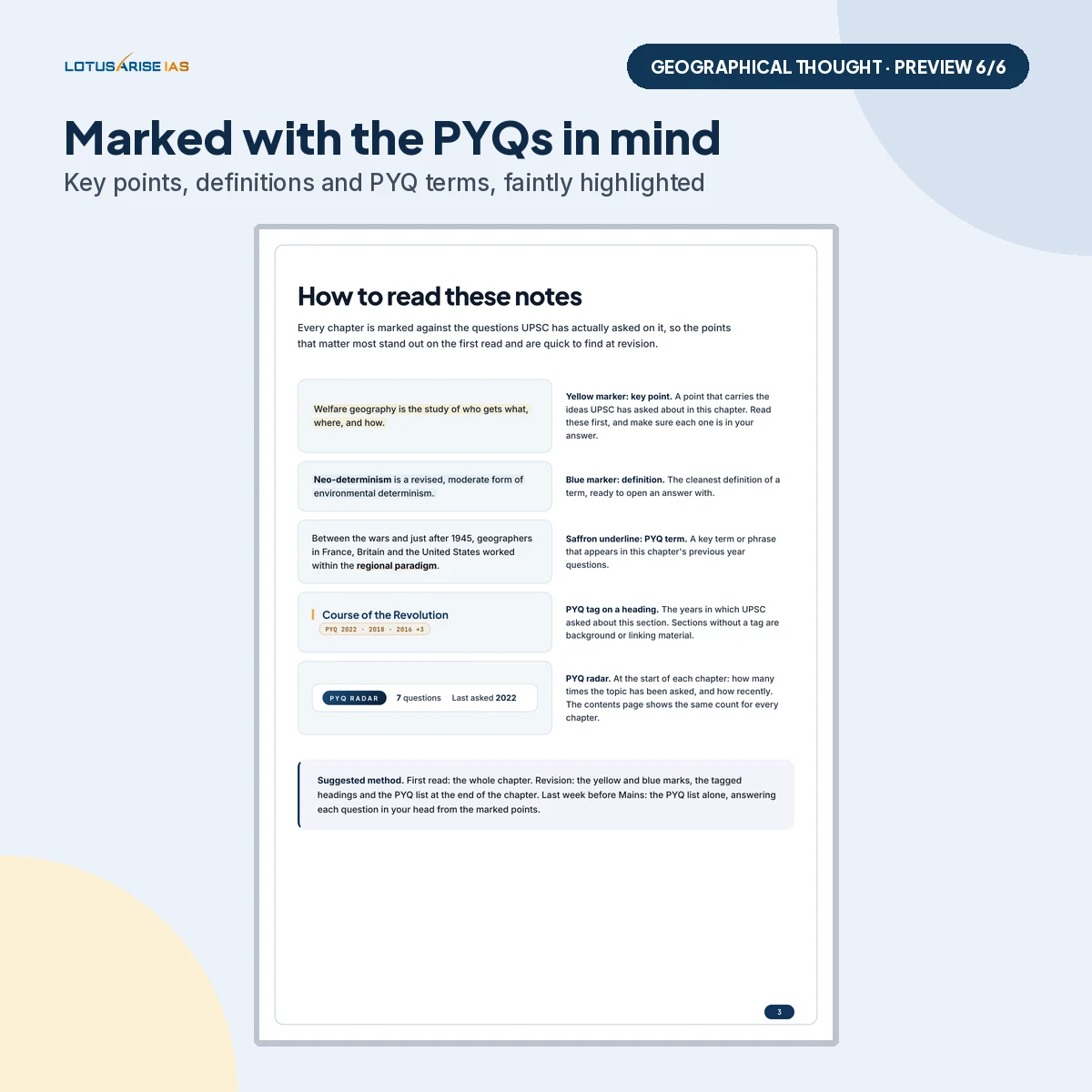
What makes this different from a downloaded PDF? Each chapter is marked against the questions UPSC has actually asked on it. A PYQ radar at the start shows how many times the topic has come and when it last did. Year tags sit on the headings UPSC has asked about. Faint highlights pick out key points, definitions and PYQ terms, so your second reading takes far less time than your first.
One thing to be clear about: the book gives the previous year questions, not model answers. Solved answers are in the Geography Optional 300+ Score Pack.
The aspirant who buys this
First-timers — Read Units 3, 5 and 6 closely, and use Units 1 and 2 for the context behind them.
Repeaters — You know the labels, but your answers describe each approach without showing what it reacted against. Use the evaluation sections, then go through the PYQ list at the end of each chapter.
Aspirants short of time before Mains — The radar, year tags and highlights show you what to read first, and what can wait.
Self-study aspirants outside Delhi, Prayagraj and Jaipur — No classroom and no batch. You get one organised book that you can read anywhere, and print for handwritten practice.
Working professionals — One thinker or one debate at a time on your phone, offline, with no schedule and no expiry.
State PSC aspirants with Geography — The history of the discipline is common ground, so the same chapters serve your paper too.
Why not just use free notes from Telegram?
Free notes exist, and most aspirants already have several. Many of these topics are also on our own website, free to read.
The difference is not that free material is wrong. It is that nothing ties it together. A forwarded PDF rarely tells you which of its pages UPSC has asked about, it seldom shows how one paradigm led to the next, and nobody tells you when it has gone out of date. Here you get one order, every PYQ placed under its chapter, and a file you can keep and print.
If you have the time to build and maintain your own file from scattered sources, you may not need this. If you would rather open one book and start revising, this is what it is for.
The price
436 pages, 43 chapters, 79 PYQs and 140 diagrams and figures — ₹118. That is about 27 paise a page.
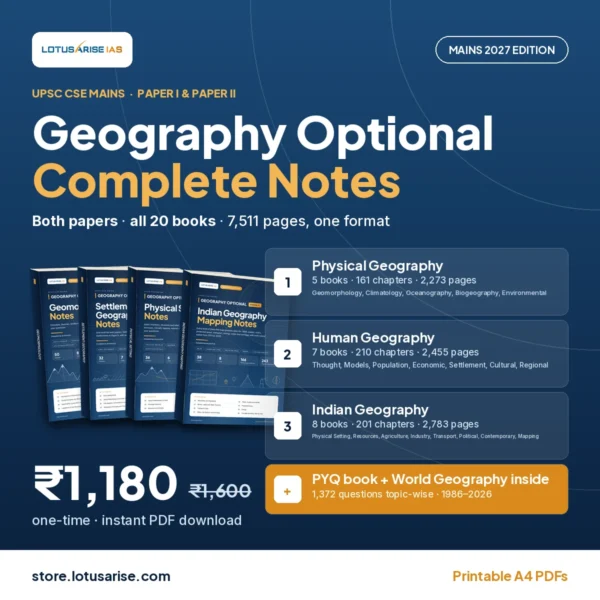
The book is also part of the Human Geography: Geography Optional Notes bundle at ₹471 and of Geography Optional Complete Notes at ₹1,180.
One-time payment. No subscription. No recurring charge.
The download link reaches your email right after payment — please check your spam folder if you do not see it. Unlimited downloads, no expiry. English medium.
Read the free sample first (PDF)
For support: support@lotusarise.com
You may also like…
-

#OFFER: Geography Optional Complete Notes (PDF) – UPSC Mains (Paper I & II)
Original price was: ₹1,600.00.₹1,180.00Current price is: ₹1,180.00.

Related products
-
-
-
Geography Optional Strategy Kit: Syllabus, PYQs (1986–2026), Study Route & Interlinking Guide by LotusArise IAS
Original price was: ₹500.00.₹236.00Current price is: ₹236.00. -