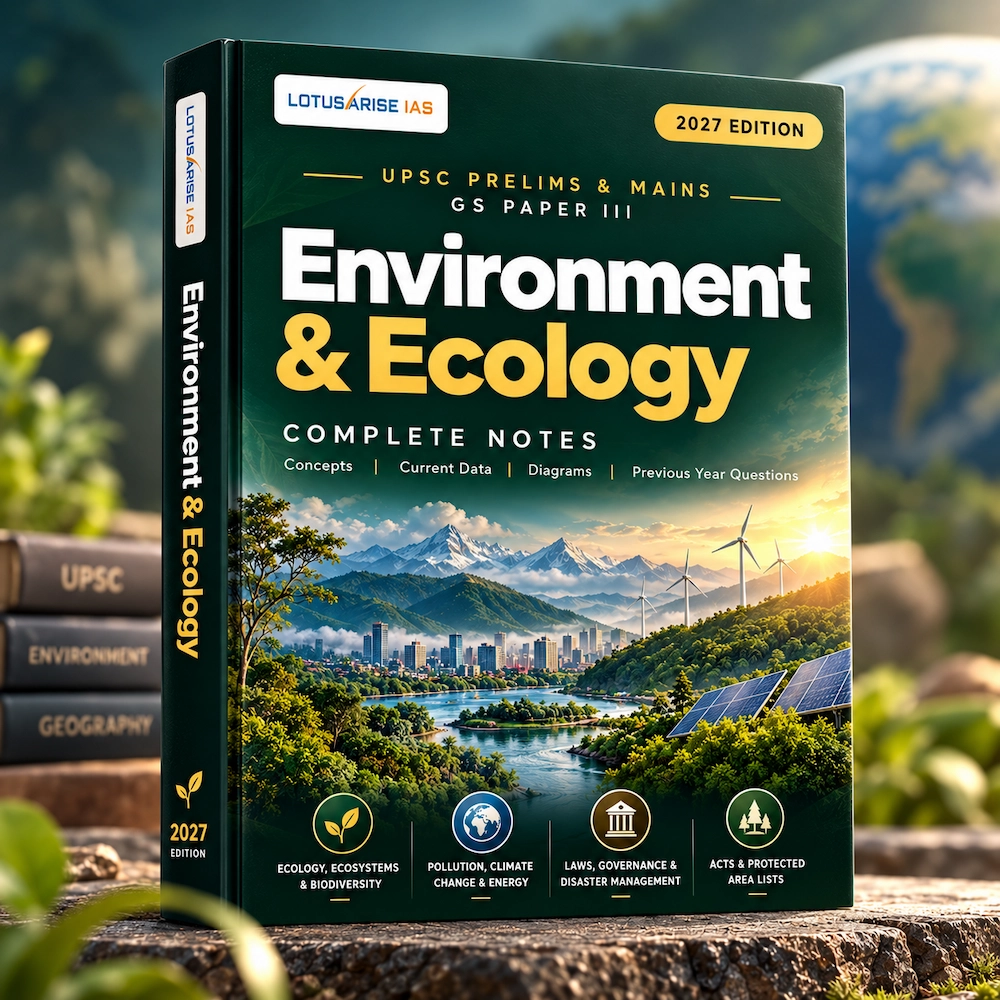


Environment and Ecology Notes for UPSC: Prelims & Mains GS Paper III (2027 Edition) by LotusArise IAS
Original price was: ₹500.00.₹236.00Current price is: ₹236.00.
₹236 launch price for the 2027 Edition. MRP ₹500 — 441 pages, under 54 paise a page.
Most aspirants study Environment the wrong way. One book for basics, a coaching handout for climate talks, a Telegram PDF for protected areas, and current affairs nowhere. Then Prelims asks about a Ramsar site, a carbon market or a Red List species, and none of the three sources has it.
Environment and Ecology Notes for UPSC puts the whole subject in one book.
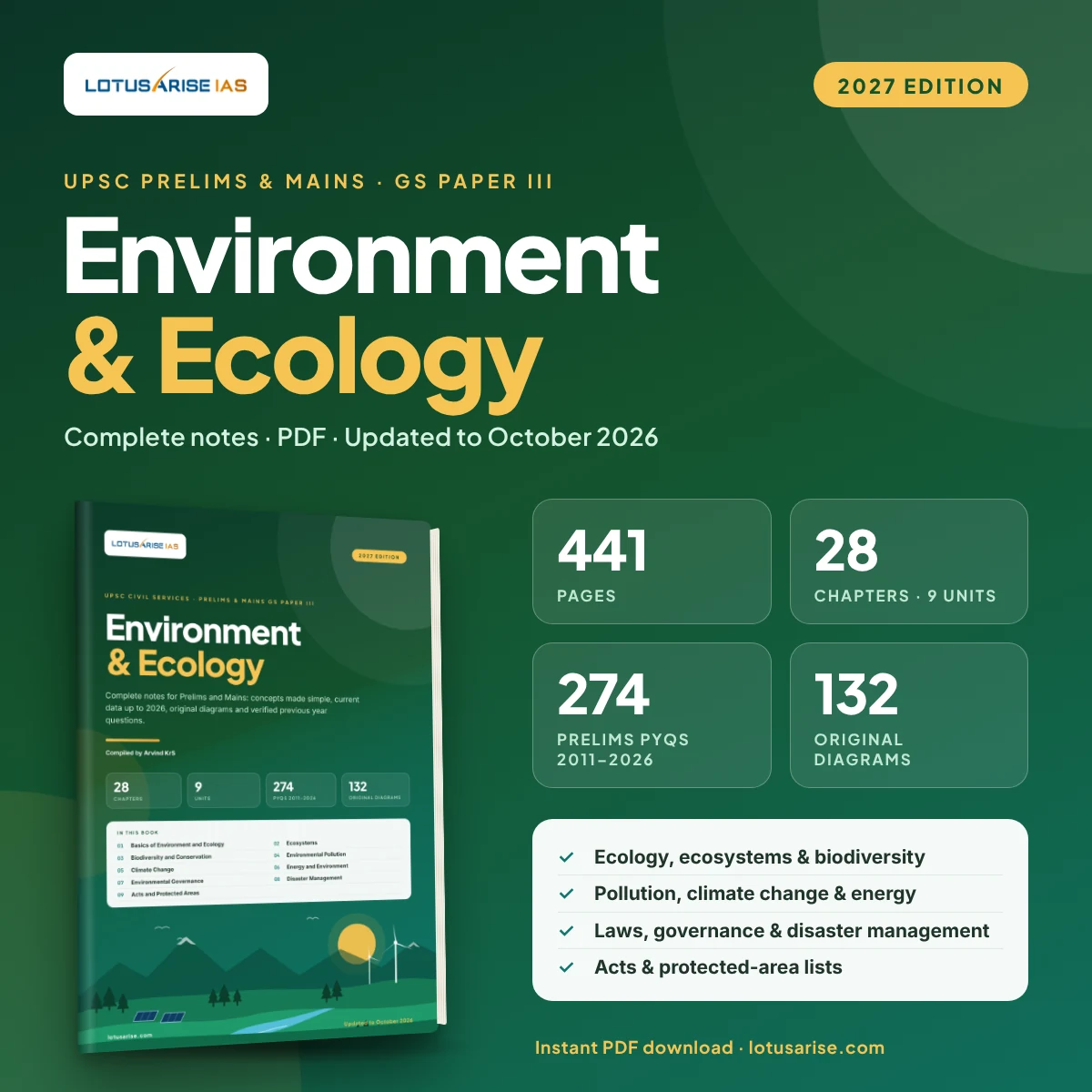
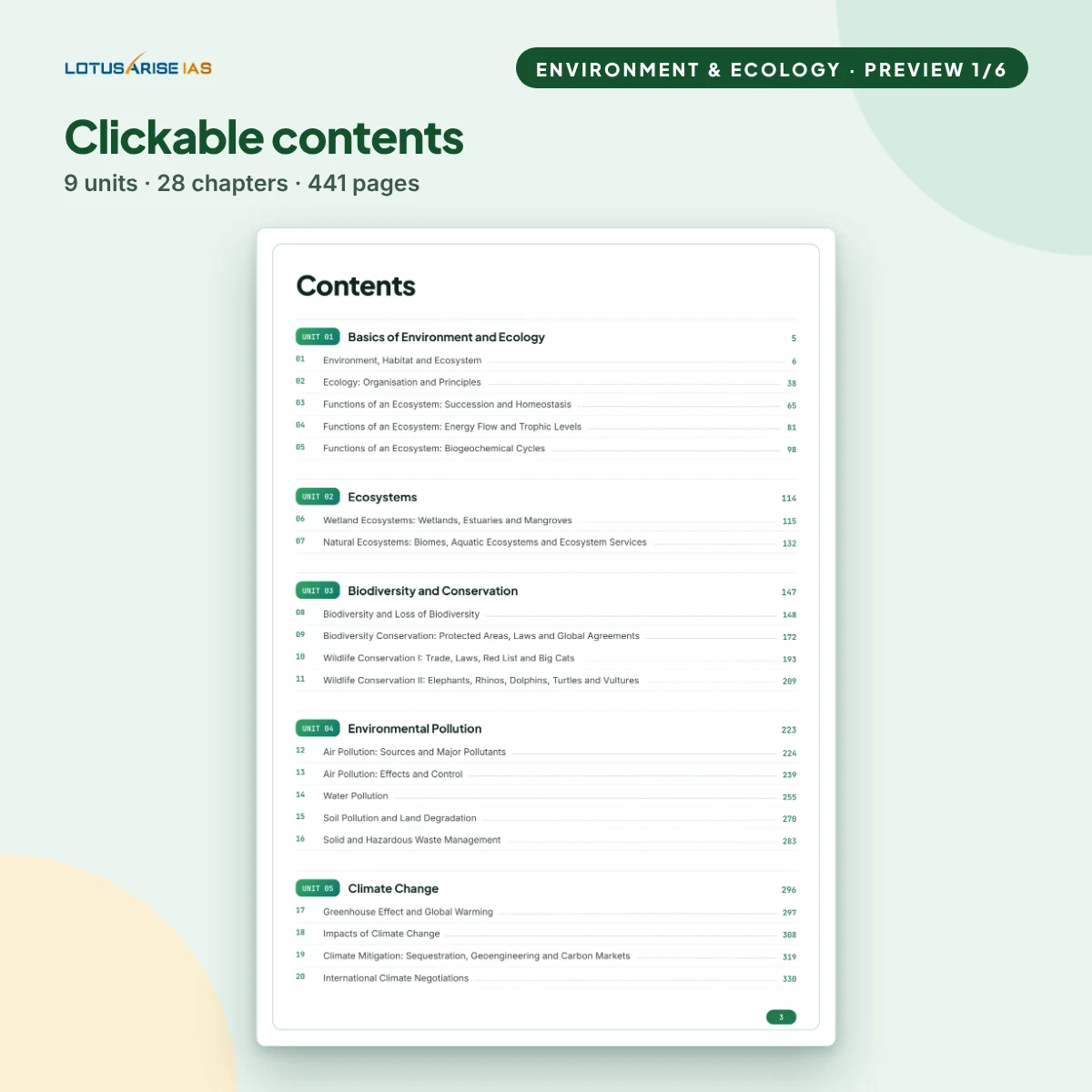
📘 28 chapters in 9 units, 441 pages — from ecosystem basics to acts and protected areas
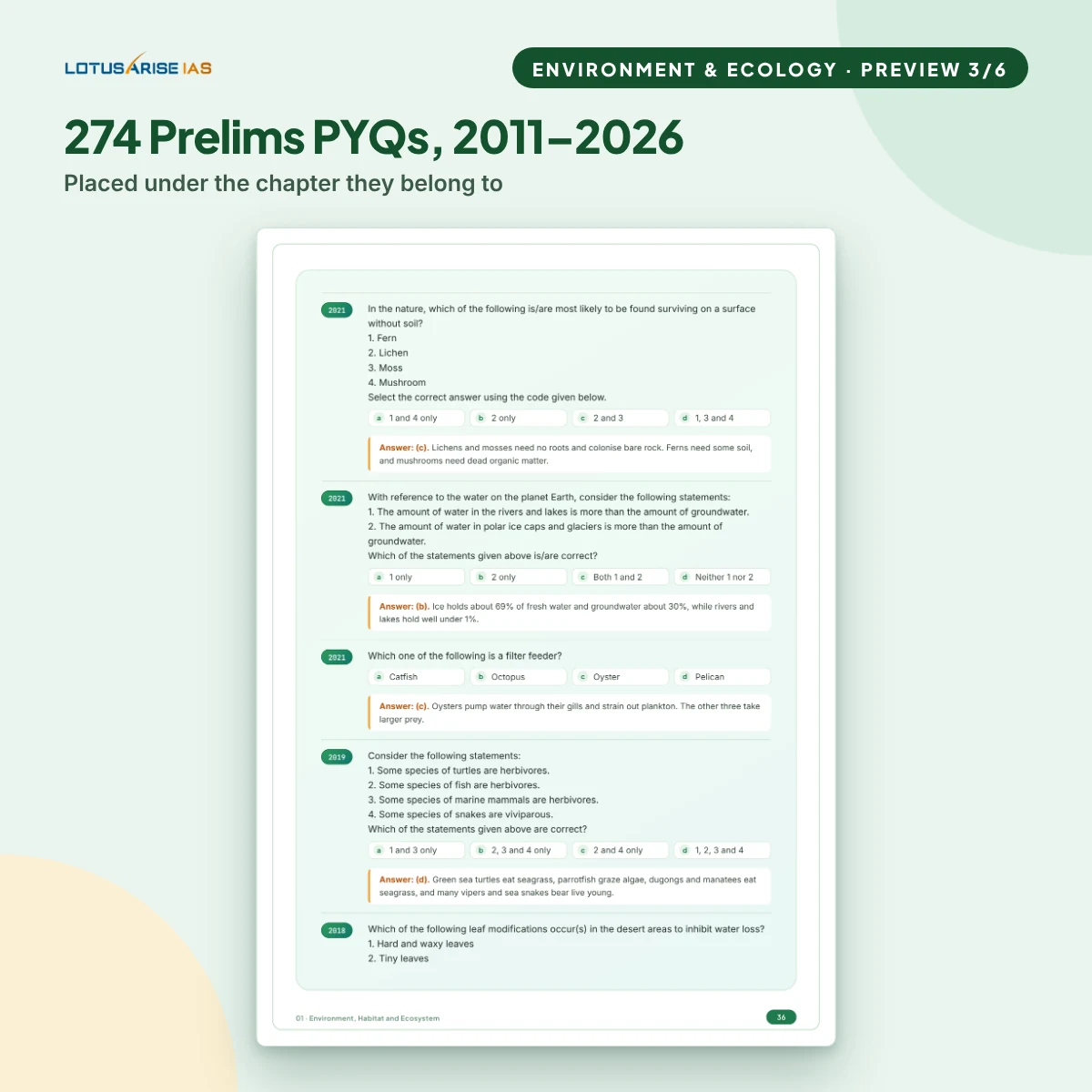
📝 274 Prelims PYQs (2011–2026) — placed under the chapter they belong to, with all four options
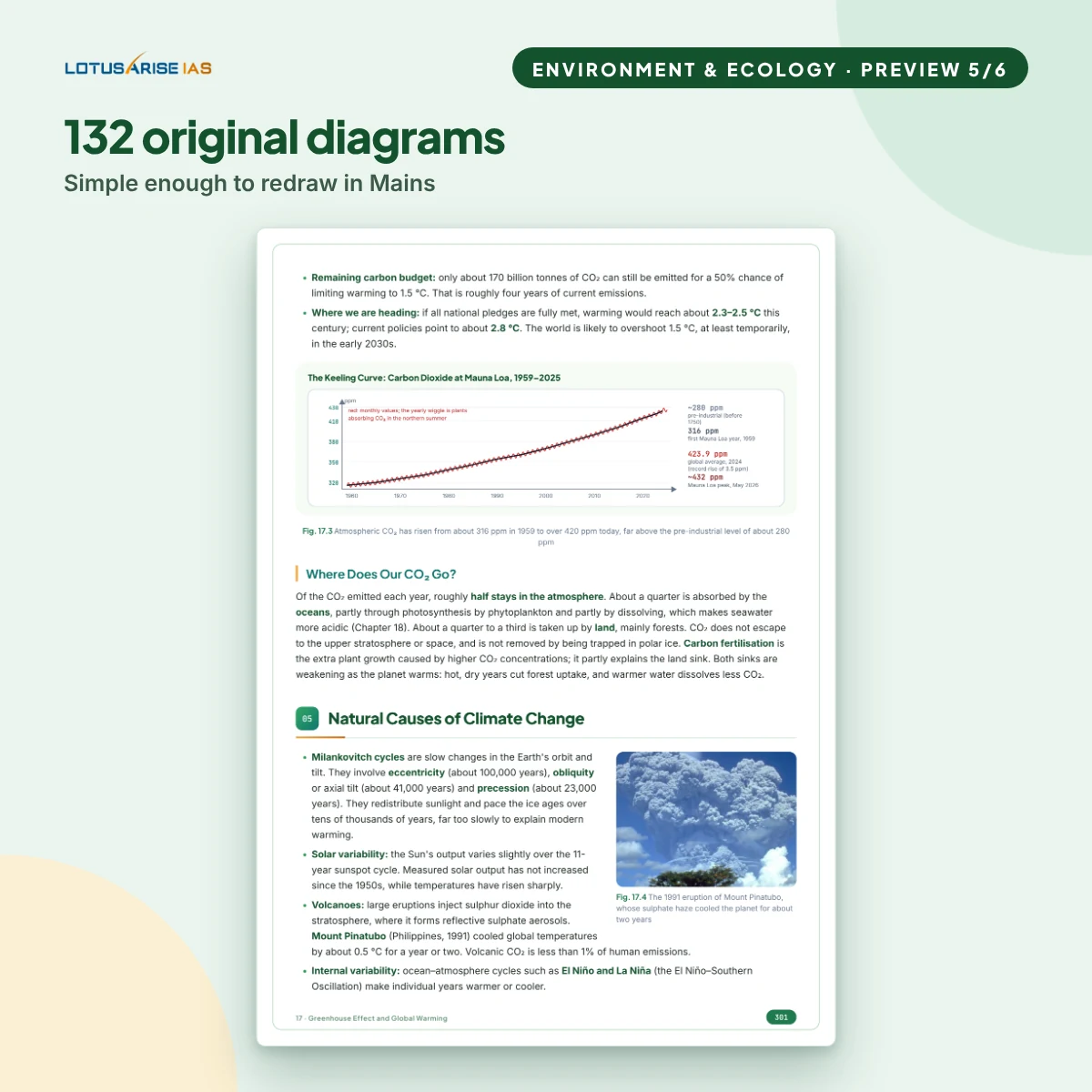
🎨 132 original diagrams + colour photographs — cycles, pyramids, timelines and maps you can redraw in Mains
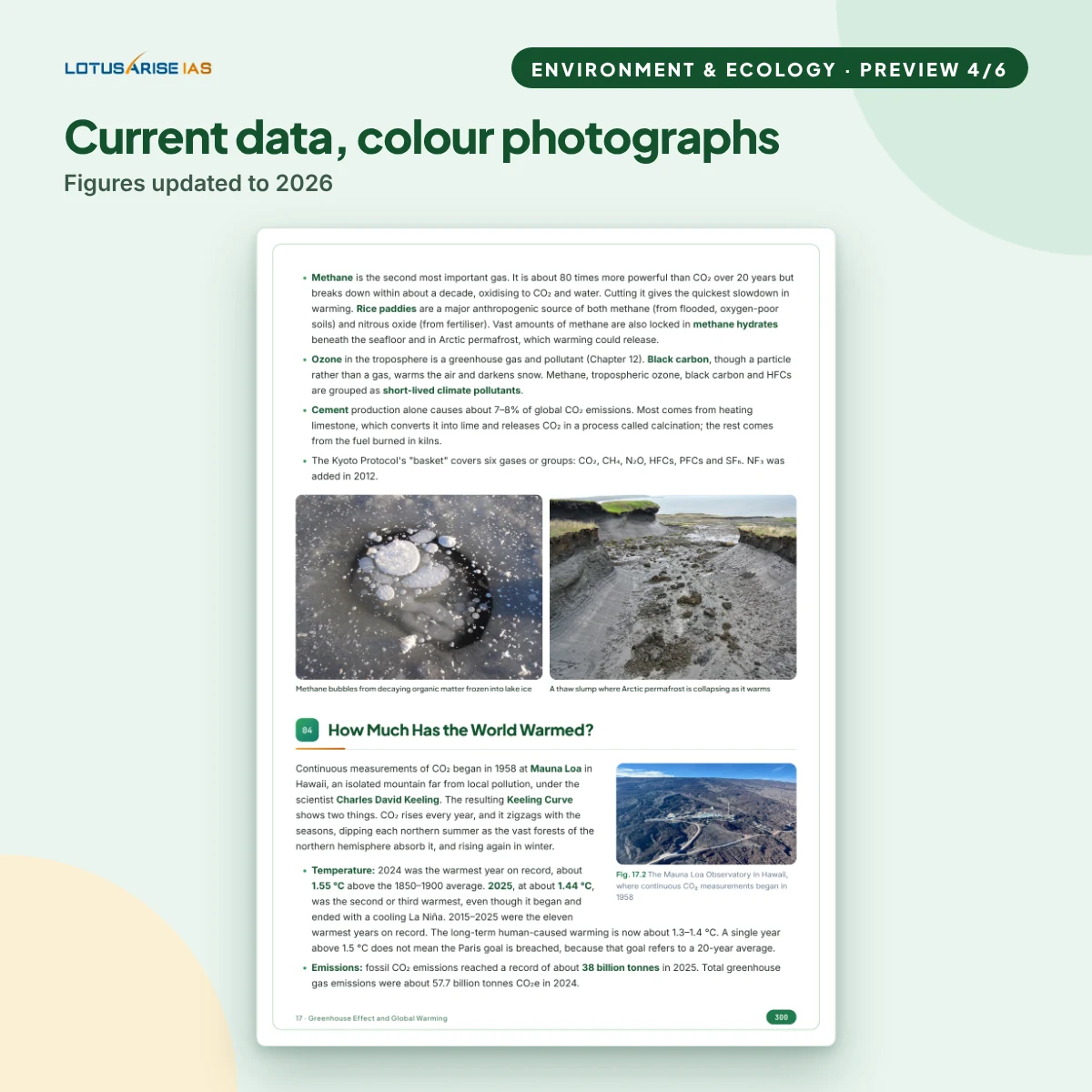
🗓️ Data updated to 2026 — protected-area counts, COP outcomes, carbon market rules, new laws and rules
📱 Instant PDF download — laptop, mobile or tablet, offline, printable
One-time payment. No subscription. Instant download after purchase. See the free sample first.
⭐ Read by 300,000+ UPSC aspirants every month on LotusArise IAS
Features:
- Comprehensive Coverage
- Complete Syllabus
- Suitable for: UPSC & State PSCs exams
- Format: Digital PDF (Downloadable)
- 337,362+ aspirants visit every month
The problem nobody admits about Environment
Ask an aspirant three months before Prelims what worries them in GS, and Environment comes up quickly. Not because the subject is hard. They will say one of three things:
“I’ve read the basics twice, but the questions are about some convention, species or scheme I’ve never heard of.”
“My notes stop around 2022. I don’t know which numbers are still correct — how many Ramsar sites, how many tiger reserves, what was decided at the last COP.”
“I have five PDFs on climate change and none of them agree with each other.”
These are not reading problems. The concepts in Environment are simple; what goes wrong is that the material is scattered, out of date and never tied to what UPSC actually asks. Environment and Ecology Notes for UPSC is one book built to fix exactly that.
Why Environment deserves a book of its own
Environment and ecology is one of the steadiest sources of questions in GS Prelims, and the 274 previous year questions from 2011 to 2026 inside this book are the proof — every one of them placed in the chapter that answers it. In Mains, the same material feeds GS Paper III (environment, conservation, pollution, EIA and disaster management), parts of GS Paper I (geography and climate) and the Essay paper, where climate and sustainability topics keep returning.
The subject also moves every year — new Ramsar sites, new rules, a new COP decision, a new species on the Red List. So the real challenge is not understanding Environment. It is having one source that is complete, current and organised the way the exam tests it.
What’s inside
📘 The complete notes — 28 chapters, 441 pages
Nine units, in the order the subject is best learnt:
- Basics of Environment and Ecology — environment, habitat, ecosystem; abiotic and biotic components; limiting factors; population, community, niche, ecotone, biome; adaptation, evolution, speciation and extinction; succession and homeostasis; productivity, food chains and webs, ecological pyramids, the ten per cent law, biomagnification; water, carbon, nitrogen, methane, phosphorus and sulphur cycles
- Ecosystems — wetlands, estuaries, lagoons and mangroves; the Ramsar Convention and India’s Ramsar sites; terrestrial biomes, aquatic ecosystems, ecosystem services, seagrass and seaweed
- Biodiversity and Conservation — measuring biodiversity, hotspots, megadiverse countries, biogeographic zones of India; drivers of loss; protected areas, eco-sensitive zones, biosphere reserves, ex-situ conservation; CITES, CMS, IUCN Red List; tigers and other big cats, elephants, rhinos, river dolphins, crocodilians, turtles, vultures, bustards and floricans
- Environmental Pollution — air pollutants, smog, acid rain, ozone depletion, the Montreal Protocol and Kigali Amendment, air quality standards; water quality, eutrophication, groundwater and marine pollution, wastewater treatment; soil pollution, desertification, erosion, salinity; plastic, e-waste, bio-medical, battery and construction waste rules
- Climate Change — greenhouse gases, warming, feedbacks and tipping points, IPCC scenarios; sea-level rise, ocean acidification, coral bleaching, the cryosphere, El Niño and the Indian Ocean Dipole; carbon sequestration, geoengineering, carbon pricing and India’s carbon market; UNFCCC, the Paris Agreement, recent COPs, climate finance; India’s NDCs, NAPCC missions and India-led initiatives
- Energy and Environment — solar, wind, hydro and storage, bioenergy, nuclear, green hydrogen and fuel cells
- Environmental Governance — constitutional provisions, the Environment (Protection) Act, pollution and forest laws, CRZ, EIA, the NGT, environmental principles from the courts, green credits; sustainable development, the SDGs, UNEP and global bodies; the environmental cost of farming, rice methane, water-saving farming, natural farming and agroforestry
- Disaster Management — India’s hazard profile, the Disaster Management Act and institutions, early warning systems, major hazards, the Sendai Framework
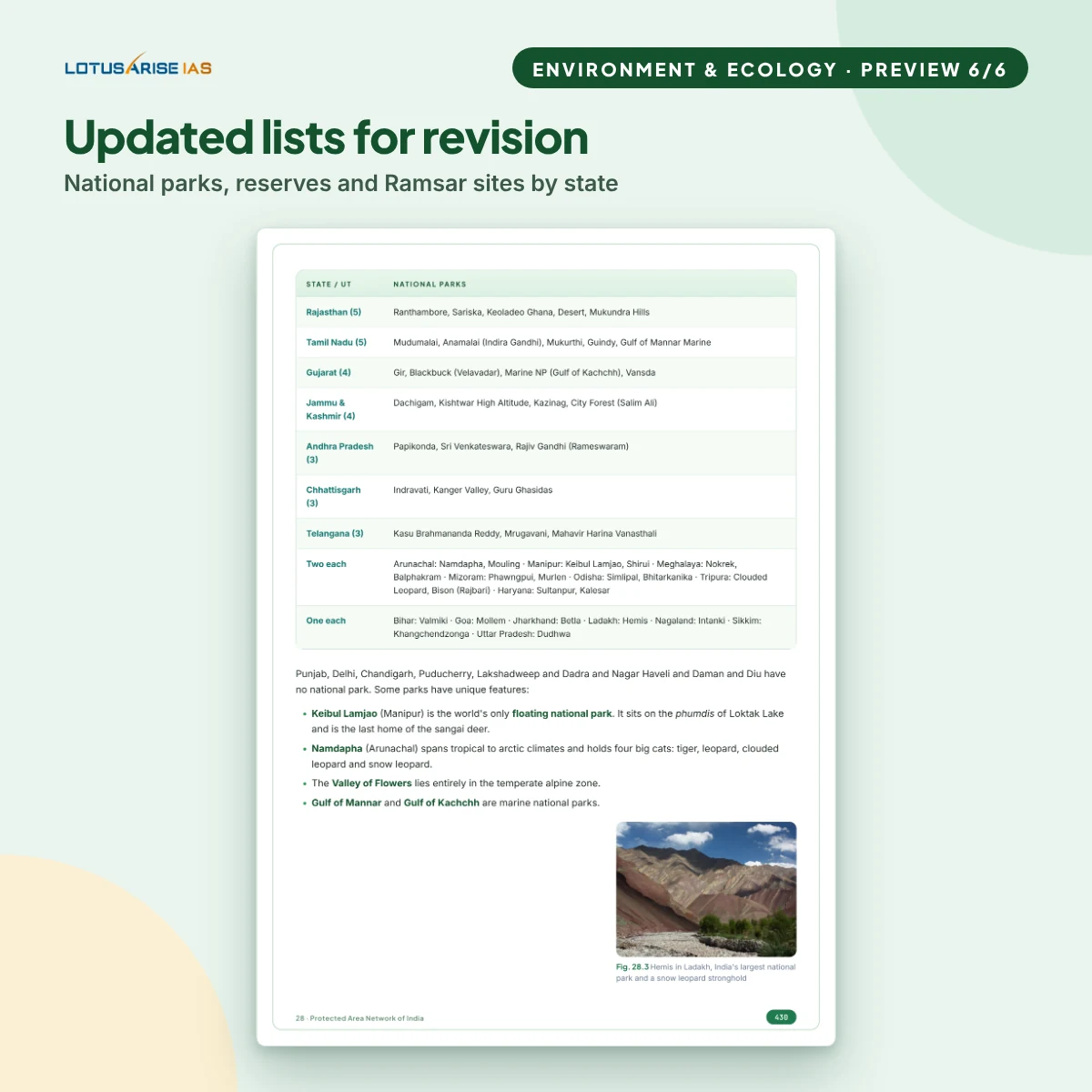
- Acts and Protected Areas — every major environment and wildlife act in one place; national parks by state, sanctuaries, conservation and community reserves, tiger and elephant reserves, biosphere reserves, Ramsar sites, World Heritage sites, biodiversity heritage sites, mangrove sites and bird sanctuaries
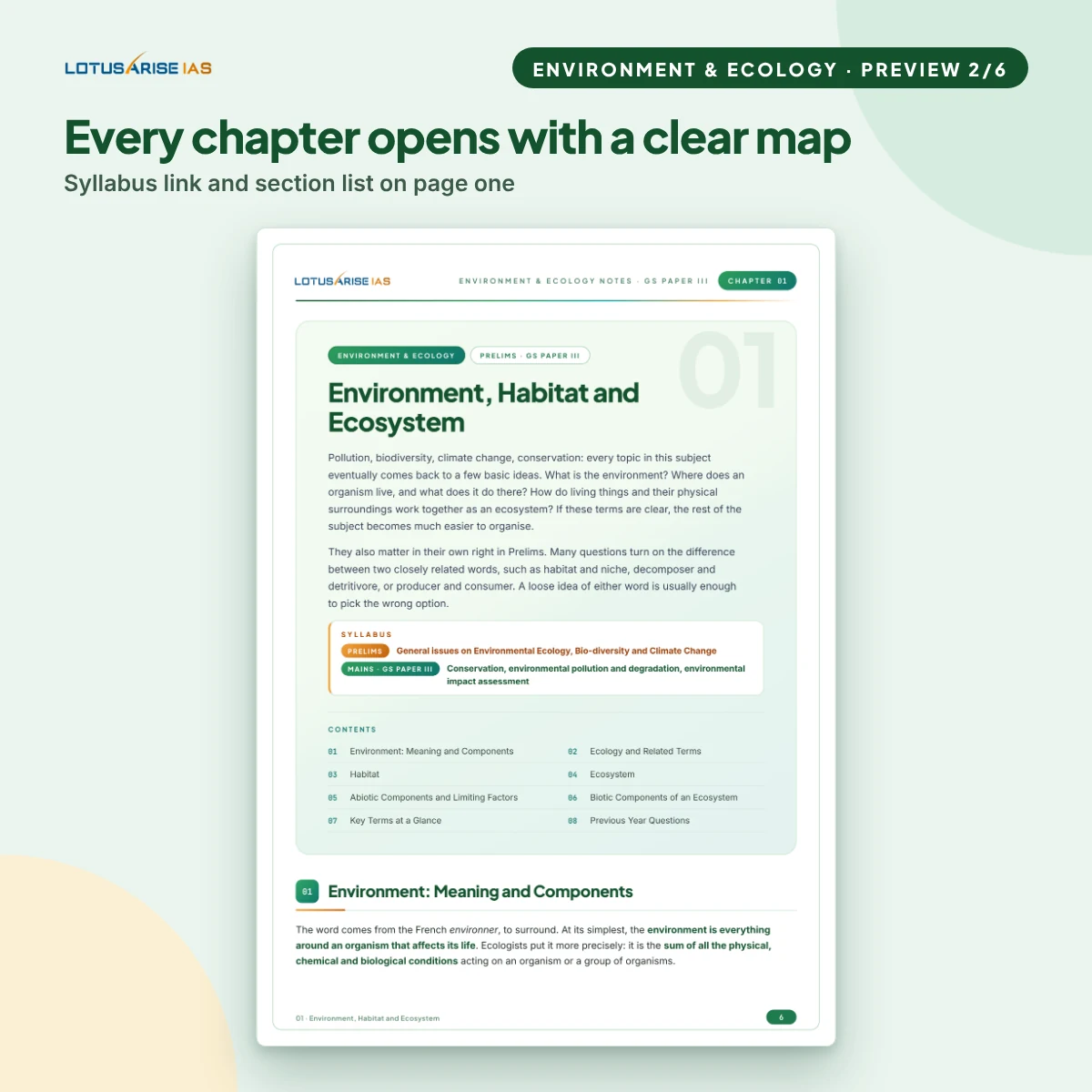
What makes this different from downloaded PDFs: every chapter is written from scratch for the exam, not copied from a textbook. Numbers are checked against current official data — the protected-area network, for example, uses the 2025 count. Each chapter closes with its own previous year questions, so you finish a topic and immediately see how UPSC has tested it. And the language is plain: short paragraphs, clear headings and key-insight boxes rather than dense academic prose.
📝 274 Prelims PYQs (2011–2026)
Every question appears verbatim, with all four options, under the chapter that answers it — not dumped in a separate book at the end. Read the chapter, then test yourself on what UPSC actually asked from it.
🎨 132 original diagrams and colour photographs
Nutrient cycles, ecological pyramids, succession stages, the greenhouse effect, climate-negotiation timelines, EIA steps, the disaster-management structure and protected-area maps — each drawn fresh and simple enough to reproduce in a Mains answer. Colour photographs of species, ecosystems and landforms help you recognise what you are reading about.
🗂️ Built for revision
A clickable contents page, unit pages that list every topic before you begin, and a bookmark panel that takes you to any section in one tap. Key-terms tables close many chapters for quick last-week revision.
The aspirant who buys this
First-time aspirants — you want one trusted book to read Environment from start to finish, instead of stitching together five sources in your first year.
Repeaters who lost marks in Environment in Prelims — you know the basics; what hurt you were the species, sites, conventions and schemes. The protected-area lists, wildlife chapters and placed PYQs are built for exactly those questions.
Mains aspirants preparing GS Paper III — conservation, pollution, climate change, EIA and disaster management are all here, with diagrams you can draw in an answer.
Self-study aspirants outside Delhi, Prayagraj or Jaipur — no classroom, no batch timings; one PDF on your phone that covers the whole subject.
State PSC aspirants — the environment syllabus of most State PSCs overlaps heavily with UPSC, so the same book serves both.
Why not just use free notes from Telegram?
Free Environment notes exist, and plenty of aspirants have folders full of them. The problem is not that they are bad. It is that they are scattered across a dozen files, often several years old, and never connected to the questions UPSC has actually asked. Numbers that changed in 2024 or 2025 are still printed the old way. Nobody tells you which file covers which part of the syllabus.
This book is one connected system: one sequence of 28 chapters, current data, and every PYQ placed where it belongs.
If you have the time and discipline to build that system yourself from scattered sources, you may not need this. If you want it already built — open it and start reading — this is what the book is for.
Price and delivery
Printed Environment guides alone usually cost more than this PDF, and they do not include placed PYQs or current data.
MRP ₹500 → Launch price ₹236 for 441 pages — under 54 paise a page.
Want to see it first? Download the free sample PDF — the cover, the full contents and two complete chapters (01 and 17).
One-time payment. No subscription. No recurring charge.
Instant PDF download after payment. The download link is also sent to your email — please check the spam folder if it does not arrive in a few minutes. Download it again any time from My Account.
For support: support@lotusarise.com