


Indian Economy Notes for UPSC: Prelims & Mains GS Paper III (2027 Edition) by LotusArise IAS
Original price was: ₹700.00.₹349.00Current price is: ₹349.00.
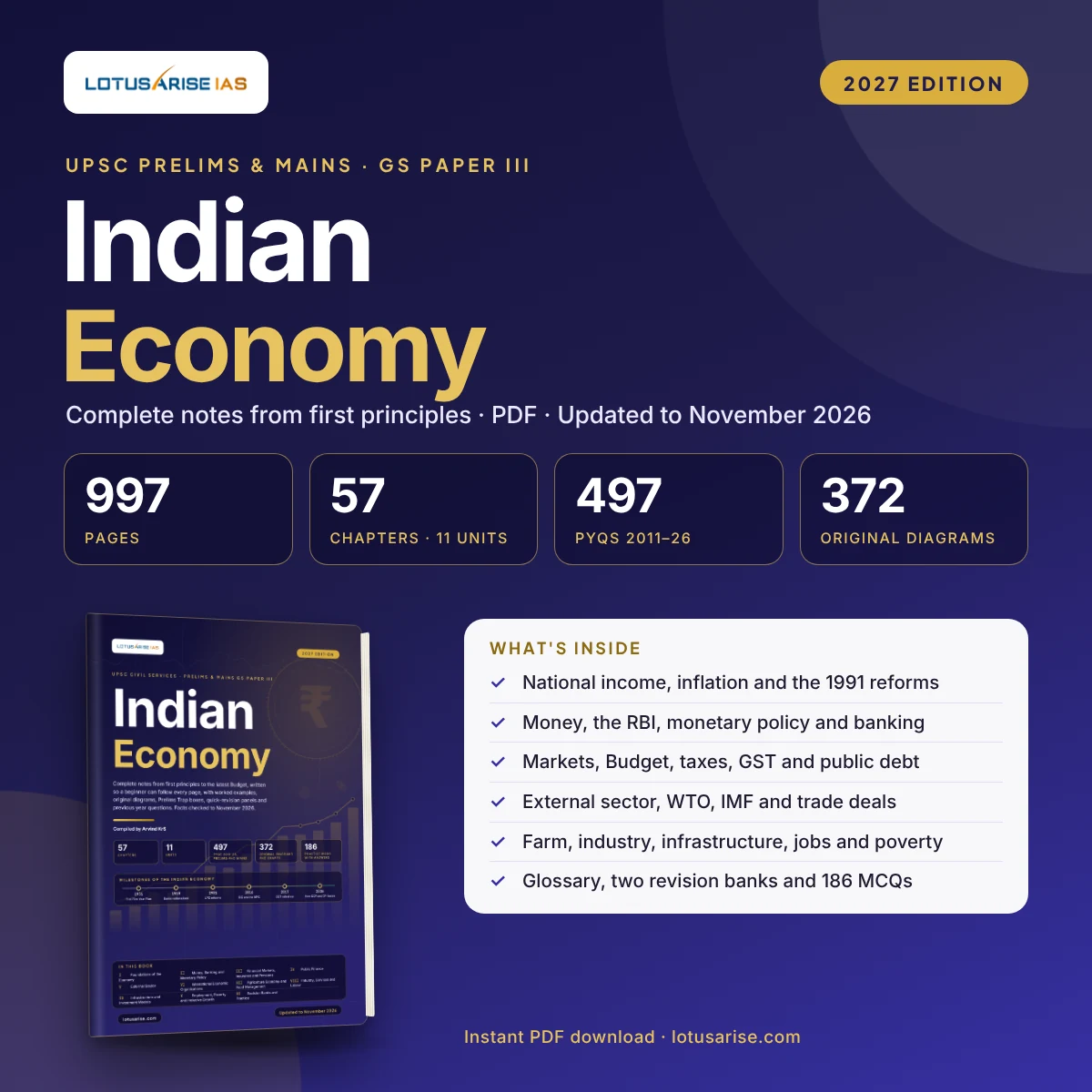
₹349 for the 2027 Edition ₹700 — 997 pages, about 35 paise a page.
Most aspirants learn Economy as a list of terms. Repo, SDF, MSF. Fiscal deficit, primary deficit, effective revenue deficit. Then Prelims asks who decides the Bank Rate, the MPC or the RBI — and a memorised definition is no help, because the question is about how the thing works.
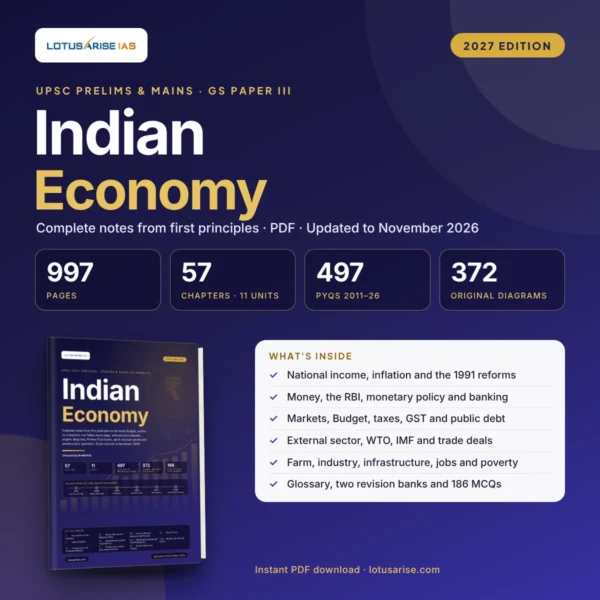
Indian Economy Notes for UPSC starts every topic from zero and builds it up to exam level, current to November 2026.
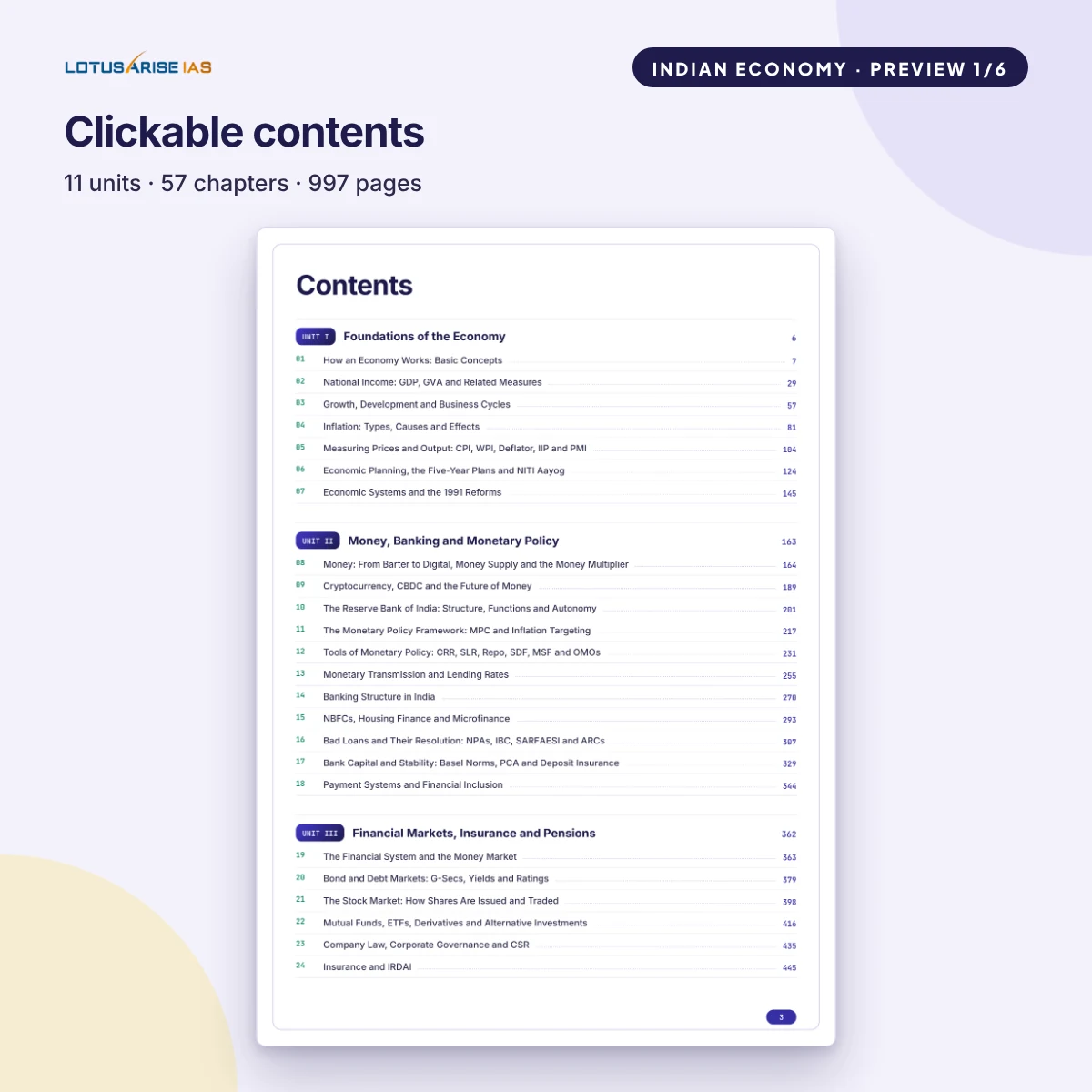
📘 57 chapters in 11 units, 997 pages — national income, inflation, money and banking, markets, the Budget and taxes, the external sector, agriculture, industry, jobs and poverty
🧩 372 original diagrams, 233 Start Here stories, 116 worked examples — an everyday case and real numbers before every definition
📝 497 PYQs, 2011–2026 — 333 Prelims in UPSC’s wording with the right option and a one-line reason; 164 Mains with an approach line
📚 Three revision banks + 186 practice MCQs — a 616-term glossary, committees and indices, schemes and institutions, every MCQ explained
📱 Instant PDF download — laptop, mobile or tablet, offline, printable
One-time payment. No subscription. Unlimited downloads — the link does not expire.
⭐ Read by 300,000+ UPSC aspirants every month on LotusArise IAS
Features:
- Comprehensive Coverage
- Complete Syllabus
- Suitable for: UPSC & State PSCs exams
- Format: Digital PDF (Downloadable)
- 337,362+ aspirants visit every month
The Economy problem most aspirants don’t talk about
Ask an aspirant how Economy is going, and you will rarely hear “I haven’t started”. You will hear one of three things:
“I have watched the lectures and I have the handouts. I can define repo and reverse repo. Put SDF, MSF and the Bank Rate in four options and I am guessing.”
“I am not from a commerce background. Every chapter assumes I already know what a bond yield or a current account is, so I read the same page three times.”
“My notes say the repo rate is 6.5% and the base year is 2011-12. I know both have changed. I don’t know what else has.”
None of this is about intelligence or effort. Economy is the one GS subject where every term rests on another term, and where the numbers move every few months. Most material either skips the first step or was written before the last change. Indian Economy Notes for UPSC is written from the first step, and checked to November 2026.
Why Economy is worth the hours
Economy is one of the most heavily asked areas of Prelims. This book alone carries 333 Prelims questions from 2011–2026, about 21 a paper on average, and 19 from Prelims 2026.
It pays again in Mains. GS Paper III opens with “Indian Economy and issues relating to planning, mobilization of resources, growth, development and employment”, and goes on to inclusive growth, Government Budgeting, agriculture, industry, infrastructure and investment models. The same chapters feed your Essay and your Interview.
The challenge is not the syllabus. It is having one source that explains each mechanism from the beginning, keeps the figures current, and puts the Prelims-level detail where you can find it again.
What’s inside — 997 pages
📘 The complete notes — 57 chapters in 11 units
- Foundations of the Economy — how an economy works, national income and the new GDP series (base 2022-23), growth and development, inflation, CPI (base 2024), WPI, IIP and PMI, planning and NITI Aayog, the 1991 reforms
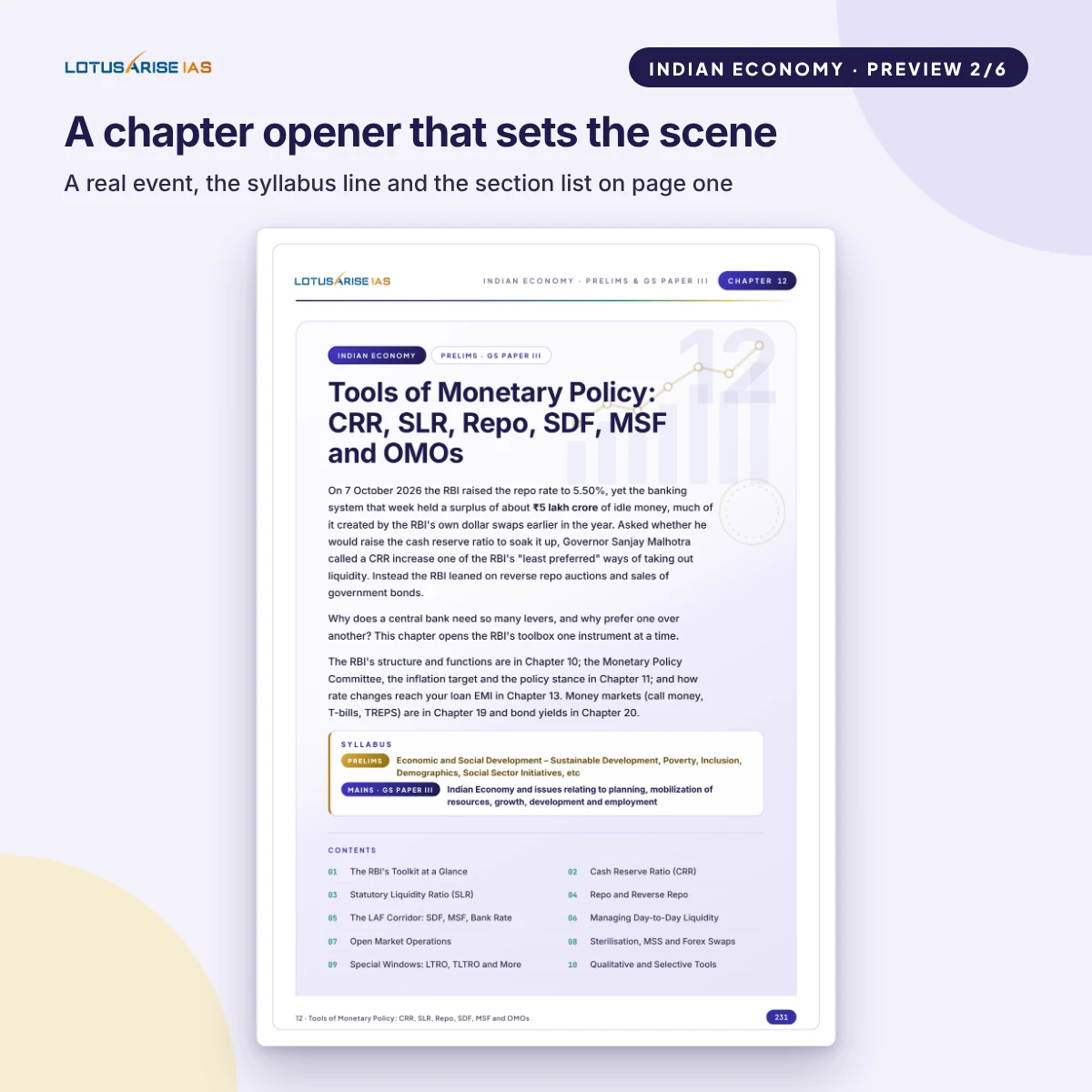
- Money, Banking and Monetary Policy — money supply and the money multiplier, crypto and the e-rupee, the RBI, the MPC and inflation targeting, CRR, SLR, repo, SDF, MSF and OMOs, transmission, the banking structure, NBFCs, NPAs and the IBC, Basel norms, payment systems and financial inclusion
- Financial Markets, Insurance and Pensions — the money market, G-Secs and yields, the stock market, mutual funds and derivatives, company law and CSR, insurance, NPS, UPS, APY and EPFO
- Public Finance — the Budget and its documents, deficits, direct taxes, GST, the Finance Commissions, FRBM and public debt, subsidies, disinvestment and black money
- External Sector — the balance of payments, exchange rates and forex reserves, trade policy, FDI, FPI, ECB and FEMA, external debt and the internationalisation of the rupee
- International Economic Organisations — the WTO, the IMF and the World Bank Group, AIIB, NDB, ADB, BIS, FATF and the G20, FTAs and CEPAs
- Agriculture Economy and Food Management — land reforms, farm credit, insurance and subsidies, MSP and marketing, food security, the PDS and buffer stocks, allied sectors and food processing
- Industry, Services and Labour — industrial policy, Make in India, PLI and IPR, MSMEs and the digital economy, the labour codes and ease of doing business
- Infrastructure and Investment Models — energy, transport, communication and urban infrastructure, PPP models, the NIP, asset monetisation and PM Gati Shakti
- Employment, Poverty and Inclusive Growth — unemployment and the labour market, poverty lines, inequality and human development
What makes this different from downloaded PDFs: it is one book written in one sequence, so Chapter 12 can rely on what Chapter 8 taught. Every chapter was checked against primary sources (the RBI, the Budget documents, the statistics ministry, official releases) and then audited again, chapter by chapter. Every worked example was recomputed.
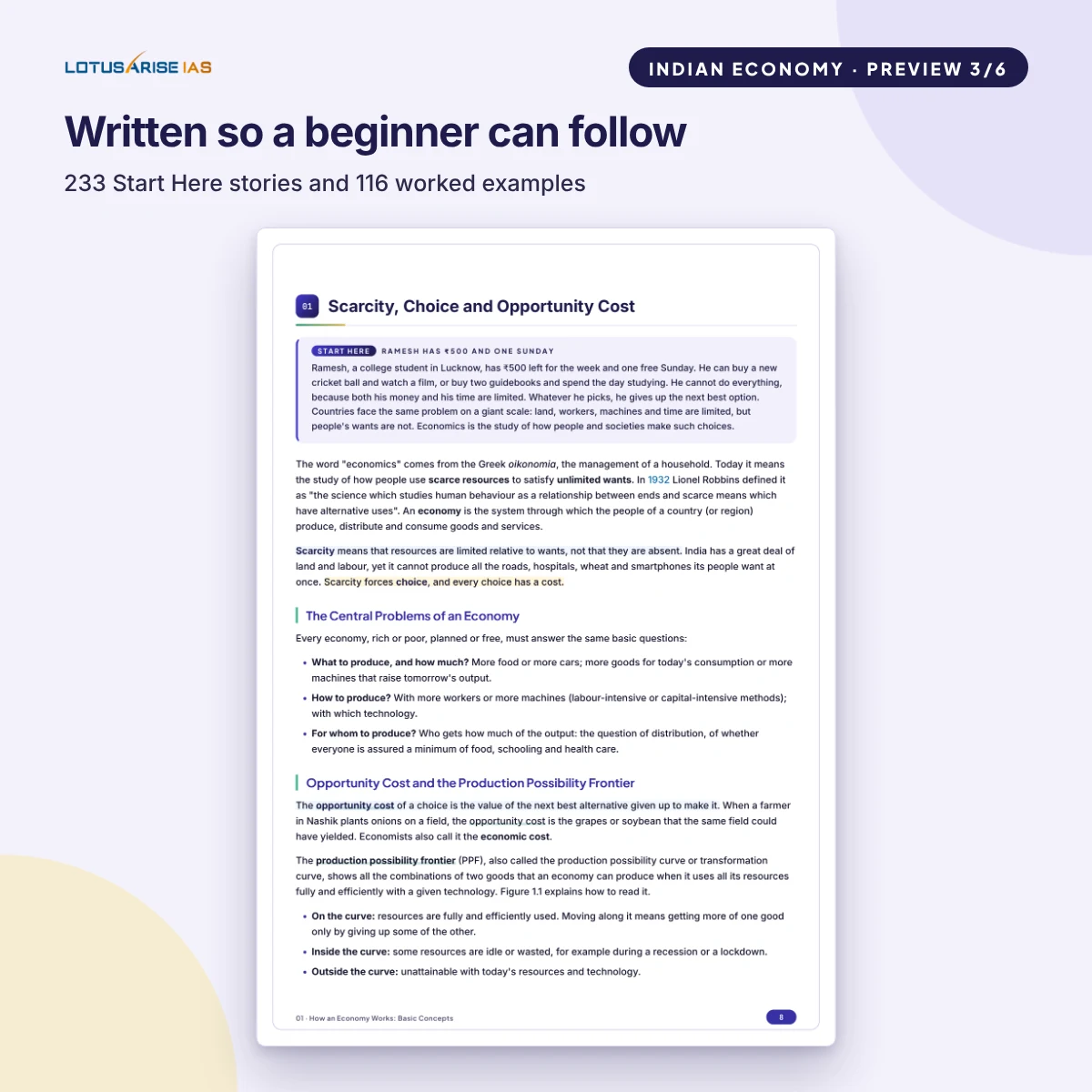
🧩 Explained from zero — 233 Start Here stories and 116 worked examples
Each new idea opens with an everyday case: a student with ₹500 and one Sunday for opportunity cost, your own ₹100 deposit for CRR and SLR. Then come the numbers, worked line by line, and only then the definition. An aspirant who has never studied economics can follow every page.
📊 372 original diagrams and a mind-map in every chapter
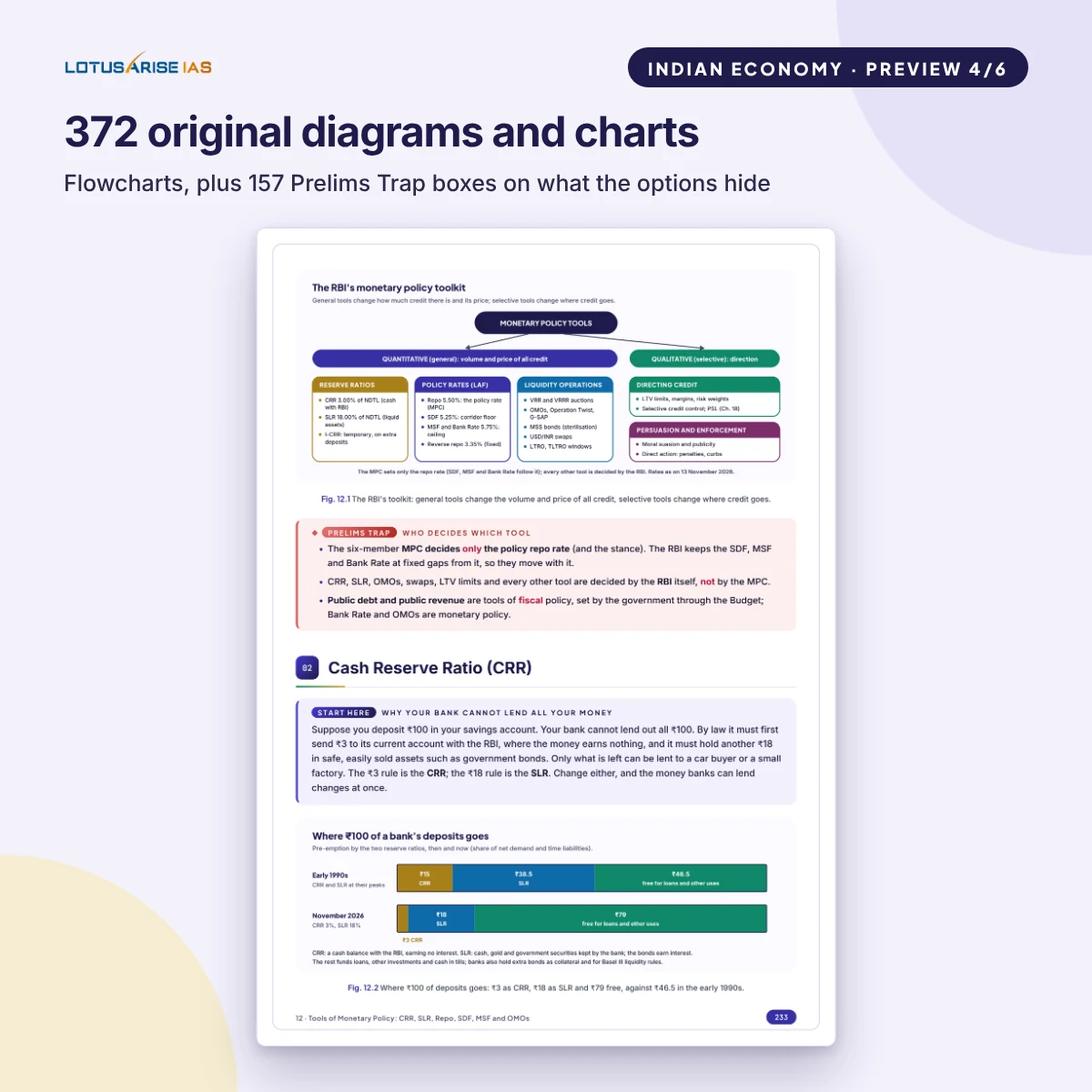
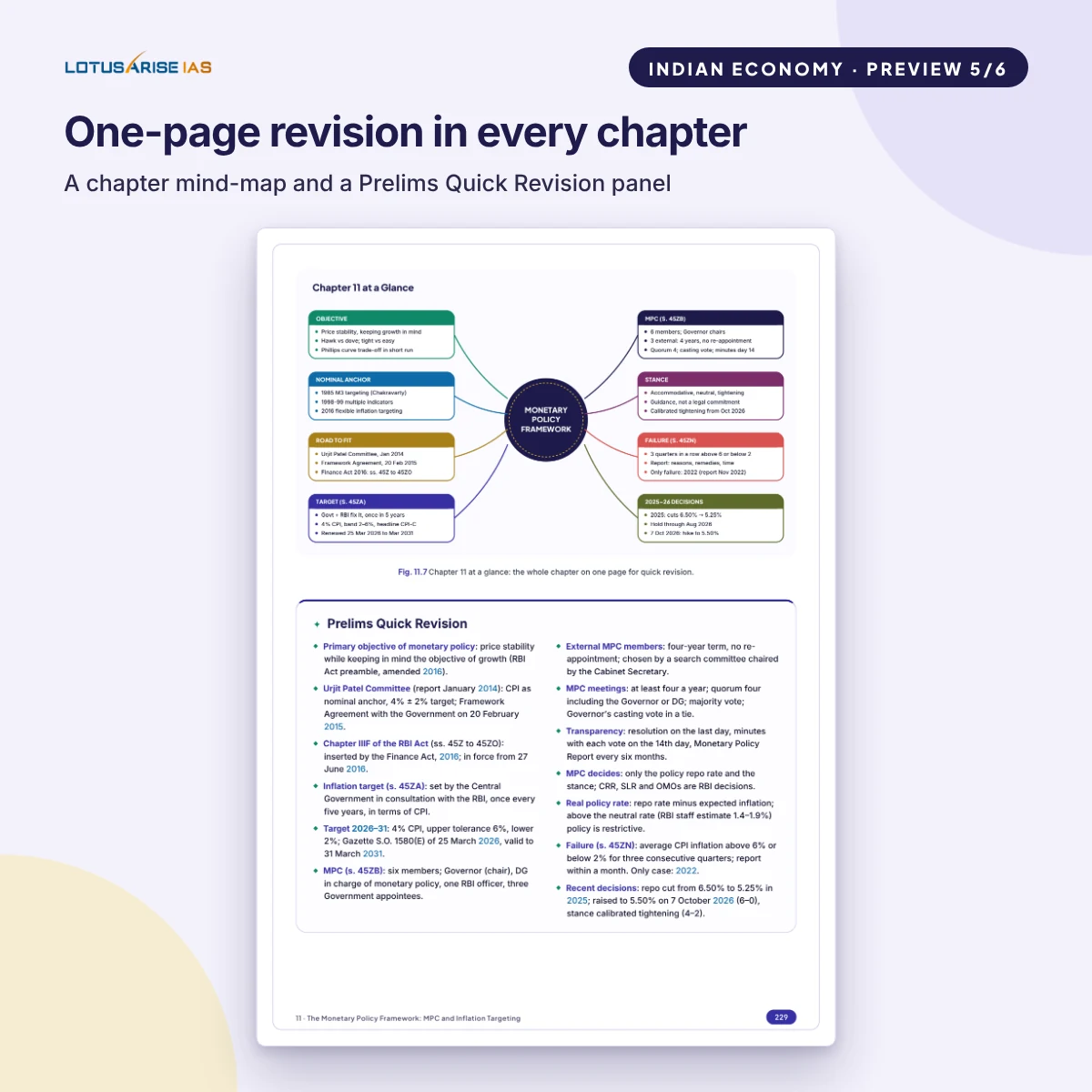
Flowcharts for every mechanism: how a rate change reaches your EMI, how the Budget moves through Parliament, how the balance of payments adds up. Each of the 53 main chapters closes with a chapter mind-map and a Prelims Quick Revision panel.
🎯 157 Prelims Trap boxes
The look-alike terms and half-true statements that options are built from: which rates the MPC decides and which the RBI sets, what counts in M1, which deficit leaves out interest payments.
📝 497 previous year questions, 2011–2026
333 Prelims questions in UPSC’s wording, with the right option marked and a one-line reason. 164 Mains questions from 2013–2026, each with an approach line that names the sections to draw on.
📚 Three revision banks and 186 practice MCQs
- Glossary — 616 terms, each in one line with its chapter
- Committees, Reports and Indices Bank — 125 committees and 64 reports and indices, with publisher and India’s latest rank
- Schemes and Institutions Bank — 141 schemes and 78 institutions, with ministry, year and purpose
- 186 practice MCQs — Prelims-style, grouped by unit, each with the answer and the reason
The aspirant who buys this
First-timers without an economics background — engineers, science and arts graduates who want one book that starts at the beginning and does not assume the vocabulary.
Repeaters — you know the syllabus, yet you lose Prelims marks on close options and on figures that have changed since your notes were made. This book gives you the mechanism and the current number.
Mains-focused aspirants — 164 GS questions with approach lines, and diagrams you can redraw in an answer.
Self-study aspirants outside Delhi, Prayagraj or Jaipur — no classroom, no batch timings; one PDF on your phone that covers the whole syllabus.
State PSC aspirants — Indian Economy is part of the State PSC syllabuses too, so the same book serves both.
Why not just use free handouts and lecture notes?
Free Economy material exists, and much of it is good. Most aspirants already have a folder of it. The problem is not quality. It is that handouts are written to accompany a lecture, so they skip the steps the lecture explained, and that they date quickly: a policy rate, a base year, a scheme renamed or closed, a Budget figure.
This book is one connected, checked system: the whole syllabus in sequence, written to be read on its own, current to November 2026, with diagrams, worked examples, PYQs, three revision banks and practice MCQs for the last month before the exam.
If you have the time to rebuild your notes from the primary sources after every policy change, you may not need this. If you want it already done — open it and start — this is what the book is for.
Price and delivery
₹349 (₹700) for 997 pages — about 35 paise a page, or about ₹6 a chapter.
Want to see it first? Download the free sample PDF — the cover, the full contents, and two complete chapters: Chapter 1 (How an Economy Works) and Chapter 12 (Tools of Monetary Policy).
One-time payment. No subscription. No recurring charge.
Instant PDF download after payment. The download link is also sent to your email — please check the spam folder if it does not arrive in a few minutes. Download it again any time from My Account.
For support: support@lotusarise.com
Related products
-

-
-
-
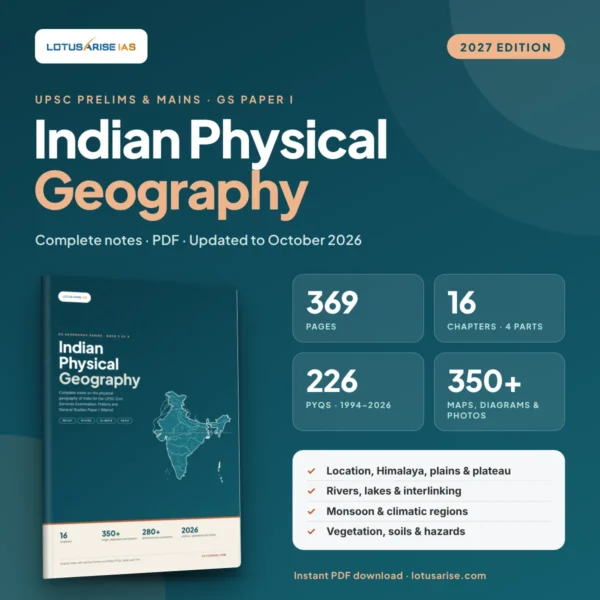
Indian Physical Geography Notes for UPSC: Prelims & Mains GS Paper I (2027 Edition) by LotusArise IAS
Original price was: ₹300.00.₹149.00Current price is: ₹149.00.