


Disaster Management Notes for UPSC: GS Paper III (2027 Edition) by LotusArise IAS
₹149.00
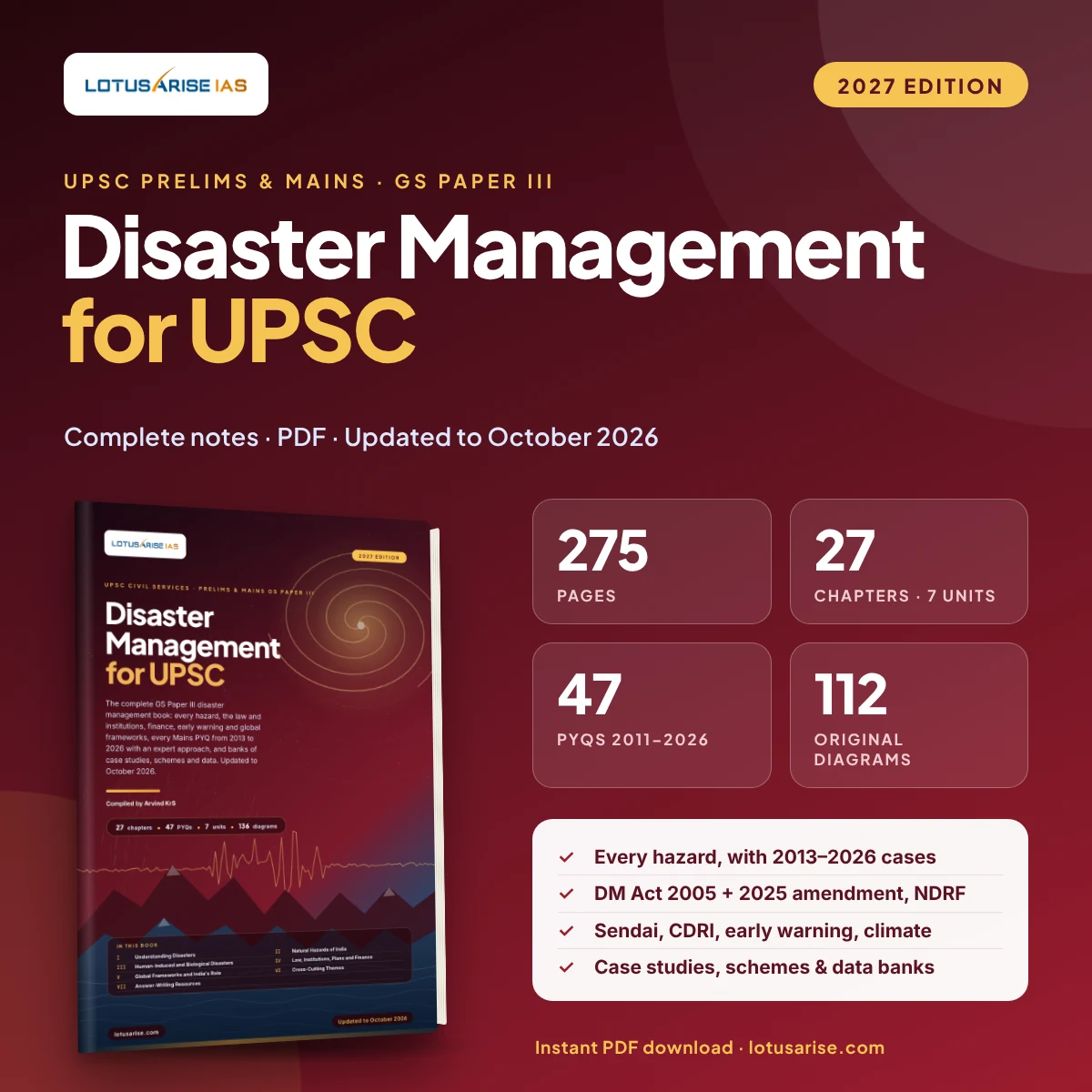
₹149 for the 2027 Edition — 275 pages, about 54 paise a page.
Most aspirants prepare Disaster Management the wrong way. An old notes PDF that stops at the 2005 Act, a list of NDMA guidelines they never revise, and case studies they cannot date. Then the paper asks about disaster resilience and the Sendai targets, urban floods, or community participation — and their notes have nothing after 2016.
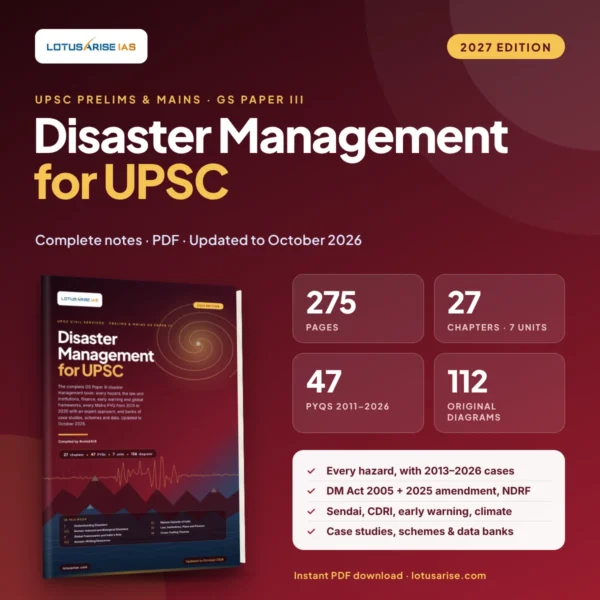
Disaster Management Notes for UPSC puts the whole subject, current to October 2026, in one book.
🌊 27 chapters in 7 units, 275 pages — earthquakes, tsunamis, cyclones, floods, cloudbursts, GLOFs, urban floods, heat waves, landslides, industrial, nuclear and biological disasters, stampedes
📜 The law and the system, updated — DM (Amendment) Act 2025, NDMA, NDRF, 15th and 16th Finance Commission funds, Mission Mausam, cell broadcast alerts
📝 47 PYQs inside their chapters — 37 Mains questions (2013–2026, including Mains 2026) verbatim with an Approach box, 10 Prelims with answers
🗂️ Three ready-reference banks — 26 case studies from Kedarnath 2013 to Rasuwa 2026, a schemes-laws-frameworks bank, a data and indices bank
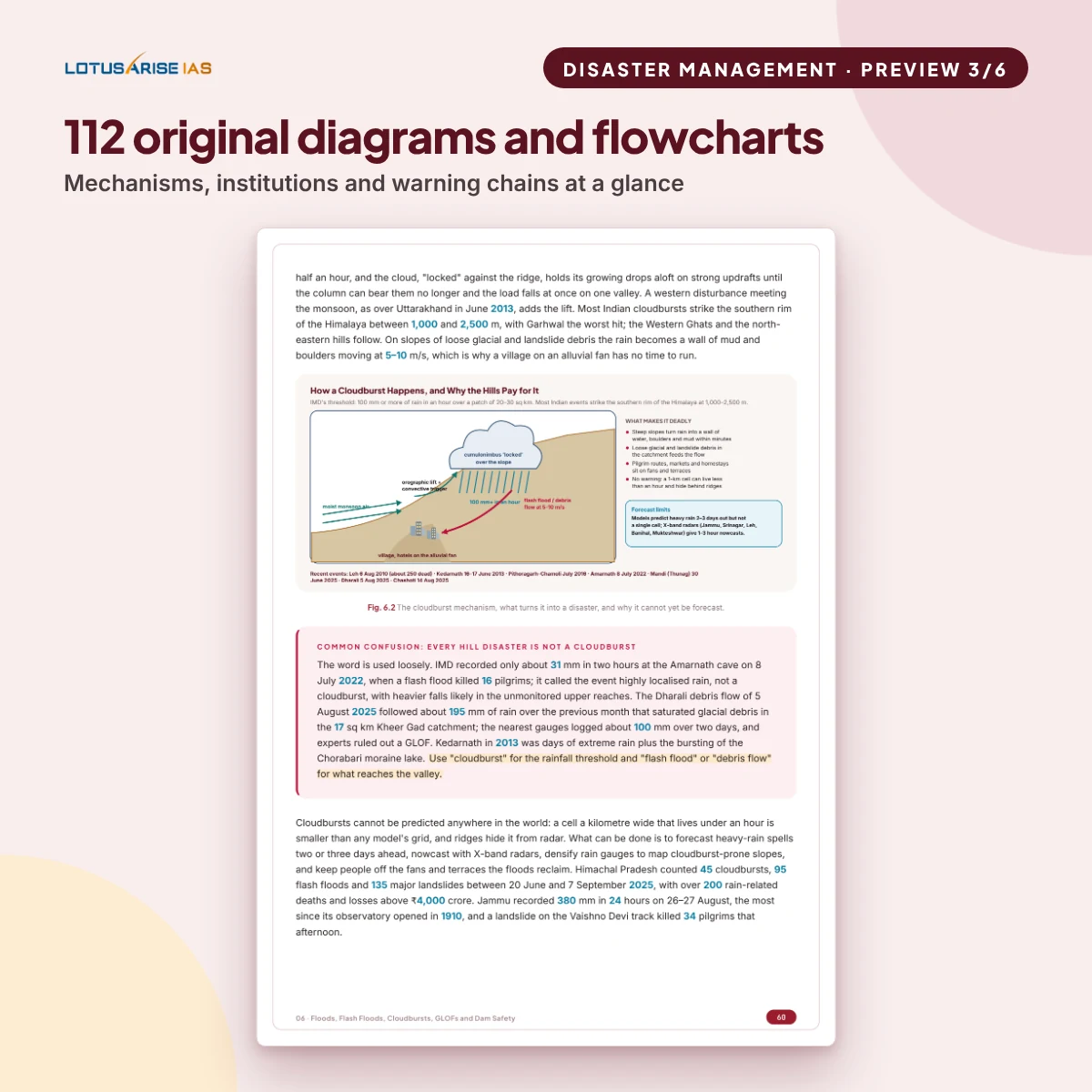
🎨 112 original diagrams, 38 photographs, a mind-map per chapter — instant PDF for laptop, mobile or tablet, offline, printable
One-time payment. No subscription. Unlimited downloads — the link does not expire.
⭐ Read by 300,000+ UPSC aspirants every month on LotusArise IAS
Features:
- Comprehensive Coverage
- Complete Syllabus
- Suitable for: UPSC & State PSCs exams
- Format: Digital PDF (Downloadable)
- 337,362+ aspirants visit every month
The problem nobody admits about Disaster Management
Ask an aspirant a few months before Mains how they are preparing Disaster Management, and the honest answer is “from my old notes, it’s only one question”. Push a little, and you hear one of three things:
“My notes describe NDMA and the 2005 Act. I know there was an amendment in 2025, but I can’t say what it changed — urban authorities, disaster databases, anything.”
“I remember Kedarnath and the 2004 tsunami. But when a question asks for two recent examples, I have nothing after 2018 that I can write with a date and a figure.”
“I can define hazard and vulnerability. A 15-mark question on resilience or community participation wants a framework, Sendai’s targets and an Indian case — and I don’t have them ready.”
These are not effort problems. Most aspirants have read about disasters for years. What they lack is one current source that joins the hazards, the law, the institutions, the money and the questions. Disaster Management Notes for UPSC is that source, in one book.
Why Disaster Management deserves a book of its own
Disaster management is a named GS Paper III topic, and UPSC has set at least one Mains question on it almost every year since 2013 — vulnerability, the Sendai and Hyogo frameworks, earthquakes, landslides, cloudbursts, urban floods, dam failures, mining hazards, and in 2026 both infrastructure in fragile areas and community participation. GS Paper I asks for the mechanisms — cyclones, tsunamis, cloudbursts, El Niño — and Prelims keeps returning to them.
It is also the topic that changes fastest. Since 2024 India has amended the Disaster Management Act, launched Mission Mausam and the Bharat Forecast System, switched on cell broadcast alerts, added heat waves and lightning to the notified list and moved to the 16th Finance Commission’s disaster funds — while Wayanad, the 2025 Himalayan floods and the stampedes of 2024–25 rewrote the case-study list. The real challenge is not understanding disasters. It is having one source that tracks every change and shows how UPSC asks about it.
What’s inside
🌊 The complete notes — 27 chapters in 7 units, 275 pages
- Understanding Disasters — hazard, vulnerability, exposure, risk and resilience; the disaster management cycle; DRR and Build Back Better
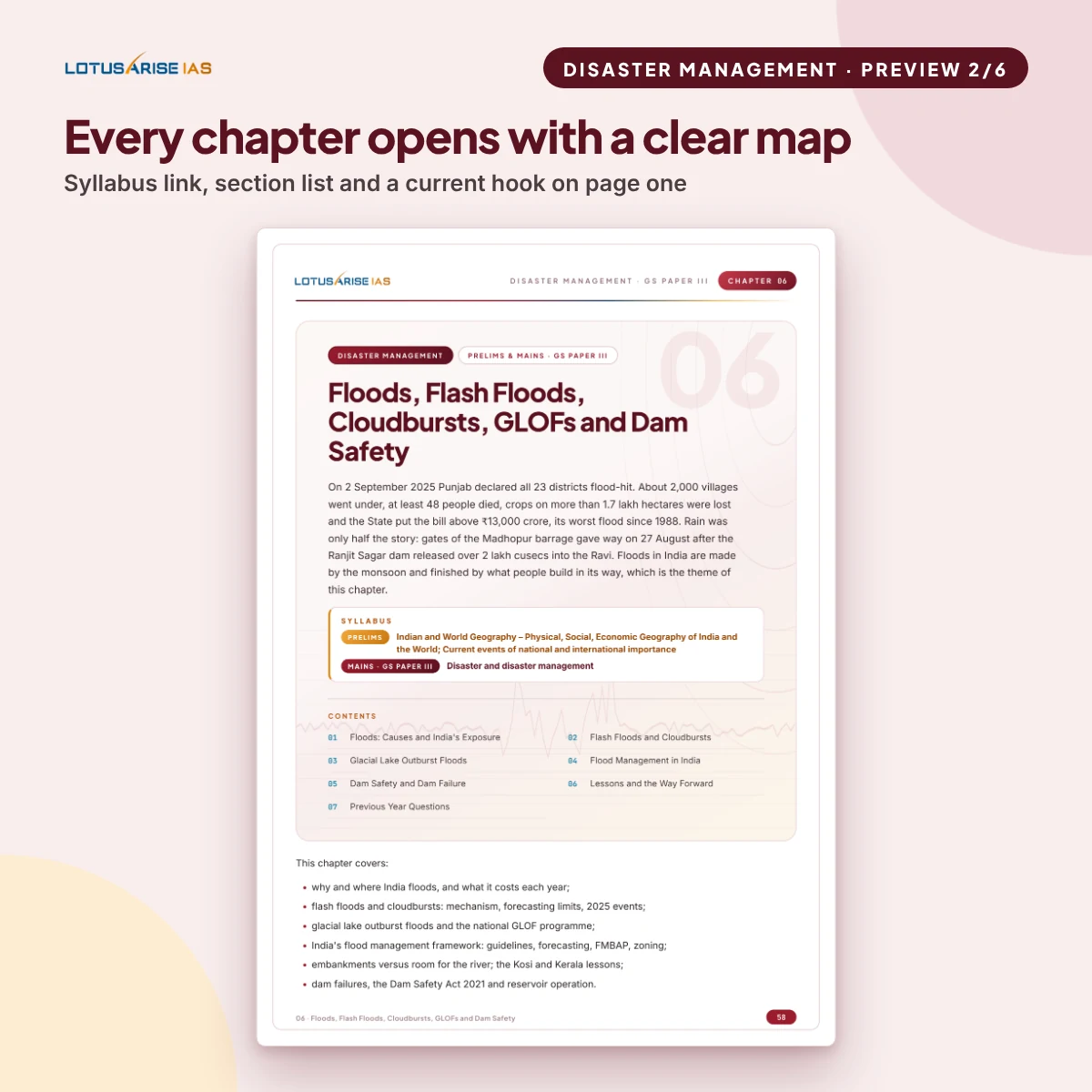
- Natural Hazards of India — earthquakes, tsunamis, tropical cyclones, floods, cloudbursts, GLOFs and dam safety, urban flooding, droughts and heat waves, landslides and land subsidence, lightning, forest fires, cold waves, dust storms and hail
- Human-Induced and Biological Disasters — industrial and chemical accidents, nuclear and radiological emergencies, epidemics and pandemics, fires, building collapses and crowd disasters, transport and mining accidents
- Law, Institutions, Plans and Finance — the DM Act 2005 and the 2025 Amendment, NDMA, SDMAs, DDMAs, NDRF and NIDM, the national plan, financing disaster risk, early warning and technology
- Global Frameworks and India’s Role — Yokohama, Hyogo and Sendai, loss and damage, CDRI, and India’s relief operations abroad
- Cross-Cutting Themes — climate change and development in fragile regions; community, vulnerable groups and the social side of disasters
- Answer-Writing Resources — the Case Studies, Schemes-Laws-Frameworks, and Data-Reports-Indices banks
What makes this different from downloaded PDFs: every chapter is written for the exam and current to October 2026. The DM (Amendment) Act 2025 and the first urban disaster authorities, the 16th Finance Commission’s ₹2,04,401 crore for State disaster funds, heat waves and lightning as notified disasters, Mission Mausam, the Bharat Forecast System, cell broadcast alerts, NCRB 2024, the 2025 earthquake code and its withdrawal, and the Tsunami Ready villages are already in their chapters. Every chapter was fact-checked independently against official sources.
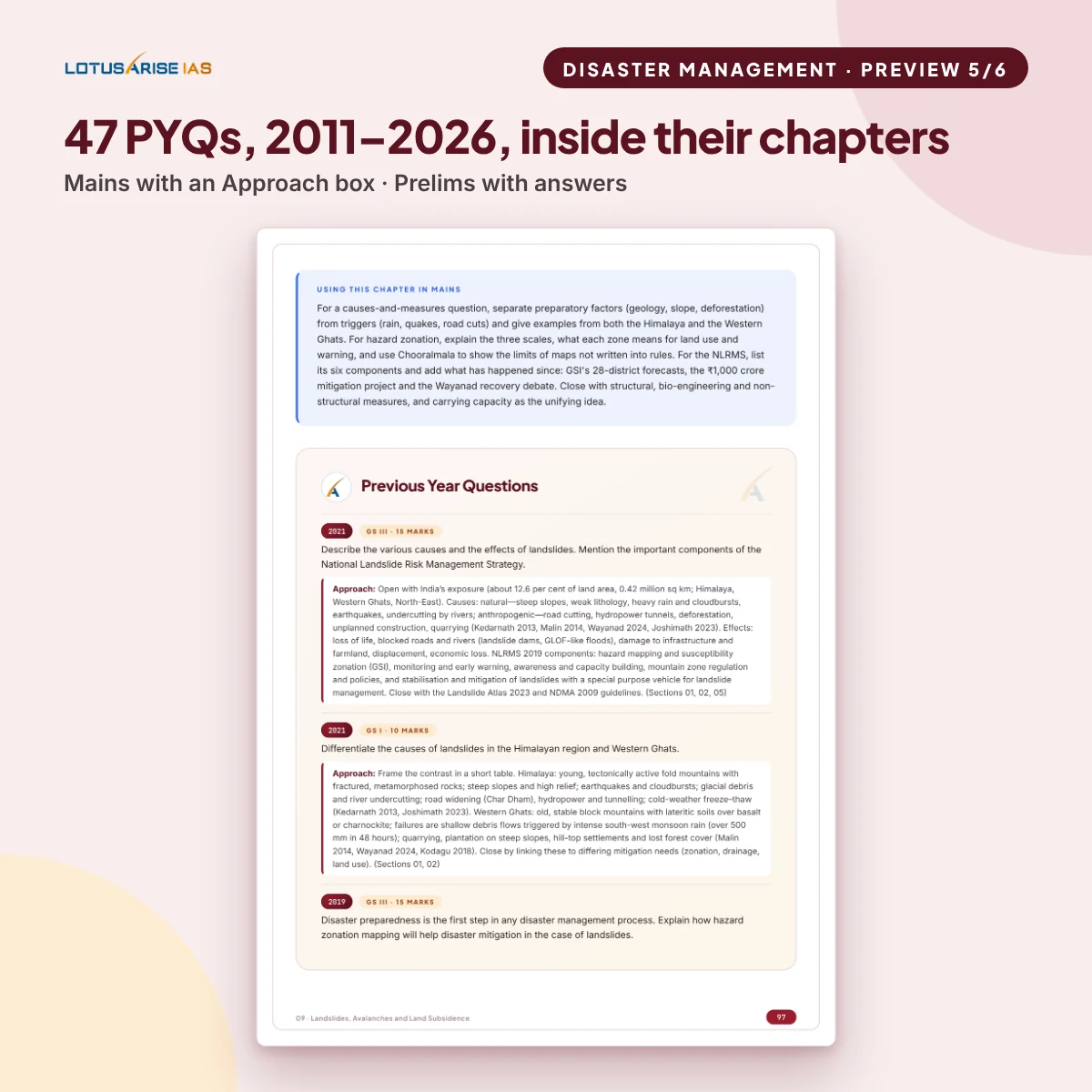
📝 47 PYQs — placed in the chapter that answers them
37 Mains questions from 2013 to 2026, including Mains 2026, appear verbatim, each with an Approach box that shows how to build the answer from the chapter. 10 Prelims questions come with their options, the answer and a one-line explanation. You finish a topic and immediately see how UPSC has tested it.
🗂️ Three ready-reference banks
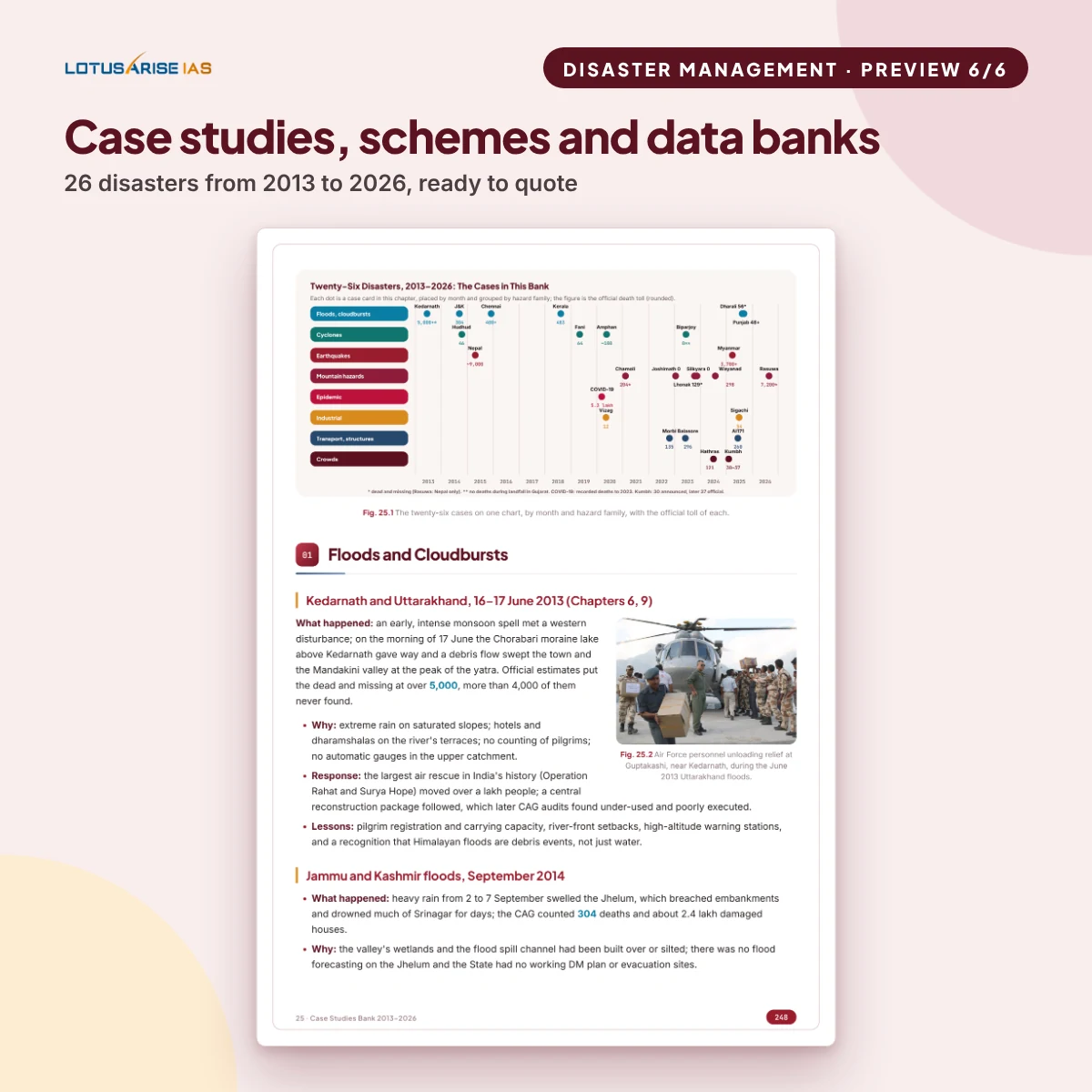
- Case Studies Bank — 26 disasters from Kedarnath 2013 to the Rasuwa avalanche of 2026, each with what happened, why, the response and the lesson
- Schemes, Laws and Frameworks Bank — the Acts, plans, programmes, funds and global frameworks, each in a few lines with its year and status in 2026
- Data, Reports and Indices Bank — India’s hazard profile, death and loss figures with their sources, and India’s place on the global risk indices
🎨 112 original diagrams, 38 photographs and a mind-map per chapter
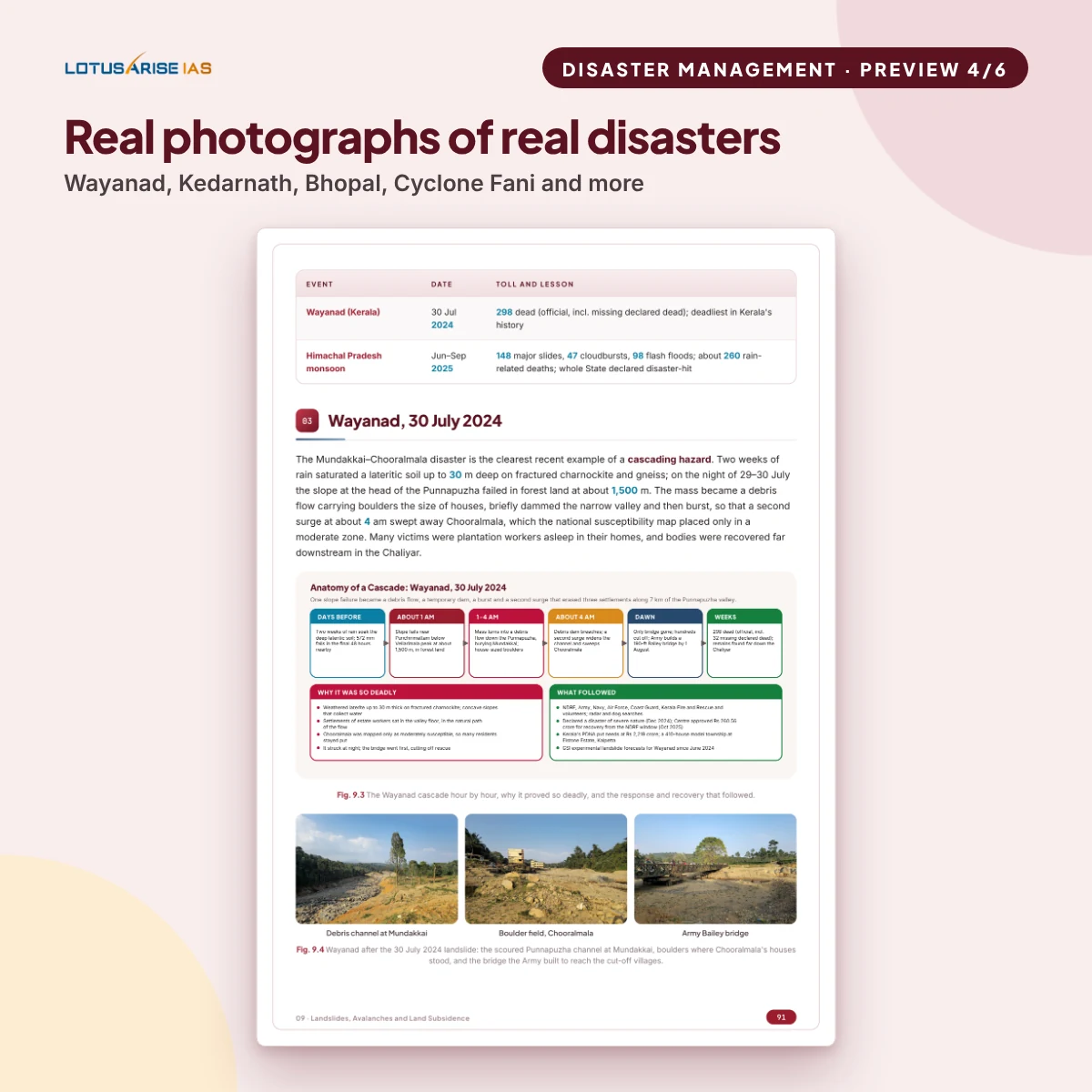
Mechanisms, institutions and warning chains drawn simple enough to reproduce in a Mains answer, real photographs of the events you will cite, and a one-page “Chapter at a Glance” mind-map for revision.
The aspirant who buys this
First-time aspirants — you want one trusted book for Disaster Management from day one, instead of stitching together old notes, NDMA guidelines and news reports.
Repeaters whose GS III answers stayed general — you know the cycle and the definitions. What costs you marks is the missing recent example, framework or figure. The case studies bank and the chapter-wise PYQs fix exactly that.
Geography-heavy aspirants — the hazard chapters double as GS Paper I material on cyclones, tsunamis, earthquakes, cloudbursts and landslides.
Self-study aspirants outside Delhi, Prayagraj or Jaipur — no classroom, no batch timings; one PDF on your phone that covers the whole topic.
State PSC aspirants — disaster management is part of most State PSC syllabi, so the same book serves both.
Why not just use free notes and current-affairs PDFs?
Free disaster management material exists, and most aspirants have folders of it. The problem is not that it is bad. It is that it is scattered and dated: guideline summaries from 2010, case studies without figures, and an Act described as it was before 2025.
This book is one connected system: every hazard and institution in sequence, every PYQ placed where it belongs, the case studies, laws and data collected for revision, and facts checked to October 2026.
If you have the time and discipline to build that system yourself from scattered sources, you may not need this. If you want it already built — open it and start — this is what the book is for.
Price and delivery
₹149 for 275 pages — about 54 paise a page, with 47 previous year questions and developments up to October 2026 that a printed guide cannot carry.
Want to see it first? Download the free sample PDF — the cover, the full contents, two unit pages and two complete chapters (01 and 06).
One-time payment. No subscription. No recurring charge.
Instant PDF download after payment. The download link is also sent to your email — please check the spam folder if it does not arrive in a few minutes. Download it again any time from My Account.
For support: support@lotusarise.com
Related products
-

-
World Geography & Mapping Notes for UPSC: Prelims & Mains GS Paper I (2027 Edition) by LotusArise IAS
Original price was: ₹300.00.₹149.00Current price is: ₹149.00. -
Indian Physical Geography Notes for UPSC: Prelims & Mains GS Paper I (2027 Edition) by LotusArise IAS
Original price was: ₹300.00.₹149.00Current price is: ₹149.00. -