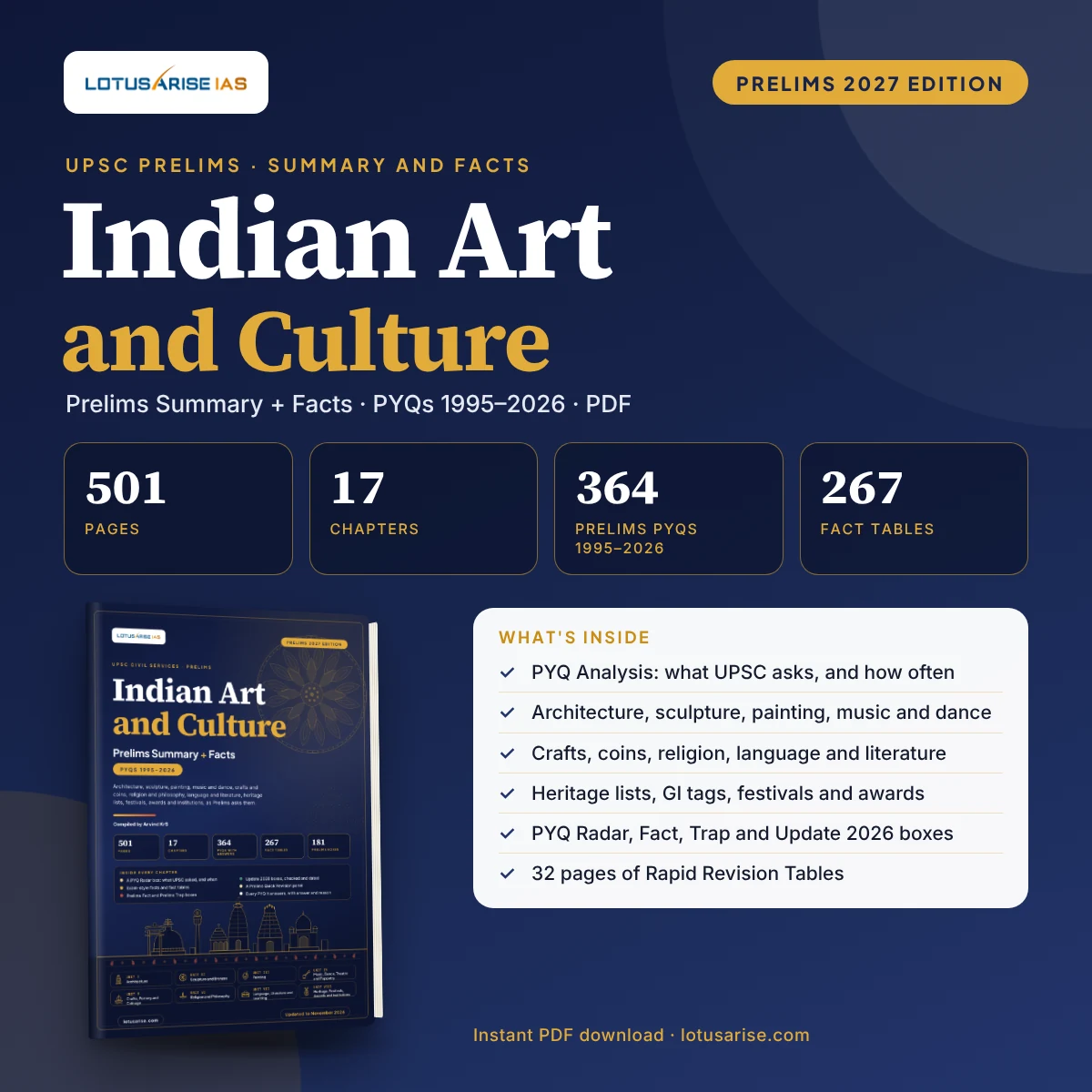


Indian Art and Culture Prelims Summary Notes for UPSC: Facts and PYQs 1995–2026 (2027 Edition) by LotusArise IAS
₹149.00
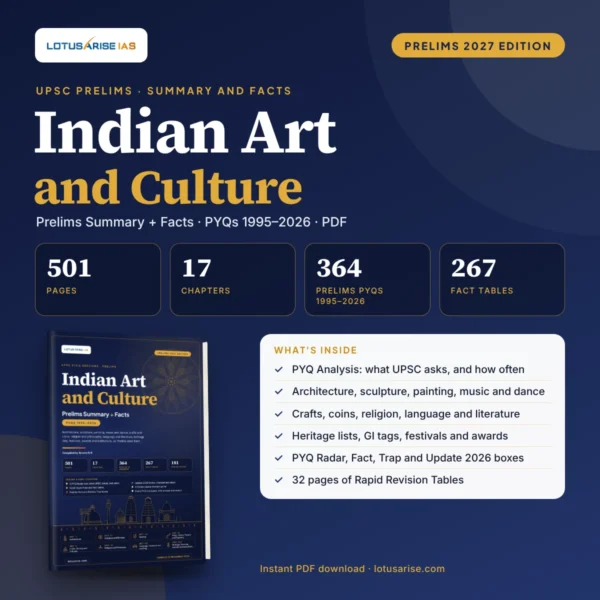
₹149 for the Prelims 2027 Edition — 501 pages, about 30 paise a page.
Most aspirants revise Art and Culture by rereading a 600-page book the month before Prelims. Every topic gets the same time. Then the paper asks which pairs are correctly matched, and three of four look right.
Indian Art and Culture Prelims Summary Notes turns this around: it starts from the questions.
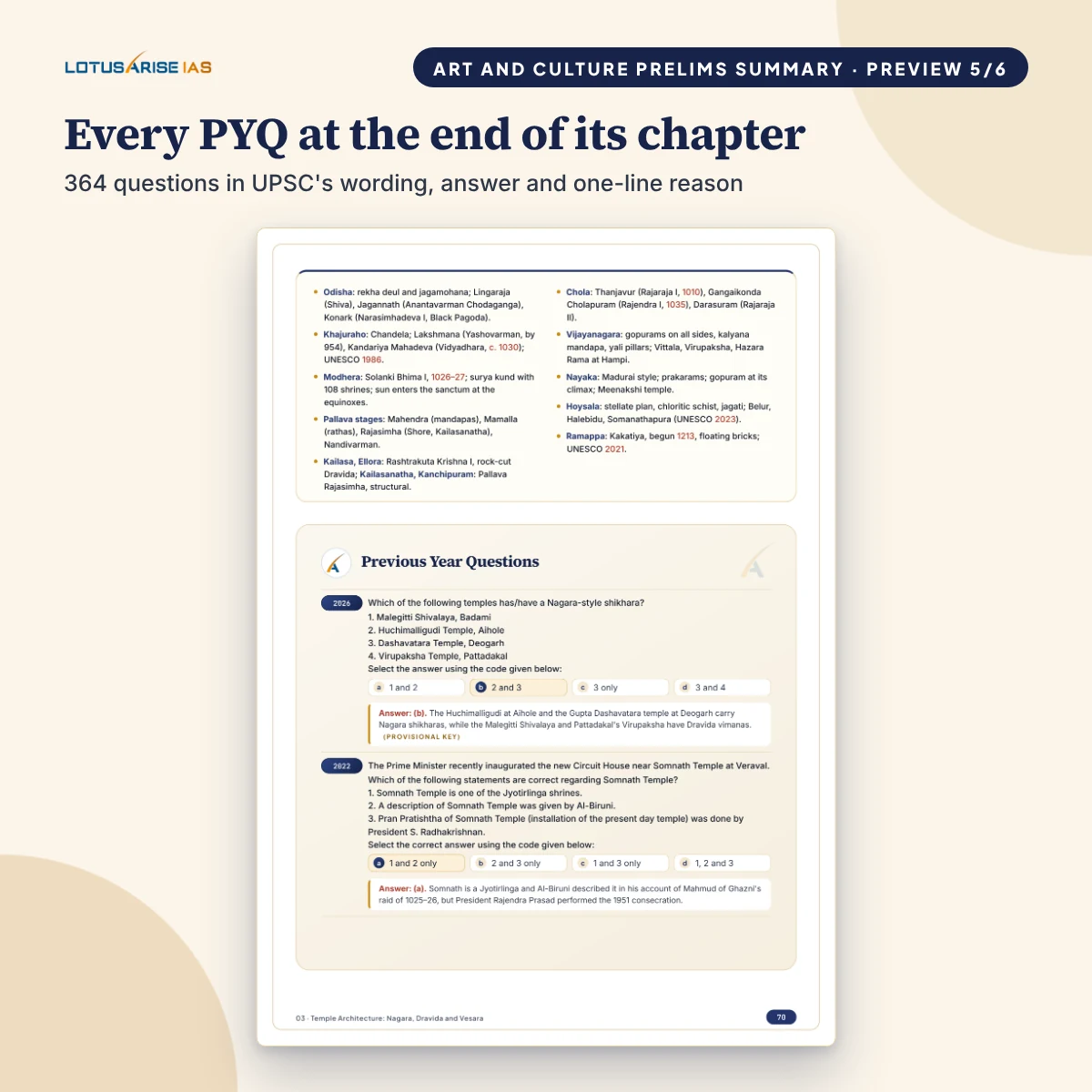
🎯 All 364 Art and Culture Prelims PYQs, 1995–2026 — UPSC’s wording, answer marked, one-line reason, each at the end of the chapter that answers it
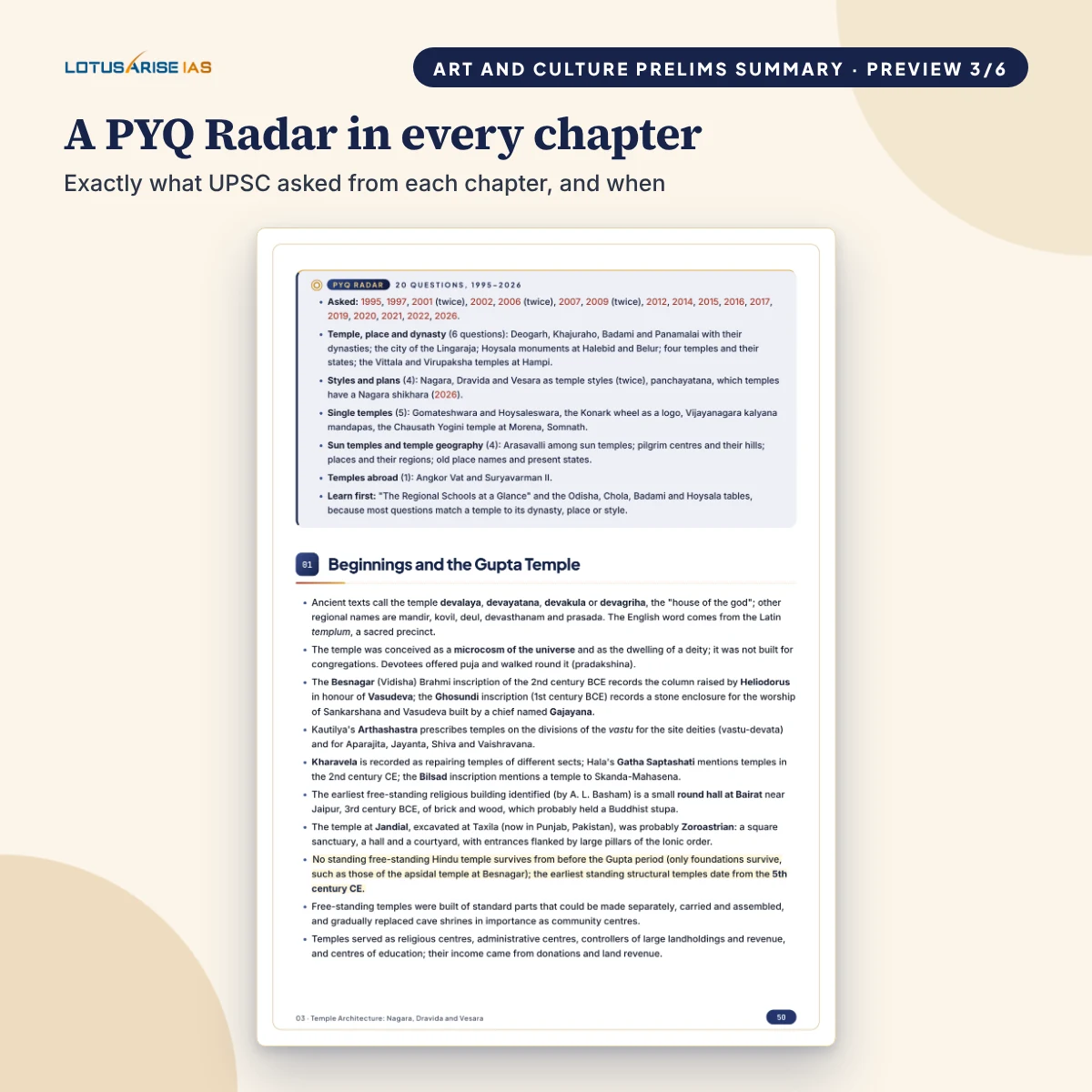
📡 A PYQ Radar opening every chapter — what UPSC asked from it, in which years, and which table to learn first
📋 267 fact tables and 181 Prelims Fact, Trap and Update 2026 boxes — temples, caves, dances, saints, festivals, and the look-alikes UPSC builds options from
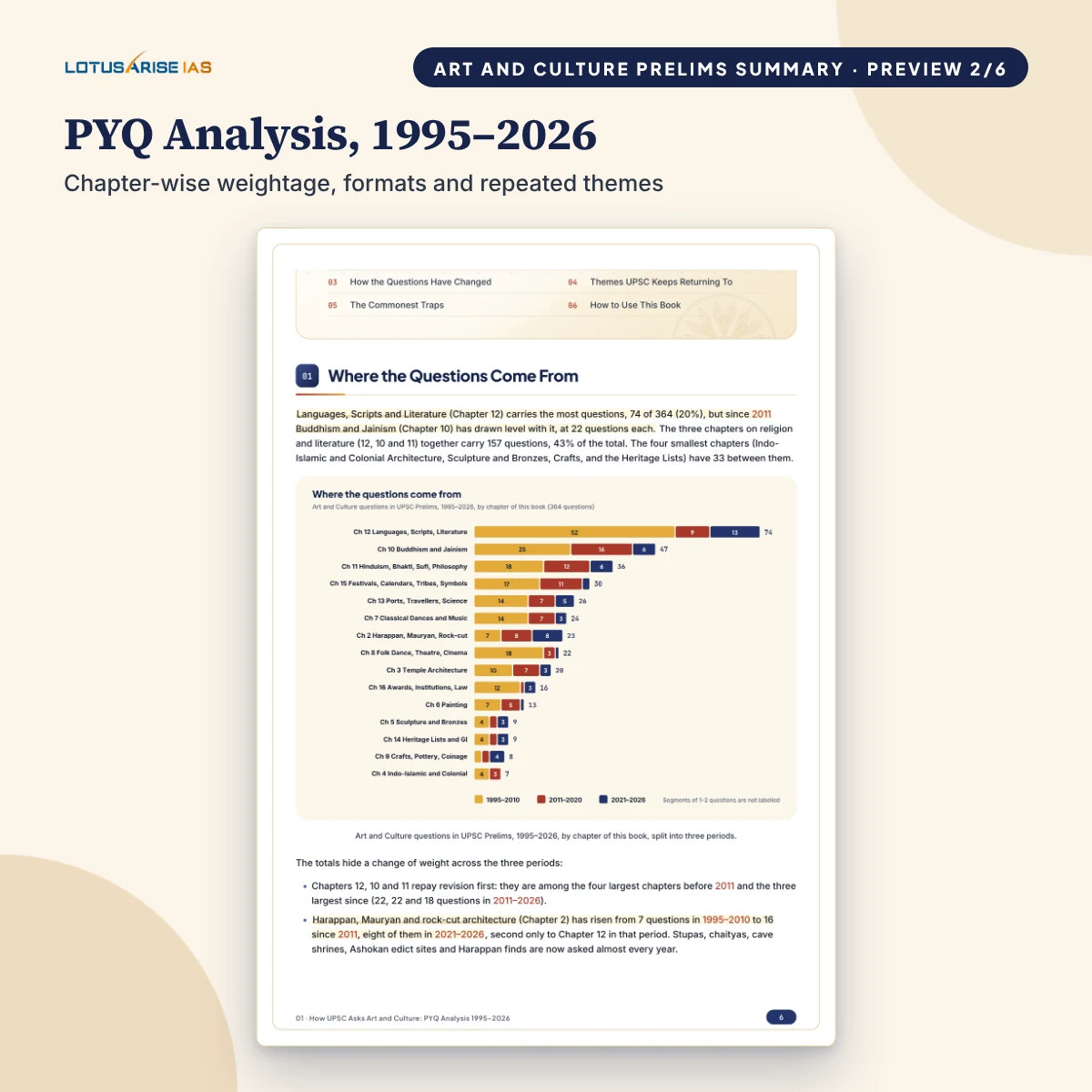
📊 PYQ Analysis chapter — chapter-wise weightage across 1995–2026, how the question formats changed, and the facts asked twice or more
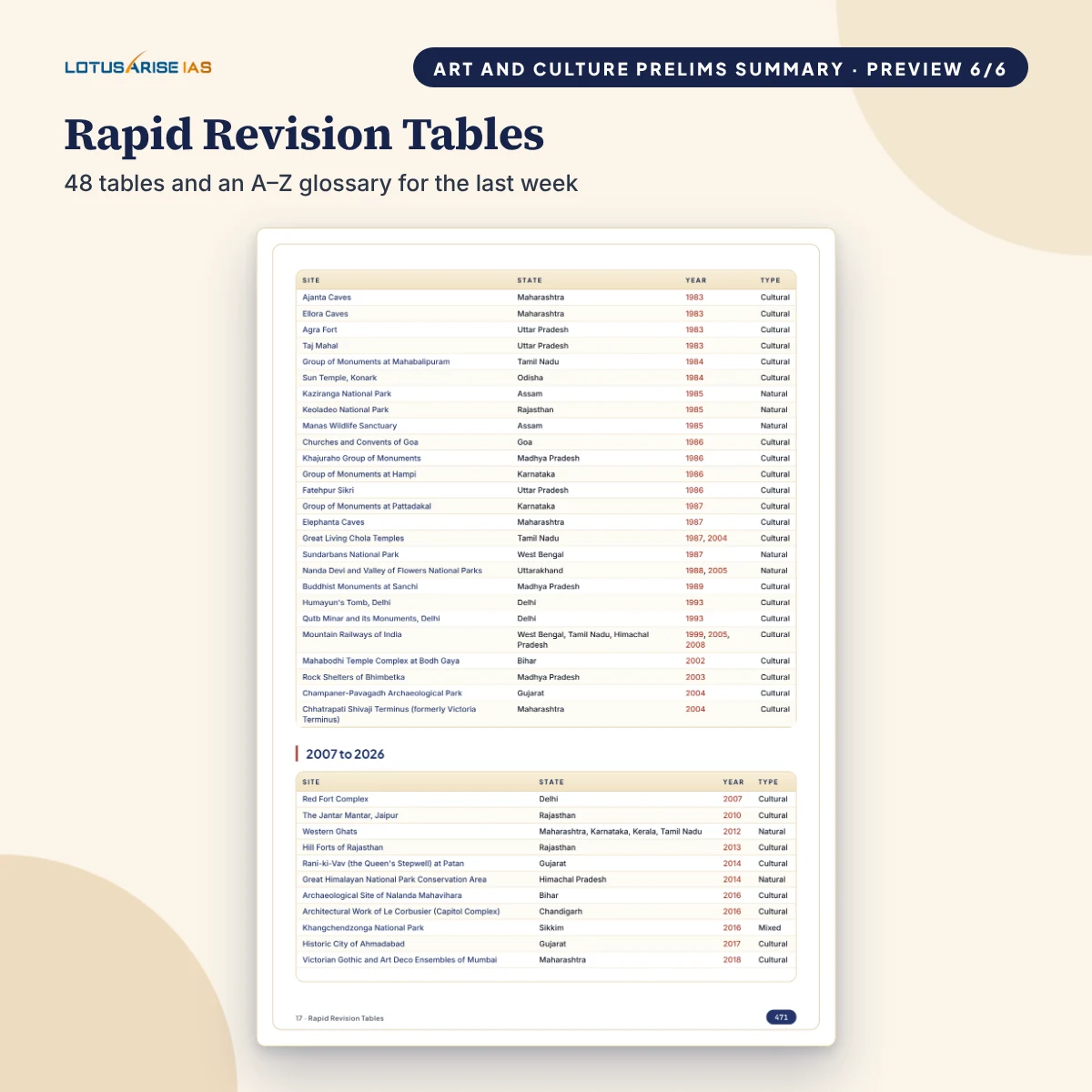
🗂️ 32 pages of Rapid Revision Tables — 48 tables and a 135-term glossary for the last week · instant PDF, any device
One-time payment. No subscription. Unlimited downloads — the link does not expire.
⭐ Read by 300,000+ UPSC aspirants every month on LotusArise IAS
Features:
- Comprehensive Coverage
- Complete Syllabus
- Suitable for: UPSC & State PSCs exams
- Format: Digital PDF (Downloadable)
- 337,362+ aspirants visit every month
The Art and Culture problem nobody admits before Prelims
Ask an aspirant a month before Prelims how Art and Culture is going. They will not say they haven’t read it. They will say one of three things:
“I’ve read the temple chapter three times. In the paper I still mix up Kailasa at Ellora and Kailasanatha at Kanchipuram.”
“Dances, puppets, folk theatre, GI tags, festivals — there are hundreds of state pairs, and they all blur together in the exam hall.”
“I have a 600-page book and four weeks. I can’t reread all of it, and I don’t know what to drop.”
None of these is a memory problem. Art and Culture is a subject of sets, namesakes and look-alike terms, and most books give every page the same weight. What is missing is a filter: a way to know which facts UPSC actually asks, and to revise those first. Indian Art and Culture Prelims Summary Notes is that filter, built from the questions themselves.
Why the questions are the right place to start
Art and Culture has been a steady part of the Prelims paper for three decades: about 13 questions a paper before 2011, and close to 10 a paper since, roughly one question in ten. Few areas of the syllabus pay as reliably for the hours you put in.
The questions are also more predictable than they look. Thirty-two years of papers show the same themes coming back: languages and literature, Buddhism and Jainism, Bhakti and Sufi saints, temple and cave architecture, classical dance and music, UNESCO lists and GI tags. The format has changed too. Match-the-list questions have disappeared, and statement, pairs and “how many of the above” questions now make up more than half of the culture questions, which punish half-remembered facts.
The challenge is not the subject. It is knowing which facts the paper keeps returning to, and having them in one place.
What’s inside — 501 pages, 17 chapters
📊 Chapter 1: PYQ Analysis, 1995–2026
- Chapter-wise weightage of all 364 questions, split into 1995–2010, 2011–2020 and 2021–2026, with charts
- Questions per year, and how the question formats changed
- The themes UPSC keeps returning to, with counts and what exactly is asked
- The facts asked twice or more, and the commonest traps in culture questions
📚 15 fact chapters in eight units
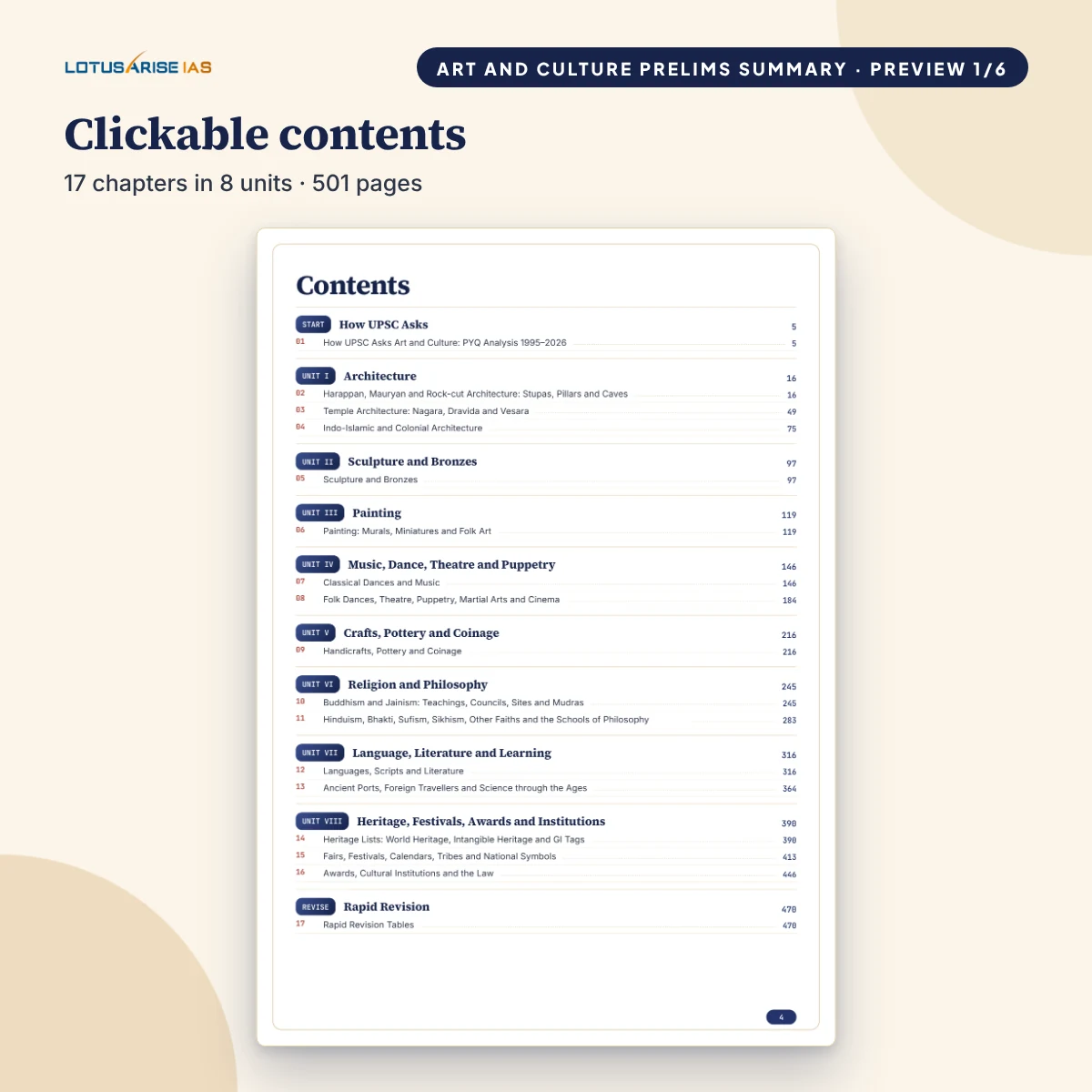
- Architecture — Harappan towns, Mauryan pillars, stupas and rock-cut caves; Nagara, Dravida and Vesara temples; Indo-Islamic and colonial architecture
- Sculpture and bronzes — Gandhara, Mathura and Amaravati; Chola and Pala bronzes
- Painting — murals from Ajanta to Lepakshi, Mughal, Rajasthani and Pahari miniatures, folk painting
- Music, dance, theatre and puppetry — classical dances and their exponents, Hindustani and Carnatic music, gharanas and instruments; folk dances, folk theatre, puppetry, martial arts and cinema
- Crafts, pottery and coinage — handicrafts and weaves by state, pottery cultures, coins from punch-marked to Mughal
- Religion and philosophy — Buddhism and Jainism (councils, texts, sites, mudras); Hinduism, Bhakti, Sufism, Sikhism, other faiths and the six schools
- Language, literature and learning — languages, scripts and literature; ancient ports, foreign travellers and science through the ages
- Heritage, festivals, awards and institutions — all 45 World Heritage Sites and 16 intangible heritage elements, GI tags, fairs, festivals, calendars, tribes, national symbols, awards, cultural institutions and the law
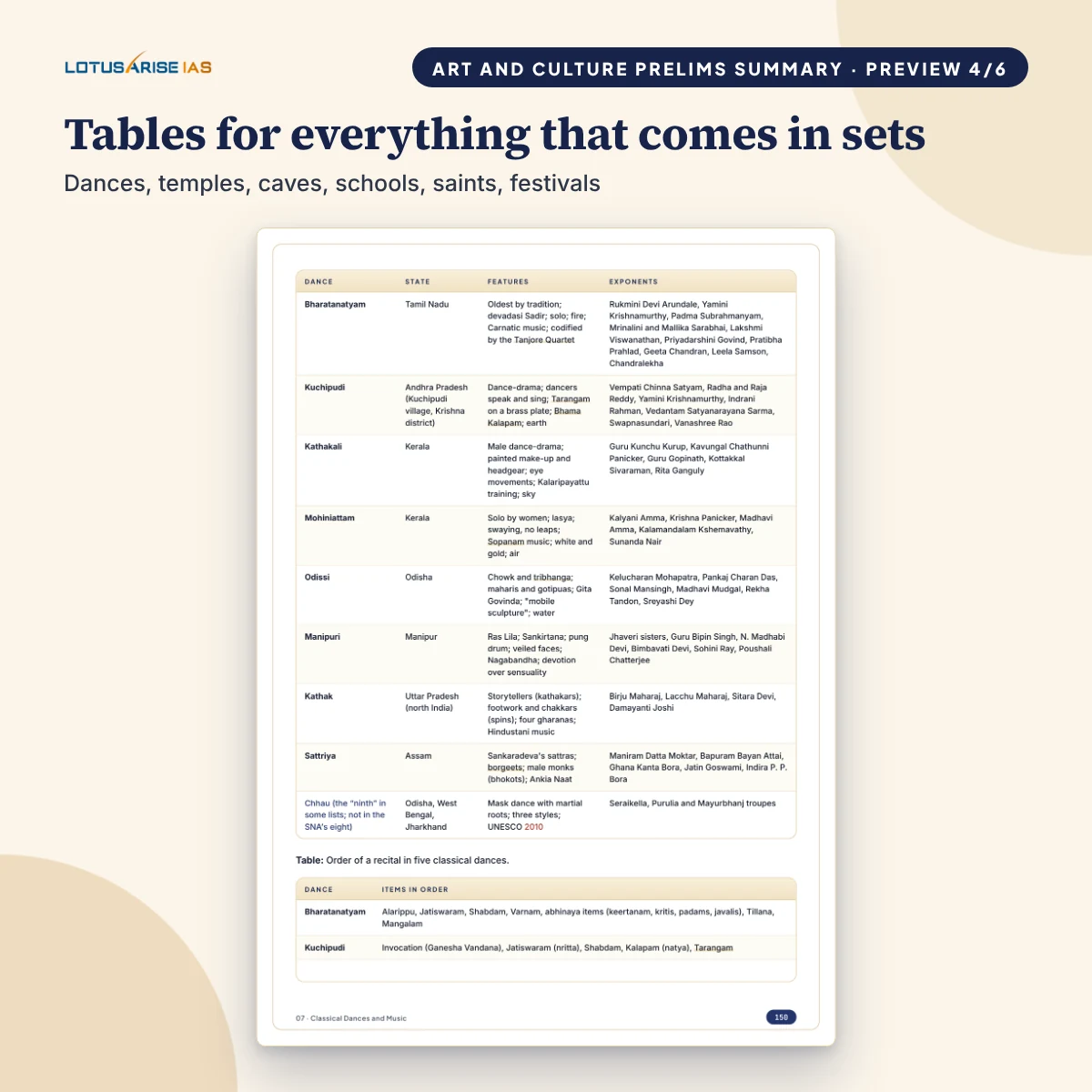
What makes this different from downloaded summary PDFs: each chapter opens with a PYQ Radar that tells you what UPSC asked from it and in which years, so you know where to spend your time before you read a line. The facts are written the way a correct statement reads in a Prelims question, and anything that comes in a set (temple, dynasty and style; cave, state and religion; dance, state and exponents; painting school and patron; puppet form and state; festival, state and month) is a table. Key pictures sit where seeing helps: temple styles, mudras, painting schools and bronzes. Every chapter was written and then checked fact by fact by a separate reviewer against standard texts and official sources.
🎯 364 Prelims PYQs, each where it belongs
Every Art and Culture question from 1995 to 2026, in UPSC’s wording, placed at the end of the chapter that answers it, with the right option marked and a one-line reason. Answers for 2011–2025 follow UPSC’s official keys and 2026 follows UPSC’s provisional key, marked as such. For 1995–2010, the answers are the agreed answers from solved papers, each checked against the facts.
🧩 181 Prelims Fact, Trap and Update 2026 boxes
The Trap boxes take on the confusions UPSC builds options from: Kailasa or Kailasanatha, Nagara, Dravida or Vesara, Kathakali or Kuchipudi make-up, mudra or hasta, Hindustani or Carnatic terms, Chola or Pala bronzes. The Update 2026 boxes carry dated changes: Sarnath and the Maratha Military Landscapes on the World Heritage List, Deepavali on the intangible heritage list, new GI tags, the latest Padma, Phalke and Sangeet Natak Akademi awards.
🗂️ Rapid Revision Tables — 32 pages
48 tables for the last week: World Heritage Sites with their listing years, intangible heritage, classical dances and exponents, gharanas, ragas and instruments, folk dances and folk theatre by state, painting schools, caves and temples and who built them, Buddhist and Jain councils and texts, texts and authors, Bhakti and Sufi saints, festivals and fairs, GI crafts by state, institutions and awards, and a 135-term glossary of art and architecture.
The aspirant who buys this
Prelims 2027 aspirants in revision mode — you have read Art and Culture once and need a version that puts what UPSC asks first.
Repeaters — you keep losing marks on pairs and “how many” questions about dances, temples and festivals. The PYQ Radar and the Trap boxes are built for exactly that.
First-time aspirants — you want to see, before you open a long book, which parts of the subject the paper actually tests.
State PSC aspirants — art, culture and heritage are in every State PSC paper, and the state-wise tables serve both.
Why not just solve the PYQs from a free list?
Free PYQ lists exist, and they are useful. But a list of questions only tells you what was asked once. It does not give you the other members of each set, the facts behind the wrong options, or the context that makes the right answer stick, and it is ordered by year, not by topic.
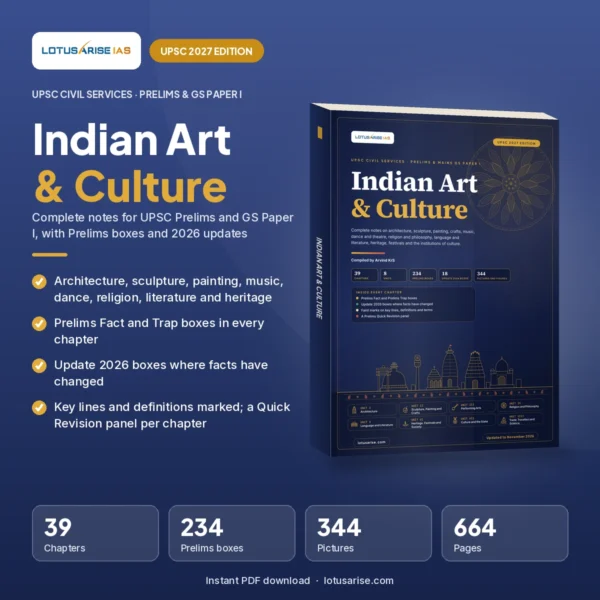
This book answers each question inside the chapter that teaches it, and then gives you the whole set UPSC could ask next. If you want the full notes with every topic explained at length, the companion Indian Art and Culture Notes (664 pages, ₹236) is the complete book. This summary is the version you revise from.
Price and delivery
₹149 for 501 pages — about 30 paise a page, and less than most aspirants spend on a single printed guide.
Want to see it first? Download the free sample PDF — the cover, the full contents and three complete chapters: Chapter 1 (PYQ Analysis), Chapter 3 (Temple Architecture) and Chapter 7 (Classical Dances and Music).
One-time payment. No subscription. No recurring charge.
Instant PDF download after payment. The download link is also sent to your email — please check the spam folder if it does not arrive in a few minutes. Download it again any time from My Account.
For support: support@lotusarise.com
You may also like…

Related products
-

Environment and Ecology Notes for UPSC: Prelims & Mains GS Paper III (2027 Edition) by LotusArise IAS
Original price was: ₹500.00.₹236.00Current price is: ₹236.00. -
-
Ethics, Integrity and Aptitude Notes for UPSC: Mains GS Paper IV (2027 Edition) by LotusArise IAS
Original price was: ₹500.00.₹295.00Current price is: ₹295.00. -