

Science and Technology Notes for UPSC: Prelims & Mains GS Paper III (2027 Edition) by LotusArise IAS
Original price was: ₹500.00.₹295.00Current price is: ₹295.00.
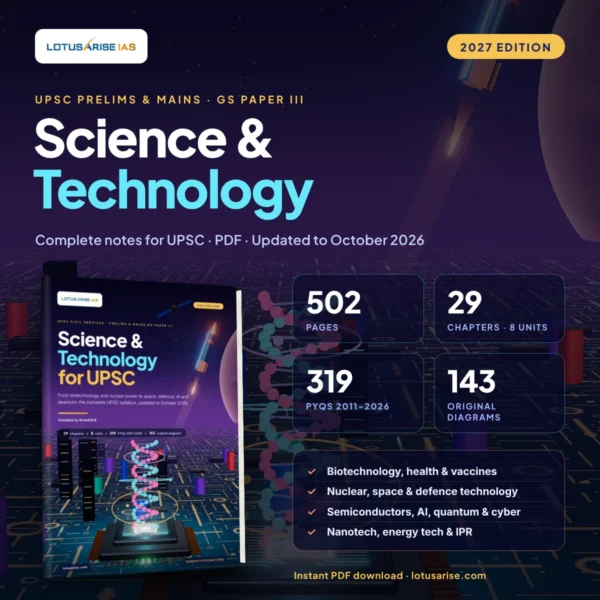
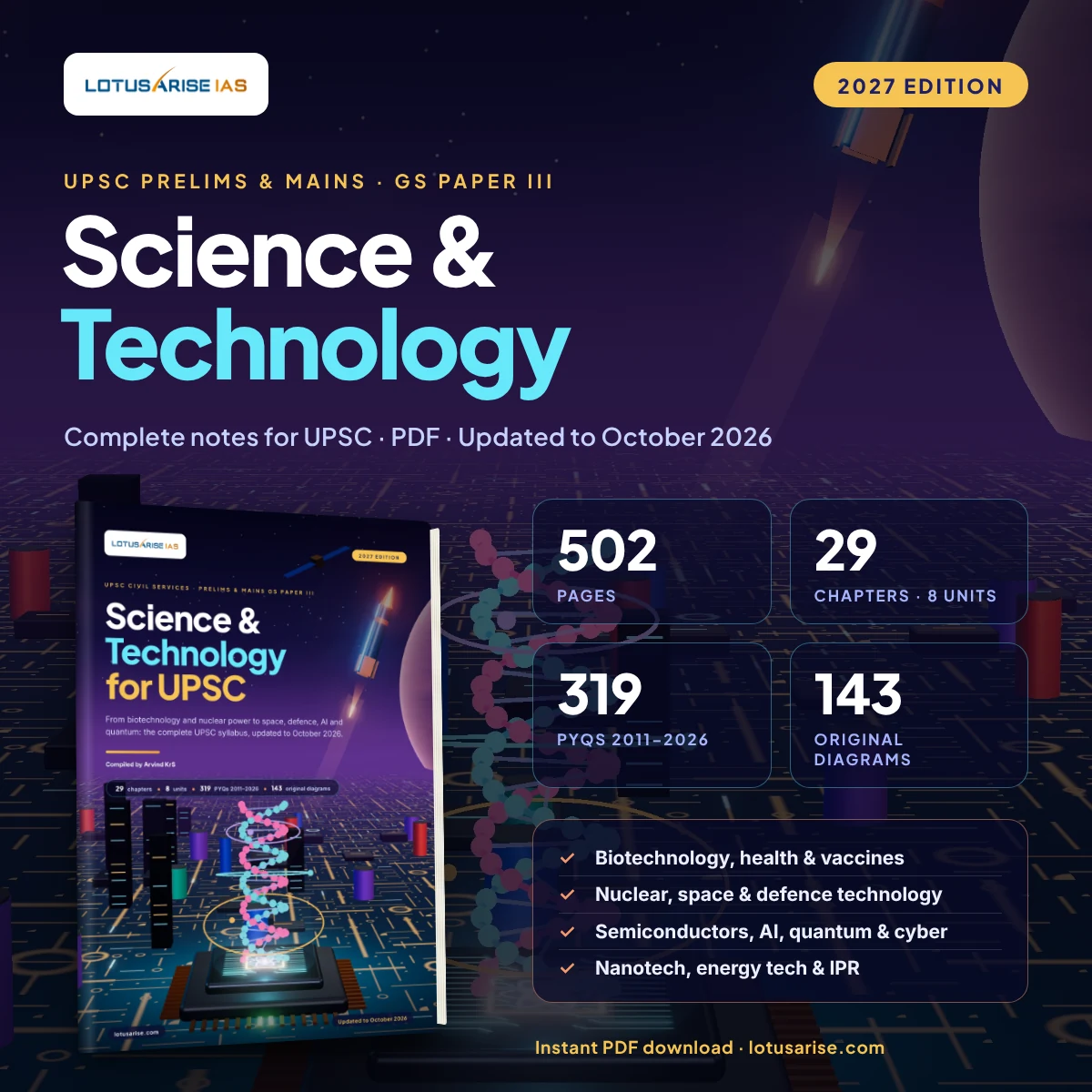
₹295 for the 2027 Edition. MRP ₹500 — 502 pages, about 59 paise a page.
Most aspirants study Science & Technology the wrong way. An old notes PDF for the basics, two or three current-affairs compilations for the news, and nothing that joins them. Then Prelims asks about a Majorana chip, the Deep Ocean Mission or monoclonal antibodies — and the answer is in none of the files, or half-right in all of them.
Science and Technology Notes for UPSC puts the basics and the news in one book.
🧬 29 chapters in 8 units, 502 pages — biotech and health, nuclear, space, defence, semiconductors, AI, quantum, cyber security, nanotech, energy tech and IPR
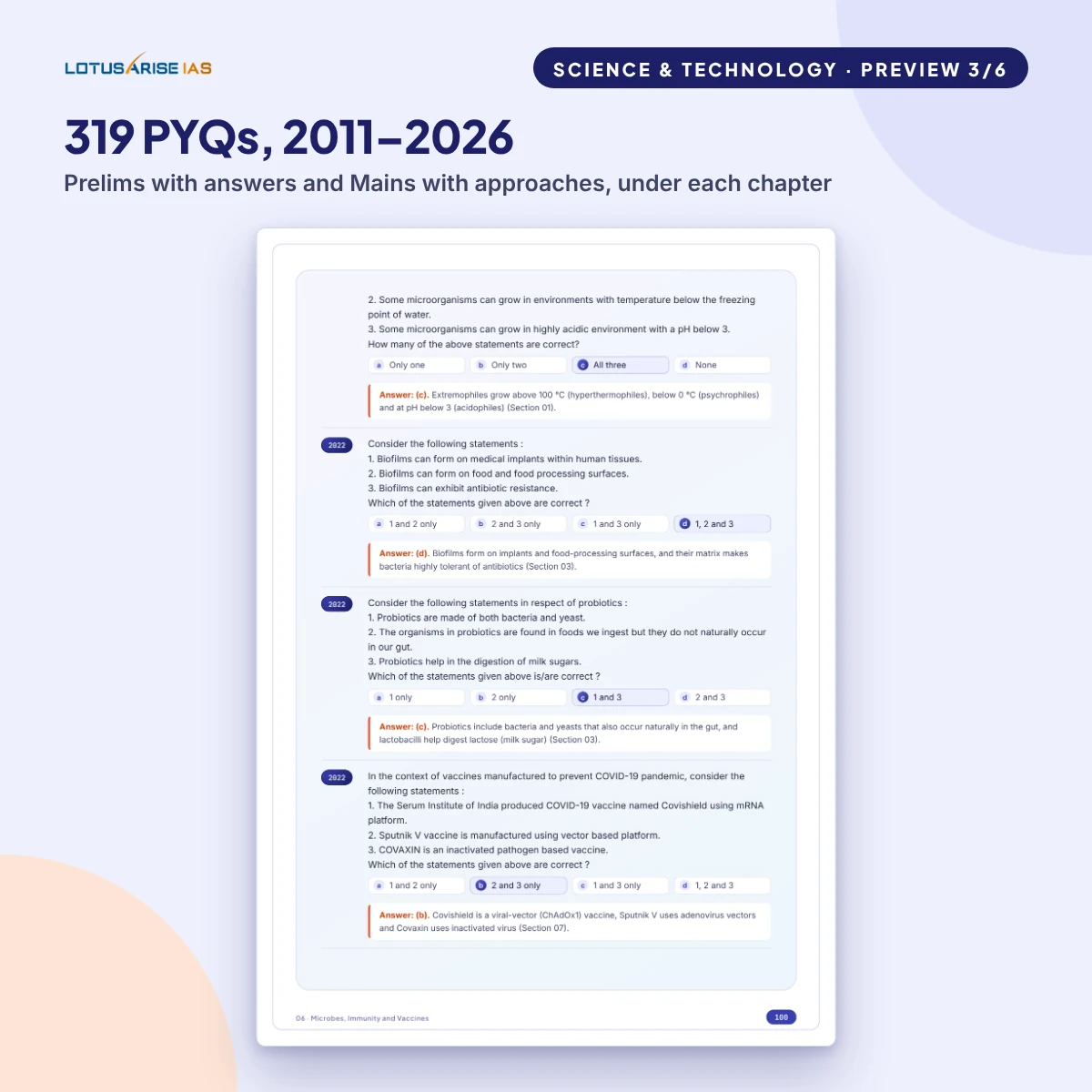
📝 319 PYQs — 246 Prelims (2011–2026) with answers and 73 Mains (2013–2026) with answer approaches, each under its chapter
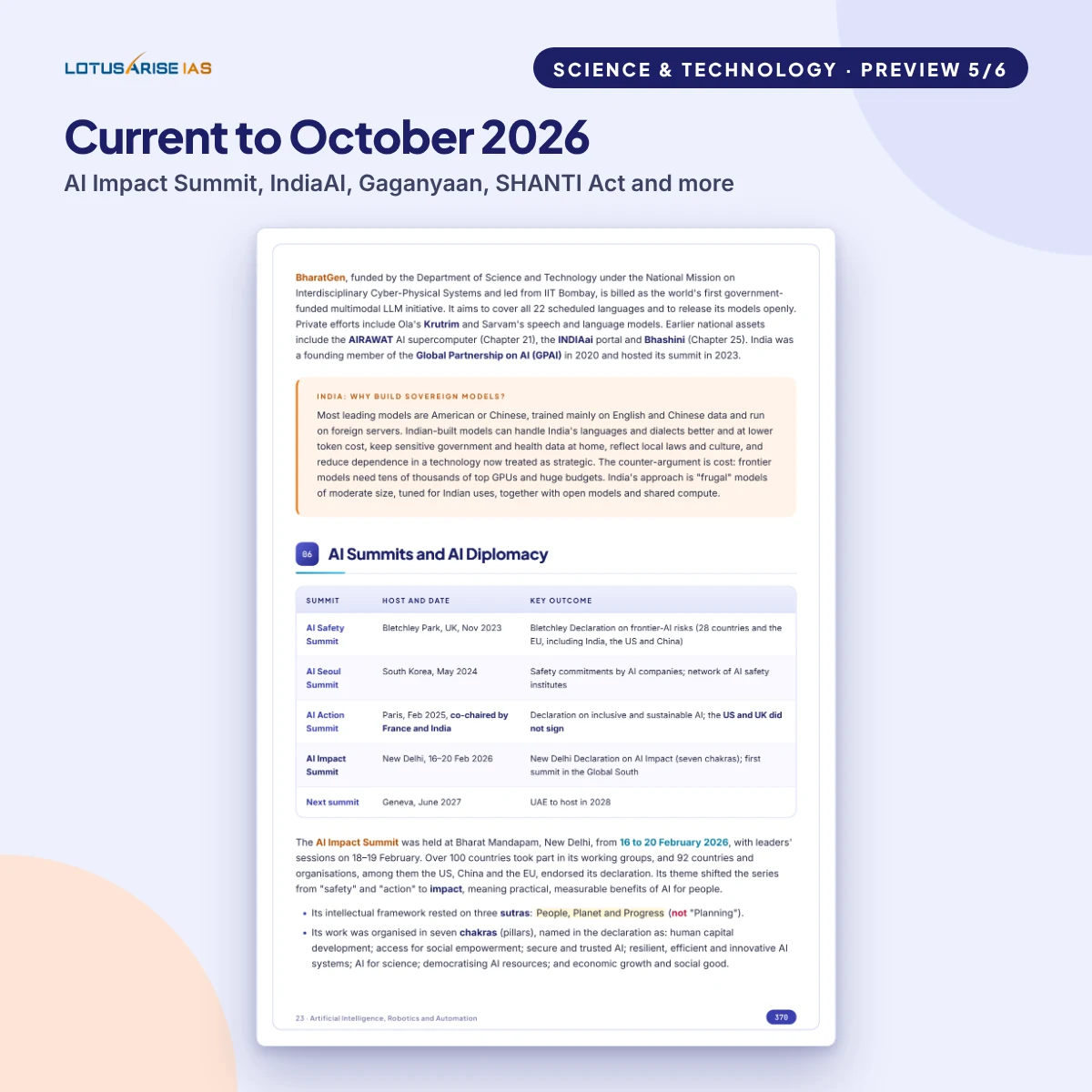
🛰️ Current to October 2026, fact-checked — Gaganyaan, the PSLV failures, the SHANTI Act, IndiaAI and the AI Impact Summit, Semicon 2.0, DPDP Rules, the 2026 Nobel Prizes
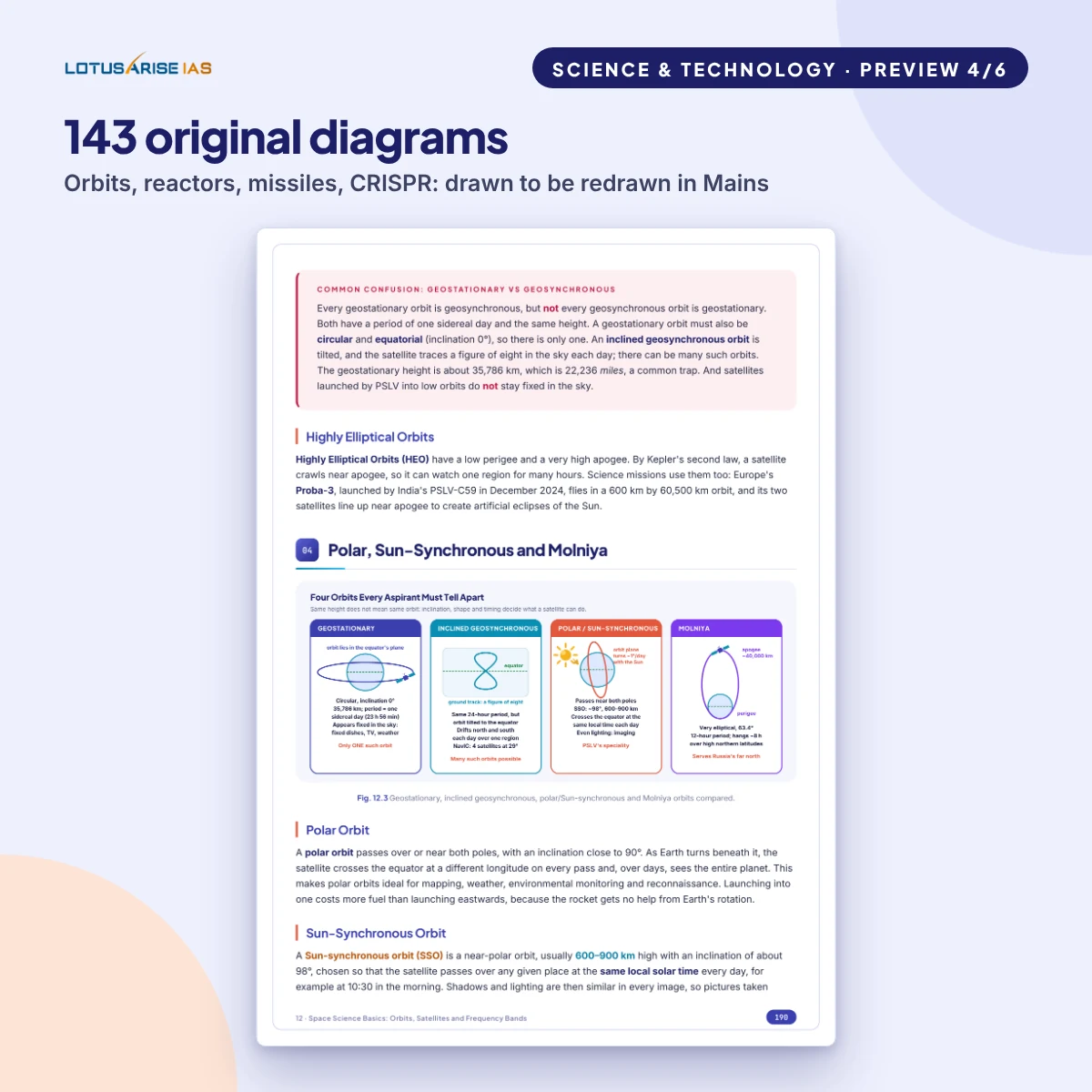
🎨 143 original diagrams + 94 colour photographs — orbits, reactors, CRISPR, missile classes and more, simple enough to redraw in Mains
📱 Instant PDF download — laptop, mobile or tablet, offline, printable
One-time payment. No subscription. Unlimited downloads — the link does not expire.
⭐ Read by 300,000+ UPSC aspirants every month on LotusArise IAS
Features:
- Comprehensive Coverage
- Complete Syllabus
- Suitable for: UPSC & State PSCs exams
- Format: Digital PDF (Downloadable)
- 337,362+ aspirants visit every month
The problem nobody admits about Science & Technology
Ask an aspirant three months before Prelims how they are preparing Science & Technology, and the honest answer is “from everywhere”. They will say one of three things:
“My S&T notes are from 2022 or 2023. I don’t know what happened to Gaganyaan, which chips India now makes, or what the new nuclear law says.”
“I have three current-affairs compilations. Each lists 80 items — Mpemba effect, odd radio circles, a missile I’ve never heard of — and none tells me how they connect to the basics.”
“I can define CRISPR or a cryogenic engine. But a Mains question on India’s semiconductor push or AI governance leaves me with nothing to write.”
These are not reading problems. Science & Technology is not a hard subject; what goes wrong is that the concepts sit in one file, the news in five others, and nothing is current. Science and Technology Notes for UPSC is one book built to fix exactly that.
Why Science & Technology deserves a book of its own
S&T questions turn up in GS Prelims every single year — the 246 Prelims questions from 2011 to 2026 inside this book are the proof, from vaccines, viruses and stem cells to orbits, missiles, quantum computing and blockchain. In Mains, GS Paper III asks about it every year too: the 73 Mains questions from 2013 to 2026 cover space, biotechnology, nuclear energy, IT and cyber security, nanotechnology and intellectual property rights.
And no subject moves faster. In 2025 and 2026 alone India launched its first private orbital rocket, lost two PSLV missions, made its first chips in Indian packaging plants, passed a new nuclear law and hosted a global AI summit. The real challenge is not understanding S&T. It is having one source that explains the concept, adds the news and stays current.
What’s inside
🧬 The complete notes — 29 chapters, 502 pages
Eight units, in the order the subject is best learnt:
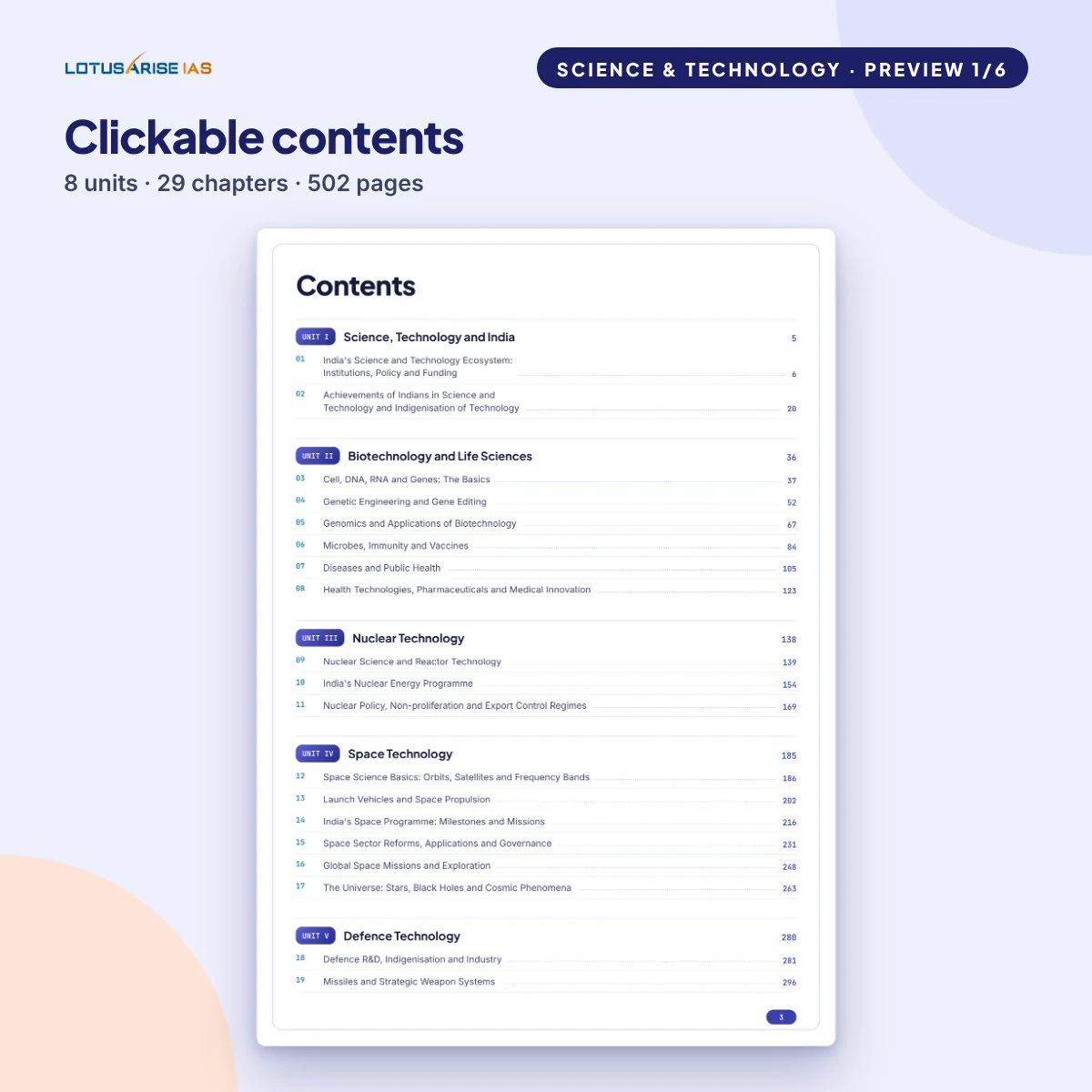
- Science, Technology and India — institutions, S&T policy and R&D spending, ANRF and the RDI Scheme, national missions; achievements of Indian scientists and the indigenisation of technology
- Biotechnology and Life Sciences — cells, DNA and genes; genetic engineering, CRISPR and gene therapy; genomics and BioE3; microbes, immunity and vaccines; diseases and public health; pharma, diagnostics and health technology
- Nuclear Technology — fission, fusion and reactor types; India’s three-stage programme, PFBR and the SHANTI Act 2025; nuclear doctrine, NPT, CTBT, NSG and the export control regimes
- Space Technology — orbits, satellites and frequency bands; launch vehicles and propulsion; Chandrayaan, Aditya-L1, NISAR, SpaDeX and Gaganyaan; space reforms, IN-SPACe and space law; global missions; stars, black holes and gravitational waves
- Defence Technology — DRDO, defence production and exports; missiles from Agni to BrahMos and missile defence; aircraft, warships, submarines, drones and military exercises
- ICT and Emerging Technologies — semiconductors and supercomputers; 5G, 6G and satellite communication; AI, robotics and the IndiaAI Mission; quantum, blockchain and cloud; Digital India, cyber security and the DPDP Act
- Nanotechnology, Materials and Energy — nanomaterials, graphene, plastics and composites; batteries, green hydrogen, fuel cells and carbon capture
- IPR and Science in the News — patents, GIs, TRIPS and Section 3(d); scientific concepts and discoveries in the news, with the Nobel Prizes of 2024–2026
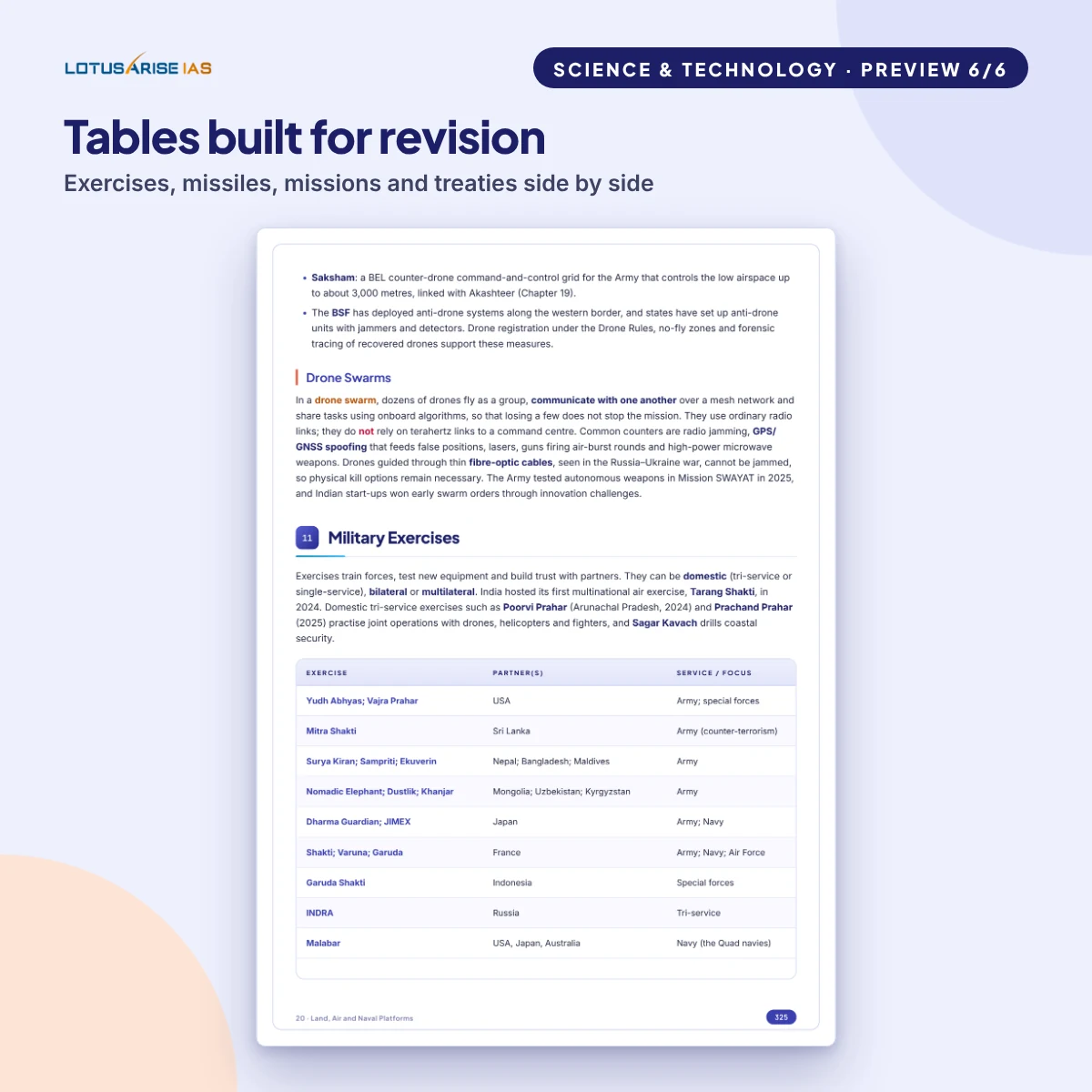
What makes this different from downloaded PDFs: every chapter is written fresh for the exam. The news is placed inside the chapter it belongs to, so you read about Gaganyaan next to the rocket that will carry it, not in a separate list. Every figure and status was checked against official sources in October 2026. Each chapter closes with its own previous year questions, so you finish a topic and immediately see how UPSC has tested it. The language is plain: short paragraphs, clear headings, comparison tables and “common confusion” boxes.
📝 319 PYQs — Prelims 2011–2026 and Mains 2013–2026
Every Prelims question appears verbatim with all four options and the answer marked, plus a one-line reason pointing to the section that explains it. Every Mains question carries its paper and marks and a short answer approach. Both sit under the chapter that answers them, not in a separate book at the end.
🎨 143 original diagrams and 94 colour photographs
Orbits and Lagrange points, a reactor core, the CRISPR mechanism, the types of vaccines, missile classes and ranges, India’s launch vehicles drawn to scale — each drawn fresh and simple enough to reproduce in a Mains answer. Photographs of rockets, telescopes, labs and aircraft help you recognise what you are reading about.
🗂️ Built for revision
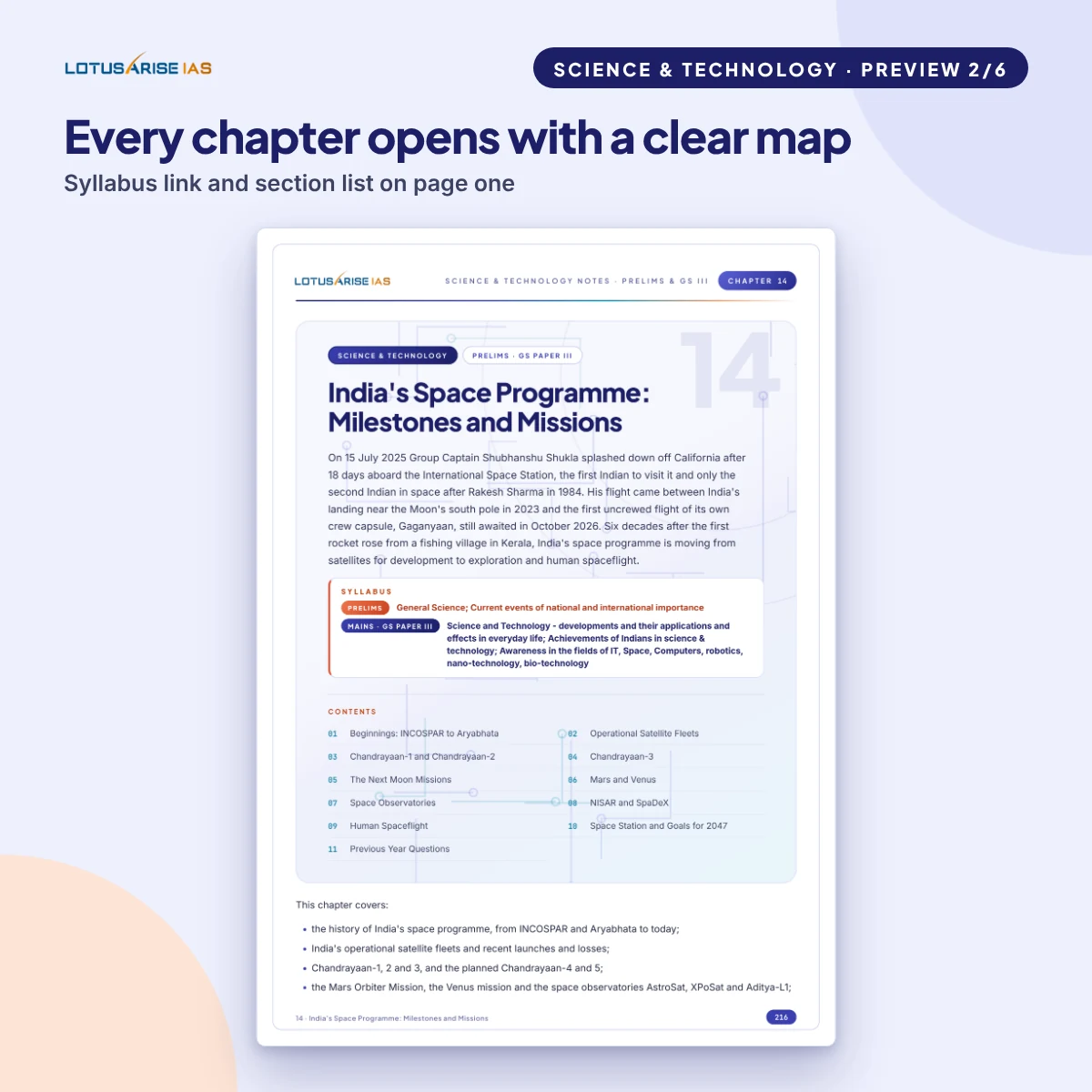
A clickable contents page, unit pages that list every topic before you begin, a bookmark panel that takes you to any section in one tap, and a “Using this chapter in Mains” box at the end of every chapter.
The aspirant who buys this
First-time aspirants — you want one trusted book that covers S&T from DNA to quantum computing, instead of collecting it from old notes and monthly magazines.
Repeaters who lost marks to S&T questions in Prelims — you know the basics; what hurt you were the current items: a new mission, a new chip, a new vaccine. The chapter-wise PYQs show exactly where those questions come from.
Mains aspirants preparing GS Paper III — space, biotech, nuclear, IT, nano and IPR are all here, with diagrams and answer approaches you can use directly.
Self-study aspirants outside Delhi, Prayagraj or Jaipur — no classroom, no batch timings; one PDF on your phone that covers the whole subject.
State PSC aspirants — science and technology is part of most State PSC syllabi, so the same book serves both.
Why not just use free notes and current-affairs PDFs?
Free S&T material exists, and most aspirants have folders full of it. The problem is not that it is bad. It is that it is scattered: basics in one file, news in five others, and much of it is out of date — missions still “planned” that have flown or failed, laws that have been replaced, figures from three years ago.
This book is one connected system: 29 chapters in sequence, the news woven into the right chapter, facts checked to October 2026, and every PYQ placed where it belongs.
If you have the time and discipline to build that system yourself from scattered sources, you may not need this. If you want it already built — open it and start reading — this is what the book is for.
Price and delivery
A single printed science and technology guide usually costs more than this PDF, and it will not carry chapter-wise PYQs to 2026 or developments up to October 2026.
MRP ₹500 → ₹295 for 502 pages — about 59 paise a page.
Want to see it first? Download the free sample PDF — the cover, the full contents and two complete chapters (01 and 14).
One-time payment. No subscription. No recurring charge.
Instant PDF download after payment. The download link is also sent to your email — please check the spam folder if it does not arrive in a few minutes. Download it again any time from My Account.
For support: support@lotusarise.com
Related products
-

-
Indian Physical Geography Notes for UPSC: Prelims & Mains GS Paper I (2027 Edition) by LotusArise IAS
Original price was: ₹300.00.₹149.00Current price is: ₹149.00. -
-
Environment and Ecology Notes for UPSC: Prelims & Mains GS Paper III (2027 Edition) by LotusArise IAS
Original price was: ₹500.00.₹236.00Current price is: ₹236.00.