

Cultural Setting | Geography Optional UPSC Notes
₹118.00
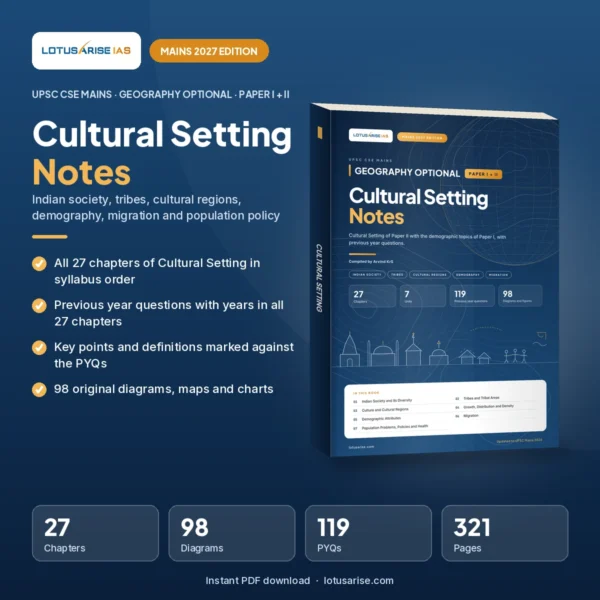
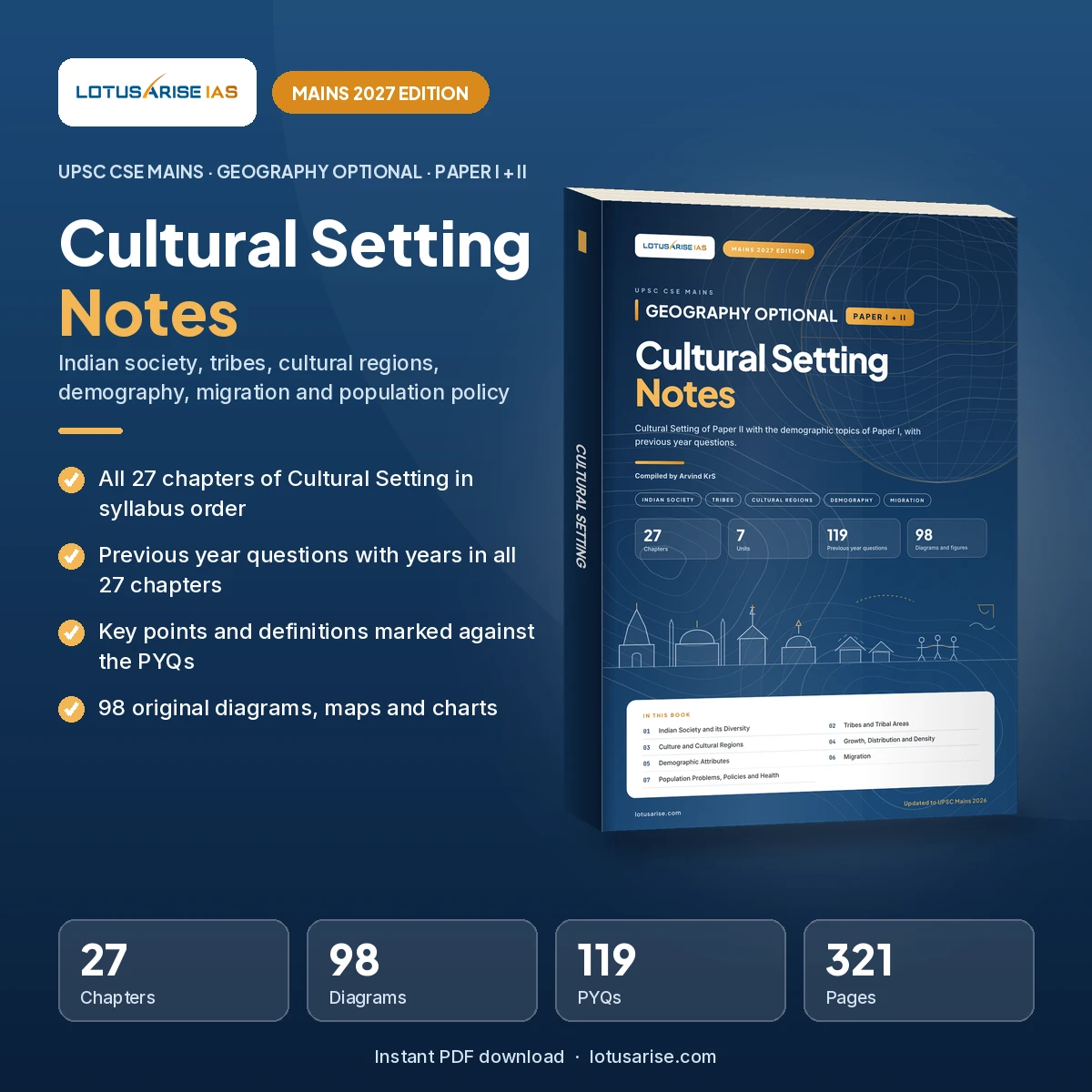
₹118 for 321 pages — about 37 paise a page. Mains 2027 Edition.
Most Geography Optional aspirants meet this section as lists. Tribes by state, languages by family, census tables by decade. The same three tribal problems for every answer. Then UPSC asks why tribal areas still lag despite the programmes, and the answer has no evidence.
Cultural Setting is one book for Paper II’s Cultural Setting and the demographic topics of Paper I Human Geography, so you need no separate PDF for them. Population theories: see Population Geography.
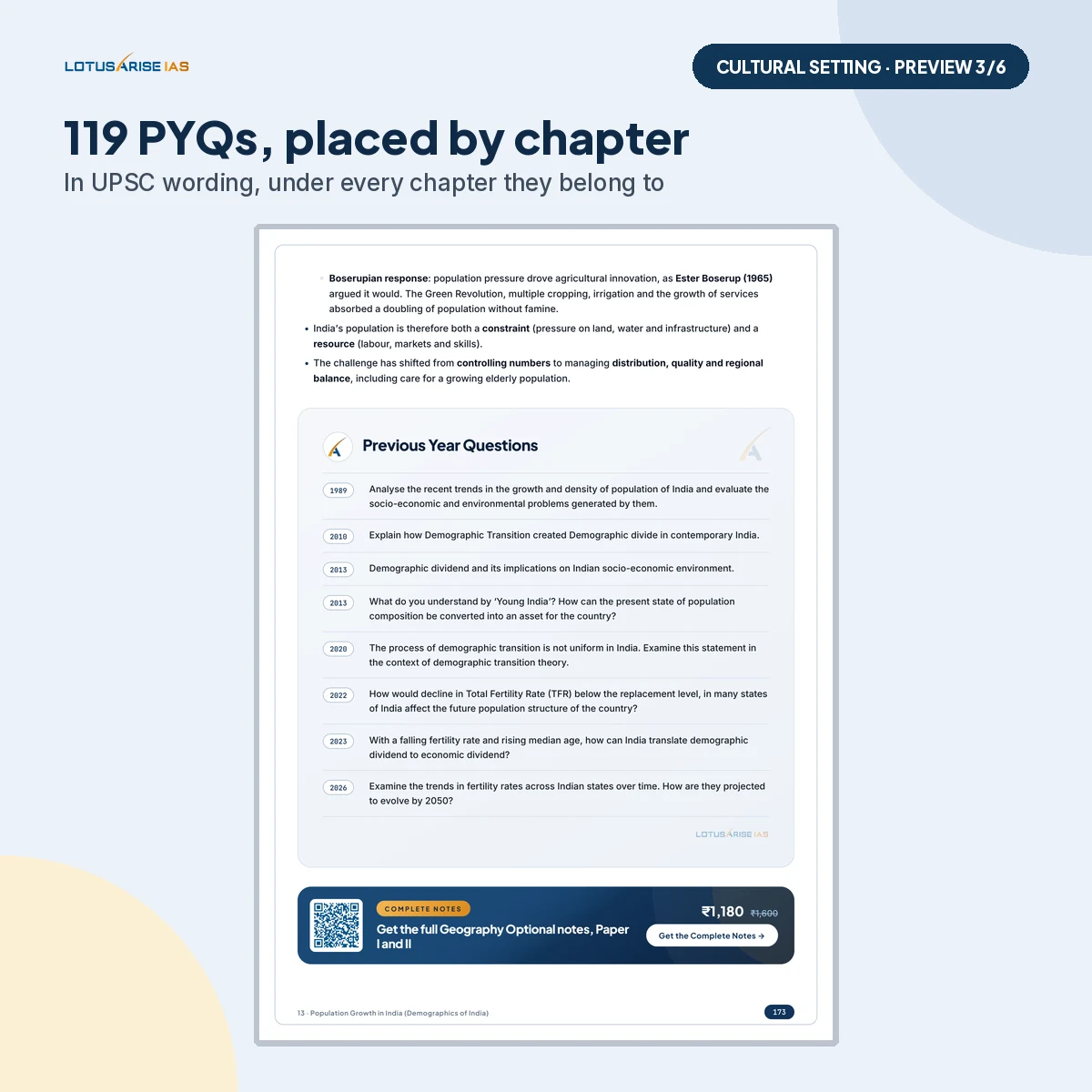
📝 119 PYQs, updated to Mains 2026 — in UPSC’s wording, under the chapter each belongs to
📚 Paper II with Paper I demography — checked against the official syllabus, each unit marked by its paper
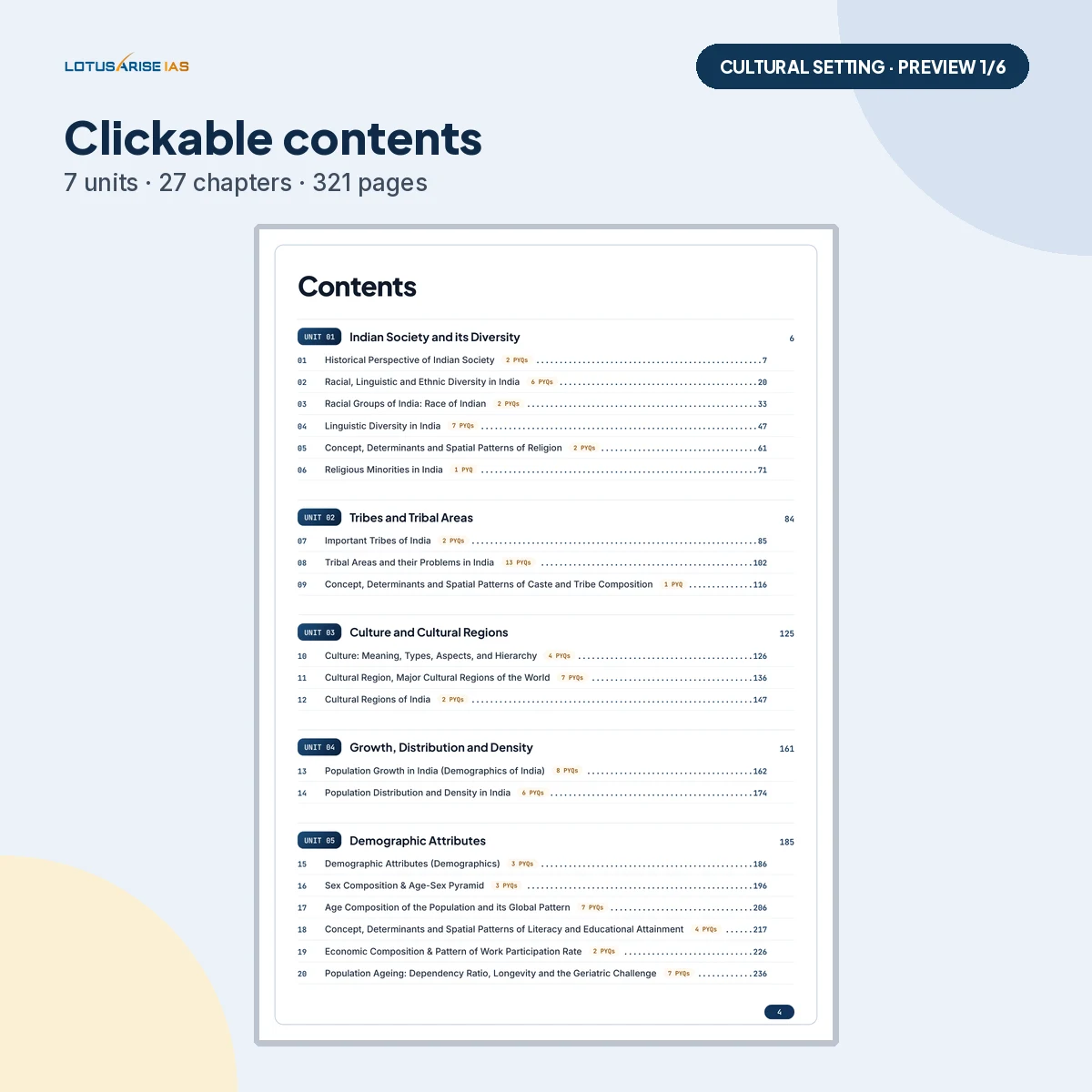
🧭 27 chapters in 7 units — Indian society, tribes, cultural regions, demography, migration, policy
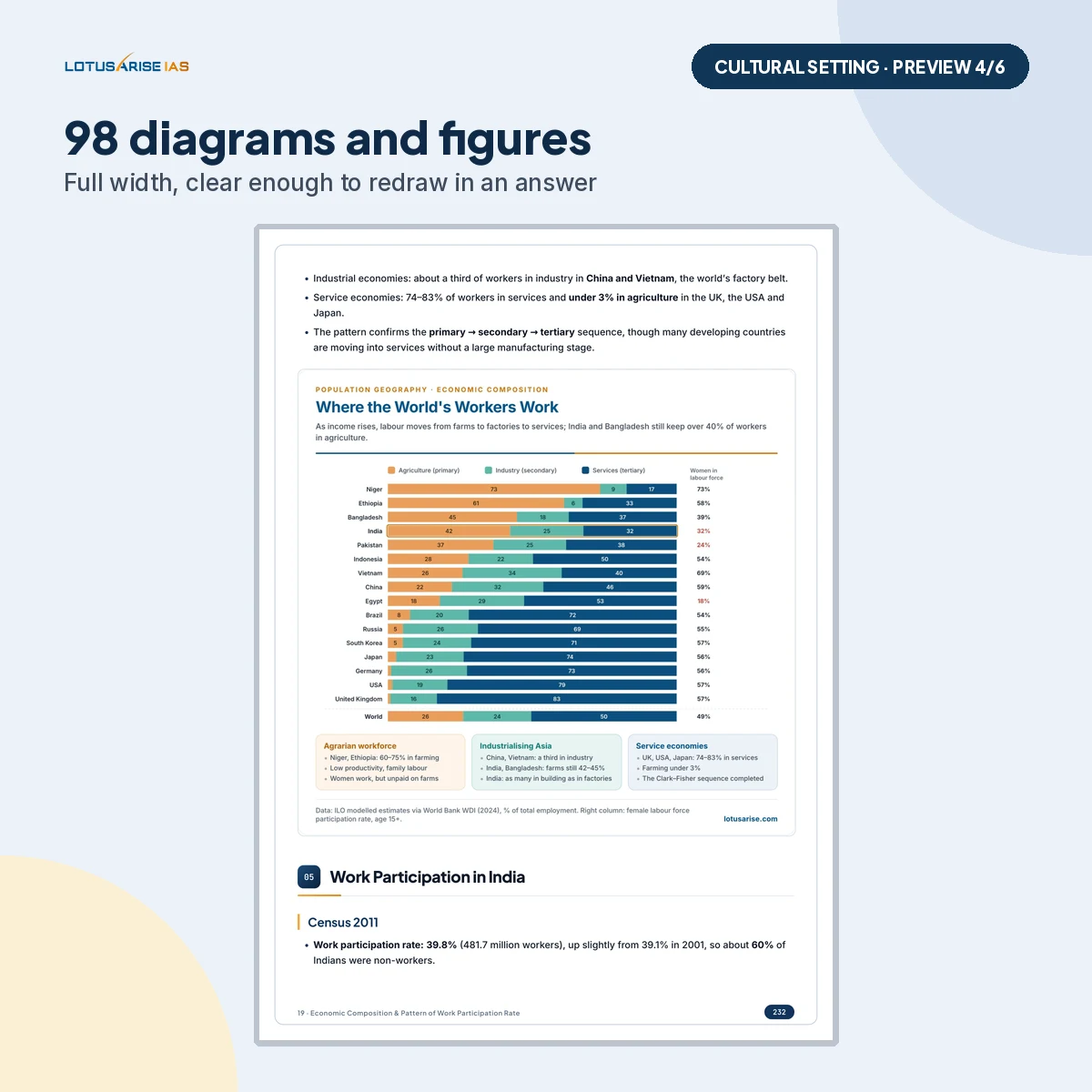
🗺️ 98 diagrams and figures — full width, clear enough to redraw in an answer
📱 Instant PDF download, 321 pages — clickable contents, laptop, mobile or tablet, offline, printable
One-time payment. No subscription. Unlimited downloads — the link does not expire.
⭐ Read by 300,000+ UPSC aspirants every month on LotusArise IAS
Features:
- Comprehensive Coverage
- Complete Syllabus
- Suitable for: UPSC & State PSCs exams
- Format: Digital PDF (Downloadable)
- 337,362+ aspirants visit every month
The problem most aspirants don’t talk about
Ask a Geography Optional aspirant about Cultural Setting a few months into preparation. They won’t say it is difficult. They will say one of three things:
“I can list tribes by state. When the question asks why tribal areas still lag behind, I write the same three problems every time.”
“My notes mix up race, language and ethnicity, and I quote classifications without knowing their flaws.”
“Sex ratio, literacy and migration are in my Paper II file and my Paper I file, and the two don’t match.”
None of this is a lack of effort. This section looks like general knowledge, so most notes treat it as lists, when UPSC wants regions, causes and evidence. What is missing is one book that treats India’s society, tribes and demography as geography. Cultural Setting is that book.
To be exact about what it covers: this one book takes Cultural Setting of Paper II Indian Geography together with the demographic topics of Paper I Human Geography, so you need no separate PDF for those. Population theories, and the world chapters on growth and distribution, are in Population Geography.
Why this section is a smart place to spend your hours
The book lists 119 PYQs under their chapters (106 distinct questions) from 1987 to 2026, with at least three in every year’s papers from 2013 to 2026. Tribal areas and their problems have 13. Migration in India has 9. Population growth in India has 8. Linguistic diversity, cultural regions of the world, age composition, ageing and health indicators have 7 each.
The questions are specific: the genesis of racial diversity, vanishing linguistic plurality, religious minorities in border States, the Forest Rights Act.
It pays back beyond this section. Tribal problems run into tribal area planning, and interstate migration into regional disparity.
The challenge is not memory. It is having one current account, with its evidence, that you can actually revise.
What’s inside — 321 pages in 7 units
Units 1 to 3 are Paper II. Units 4 to 7 serve both papers.
🏺 Indian Society and its Diversity — 6 chapters
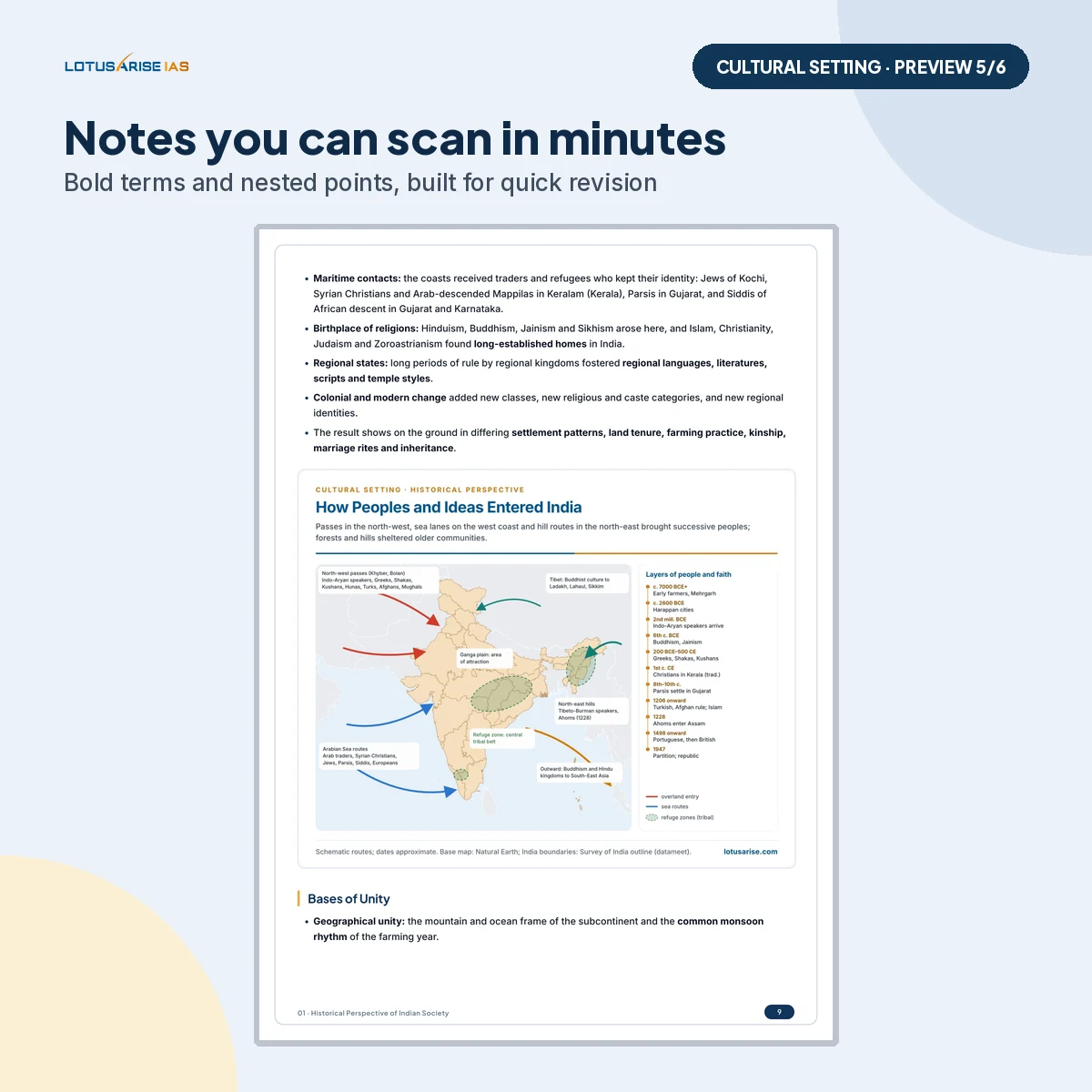
- Historical perspective: Harappan society to independent India
- Racial, linguistic and ethnic diversity, the North-East
- Racial groups: Risley, Guha, the Rakhigarhi genome
- Linguistic diversity: language families, reorganisation of States, endangered languages
- Religion: core-periphery pattern
- Religious minorities: border States, minority concentration areas
🪶 Tribes and Tribal Areas — 3 chapters
- Important tribes by region, PVTGs with PM-JANMAN figures to October 2026
- Tribal areas: Fifth and Sixth Schedules, their problems, why they still lag
- Why SC and ST distributions differ
🎭 Culture and Cultural Regions — 3 chapters
- Culture, hearth and diffusion, Hägerstrand’s model
- World cultural regions: formal, functional, vernacular, realm by realm
- Cultural regions of India: language, religion and customs
📈 Growth, Distribution and Density — 2 chapters
- India’s five phases of growth since 1901, the demographic dividend
- Density regions and million cities
👥 Demographic Attributes — 7 chapters
- Sex ratio, age-sex pyramid, age composition, literacy and work participation, with spatial patterns
- Ageing: dependency ratio, longevity, the geriatric challenge
- Fertility: TFR to NRR
🚶 Migration — 3 chapters
- Migration in India: streams, inter-state disparity, circular migration, emigration
- Measurement, trends and patterns
- Ravenstein’s laws against the Indian evidence
🏥 Population Problems, Policies and Health — 3 chapters
- Health indicators across Indian States, stunting and wasting
- Population policy: rationale, India’s policies, the two-child norm
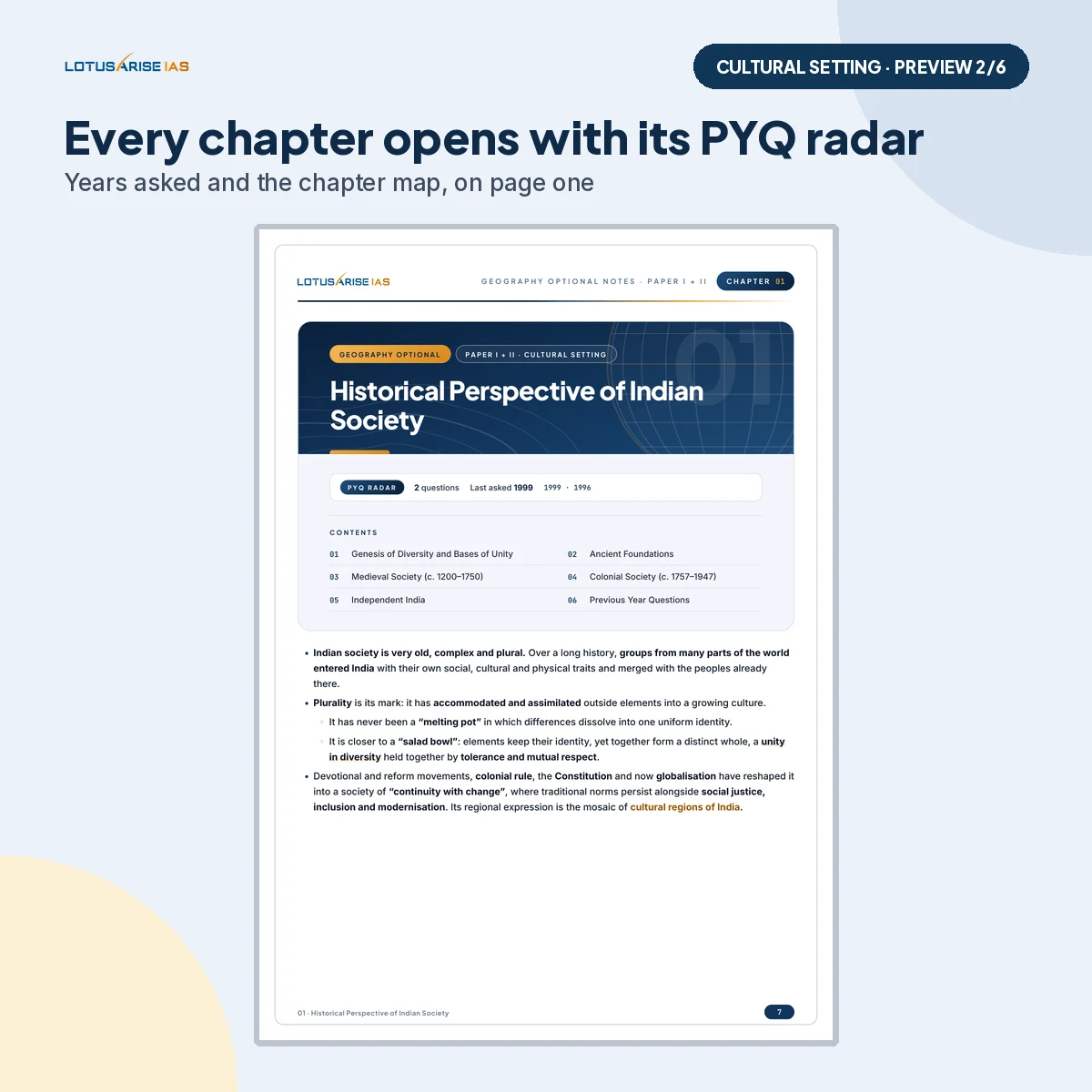
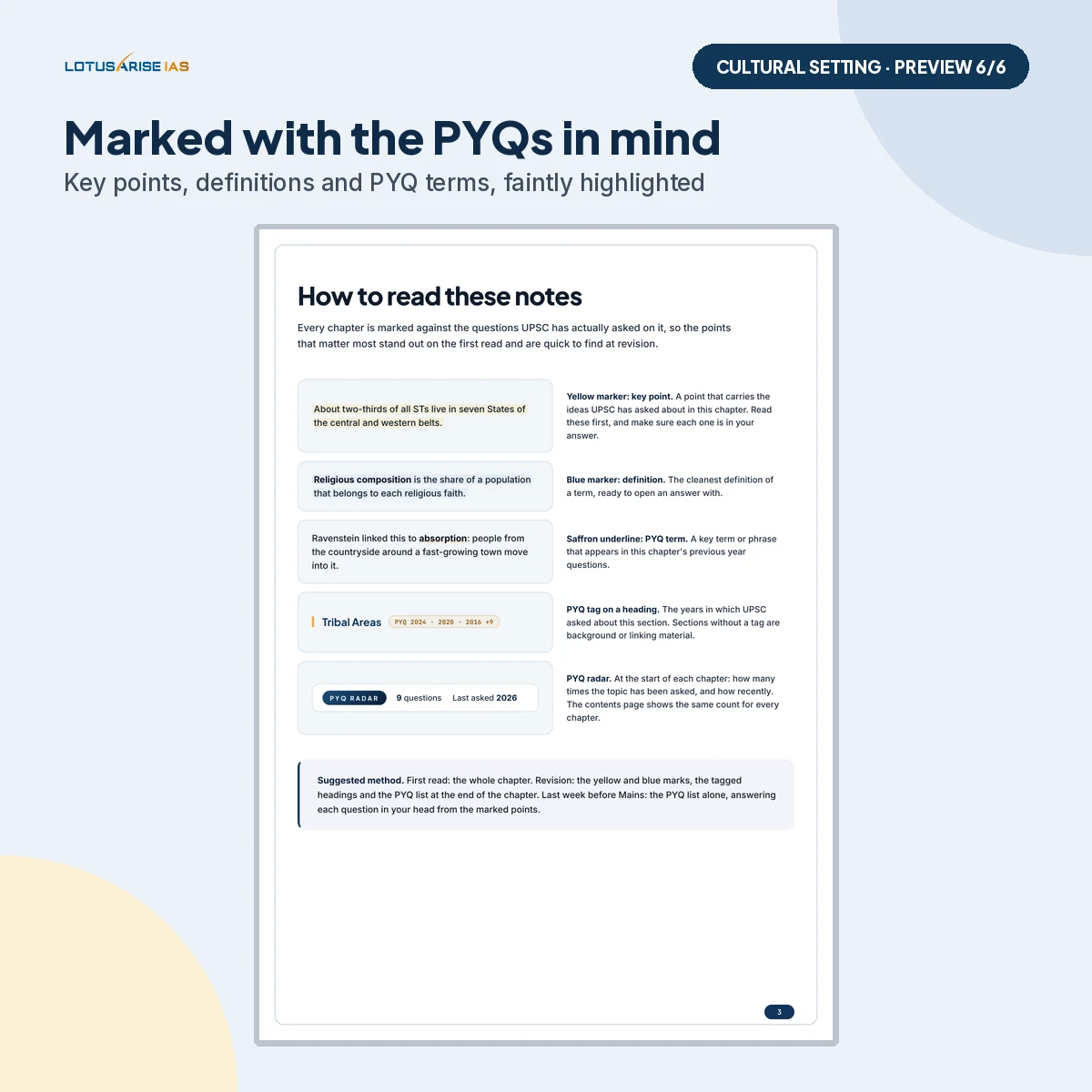
What makes this different from a downloaded PDF? Each chapter is marked against the questions UPSC has actually asked on it. A PYQ radar at the start shows how many times the topic has come and when it last did. Year tags sit on the headings UPSC has asked about. Faint highlights pick out key points, definitions and PYQ terms, so your second reading takes far less time than your first.
One thing to be clear about: the book gives the previous year questions, not model answers. Solved answers are in the Geography Optional 300+ Score Pack.
If you are buying more than one book: 16 chapters here, on religion, caste, tribe, India’s growth, attributes, migration, health and policy, also appear in Population Geography.
The aspirant who buys this
First-timers — Read Units 1 to 3 for Paper II, then the demography units for both papers.
Repeaters — You have the lists, but your answers lack regions and evidence. Use the spatial pattern and evaluation sections, then go through the PYQ list at the end of each chapter.
Aspirants short of time before Mains — Start with tribal areas, language and migration. The radar, year tags and highlights show you what to read first.
Self-study aspirants outside Delhi, Prayagraj and Jaipur — No classroom and no batch. You get one organised book that you can read anywhere, and print for handwritten practice.
Working professionals — One chapter at a time on your phone, offline, with no schedule and no expiry.
State PSC aspirants with Geography — India’s society, tribes and demography are common ground, so the same chapters serve your paper too.
Why not just use free notes from Telegram?
Free notes exist, and most aspirants already have several. Many of these topics are also on our own website, free to read.
The difference is not that free material is wrong. It is that nothing ties it together. A forwarded PDF rarely tells you which of its pages UPSC has asked about, it seldom gives the region behind the fact, and nobody tells you when its schemes have gone out of date. Here you get one order, every PYQ placed under its chapter, and a file you can keep and print.
If you have the time to build and maintain your own file from scattered sources, you may not need this. If you would rather open one book and start revising, this is what it is for.
The price
321 pages, 27 chapters, 119 PYQs and 98 diagrams and figures — ₹118. That is about 37 paise a page.
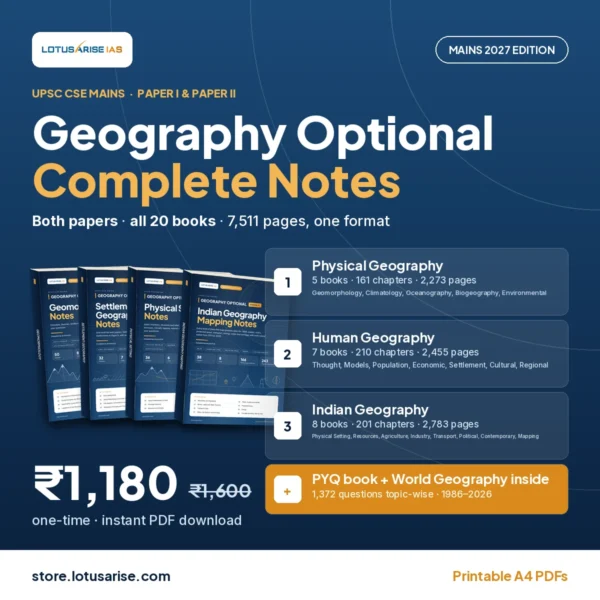
The book is also part of the Human Geography: Geography Optional Notes bundle at ₹471, the Indian Geography: Geography Optional Notes bundle at ₹590, and Geography Optional Complete Notes at ₹1,180.
One-time payment. No subscription. No recurring charge.
The download link reaches your email right after payment — please check your spam folder if you do not see it. Unlimited downloads, no expiry. English medium.
Read the free sample first (PDF)
For support: support@lotusarise.com
You may also like…
-

-
-
#OFFER: Geography Optional Complete Notes (PDF) – UPSC Mains (Paper I & II)
Original price was: ₹1,600.00.₹1,180.00Current price is: ₹1,180.00.